

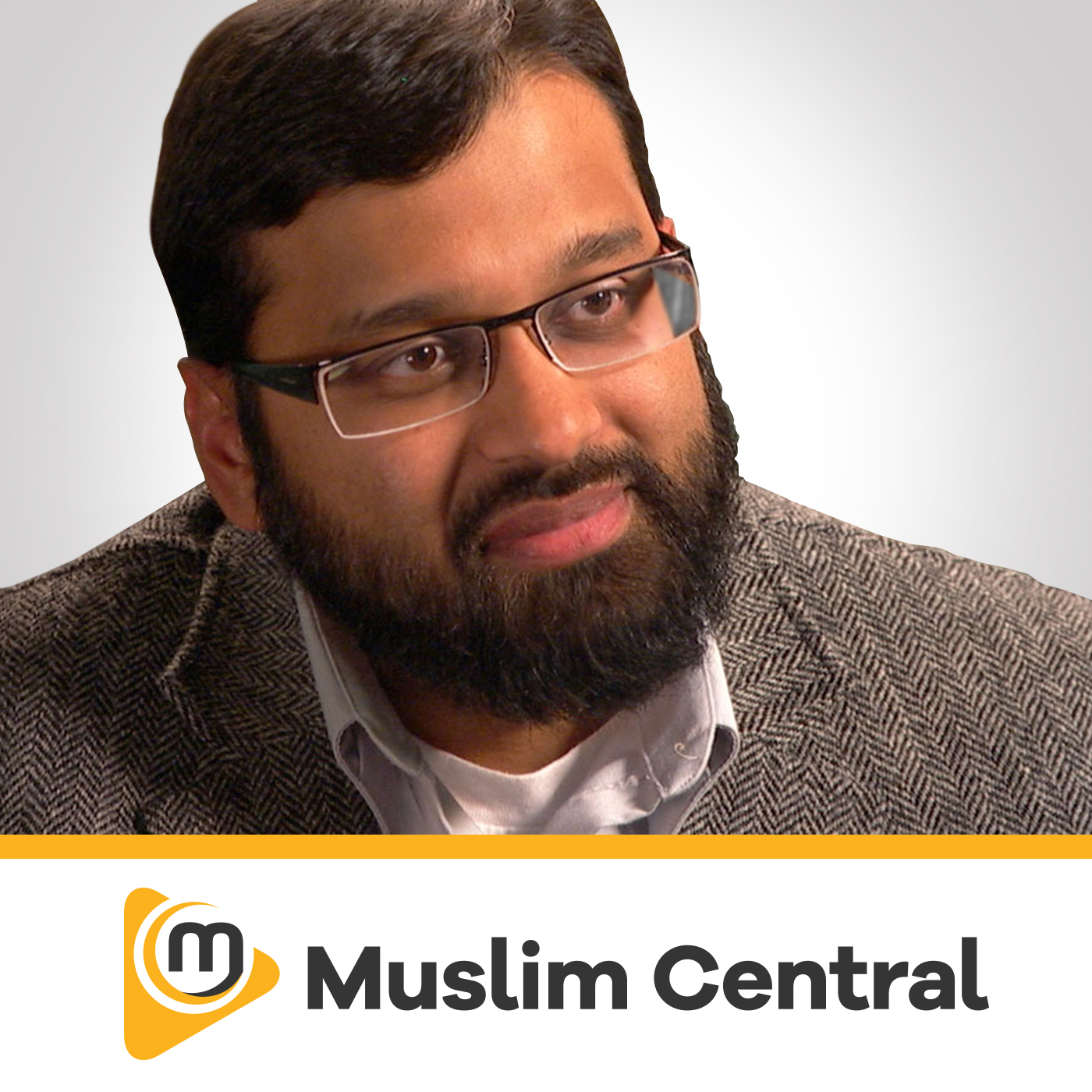
Yasir Qadhi
Muslim Central
Yasir Qadhi was born in Houston, Texas and completed his primary and secondary education in Jeddah, Saudi Arabia. He graduated with a B.Sc. in Chemical Engineering from the University of Houston, after which he was accepted as a student at the Islamic University of Madinah.
After completing a diploma in Arabic, he graduated with a B.A. from the College of Hadith and Islamic Sciences.
Thereafter, he completed a M.A. in Islamic Theology from the College of Dawah, after which he returned to America and completed his doctorate, in Religious Studies, from Yale University. Currently he is teaching at Rhodes College, in Memphis, TN.
After completing a diploma in Arabic, he graduated with a B.A. from the College of Hadith and Islamic Sciences.
Thereafter, he completed a M.A. in Islamic Theology from the College of Dawah, after which he returned to America and completed his doctorate, in Religious Studies, from Yale University. Currently he is teaching at Rhodes College, in Memphis, TN.
Episodes
Mentioned books

Dec 31, 2014 • 14min
Ramadan 2014 - Tafsir Surah Al-Fatiha - 17
In this episode of the Tafsir of Surat al-Fatihah, Shaykh Dr. Yasir Qadhi discusses :
The understanding that the verse Sirat Al-Ladhina 'An`amta `Alayhim proves the Khilafah of Abu Bakr RA.
The paths that lead to Allah.
The concept of Hidaya (Guidance).
The reasoning behind a Muslim asking for Hidaya while he has already been guided to the truth.
The different levels of Hidayah.
Dec 31, 2014 • 15min
Ramadan 2014 - Tafsir Surah Al-Fatiha - 16
In this episode of the Tafsir of Surat al-Fatihah, Shaykh Dr. Yasir Qadhi discusses the following aspects:
An analysis of the Verse no: 5 - Ihdinas Sirata Al-Mustaqim (Guide us to the Straight Path).
The etiquette of making Dua to Allah.
The meaning of the word ‘Hidaya’ and its various types.
The meaning of the words Siraat, Sabeel and Tareek and Mustaqeem.
Dec 31, 2014 • 20min
Ramadan 2014 - Tafsir Surah Al-Fatiha - 15
In this episode of the Tafsir of Surat al-Fatihah, Shaykh Dr. Yasir Qadhi elaborates on the following:
Comprehending the very essence of our worship -servitude to Allah SWT.
The Hadith regarding Ihsan - the intense,humble and genuine worship of a servant of Allah such that he is fully aware of his presence before Allah as though he is seeing Him.
The meaning of Ibadah - worship.
The meaning of the phrase - Isti'anah - seeking or pleading for Allah's help.
The 3 motivational factors of worship - Love, hope, fear
The prime requisites for our worship to be accepted by Allah.
Dec 31, 2014 • 12min
Ramadan 2014 - Tafsir Surah Al-Fatiha - 14
In this episode of the Tafsir of Surat al-Fatihah, Shaykh Dr. Yasir Qadhi discusses the following:
Acquaintance and emphasis on the sheer eloquence of the verse 'Iyyaka Na’budu Wa 'Iyyaka Nasta’in’.
The common doubt in the mind of a common man regarding the Divine Speech of Allah SWT and considering it flawed with grammatical errors( Astaghfirullah) and the reason for this in the realms of difference in grammar of the Arabic and English language.
Dec 31, 2014 • 10min
Ramadan 2014 - Tafsir Surah Al-Fatiha - 13
For some religions, the main characteristic they attribute to their god is an angry vengeful jealous god that must be appeased else his wrath will be upon you.
On the other side of the spectrum, you have certain religions that only focus on love mercy and claim that "God is love" and with such beliefs create great injustices to themselves and those around them having no fear of accountability.
Unlike other religions, in Islam, we worship Allah (suba¸hanahu wa ta'ala) based upon three motivational factors of Love, Hope; Fear.
In this special Ramadan series episode of the Tafsir of Surat al-Fatihah, Shaykh Dr Yasir Qadhi discusses the three motivational factors of worship; namely Love, Hope; Fear and the theological concepts of Monotheism, Messengers and the Day of Judgement.
Dec 31, 2014 • 15min
Ramadan 2014 - Tafsir Surah Al-Fatiha - 12
In this episode of the Tafsir of Surat al-Fatihah, Shaykh Dr Yasir Qadhi educates us on the following:
Profundity of the verse "Maliki Yawmi Ad-Din" which means "Master of the Day of Judgement"
The way to make one’s accounting easy and quick on the Day of Judgement.
The day of immense grandeur will be the Day of Judgement where each one of the creations will gather in front of Allah SWT, the ultimate Owner, Judge of the Day of Judgement.
Dec 31, 2014 • 16min
Ramadan 2014 - Tafsir Surah Al-Fatiha - 11
In this episode of the Tafsir of Surat al-Fatihah, Shaykh Dr. Yasir Qadhi helps us comprehend the profound meaning of the phrase - "Rabbi Al-`Alamin".
We gather information as to how perfect all of the creation of Allah is, how everything that surrounds us is in perfect harmony without any hitch.
Allah SWT is the Owner, the One who is obeyed and the One who Sustains all that exists.
Dec 31, 2014 • 10min
Ramadan 2014 - Tafsir Surah Al-Fatiha - 10
Shaykh Dr. Yasir Qadhi unravels the secret to Salah in this episode of the Tafsir of Surat al-Fatihah where he acquaints us in detail with the Hadith Qudsi of the conversation between Allah SWT and the one in prayer. The Hadith is as follows:
Abu Hurayrah RA narrated that the Prophet ﷺ said that Allah SWT said: "I have divided the prayer between Myself and My servant into two halves, and My servant shall have what he has asked for."
Hence, we can extrapolate a few important details from the above:
Salah (prayer) is a personal conversation between the slave and his Master between the worshipper and the Lord of the Heavens and the earth.
The absolute magnificence of the fact that Allah SWT Himself is responding to us when we recite Surat al-Fatihah in our Salah and the need for us to be in full realisation and awareness of it the next time we perform Salah.
Dec 31, 2014 • 13min
Ramadan 2014 - Tafsir Surah Al-Fatiha - 09
"And if you should count the favors of Allah, you could not enumerate them." - [Surat An-Nahl]
In this episode of the Tafsir of Surat al-Fatihah, Shaykh Dr. Yasir Qadhi encourages us to delve on the following points:
The fact of the matter that our lives are consistently and completely dependent on the blessings of Allah SWT and the absolute need to comprehend this with utmost reverence and gratitude as opposed to attributing one’s achievements and bounties to the self.
The acceptance of the fact that we will never be able to fully ever count all of the blessings of Allah upon us since they are innumerable.
The reason behind Allah choosing the phrase "Alhamdulillah" for Himself.
The meaning of "Rabb".
Dec 31, 2014 • 13min
Ramadan 2014 - Tafsir Surah Al-Fatiha - 08
In this episode of the Tafsir of Surat al-Fatiha Shaykh Dr Yasir Qadhi discusses the following key aspects:
The Prophet ﷺ would regularly make supplication to Allah SWT in the middle of the night bowing down in prostration saying -'How exalted are You, O Allah! I cannot do justice in praising You the way You deserve to be praised. Verily, only You can do justice in praising Yourself!'
The Prophet ﷺ was always in a state of constant realization and reverence regarding the Majesty and Honour befitting to Allah alone.
The essential need to comprehend and fathom the greatness of Allah in our prayers and our daily routine, thereby, imitating the Prophet ﷺ.
The magnificence of the praise - Alhumdulilah.
The difference between Hamd and Shukr.

