

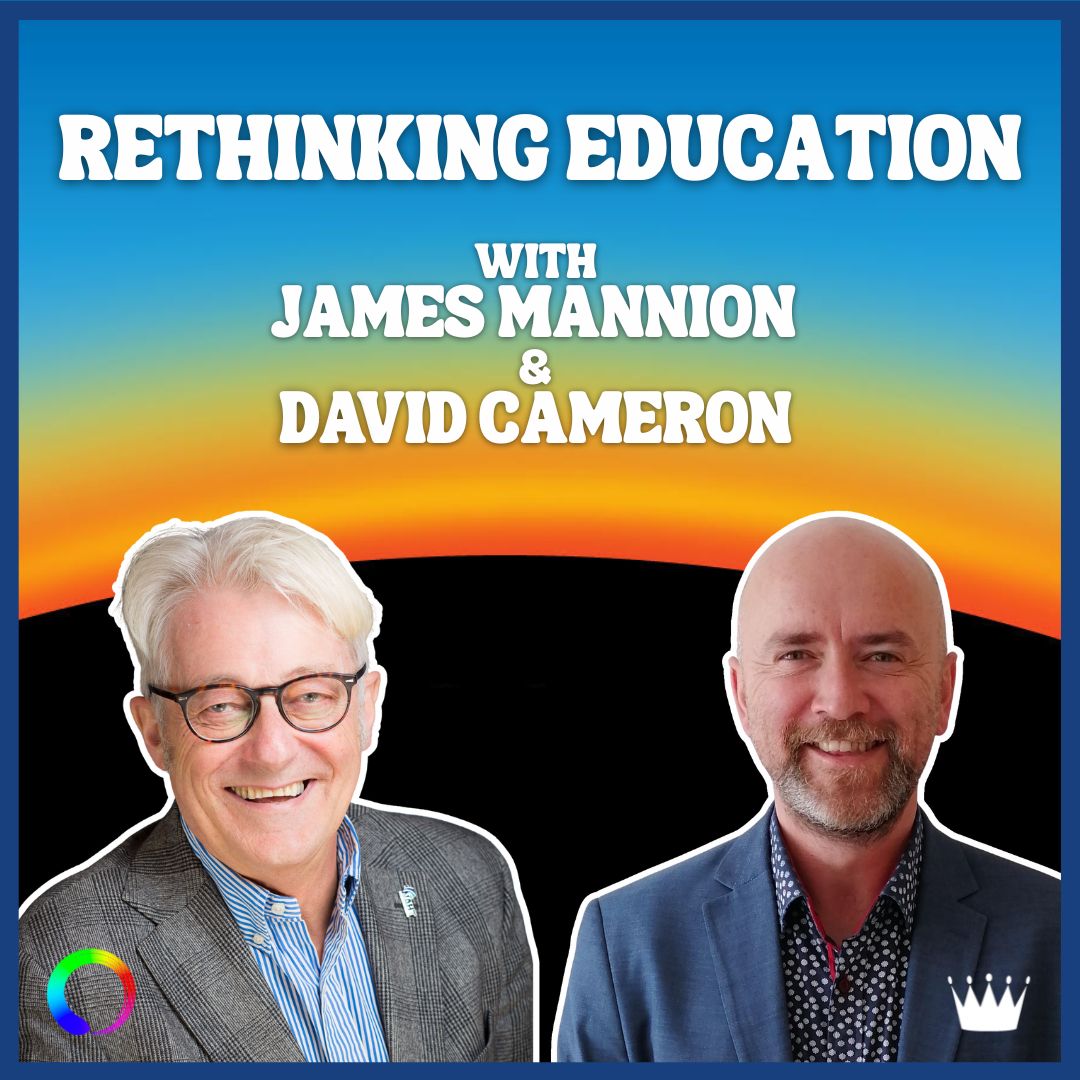
Rethinking Education
Dr James Mannion
"Civilisation is a race between education and catastrophe." (HG Wells)
In this podcast, we take Wells at his word. Hosted by Dr James Mannion and David Cameron, Rethinking Education features long-form conversations with fascinating guests about how we might create a more diverse, intelligent, responsive educational ecosystem that works for *all* young people.
If this sounds interesting to you, welcome to Rethinking Education: Education's Critical Friend: https://rethinking-ed.org/podcast
In this podcast, we take Wells at his word. Hosted by Dr James Mannion and David Cameron, Rethinking Education features long-form conversations with fascinating guests about how we might create a more diverse, intelligent, responsive educational ecosystem that works for *all* young people.
If this sounds interesting to you, welcome to Rethinking Education: Education's Critical Friend: https://rethinking-ed.org/podcast
Episodes
Mentioned books

Mar 7, 2026 • 1h 17min
Education as expanding dialogue – Rethinking learning with Professor Rupert Wegerif
Professor Rupert Wegerif, Cambridge education scholar and dialogic-learning pioneer, discusses how teaching children to reason together reshapes classrooms and thinking. He describes the Thinking Together approach, why group work often fails and how simple dialogue ground rules help. The conversation spans classroom practice, culture as a living tradition, double dialogue with disciplines, and the implications of AI for dialogic learning.

10 snips
Mar 6, 2026 • 50min
Teaching that grips: Hywel Roberts on the Pedagogy of Botheredness
Why do so many lessons feel disconnected to students – even when the content is genuinely fascinating?
In this episode, Dr James Mannion is joined by teacher and author Hywel Roberts to explore 'botheredness' – a way of teaching that draws students into learning through narrative, curiosity and shared imagination.
They discuss why pupils often struggle to see the relevance of what they are learning, and how small shifts in pedagogy can transform a lesson from something students comply with into something they actively care about. As Hywel explains, the key is not entertainment or gimmicks, but creating context, tension and meaning around knowledge.
The conversation explores practical techniques such as ‘let’s say’ narratives, teacher-in-role, and the use of story structures built around people, place and problem. These approaches help teachers bring abstract knowledge to life and ‘protect students into learning’ by making them feel safe, curious and invested in the lesson.
James also reflects on the challenge many teachers face: delivering a knowledge-rich curriculum that can sometimes feel like a sequence of disconnected topics. Together they explore how storytelling and implementation thinking can help embed this approach into everyday classroom practice.
They also introduce a new professional learning programme combining the pedagogy of botheredness with implementation science, designed to help teachers move from one-off inspiration to sustained classroom change.
In this episode:
- Why students often ask ‘Why are we learning this?’
- The difference between engagement and investment in learning
- How stories create curiosity, tension and motivation
- The power of ‘let’s say…’ as an invitation into learning
- What it means to ‘protect children into learning’
- Using narrative as retrieval and assessment
- The barriers that stop imaginative pedagogy becoming routine practice
- How implementation thinking can help make botheredness stick
Links and resources
Hywel's website: https://botheredness.co.uk
Implementing Botheredness 2026: https://www.makingchangestick.co/implementing-botheredness-2026
Book a free 20-minute call: https://calendly.com/rethinkingjames/implementing-botheredness-chat-with-james-hywel

5 snips
Mar 1, 2026 • 1h 3min
Seven minutes out of every thirty are lost to low-level disruption. But why?
Tara Elie, educational psychologist specialising in positive psychology and the psychology of mattering, explains why feeling valued and adding value drive behaviour. She and James Mannion explore how implementation science and mattering reveal hidden causes of low-level disruption. Short, sharp insights on staff and pupil mattering, root-cause diagnostics, and practical change approaches.

Jan 24, 2026 • 1h 29min
Generation to generation: Holocaust education in a changing world
Callum Isaacs, a third-generation descendant who shares his grandmother's survival story. Vivienne Cato, an educator who presents her mother Eva's testimony and draws on teaching and Jewish education. Hannah Wilson, an outreach officer and researcher training descendants to tell family Holocaust histories. They discuss why testimony matters, teaching challenges, countering online distortion, students' responses, and connecting memory to civic responsibility.

Jan 23, 2026 • 55min
Why ‘consistency’ isn’t enough: the implementation blind spot in school behaviour
In this second episode of a two-part mini-series, Tara Elie turns the tables and interviews Dr James Mannion about the thinking behind Making Change Stick – and why so many school behaviour initiatives fail, even when the policy itself is sound.
Following on from the previous episode on the psychology of mattering, this conversation explores what happens after the policy launch: how change is (or isn’t) implemented in real schools, and why top-down, ‘black box’ approaches so often lead to inconsistency, frustration, and drift.
James traces jis 12-year journey into implementation science, drawing on lessons from healthcare, engineering and systems change – including a powerful case study from Cincinnati Children’s Hospital – to show how schools can dramatically improve uptake, consistency and outcomes by changing how decisions are made.
Together, they explore:
- Why behaviour is often led by a single senior leader – and why this rarely works in practice
- The importance of slice teams: representative groups that bring together staff from across a school (and sometimes students and families) to design, test and refine change
- How slice teams improve both decision-making and buy-in by redistributing power without undermining leadership
- Why implementation is a process, not an event – and why policies need ongoing review, feedback and adaptation
- The role of mattering in behaviour systems: how staff feeling heard, trusted and involved leads to greater consistency for pupils
- Practical tools schools rarely use – but should – including root cause analysis, communications plans, pre-mortems and ‘tight but loose’ implementation
- How understanding the root causes of behaviour issues can lead to unexpected but powerful solutions (including links to oracy, wellbeing and relationships)
- Why fear-based compliance may look like ‘good behaviour’ on the surface, but often masks deeper problems
This episode is for school leaders, behaviour leads, teachers and system leaders who are tired of rolling out initiatives that never quite stick – and who want a more humane, effective and sustainable way to improve behaviour, relationships and attendance.
Support #repod
The Rethinking Education podcast is brought to you by Crown House Publishing. It is hosted by Dr James Mannion and David Cameron, and produced by Sophie Dean.
This podcast is a labour of love, with the emphasis on both the labour and the love. If you’d like to support the podcast and convey your appreciation for these conversations, you can:
Become a patron: https://www.patreon.com/repod
Buy us a coffee: https://www.buymeacoffee.com/repod

14 snips
Jan 15, 2026 • 54min
Rebooting behaviour: the two missing pieces of the puzzle (with Tara Elie)
Tara Elie, an educator focused on mattering in schools, interviews James Mannion about effective behavior change in education. They discuss why top-down behavior leadership often fails and the importance of slice teams for collaborative decision-making. James shares lessons from implementation science, including insights from Cincinnati Children's Hospital, emphasizing that change is a process needing continuous review. They also explore practical tools like communication plans and root cause analysis, and how fostering student and staff mattering can lead to improved school culture.

10 snips
Jan 9, 2026 • 42min
Why ‘belonging’ isn’t enough: The missing piece in behaviour, attendance and staff burnout (w/ Tara Elie)
In this enlightening discussion, Tara Elie, a former secondary drama teacher turned behaviour specialist and positive psychology practitioner, challenges traditional notions of belonging in education. She emphasizes that mattering – the feeling of being valued and adding value – is crucial for staff wellbeing and student engagement. Tara shares insights from her research, explaining how low mattering leads to burnout and disengagement. The conversation highlights practical ways for school leaders to promote mattering, linking it to a more inclusive and psychologically safe school culture.

Dec 24, 2025 • 50min
"It’s choppy out there – but hope is happening...": Strap in for the 2025 end of year review!
As 2025 draws to a close, James and David come together for a wide-ranging Christmas conversation that reflects on a turbulent year in education – and looks ahead to where hope, change, and renewal might yet be found.
Kicking off with a powerful metaphor drawn from winter sea swimming, the discussion explores why schools currently feel so ‘choppy’, from behaviour and attendance to widening inequality and system-level pressures. Along the way, we reflect on what really matters in education – relationships, belonging, and being known – and why these often get squeezed out by accountability and assessment.
The episode revisits key debates sparked by the Curriculum and Assessment Review, including the future of GCSEs, the limits of ‘manageable change’, and the uneasy separation of curriculum, assessment, and pedagogy.
A detour into restorative justice, inspired by Punch and the story of Jacob Dunne, deepens the conversation about connection, responsibility, and what happens when people are truly seen. The parallels with schooling – and with how society treats its most vulnerable young people – are stark.
The episode closes on a hopeful note, spotlighting examples of schools doing brave, relational, and imaginative work within the current system, and outlining plans for the podcast in 2026: fewer trench wars, more light-shining on practice that actually helps children and young people thrive.
James also shares upcoming programmes and projects focused on oracy, behaviour, botheredness, and learning beyond subjects – all grounded in the belief that meaningful change is possible when we start with relationships and implementation.
In this episode, we explore:
- Why education feels ‘choppy’ – and what the winter swim metaphor reveals
- Behaviour, discipline, and the limits of coercive models
- Restorative justice, Punch, and the power of being known
- What the Curriculum and Assessment Review did – and didn’t – make possible
- GCSEs, adolescent development, and the problem of high-stakes exams at 16
- Why relationships matter more than systems – and what the evidence says
- Examples of hopeful practice already happening in schools
- What’s next for the podcast in 2026
Support #repod
The Rethinking Education podcast is brought to you by Crown House Publishing. It is hosted by Dr James Mannion and David Cameron, and produced by Sophie Dean.
This podcast is a labour of love, with the emphasis on both the labour and the love. If you’d like to support the podcast and convey your appreciation for these conversations, you can:
Become a patron: https://www.patreon.com/repod
Buy us a coffee: https://www.buymeacoffee.com/repod
Dec 22, 2025 • 1h 57min
Inside the Curriculum & Assessment Review: What Changed, What Didn’t – And Why
Lisa O’Loughlin, Principal and CEO of Nelson and Colne College Group, and Jon Hutchinson, Director of Curriculum and Teacher Development at the Reach Foundation, share their insights from the Curriculum and Assessment Review panel. They discuss the challenges of balancing ambition with political constraints and the importance of post-16 education. The conversation highlights the growth of oracy and the arts in the curriculum, while acknowledging the complexities of assessment reform. Their perspectives provide a rare glimpse into the evolution of England's educational landscape.
Dec 6, 2025 • 1h 32min
Dave Whitaker on relational practice, inclusive culture, and “battering them with kindness”
Dave Whitaker, Chief Education Officer at Wellspring Academy Trust and author of The Kindness Principle, talks about transforming school cultures. He emphasizes the importance of kindness and compassion over zero-tolerance policies, arguing that all children can thrive in inclusive environments. Whitaker discusses the need for gradual culture change and the role of relationships in effective teaching. He critiques short-term educational reforms and advocates for a curriculum that supports human development and local collaboration.

