

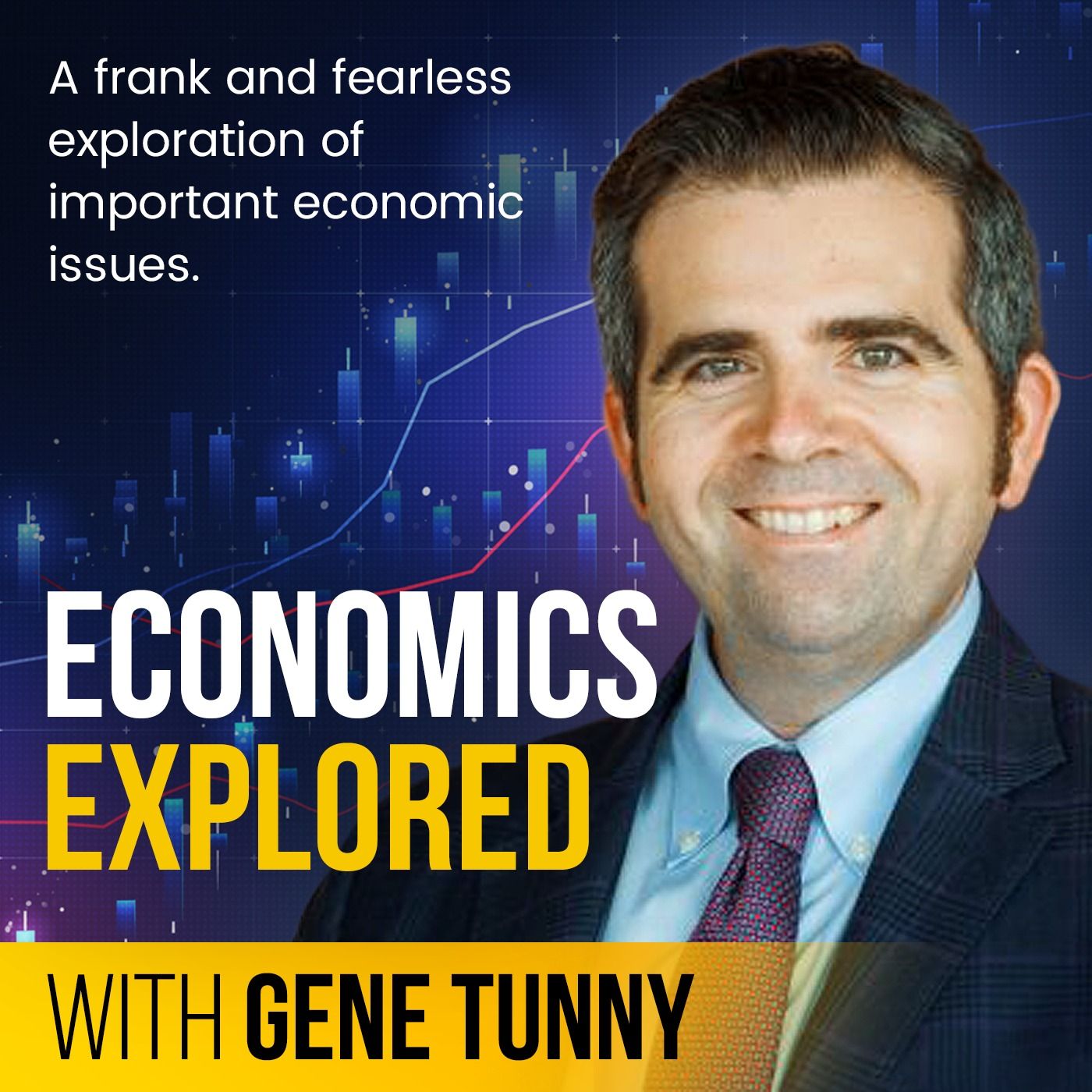
Economics Explored
Gene Tunny
Hard-headed economic analysis applied to important economic, social, and environmental issues.
Episodes
Mentioned books

Mar 25, 2020 • 39min
Coronavirus policy responses with Dr Nicholas Gruen of Lateral Economics
Would strong early action on coronavirus have been better, from both public health and economic perspectives, than the incremental policy responses we have seen in countries such as Australia and the US? In this episode, Economics Explained host Gene Tunny discusses policy responses to coronavirus with Dr Nicholas Gruen, CEO of Lateral Economics. Nicholas is a Visiting Professor at King’s College, London, and former Chair of several government, non-profit, and private sector organisations, including Innovation Australia and Kaggle.TimestampsUse these (approximate) timestamps to jump right to the highlights:4:00 – Nicholas discusses his recent article on coronavirus policy PANIC IS OUR FRIEND! which argues in favour of strong, early action on coronavirus, rather than the incremental ramping up of restrictions we have seen7:50 – Nicholas notes these decisions are challenging because panic itself has costs, as argued by Paul Frijters in his article The Corona Dilemma12:30 – discussion of John Quiggin’s Option value post on the benefits of early action 14:05 – Nicholas suggests policy makers should follow Google’s example and experiment and AB test policy responses, generating feedback to improve policies 15:05 – discussion of what Ben Shapiro calls The Un-askable Question26:35 – Nicholas observes “when things change they become highly unpredictable” in our discussion of what coronavirus could mean for our future economic system36:00 – conclusion of discussion with a quote from Nicholas’s article: “Right now, panic is the friend of anyone who doesn’t want to get this disease, which continues to surprise on the downside (i.e. the bad side).”
Mar 18, 2020 • 29min
COVID-19, machine trading & financial markets with Michael Knox
Why are financial markets swinging so wildly in response to the novel coronavirus, COVID-19? Economics Explained host Gene Tunny speaks with Michael Knox, Chief Economist of Morgans, who thinks it's related to the machine trading programs which dominate financial markets.Morgans is Australia's largest national full-service stockbroking and wealth management network with more than 240,000 client accounts, 500 authorised representatives and 950 employees operating from offices in all states and territories.TimestampsUse these (approximate) timestamps to jump right to the highlights:0:00 – discussion begins with Gene referring to Michael’s recent note The revenge of the machines which begins “The market is being sold down by machine trading programs focused on momentum.” 4:00 – Michael says recent market gyrations have “nothing to do with fundamentals….we're in a situation because of the epidemic, because of the emergency that only happened once every hundred years or every 50 years - you can't build a model of something like that. So inherently, what those trading models are acting on is the momentum signal…”7:00 – beginning of discussion on market liquidity11:00 – Michael discusses the relationships between liquidity, price discovery, and market volatility 15:10 – Michael notes re. COVID-19, “On this occasion, you had a change, which was caused by a once in 50 years shock or once in 100 years shock. The market doesn't have that kind of memory of data to be able to price that in.”16:15 – discussion of valuation of shares/stocks18:15 – what is momentum?24:20 – discussion of fair value of Australian sharemarket and Australian economic outlookNothing in this podcast should be considered financial advice, and it contains general information only.
Mar 11, 2020 • 55min
City Infrastructure with Craig Lawrence
A lot of the infrastructure assets relevant to our daily lives, such as roads, bridges, and parks, are provided by city or municipal governments. In this episode, we ask the question: how should we assess the economic viability of city infrastructure projects? To answer this question, we’ve invited Craig Lawrence, Managing Director of Lytton Advisory, back on to the program. Lytton Advisory is an Australian professional services firm specialising in infrastructure economics and decision making.*Use these (approximate) timestamps to jump right to the highlights:1:00 – conversation starts with host Gene Tunny asking Craig about a recent post (A $7 Crossing) he wrote about the economic viability of Brisbane City Council’s proposed $190 million Kangaroo Point to Brisbane City pedestrian bridge12:00 – discussion of external benefits (or externalities) and wider economic benefits relevant in assessment of city infrastructure projects18:00 – discussion of agglomeration effects and benefits of active transport23:30 – Craig delivers his assessment of the economic viability of the Brisbane City to Kangaroo Point pedestrian bridge – “at the moment, there's not enough evidence on the benefit side, to be able to justify the project “26:00 – further discussion of wider economic benefits – Craig notes a rule of thumb is that they should only be 15-20% on top of private benefits32:00 – Gene commences conversation with Craig about Brisbane City Council’s un-costed redevelopment of Victoria Park Golf Course into a public park and how one might assess its economic viability43:20 – beginning of discussion on Cross River Rail, a controversial new subway system in Brisbane which was originally costed at $5 billion but may end up costing $12 billion, a mega project which Craig has previously been sceptical about (Cross River Rail Dice Roll?) *Economics Explained host Gene Tunny is currently working with Craig as a Senior Associate with Lytton Advisory on projects in the Middle East and Australia.
Mar 4, 2020 • 34min
Climate change with Nicki Hutley from Deloitte Access Economics
In an Australian ABC News story in early February, Deloitte Access Economics Partner Nicki Hutley referred to the potential cost of climate change as “astronomical”. In this episode, Economics Explained host Gene Tunny chats with Nicki about the cost of action compared with the cost of inaction on climate change. Use these (approximate) timestamps to jump right to the highlights:1:10 – Nicki describes why the costs of unmitigated climate change would be "astronomical"4:40 – reference to Deloitte report for Australian Business Roundtable finding cost of extreme weather events in Australia will be $40 billion per year by 20508:00 – further discussion of cost of inaction, including a reference to Deloitte’s report on the value of the Great Barrier Reef10:30 – what needs to be done to avert catastrophic climate change (i.e. need to transition away from using fossil fuels) and the distinction between mitigation and adaptation15:20 – current international agreements/measures won’t reduce emissions enough16:00 – discussion of the inadequacy of Australian state government aspirational targets for renewable energy in the absence of a carbon price/emissions trading scheme or carbon tax21:00 – Nicki argues that, due to the lack of a carbon price, we are not encouraging sufficient investment in renewables or in R&D – reference to blue and green hydrogen (check out Woodside’s website for information)22:50 – Gene mentions Brian Fisher’s controversial estimate of the cost of the Australian Opposition’s climate change plan of $500 billion and asks Nicki about the cost of acting versus not acting, with Nicki noting the cost of inaction would be many multiples of the cost of action25:40 – discussion of implications of transition away from fossil fuels for coal miners, etc.27:40 – costs of renewable energy vs coal
Feb 26, 2020 • 36min
The FIRE movement with Dr Di Johnson
Bloggers such as Mr Money Mustache and the Financial Samurai have been responsible for starting a new movement: the FIRE movement. FIRE stands for Financial Independence Retire Early. By early, proponents typically mean retiring in your 30s or 40s. To discuss the FIRE movement, Economics Explained host Gene Tunny has invited Griffith University Business School lecturer Dr Di Johnson back on to the program. Di is a member of the Australian Securities and Investments Commission’s Financial Capability Research Network. In addition to teaching and researching, Di is a regular commentator on financial issues on ABC radio and TV here in Brisbane, Australia.TimestampsUse these timestamps to jump right to the highlights:1:40 – Dr Di provides an overview of the FIRE movement (also check out this Forbes article The 9 FIRE blogs you should read) 3:45 – is the FIRE movement a millennial idea? 7:35 – doing the math, you can see some big risks with the FIRE concept (Di mentions some information on average spending by singles and couples that was once on ASIC’s MoneySmart website: Weekly spend by life stage)11.20 – challenge of forecasting future living costs in decades to come – e.g. think about trying to forecast current Sydney cost of housing back in the 1970s16:40 – Di says some positives of the FIRE movement are it encourages people to save when they’re young and it promotes conscious consumerism23:05 – what is Barista FIRE?25:35 – discussion of digital nomads and vagabonding30:05 – Di notes it may be preferable to just find ways to make your current work more enjoyable – e.g. the slow work movement, taking longer holidays, etc. The episode was recorded via Zoom video conferencing on the 25th of February 2020.
Feb 19, 2020 • 45min
Entrepreneurship with Professor Peter G. Klein
Many universities now offer courses in entrepreneurship, as students have been inspired by tech entrepreneurs such as Elon Musk and Mark Zuckerberg. But what exactly is entrepreneurship and who qualifies as an entrepreneur? Is entrepreneurship essential for economic growth? To help answer these questions, Economics Explained host Gene Tunny invited Professor Peter G. Klein on to the program. Peter is W. W. Caruth Chair and Professor of Entrepreneurship at Baylor University in Texas. He is also Carl Menger Research Fellow at the Mises Institute. TimestampsUse these timestamps to jump right to the highlights:2:25 – what is entrepreneurship? Entrepreneurship as a mindset 6:50 – Was Donald Trump an entrepreneur?15:50 – Schumpeter’s theory of creative destruction19:20 – Peter’s Entrepreneurial Judgment model (check out Peter’s book co-authored with Nikolai J. Foss Organizing Entrepreneurial Judgment and Peter’s Murray N. Rothbard lecture The Present State of Entrepreneurship Research on YouTube)26:15 – Gene mentions Cal Newport’s point that Steve Jobs thought the big value add of the iPhone was you could have your phone and iPod in the one device and didn’t foresee just how important all the apps would be (check out Newport’s great book Digital Minimalism) 35:15 – discussion of best places to be an entrepreneur, in which Peter tells Gene that Australia may not be as bad as he thinks, and Austin, Texas is attracting people who are leaving Silicon Valley39:05 – Peter says entrepreneurs are “absolutely front and centre in the process of economic growth” 44:15 – Peter refers to "the allure of fine tuning the economy" regarding frequent tweaks to R&D tax incentives The episode was recorded via Zoom video conferencing on the 12th of February 2020.
Feb 12, 2020 • 37min
Antitrust with Danielle Wood from the Grattan Institute
The massive market power of the big tech companies, such as Google, Facebook, and Amazon, has prompted a renewed interest in antitrust laws. To help us understand antitrust, we’ve invited Danielle Wood from the Grattan Institute on to Economics Explained. The Grattan Institute is a leading Australian public policy think tank based in Melbourne. Danielle is Budget Policy and Institutional Reform Program Director at Grattan. Later this year, she will take up the CEO position at the Institute. Danielle is well qualified to talk about antitrust, having once worked as Principal Economist and Mergers Director at the ACCC, the Australian Competition and Consumer Commission.Check out Danielle’s 2019 Inside Story article The hipster trustbusters.TimestampsUse these timestamps to jump right to the highlights:1:45 – what is antitrust? 5:40 – the hipster trustbusters8:58 – the problem with Amazon12:20 – the Chicago school view on antitrust17:28 – the data the tech companies have on us and network effects as barriers to entry19:45 – Grattan’s analysis of market concentration in Australia25:05 – problem isn’t market power per se, but the abuse of it26:15 – discussion of US Department of Justice-Microsoft case31:10 – should we break up big tech companies?33:29 – ACCC has been good at pushing for new powers, but it hasn’t been successful in mergers cases in the courts in the last 20 yearsThe episode was recorded via Zoom video conferencing on the 10th of February 2020.
Feb 5, 2020 • 52min
Surveillance Capitalism with Darren Brady Nelson
So-called surveillance capitalism was one of the big issues for the 2020s identified in the first Economics Explained episode this year. Google, Facebook, and other tech giants have massive amounts of data on us and they are using it for commercial gain. In this episode, Economics Explained host Gene Tunny discusses various perspectives on surveillance capitalism with his good friend Darren Brady Nelson, Chief Economist of LibertyWorks, an Australian libertarian think tank.Darren’s recently had an article published on the Mises Institute website with the title Surveillance Capitalism: A summary of critics. This is Darren’s second appearance on Economics Explained, and we spoke via Zoom video conferencing on the 18th of January 2020.Use these timestamps to jump right to the highlights:4:45 – Darren argues some criticism of surveillance capitalism is simply the latest manifestation of opposition to capitalism in general11:40 – Darren mentions work by Austrian economist George Gilder who thinks current tech giants are “going over the hill” (according to this Forbes article) and companies to watch will be in blockchain and quantum computing25:55 – Darren mentions section 230 of the US Communications Decency Act, often referred to as “The Twenty-Six Words That Created the Internet”27:30 – discussion of how it’s monarchs or governments which have traditionally created monopolies – e.g. British East India Company42.30 – mention of recent laws affecting tech companies – EU GDPR (e.g. see this Wired article) and California Consumer Privacy Act (for info, check out this Guardian article)
Jan 29, 2020 • 31min
Innovation + Equality with Dr Andrew Leigh MP
Australian economist and federal Member of Parliament Dr Andrew Leigh is interviewed about his new book with co-author Professor Joshua Gans Innovation + Equality: How to Create a Future that is More Star Trek than Terminator, published by MIT Press in 2019. This wide-ranging conversation covers a range of issues, including labour market impacts of digital disruption, universal basic income, and how to improve teacher effectiveness, among other issues.Use these timestamps to jump right to the highlights:4:20 – impact of AI and automation on jobs9:50 – criticisms of Universal Basic Income – fiscal critique and the fact work brings meaning – in which Andrew mentions Blanchflower and Oswald study Wellbeing over time in Britain and the USA11:05 – Andrew advises young people not to over-specialise15:20 – innovation is generally good for the economy and society, so Andrew rejects Bill Gates’s robot tax idea (see this Business Insider article)19.05 – Gene asks Andrew about Nicholas Gruen’s idea about public private partnerships for digital public goods (e.g. listen to Economics Explained episode 7)24:00 – Andrew tells us how we can connect with him, including by listening to his Good Life podcast24:40 – discussion of how to improve teach effectiveness, in which Gene asks about teachers’ unions and performance-based/teacher merit pay; check out Andrew’s 2012 paper The economics and politics of teacher merit pay (NB Gene mangled the end of his question, but Andrew got the gist of it, thankfully)28:45 – Andrew proposes assessing teacher quality policy measures via Randomised Controlled Trials (RCTs) This episode was recorded on 20 January 2020 via Skype.
Jan 22, 2020 • 55min
Cannabis with Dr Stephen Thornton
Several jurisdictions around the world, such as the US states of California and Colorado, have legalised cannabis, also known as marijuana. In Australia, the Australian Capital Territory will become the first Australian jurisdiction to legalise recreational cannabis use on the last day of January 2020. What are the pros and cons of cannabis legalisation? To help us answer this question, we’re joined this episode by Dr Stephen Thornton of BG Economics, a Brisbane-based economic consulting firm specialising in the economics of social issues.Use these timestamps to jump right to the highlights:1:15 – overview of cannabis laws in US, Canada, and Australia8:30 – why cannabis was banned in the first place – the Reefer Madness moral panic 12:00 – Stephen notes ex-Queensland Premier Campbell Newman has declared the war on drugs has failed13:00 – economic consequences of prohibiting cannabis19:30 – Stephen mentions cannabis price data are available via http://www.priceofweed.com/; Stephen has noted that, based on Price of Weed data, the black market price of cannabis in the non-legalised countries of Australia and UK is higher than the average price in Canada/California (approx. $200.00/ounce), with Australia approx. 40% higher and the UK approx. 25% higher32:50 – discussion of Stephen’s preliminary cost-benefit analysis of legalising Cannabis in Queensland, The Economic and Social Benefits and Costs of Legalising Recreational Cannabis in Queensland, which received a couple of media mentions (e.g. this Brisbane Times article)40:20 – discussion of US House of Representatives Judiciary Committee’s view on cannabis (e.g. see House panel approves of marijuana decriminalization, but it faces a long, hard road)43:40 – Stephen mentions Australian Senate inquiry on Current barriers to patient access to medicinal cannabis in Australia44:30- reference to share price surge of CannPal, which is developing medicinal cannabis-based products for pets This episode was recorded on 6 January at the Adept Economics office, Spring Hill, Brisbane. Australia.

