

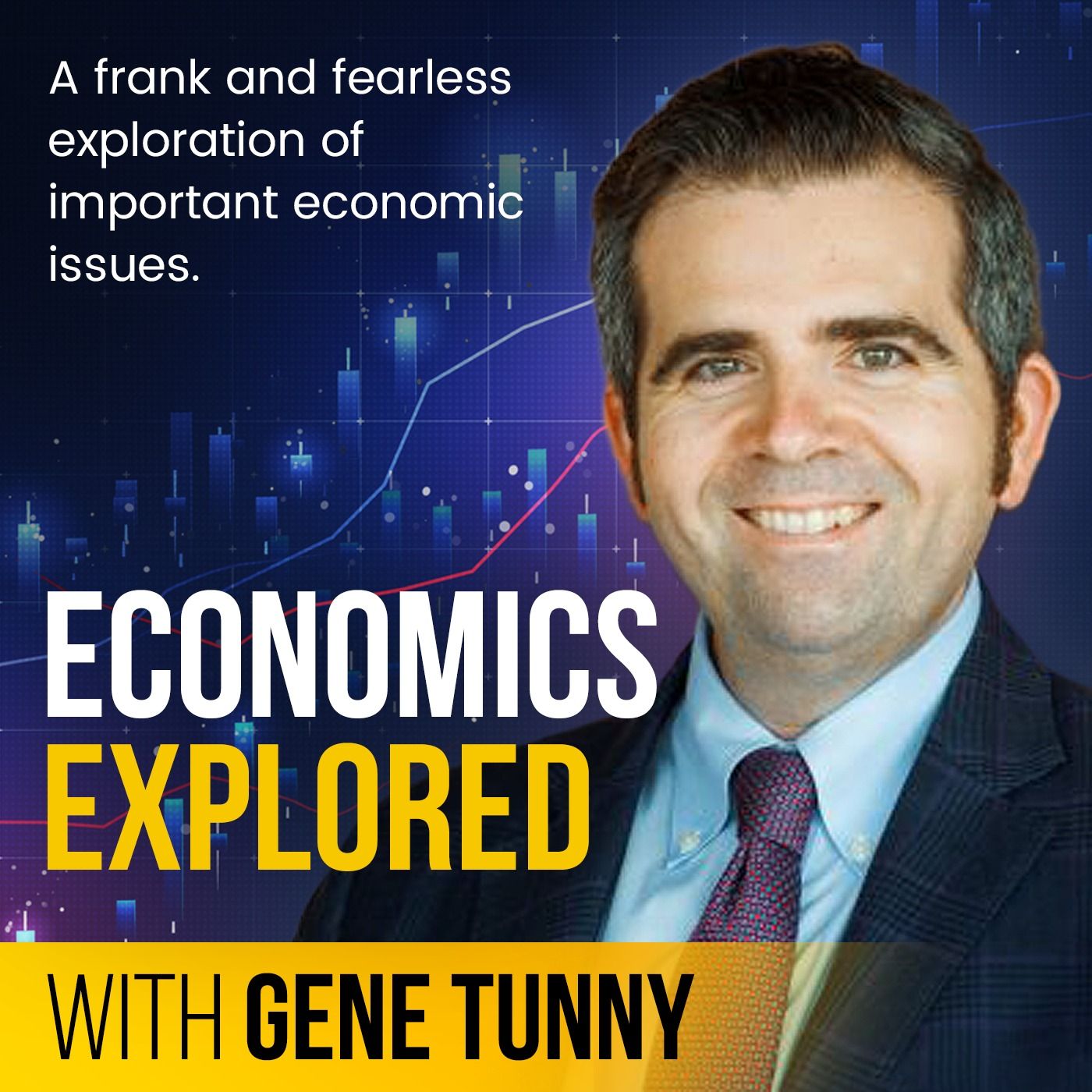
Economics Explored
Gene Tunny
Hard-headed economic analysis applied to important economic, social, and environmental issues.
Episodes
Mentioned books

Jun 3, 2020 • 58min
Picking winners: Industry policy with Craig Lawrence
Economics Explained host Gene Tunny speaks with Craig Lawrence, Managing Director of Lytton Advisory, regarding the pros and cons of picking winners and interventionist industry policy more broadly.Craig Lawrence has over 30 years of experience across government and private sector projects, particularly in infrastructure, transport, and tourism. Prior to establishing Lytton Advisory, Craig was Director-Infrastructure Policy at the Queensland Government Department of State Development, Infrastructure and Planning where he led a team of policy and regulatory analysts and economists looking at infrastructure prioritisation and resource region supply chain optimisation. He was previously Director-Economic Policy within the Department.Reports mentioned in the conversation include:QCA Industry Assistance Review Report (see p. 25 for the footloose Berri Fruit Juice example) Productivity Commission Automotive Industry Modelling Report (see p. 80 for the PC’s estimate of the high cost per job saved Gene mentioned in the conversation)
May 27, 2020 • 50min
Uncertainty and the perils of prediction with William M Briggs
Economics Explained host Gene Tunny speaks with statistician William M “Matt” Briggs about uncertainty and the perils of prediction.Matt is a consulting statistician and a policy advisor to the Heartland Institute. He has been a visiting Professor of Statistics at Central Michigan University and an Adjunct Professor of Statistics at the Cornell Medical School. Matt is the author of the 2016 book Uncertainty: The Soul of Modeling, Probability and Statistics, published by Springer.In the interview I mention Matt’s article Why is Economics plagued by Math? This article by Matt refers to a 2015 paper by Nobel Prize winning economist Paul Romer Mathiness in the theory of economic growth.If you’re interested in learning more about Matt’s work, check out this video on YouTube:The crisis of evidence, or why probability and statistics cannot discover causeIn my introductory remarks I quote from John Bohannon’s Science Magazine article: About 40% of economics experiments fail replication survey
May 20, 2020 • 37min
US infrastructure: lessons from Australia, with Darren Brady Nelson
Darren Brady Nelson speaks about his new Heartland Institute Policy Brief How to fix America's crumbling infrastructure: lessons from Australia with Economics Explained host Gene Tunny. Darren is an Austrian school economist who serves as the chief economist at LibertyWorks, an Australian think tank, and as an associate scholar with the US Center for Freedom and Prosperity. He is also a policy advisor to the Heartland Institute. Darren has previously worked for NSW Treasury, various consulting firms, industry associations, a US Presidential campaign, and for an Australian Senator. Use these (approximate) timestamps as a guide to the conversation:2:20 – Darren gives an overview of the US’s crumbling infrastructure7:15 – Darren observes “the average US airport…looks like something out of the Soviet Union”19:00 – Darren notes “the key is to actually open things up to competition as well, not just to privatize things or to recycle an asset”20:00 – discussion of National Competition Policy in Australia and how the Australian economic reform process slowed down in the 2000s28:10 – reference to Productivity Commission’s finding of substantial economic gains from National Competition Policy in Australia (e.g. see the 2005 Inquiry Report - Review of National Competition Policy Arrangements) and Darren argues the US can easily replicate Australia's very high ROI with a US National Competition Policy
May 13, 2020 • 36min
Working from home during & after the pandemic with Alison Pennington
Working from Home: Opportunities and Risks is a new briefing paper from Alison Pennington and Jim Stanford from the Centre for Future Work at the Australia Institute. Economics Explained host Gene Tunny interviews Alison regarding the paper in this episode. Alison Pennington is Senior Economist with the Centre for Future Work. Her research focus is on work in Australia today, and in the future. She received a Master of Political Economy from the University of Sydney. Her research focus was on the Australian finance system, housing and inequality. Her twitter handle is @ak_pennington.TimestampsUse these (approximate) timestamps to jump right to the highlights:5:40 – productivity impacts discussion8:30 – how social isolation can impair cognitive ability12:00 – discussion of the view expressed in the paper that “working from home will likely become more common in coming years. For millions of workers, indeed, it will become the ‘new normal.’”16:30 – how workplaces can adapt – an end to hot-desking, a return to pods, and staggered start times28:05 – discussion of employee surveillance by employers – 70% of employees subject to at least one type of digital surveillance and there is a risk this can extend into people’s homes if working from home becomes the new normal32:20 – reference to how the Australian Taxation Office (ATO) has tried to make working from home easier (check out the ATO page Working from home during COVID-19)
May 6, 2020 • 49min
Highlights of recent coronavirus-related episodes
This episode is a review of the big issues covered in recent Economics Explained episodes on coronavirus. Economics Explained host Gene Tunny and Brisbane-based businessman Tim Hughes of Urban Ergo react to excerpts of recent episodes and discuss the important policy issues regarding coronavirus. TimestampsUse these (approximate) timestamps to jump right to the highlights:1:40 – radical uncertainty around coronavirus impacts, featuring an excerpt from EP33 with Prof. John Kay CBE11:40 – discussion of issues around re-opening economies and whether we’re “putting a price tag on human life”, featuring an excerpt from EP32 with Dr Dan Mitchell20:00 – discussion of Benno Torgler’s paper on certified corona-immunity (check out EP30 with Prof. Benno Torgler)24:10 – discussion of an excerpt of my conversation with Joe Branigan on how we pay for the coronavirus response (EP31 with Joe Branigan)30:10 – reference to the Quantity Theory of Money33:40 – discussion of Dr Dan Mitchell’s views on bailouts43:10 – discussion of Australia’s COVIDSafe appOther recent coronavirus-related episodes not yet mentioned include:EP28 with Dr Nicholas Gruen on coronavirus policy responsesEP27 with Michael Knox from Morgans on coronavirus, machine trading & financial markets
Apr 29, 2020 • 30min
Radical Uncertainty with Prof. John Kay CBE
Radical Uncertainty: Decision making for an unknowable future is a new book from eminent British economists Professor John Kay CBE, FRSE, FBA, FAcSS and former Bank of England Governor Lord Mervyn King. Economics Explained host Gene Tunny interviews Professor Kay about the book in this episode. TimestampsUse these (approximate) timestamps to jump right to the highlights:2:34 – John Kay on what is meant by Radical Uncertainty, beginning with references to Maynard Keynes and Frank Knight8:40 – discussion of what Kay and King see as the critical question, “What is going on here?”, in the context of coronavirus14:35 – discussion of non-stationary process16:25 – discussion of the usefulness of economic models, with Gene asking John to explain the statement in the book “"You cannot derive a probability or a forecast or a policy recommendation from a model..."26:10 – John explains the importance of robustness and resilience in systems in response to a question referencing climate changeKay and King’s lessons on the appropriate use of economic models include:deploy simple models (as you’re trying to “illuminate part of the large world of radical uncertainty”, rather than trying to precisely describe it)identify the most important parameters and undertake research to determine sensible values of those parameters,simple models are more flexible, andunder radical uncertainty, options provided by a particular policy can be extremely important.It goes without saying that this book is highly recommended reading. This episode was recorded on Friday 24 April 2020 using Zoom.
Apr 22, 2020 • 37min
Bailouts in this time of coronavirus with Dr Dan Mitchell
Economics Explained host Gene Tunny speaks with Dr Dan Mitchell about government bailouts of companies such as airlines which we are seeing in this time of coronavirus. Dr Mitchell is the Founder of the Center for Freedom and Prosperity and a former Senior Fellow at the Cato Institute. He runs the highly informative and thought-provoking blog International Liberty.TimestampsUse these (approximate) timestamps to jump right to the highlights:1:05 – discussion of venture capitalist Chamath Palihapitiya’s view that companies should go bankrupt rather than being bailed out (check out Government should let airlines fail)5:15 – an ostensible libertarian justification for bailouts, the concept of regulatory taking (check out Dan’s post Protecting Airlines and Other Companies from Government Control)7:40 – we need to ensure there isn’t a permanent expansion of government when it’s all over10:00 – discussion of merits of different ways of bailing out companies, after Gene quotes from a Guardian article US government agrees on $25bn bailout for airlines as pandemic halts travel11:50 – “There are no good options” according to Dan17:00 – is the coronavirus crisis an indictment of capitalism? No, says Dan. Check out Dan’s post Coronavirus and the Tradeoff Between Big Government and Competent Government19:10 – to what extent is US situation a failure of the federal government versus state governments? Dan thinks the states are best placed to deal with coronavirus25:10 – discussion of what Dan thinks are misplaced concerns about stock buybacks (check out Dan’s post Washington’s Counterproductive Attack on Stock Buybacks)32:05 – discussion of Dan’s Venn diagram in his post Coronavirus, Economics, and Saving Lives34:05 – reference to UN report which acknowledges economic cost of coronavirus containment measures (check out this NPR article U.N. Agency Fears ‘Vulnerable’ Africa May Suffer At Least 300,000 COVID-19 Deaths)This episode was recorded early on the morning of Saturday 18 April 2020 (Australian Eastern Standard Time) via Zoom.
Apr 15, 2020 • 52min
Paying for the coronavirus rescue measures with Joe Branigan
Social distancing measures to contain coronavirus have crashed economies around the world, reducing government tax revenues. At the same time, governments have brought in massive economic rescue packages to support workers and businesses. An obvious question is: where is the money coming from to pay for these rescue packages and to make up for the lost tax revenue? Economics Explained host Gene Tunny explores this question with Joe Branigan, Director of Tulipwood Economics. TimestampsUse these timestamps to help you jump right to the highlights:5:45 - Gene recalls his time in the Australian Treasury's Budget Policy Division where he dealt with debt policy and cash management issues7:15 - discussion of how governments borrow money by selling bonds12:20 - discussion of bond auctions/tenders by the Australian Office of Financial Management (AOFM)17:30 - who buys bonds? (for Australian info, check out the excellent AOFM article The Australian Government Securities investor base)20:00 - discussion of Bank of England direct financing of UK Gov't spending (discussed in a pay-walled article in the Financial Times, Bank of England to directly finance UK government's extra spending), monetisation of deficits, and Modern Monetary Theory29:20 - repaying versus refinancing/refunding the debt31:10 - long-term problems/risks with government debt37:30 - overview of Joe's research on costs and benefits of coronavirus policy measures
Apr 8, 2020 • 30min
Certified Corona-Immunity as a Resource with Prof. Benno Torgler
Economics Explained host Gene Tunny speaks with Professor Benno Torgler of QUT about a new paper he has co-authored: Certified Corona-Immunity as a Resource and Strategy to Cope with Pandemic Costs.Professor Benno Torgler is Professor of Economics in the School of Economics and Finance and Centre for Behavioural Economics, Society and Technology (BEST), QUT. He was also Adjunct Professor at the EBS Universität für Wirtschaft und Recht, Germany (2012-2015) and an ARC Future Fellow (2011-2015).TimestampsUse these (approximate) timestamps to jump right to the highlights:1:20 – abstract/overview of Benno’s paper – immune people must be identified and re-integrated into normal activities as soon as possible5:15 – reference to Gene’s interview with CCIQ Chief Economist Marcus Smith on the economic impacts of coronavirus5:40 – concept of Immunity Certificates8:50 – what does Benno mean by actively producing the resource of corona-immunity?11:55 – importance of widespread testing and the need to discuss trade-offs (e.g. public health and economy), prompting discussion of final sentence of abstract, “There is a risk that the impacts of the secondary crisis could outweigh that of the biological event from a health and societal perspective.”13:40 – discussion of Frank Snowden’s book Epidemics and Society: From the Black Death to the Present16:40 – reference to post-September 11 study which showed driving deaths increased following terrorist attack which led to less air travel by Gerd Gigerenzer, Out of the Frying Pan into the Fire: Behavioral Reactions to Terrorist Attacks21:00 – reference to Paul Frijters’ articles on the virus - e.g. The Corona Dilemma23:45 – Benno mentions Rizio and Skali paper on How often do dictators have positive economic effects?
Apr 1, 2020 • 36min
Coronavirus responses with Joe Branigan, Tulipwood Economics
Economics Explained host Gene Tunny discusses coronavirus policy responses with Joe Branigan, Director, Tulipwood Economics. The episode features a discussion of what we're learning from around the world, including from experiences in Australia, NZ, Italy, and the US, among other countries.Use these timestamps to help you jump to the highlights:1:50 - Joe reviews international data on coronavirus cases as at 1 April5:00 - how case fatality rates depend on the testing regime7:30 - why Italy has been so badly affected compared with Australia11:05 - what is a Disability Adjusted Life Year (DALY)?13:00 - discussion of whether cost-benefit analysis is relevant in assessing coronavirus responses20:50 - Sweden identified as a country which appears willing to tolerate a worse public health outcome to avoid enacting draconian measures23:20 - discussion of pros and cons of a full lock-down strategy30:20 - "No one knows what the right answer is" - recognition we have much to learn from the variety of responses and experiences around the world32:00 - major takeaway is that each country is on its own trajectory and policy responses need to be specific to each country

