

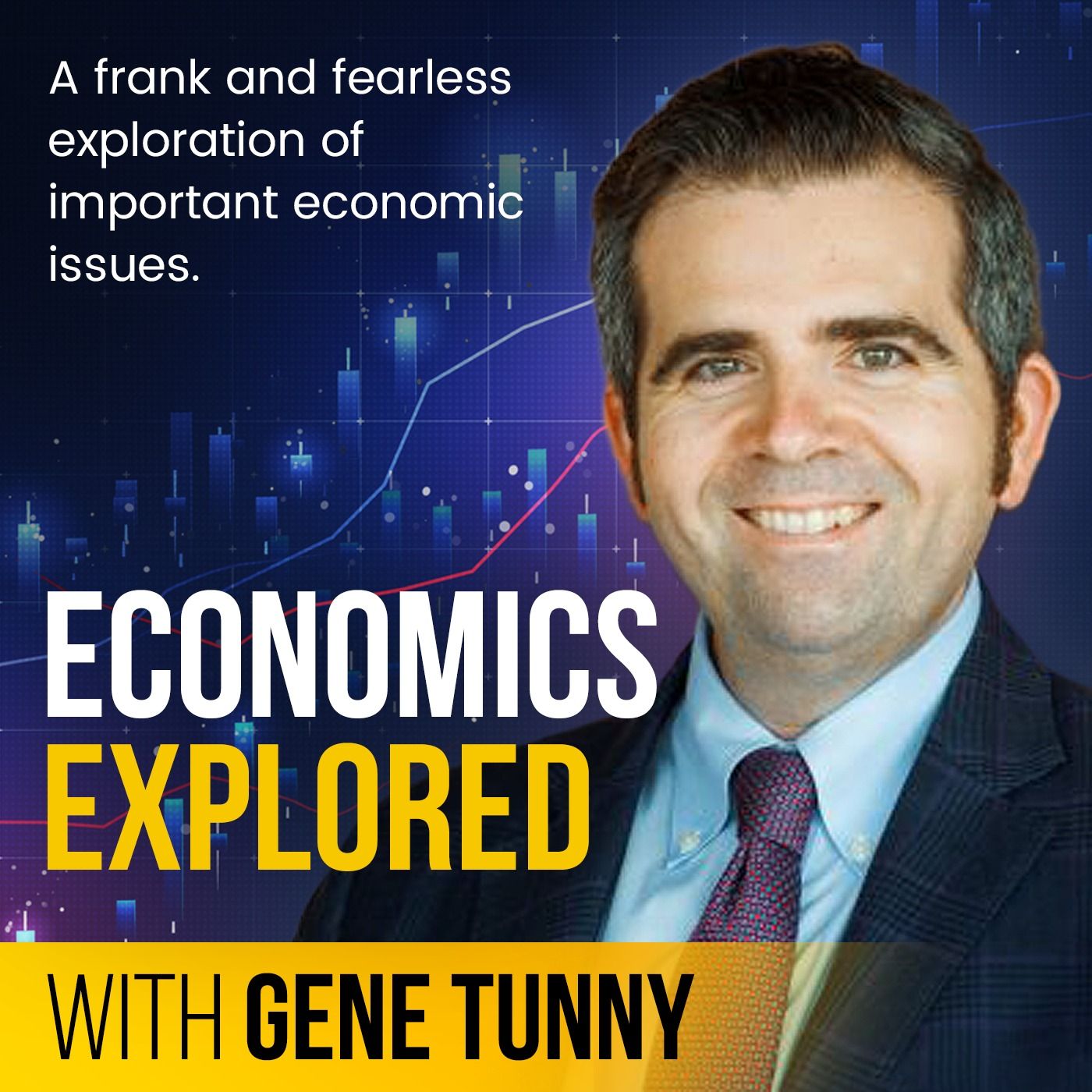
Economics Explored
Gene Tunny
Hard-headed economic analysis applied to important economic, social, and environmental issues.
Episodes
Mentioned books

Dec 10, 2021 • 1h 8min
COP26 Glasgow Climate Change Summit: Success or Failure?
The COP26 climate change summit in Glasgow in 2021 disappointed many advocates for strong action on climate change. Economics Explored host Gene Tunny discusses whether COP26 should be perceived as a failure or, at best, a mild success with fellow Brisbane-based economist Scott Hook, who has attended several global climate change summits in the past. About this episode’s guest - Scott HookScott Hook has over 25 years of experience in policy, economic, environmental and financial analysis and in the development of Pacific regional, national and local government policy. He has also researched and written on the role of institutions in shaping policy implementation in Fiji and the Pacific, climate change and disaster risk and climate and security issues. He has a PhD from the University of Queensland that was completed in 2010. In the last decade he has worked extensively on infrastructure reform and policy, understanding and building resilience to climate and disaster risk and improving access to, and management of, climate change and disaster risk finance for Pacific island countries. He has supported Pacific Island Delegations in the Finance discussions of the UNFCCC Conference of the Parties negotiations as a technical adviser, coordinator and negotiator.He has experience with working with a range of partners and their modalities of engagement, such as. the Green Climate Fund (Forum Secretariat is a Readiness Partner and organising the 2015 and 2016 Pacific Roundtable Meetings), European Development Fund (design and governance for a €29 million energy programme), and a US$10 million regional programme of the Climate Investment Fund through the development of the Pacific component of the Strategic Program for Climate Resilience. He has worked closely with a wide range of partners including the Pacific Community, SPREP, DFAT, EU, NZAID, the ADB and World Bank.Links relevant to the conversationNew Zealand commits millions to climate relocation fund for FijiWorld’s First –Ever Relocation Trust Fund for People Displaced by Climate Change Launched by Fijian Prime MinisterPacific Adaptation for Climate Change (PACC) ProjectPrevious Economics Explored episodes on COP26:EP108 – COP26 climate change summit with Tony Wood, Grattan InstituteEP110 – COP26 Dissenting Voices Part 1: Dr Alan MoranEP111 – Australian Senator Matt Canavan – COP26 Dissenting Voices Part 2Thanks to the show’s audio engineer Josh Crotts for his assistance in producing the episode. Please get in touch with any questions, comments and suggestions by emailing us at contact@economicsexplored.com or sending a voice message via https://www.speakpipe.com/economicsexplored. Economics Explored is available via Apple Podcasts, Google Podcast, and other podcasting platforms.
Dec 3, 2021 • 44min
The Great Resignation
What’s going on with the Great Resignation, the record numbers of people leaving jobs in the US and the UK? Will we see it in other countries such as Australia? What can employers do to hold on to staff? Economics Explored host Gene Tunny speaks with his serviced office neighbours Anthony Bersz and Louise Gibson from Remedy Resourcing, a Brisbane-headquartered recruitment firm.A video of this episode has been recorded and can be found, when available from approximately 6 December 2021, via www.economicsexplored.com. About this episode’s guests - Anthony Bersz and Louise Gibson, Remedy ResourcingAnthony Bersz is Managing Director of Remedy Resourcing and Director of Remedy Information Technology. Anthony’s recruitment career started in 2010 working for one of the world's leading recruitment agencies based in the UK. After a number of years supporting his candidates and clients throughout the North West of England, Anthony made the move to Brisbane, Australia. On arrival to Brisbane, Anthony continued his career within the same global brand supporting IT companies and professionals with their recruitment and career needs. After listening to the candidate and client frustrations of working with a large global agency, Anthony decided to create Remedy Resourcing to provide a more tailored and flexible approach.Email anthony@remedyresourcing.comLouise Gibson is Director of Remedy Legal. Louise’s recruitment career began in 2001 (whilst living in the United Kingdom) and for the next several years, she recruited for one of the largest recruitment agencies in the world, before obtaining a Directorship in the North West’s leading taxation and legal search and selection firms. During this decade, Louise sourced both tax accountants and tax lawyers for Big 4 Accounting, magic circle law firms and other private practice and FTSE 100 companies.Louise moved to Brisbane in 2012 and returned to the same international agency for several years where she took responsibility for managing the legal, professional services and finance team for their Brisbane office. It was here in 2015 that she was awarded the Queensland state record for the highest fees billed in a single period since records began. At the end of 2015, Louise joined Remedy to head up and develop the Legal recruitment arm of the business.Email louise@remedyresourcing.comLinks relevant to the conversationGreat Resignation charts Gene refers to in conversationWho Is Driving the Great Resignation? HBR articleTop reasons for quitting jobs in the Great Resignation: health fears, burnout, and bad managers Washington Post articleThe Great Resignation Is Accelerating Atlantic Monthly articleAustralia's 'great resignation' is a myth — we are changing jobs less than ever before article by Mark Wooden showing Great Resignation hasn’t come to Australia yetEscape to the country: how Covid is driving an exodus from Britain’s cities (September 2020 Guardian article)Thanks to the show’s audio engineer Josh Crotts for his assistance in producing the episode. Please get in touch with any questions, comments and suggestions by emailing us at contact@economicsexplored.com or sending a voice message via https://www.speakpipe.com/economicsexplored. Economics Explored is available via Apple Podcasts, Google Podcast, and other podcasting platforms.
Nov 26, 2021 • 50min
The Opioid Crisis and the War on Drugs with Dr Jeffrey Singer
100,000 Americans have died of drug overdoses in a 12 month period, mostly with opioids. A conversation on the US Opioid crisis and the failed War on Drugs, and why a Harm Reduction approach is preferable, with Dr Jeffrey Singer MD from the Cato Institute. About this episode’s guest - Dr Jeffrey Singer MDJeffrey A. Singer is a senior fellow at the Cato Institute and works in the Department of Health Policy Studies. He is principal and founder of Valley Surgical Clinics Ltd., the largest and oldest group private surgical practice in Arizona, and has been in private practice as a general surgeon for more than 35 years.He is also a visiting fellow at the Goldwater Institute in Phoenix. Singer is a member of the Board of Scientific Advisors of the American Council on Science and Health. From 1994 to 2016, he was a regular contributor to Arizona Medicine, the journal of the Arizona Medical Association. He served on the Advisory Board Council of the Center for Political Thought and Leadership at Arizona State University from 2014 to 2018 and is an adjunct instructor in the Program on Political History and Leadership at ASU. He writes and speaks extensively on regional and national public policy, with a specific focus on the areas of health care policy and the harmful effects of drug prohibition.He received his BA from Brooklyn College (City University of New York) and his MD from New York Medical College. He is a fellow of the American College of Surgeons.Jeff is @dr4liberty on Twitter. Links relevant to the conversationThe North Carolina study:https://pubmed.ncbi.nlm.nih.gov/26333030/ The Harvard/Johns Hopkins study on misuse rates in opioid naive post-surgical patients:https://www.bmj.com/content/360/bmj.j5790 The Cicero study on the rise of heroin as the "gateway" drug:https://pubmed.ncbi.nlm.nih.gov/28582659/Jeff’s report in the Journal of Pain Research:https://www.ncbi.nlm.nih.gov/pmc/articles/PMC6369835/Jeff’s Quadrant article on e-cigarettes:https://quadrant.org.au/opinion/public-health/2021/10/whose-lungs-are-they-anyway/Thanks to the show’s audio engineer Josh Crotts for his assistance in producing the episode.Please get in touch with any questions, comments and suggestions by emailing us at contact@economicsexplored.com or sending a voice message via https://www.speakpipe.com/economicsexplored. Economics Explored is available via Apple Podcasts, Google Podcast, and other podcasting platforms.
Nov 19, 2021 • 33min
Tax rules benefiting tech titans and hedge fund managers in the US
Controversial US tax rules (e.g. carried interest, step up in basis) mean that billionaire tech titans and hedge fund managers pay arguably relatively low amounts of tax, as Steve Rosenthal, Senior Fellow at the Urban Institute, explains to show host Gene Tunny in Economics Explored episode 114. Steve also talks about former President Trump's tax affairs.About this episode’s guest - Steven M. RosenthalSteve Rosenthal, a senior fellow in the Urban-Brookings Tax Policy Center at the Urban Institute, researches, speaks, and writes on a range of federal income tax issues, with a particular focus on business taxes. In 2013, he was the staff director of the DC Tax Revision Commission.Before joining Urban, Rosenthal practiced tax law in Washington, DC, for over 25 years, most recently as a partner at Ropes and Gray. He was a legislation counsel with the Joint Committee on Taxation, where he helped draft tax rules for financial institutions, financial products, capital gains, and related areas. He is the former chair of the Taxation Section of the District of Columbia Bar Association.Rosenthal holds an AB and JD from the University of California, Berkeley, and an MPP from Harvard University.Links relevant to the conversationTax Fairness: President Donald Trump, a Case Study (Steve’s testimony before the U.S. House Ways and Means Oversight Subcommittee)Buy, borrow, die: How rich Americans live off their paper wealth (WSJ article)Thanks to the show’s audio engineer Josh Crotts for his assistance in producing the episode. Please get in touch with any questions, comments and suggestions by emailing us at contact@economicsexplored.com or sending a voice message via https://www.speakpipe.com/economicsexplored. Economics Explored is available via Apple Podcasts, Google Podcast, and other podcasting platforms.
Nov 12, 2021 • 56min
Lithium and the new energy revolution with Lukasz Bednarski
Lukasz Bednarski talks about his new book “Lithium: The Global Race for Battery Dominance and the New Energy Revolution” with show host Gene Tunny in Economics Explored episode 113. The blurb for Lukasz’s book reads:“A global energy revolution is unfolding before our eyes: ever-growing numbers of electric vehicles on our roads, laptops that last all day on a single charge and solar panels on our roofs, all reliant on lithium-ion batteries. This revolution is happening at breath-taking speed, with the potential to completely transform key industries and the way we live. For the first time in history, we can now actually store this green energy we talk so much about. Often referred to as ‘the new oil’, lithium allows large amounts of energy to be squeezed into a very small space.”About this episode’s guest - Lukasz BednarskiLukasz Bednarski is a battery materials analyst, founder of the lithium industry portal Lithium Today and a former commodity trader.Links relevant to the conversationLithium: The Global Race for Battery Dominance and the New Energy Revolution by Lukasz BednarskiAmazon page for Lukasz’s bookHow Tesla’s Battery Mastermind Is Tackling EV's Biggest ProblemAre aviation biofuels ready for take off?Thanks to the show’s audio engineer Josh Crotts for his assistance in producing the episode. Please get in touch with any questions, comments and suggestions by emailing us at contact@economicsexplored.com. Economics Explored is available via Apple Podcasts, Google Podcast, and other podcasting platforms.
Nov 5, 2021 • 41min
Taxing the rich - Billionaire and inheritance taxes
Tax expert Prof. Miranda Stewart speaks with show host Gene Tunny about taxes on wealth, including inheritance taxes and the proposed billionaire tax in the United States. What is driving calls to “Tax the Rich” from politicians such as Alexandria Ocasio-Cortez and various commentators? Would it be sensible to do so? About this episode’s guest - Professor Miranda StewartMiranda Stewart is Professor of Law at the University of Melbourne Law School where she is Director of the Tax Group and is a Fellow at the Tax and Transfer Policy Institute at the Crawford School of Public Policy, The Australian National University. Miranda was the inaugural Director of the Institute from 2014 to 2017. Miranda has more than 25 years research, practical and leadership experience in tax law and policy in academia, government and the private sector.Links relevant to the conversationDeath duties: Why experts think this tax should be re-introduced (Australian media article quoting Prof. Stewart on inheritance tax)The coming boom in inherited wealth by John QuigginThanks to the show’s audio engineer Josh Crotts for his assistance in producing the episode. Check out his Upwork profile here:https://www.upwork.com/o/profiles/users/~01ce8c1d226cc8909e/Please get in touch with any questions, comments and suggestions by emailing us at contact@economicsexplored.com. Economics Explored is available via Apple Podcasts, Google Podcast, and other podcasting platforms.
Oct 27, 2021 • 50min
Aussie Senator Matt Canavan - COP26 Dissenting Voices Part 2
Senator Matt Canavan, Australia’s most prominent critic of the Net Zero by 2050 policy to address climate change, speaks with show host Gene Tunny about the 2021 UN climate change summit, COP26 (i.e. the 26th Conference of the Parities). About this episode’s guest - Senator Matt CanavanMatt Canavan is a Liberal National Party Senator for the state of Queensland, Australia. Matt was first elected at the 2013 Australian federal election for the term beginning 1 July 2014. He was the Minister for Resources and Northern Australia between February 2016 and February 2020. Matt holds the degrees of Bachelor of Arts and Bachelor of Economics (Hons.) from the University of Queensland. He has professional experience working as an economist in Australia’s Productivity Commission, and he has also worked as a consultant at KPMG. Matt’s main office is in Rockhampton, in Central Queensland. He spoke with Gene over Zoom while located in his Parliament House office in Canberra, Australia. Links relevant to the conversationFLASHBACK: Queensland’s hydrogen-powered car | 7NEWSGlobal Coal Plant TrackerEP110 - COP26 Dissenting Voices Part 1 - Dr Alan MoranEP108 – COP26 climate change summit with Tony Wood, Grattan InstituteThanks to the show’s audio engineer Josh Crotts for his assistance in producing the episode. Check out his Upwork profile.Please get in touch with any questions, comments and suggestions by emailing us at contact@economicsexplored.com. Economics Explored is available via Apple Podcasts, Google Podcast, and other podcasting platforms.
Oct 22, 2021 • 34min
COP26 Dissenting Voices Part 1 - Dr Alan Moran
Dr Alan Moran, prominent Australian critic of climate change and renewable energy policies, speaks with show host Gene Tunny about the 2021 UN climate change summit, COP26 (i.e. the 26th Conference of the Parities). About this episode’s guest - Dr Alan MoranDr Alan Moran is Director of Regulation Economics, a consultancy firm. He is a noted economist who, in his own words, “has analysed and written extensively from a free market perspective.” Dr Moran was the Director of the Deregulation Unit at the Australian Institute of Public Affairs from 1996 until 2014. He was previously a senior official in Australia’s Productivity Commission and Director of the Australian Government’s Office of Regulation Review. Subsequently, he played a leading role in the development of energy policy and competition policy review as the Deputy Secretary for Energy in the Victorian Government. Dr Moran was educated in the UK and has a PhD in transport economics from the University of Liverpool and degrees from the University of Salford and the London School of Economics. Links relevant to the conversationBeware a blind charge to net-zero emissions | The Spectator AustraliaAustralia’s Obscene Green Subsidy Machine – Quadrant OnlineThe Business Council of Australia’s green schizophrenia | The Spectator AustraliaBruce Mountain article The verdict is in: renewables reduce energy prices (yes, even in South Australia)Australia’s Renewable Energy Target (RET)EP108 – COP26 climate change summit with Tony Wood, Grattan InstituteThanks to the show’s audio engineer Josh Crotts for his assistance in producing the episode. Check out his Upwork profile.Please get in touch with any questions, comments and suggestions by emailing us at contact@economicsexplored.com. Economics Explored is available via Apple Podcasts, Google Podcast, and other podcasting platforms.
Oct 15, 2021 • 1h 1min
Philosophy and Truth
In Economics Explored EP109, Dr John Atkins, philosopher and Honorary Research Fellow at the University of Queensland, provides great insights into the nature of truth, an important topic to discuss in this time of big debates over the pandemic and climate change, among other issues. Dr Atkins highlights the importance of trust, probabilistic thinking (i.e. thinking not necessarily about truth but our level of certainty in a fact), and the Socratic method. Show host Gene Tunny shares his own views on the nature of truth, including his commitment to being “radically open-minded”, a stance promoted by legendary investor Ray Dalio (see Principles). Also joining the conversation is regular Economics Explored guest Tim Hughes, Business Development Manager at Adept Economics and founder of Urban Ergo. About this episode’s guest - Dr John AtkinsDr John Atkins is an Honorary Research Fellow in the School of Historical and Philosophical Inquiry, Faculty of Humanities and Social Sciences, at the University of Queensland. His research interests include Wittgenstein, Quietism, and Institutional Integrity. He has a PhD from the University of Queensland.Links relevant to the conversationEP101 – How do we know what’s true or why trust science?Ray Dalio says going broke in 1982 was the ‘best thing that ever happened’ to himHelgoland by Carlo Rovelli (book on Heisenberg Uncertainty Principle and Quantum Physics mentioned by Gene)Thanks to the show’s audio engineer Josh Crotts for his assistance in producing the episode. Check out his Upwork profile here:https://www.upwork.com/o/profiles/users/~01ce8c1d226cc8909e/Please get in touch with any questions, comments and suggestions by emailing us at contact@economicsexplored.com. Economics Explored is available via Apple Podcasts, Google Podcast, and other podcasting platforms.
Oct 8, 2021 • 38min
COP26 climate change summit with Tony Wood, Grattan Institute
Energy and climate change policy expert Tony Wood from the Grattan Institute explains what COP26 (the 2021 climate change conference in Glasgow) is all about and why it’s important. Tony discusses what Net Zero emissions means exactly, the prospects for nuclear energy, and implications for fossil fuel (e.g. coal) dependent economies, among other relevant issues.About this episode’s guest - Tony Wood AMTony Wood is Program Director for Energy and Climate Change at the Grattan Institute, a leading Australian public policy think tank. Tony has been a Program Director at Grattan since 2011 after 14 years working at Origin Energy in senior executive roles.From 2009 to 2014 he was also Program Director of Clean Energy Projects at the Clinton Foundation, advising governments in the Asia-Pacific region on effective deployment of large-scale, low-emission energy technologies. In 2008, he was seconded to provide an industry perspective to the first Garnaut climate change review.In January 2018, Tony was awarded a Member of the Order of Australia in recognition of his significant service to conservation and the environment, particularly in the areas of energy policy, climate change and sustainability. In October 2019, Tony was elected as a Fellow to the Australian Academy of Technology and Engineering.Links relevant to the conversationAustralia’s emissions strategy should be a countdown to zeroEP99 - Carbon border taxesEP92 – Nuclear energy and decarbonizing economiesEP86 – Decarbonizing the EconomyThanks to the show’s audio engineer Josh Crotts for his assistance in producing the episode. Check out his Upwork profile here:https://www.upwork.com/o/profiles/users/~01ce8c1d226cc8909e/Please get in touch with any questions, comments and suggestions by emailing us at contact@economicsexplored.com. Economics Explored is available via Apple Podcasts, Google Podcast, and other podcasting platforms.

