

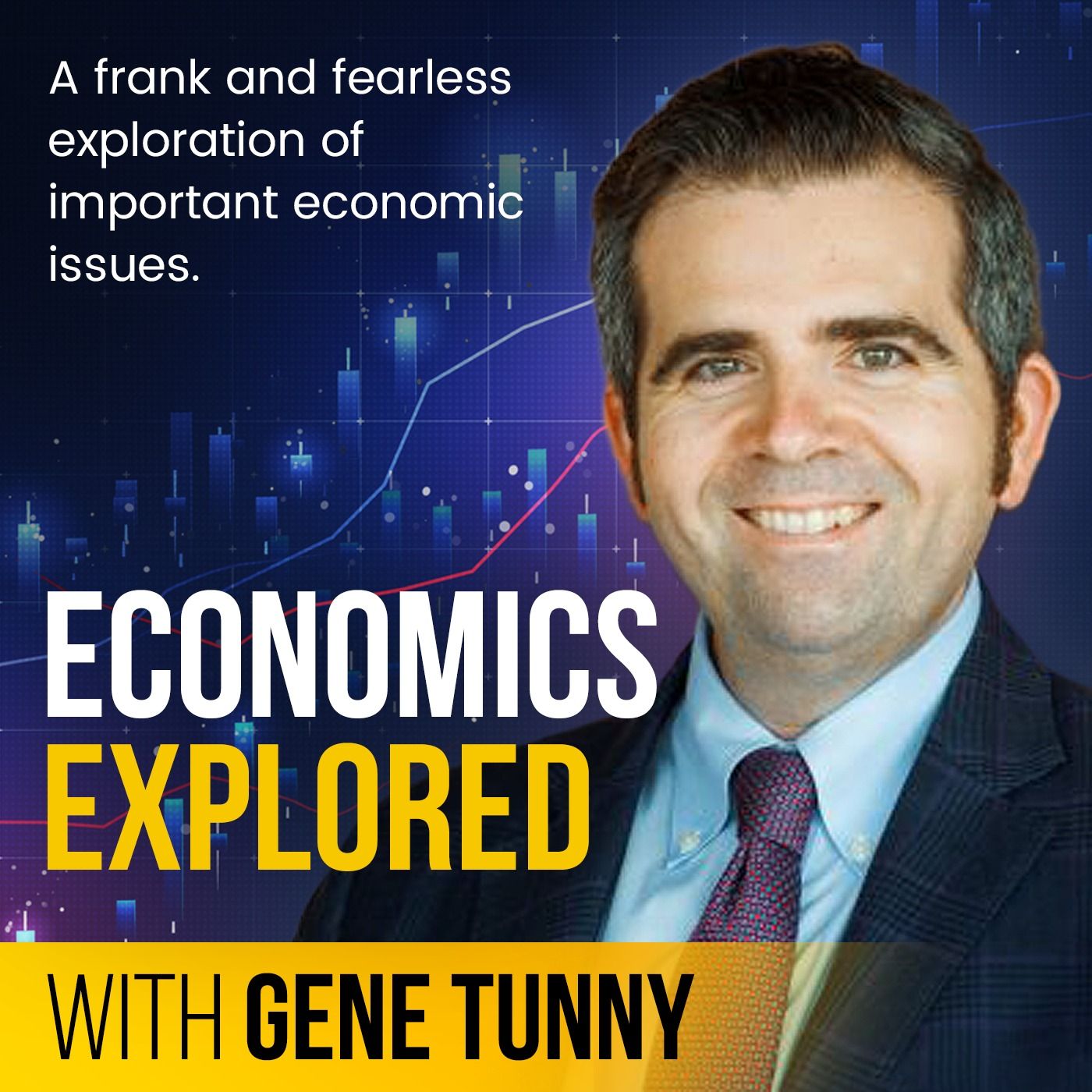
Economics Explored
Gene Tunny
Hard-headed economic analysis applied to important economic, social, and environmental issues.
Episodes
Mentioned books

Feb 18, 2022 • 1h 26min
US Inflation, Woke Capitalism & China w/ Darren Brady Nelson + weird Aussie tax rules - EP127
With US inflation at a 40-year high, who wins and who loses? Are greedy corporations to blame as some pundits are suggesting? A wide-ranging conversation with Darren Brady Nelson, Chief Economist of LibertyWorks, an Australian libertarian think tank, which also considers so-called Woke Capitalism and what’s going on with China. In the second part of the show, the Grattan Institute’s Economic Policy Program Director Brendan Coates explains the franking credits controversy, related to some peculiar Australian tax rules, to show host Gene Tunny. About this episode’s guestsDarren Brady Nelson is an Austrian School economist and liberty evangelion as well as a C.S. Lewis and G.K. Chesterton style Christian. He is currently the Chief Economist at LibertyWorks of Brisbane Australia and a long-time policy advisor to The Heartland Institute of Chicago USA. He is also a regular commentator in traditional and online Australian and American media. Check out his full profile at Regular guests – Economics Explored.Brendan Coates is the Economic Policy Program Director at Grattan Institute, where he leads Grattan’s work on tax and transfer system reform, retirement incomes and superannuation, housing, macroeconomics, and migration. He is a former macro-financial economist with the World Bank in Indonesia and consulted to the Bank in Latin America. Prior to that, he worked in the Australian Treasury in areas such as tax-transfer system reform and macro-economic forecasting, with a strong focus on the Chinese economy.Links relevant to the conversationAmericans Return to Work as Biden Administration Work Disincentives Expire, but Jobs Remain Over 7 million Below Trend | Latest | America First Policy Institute (article referring to inflation tax of $855/year for an American family associated with a 7% yearly inflation rate)Summers stumbles – John QuigginWoke Capitalism Is a Monopoly Game | Mises WireJoe Biden appears to insult Fox News reporter over inflation questionThe implications of removing refundable franking credits - Grattan InstituteChartsUS CPI inflation rate, through-the-yearUS Producer Prices inflation rate, through-the-yearUS inflation expectations - University of Michigan estimatesClarifications“Average hourly earnings for all employees on US private nonfarm payrolls increased by 5.7% year-on-year in January of 2022” (see United States Average Hourly Earnings YoY - January 2022 Data - 2007-2021 Historical) This compares with inflation running at 7.5% through-the-year. Amazon hikes average US starting pay to $18, hires for 125,000 jobs | ReutersAbbreviationsCPI Consumer Price IndexPPI Producer Price IndexCreditsThanks to Darren and Brendan for great insights and conversation, and to the show’s audio engineer Josh Crotts for his assistance in producing the episode. Please get in touch with any questions, comments and suggestions by emailing us at contact@economicsexplored.com or sending a voice message via https://www.speakpipe.com/economicsexplored. Economics Explored is available via Apple Podcasts, Google Podcast, and other podcasting platforms.
Feb 11, 2022 • 54min
UBI: Universal Basic Income w/ Ben Phillips, ANU - EP126
The economics of a Universal Basic Income (UBI) is explored with Ben Phillips, Associate Professor at the Australian National University, and a leading expert on microsimulation modelling. Also, show host Gene Tunny reflects on experimental evidence regarding UBI.About this episode’s guest - Ben PhillipsAssociate Professor Ben Phillips is a Principal Research Fellow at the Centre for Social Research and Methods. He has nearly 20 years of experience as an economic and social researcher in Australia. Prior to joining the ANU Ben was responsible for a range of modelling projects at NATSEM including the STINMOD microsimulation model of Australia’s tax and transfer system. Ben managed several key projects including the distributional analysis of the Australian Government’s 2014-15 and 2015-16 Budgets.Prior to joining the ANU Ben twice worked at NATSEM and has also had roles at the Australian Bureau of Statistics as a methodologist and economist, The Housing Industry Association as a senior economist and the Bureau of Tourism Research as an economic forecaster. Ben has a first class honours degree in economics and is undertaking a PhD through the Crawford School of Public Policy focusing on the tax and transfer system.Links relevant to the conversationEP112 – Taxing the rich: Billionaire and inheritance taxes with Miranda StewartBen’s co-authored 2019 paper: A basic income for Australia? Exploring rationale, design, distribution and costEconomist article Gene quotes from: Might the pandemic pave the way for a universal basic income?Thanks to the show’s audio engineer Josh Crotts for his assistance in producing the episode. Please get in touch with any questions, comments and suggestions by emailing us at contact@economicsexplored.com or sending a voice message via https://www.speakpipe.com/economicsexplored.
Feb 4, 2022 • 45min
Price controls to fight inflation a bad idea + infrastructure lessons from POTUS 21 Chester Arthur w/ Larry Reed - EP125
Price controls are being suggested by some commentators as a way to fight inflation. But, as Lawrence W. Reed, President Emeritus of the Foundation for Economic Education explains, price controls would be a really bad idea. Larry also chats with show host Gene Tunny about whether Jesus was a socialist, why banks and the state should be kept separate, and why President Biden would benefit from lessons on infrastructure from the 21st President Chester A. Arthur. About this episode’s guest - Lawrence W. ReedLawrence W. (“Larry”) Reed became President of the Foundation for Economic Education (FEE) in 2008 after serving as chairman of its board of trustees in the 1990s and both writing and speaking for FEE since the late 1970s. He previously served for 21 years as President of the Mackinac Center for Public Policy in Midland, Michigan (1987-2008). He also taught economics full-time from 1977 to 1984 at Northwood University in Michigan and chaired its department of economics from 1982 to 1984.In May 2019, he retired to the role of President Emeritus at FEE and assumed the titles of Humphreys Family Senior Fellow, and Ron Manners Global Ambassador for Liberty. He holds a B.A. in economics from Grove City College (1975) and an M.A. degree in history from Slippery Rock State University (1978), both in Pennsylvania. He holds two honorary doctorates, one from Central Michigan University (public administration, 1993) and Northwood University (laws, 2008).Reed has authored nearly 2,000 columns and articles in newspapers, magazines and journals in the United States and abroad. His writings have appeared in The Wall Street Journal, The Washington Examiner, Christian Science Monitor, Intellectual Takeout, USA Today, Baltimore Sun, The Epoch Times, Detroit News and Detroit Free Press, among many others. He has authored or coauthored eight books, the most recent being Was Jesus a Socialist? (a major expansion in 2020 of an earlier essay) and Real Heroes: Inspiring True Stories of Courage, Character and Conviction. Additionally, he co-authored and edited five e-Books. See the “Books” section of this web site for more info. He is frequently interviewed on radio talk shows and has appeared as a guest on numerous television programs.Links relevant to the conversationLarry’s article “Price controls: killing the messenger”:https://elamerican.com/price-controls-killing-the-messenger/Larry’s article “Why I wish we could put Chester Arthur and Joe Biden in a room together to talk infrastructure spending”:https://fee.org/articles/why-i-wish-we-could-put-chester-arthur-and-joe-biden-in-a-room-together-to-talk-infrastructure-spending/Larry’s article “The World’s Oldest Republic Reveals the Secret to Peace and Prosperity”:https://fee.org/articles/the-world-s-oldest-republic-reveals-the-secret-to-peace-and-prosperity/Larry’s article “Why the Separation of Bank and State Is so Important”:https://fee.org/articles/why-the-separation-of-bank-and-state-is-so-important/Leonard E. Read’s article “I, Pencil”:https://fee.org/resources/i-pencil/Article on “Is It Wrong for Christians to Raise Rent on Tenants? Dave Ramsey Sparks Controversy With His Answer”:https://churchleaders.com/news/414426-is-it-wrong-for-christians-to-raise-rent-on-tenants-dave-ramsey-sparks-controversy-with-his-answer.htmlThe parable of the vineyard workers: https://www.bbc.co.uk/bitesize/guides/zd76rj6/revision/5Thanks to the show’s audio engineer Josh Crotts for his assistance in producing the episode. Please get in touch with any questions, comments and suggestions by emailing us at contact@economicsexplored.com or sending a voice message via https://www.speakpipe.com/economicsexplored. Economics Explored is available via Apple Podcasts, Google Podcast, and other podcasting platforms.
Jan 28, 2022 • 1h 11min
Women in Economics w/ Dr Leonora Risse of RMIT, Melbourne - EP124
RMIT’s Dr Leonora Risse, formerly of Harvard’s Women and Public Policy Program, argues greater gender diversity in economics would improve the quality of economic analysis and policy advice. Arguably, it would shine more light on and promote solutions to gender inequality (e.g. the gender pay gap). Is Leonora right, or is this “self-serving identity politics” as some fellow economists have alleged about a focus on gender issues? Economics Explored host Gene Tunny explores this question in a wide-ranging conversation with Leonora. The discussion considers differing average preferences among male and female economists on policy issues such as fiscal austerity and redistribution, touching on UBI. About this episode’s guest - Dr Leonora RisseDr Leonora Risse is an economist who specialises in gender equality. She is a Research Fellow with the Women’s Leadership Institute Australia, and recently spent time in residence at Harvard University as a Research Fellow with the Women and Public Policy Program.Leonora is a co-founder of the Women in Economics Network (WEN) in Australia and currently serves as the WEN National Chair. Leonora earned her PhD in Economics from the University of Queensland, and previously served as a Senior Research Economist for the Australian Government Productivity Commission. She is currently appointed as a Senior Lecturer in Economics at RMIT University in Melbourne, Australia.Leonora’s research focuses on understanding gender differences in economic opportunities and outcomes, encompassing such issues as the gender pay gap, women’s under-representation in leadership, and the influence of societal norms. Her areas of expertise extend to labour economics, demographic economics, economic psychology, disadvantage and wellbeing.She engages regularly with public audiences, government, industry and community groups on gender equality issues. This includes identifying evidence-based strategies to close gender gaps and applying a ‘gender lens’ to economic analysis and policy design.Leonora was named among Apolitical’s 100 Most Influential People in Gender Policy in 2021.Leonora’s Twitter handle: @leonora_risseLinks relevant to the conversationLeonora’s papers:Lifting diversity and inclusion in economics: How the Australian Women in Economics Network put the evidence into actionEconomics and Gender Equality: A Lens from WithinOther material:Reserve Bank of Australia: Women in Economics educational materialThe Gender Pay Gap with Dr Leonora RisseThanks to the show’s audio engineer Josh Crotts for his assistance in producing the episode. Please get in touch with any questions, comments and suggestions by emailing us at contact@economicsexplored.com or sending a voice message via https://www.speakpipe.com/economicsexplored. Economics Explored is available via Apple Podcasts, Google Podcast, and other podcasting platforms.
Jan 21, 2022 • 1h
Truth (or the lack of it) in politics and how to think critically with help from Descartes - EP123
Why politicians need to stop lying and cut the endless BS. A conversation with Philosophy Professor Deb Brown, Director of the Critical Thinking Project at the University of Queensland. Deb also chats with show host Gene Tunny and guest co-host Tim Hughes about what it means to think critically, drawing on her expertise in philosophy, including her study of Descartes. About this episode’s guest - Professor Deb BrownDeborah Brown is Professor, School of Historical and Philosophical Inquiry at the University of Queensland, Australia. During her time in the Faculty of Humanities and Social Sciences, Deb has coordinated a wide range of projects focusing on critical thinking. She has been instrumental in establishing connections and partnerships within the school sector, including with the Queensland Department of Education, as well as building partnerships across UQ and with international education providers. As part of her role, Deb works to link the UQ Critical Thinking Project into relevant projects within the university to provide educators with an understanding of how to embed critical thinking in classroom practice and assessment and to maximise outcomes for students, particularly those from disadvantaged backgrounds. Deb has established a professional development program for educators, booster courses for school and university students and research collaborations with a diverse range of researchers from the broader UQ community. Deb has a Bachelor of Arts from the University of Queensland and a Master of Arts and PHD from the University of Toronto.Links relevant to the conversationAbbreviations Deb uses:NAPLAN: National Assessment Program – Literacy and NumeracySES: Socio-economic statusThe Australian ABC News article Deb was quoted in:Is telling the truth too much to ask of our politicians?A book Deb highly recommends:On Bullshit by Harry G. FrankfurtArticle on the AUKUS (Australia-UK-US) nuclear submarine agreement:https://www.ussc.edu.au/analysis/explainer-what-is-the-aukus-partnershipNPR report on Trump-Trudeau argument about the US’s trade balance with Canada:Trump Admits To Making Up Trade Deficit In Talks With Canadian Prime MinisterNote that the claim made by President Trump was that the US was running a trade deficit with Canada, whereas the US typically has a trade surplus with Canada (i.e. typically US exports of goods and services to Canada exceed imports to the US from Canada). The White House argued that President Trump was referring to the trade balance relating to goods only and excluding services. Thanks to the show’s audio engineer Josh Crotts for his assistance in producing the episode. Please get in touch with any questions, comments and suggestions by emailing us at contact@economicsexplored.com or sending a voice message via https://www.speakpipe.com/economicsexplored. Economics Explored is available via Apple Podcasts, Google Podcast, and other podcasting platforms.
Jan 14, 2022 • 43min
Dan Mitchell on the global tax cartel and California’s economic suicide - EP122
136 countries have agreed to implement a global minimum corporate tax rate of 15%. Renowned US public policy economist Dr Dan Mitchell explains why he thinks this “global tax cartel” is bad news. Dan also explains to Economics Explored host Gene Tunny how California is committing “economic suicide”, and why entrepreneurs are moving to Texas, Nevada, and Florida, among other lower tax states. About this episode’s guest - Dr Dan MitchellDan Mitchell is Chairman of the Center for Freedom and Prosperity, a pro-market public policy organization he founded in 2000. His major research interests include tax reform, international tax competition, and the economic burden of government spending. Having also worked at the Heritage Foundation and Cato Institute, he has decades of experience writing editorials, working with the public policy community, and presenting the free-market viewpoint to media sources. He holds a PhD in economics from George Mason University.Links relevant to the conversationRelevant posts on Dan’s International Liberty blog:https://danieljmitchell.wordpress.com/2022/01/13/yes-starve-the-beast/https://danieljmitchell.wordpress.com/2022/01/03/the-need-for-global-tax-competition/https://danieljmitchell.wordpress.com/2021/11/01/the-global-tax-cartel-is-a-victory-for-politicians-over-workers/https://danieljmitchell.wordpress.com/2016/05/11/the-necessary-and-valuable-economic-role-of-tax-havens/https://danieljmitchell.wordpress.com/2022/01/12/california-and-economic-suicide/Other relevant material:https://www.weforum.org/agenda/2021/11/global-minimum-tax-rate-deal-signed-countries/https://ministers.treasury.gov.au/ministers/josh-frydenberg-2018/media-releases/g20-endorses-global-minimum-tax-ratehttps://www.reuters.com/business/ireland-backs-global-tax-deal-gives-up-prized-125-rate-2021-10-07/Information on incidence of corporate taxation In his textbook Public Finance and Public Policy (6th edition, p. 748), MIT’s Jonathan Gruber wrote:Suarez Serrato and Zidar (2016) estimate that 35% of corporate taxes are shifted to wages, 25% is shifted to land owners (through general equilibrium effects), and 40% is borne by corporate owners. The study Gruber cites was published in vol. 106, no. 9 of the American Economic Review:Who Benefits from State Corporate Tax Cuts? A Local Labor Markets Approach with Heterogeneous FirmsThanks to the show’s audio engineer Josh Crotts for his assistance in producing the episode. Please get in touch with any questions, comments and suggestions by emailing us at contact@economicsexplored.com or sending a voice message via https://www.speakpipe.com/economicsexplored. Economics Explored is available via Apple Podcasts, Google Podcast, and other podcasting platforms.
Jan 7, 2022 • 1h 5min
What is the Economy? And Why It Matters to You | EP121
What is the Economy? And Why It Matters to You is a new book from UK economics writers Beth Leslie and Joe Richards, who are interviewed in this episode of Economics Explored. Legendary music producer Brian Eno has endorsed the book, writing “This clear and comprehensible book is long overdue.”About this episode’s guests - Beth Leslie and Joe RichardsBeth Leslie is a writer and editor. She became interested in economics when she realised it was a great way to better understand the world around her. Beth is currently the Editor for Economy, a charity that seeks to make economics more understandable for everyone.Joe Richards is an author, educator and economist. After the financial crash of 2008, Joe’s family lost their business and the home they grew up in. Spotting a lack of public understanding in the economy, Joe’s journey in economics began. Joe campaigned to make economics more accessible for everyone, working with organizations from the Bank of England and BBC News, to local schools and the UK government.Links relevant to the conversationWhere you can purchase What is the Economy? And Why it Matters to You:US https://www.bloomsbury.com/us/what-is-the-economy-9781786995605/UK https://www.bloomsbury.com/uk/what-is-the-economy-9781786995605/Australia https://www.booktopia.com.au/what-is-the-economy--beth-leslie/book/9781786995605.htmlThanks to the show’s audio engineer Josh Crotts for his assistance in producing the episode. Please get in touch with any questions, comments and suggestions by emailing us at contact@economicsexplored.com or sending a voice message via https://www.speakpipe.com/economicsexplored. Economics Explored is available via Apple Podcasts, Google Podcast, and other podcasting platforms.
Dec 31, 2021 • 55min
120: Inflation, Covid, China & Crypto - looking back on 2021 and forward to 2022
2021 saw accelerating inflation in advanced economies, the pandemic continuing, cracks appearing in the Chinese economic model, and massive price growth in cryptocurrencies and NFTs. Economics Explored host Gene Tunny discusses the big issues of 2021 and looks forward to 2022 with frequent guest Tim Hughes. The episode also features discussion on the COP26 climate change summit, the idea of “degrowth” advanced by some ecologists and environmentalists, and feedback on EP115 on the Opioid Crisis and the War on Drugs. Links relevant to the conversationCrazy Crypto charts Gene refers to in the episodeAustralia’s largest bitcoin mine hopes to utilise unused renewable energy and lead the world on decarbonisationCovid: Dutch go into Christmas lockdown over Omicron waveWHO forecasts coronavirus pandemic will end in 2022China struggles to shrug off weak consumer spending and property woes China Evergrande reports progress in resuming home deliveriesLife in a ‘degrowth’ economy, and why you might actually enjoy itEP115 – The Opioid Crisis and the War on DrugsThanks to the show’s audio engineer Josh Crotts for his assistance in producing the episode. Please get in touch with any questions, comments and suggestions by emailing us at contact@economicsexplored.com or sending a voice message via https://www.speakpipe.com/economicsexplored. Economics Explored is available via Apple Podcasts, Google Podcast, and other podcasting platforms.
Dec 23, 2021 • 35min
What Tony Makin taught us about macroeconomics with ex-Ambassador to OECD, Alex Robson
The late Professor Tony Makin was a leading Australian economist who made major contributions to the economic policy debate in Australia on the balance of payments and the effectiveness of fiscal stimulus, of which Tony was highly sceptical. In Economics Explored EP119, Former Ambassador to the OECD for Australia Dr Alex Robson, now an Associate Partner at EY, reflects on Tony’s contributions to open economy macroeconomics and the policy debate. About this episode’s guest - Dr Alex RobsonDr Alex Robson is Associate Partner at EY. He has previously been Professor of Economics at Griffith University, Australian Ambassador to the OECD, Chief Economist for the Australian Prime Minister, a lecturer at ANU, and Director at Deloitte Access Economics. He is the author of Law and Markets, and has consulted to ASX 200 companies, Australian and NZ Government Departments and the OECD. Alex has a PhD and Masters in Economics from University of California, Irvine, USA.Links relevant to the conversationCelebrating the Life of Anthony John MakinGene’s Economic Explored conversation with Tony: A Fiscal Vaccine for COVID-19 with Tony Makin – new podcast episodeTony’s critique of the 2008-09 Australian Government fiscal stimulus: Did Australia’s Fiscal Stimulus Counter Recession?: Evidence from the National AccountsTony’s paper for the Minerals Council of Australia which prompted a critical response from the Australian Treasury: Australia’s Competitiveness: Reversing the SlideAustralian Treasury’s 2014 Response to Professor Tony Makin’s Minerals Council of Australia Monograph – ‘Australia’s Competitiveness: Reversing the Slide’Tony’s 2016 paper prepared for the Treasury reiterating the arguments he previously made about the ineffectiveness of fiscal stimulus: The Effectiveness of Federal Fiscal Policy: A ReviewAlex’s papers with Tony (NB full articles behind paywalls): Missing money found causing Australia's inflation, The Welfare Costs of Capital Immobility and Capital ControlsGene’s paper with Tony: The MMT HoaxThanks to the show’s audio engineer Josh Crotts for his assistance in producing the episode. Please get in touch with any questions, comments and suggestions by emailing us at contact@economicsexplored.com or sending a voice message via https://www.speakpipe.com/economicsexplored. Economics Explored is available via Apple Podcasts, Google Podcast, and other podcasting platforms.
Dec 17, 2021 • 48min
EP118: The Skyscraper Curse and Austrian Economics with Mark Thornton, Mises Institute
There is an eerie correlation between the construction of a new world’s tallest building and economic crisis, the so-called Skyscraper Curse. Prof. Mark Thornton, Senior Fellow at the Mises Institute, explains why this is so, drawing on his expertise in Austrian economics. About this episode’s guest - Mark ThorntonMark Thornton is the Peterson-Luddy Chair in Austrian Economics and a Senior Fellow at the Mises Institute. He serves as the Book Review Editor of the Quarterly Journal of Austrian Economics. His publications include The Economics of Prohibition (1991), Tariffs, Blockades, and Inflation: The Economics of the Civil War (2004), The Quotable Mises (2005), The Bastiat Collection (2007), An Essay on Economic Theory (2010), The Bastiat Reader (2014), and The Skyscraper Curse and How Austrian Economists Predicted Every Major Crisis of the Last Century (2018).Dr. Thornton served as the editor of the Austrian Economics Newsletter and was a member of the Editorial Board of the Journal of Libertarian Studies and several other academic journals. He has served as a member of the graduate faculties of Auburn University and Columbus State University. He has also taught economics at Auburn University at Montgomery and Trinity University in Texas. Mark served as Assistant Superintendent of Banking and economic adviser to Governor Fob James of Alabama (1997-1999), and he was awarded the University Research Award at Columbus State University in 2002. He is a graduate of St. Bonaventure University and received his PhD in economics from Auburn University. In 2014, he debated in opposition to the "War on Drugs" at Oxford Union.Links relevant to the conversationhttps://mises.org/Mark Thornton’s book The Skyscraper Curse: And How Austrian Economists Predicted Every Major Economic Crisis of the Last CenturyCantillon’s Essay on Economic Theory edited by Mark ThorntonThanks to the show’s audio engineer Josh Crotts for his assistance in producing the episode. Please get in touch with any questions, comments and suggestions by emailing us at contact@economicsexplored.com or sending a voice message via https://www.speakpipe.com/economicsexplored. Economics Explored is available via Apple Podcasts, Google Podcast, and other podcasting platforms.

