

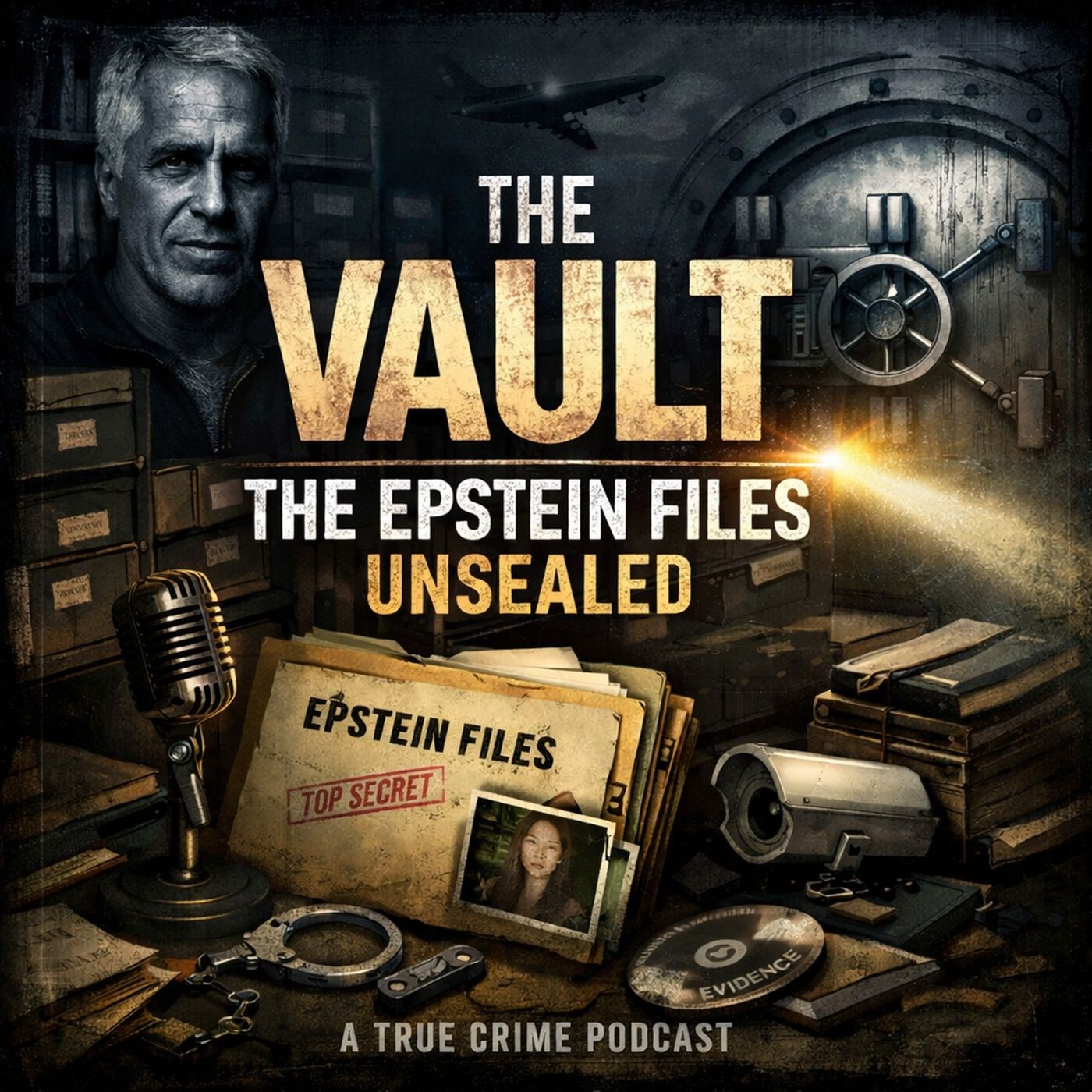
The Vault: The Epstein Files
Bobby Capucci
The Vault: The Epstein Files Unsealed is a deep-dive investigative podcast that pulls back the curtain on one of the most protected criminal networks in modern history. This series is built from the ground up on the actual paper trail—unsealed court records, depositions, exhibits, emails, and filings that were never meant to be read by the public. No pundit panels. No spin. Just the documents themselves, examined line by line, name by name, connection by connection—paired with precise, document-driven analysis that explains what the record truly shows.Each episode opens the vault on newly unsealed or long-buried Epstein files and walks listeners through what they actually reveal about power, money, influence, and the systems that failed survivors at every turn. Alongside the filings themselves, informed commentary breaks down the legal strategy, the institutional behavior, the contradictions, and the implications hiding between the lines. From judges’ orders and sealed exhibits to sworn testimony and back-channel communications, the show connects the dots the media often won’t—or can’t. Patterns emerge. Timelines collapse. Excuses fall apart.The Vault is a working archive in audio form, a living record of the Epstein case as told by the courts themselves—supplemented by rigorous analysis that provides context, challenges official narratives, and exposes where the record has been distorted, sanitized, or deliberately ignored. Every claim is grounded in filings. Every episode is anchored to the record. Listeners aren’t told what to think—they are shown what exists, what was said under oath, and what the commentary reveals about how those facts were buried, softened, or misrepresented.If you want to understand how Jeffrey Epstein was protected, who circled him, how institutions closed ranks, and why accountability keeps slipping through the cracks, The Vault: The Epstein Files Unsealed is where the record finally speaks for itself—and where the commentary ensures the documents do what no press release ever will.
Episodes
Mentioned books

Feb 17, 2026 • 14min
Virginia Roberts Giuffre’s Deposition in Edwards and Cassell v. Alan Dershowitz (Part 6) (2/17/26)
The videotaped deposition of Virginia Roberts Giuffre taken on January 16, 2016, in Fort Lauderdale sits at the center of the bitter legal war between Epstein survivors’ attorneys Bradley Edwards and Paul Cassell and Alan Dershowitz, who was accused by Giuffre of sexually abusing her when she was a minor trafficked by Jeffrey Epstein. In the deposition, Giuffre gives a detailed, sworn narrative of how she was recruited by Ghislaine Maxwell, groomed, trafficked to powerful men, and moved across multiple jurisdictions while still underage. She identifies Epstein’s residences, flight patterns, intermediaries, and specific encounters, placing her allegations firmly inside the broader trafficking structure rather than as isolated claims. The testimony was preserved on video precisely because her lawyers anticipated that credibility, consistency, and demeanor would become central issues in the defamation battle that followed. It also captured Giuffre under oath before years of public pressure, media narratives, and evolving legal strategies could reshape the record.What made this deposition legally explosive was its direct role in the defamation and civil litigation between Dershowitz and the Edwards–Cassell team, after Giuffre publicly accused Dershowitz and he responded with an aggressive campaign claiming she had fabricated the allegations and falsely implicated him. The video became a critical piece of evidence in determining whether Giuffre’s statements were knowingly false or grounded in a consistent trafficking account supported by contemporaneous detail. Dershowitz’s lawyers later argued that contradictions, memory gaps, and timeline disputes undermined her credibility, while Giuffre’s side pointed to the overall coherence of her narrative and the corroborating travel and contact records emerging in parallel cases. Long before the unsealing battles and public reckonings, this deposition quietly locked in one of the earliest comprehensive sworn accounts of Epstein’s trafficking network—and the legal fault line that would later fracture the reputations of some of the most powerful lawyers and institutions tied to the case.to contact me:bobbycapucci@protonmail.comsource:1257-12.pdf
Feb 17, 2026 • 19min
Zorro Ranch Under the Microscope: New Mexico Launches Epstein Truth Commission (2/17/26)
A bipartisan truth-finding commission has been officially created by the New Mexico House of Representatives to investigate what happened at Jeffrey Epstein’s former Zorro Ranch near Santa Fe and the state’s connections to his activities. The resolution creating the four-member panel passed unanimously 62-0 and appoints two Democrats and two Republicans, including Rep. Andrea Romero, who sponsored the measure, and members with legal and investigative backgrounds. The commission is scheduled to hold its first meeting this week, will allow public testimony, has subpoena power to compel witnesses to testify, and is expected to publicly post information it gathers. Though it cannot directly launch criminal investigations, it can coordinate with law enforcement and will issue a report by the end of 2026 outlining its findings and recommendations.Lawmakers say the commission aims to explore gaps in past enforcement and understanding of allegations of sexual abuse and human trafficking tied to Epstein’s long tenure in New Mexico, where civil suits have accused him of abusing women and girls at the ranch. The initiative comes amid ongoing scrutiny following the release of federal files that mention New Mexico figures and activities, and officials have pointed to the need to ensure such crimes are fully documented and that “gaps in the law and enforcement” are addressed. Past state efforts never resulted in criminal charges, and the panel’s work could renew focus on what state officials knew and how these events unfolded.to contact me:bobbycapucci@protonmail.comsource:Truth-finding commission focused on Epstein's activities in New Mexico set to ramp up quickly
Feb 17, 2026 • 22min
Left vs. Right Is a Distraction: The Cross-Partisan Web Around Epstein (2/17/26)
Jeffrey Epstein’s rise, protection, and long run of abuse cannot be honestly framed as a partisan scandal. He cultivated relationships across the political spectrum—courting Democrats and Republicans, donating to candidates, socializing with presidents and princes, embedding himself in elite universities, financial institutions, and think tanks. His 2008 non-prosecution agreement in Florida was negotiated under a Republican U.S. attorney, but later federal oversight failures, intelligence lapses, and regulatory blind spots spanned multiple administrations. He moved easily between Wall Street, academia, philanthropy, and politics, exploiting a culture in which wealth and access often buy insulation. The machinery that allowed him to operate—deferred prosecution deals, sealed records, lax oversight in federal detention, and elite deference—was not owned by one party. It was enabled by a system that too often prioritizes influence, reputation management, and institutional self-protection over transparency and accountability.Reducing Epstein to a left-versus-right talking point obscures the broader failure: a bipartisan ecosystem of power that tolerated, minimized, or ignored red flags because he was useful, connected, or financially valuable. Figures from both sides distanced themselves only after public exposure forced their hand. The revolving doors between government, finance, and academia, along with opaque plea negotiations and limited victim notification, reveal structural weaknesses that transcend party labels. When scrutiny becomes selective—weaponized against political opponents while allies receive softer treatment—it reinforces the very dynamics that allowed Epstein to thrive. Accountability, if it is to mean anything, must confront institutional incentives, prosecutorial discretion, and elite gatekeeping across administrations. The scandal endures not because it belongs to one ideology, but because it exposed a system in which power protected power.to contact me:bobbycapucci@protonmail.comsource:Epstein was invited to gatherings with a dozen members of Congress years after his initial arrest, documents reveal | The Independent
Feb 17, 2026 • 19min
From Wall Street to DEF CON: How Epstein Sought Access to Cybersecurity’s Inner Circle (2/17/26)
Documents released by the U.S. Justice Department show that convicted sex offender Jeffrey Epstein spent years corresponding with figures in the cybersecurity community and repeatedly tried to involve himself with two of the world’s biggest hacker conventions, DEF CON and Black Hat, in Las Vegas. According to emails reviewed by Politico, Epstein’s interest in cryptography and cybersecurity extended back to at least 2010, and he discussed topics ranging from network security to ways of pushing negative information about himself down in internet search results. Though he expressed a desire to attend these major events — even at times proposing to bring high-profile guests — there’s no clear evidence he ever actually got into either conference, and organizers like Jeff Moss have said there’s no proof he followed through on plans to attend.The documents also reveal Epstein’s broader tech network, including contacts with researchers and entrepreneurs introduced through academic and startup circles. Among those mentioned was Italian security researcher Vincenzo Iozzo, who communicated with Epstein about potential business opportunities and emerging technologies but has denied doing any technical work for him. An FBI file included in the release also alleges Epstein may have had an unidentified “personal hacker” who developed offensive cyber tools sold to governments, though the name was redacted and some of the claims remain unverified.to contact me:bobbycapucci@protonmail.comsource:Jeffrey Epstein spent years building ties to well-known hackers - POLITICO
Feb 17, 2026 • 20min
Flooding the Zone: How Volume Replaced Clarity in the DOJ's Epstein Document Dump (2/17/26)
The Department of Justice is trying to sell finality where there is still fog. After a chaotic rollout of Epstein-related materials, officials have framed the release as complete and urged the public to move on. But volume without structure is not transparency. Dumping massive amounts of material without clear indexing, consistent redaction explanations, and a verifiable accounting of what was withheld creates confusion rather than clarity. The public was promised a legally mandated framework under the Epstein Files Transparency Act that would identify categories of records, explain redactions, and specify which government officials and politically exposed persons were named. Instead, critics argue the process feels curated and defensive, more focused on narrative control than genuine accountability. Declaring “no more files” does not resolve outstanding questions about scope, missing categories, or investigative decisions—it freezes the narrative at a politically convenient moment.At its core, the frustration stems from a longstanding distrust of how powerful institutions handle cases involving powerful people. A serious transparency effort would provide traceability, context, independent review mechanisms, and precise legal justifications for every withholding decision. Without those guardrails, the release risks functioning as a containment strategy rather than a corrective one. Calls to “move on” land as dismissive because the underlying questions—who enabled Epstein, who benefited, and whether institutional actors were protected—remain unresolved in the public’s mind. If the administration wants credibility, it must move beyond slogans and provide structured, auditable disclosures that withstand scrutiny. Otherwise, skepticism will continue, not because people crave drama, but because incomplete transparency invites suspicion.to contact me:bobbycapucci@protonmail.com
Feb 17, 2026 • 16min
'Uncle Jeffrey’: New DOJ Files Detail Epstein’s Troubling Obsession with Celina Dubin (2/17/26)
Newly released United States Department of Justice files, as reported by The New York Post, reveal disturbing details about Jeffrey Epstein’s long-standing and unusually close involvement with Celina Dubin, the daughter of his former girlfriend, Eva Dubin. Epstein first met Celina when she was a child through Eva, with whom he had a relationship in the 1980s and early ’90s. Emails in the documents show that even after his 2008 conviction for soliciting and procuring a minor for prostitution, Epstein maintained contact with Celina through hundreds of messages in which she called him “Uncle F.” He attended family events — including visits to her home and her high school lacrosse games — and was involved in aspects of her life that went beyond typical family friend interaction, such as offering to help with potential modeling opportunities and academic connections. Records also showed him buying clothes for her as a teenager and arranging professional contacts for her, though plans like a photoshoot never came to fruition.One of the most striking revelations in the documents is that Epstein told acquaintances around 2014 that Celina, then 19, was “the only person he wanted to marry.” While there is no evidence of a romantic or physical relationship, the assertion raised concerns due to his history and the ages involved. Epstein even named Celina a contingent beneficiary of his trust without her knowledge; she later renounced any claim after learning of it. The Dubin family, through a spokesperson, pushed back against the implications, stressing that Celina was unaware of Epstein’s intentions, did not benefit from his estate, and that Eva Dubin would have cut ties had she known about his criminal conduct.to contact me:bobbycapucci@protonmail.comsource:Jeffrey Epstein's obsession with ex Celina Dubin's teen daughter
Feb 17, 2026 • 15min
Virginia Roberts Giuffre’s Deposition in Edwards and Cassell v. Alan Dershowitz (Part 5) (2/17/26)
The videotaped deposition of Virginia Roberts Giuffre taken on January 16, 2016, in Fort Lauderdale sits at the center of the bitter legal war between Epstein survivors’ attorneys Bradley Edwards and Paul Cassell and Alan Dershowitz, who was accused by Giuffre of sexually abusing her when she was a minor trafficked by Jeffrey Epstein. In the deposition, Giuffre gives a detailed, sworn narrative of how she was recruited by Ghislaine Maxwell, groomed, trafficked to powerful men, and moved across multiple jurisdictions while still underage. She identifies Epstein’s residences, flight patterns, intermediaries, and specific encounters, placing her allegations firmly inside the broader trafficking structure rather than as isolated claims. The testimony was preserved on video precisely because her lawyers anticipated that credibility, consistency, and demeanor would become central issues in the defamation battle that followed. It also captured Giuffre under oath before years of public pressure, media narratives, and evolving legal strategies could reshape the record.What made this deposition legally explosive was its direct role in the defamation and civil litigation between Dershowitz and the Edwards–Cassell team, after Giuffre publicly accused Dershowitz and he responded with an aggressive campaign claiming she had fabricated the allegations and falsely implicated him. The video became a critical piece of evidence in determining whether Giuffre’s statements were knowingly false or grounded in a consistent trafficking account supported by contemporaneous detail. Dershowitz’s lawyers later argued that contradictions, memory gaps, and timeline disputes undermined her credibility, while Giuffre’s side pointed to the overall coherence of her narrative and the corroborating travel and contact records emerging in parallel cases. Long before the unsealing battles and public reckonings, this deposition quietly locked in one of the earliest comprehensive sworn accounts of Epstein’s trafficking network—and the legal fault line that would later fracture the reputations of some of the most powerful lawyers and institutions tied to the case.to contact me:bobbycapucci@protonmail.comsource:1257-12.pdf
Feb 17, 2026 • 15min
Virginia Roberts Giuffre’s Deposition in Edwards and Cassell v. Alan Dershowitz (Part 4) (2/16/26)
The videotaped deposition of Virginia Roberts Giuffre taken on January 16, 2016, in Fort Lauderdale sits at the center of the bitter legal war between Epstein survivors’ attorneys Bradley Edwards and Paul Cassell and Alan Dershowitz, who was accused by Giuffre of sexually abusing her when she was a minor trafficked by Jeffrey Epstein. In the deposition, Giuffre gives a detailed, sworn narrative of how she was recruited by Ghislaine Maxwell, groomed, trafficked to powerful men, and moved across multiple jurisdictions while still underage. She identifies Epstein’s residences, flight patterns, intermediaries, and specific encounters, placing her allegations firmly inside the broader trafficking structure rather than as isolated claims. The testimony was preserved on video precisely because her lawyers anticipated that credibility, consistency, and demeanor would become central issues in the defamation battle that followed. It also captured Giuffre under oath before years of public pressure, media narratives, and evolving legal strategies could reshape the record.What made this deposition legally explosive was its direct role in the defamation and civil litigation between Dershowitz and the Edwards–Cassell team, after Giuffre publicly accused Dershowitz and he responded with an aggressive campaign claiming she had fabricated the allegations and falsely implicated him. The video became a critical piece of evidence in determining whether Giuffre’s statements were knowingly false or grounded in a consistent trafficking account supported by contemporaneous detail. Dershowitz’s lawyers later argued that contradictions, memory gaps, and timeline disputes undermined her credibility, while Giuffre’s side pointed to the overall coherence of her narrative and the corroborating travel and contact records emerging in parallel cases. Long before the unsealing battles and public reckonings, this deposition quietly locked in one of the earliest comprehensive sworn accounts of Epstein’s trafficking network—and the legal fault line that would later fracture the reputations of some of the most powerful lawyers and institutions tied to the case.to contact me:bobbycapucci@protonmail.comsource:1257-12.pdf
Feb 17, 2026 • 13min
Virginia Roberts Giuffre’s Deposition in Edwards and Cassell v. Alan Dershowitz (Part 3) (2/16/26)
The videotaped deposition of Virginia Roberts Giuffre taken on January 16, 2016, in Fort Lauderdale sits at the center of the bitter legal war between Epstein survivors’ attorneys Bradley Edwards and Paul Cassell and Alan Dershowitz, who was accused by Giuffre of sexually abusing her when she was a minor trafficked by Jeffrey Epstein. In the deposition, Giuffre gives a detailed, sworn narrative of how she was recruited by Ghislaine Maxwell, groomed, trafficked to powerful men, and moved across multiple jurisdictions while still underage. She identifies Epstein’s residences, flight patterns, intermediaries, and specific encounters, placing her allegations firmly inside the broader trafficking structure rather than as isolated claims. The testimony was preserved on video precisely because her lawyers anticipated that credibility, consistency, and demeanor would become central issues in the defamation battle that followed. It also captured Giuffre under oath before years of public pressure, media narratives, and evolving legal strategies could reshape the record.What made this deposition legally explosive was its direct role in the defamation and civil litigation between Dershowitz and the Edwards–Cassell team, after Giuffre publicly accused Dershowitz and he responded with an aggressive campaign claiming she had fabricated the allegations and falsely implicated him. The video became a critical piece of evidence in determining whether Giuffre’s statements were knowingly false or grounded in a consistent trafficking account supported by contemporaneous detail. Dershowitz’s lawyers later argued that contradictions, memory gaps, and timeline disputes undermined her credibility, while Giuffre’s side pointed to the overall coherence of her narrative and the corroborating travel and contact records emerging in parallel cases. Long before the unsealing battles and public reckonings, this deposition quietly locked in one of the earliest comprehensive sworn accounts of Epstein’s trafficking network—and the legal fault line that would later fracture the reputations of some of the most powerful lawyers and institutions tied to the case.to contact me:bobbycapucci@protonmail.comsource:1257-12.pdf
Feb 17, 2026 • 12min
Virginia Roberts Giuffre’s Deposition in Edwards and Cassell v. Alan Dershowitz (Part 2) (2/16/26)
The videotaped deposition of Virginia Roberts Giuffre taken on January 16, 2016, in Fort Lauderdale sits at the center of the bitter legal war between Epstein survivors’ attorneys Bradley Edwards and Paul Cassell and Alan Dershowitz, who was accused by Giuffre of sexually abusing her when she was a minor trafficked by Jeffrey Epstein. In the deposition, Giuffre gives a detailed, sworn narrative of how she was recruited by Ghislaine Maxwell, groomed, trafficked to powerful men, and moved across multiple jurisdictions while still underage. She identifies Epstein’s residences, flight patterns, intermediaries, and specific encounters, placing her allegations firmly inside the broader trafficking structure rather than as isolated claims. The testimony was preserved on video precisely because her lawyers anticipated that credibility, consistency, and demeanor would become central issues in the defamation battle that followed. It also captured Giuffre under oath before years of public pressure, media narratives, and evolving legal strategies could reshape the record.What made this deposition legally explosive was its direct role in the defamation and civil litigation between Dershowitz and the Edwards–Cassell team, after Giuffre publicly accused Dershowitz and he responded with an aggressive campaign claiming she had fabricated the allegations and falsely implicated him. The video became a critical piece of evidence in determining whether Giuffre’s statements were knowingly false or grounded in a consistent trafficking account supported by contemporaneous detail. Dershowitz’s lawyers later argued that contradictions, memory gaps, and timeline disputes undermined her credibility, while Giuffre’s side pointed to the overall coherence of her narrative and the corroborating travel and contact records emerging in parallel cases. Long before the unsealing battles and public reckonings, this deposition quietly locked in one of the earliest comprehensive sworn accounts of Epstein’s trafficking network—and the legal fault line that would later fracture the reputations of some of the most powerful lawyers and institutions tied to the case.to contact me:bobbycapucci@protonmail.comsource:1257-12.pdf

