

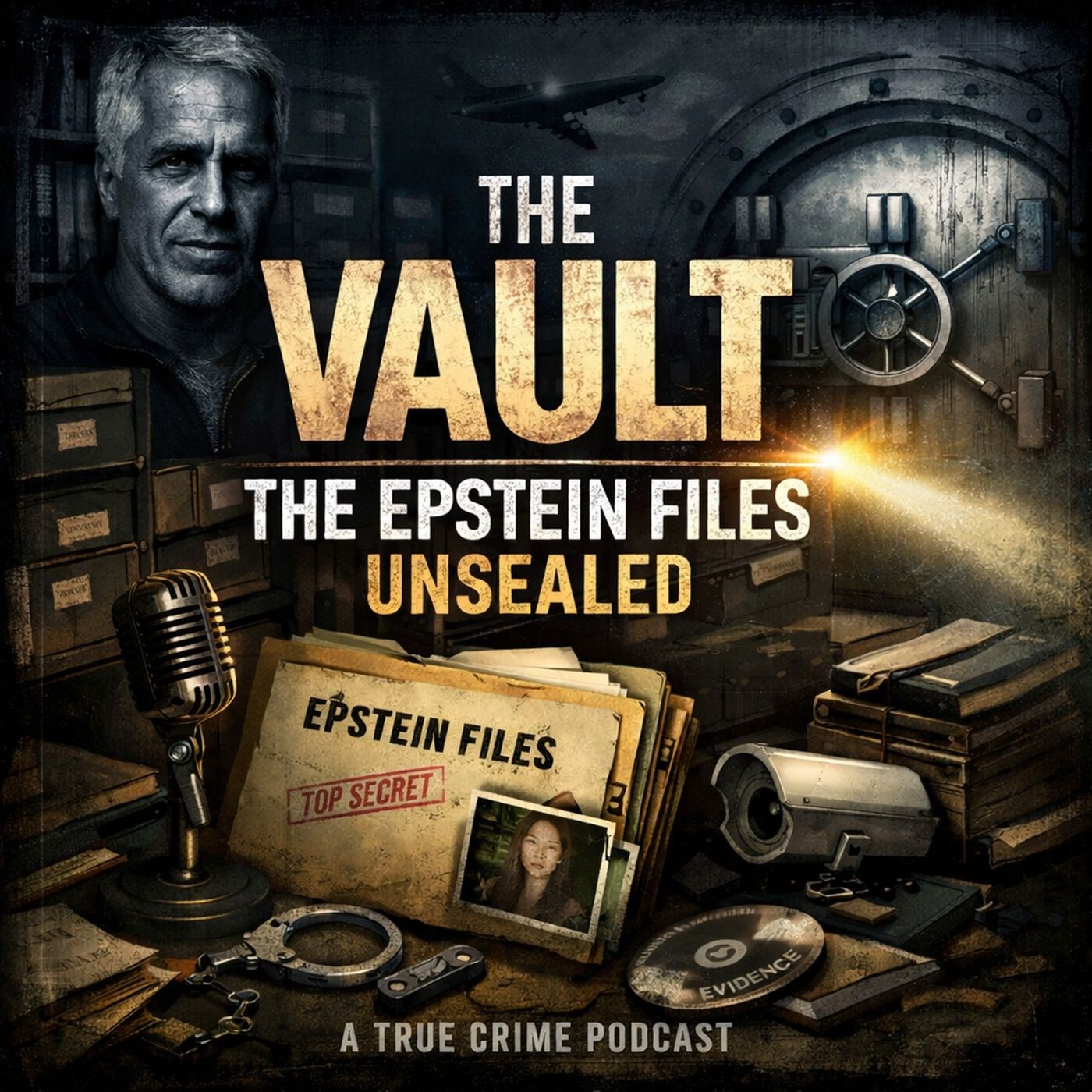
The Vault: The Epstein Files
Bobby Capucci
The Vault: The Epstein Files Unsealed is a deep-dive investigative podcast that pulls back the curtain on one of the most protected criminal networks in modern history. This series is built from the ground up on the actual paper trail—unsealed court records, depositions, exhibits, emails, and filings that were never meant to be read by the public. No pundit panels. No spin. Just the documents themselves, examined line by line, name by name, connection by connection—paired with precise, document-driven analysis that explains what the record truly shows.Each episode opens the vault on newly unsealed or long-buried Epstein files and walks listeners through what they actually reveal about power, money, influence, and the systems that failed survivors at every turn. Alongside the filings themselves, informed commentary breaks down the legal strategy, the institutional behavior, the contradictions, and the implications hiding between the lines. From judges’ orders and sealed exhibits to sworn testimony and back-channel communications, the show connects the dots the media often won’t—or can’t. Patterns emerge. Timelines collapse. Excuses fall apart.The Vault is a working archive in audio form, a living record of the Epstein case as told by the courts themselves—supplemented by rigorous analysis that provides context, challenges official narratives, and exposes where the record has been distorted, sanitized, or deliberately ignored. Every claim is grounded in filings. Every episode is anchored to the record. Listeners aren’t told what to think—they are shown what exists, what was said under oath, and what the commentary reveals about how those facts were buried, softened, or misrepresented.If you want to understand how Jeffrey Epstein was protected, who circled him, how institutions closed ranks, and why accountability keeps slipping through the cracks, The Vault: The Epstein Files Unsealed is where the record finally speaks for itself—and where the commentary ensures the documents do what no press release ever will.
Episodes
Mentioned books

Feb 20, 2026 • 12min
The Brad Edwards Affidavit In Support Of Epstein Related Transparency (Part 3) (2/19/26)
The affidavit submitted by attorney Bradley J. Edwards in the Southern District of Florida lays out a detailed argument for why the U.S. government should be compelled to produce documents related to the federal handling of the Jeffrey Epstein case. Edwards, representing Jane Doe No. 1 and Jane Doe No. 2, explains that the requested records are essential to proving that federal prosecutors violated the Crime Victims’ Rights Act (CVRA) by secretly negotiating and finalizing Epstein’s 2007–2008 non-prosecution agreement without notifying the victims. He asserts that internal DOJ communications, emails, memoranda, and investigative records would show what prosecutors knew, when they knew it, and how deliberate their decision was to exclude victims from the process despite clear statutory obligations.Edwards further argues that the government’s resistance to producing these materials undermines transparency and prevents the court from fully evaluating the extent of the misconduct. He emphasizes that the victims cannot meaningfully litigate their CVRA claims without access to evidence exclusively in the government’s possession, particularly records documenting decision-making within the U.S. Attorney’s Office and DOJ headquarters. The affidavit frames the document production not as a fishing expedition, but as a narrowly tailored request necessary to expose how Epstein was granted extraordinary leniency, how victims were intentionally misled, and how federal officials acted with impunity while shielding both Epstein and themselves from accountability.to contact me:bobbycacpucci@protonmail.comsource:gov.uscourts.flsd.317867.265.1_1.pdf
Feb 20, 2026 • 12min
The Brad Edwards Affidavit In Support Of Epstein Related Transparency (Part 2) (2/19/26)
The affidavit submitted by attorney Bradley J. Edwards in the Southern District of Florida lays out a detailed argument for why the U.S. government should be compelled to produce documents related to the federal handling of the Jeffrey Epstein case. Edwards, representing Jane Doe No. 1 and Jane Doe No. 2, explains that the requested records are essential to proving that federal prosecutors violated the Crime Victims’ Rights Act (CVRA) by secretly negotiating and finalizing Epstein’s 2007–2008 non-prosecution agreement without notifying the victims. He asserts that internal DOJ communications, emails, memoranda, and investigative records would show what prosecutors knew, when they knew it, and how deliberate their decision was to exclude victims from the process despite clear statutory obligations.Edwards further argues that the government’s resistance to producing these materials undermines transparency and prevents the court from fully evaluating the extent of the misconduct. He emphasizes that the victims cannot meaningfully litigate their CVRA claims without access to evidence exclusively in the government’s possession, particularly records documenting decision-making within the U.S. Attorney’s Office and DOJ headquarters. The affidavit frames the document production not as a fishing expedition, but as a narrowly tailored request necessary to expose how Epstein was granted extraordinary leniency, how victims were intentionally misled, and how federal officials acted with impunity while shielding both Epstein and themselves from accountability.to contact me:bobbycacpucci@protonmail.comsource:gov.uscourts.flsd.317867.265.1_1.pdf
Feb 19, 2026 • 12min
The Brad Edwards Affidavit In Support Of Epstein Related Transparency (Part 1) (2/19/26)
The affidavit submitted by attorney Bradley J. Edwards in the Southern District of Florida lays out a detailed argument for why the U.S. government should be compelled to produce documents related to the federal handling of the Jeffrey Epstein case. Edwards, representing Jane Doe No. 1 and Jane Doe No. 2, explains that the requested records are essential to proving that federal prosecutors violated the Crime Victims’ Rights Act (CVRA) by secretly negotiating and finalizing Epstein’s 2007–2008 non-prosecution agreement without notifying the victims. He asserts that internal DOJ communications, emails, memoranda, and investigative records would show what prosecutors knew, when they knew it, and how deliberate their decision was to exclude victims from the process despite clear statutory obligations.Edwards further argues that the government’s resistance to producing these materials undermines transparency and prevents the court from fully evaluating the extent of the misconduct. He emphasizes that the victims cannot meaningfully litigate their CVRA claims without access to evidence exclusively in the government’s possession, particularly records documenting decision-making within the U.S. Attorney’s Office and DOJ headquarters. The affidavit frames the document production not as a fishing expedition, but as a narrowly tailored request necessary to expose how Epstein was granted extraordinary leniency, how victims were intentionally misled, and how federal officials acted with impunity while shielding both Epstein and themselves from accountability.to contact me:bobbycacpucci@protonmail.comsource:gov.uscourts.flsd.317867.265.1_1.pdf
Feb 19, 2026 • 20min
Inside the Andrew Arrest: Allegations, Potential Exposure, and the Legal Path Ahead (2/19/26)
When you’re dealing with high-profile figures who are rich and powerful, investigations cannot be handled like routine cases. Prince Andrew’s arrest for allegedly passing classified information to Jeffrey Epstein illustrates that reality. What some dismiss as “procedural” is, in truth, a strategic entry point. An arrest shifts the case from public debate to formal legal process, where evidence is compelled, timelines are tested, and statements are measured against documents. In Andrew’s case, the allegations carry severe potential penalties and open lawful avenues for investigators to re-examine broader questions about his conduct and associations. Once a subject is in custody and under scrutiny, the space for narrative management narrows and the focus turns to provable facts.Andrew’s arrest also demonstrates how a targeted charge can expand the investigative scope when supported by evidence. Allegations tied to misuse of access can lead investigators to review communications, travel records, financial ties, and prior statements—especially in matters connected to Epstein. The strategy is not theatrical; it is methodical: charge what is provable, secure cooperation or test denials, and follow the evidence wherever it leads. In high-profile cases, accountability often begins with a narrow but solid case that unlocks a broader examination of potential wrongdoing. Andrew’s situation underscores that principle—use lawful leverage, apply consistent standards, and let documented evidence determine how far the investigation ultimately reaches.to contact me:bobbycapucci@protonmail.com
Feb 19, 2026 • 19min
Transatlantic Fallout: France and the UK Intensify Their Epstein Related Investigations (2/19/26)
In France, prosecutors in Paris have opened multiple new investigations into suspected crimes connected to late U.S. financier Jeffrey Epstein following the public release of millions of pages of previously sealed documents by U.S. authorities. Authorities announced two preliminary probes — one focused on alleged sex abuse and human trafficking offenses and the other on potential financial and economic wrongdoing, including money laundering, corruption, and tax fraud — with the goal of examining whether any French nationals or activities in France played a role in Epstein’s network. Prosecutors are also encouraging potential victims in France to come forward and are revisiting earlier inquiries, including the case of French modeling agent Jean-Luc Brunel, an Epstein associate who was charged with sex crimes but died in custody before trial. The investigations extend to high-profile figures, with probes under way into former culture minister Jack Lang and his daughter for suspected tax fraud linked to Epstein-related financial arrangements, as well as scrutiny of a French diplomat accused of improper conduct based on emails in the released files.In the United Kingdom, police have stepped up inquiries into potential ties between Epstein and activities on British soil as documents released by U.S. authorities shed light on previously unseen details. U.K. law enforcement agencies are examining whether Epstein may have used private flights in and out of UK airports, notably Stansted and Luton, to traffic women — claims prompted by flight logs and passenger lists found in the newly disclosed files. Multiple police forces, including Essex, Thames Valley, Surrey, and the Metropolitan Police, are coordinating through a national group to assess emerging allegations linked to trafficking, immigration irregularities, and connections to British-linked associates, with inquiries involving figures such as Peter Mandelson and Andrew Mountbatten-Windsor (both of whom have denied wrongdoing). The coordinated effort is part of a broader response to the global revelations from the Epstein files and reflects growing political and legal pressure in Britain to investigate any potential abuses or misconduct tied to Epstein’s network.to contact me:bobbycapucci@protonmail.comsource:Paris prosecutors open two new Epstein probes and call on victims to come forwardPolice probe claims Epstein trafficked British victims through Stansted | The Independent
Feb 19, 2026 • 14min
Former Prince Andrew Has Been Arrested By Authorities In The U.K. (2/19/26)
Former Prince Andrew, now Andrew Mountbatten-Windsor, was arrested on February 19, 2026 — his 66th birthday — by British police on suspicion of misconduct in public office after authorities began investigating allegations linked to his conduct during his time as a UK trade envoy. Thames Valley Police confirmed they arrested a man in his sixties in Norfolk on those suspicions and were carrying out searches at properties in both Norfolk and Berkshire; under UK procedure the arrested person was not immediately named but the reporting makes clear it was Mountbatten-Windsor. The inquiry stems from documents in the recently released Epstein files suggesting he may have shared confidential government information with convicted sex offender Jeffrey Epstein, and he remains in custody while the investigation continues.The arrest represents a historic moment as the first senior British royal to be taken into custody in modern times and follows years of public scrutiny over his association with Epstein and prior civil litigation, including a high-profile settlement with accuser Virginia Giuffre. King Charles III responded to the news by affirming that “the law must take its course,” emphasizing cooperation with police, while Giuffre’s family welcomed the development as a sign that no one is above the law. The exact legal outcome — whether formal charges will be filed — remains to be seen as the investigation unfolds.to contact me:bobbycapucci@protonmail.comsource:UK police arrest Andrew Mountbatten-Windsor for misconduct in public office | AP News
Feb 19, 2026 • 1h 27min
Mega Edition: Jeffrey Epstein And The Females That Enabled Him (Core 4) (Part 5-7) (2/19/26)
Jeffrey Epstein’s “Core Four” referred to the group of women who played key roles in recruiting and managing his trafficking operation. These four women—Ghislaine Maxwell, Sarah Kellen, Adriana Ross, and Lesley Groff and Nadia Marcinkova—allegedly helped Epstein lure underage girls into his network, scheduling massages that often turned into abuse. **Ghislaine Maxwell**, the most infamous of the group, acted as Epstein’s chief recruiter and was convicted in 2021 for sex trafficking. **Sarah Kellen**, Epstein’s personal assistant, was accused of booking and managing the young girls’ schedules, sometimes coercing them into compliance. **Lesley Groff**, another longtime assistant, was described as Epstein’s "executive secretary," allegedly facilitating travel and communication for the victims. **Adriana Ross**, a former model, reportedly helped remove evidence from Epstein’s properties to avoid law enforcement detection.While Maxwell was convicted, Kellen, Groff, and Ross have denied wrongdoing and have not faced criminal charges. Kellen, who changed her name to Sarah Kensington after Epstein’s arrest, claimed she was also a victim, groomed into her role from a young age. Groff's legal team has insisted she was unaware of any abuse, despite being named in multiple lawsuits. Ross, who worked as an Epstein housekeeper and was seen in photographs with Maxwell, has remained largely out of the public eye. Prosecutors described these women as essential to Epstein’s operations, ensuring a steady supply of victims while maintaining his elaborate trafficking network. However, legal scrutiny has largely focused on Maxwell, leaving questions about whether the other three will ever face consequences.to contact me:bobbycapucci@protonmail.com
Feb 19, 2026 • 1h 10min
Mega Edition: Jeffrey Epstein And The Females That Enabled Him (Core 4) (Part 3-4) (2/19/26)
Jeffrey Epstein’s “Core Four” referred to the group of women who played key roles in recruiting and managing his trafficking operation. These four women—Ghislaine Maxwell, Sarah Kellen, Adriana Ross, and Lesley Groff and Nadia Marcinkova—allegedly helped Epstein lure underage girls into his network, scheduling massages that often turned into abuse. **Ghislaine Maxwell**, the most infamous of the group, acted as Epstein’s chief recruiter and was convicted in 2021 for sex trafficking. **Sarah Kellen**, Epstein’s personal assistant, was accused of booking and managing the young girls’ schedules, sometimes coercing them into compliance. **Lesley Groff**, another longtime assistant, was described as Epstein’s "executive secretary," allegedly facilitating travel and communication for the victims. **Adriana Ross**, a former model, reportedly helped remove evidence from Epstein’s properties to avoid law enforcement detection.While Maxwell was convicted, Kellen, Groff, and Ross have denied wrongdoing and have not faced criminal charges. Kellen, who changed her name to Sarah Kensington after Epstein’s arrest, claimed she was also a victim, groomed into her role from a young age. Groff's legal team has insisted she was unaware of any abuse, despite being named in multiple lawsuits. Ross, who worked as an Epstein housekeeper and was seen in photographs with Maxwell, has remained largely out of the public eye. Prosecutors described these women as essential to Epstein’s operations, ensuring a steady supply of victims while maintaining his elaborate trafficking network. However, legal scrutiny has largely focused on Maxwell, leaving questions about whether the other three will ever face consequences.to contact me:bobbycapucci@protonmail.com
Feb 19, 2026 • 1h 6min
Mega Edition: Jeffrey Epstein And The Females That Enabled Him (Core 4) (Part 1-2) (2/18/26)
Jeffrey Epstein’s “Core Four” referred to the group of women who played key roles in recruiting and managing his trafficking operation. These four women—Ghislaine Maxwell, Sarah Kellen, Adriana Ross, and Lesley Groff and Nadia Marcinkova—allegedly helped Epstein lure underage girls into his network, scheduling massages that often turned into abuse. **Ghislaine Maxwell**, the most infamous of the group, acted as Epstein’s chief recruiter and was convicted in 2021 for sex trafficking. **Sarah Kellen**, Epstein’s personal assistant, was accused of booking and managing the young girls’ schedules, sometimes coercing them into compliance. **Lesley Groff**, another longtime assistant, was described as Epstein’s "executive secretary," allegedly facilitating travel and communication for the victims. **Adriana Ross**, a former model, reportedly helped remove evidence from Epstein’s properties to avoid law enforcement detection.While Maxwell was convicted, Kellen, Groff, and Ross have denied wrongdoing and have not faced criminal charges. Kellen, who changed her name to Sarah Kensington after Epstein’s arrest, claimed she was also a victim, groomed into her role from a young age. Groff's legal team has insisted she was unaware of any abuse, despite being named in multiple lawsuits. Ross, who worked as an Epstein housekeeper and was seen in photographs with Maxwell, has remained largely out of the public eye. Prosecutors described these women as essential to Epstein’s operations, ensuring a steady supply of victims while maintaining his elaborate trafficking network. However, legal scrutiny has largely focused on Maxwell, leaving questions about whether the other three will ever face consequences.to contact me:bobbycapucci@protonmail.com
Feb 19, 2026 • 13min
The Ghislaine Maxwell 2019 SDNY Grand Jury Transcript Unsealed (Part 6) (2/19/26)
The newly unsealed New York grand jury materials related to Ghislaine Maxwell provide a clearer window into how federal prosecutors built the case that ultimately led to her conviction. The documents outline the scope of witness testimony, evidentiary focus, and investigative priorities considered by the grand jury, reinforcing that Maxwell was not viewed as a peripheral figure but as a central facilitator within Jeffrey Epstein’s trafficking operation. While much of the material aligns with facts already established at trial—including patterns of recruitment, grooming, and abuse—the unsealing confirms that prosecutors presented a structured, victim-centered narrative to the grand jury well before Maxwell’s arrest, countering claims that the case was rushed or politically motivated.At the same time, the documents have drawn attention for what they do not contain. The grand jury materials remain narrowly focused on Maxwell’s conduct and charges, offering little insight into why broader conspiracy cases against other Epstein associates were never pursued in New York. This has fueled renewed scrutiny of prosecutorial discretion and investigative limits, as the records show a deliberate effort to secure Maxwell’s indictment while leaving larger questions about Epstein’s network unresolved. For critics and survivors alike, the unsealing represents both a measure of long-delayed transparency and a reminder of how much of the Epstein story remains outside the bounds of criminal accountability.to contact me:bobbycapucci@protonmail.com

