

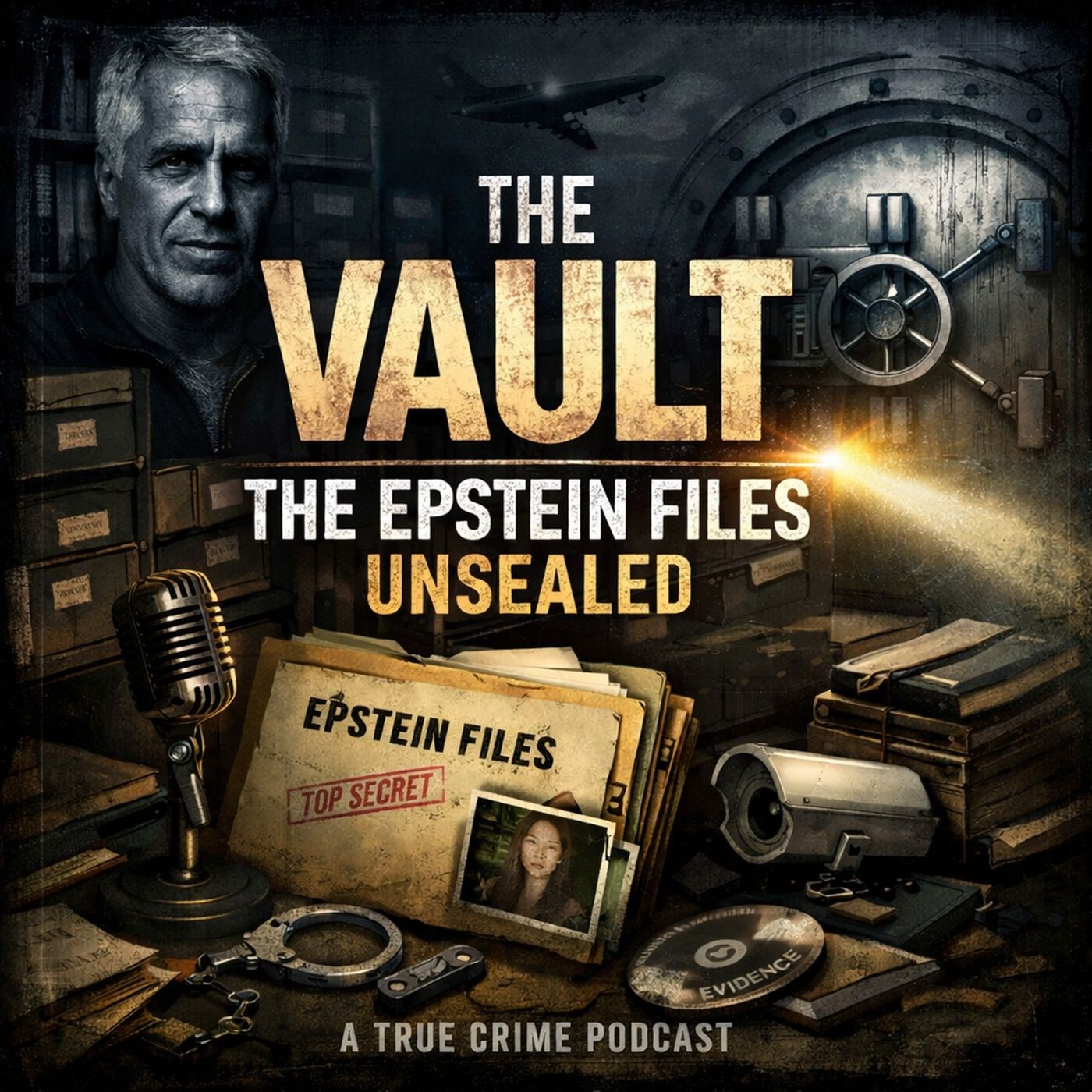
The Vault: The Epstein Files
Bobby Capucci
The Vault: The Epstein Files Unsealed is a deep-dive investigative podcast that pulls back the curtain on one of the most protected criminal networks in modern history. This series is built from the ground up on the actual paper trail—unsealed court records, depositions, exhibits, emails, and filings that were never meant to be read by the public. No pundit panels. No spin. Just the documents themselves, examined line by line, name by name, connection by connection—paired with precise, document-driven analysis that explains what the record truly shows.Each episode opens the vault on newly unsealed or long-buried Epstein files and walks listeners through what they actually reveal about power, money, influence, and the systems that failed survivors at every turn. Alongside the filings themselves, informed commentary breaks down the legal strategy, the institutional behavior, the contradictions, and the implications hiding between the lines. From judges’ orders and sealed exhibits to sworn testimony and back-channel communications, the show connects the dots the media often won’t—or can’t. Patterns emerge. Timelines collapse. Excuses fall apart.The Vault is a working archive in audio form, a living record of the Epstein case as told by the courts themselves—supplemented by rigorous analysis that provides context, challenges official narratives, and exposes where the record has been distorted, sanitized, or deliberately ignored. Every claim is grounded in filings. Every episode is anchored to the record. Listeners aren’t told what to think—they are shown what exists, what was said under oath, and what the commentary reveals about how those facts were buried, softened, or misrepresented.If you want to understand how Jeffrey Epstein was protected, who circled him, how institutions closed ranks, and why accountability keeps slipping through the cracks, The Vault: The Epstein Files Unsealed is where the record finally speaks for itself—and where the commentary ensures the documents do what no press release ever will.
Episodes
Mentioned books

Feb 20, 2026 • 12min
The Epstein Enterprise: A System Designed to Recruit and Exploit (2/20/26)
At its core, the case hinges on a straightforward legal framework: sex trafficking of minors involves recruiting or obtaining someone under eighteen for sexual activity in exchange for money or something of value. The conduct described in this instance followed a consistent pattern. Underage girls were allegedly approached with offers of cash for “massages,” encounters escalated into sexual acts, and payments were made afterward. Reports further described a referral system in which girls were encouraged to bring other girls and were compensated for doing so. Because minors cannot legally consent to commercial sex, the presence of payment and recruitment carries decisive legal weight. The absence of overt force does not negate the charge when the alleged victims are under eighteen.The allegations were not confined to a single episode or location. Similar accounts surfaced across multiple properties and over an extended period, suggesting repetition and coordination rather than isolated misconduct. Critics note that a prior plea agreement and the lack of a completed federal trial do not eliminate the factual allegations that formed the basis of later indictments. The commercial element—cash tied to sexual access involving minors—remains central. When recruitment, payment, and repetition converge, investigators and prosecutors characterize that structure as organized commercial sexual exploitation of minors. Stripped of political framing, the factual framework aligns with the statutory definition of sex trafficking.to contact me:bobbycapucci@protonmail.com
Feb 20, 2026 • 23min
The Deal That Never Happened: Inside Brunel’s Planned Cooperation With U.S. Prosecutors (Part 2) (2/20/26)
In 2016, French modeling agent Jean-Luc Brunel was reportedly close to cooperating with U.S. prosecutors against Jeffrey Epstein, offering to testify about how he recruited girls for Epstein’s sex-trafficking operations and possessed incriminating material in exchange for immunity. Federal records show Brunel had discussions with lawyers for Epstein’s victims and was planning a meeting with the U.S. Attorney’s Office—suggesting he was prepared to provide evidence that could have significantly strengthened the case against Epstein years earlier. But once Epstein learned of these negotiations, Brunel suddenly went silent and ultimately never offered testimony, and prosecutors didn’t take immediate action at the time.Brunel, who ran the modeling agency MC2 with Epstein’s financial backing and has long been accused of facilitating abuse by recruiting vulnerable women and girls under the pretense of modeling work, was not pursued by prosecutors in 2016 and Epstein remained free until his 2019 arrest. U.S. files show that this missed cooperation set back efforts to hold Epstein accountable and allowed his exploitation to continue. Brunel was later arrested in France in 2020 on sex-crime allegations and died in custody in 2022, but the earlier opportunity to challenge Epstein’s operations appears to have been lost when Brunel backed out of his planned cooperation.to contact me:bobbycapucci@protonmail.comsource:The accomplice who was going to testify against Jeffrey Epstein—then went dark
Feb 20, 2026 • 18min
The Deal That Never Happened: Inside Brunel’s Planned Cooperation With U.S. Prosecutors (Part 1) (2/20/26)
In 2016, French modeling agent Jean-Luc Brunel was reportedly close to cooperating with U.S. prosecutors against Jeffrey Epstein, offering to testify about how he recruited girls for Epstein’s sex-trafficking operations and possessed incriminating material in exchange for immunity. Federal records show Brunel had discussions with lawyers for Epstein’s victims and was planning a meeting with the U.S. Attorney’s Office—suggesting he was prepared to provide evidence that could have significantly strengthened the case against Epstein years earlier. But once Epstein learned of these negotiations, Brunel suddenly went silent and ultimately never offered testimony, and prosecutors didn’t take immediate action at the time.Brunel, who ran the modeling agency MC2 with Epstein’s financial backing and has long been accused of facilitating abuse by recruiting vulnerable women and girls under the pretense of modeling work, was not pursued by prosecutors in 2016 and Epstein remained free until his 2019 arrest. U.S. files show that this missed cooperation set back efforts to hold Epstein accountable and allowed his exploitation to continue. Brunel was later arrested in France in 2020 on sex-crime allegations and died in custody in 2022, but the earlier opportunity to challenge Epstein’s operations appears to have been lost when Brunel backed out of his planned cooperation.to contact me:bobbycapucci@protonmail.comsource:The accomplice who was going to testify against Jeffrey Epstein—then went dark
Feb 20, 2026 • 15min
Reuters/Ipsos Poll Finds Majority Believe Epstein Files Prove Powerful Avoid Consequences (2/19/26)
A new Reuters/Ipsos poll finds that a large majority of Americans believe the recently released files connected to Jeffrey Epstein reveal a broader pattern in which wealthy and powerful figures in the United States are rarely held accountable for their actions. About 69% of respondents said the statement that the Epstein files “show that powerful people in the U.S. are rarely held accountable” reflected their views very or extremely well, and another 17% agreed somewhat. This sentiment cut across party lines, with more than 80% of both Republicans and Democrats saying the statement described their thinking at least somewhat well. The poll, conducted online with 1,117 U.S. adults and a 3-point margin of error, came shortly after the U.S. Justice Department released millions of pages of records showing Epstein’s ties to prominent figures in politics, business, finance and academia.While some corporate leaders have resigned in the wake of the disclosures, others who had contact with Epstein remain in powerful posts, and individuals such as the Trump administration’s Commerce Secretary and health official Dr. Mehmet Oz are noted in the documents without being accused of crimes. The issue remains politically charged: a significant portion of Republicans (67%) said it’s time for the country to move on from talking about the Epstein files, compared with only 21% of Democrats. The poll reflects widespread skepticism about elite accountability and highlights partisan differences over how long the controversy should continue to figure in public debate.to contact me:bobbycapucci@protonmail.comsource:Americans believe Epstein files show the powerful get a pass, Reuters/Ipsos poll finds | Reuters
Feb 20, 2026 • 16min
Inside the Resignation of Tom Pritzker Amid Epstein Revelations (2/19/26)
Tom Pritzker, the billionaire executive chairman of Hyatt Hotels and a prominent member of the Pritzker family, announced his immediate resignation as executive chair following revelations in newly released files tying him to convicted sex offender Jeffrey Epstein and his associate Ghislaine Maxwell. The disclosures showed that Pritzker maintained contact with Epstein well after Epstein’s 2008 conviction for sex crimes, including email exchanges and interactions with Epstein’s inner circle. In his resignation letter to Hyatt’s board, Pritzker acknowledged exercising “terrible judgment” in not distancing himself sooner and said he deeply regretted the association, stressing that protecting Hyatt’s reputation was his top priority. He also confirmed he would not seek re-election to the board at the company’s upcoming annual meeting and that CEO Mark Hoplamazian would take over as chairman.Beyond the corporate fallout, Epstein accuser Virginia Roberts Giuffre had previously named Pritzker in court filings connected to her trafficking lawsuit against Epstein and Maxwell. In depositions released in the years after Epstein’s death, Giuffre alleged that she was trafficked to and had sexual encounters with Pritzker at Epstein’s direction—claims he has vehemently denied. Those allegations, while never resulting in criminal charges, were part of the wave of unsealed documents that put scrutiny on Pritzker’s ties to Epstein and helped fuel the pressure leading to his resignation.to contact me:bobbycapucci@protonmail.comsource:Hyatt executive chair Tom Pritzker steps down over Jeffrey Epstein ties
Feb 20, 2026 • 10min
The Brad Edwards Affidavit In Support Of Epstein Related Transparency (Part 7) (2/20/26)
The affidavit submitted by attorney Bradley J. Edwards in the Southern District of Florida lays out a detailed argument for why the U.S. government should be compelled to produce documents related to the federal handling of the Jeffrey Epstein case. Edwards, representing Jane Doe No. 1 and Jane Doe No. 2, explains that the requested records are essential to proving that federal prosecutors violated the Crime Victims’ Rights Act (CVRA) by secretly negotiating and finalizing Epstein’s 2007–2008 non-prosecution agreement without notifying the victims. He asserts that internal DOJ communications, emails, memoranda, and investigative records would show what prosecutors knew, when they knew it, and how deliberate their decision was to exclude victims from the process despite clear statutory obligations.Edwards further argues that the government’s resistance to producing these materials undermines transparency and prevents the court from fully evaluating the extent of the misconduct. He emphasizes that the victims cannot meaningfully litigate their CVRA claims without access to evidence exclusively in the government’s possession, particularly records documenting decision-making within the U.S. Attorney’s Office and DOJ headquarters. The affidavit frames the document production not as a fishing expedition, but as a narrowly tailored request necessary to expose how Epstein was granted extraordinary leniency, how victims were intentionally misled, and how federal officials acted with impunity while shielding both Epstein and themselves from accountability.to contact me:bobbycacpucci@protonmail.comsource:gov.uscourts.flsd.317867.265.1_1.pdf
Feb 20, 2026 • 11min
The Brad Edwards Affidavit In Support Of Epstein Related Transparency (Part 6) (2/20/26)
The affidavit submitted by attorney Bradley J. Edwards in the Southern District of Florida lays out a detailed argument for why the U.S. government should be compelled to produce documents related to the federal handling of the Jeffrey Epstein case. Edwards, representing Jane Doe No. 1 and Jane Doe No. 2, explains that the requested records are essential to proving that federal prosecutors violated the Crime Victims’ Rights Act (CVRA) by secretly negotiating and finalizing Epstein’s 2007–2008 non-prosecution agreement without notifying the victims. He asserts that internal DOJ communications, emails, memoranda, and investigative records would show what prosecutors knew, when they knew it, and how deliberate their decision was to exclude victims from the process despite clear statutory obligations.Edwards further argues that the government’s resistance to producing these materials undermines transparency and prevents the court from fully evaluating the extent of the misconduct. He emphasizes that the victims cannot meaningfully litigate their CVRA claims without access to evidence exclusively in the government’s possession, particularly records documenting decision-making within the U.S. Attorney’s Office and DOJ headquarters. The affidavit frames the document production not as a fishing expedition, but as a narrowly tailored request necessary to expose how Epstein was granted extraordinary leniency, how victims were intentionally misled, and how federal officials acted with impunity while shielding both Epstein and themselves from accountability.to contact me:bobbycacpucci@protonmail.comsource:gov.uscourts.flsd.317867.265.1_1.pdf
Feb 20, 2026 • 12min
The Brad Edwards Affidavit In Support Of Epstein Related Transparency (Part 5) (2/19/26)
The affidavit submitted by attorney Bradley J. Edwards in the Southern District of Florida lays out a detailed argument for why the U.S. government should be compelled to produce documents related to the federal handling of the Jeffrey Epstein case. Edwards, representing Jane Doe No. 1 and Jane Doe No. 2, explains that the requested records are essential to proving that federal prosecutors violated the Crime Victims’ Rights Act (CVRA) by secretly negotiating and finalizing Epstein’s 2007–2008 non-prosecution agreement without notifying the victims. He asserts that internal DOJ communications, emails, memoranda, and investigative records would show what prosecutors knew, when they knew it, and how deliberate their decision was to exclude victims from the process despite clear statutory obligations.Edwards further argues that the government’s resistance to producing these materials undermines transparency and prevents the court from fully evaluating the extent of the misconduct. He emphasizes that the victims cannot meaningfully litigate their CVRA claims without access to evidence exclusively in the government’s possession, particularly records documenting decision-making within the U.S. Attorney’s Office and DOJ headquarters. The affidavit frames the document production not as a fishing expedition, but as a narrowly tailored request necessary to expose how Epstein was granted extraordinary leniency, how victims were intentionally misled, and how federal officials acted with impunity while shielding both Epstein and themselves from accountability.to contact me:bobbycacpucci@protonmail.comsource:gov.uscourts.flsd.317867.265.1_1.pdf
Feb 20, 2026 • 13min
The Brad Edwards Affidavit In Support Of Epstein Related Transparency (Part 4) (2/19/26)
The affidavit submitted by attorney Bradley J. Edwards in the Southern District of Florida lays out a detailed argument for why the U.S. government should be compelled to produce documents related to the federal handling of the Jeffrey Epstein case. Edwards, representing Jane Doe No. 1 and Jane Doe No. 2, explains that the requested records are essential to proving that federal prosecutors violated the Crime Victims’ Rights Act (CVRA) by secretly negotiating and finalizing Epstein’s 2007–2008 non-prosecution agreement without notifying the victims. He asserts that internal DOJ communications, emails, memoranda, and investigative records would show what prosecutors knew, when they knew it, and how deliberate their decision was to exclude victims from the process despite clear statutory obligations.Edwards further argues that the government’s resistance to producing these materials undermines transparency and prevents the court from fully evaluating the extent of the misconduct. He emphasizes that the victims cannot meaningfully litigate their CVRA claims without access to evidence exclusively in the government’s possession, particularly records documenting decision-making within the U.S. Attorney’s Office and DOJ headquarters. The affidavit frames the document production not as a fishing expedition, but as a narrowly tailored request necessary to expose how Epstein was granted extraordinary leniency, how victims were intentionally misled, and how federal officials acted with impunity while shielding both Epstein and themselves from accountability.to contact me:bobbycacpucci@protonmail.comsource:gov.uscourts.flsd.317867.265.1_1.pdf
Feb 20, 2026 • 12min
The Brad Edwards Affidavit In Support Of Epstein Related Transparency (Part 3) (2/19/26)
The affidavit submitted by attorney Bradley J. Edwards in the Southern District of Florida lays out a detailed argument for why the U.S. government should be compelled to produce documents related to the federal handling of the Jeffrey Epstein case. Edwards, representing Jane Doe No. 1 and Jane Doe No. 2, explains that the requested records are essential to proving that federal prosecutors violated the Crime Victims’ Rights Act (CVRA) by secretly negotiating and finalizing Epstein’s 2007–2008 non-prosecution agreement without notifying the victims. He asserts that internal DOJ communications, emails, memoranda, and investigative records would show what prosecutors knew, when they knew it, and how deliberate their decision was to exclude victims from the process despite clear statutory obligations.Edwards further argues that the government’s resistance to producing these materials undermines transparency and prevents the court from fully evaluating the extent of the misconduct. He emphasizes that the victims cannot meaningfully litigate their CVRA claims without access to evidence exclusively in the government’s possession, particularly records documenting decision-making within the U.S. Attorney’s Office and DOJ headquarters. The affidavit frames the document production not as a fishing expedition, but as a narrowly tailored request necessary to expose how Epstein was granted extraordinary leniency, how victims were intentionally misled, and how federal officials acted with impunity while shielding both Epstein and themselves from accountability.to contact me:bobbycacpucci@protonmail.comsource:gov.uscourts.flsd.317867.265.1_1.pdf

