

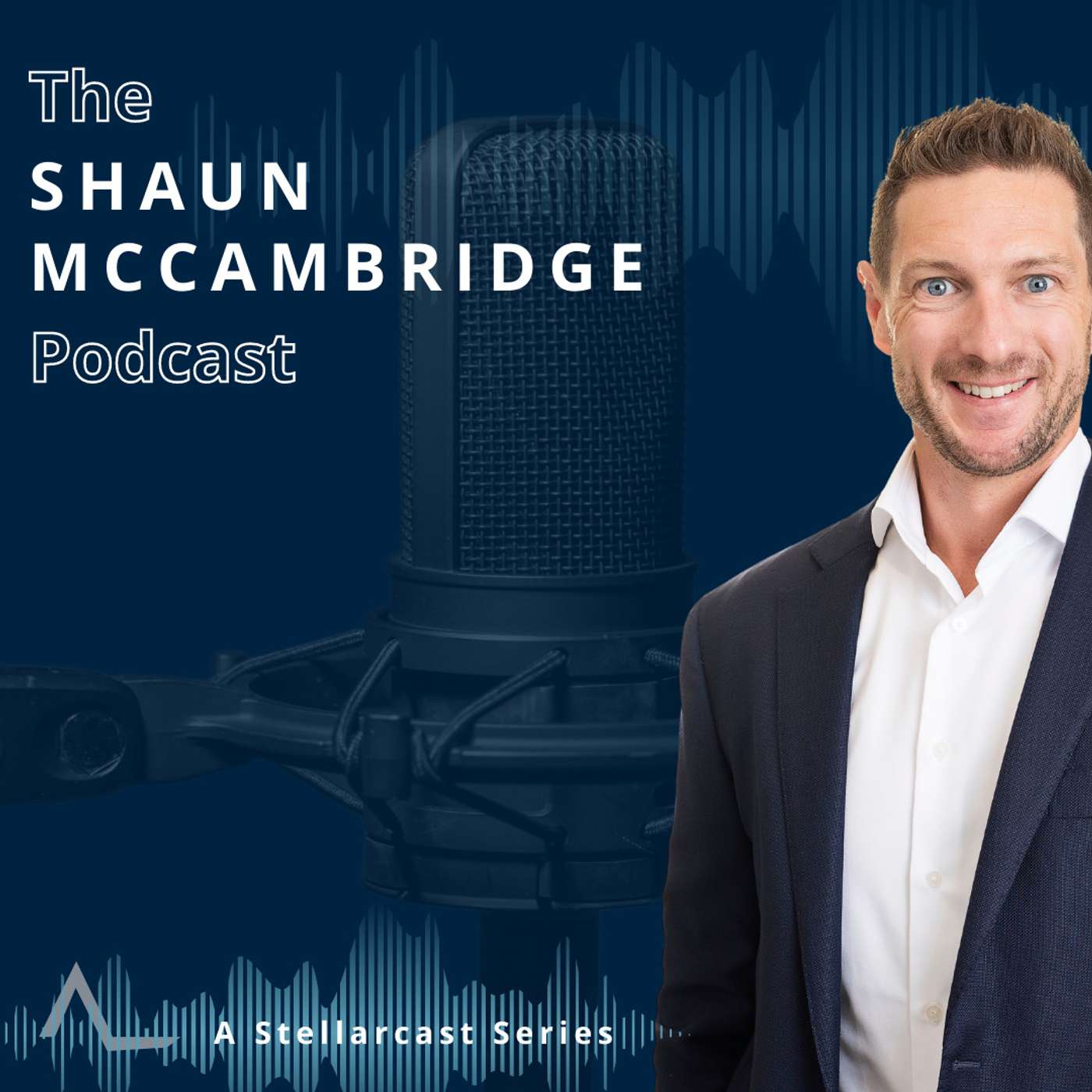
The Shaun McCambridge Podcast
Shaun McCambridge
For over 20 years, Shaun McCambridge has been inquisitive, learning and experimenting with different ways to leverage our greatest asset….. our minds, to work for us rather than against us.
Join Shaun as he engages with inspiring guests to provide you with tangible knowledge and insights to help you achieve more.
This show is powered by Stellar Recruitment and is inspired by our company purpose and WHY which is….. “Inspiring growth, Changing lives”. Shaun McCambridge is the Managing Director of Stellar Recruitment, a devoted husband and father to four spritely children. Ensure that you subscribe, rate and review!
Join Shaun as he engages with inspiring guests to provide you with tangible knowledge and insights to help you achieve more.
This show is powered by Stellar Recruitment and is inspired by our company purpose and WHY which is….. “Inspiring growth, Changing lives”. Shaun McCambridge is the Managing Director of Stellar Recruitment, a devoted husband and father to four spritely children. Ensure that you subscribe, rate and review!
Episodes
Mentioned books

Nov 3, 2019 • 33min
12: Talking to your brain – with Clarissa Johnson and Veronica Colley Part B
This episode features Clarissa Johnson and Veronica Colley, both practicing teachers, who run a business to teach language of mindset and self-talk to teachers and students. They want to share this with others to make a difference to the future of children.
Highlights1:20 How Clarissa and Veronica were able to implement the first program3:15 What results are they seeing thus far?5:40 About Clarissa’s two books, ‘Hello Brain’ and ‘Talk to your brain’.10:06 The power of the word ‘yet’13:00 Tips for parents on devices and social media16:35 Examples of results of growth mindset in kids20:35 tips on getting kids to open up about their challenges25:00 Veronica’s tips for her 10-year-old self27:50 What Clarissa & Veronica offer in their services, and recommended materials
What results are you seeing thus far?I think this year I’ve seen a lot of changes in the language and the effort. I have a class that would really like to do well. Their effort in the classroom at the start of the year, to now is huge. Im halfway through parent teacher interviews, and 8/10 have commented on a change coming home with the kids. One of my little girls is leaving at the end of the year for her senior years, and she said at the start of the year she hated the idea, she was not positive at all and did not want to go. Now she’s really looking forward to it, and she’s shifting her focus to look at the positives and her outlook has changed completely. As far as I’m concerned that is a major success. Talk to us about the power of the word ‘Yet’Language is so powerful, and we teach our kids this. Whether it goes to themselves or other people around them, the words they use and the language they throw around leaves a mark and they have the power to build us up or break us down. ‘yet’ really is powerful, we have kids as young as prep saying ‘I can’t do it’ the more they say it the more they are going to believe it, and unfortunately í cant’ is a word and a phrase that is thrown around so flippantly, and I as an adult am trying to break it too. Its like a baby learning to walk, if they kept falling down and couldn’t get up then just gave up and said they couldn’t do it, the world would be a pretty funny place. The kids love that example, but it really rings true, and they see the power in it. So, whenever they see something that is challenging initially, they follow up with the word ‘yet’ which empowers them to know that they will be able to get there eventually. Are there any tips for parents as to how they can use devices as a tool for good and not for bad?For those kids around 10 years old, they are right about on the cusp of a vital age. I think that if kids are not equipped with the tools to cope or problems solve effectively in the real world then they are not equipped to problem solve or manage in an online world. Before they even get to social media, they need to know who they are as a person and have that self-worth and self-love, its difficult in this day and age as it is everywhere for kids. I think they need the skills first to deal with cyber bullying and everything else that comes with it. I think its easy to disregard the level of danger regarding social media, but my opinion is parents need to be more vigilant of what they are doing online. Kids are very savvy with it, and its our responsibility to help them develop the skills before they get online.
Oct 27, 2019 • 23min
11: Talking to your brain – with Clarissa Johnson and Veronica Colley Part A
This episode features Clarissa Johnson and Veronica Colley, both practicing teachers, who run a business to teach language of mindset and self-talk to teachers and students. They want to share this with others to make a difference to the future of children.
Highlights2:10 How did the business of ‘talk to your brain’ begin?5:00 How the program supports families/teachers to build resilience and self-love9:20 Two key things to pass on to kids11:35 Average response from kids around self-love and self-worth16:55 About kids and reaching out for help18:30 How to embed meaningful change How did the story of this business begin?Clarissa: It started from a significant need to change what we were seeing in our classroom and support our students in their learning journey as well as their emotional journey. Throughout our years of teaching especially in the last few years we would notice things that would show up in our classrooms, like not being able to problem solve, lacking in resilience in regards to their own learning journey, social interactions etc and as teachers we are always looking for better ways of doing things and helping to support our students and cultivate success. Initially I decided to write a children’s book to support students and teachers and parents with having conversations around using more mindful language and how to build those skills. But after that I wanted to find a more explicit way to help them. I soon met Veronica and we noticed we were noticing the same situations in our classrooms. We did a research paper together, to see if we could explicitly teach growth mindset and how it would affect our kids. We wanted to know if we could make a significant difference with this and the research was astounding. It made a massive difference with how kids approached everything in our classrooms. After a while we noticed there was no ‘how-to guide’ for teachers on this, so we decided we would create one. Now we are super passionate about impacting as many parents and teachers and kids as we can.
It feels like life is becoming more challenging for kids these days, with increasing rates of anxiety and depression, how does your ‘talk to your brain’ program support families to build resilience, persistence and improve self-love for your students?The program ‘talk to your brain’ has sections on all those topics and more, and that’s because they are so vital. We believe that through teaching these we can improve the wellbeing of our children. It provides parents and teachers with key phrases, lessons, questions and activities that they can do which teach them the skills that they need to function in society. The growing rates of anxiety, depression and bullying are really concerning, and the ages of these experiences is getting younger and younger. The whole premise behind this is to equip students with skills well before they need intervention.
If you could focus on only a few key things with kids, what would they be?Emotional intelligence is vital, we always have to face things that come at us whether they are challenging or not. If we’re not provided with strategies on how to do this, unfortunately a lot of people turn to negative coping mechanisms, such as overeating, alcoholism, drugs etc. If we can teach emotional intelligence to kids, they will be better equipped for the challenges they will face as adults. Being able to identify emotions in other people is also massively important in emotional intelligence, we’ll always come across things that involve people, whether its family, relationships, work life or study, being able to identify motions in other people is going to strengthen these relationships and make for more positive interactions. The other would be self-love, these kids need to understand that they are valuable, and they need self-worth, before anyone can love them, they ‘need to love themselves, when something bad happens. If they don’t then they blame themselves and are harder on themselves and will affect their confidence later in life.

Oct 8, 2019 • 36min
10: Dr. Tara Swart – Debunking Neuroscience - Part 2
Welcome to part 2 of the Dr. Tara Swart Episode.Dr. Tara Swart is a neuroscientist, leadership coach, award-winning author and a medical doctor. She works with leaders all over the world to help them achieve mental resilience and peak brain performance, improving their ability to manage stress, regulate emotions and retain information.1: 25 Tangible benefits of those you spend your time with5:25 Why Dr Swart coaches on emotional intelligence and resilience8:35 The process of strengthening neural pathways12:20 What are vision boards? Why are they so powerful?15:35 Why is journaling important to peak brain performance?17:35 The Tetris effect20:40 Adverse impacts of too much time on your device25:10 Core philosophies for living a successful and fulfilling life

Oct 1, 2019 • 36min
9: Dr. Tara Swart – Debunking Neuroscience - Part 1
Dr Tara Swart is a neuroscientist, leadership coach, award-winning author and a medical doctor. She works with leaders all over the world to help them achieve mental resilience and peak brain performance, improving their ability to manage stress, regulate emotions and retain information.Why should I not have caffeine after 12 o’clock every day? The quarter life of caffeine is 12 hours, so 12 hours after you have your last caffeine, a quarter of that is still buzzing around your brain. What are the benefits of cold showers?Ideally, the research that is most ideal is an ice bath followed by a sauna. But while that’s not mostly practical for all of us, there’s some research from Finland that’s shows there’s some benefits of a 15, 30 or 60 second cold shower because it has a beneficial effects of our immunity from colds and even if you do get sick it reduces the number of days you get sick. What you want to do is shock your body and show it that you can control your recovery afterwards, so it’s important to have the cold shower first then warm yourself up afterwards. It’s almost like a form of inoculation.Why should I not have too much alcohol particularly within 2 minutes of bedtime?Timing is really important here, and its binary, which is that even small amounts of alcohol have a disproportionate effect on your sleep. Any consumption, eating or drinking means that your body can’t go into recovery during sleep until you’ve digested or dealt with any toxins (like alcohol) even if you don’t drink alcohol or you eat late, it will still disturb you. Why should I not look at my phone during the night?Any devices that admit blue light, (which mimics natural daylight) there’s a gland called the pineal gland which releases melatonin one hour before we fall asleep and the blue light disrupts that process. There is an app called flux that makes the light on your devices more orange, which is helpful, but it’s also because your brain is buzzing with the latest thing that you’ve read and stops the winding down process. Even checking it for 2 seconds, the blue lights effect on you can be disastrous for this process. There is even evidence that it can increase your cancer risk – which is due to the body not adopting the natural day and night cycles. What are the positive impacts of practicing some form of gratitude?It’s so easy to go through life and not pause and think about what you’ve accomplished and move on to the next thing, and the reason for that is to ensure our survival our brains are geared more to avoid a loss than to seek a reward, we focus on the negatives about twice as much as we focus on the positives. I do a list of 10 things and write them down. Gratitude brings to the front of the mind the more positive, abundant style of thinking and in the research that I’ve done, I’ve found that overtime that list develops and moves more from the external things like friends and family that you are grateful for to more intrinsic capabilities like my resilience my creativity, my adaptability my ability to solve problems. Once you really acknowledge that to yourself you start to feel like ok, if something bad happens to me, I’m more aware of the capabilities I have to deal with that. So, when there’s a crisis, you know you can get through it. Highlights:3:25 – 5 key areas for peak brain performance7:10 – Best foods for brain health10:10 – Why Mark Zuckerberg wears the same clothes every day11:48 – ‘Fully Integrated Brain Power’ + The 6 ways of thinking 18:15 – Why not to have caffeine after midday18:55 – Benefits of cold showers20:00 – Why you shouldn’t drink alcohol within 2 hours of sleep22:00 – Why you shouldn’t look at your phone during the night23:45 – Positive impacts of gratitude25:45 – Improve 10 things by 1% concept27:55 – The peak operating age of the brain 30:30 – Self-limiting behaviours, and the impact of self-talk

Sep 2, 2019 • 48min
8: Scaling Up – Verne Harnish Debunks The Process Of Business Growth
This episode features Verne Harnish – internationally renowned business expert, founder of the entrepreneur’s organisation, founder and CEO of ‘Scaling Up’ author of ‘Mastering the Rockefeller Habits’ and his latest book ‘Scaling Up’. In this podcast he discusses his views on business leadership, what companies get right in their approach to growth and scaling up, as well as what it takes to cultivate the high performance culture within an organisation.
You’ve seen a lot and studied a lot, you’ve met some very impressive business leaders across the globe, is there anyone that sticks out as the most impressive business leader and why?
A big company example would be Bill Gates, to think today as we are doing this podcast the company Microsoft is worth over $1 trillion, and they are ahead of the Facebooks, the Apples and the Amazons, Bill would clearly be the wealthiest guy on the planet next to Putin, if he hadn’t given away a chunk of his change. The decisions that they have made, the way they have structured the company not to be resilient but to be ‘anti=-fragile’ the fact that Microsoft is driven by 15,000 or so entrepreneurs, these ‘solution providers’ that are in the field, that is a business model that you just can’t beat. In our day and age, I don’t think there is a smarter business leader. On the mid-market, it’s the Australian guys over at Atlassian, the last I checked they were around 32 billion in value, and it’s because of their outstanding leadership, and their new approach to business plus their technology is really causing a revolution in the way we lead companies around the planet.
How do you walk the line of high performance and the aspect of accountability that comes with that, and the aspect of care and empathy/connection with your team?
There is nothing better than the win and winning begets winning. One of the things that we encourage is if you’ve been losing for a while and your culture is damaged, that you piece together some little wins. They’ve got to get that taste of victory back in their mouth. One of the things I focused on as a parent was getting each one of my kids to taste real success. Once they get that taste in their mouths, you can set them free because they will hunger for it the rest of their lives. Its kind of a chicken and egg question, so you want to start by ‘what do we have to accomplish today to move the needle’ then do it then do the same thing tomorrow.
The three pillars to the Rockefeller habits are priorities, data and rhythm. How does that translate to positive results for companies and how do they piece together to move the business forward?
So we start with priorities, the first step is to pick the most important next. Today, this week the next few weeks. It’s the essence of the sprint, that they talk about in Silicon Valley. You can only eat an elephant one bite at a time, so they break it down. So first set priority, 2 you need to gather data around that, both qualitative and quantitative. 3, you need to get in a room and talk about it. If you catch up regularly you can consider all the facts, then you can decide what to do next.
Can you explain what a BHAG is?
It’s a term coined by Jim Collins; it stands for Big Hairy Audacious Goal. The idea is to put a stake in the ground 10, 20 or 30 out. It doesn’t need to have a deadline, it’s just something that you want to achieve long term, but it does have to be measurable. You need to know that you’ve accomplished it. The BHAG is the measurable component of your overall purpose and why.

Aug 19, 2019 • 29min
7: Interview With My Daughter – Growth Mindset For Kids, Part 1
This eisode features Sophie McCambridge – Shaun’s 9-year-old daughter. Sophie speaks with her Dad about growth mindsets and the following topics: · What is growth vs fixed mindset?· How parents and schools can help children adopt a growth mindset· Examples where Sophie has used a growth mindset, including her NAPLAN test· Shaun’s personal journey with his growth mindset
Maybe we can start by telling the listeners what a growth and fixed mindset is based on what you understand?
So, a growth mindset is something that can keep you positive and happy through the day, a fixed mindset is something that no one ever wants to use and no one should use it. It’s something where you say, ‘I can’t’ or ‘I’ll never be able to do this’.
And why do you think a growth mindset would be better than a fixed mindset?
Because a growth mindset is you being positive, and you can go way further than with a fixed mindset.
When have you had to use a growth mindset yourself?
An example of when I had to use it was last year I was in the middle of a NAPLAN test and I came to a difficult question in the maths part, and I thought ‘oh no I’m not going to have enough time I can’t do this’ so I thought I might have a growth mindset and just think ‘oh yes I should use a growth mindset’ and I kept on going, I skipped that answer and then at the end I had extra time, I filled in that answer and I figured out that I got an A+ for that question.
Sophie to Shaun: In what situations would you like to use a growth mindset?
In my point of view using a growth mindset, you use it daily. There is so many situations where you use it, whether it’s being confronted by challenges or opportunities. I try and use it when I’m going to do things like public speaking or physical challenges like an Iron Man or a boxing event sometimes when my mind is trying to tell me that I can’t do these things. In business and in all aspects of life there’s always opportunities to use it and I think that’s great.
Dad, why would you not want to use a fixed mindset?
I think it’s really quite stressful to use a fixed mindset. Because when you’re confronted with those challenges and everything else, there’s often language like you said before ‘I can’t, this is too much this is intimidating what am I going to do?’ All those sorts of things point to not really helping you in that situation and you feel a little bit out of control. And if you can I think a growth mindset helps you to focus on the solution, or a way forward rather than getting stuck and stressed out by things that come at you.

Jul 1, 2019 • 48min
6: The Code - Empowering People with Purpose’ With Shaun Tomson
This episode features Shaun Tomson - former world champion surfer, author, entrepreneur, father and husband. In this podcast he discusses his process detailed in ‘The Surfer’s Code – 12 Simple Lessons for riding through life’ and his number on best seller ‘The Power of I Will’. Shaun has been an academic and a motivational speaker who has toured the world discussing the power of purpose and choice in the lives of everyday people and how having solid foundations in attitude and direction can help empower individuals to lead their best lives.
When did it become clear to you that you wanted to become a pro surfer?I love surfing and I was really passionate about competition and I really felt it was possible to develop this lifestyle that we love into a career, into a pursuit into an endeavour that would ultimately be able to build a life for me and really I think it happened in a very short period of time, where Bartholemew (Wayne "Rabbit" Bartholomew) and I were great friends but great rivals too and we began to think it would be possible to perhaps become pro suffers. It was at the end of pipeline in 1975 when I was going to go back to university and I asked him what he was going to do, and he told me ‘I’m going to become a pro surfer mate’. It was that statement that lead me to wanting to take things further and begin to build the competition into what it is today.Talk to us about the code and how this framework exists to find their purpose?I remember it didn’t take me long to write, maybe 30 minutes. I sat down and wrote 12 lines, all about commitment and each line starting with ‘I will’. They were 12 lines of commitment, 12 lines of essential lessons that surfing has taught me about life. After word of this got out and people started to want to know more, in search of a higher purpose and discovering their ‘why’ I started to realize the code was something much bigger than what I had written, I started to realize it was a calling perhaps for many people to write their own codes. After a lot of academic research and further learning I started to realize that there was something missing in the world that really boiled down to powerlessness, and when people found their purpose, they found their power. What’s happening from a neurology point of view when people go through the process of the code?I don’t know what’s happening from a neuroscience point of view, but our lives are a series of small and big decisions and what underlines all our decisions is our attitude and our purpose. Our attitude is how we feel about something and you can instantaneously change how you feel about something. Attitude is a fundamental choice in life, and attitude and purpose are fundamentally aligned. Attitude is how we feel about something; purpose is what we are going to do about something. They are inextricably linked. Do you know the biggest social problem in the world is choice? Bad choice. 1,000,000 people in the US die every year from bad choices. Whether that’s bad food, alcohol, drugs whatever. There are many deaths outside of choices, but if you can somehow fundamentally change the choice of people and show them, they are not powerless to keep doing drugs, keep drinking keep eating, they can change. With the code you can find your purpose and power, and with your power you can make a positive decision.

Jun 2, 2019 • 48min
5: Fixed Vs Growth Mindsets & Psychologically Safe Workplaces - with Naomi Armitage
Today’s episode features Naomi Armitage - a Psychologist and advocate for ‘Psychological Safety ‘in the workplace and an expert on the topic of fixed vs growth mindsets. Naomi has her own practice and has worked with some of Australia’s largest companies in transforming and empowering workplaces to create more innovative, productive and forward-thinking cultures. She provides practical advice on how individuals and leaders can better apply these learnings in their lives and help to better develop themselves and their teams.
Can you talk to us a little bit about fixed and growth mindset? From your perspective what are the basic differences between the two mindsets?
Really a fixed mindset is the belief that your basic abilities and intelligence are fixed traits that you are born with, and you can’t change them. Whereas someone with a growth mindset believes their talents and abilities can be developed through efforts and persistence and that those efforts will be rewarded through change and mastery of different ideas or topics. They are very different, someone with a fixed mindset will avoid challenges and try and cover up mistakes because you believe that you need to protect the view that you may be the expert and know everything. Often people with a fixed mindset tend to plateau early in their careers, and don’t go on to learn and develop. Someone with a growth mindset loves opportunities to learn. They see it as an opportunity to develop and they accept criticism in their feedback and find lessons in their failures. They are the ones who tend to achieve more and have that greater sense of free will and control.
From your perspective how does one truly change from a fixed to a growth mindset?
It’s hard. To be able to get to that point you need two things, firstly you need to have a safe environment where you are allowed to learn and grow and make mistakes, if you are in an environment where failure is bad and you can’t afford to lose face because you’ll be punished or ridiculed then of course you’re not going to practice a growth mindset. So that environment where you accept mistakes and that they are inevitable is the number one thing. The second one is embracing that it’s a possibility and then just practicing it. Instinctively we want to try and manage our self-image, we want to fit in and look like we know what we’re doing, but that’s a line to that fixed mindset. So it’s about letting go of that, and being ok with being uncomfortable and letting go of your ego and practicing just on everyday behaviours.
Why is psychological safety so important to workplaces and why should companies invest in this?
The basis to diversity and inclusion, innovation and a lot of other organisational goals that business are trying to set today is in psychological safety. If businesses really simplify and drill down to their foundation and see if they work on building this climate of psychological safety, they will hit all their other targets along the way. It really has a business outcome with better performance, but also staff are likely to be more engaged, and you are more likely to retain them. You are looking after your people and your resources.

May 1, 2019 • 52min
4: All Black Captain Richie McCaw Debunks Success, Talent And Hard Work.
This week's episode from our vault, features Richard ‘Richie’ McCaw, former New Zealand Rugby Union player and 2-time world cup winning captain of the All Blacks. From being approached at school about one day playing for the New Zealand Rugby team to then being highlighted as an All Black Great, Richie makes it really clear that hard work, perseverance, and dedication is what helped him transform this opportunity into a reality.
“You do need the talent, there is no doubt on that. But a lot is attributed to instinct, perseverance, work ethics – a healthy mind set. You’ve got to have the mindset to put in the hard yards and there is no substitute for hard work! It’s not just hard work though its being smart. You need to understand the whole game and a range of things to help you perform.” – Richie McCaw
Tune in to listen to how Richie achieved the dreams of every young NZ rugby fan.
thepodcastboss.com

Apr 11, 2019 • 56min
3: Turning Adversity and Problems into Vision and Solutions with Tamika Smith
Tamika is an inspirational individual and entrepreneur who has created two fast growing companies and is also driven by a strong purpose. Despite challenges and trauma early in life she made the CHOICE to create a different future to what was playing out at the time. We covered a lot on the podcast including:
· How hurdles and adversity have been turned into opportunities including a bout of chronic fatigue
· How she has used journaling and daily reflection to increase her consciousness about what’s working well, and what needs to be worked on
· How she is shining a light on woman globally and assisting with social housing initiatives
· What attributes took her to become Metricon’s No 1 salesperson at a very young age
· Moving her drivers from Fear to Love
· Advice for my young 9 year old daughter Sophie
· How she has grown herself as a person
· What daily habits she practices to get the most out of herself
There is no surprise that Tamika become the Gold Coast Business Woman of the Year in 2017 and become a finalist in 2018 for the Australian Construction awards for “woman in construction”. Tamika is driven, inspirational and committed to leaving a positive legacy and I’m sure that she will continue to achieve great things in the future.
Jump over to www.top100women.com.au and stay tuned to what Tamika & her team are building behind the scenes for Women & girls in what is known to be the largest male dominated sector in the World.
Books discussed in the episode:
Tools OF Titans - Tim Ferris
The Rise and Rise of Kerry Packer- Paul Barry
Power of Love
Tom Hopkins' Low Profile Selling: Act Like a Lamb : Sell Like a Lion - Tom Hopkins

