

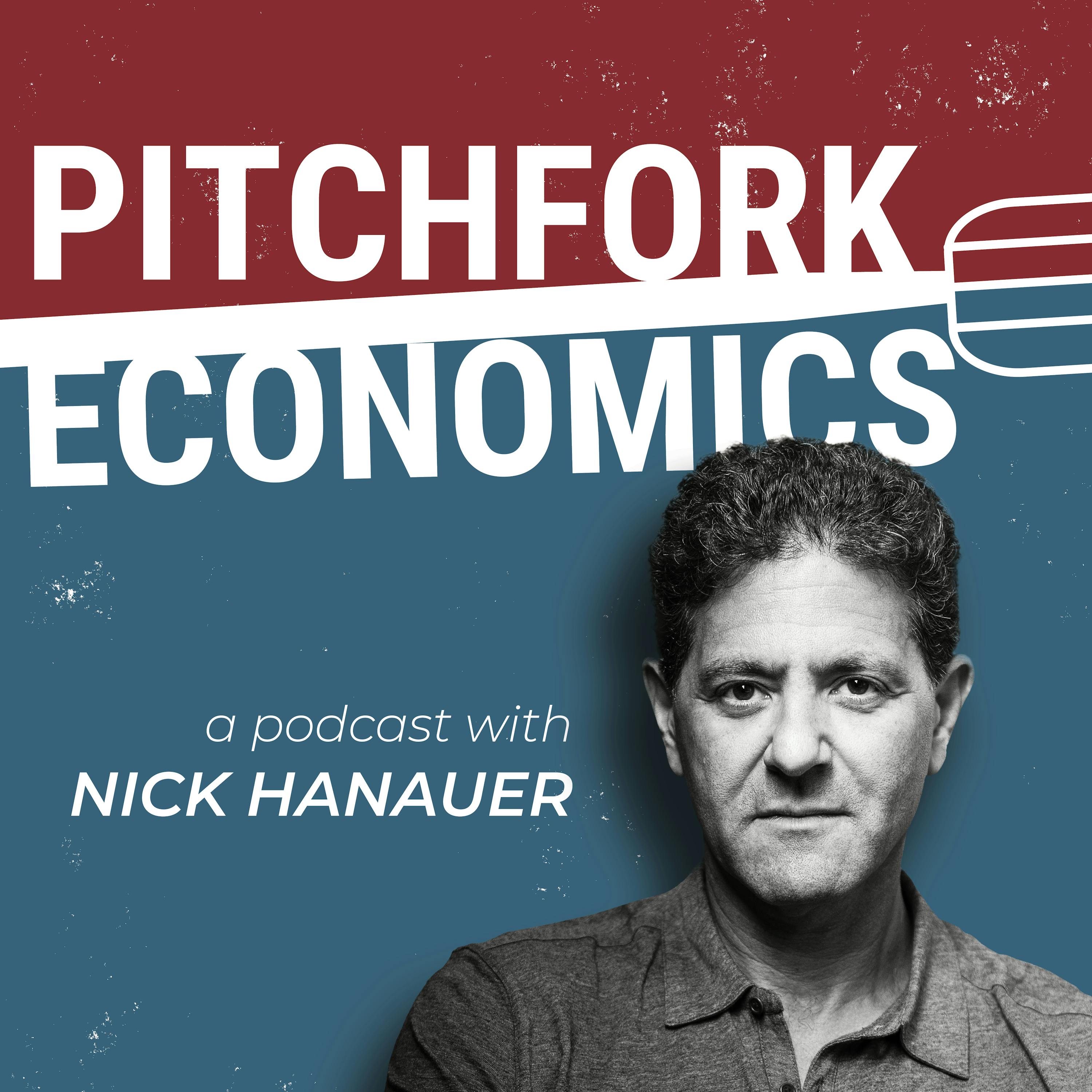
Pitchfork Economics with Nick Hanauer
Civic Ventures
We are living through a paradigm shift from trickle-down neoliberalism to middle-out economics — a new understanding of who gets what and why. Join zillionaire class-traitor Nick Hanauer and some of the world’s leading economic and political thinkers as they explore the latest thinking on how the economy actually works.
Episodes
Mentioned books

Mar 12, 2019 • 47min
Whatever happened to overtime? (with Sharon Block and Chris Lu)
The overtime threshold used to be the minimum wage for the middle class—but where did it go? Labor experts Sharon Block and Chris Lu join Nick and Jasmin to explain why the overtime threshold, which used to cover 65 percent of workers, today covers only 7 percent. That’s craziness! And surprise, surprise—employers love to claim that forcing you to work for free is in your own best interest. But are they telling the truth?Sharon Block is the Executive Director of the Labor and Worklife Program at Harvard Law School. For twenty years, she held key labor policy positions across the legislative and executive branches of the federal government, including head of the policy office at the Department of Labor. Twitter: @sharblockChris Lu was the U.S. Deputy Secretary of Labor in the Obama Administration from 2014 to 2017. He also served as Assistant to the President and White House Cabinet Secretary under Obama from 2009 to 2013. He is a Practitioner Senior Fellow at the UVA Miller Center.Twitter: @ChrisLu44Further reading: https://crooked.com/articles/beat-trump-overtime-pay/https://www.politico.com/magazine/story/2014/11/overtime-pay-obama-congress-112954
Mar 8, 2019 • 14min
BONUS: Econ terms and definitions explained by Nick and Goldy
Ever been in the middle of a Pitchfork Economics pod ep and thought, “WTF are they talking about?” If so, this might help - we define some complex terms that get thrown around a lot (neoclassical, neoliberal, heterodoxy, monopoly, monopsony, and stock buybacks) because we want this to be a fun and informative pod, not, like, a painful and confusing pod. Twitter: @NickHanauer @GoldyHA
Mar 5, 2019 • 46min
What can a board game teach us about capitalism? (with Jared Bernstein and Jonathan Tepper)
Monopoly and its equally evil twin monopsony are destroying competition, depressing wages, and slowing economic growth. Is market concentration an inevitable outcome of capitalism, or is there a smarter solution?Jared Bernstein: Senior Fellow at the Center on Budget and Policy Priorities, former Chief Economist and Economic Adviser to VP Biden and Executive Director of the White House Task Force on the Middle Class, and author of ‘The Reconnection Agenda: Reuniting Growth and Prosperity’. Twitter: @econjared Jonathan Tepper: Founder of Variant Perception, a macroeconomic research group that caters to asset managers. Author of ‘The Myth of Capitalism: Monopolies and the Death of Competition’, ‘Endgame: The End of the Debt Supercycle’, and ‘Code Red’, a book on unconventional monetary policy. Twitter: @jtepper2 Further reading: https://democracyjournal.org/magazine/51/progressive-labor-standards/
Feb 26, 2019 • 32min
Senator Cory Booker explains: what the hell is a stock buyback?
Senator Cory Booker explains the problem with stock buybacks, walks us through his Workers Dividend Act, and offers Goldy some much-needed counseling. Cory Booker is the U.S. Senator from New Jersey and a 2020 Democratic presidential candidate. Twitter: @CoryBookerFurther reading: https://www.vox.com/policy-and-politics/2018/3/6/17083398/booker-buyback-populist https://www.theatlantic.com/politics/archive/2015/02/kill-stock-buyback-to-save-the-american-economy/385259/
Feb 19, 2019 • 47min
What is the purpose of a corporation? (with William Lazonick and Lenore Palladino)
Nick, Goldy, and their guests William Lazonick and Lenore Palladino explain why "shareholder value maximization" is the world's dumbest idea. William Lazonick: Professor of economics at University of Massachusetts Lowell, visiting Professor at University of Ljubljana, professeur associé at Institut Mines-Télécom in Paris, and professorial research associate, SOAS, University of London. His book ‘Sustainable Prosperity in the New Economy? Business Organization and High-Tech Employment in the United States’ won the 2010 Schumpeter Prize, and he has written extensively on corporate profits.Twitter: @LazonickLenore Palladino: Senior Economist and Policy Counsel at the Roosevelt Institute, where she brings expertise to Roosevelt’s work on inequality and finance. Her research and writing focuses on financial reform, financial taxation, labor rights, and financial crises. Her publications have appeared in The Nation, The New Republic, State Tax Notes, and other venues. Twitter: @lenorepalladinoFurther reading: https://www.brookings.edu/research/stock-buybacks-from-retain-and-reinvest-to-downsize-and-distribute/https://hbr.org/2014/09/profits-without-prosperity/http://rooseveltinstitute.org/ending-shareholder-primacy-corporate-governance/http://rooseveltinstitute.org/rewriting-rules-take-aim-stock-buybacks-and-force-companies-invest-their-workers-stop-walmart-act/http://rooseveltinstitute.org/what-wells-fargos-40-6-billion-stock-buybacks-could-have-meant-its-employees-and-customers/http://rooseveltinstitute.org/towards-accountable-capitalism/
Feb 15, 2019 • 40min
BONUS: Yuval Harari - Unedited Conversation
When we talked with historian Yuval Harari, the best-selling author of Sapiens, Homo Deus, and 21 Lessons for the 21st Century, the conversation was so wide-ranging and so smart that we just couldn't bear to leave any of it behind on the cutting room floor. So here's the full, unedited interview on a range of topics including why our society has fallen so hard for the myth of trickle-down economics.
Feb 12, 2019 • 49min
Do higher wages kill jobs? (with Mayor Eric Garcetti and Alan Krueger)
Trickle-downers always argue that raising the minimum wage inevitably kills jobs. But the empirical evidence from Seattle, Los Angeles, and elsewhere prove otherwise. Experts, including Mayor Garcetti of LA, discuss how our economic understanding has changed, and why changing the public perception around the minimum wage has been so difficult.Eric Garcetti: Mayor of Los Angeles since 2013. Former member of the LA City Council, serving as council president from 2006 to 2012. Twitter: @ericgarcetti Alan Krueger: Bendheim Professor of Economics and Public Affairs at Princeton. Former Chairman of President Obama’s Council of Economic Advisers and a member of the Cabinet from 2011 to 2013. Co-author of ‘Myth of Measurement: The New Economics of the Minimum Wage’ and ‘Inequality in America: What Role for Human Capital Policies?’. Twitter: @Alan_KruegerRichard Kirsch: Director of Our Story at the Hub for American Narratives. Led development of Progressive Economic Narrative Project and has done extensive training with organizational leaders and elected officials on delivering powerful narratives.Twitter: @_RichardKirschFurther reading: Raising the Minimum Wage Is Good for EveryoneSeattle’s $15 Minimum Wage Experiment Is a Success
Feb 5, 2019 • 39min
Do regulations kill growth? (with Robert Reich)
Deregulation for the powerful is a central tenet of the trickle-down myth, embraced by Democrats and Republican alike. Government regulations, we’re told, are costly and inefficient intrusions that slow grow and kill jobs. But Robert Reich explains that when thoughtfully applied, regulations are absolutely essential to growing a safe, secure, and broadly prosperous economy. Robert Reich: Chancellor’s Professor of Public Policy at UC Berkeley and Senior Fellow at the Blum Center for Developing Economies. Served as Secretary of Labor in the Clinton administration. Author of fifteen books, including ‘The Common Good’. Co-creator of the documentaries ‘Inequality for All’ and ‘Saving Capitalism’. Twitter: @RBReich Facebook: Robert Reich Further reading: Robert B. Reich: How Trump's war on regulation is trickle-down economics

Jan 31, 2019 • 6min
BONUS: Why Howard Schultz would make a terrible president
Former Starbucks CEO Howard Schultz says he’s seriously considering running for President. Nick Hanauer, who knows Schultz, says that businesspeople often make terrible politicians.
Jan 29, 2019 • 37min
Do tax cuts for rich people create growth? (with Bruce Bartlett)
Since forever, Republicans have insisted that cutting taxes on wealthy corporations and individuals would grow the economy, create jobs, and lift wages. But it never does. As an early architect of what became “Reaganomics,” Bruce Bartlett was there at the birth of this GOP tax myth. He joins the podcast to help set the record straight.Bruce Bartlett: American historian who helped draft the Kemp-Roth tax bill that formed the basis of President Reagan’s 1981 tax cuts. Served as domestic policy adviser for Reagan, in the Treasury for George H.W. Bush, and in senior roles for other American politicians. Former Executive Director of the Joint Economic Committee of Congress. Twitter: @BruceBartlettFurther reading:Want to Expand the Economy? Tax the Rich! https://prospect.org/article/want-expand-economy-tax-rich I helped create the GOP tax myth. Trump is wrong: Tax cuts don’t equal growth. https://www.washingtonpost.com/news/posteverything/wp/2017/09/28/i-helped-create-the-gop-tax-myth-trump-is-wrong-tax-cuts-dont-equal-growth/?noredirect=on&utm_term=.4344a80a6efc

