

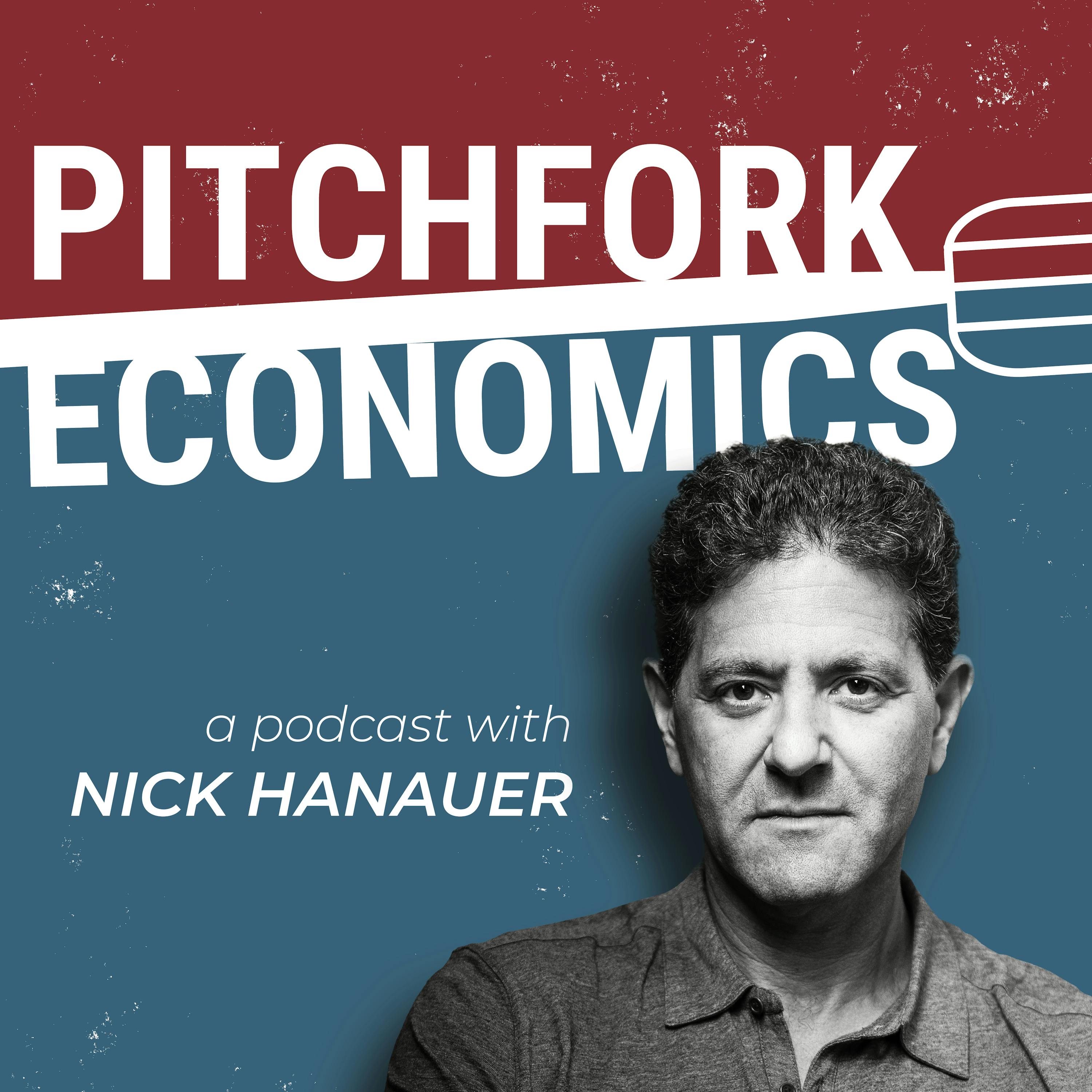
Pitchfork Economics with Nick Hanauer
Civic Ventures
We are living through a paradigm shift from trickle-down neoliberalism to middle-out economics — a new understanding of who gets what and why. Join zillionaire class-traitor Nick Hanauer and some of the world’s leading economic and political thinkers as they explore the latest thinking on how the economy actually works.
Episodes
Mentioned books

Apr 30, 2019 • 49min
What are the economics of climate change? (with Governor Jay Inslee and Fadhel Kaboub)
All the economic and social policy that we discuss on this podcast won’t matter if we don’t address climate change. Governor Jay Inslee and Professor Fadhel Kaboub join Nick and Goldy to explain that if we don’t get climate right… well, the pitchforks are coming. Jay Inslee is the Governor of Washington state. In March of this year, he announced he is running for president on a platform of combating climate change. Twitter: @JayInsleeFadhel Kaboub is President of the Global Institute for Sustainable Prosperity, and Associate Professor of economics at Denison University. His research focuses on the political economy of the Middle East, and the fiscal and monetary policy dimensions of job creation programs. Twitter: @FadhelKaboub
Apr 23, 2019 • 45min
What is Modern Monetary Theory? (with Stephanie Kelton)
Is government debt real? Is anything real? Professor Stephanie Kelton gives Nick and Goldy a master class on the hottest idea in economics right now: Modern Monetary Theory. Stephanie Kelton is a professor of public policy and economics at Stony Brook University and a senior economic adviser to Bernie Sanders’s 2016 and 2020 presidential campaigns. She was the chief economist on the U.S. Senate Budget Committee in 2015 and in 2016, POLITICO named her one of the 50 people most influencing the public debate in America. Her forthcoming book, ‘The Deficit Myth: Modern Monetary Theory and the Birth of a New Economy’ will be published by Public Affairs in 2020. Twitter: @StephanieKeltonFurther reading: https://www.vox.com/future-perfect/2019/4/16/18251646/modern-monetary-theory-new-moment-explainedhttps://www.nytimes.com/2017/10/05/opinion/deficit-tax-cuts-trump.html https://www.cnbc.com/2019/03/01/bernie-sanders-economic-advisor-stephanie-kelton-on-mmt-and-2020-race.htmlhttps://www.thenation.com/article/the-rock-star-appeal-of-modern-monetary-theory/
Apr 16, 2019 • 34min
Should Democrats appeal to the center by moving hard left? (with Congresswoman Pramila Jayapal)
For too long, pundits and politicians have talked about the political center as a perfect balance between conservatives and liberals. But this quest for some sort of mythical middle ground between left and right has only succeeded in elevating the interests of the top one percent over everyone else. Congresswoman Pramila Jayapal joins Nick to propose a new way of thinking about centrism: a framework of wildly popular policies that directly and significantly improve the lives of the vast majority of Americans who have been left out of economic growth. Congresswoman Pramila Jayapal is the U.S. Representative from Washington’s 7th congressional district, which includes most of Seattle. She is the co-chair of the Congressional Progressive Congress. Twitter: @PramilaJayapalFurther reading:https://www.politico.com/magazine/story/2018/08/14/democrats-must-reclaim-the-center-by-moving-hard-left-219354https://cpc-grijalva.house.gov/
Apr 13, 2019 • 37min
BONUS: Senator Cory Booker - Unedited Conversation
We spoke to Senator Cory Booker about stock buybacks and his Workers Dividend Act in February. We hope you enjoy the full, unedited conversation!Cory Booker is the U.S. Senator from New Jersey and a 2020 Democratic presidential candidate. Twitter: @CoryBooker
Apr 9, 2019 • 54min
Why does the U.S. hate families? (with Anne-Marie Slaughter and Katie Hamm)
For all our talk about family values, the U.S. is actually the worst place to raise a family in the developed world. Anne-Marie Slaughter and Katie Hamm join Nick and Jessyn to explain how our family policies got stuck in the last century, and what we should do about it. Anne-Marie Slaughter is the President and CEO of New America, a think and action tank dedicated to renewing America in the Digital Age. She is also a professor of politics and international affairs at Princeton University, and from 2009-2011 she served as director of Policy Planning for the U.S. Department of State—the first woman to hold that position. Twitter: @SlaughterAMKatie Hamm is the Vice President for Early Childhood Policy at the Center for American Progress, where she leads CAP’s work on policies impacting young children from birth to five.Twitter: @DCHammsliceKristine Reeves is a member of the Washington House of Representatives representing the 30th legislative district. She is also the Director of Economic Development for the Military and Defense sector for the state of Washington. Twitter: @KMReevesWAFurther reading: https://www.theatlantic.com/magazine/archive/2012/07/why-women-still-cant-have-it-all/309020/https://www.americanprogress.org/issues/early-childhood/reports/2017/09/07/438428/blueprint-child-care-reform/https://www.americanprogress.org/issues/early-childhood/news/2017/10/31/441825/the-cost-of-inaction-on-universal-preschool/https://www.nytimes.com/2018/06/24/upshot/americans-love-families-american-policies-dont.html?rref=collection%2Fbyline%2Fclaire-cain-miller
Apr 2, 2019 • 35min
Is economics moral? (with Heather McGhee)
We’ve established that trickle-down economics and neoliberalism are failed philosophies. But we haven’t yet explored whether economics should be moral - should it reflect our behaviors and preferences, or is it a science that lives separately from our societal norms and values? Heather McGhee joins Nick and Paul to argue that an inclusive economy is not only possible, but imperative to growth. Heather McGhee was the President of Demos from 2014-2018, where she is now a Distinguished Senior Fellow. She’s finishing a major book about the personal, economic, and societal costs of racism to everyone in America—including white people. A recognized thought leader on the national stage, Heather serves as a contributor to NBC News and frequently appears on shows such as Meet the Press. Her opinions, writing, and research have appeared in numerous outlets, including The New York Times, The Nation, and The Hill. Twitter: @hmcgheeFurther reading: https://www.demos.org/issue/economy-opportunity https://www.ineteconomics.org/perspectives/blog/the-moral-burden-on-economists
Mar 29, 2019 • 10min
BONUS: Why the Green New Deal is good economics
You’ve definitely heard of the Green New Deal by now, right? Zach and Annie talk it up in this bonus episode and explain why the economic bill of rights component is so important.
Mar 26, 2019 • 51min
What's preventing pay equity? (with Julie Nelson and Claire Cain Miller)
In 2009, President Obama signed the Lily Ledbetter Fair Pay Act into law, thereby ensuring that women across the United States were finally paid the same as men. Just kidding! Women still only make 80% of what their male counterparts do. What is this bullshit? Why hasn’t pay equity been achieved yet? Economist Julie Nelson and journalist Claire Cain Miller join Nick and Steph to explain why this problem is so damn persistent, and to offer solutions for how we can fully include women in the economy. Julie Nelson is a professor of economics and department chair at the University of Massachusetts Boston, most known for her application of feminist theory to economics. She is the author of ‘Economics for Humans’ and ‘Feminism, Objectivity, and Economics’. Twitter: @julie_nelsonClaire Cain Miller is a correspondent for The New York Times, where she writes about gender, families, and the future of work for The Upshot, a Times site for analysis of policy and economics. She was part of a team that won a Pulitzer Prize in 2018 for public service for reporting on workplace sexual harassment issues. Twitter: @clairecmFurther readinghttp://evonomics.com/yes-economics-problem-women/http://evonomics.com/pretending-hard-science-ethics-free-julie-nelson/https://www.nytimes.com/2017/05/13/upshot/the-gender-pay-gap-is-largely-because-of-motherhood.htmlhttps://hbr.org/2018/01/when-more-women-join-the-workforce-wages-rise-including-for-men
Mar 22, 2019 • 21min
BONUS: Alan Krueger - Unedited Conversation
We at Pitchfork Economics were saddened to learn of the passing of the brilliant economist Alan Krueger last weekend. We were fortunate to speak with him last year - here’s the full conversation.
Mar 19, 2019 • 40min
Why is getting out of poverty so hard? (with Felicia Wong)
Here are two phrases that should be oxymorons, but aren’t: ‘working poor’ and ‘poverty-level jobs.’ Writer and anti-poverty advocate Hanna Brooks Olsen joins Nick and Goldy to explore how the intense burdens of poverty make it nearly impossible to even think about climbing the economic ladder. Felicia Wong is the President and CEO of the Roosevelt Institute, a think tank that seeks to re-imagine the social and economic policies of Franklin and Eleanor Roosevelt for the 21st century. Twitter: @FeliciaWongRI @rooseveltinstHanna Brooks Olsen is a writer and policy consultant. Her work has appeared in The Atlantic, the Nation, Salon, the New York Daily News, the Huffington Post, and Democracy.Twitter: @mshannabrooksFurther reading:https://medium.com/@mshannabrooks/but-seriously-lets-talk-about-millennial-poverty-526066ad9adbhttps://aspe.hhs.gov/system/files/pdf/154286/50YearTrends.pdf

