

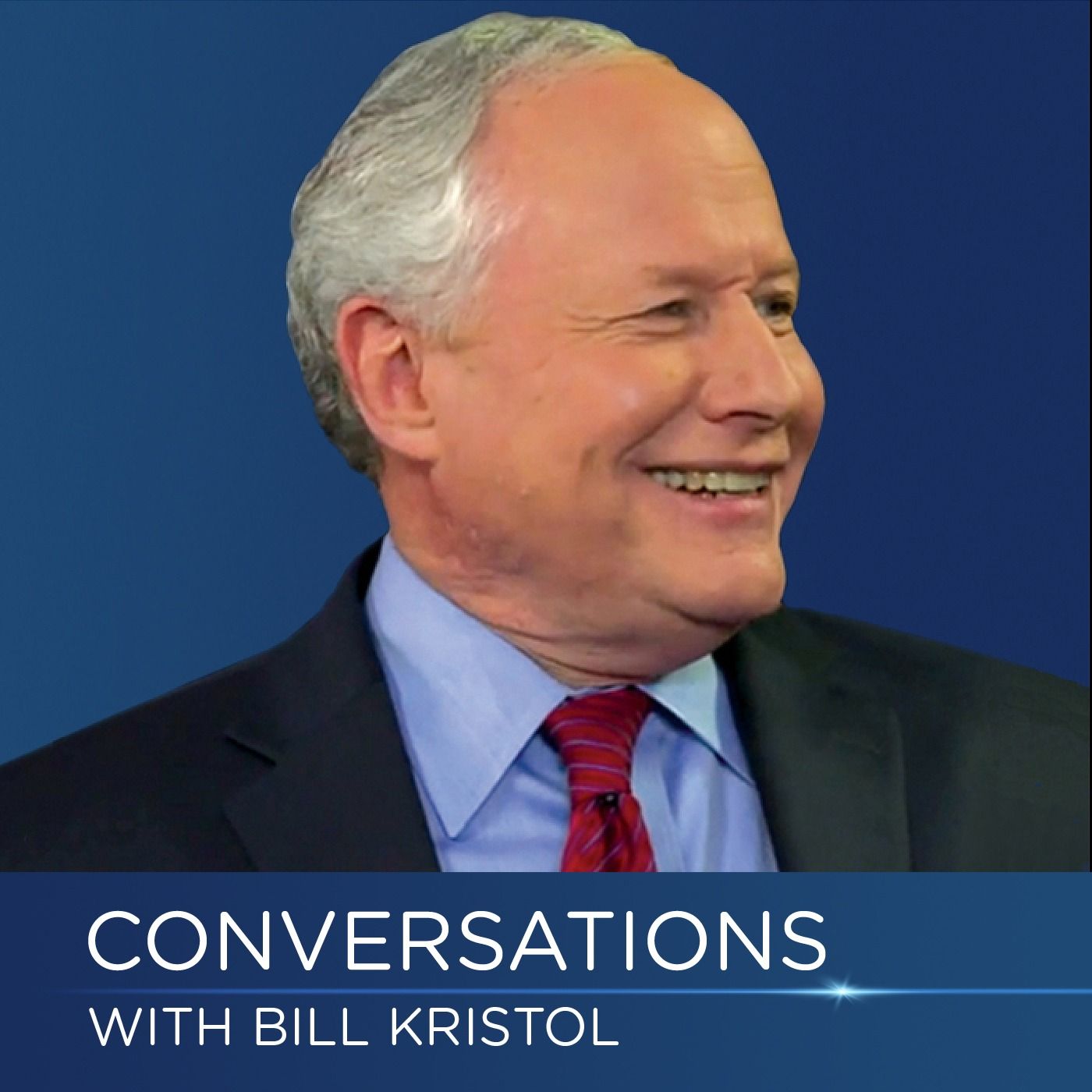
Conversations with Bill Kristol
Bill Kristol
Conversations with Bill Kristol features in-depth, thought-provoking discussions with leading figures in American public life.
Episodes
Mentioned books

Jul 28, 2018 • 1h 6min
Steven F. Hayward on Winston Churchill and Statesmanship
Steven F. Hayward is a visiting scholar at UC Berkeley and author of important books on Churchill, Reagan, and many other subjects. In this Conversation, Hayward analyzes Churchill’s wartime leadership and his domestic political concerns—as well as his often neglected writings, which contain both timeless and timely political insights. Highlighting Churchill’s attachment to principles as well as his understanding of circumstances, Hayward demonstrates that Churchill remains vital to understanding statesmanship. Kristol and Hayward also compare and recommend their favorite speeches and works by and about Churchill.

Jul 14, 2018 • 1h 24min
Ronald Brownstein on Red and Blue America, 2018, and 2020
Ronald Brownstein is a Senior Editor at The Atlantic, Senior Political Analyst at CNN, and a shrewd observer of American politics. In this Conversation, Brownstein analyzes factors that fuel our increasingly polarized politics. He explains why these partisan divisions are likely to increase as we head toward elections in 2018 and 2020. Brownstein and Kristol also consider possible outcomes in the midterms, the direction of the Trump presidency, and reflect on the electoral dilemmas both parties face in an atmosphere of intense partisanship.

Jul 2, 2018 • 59min
Diana Schaub on the Life and Political Thought of Frederick Douglass
Diana Schaub is a professor of political science at Loyola University Maryland and a leading interpreter of political philosophy and American political thought. In this Conversation, Schaub considers the life and ideas of the statesman and political thinker Frederick Douglass (c. 1818 – 1885). Schaub reflects on Douglass’s life, including his experience of slavery, his abolitionist politics, his work on behalf of the Union in the Civil War, and his post-war efforts to secure civil rights. Schaub demonstrates Douglass’s importance as a political thinker, pointing to his reflections on the corruptions of slavery, the meaning and requirements of freedom, the significance of the Declaration of Independence and the Constitution, and the role of prudence in politics.

Jun 21, 2018 • 1h 19min
Paul Cantor on Shakespeare and Politics (Part II)
In July 2014, we released the first part of a Conversation with University of Virginia literature professor Paul Cantor on Shakespeare and politics. Now we are pleased to share the second part—in which Cantor analyzes central themes in the English history plays, including the character of monarchies and republics and the relationship of religion and state. Turning to Shakespeare’s comedies, Cantor argues that Shakespeare sought to replace medieval Christian notions of romantic love with a more reasoned approach to love. Finally, in his analysis of "The Tempest," Cantor contends that Shakespeare was the only poet who could write tragedies and comedies at the highest level, transcending the division between the tragic and comedic views of life.

Jun 15, 2018 • 59min
Christopher Caldwell on Populism and the Future of the European Union
A leading commentator on European politics, Caldwell shares his perspective on recent developments in Europe, particularly the surging populist movements that have upended politics in many countries. Caldwell focuses particularly on populist parties and movements in Britain, France, Germany, Italy, and Hungary—and also analyzes the ramifications for Europe as a whole. Highlighting the effects of mass migration, weak economies, and mounting debt, Caldwell anticipates greater turmoil and significant threats to the European Union in the years ahead.

Jun 2, 2018 • 1h 21min
Edward Conard on Innovation, Income Inequality, and High-Skilled Immigration
Edward Conard is a former Managing Director of Bain Capital and bestselling author. In this Conversation, Conard shares his perspective on why innovation is the key to America’s long-term economic vitality and how we can go about fostering it. To address what he describes as a shortage of properly-trained talent and risk-bearing capital, Conard calls for increasing high-skilled immigration and other public policies that match talent with opportunities. Conard and Kristol also reflect on the inequalities that are inherent in a technology-driven economy and consider what can be done now to benefit lower-skilled workers in the years to come.

May 19, 2018 • 1h 12min
Paul Begala on the Democratic Party, the Midterms, and 2020
Paul Begala is a veteran Democratic strategist and commentator, and served as counselor to the president in the Clinton White House. In this Conversation, Begala analyzes the key dynamics within the Democratic Party today. Looking ahead to the midterms and to 2020, Begala considers the Democrats’ response to Trump, the tensions between progressives and moderates, and the kinds of candidates that are likely to succeed. Begala also makes a spirited case for why Democrats must defend free speech and liberal principles more generally.

May 5, 2018 • 57min
Garry Kasparov on Dictators and Democracies
Former world chess champion and human rights activist Garry Kasparov shares his perspective on threats to Western democracies from dictators abroad and illiberal movements at home. Analyzing the geopolitical situation, Kasparov argues that the challenge to the West posed by dictators like Putin remains significant and even growing. Turning to Western societies themselves, Kasparov diagnoses a dangerous complacency about the effort required to sustain political liberty. Finally, Kristol and Kasparov discuss how America can recapture the will necessary to defend itself and its principles.

Apr 21, 2018 • 1h 20min
Jonah Goldberg on Nationalism, Populism, and Identity Politics
Jonah Goldberg is a senior editor of National Review and Asness Chair in Applied Liberty at the American Enterprise Institute. Drawing on his new book Suicide of the West, Goldberg argues that strong tendencies in contemporary American culture—including tribalism, populism, nationalism, and identity politics—are increasingly undermining the moral and political foundations of America. In discussing these phenomena, Kristol and Goldberg also consider why it is important for young people to study the American political tradition and appreciate what is best in Western civilization.

Apr 7, 2018 • 1h 5min
Peter Berkowitz: Defending Liberal Democracy
Peter Berkowitz is a senior fellow at the Hoover Institution and a leading scholar of political philosophy and American politics. He serves as dean of students for the Hertog Political Studies Program and The Public Interest Fellowship, and teaches for the Tikvah Fund. In recent years, criticism of liberal democracy for its alleged hostility to tradition, family, and community has been gaining strength. In this Conversation, Berkowitz addresses such critiques, reflects on classical liberalism, and considers why liberal democracy deserves to be defended. Kristol and Berkowitz discuss thinkers within the liberal tradition including John Locke, Edmund Burke, John Stuart Mill, and Alexis de Tocqueville. As Berkowitz makes clear, these thinkers understood that liberalism—like all regimes—has drawbacks. Yet these great thinkers also provide the intellectual resources for defending liberalism. This is a must-see Conversation at a time of growing uncertainty about the core principles of the modern West.

