

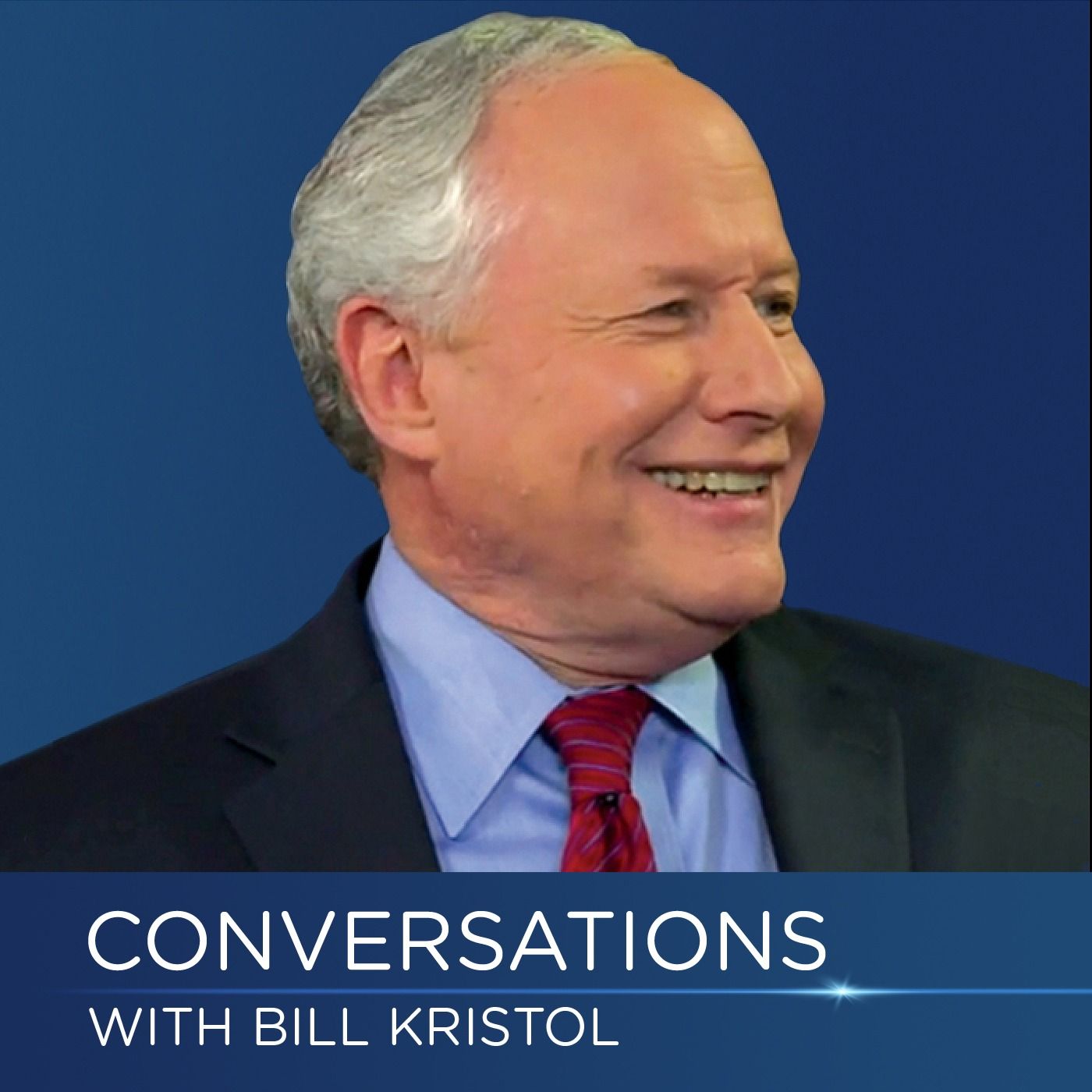
Conversations with Bill Kristol
Bill Kristol
Conversations with Bill Kristol features in-depth, thought-provoking discussions with leading figures in American public life.
Episodes
Mentioned books

Dec 15, 2018 • 57min
Mike Murphy: Onward to 2020!
Veteran political strategist and commentator Mike Murphy assesses where the Republicans and the Democrats stand as we look toward 2020. What are President Trump’s prospects for reelection? Where are the divisions in the Democratic Party, and which Democratic candidates might prevail in the primaries? And could there be a successful primary challenge to Trump? Murphy shares his thoughts on these and other pressing questions with his usual blend of political insight and humor.

Dec 1, 2018 • 2h 1min
Ronald Brownstein: From the 2018 Midterms to the 2020 Elections
Ronald Brownstein is a Senior Editor at The Atlantic, Senior Political Analyst at CNN, and a shrewd observer of American politics. In this Conversation, Brownstein shares his perspective on how the midterms reveal further intensification of the geographic and demographic divisions in American politics. Brownstein and Bill Kristol then look ahead to 2020. They assess the strengths and weaknesses of both parties, the key cultural and economic issues that are likely to feature in the campaigns, and whether President Trump might be vulnerable to a primary challenge. This is must-see electoral and political analysis at the highest level.

Nov 17, 2018 • 58min
Jack Goldsmith: Cybersecurity, Cyberwarfare, and the Threats We Face
Jack Goldsmith is a professor of law at Harvard University and served as Assistant Attorney General in the Office of Legal Counsel (2003-2004). In this Conversation, Goldsmith shares his perspective on America’s vulnerabilities to cyber attack—the complex and systemic threats to our digital and physical infrastructures, as well as to our politics via hacking and digital espionage. As Goldsmith explains, we have not done nearly enough to counter cyber threats through better defense or employment of countermeasures against adversaries. Finally, Kristol and Goldsmith consider what the government and private sector can do to improve our cybersecurity.

Nov 3, 2018 • 1h 5min
Christine Rosen on the Me Too Movement, Women, and Men
Christine Rosen is an author, the managing editor of The Weekly Standard, and a columnist at Commentary. Rosen shares her perspective on the confused and confusing state of relations between men and women in contemporary America. According to Rosen, the Me Too movement has shown how we lack the rules and even the language for understanding the new sets of challenges facing men and women today. In Rosen’s view, we can begin to address these challenges by encouraging young men and women to think not only of their rights but also of their responsibilities in a free society. Finally, Kristol and Rosen discuss why the study of history and literature can give us necessary perspective on the most important and contentious questions about men and women.

Oct 20, 2018 • 1h 12min
Scott Lincicome: In Defense of Free Trade
Scott Lincicome is a leading international trade attorney, adjunct scholar at the Cato Institute, and senior visiting lecturer at Duke University. In this Conversation, Lincicome explains the system of free trade agreements and alliances that the U.S. has built over many decades and how the system contributes to peace and prosperity for America. Lincicome also shares his perspective on the renegotiation of NAFTA, the decision not to participate in the Trans-Pacific Partnership (TPP), and other trade agreements. Finally, Kristol and Lincicome consider where Republicans and Democrats stand on trade today—and where the parties are likely to go in the future.

Oct 6, 2018 • 1h 26min
Paul Cantor on Great Television and the Emergence of a TV Canon
In his most recent Conversation, University of Virginia literature professor Paul Cantor considers how television has reached a critical stage in the history of a medium: canonization. According to Cantor, television, much like theater, novels, and movies before it, has now reached a point where people recognize that its greatest artistic triumphs have enduring cultural value. Shows such as Breaking Bad, Deadwood, The Simpsons, Seinfeld, and The X-Files, Cantor argues, will be appreciated for many generations to come. Cantor explains how the canonization of TV follows a pattern whereby a medium—originally designed for utilitarian purposes or simple entertainment—is then transformed by great artists into an instrument for the creation of great art. Finally, drawing on the history of TV shows and movies, Cantor argues that collaboration, improvization, and chance are often as essential to the production of great art as forethought and individual genius.

Sep 22, 2018 • 1h 17min
Eric Edelman: Restoring American Leadership in the World
Eric Edelman reflects on increasing threats to the U.S.-led international order and considers the dangerous consequences of a continued decline in America's geopolitical position and influence. Edelman also shares his perspective on how America can strengthen its resolve and commitment to lead in the world. Eric Edelman is The Hertog Scholar at the Center for Strategic Studies and has had a distinguished career in government, having served as ambassador to Turkey and to Finland, and as Under Secretary of Defense for Policy in the George W. Bush administration.

Sep 8, 2018 • 1h 20min
Harvey Mansfield on the Wisdom of The Federalist
Harvey Mansfield reflects on The Federalist and why it should be read seriously as a great work on politics. Mansfield’s discussion calls our attention to the subtlety and complexity of the argument of The Federalist, as a whole, and explains why it remains an indispensable guide for thinking about American government. Mansfield and Kristol also consider how The Federalist draws on, but also differs from, works of ancient and early modern political science in its analysis of good government and republicanism.

Aug 25, 2018 • 1h 3min
Linda Chavez on Immigration and American Identity
Linda Chavez is an author, syndicated columnist, and served in the Reagan administration. A longtime analyst of immigration and immigration policy in the United States, Chavez shares her perspective on the current debates over immigration. She explains why immigration remains a net benefit to the United States—and why we should address, improve, and streamline the immigration system. Citing relevant data, Chavez notes how recent arrivals to the United States are following the pattern of earlier waves of immigration and assimilating into the American way of life. Finally, Chavez proposes reforms to the immigration system that prioritize relevant skills and also would be more flexible to market conditions.

Aug 11, 2018 • 1h 3min
Jim Manzi on Artificial Intelligence and the Future of Technological Innovation
A leading software entrepreneur and developer of artificial intelligence (AI) technology, Jim Manzi shares his perspective on AI—what it is, what it can do today, and how it might develop in the coming years. Manzi also discusses how AI currently affects politics and society, and the implications of progress in AI for the future. Finally, Manzi compares today’s advances in computer science and in biology to past scientific breakthroughs in chemistry and physics.

