

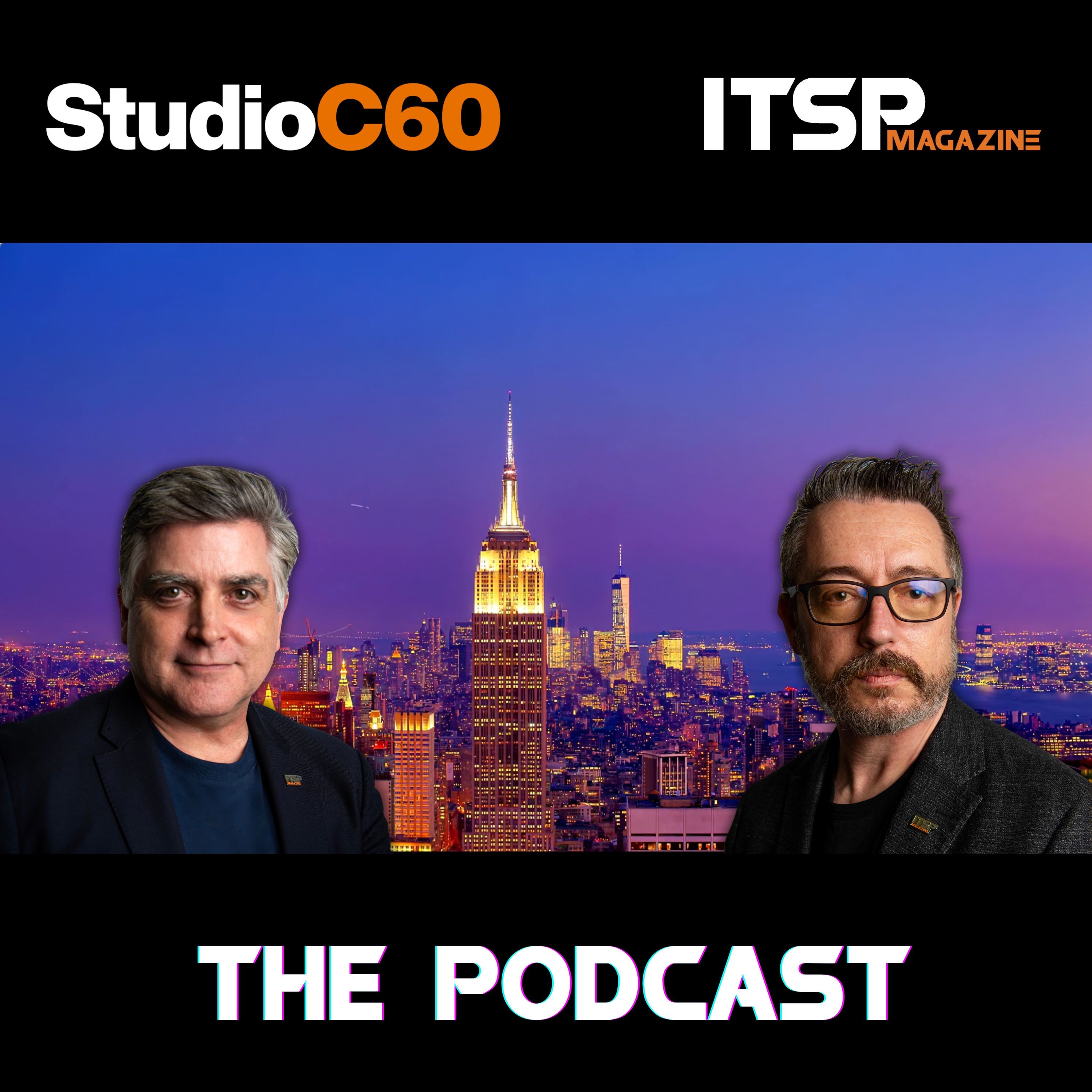
The ITSPmagazine Podcast
ITSPmagazine, Sean Martin, Marco Ciappelli
Founded in 2015, ITSPmagazine began as a vision for a publication positioned at the critical intersection of technology, cybersecurity, and society. What started as a written publication has evolved into a comprehensive repository for all their content—podcasts, articles, event coverage, interviews, videos, panels, and everything they create.
This is where Sean Martin and Marco Ciappelli talk about cybersecurity, technology, society, music, storytelling, branding, conference coverage, and whatever else catches their attention. Over a decade of conversations exploring how these worlds collide, influence each other, and shape the human experience.
This is where you'll find it all.
This is where Sean Martin and Marco Ciappelli talk about cybersecurity, technology, society, music, storytelling, branding, conference coverage, and whatever else catches their attention. Over a decade of conversations exploring how these worlds collide, influence each other, and shape the human experience.
This is where you'll find it all.
Episodes
Mentioned books

Aug 15, 2025 • 8min
Event Recap: Kieran Human at Black Hat USA 2025 — ThreatLocker Unveils Configuration Defense, Achieves FedRAMP Status & More | Brand Story with ThreatLocker from Black Hat USA 2025
Event Recap: Kieran Human at Black Hat USA 2025 — ThreatLocker Unveils Configuration Defense, Achieves FedRAMP Status & MoreThreatLocker introduced DAC configuration monitoring and achieved FedRAMP certification at Black Hat 2025, strengthening zero trust capabilities while expanding government market access through practical security solutions.Zero trust security continues evolving beyond theoretical frameworks into practical business solutions, as demonstrated by ThreatLocker's latest announcements at Black Hat USA 2025. The company introduced Defense Against Configuration (DAC), a monitoring tool addressing a critical gap in zero trust implementations.Kieran Human, Special Projects Engineer at ThreatLocker, explained the challenge driving DAC's development. Organizations implementing zero trust often struggle with configuration management, potentially leaving systems vulnerable despite security investments. DAC monitors configurations continuously, alerting administrators to potential security issues and mapping findings to compliance frameworks including Essential 8.The tool addresses human factors in security implementation. Technical staff sometimes create overly permissive rules to minimize user complaints, compromising security posture. DAC provides weekly reports to executives, ensuring oversight of configuration decisions and maintaining security standards across the organization.ThreatLocker's approach distinguishes itself through "denied by default, allowed by exception" methodology, contrasting with traditional endpoint detection and response solutions that permit by default and block threats reactively. This fundamental difference requires careful implementation to avoid business disruption.The company's learning mode capabilities address deployment concerns. With over 10,000 built-in application profiles, ThreatLocker automates policy creation while learning organizational workflows. This reduces manual configuration requirements that previously made zero trust implementations tedious and time-intensive.FedRAMP certification represents another significant milestone, opening government sector opportunities. Federal compliance requirements previously excluded ThreatLocker from certain contracts, despite strong customer demand for their zero trust capabilities. This certification enables expansion into highly regulated environments requiring stringent security controls.Customer testimonials continue validating the approach. One user reported preventing three breaches after implementing ThreatLocker's zero trust solution, demonstrating measurable security improvements. Such feedback reinforces the practical value of properly implemented zero trust architecture.The balance between security and business functionality remains crucial. Organizations need security solutions that protect assets without hampering productivity. ThreatLocker's principle of least privilege implementation focuses on enabling business requirements with minimal necessary permissions rather than creating restrictive environments that impede operations.Human described working closely with CEO Danny Jenkins, emphasizing the collaborative environment that drives product innovation. His engineering perspective provides valuable insights into customer needs while maintaining focus on practical security solutions that work in real-world environments.As zero trust adoption accelerates across industries, tools like DAC become essential for maintaining security posture while meeting business demands. The combination of automated learning, configuration monitoring, and compliance mapping addresses practical implementation challenges facing security teams today.Learn more about ThreatLocker: https://itspm.ag/threatlocker-r974Note: This story contains promotional content. Learn more.Guest: Kieran Human, Special Project Engineer at ThreatLocker | On LinkedIn | https://www.linkedin.com/in/kieran-human-5495ab170/ResourcesLearn more and catch more stories from ThreatLocker: https://www.itspmagazine.com/directory/threatlockerLearn more and catch more stories from our Black Hat USA 2025 coverage: https://www.itspmagazine.com/bhusa25Learn more about ITSPmagazine Brand Story Podcasts: https://www.itspmagazine.com/purchase-programsNewsletter Archive: https://www.linkedin.com/newsletters/tune-into-the-latest-podcasts-7109347022809309184/Business Newsletter Signup: https://www.itspmagazine.com/itspmagazine-business-updates-sign-upAre you interested in telling your story?https://www.itspmagazine.com/telling-your-story Hosted by Simplecast, an AdsWizz company. See pcm.adswizz.com for information about our collection and use of personal data for advertising.
Aug 14, 2025 • 21min
Data Kidnapping: Because File Encryption Is So 2020 | A Brand Story with Brett Stone-Gross, Senior Director of Threat Intelligence at Zscaler | A Black Hat USA 2025 Conference On Location Brand Story
At Black Hat USA 2025, Sean Martin, co-founder of ITSPmagazine, sat down with Brett Stone-Gross, Senior Director of Threat Intelligence at Zscaler, to discuss the findings from the company’s latest ransomware report. Over the past five years, the research has tracked how attack patterns, targets, and business models have shifted—most notably from file encryption to data theft and extortion.Brett explains that many ransomware groups now find it more profitable—and less risky—to steal sensitive data and threaten to leak it unless paid, rather than encrypt files and disrupt operations. This change also allows attackers to stay out of the headlines and avoid immediate law enforcement pressure, while still extracting massive payouts. One case saw a Fortune 50 company pay $75 million to prevent the leak of 100 terabytes of sensitive medical data—without a single file being encrypted.The report highlights variation in attacker methods. Some groups focus on single large targets; others, like the group “LOP,” exploit vulnerabilities in widely used file transfer applications, making supply chain compromise a preferred tactic. Once inside, attackers validate their claims by providing file trees and sample data—proving the theft is real.Certain industries remain disproportionately affected. Healthcare, manufacturing, and technology are perennial top targets, with oil and gas seeing a sharp increase this year. Many victims operate with legacy systems, slow to adopt modern security measures, making them vulnerable. Geographically, the U.S. continues to be hit hardest, accounting for roughly half of all observed ransomware incidents.The conversation also addresses why organizations fail to detect such massive data theft—sometimes hundreds of gigabytes per day over weeks. Poor monitoring, limited security staffing, and alert fatigue all contribute. Brett emphasizes that reducing exposure starts with eliminating unnecessary internet-facing services and embracing zero trust architectures to prevent lateral movement.The ransomware report serves not just as a data source but as a practical guide. By mapping observed attacker behaviors to defensive strategies, organizations can better identify and close their most dangerous gaps—before becoming another statistic in next year’s findings.Learn more about Zscaler: https://itspm.ag/zscaler-327152Note: This story contains promotional content. Learn more.Guest:Brett Stone-Gross, Senior Director of Threat Intelligence at Zscaler, | On LinkedIn: https://www.linkedin.com/in/brett-stone-gross/ResourcesLearn more and catch more stories from Zscaler: https://www.itspmagazine.com/directory/zscalerLearn more about ITSPmagazine Brand Story Podcasts: https://www.itspmagazine.com/purchase-programsNewsletter Archive: https://www.linkedin.com/newsletters/tune-into-the-latest-podcasts-7109347022809309184/Business Newsletter Signup: https://www.itspmagazine.com/itspmagazine-business-updates-sign-upAre you interested in telling your story?https://www.itspmagazine.com/telling-your-storyKeywords: sean martin, brett stone-gross, ransomware, data extortion, cyber attacks, zero trust security, threat intelligence, data breach, cyber defense, network security, file transfer vulnerability, data protection, black hat, black hat usa 2025, zscaler Hosted by Simplecast, an AdsWizz company. See pcm.adswizz.com for information about our collection and use of personal data for advertising.
Aug 14, 2025 • 22min
From Excel to Excellence: Transforming Cybersecurity Workforce Management | A Brand Story with Deidre Diamond, Founder and CEO of CyberSN, and Carraig Stanwyck, CEO and Former Fortune 200 CISO | A Black Hat USA 2025 Conference On Location Brand Story
Marco Ciappelli of ITSPmagazine explores cybersecurity workforce transformation with CyberSN's Deidre Diamond and Fortune 200 CISO-turned-CEO Carraig StanwyckThe corridors of Black Hat 2025 in Las Vegas buzzed with conversations about AI and emerging threats, but one of the most compelling discussions centered on something decidedly human: how we actually manage our cybersecurity teams. Marco Ciappelli, Co-Founder and CMO of ITSPmagazine, connected with longtime industry colleague Deidre Diamond, who brought along Carraig Stanwyck—a seasoned cybersecurity leader who recently transitioned from Fortune 200 CISO to CEO."It's been great running into people I know here at Black Hat," Ciappelli noted, "but finding Deidre after 11 years—and meeting the people she's been working with—that's what these events are really about. Finding out what's happening in the industry and reconnecting."Diamond, who has spent 11 years in cybersecurity with eight years focused on talent matching and three years developing workforce risk management practices at CyberSN, brought a unique perspective to the conversation. Her journey from building a cyber taxonomy and job matching solution to addressing the industry's critical workforce challenges—retention, burnout, capability gaps, and career planning—set the stage for understanding how one Fortune 200 CISO discovered the limitations of traditional workforce management.The Excel Trap: When Good Intentions Meet RealityWhen Stanwyck thought he had workforce management figured out, he was using Excel spreadsheets and conducting regular happiness surveys with his cybersecurity team. As someone who started his career in human intelligence and carried that people-focused approach through government, startups, and enterprise organizations, he believed he was ahead of the curve."I thought I already had a solution," Stanwyck reflects. "I was already meeting with my people, doing specific surveys to track happiness and belonging because I wanted to catch issues early. You get your team right, and you can do anything."But when he met Deidre Diamond from CyberSN at RSA two years ago, his confidence was quickly shaken. "She was talking about workforce risk management, and I was like, 'Well, yeah, I do that. I'm all set. I'm covered.'" Diamond's response was simple: "Show me how you visualize the data you use."That's when Stanwyck discovered the limitations of his Excel-based approach—old data, time-intensive processes, and a fundamental lack of real-time visibility into how his team actually functioned.Beyond Job Titles: The Hidden Workforce RealityWhat CyberSN's platform revealed transformed Stanwyck's understanding of his own team. "You can re-interview your people like a recorder," he explains. "You can see that someone you hired as an analyst is doing all this engineering work—maybe they're better on the engineering team."The platform provided something Stanwyck had never experienced: quantitative visibility into how his team's time was actually being spent. "It gave me a level of visibility in the team, what they were doing, and how their time was being spent at a quantitative level that there's no way for me to replicate manually."Even more revealing was the discovery that job descriptions become obsolete almost immediately. "The job description of our talent is old within weeks and within months from the day it's created—if it was even created correctly at all," Diamond noted during the conversation.The Fulfillment Factor: Beyond Happiness to PurposeWhile Stanwyck's happiness surveys captured surface-level satisfaction, CyberSN's approach dug into something more fundamental. "HappinessHappy is important, but one that feels fulfilled—that they have a purpose—that's the key," Stanwyck emphasizes.The platform's approach to understanding team members went beyond traditional metrics. "When you know where they want to go, how they feel about the team, you get all this extra data," Stanwyck explains. "Your ability to craft development plans, to help them move through different parts of the team, to help with career planning—it becomes so nailed that they can't help but see their way forward."The impact was immediate and lasting. When Stanwyck transitioned to his CEO role, his team specifically requested that the organization renew their CyberSN contract. "These teammates feel like, wow, they're investing in understanding me more and planning more. It just adds to professional efficacy."From Reactive to Strategic: The Business Case RevolutionPerhaps the most significant transformation was in business communication. Every cybersecurity leader knows the refrain: "We don't have enough people." But quantifying that gap had always been nearly impossible."How do you show the gaps and how you're not able to meet specific capability requirements?" Stanwyck asks. "It's really hard using the lack of tools you have right now—it's very subjective."CyberSN's dual visualization capability became a game-changer. "You can see the whole org chart from people—what they're doing. But you can also flip it and see that same org chart from a capabilities perspective," Stanwyck describes. "Here's all the capabilities we need. How are they staffed? What are we missing? How do we plan for the future as we grow?"This visibility transformed conversations with executive leadership. "It's easier to get budgets, easier to make a business case for where you're going as you grow," Stanwyck notes. "CIOs, CFOs, CEOs can now understand what the security leader is dealing with in a way that's logical, not just a spreadsheet."The Multi-Tool DiscoveryThe platform revealed something crucial about modern cybersecurity teams: people are multi-tools, not single-purpose instruments. "You hire somebody because they do X or Y—that's the assumption," Stanwyck explains. "But when you get to know them better through the taxonomies, when you figure out what they end up doing on the team even if it wasn't what they were hired for, you start realizing these tools are multi-tools."This discovery enabled better strategic planning and resource allocation. "It allows you to have a much better plan for how you're gonna leverage them throughout the organization, help them upscale, identify those opportunities for them to maximize the value they're able to provide."The Human Element in an AI-Driven WorldAs Black Hat 2025 showcased the latest in AI and automation, Stanwyck offered a refreshing perspective on the role of humans in cybersecurity's future. "AI technologies are really statistical models of existing information—they're not creative, they're not thinking outside the box," he observes.Instead of replacement, Stanwyck advocates for empowerment. "I'm excited about companies that take a smarter approach—how do we empower the human? It's kind of like putting that superhero costume on rather than getting rid of them."For cybersecurity leaders still managing teams through spreadsheets and gut feelings, this Black Hat conversation offers a clear message: true workforce visibility isn't just about knowing who works for you—it's about understanding how they work, what fulfills them, and how to strategically position your human capabilities for the challenges ahead.CyberSN's workforce risk management platform transforms how cybersecurity leaders understand, develop, and strategically deploy their most valuable asset: their people.Learn more about CyberSN: https://itspm.ag/cybersn-476941Note: This story contains promotional content. Learn more.Guests:Deidre Diamond, Founder and CEO of CyberSN | On LinkedIn: https://www.linkedin.com/in/deidrediamond/Carraig Stanwyck, CEO at 3 Tree Tech and former Fortune 200 CISO | On LinkedIn: https://www.linkedin.com/in/carraig-stanwyck/ResourcesLearn more and catch more stories from CyberSN: https://www.itspmagazine.com/directory/cybersnLearn more about ITSPmagazine Brand Story Podcasts: https://www.itspmagazine.com/purchase-programsNewsletter Archive: https://www.linkedin.com/newsletters/tune-into-the-latest-podcasts-7109347022809309184/Business Newsletter Signup: https://www.itspmagazine.com/itspmagazine-business-updates-sign-upAre you interested in telling your story?https://www.itspmagazine.com/telling-your-storyKeywords: marco ciappelli, deidre diamond, carraig stanwyck, cybersecurity, workforce management, talent retention, job descriptions, skills gap, leadership, employee engagement, career development, black hat, black hat usa, black hat 2025, workforce risk management Hosted by Simplecast, an AdsWizz company. See pcm.adswizz.com for information about our collection and use of personal data for advertising.
Aug 14, 2025 • 20min
How to Automate Cybersecurity Operations Without Coding, Crying, or Calling IT at 2 A.M. | A Brand Story with Mike Wayne, Vice President, Global Sales at BlinkOps | A Black Hat USA 2025 Conference On Location Brand Story
Mike Wayne, responsible for global sales at BlinkOps, joins ITSPmagazine host Sean Martin to discuss how organizations can harness agentic AI to transform security operations—and much more.The conversation begins with a clear reality: business processes are complex, and when security is added into the mix, orchestrating workflows efficiently becomes even more challenging. BlinkOps addresses this by providing a platform that not only automates security tasks but also extends across HR, finance, sales, and marketing. By enabling automation in areas like employee onboarding/offboarding or access management, the platform helps organizations improve efficiency, reduce risk, and free human talent for higher-value work.Mike explains that while traditional SOAR tools require heavy scripting and ongoing maintenance, BlinkOps takes a different approach. Its security co-pilot allows users to describe automations in plain language, which are then generated—90% complete—by the system. Whether the user is a SOC analyst or an HR manager, the platform supports low-code and no-code capabilities, making automation accessible to “citizen developers” across the organization.The concept of micro agents is central. Instead of relying on large, complex AI models that can hallucinate or act unpredictably, BlinkOps uses focused, purpose-built agents with smaller context windows. These agents handle specific tasks—such as enriching security alerts—within larger workflows, ensuring accuracy and control.The benefits are tangible. One customer’s triage agent processed 400 alerts in just eight days without direct human intervention, while another saved $1.8 million in manual endpoint deployment costs over a single month. Outcomes like reduced mean time to respond (MTTR) and faster time to automation are key drivers for adoption, especially when facing zero-day vulnerabilities where speed is critical.BlinkOps runs as SaaS, hybrid, or in secure environments like GovCloud, making it adaptable for organizations of all sizes and compliance requirements.The takeaway is clear: AI-driven automation doesn’t just improve security operations—it creates new efficiencies across the enterprise. As Mike puts it, when a process can be automated, “just blink it.”Learn more about BlinkOps: https://itspm.ag/blinkops-942780Note: This story contains promotional content. Learn more.Guest: Mike Wayne, Vice President, Global Sales at BlinkOps | On Linkedin: https://www.linkedin.com/in/mikejwayne/ResourcesLearn more and catch more stories from BlinkOps: https://www.itspmagazine.com/directory/blinkopsLearn more about ITSPmagazine Brand Story Podcasts: https://www.itspmagazine.com/purchase-programsNewsletter Archive: https://www.linkedin.com/newsletters/tune-into-the-latest-podcasts-7109347022809309184/Business Newsletter Signup: https://www.itspmagazine.com/itspmagazine-business-updates-sign-upAre you interested in telling your story?https://www.itspmagazine.com/telling-your-storyKeywords: sean martin, mike wayne, blink ops, ai automation, agentic ai, micro agents, security automation, soc automation, workflow automation, zero day response, alert triage, enrichment agent, low code automation, cyber security ai, enterprise automation, black hat usa, black hat 2025 Hosted by Simplecast, an AdsWizz company. See pcm.adswizz.com for information about our collection and use of personal data for advertising.
Aug 14, 2025 • 28min
Your Business Apps Are Bringing Friends You Didn’t Invite | A Brand Story with Saša Zdjelar, Chief Trust Officer at ReversingLabs and Operating Partner at Crosspoint Capital | A Black Hat USA 2025 Conference On Location Brand Story
In an era where organizations depend heavily on commercial applications to run their operations, the integrity of those applications has become a top security concern. Saša Zdjelar, Chief Trust Officer at ReversingLabs and Operating Partner at Crosspoint Capital, shares how protecting the software supply chain now extends far beyond open source risk.Zdjelar outlines how modern applications are built from a mix of first-party, contracted, open source, and proprietary third-party components. By the time software reaches production, its lineage spans geographies, development teams, and sometimes even AI-generated code. Incidents like SolarWinds, Kaseya, and CircleCI demonstrate that trusted vendors are no longer immune to compromise, and commercial software can introduce critical vulnerabilities or malicious payloads deep into enterprise systems.Regulatory drivers are increasing scrutiny. Executive Order 14028, Europe’s Cyber Resilience Act, DORA, and U.S. Department of Defense software sourcing restrictions all require greater transparency, such as a Software Bill of Materials (SBOM). However, Zdjelar cautions that SBOMs—while valuable—are like ingredient lists without recipes: they don’t reveal if a product is secure, just what’s in it.ReversingLabs addresses this gap with a no-compromise analysis engine capable of deconstructing any file, of any size or complexity, to assess its safety. This capability enables organizations to make risk-based decisions, continuously monitor for unexpected changes between software versions, and operationalize controls at points such as procurement, SCCM deployments, or file transfers into critical environments.For CISOs, this represents a true technical control where previously only contractual clauses, questionnaires, or insurance policies existed. By placing analysis at the front of the software lifecycle, organizations can reduce reliance on costly manual testing and sandboxing, improve detection of tampering or hidden behavior, and even influence cyber insurance rates.The takeaway is clear: software supply chain security is a board-level concern, and the focus must expand beyond open source. With the right controls, organizations can avoid becoming the next headline-making breach and maintain trust with customers, partners, and regulators.Learn more about ReversingLabs: https://itspm.ag/reversinglabs-v57bNote: This story contains promotional content. Learn more.Guest: Saša Zdjelar, Chief Trust Officer at ReversingLabs and Operating Partner at Crosspoint Capital | On Linkedin: https://www.linkedin.com/in/sasazdjelar/ResourcesLearn more and catch more stories from ReversingLabs: https://www.itspmagazine.com/directory/reversinglabsLearn more about ITSPmagazine Brand Story Podcasts: https://www.itspmagazine.com/purchase-programsNewsletter Archive: https://www.linkedin.com/newsletters/tune-into-the-latest-podcasts-7109347022809309184/Business Newsletter Signup: https://www.itspmagazine.com/itspmagazine-business-updates-sign-upAre you interested in telling your story?https://www.itspmagazine.com/telling-your-storyKeywords: Black Hat 2025, Black Hat USA, sean martin, saša zdjelar, software supply chain security, commercial software risk, binary analysis, software bill of materials, sbom security, malicious code detection, ciso strategies, third party software risk, software tampering detection, malware analysis tools, devsecops security, application security testing, cybersecurity compliance Hosted by Simplecast, an AdsWizz company. See pcm.adswizz.com for information about our collection and use of personal data for advertising.
Aug 13, 2025 • 19min
Black Hat 2025: Crogl's CEO Monzy Merza Explains How AI Can Help Eliminate Alert Fatigue in Cybersecurity | A Black Hat USA 2025 Conference On Location Brand Story
Black Hat 2025: Crogl's CEO Monzy Merza Explains How AI Can Help Eliminate Alert Fatigue in CybersecurityCrogl CEO Monzy Merza discusses how AI-driven security platforms automate alert investigation using enterprise knowledge graphs, enabling analysts to focus on threat hunting while maintaining data privacy.Security teams drowning in alerts finally have a lifeline that doesn't compromise their data sovereignty. At Black Hat USA 2025, Crogl CEO Monzy Merza revealed how his company is tackling one of cybersecurity's most persistent challenges: the overwhelming volume of security alerts that leaves analysts either ignoring potential threats or burning out from investigation fatigue.The problem runs deeper than most organizations realize. Merza observed analysts routinely closing hundreds of alerts with a single click, not from laziness or malice, but from sheer necessity. "When you look at the history of breaches, the signal of the breach was there. And somebody ignored it," he explained during his ITSPmagazine interview, highlighting a critical gap between alert generation and meaningful investigation.Traditional approaches have failed because they expect human analysts to become "unicorns" - experts capable of mastering multiple data platforms simultaneously while remembering complex query languages and schemas. This unrealistic expectation has created what Merza calls the "human unicorn challenge," where organizations struggle to find personnel who can effectively navigate their increasingly complex security infrastructure.Crogl's solution fundamentally reimagines the relationship between human intuition and machine automation. Rather than forcing analysts to adapt to multiple tools, the platform creates a semantic knowledge graph that maps data relationships across an organization's entire security ecosystem. When alerts arrive, the system automatically conducts investigations using established kill chain methodologies, freeing analysts to focus on higher-value activities like threat hunting and strategic security initiatives.The privacy-first architecture addresses growing concerns about data sovereignty. Operating as a completely self-contained system with no internet dependencies, Crogl can run air-gapped in the most sensitive environments, including defense intelligence communities. The platform connects to existing tools through APIs without requiring data movement, duplication, or transformation.Real-world results demonstrate the platform's versatility. One customer discovered their analysts were using Crogl for fraud detection - an application never intended by the original design. The system's ability to process natural language descriptions and convert them into executable security processes has reduced response times from weeks to minutes for complex threat hunting operations.For security leaders evaluating AI integration, Merza advocates an experimental approach. Rather than attempting comprehensive transformation, he suggests starting with focused pilot programs that address specific pain points. This measured strategy allows organizations to validate AI's value while maintaining operational stability.The broader implications extend beyond security operations. By removing technical barriers and emphasizing domain expertise over tool competency, platforms like Crogl enable security teams to become strategic business enablers rather than reactive alert processors. Organizations gain the flexibility to maintain their preferred data architectures while ensuring comprehensive security coverage across distributed environments.As cyber threats continue evolving, the industry's response must prioritize both technological capability and human potential. Solutions that enhance analyst intuition while automating routine tasks represent a sustainable path forward for security operations at scale. Watch the full interview: https://youtu.be/0GqPtPXD2ik Learn more about CROGL: https://itspm.ag/crogl-103909Note: This story contains promotional content. Learn more.Guest: Monzy Merza, Founder and CEO of CROGL | On Linkedin: https://www.linkedin.com/in/monzymerza/ResourcesLearn more and catch more stories from CROGL: https://www.itspmagazine.com/directory/croglAre you interested in telling your story?https://www.itspmagazine.com/telling-your-story Hosted by Simplecast, an AdsWizz company. See pcm.adswizz.com for information about our collection and use of personal data for advertising.
Aug 13, 2025 • 20min
The often-overlooked truth in cybersecurity: Seeing the Unseen in Vulnerability Management | A Brand Story with HD Moore, Founder and CEO of RunZero | A Black Hat USA 2025 Conference On Location Brand Story
The often-overlooked truth in cybersecurity: Seeing the Unseen in Vulnerability ManagementIn this episode, Sean Martin speaks with HD Moore, Founder and CEO of RunZero, about the often-overlooked truth in cybersecurity: the greatest risks are usually the things you don’t know exist in your environment.Moore’s career has spanned decades of penetration testing, tool creation, and product development, including leading the creation of Metasploit. That background shapes his approach at RunZero—applying attacker-grade discovery techniques to uncover devices, networks, and vulnerabilities that traditional tools miss. Why Discovery Matters MostThrough repeated penetration tests for high-security organizations, Moore observed a consistent pattern: breaches rarely occurred because defenders ignored known issues, but rather because attackers exploited unknown assets. These unknowns often bypassed mitigation strategies simply because they weren’t on the organization’s radar. Beyond CVEsMoore emphasizes that an overreliance on CVE lists leaves organizations blind to real-world risks. Many breaches stem from misconfigurations, weak credentials, or overlooked systems—problems that can be exploited within days of a vulnerability being announced. The answer, he says, is to focus on exposure and attack paths in real time, not just lists of patchable flaws. Revealing the GapsRunZero’s approach often doubles the asset count organizations believe they have, uncovering systems outside existing scanning or endpoint management coverage. By leveraging unauthenticated discovery techniques, they detect exploitable conditions from an attacker’s perspective—identifying forgotten hardware, outdated firmware, and network segmentation issues that open dangerous pathways. Changing the GameThis depth of discovery enables security teams to prioritize the small subset of issues that pose the highest business risk, rather than drowning in thousands of low-impact findings. It also helps organizations rebuild their security programs from the ground up—ensuring that every device is accounted for, properly segmented, and monitored. Collaboration and CommunityMoore also shares his ongoing contributions to open source through Project Discovery, integrating and enhancing tools like the nuclei scanner to accelerate vulnerability detection for everyone—not just paying customers. The message is clear: if you want to close the gaps, you first need to know exactly where they are—and that requires a new level of visibility most teams have never had.Learn more about runZero: https://itspm.ag/runzero-5733Note: This story contains promotional content. Learn more.Guest: HD Moore, Founder and CEO of RunZero | On Linkedin: https://www.linkedin.com/in/hdmoore/ResourcesLearn more and catch more stories from runZero: https://www.itspmagazine.com/directory/runzeroAre you interested in telling your story?https://www.itspmagazine.com/telling-your-story Hosted by Simplecast, an AdsWizz company. See pcm.adswizz.com for information about our collection and use of personal data for advertising.
Aug 12, 2025 • 18min
Stellar Cyber Revolutionizes SOC Cybersecurity Operations with Human-Augmented Autonomous Platform at Black Hat 2025 | A Stellar Cyber Event Coverage of Black Hat USA 2025 Las Vegas | Brand Story with Subo Guha
Stellar Cyber Revolutionizes SOC Cybersecurity Operations with Human-Augmented Autonomous Platform at Black Hat 2025 A Stellar Cyber Event Coverage of Black Hat USA 2025 Las VegasAn ITSPmagazine Brand Story with Subo Guha, Senior Vice President Product, Stellar Cyber____________________________Security operations centers face an unprecedented challenge: thousands of daily alerts overwhelming analyst teams while sophisticated threats demand immediate response. At Black Hat USA 2025 in Las Vegas, Stellar Cyber presented a revolutionary approach that fundamentally reimagines how SOCs operate in the age of AI-driven threats.Speaking with ITSPmagazine's Sean Martin, Subo Guha, Senior Vice President of Products at Stellar Cyber, outlined the company's vision for transforming security operations through their human-augmented autonomous SOC platform. Unlike traditional approaches that simply pile on more automation, Stellar Cyber recognizes that effective security requires intelligent collaboration between AI and human expertise.The platform's three-layer architecture ingests data from any source – network devices, applications, identities, and endpoints – while maintaining vendor neutrality through open EDR integration. Organizations can seamlessly work with CrowdStrike, SentinelOne, Sophos, or other preferred solutions without vendor lock-in. This flexibility proves crucial for enterprises navigating complex security ecosystems where different departments may have invested in various endpoint protection solutions.What sets Stellar Cyber apart is their autonomous SOC concept, which dramatically reduces alert volume from hundreds of thousands to manageable numbers within days rather than weeks. The platform's AI-driven auto-triage capability identifies true positives among thousands of false alarms, presenting analysts with prioritized "verdicts" that demand attention. This transformation addresses one of security operations' most persistent challenges: alert fatigue that leads to missed threats and burned-out analysts.The revolutionary AI Investigator copilot enables natural language interaction, allowing analysts to query the system conversationally. An analyst can simply ask, "Show me all impossible travel incidents between midnight and 4 AM," and receive actionable intelligence immediately. This democratization of security operations means junior analysts can perform at senior levels without extensive coding knowledge or years of experience navigating complex query languages.Identity threat detection and response (ITDR) emerged as another critical focus area during the Black Hat presentation. With identity becoming the new perimeter, Stellar Cyber integrated sophisticated user and entity behavior analytics (UEBA) directly into the platform. The system detects impossible travel scenarios, credential attacks, and lateral movement patterns that indicate compromise. For instance, when a user logs in from Portland at 11 PM and then appears in Moscow 30 minutes later, the platform immediately flags this physical impossibility.The identity protection extends beyond human users to encompass non-human identities, addressing the growing threat of automated attacks powered by large language models. Hackers now leverage generative AI to create credential attacks at unprecedented scale and sophistication, making robust identity security more critical than ever.Guha emphasized that AI augmentation doesn't displace security professionals but elevates them. By automating mundane tasks, analysts focus on strategic decision-making and complex threat hunting. MSSPs report dramatic efficiency gains, scaling operations without proportionally increasing headcount. Where previously a hundred thousand alerts might take weeks to process, requiring extensive junior analyst teams, the platform now delivers actionable insights within days with smaller, more focused teams.The platform's unified approach eliminates tool sprawl, providing CISOs with real-time visualization of their security posture. Executive reporting becomes instantaneous, with high-priority verdicts clearly displayed for rapid decision-making. This visualization capability transforms how security teams communicate with leadership, replacing lengthy reports with dynamic dashboards that convey risk and response status at a glance.Real-world deployments demonstrate significant operational improvements. Organizations report faster mean time to detection and response, reduced false positive rates, and improved analyst satisfaction. The platform's learning capabilities mean it becomes more intelligent over time, adapting to each organization's unique threat landscape and operational patterns.As organizations face increasingly sophisticated threats powered by generative AI, Stellar Cyber's human-augmented approach represents a paradigm shift. By combining AI intelligence with human intuition, the platform delivers faster threat detection, reduced false positives, and empowered security teams ready for tomorrow's challenges. The company's commitment to continuous innovation, evidenced by rapid feature releases between RSA and Black Hat, positions them at the forefront of next-generation security operations. Learn more about Stellar Cyber: https://itspm.ag/stellar-cyber--inc--357947Note: This story contains promotional content. Learn more.Guest: Subo Guha, Senior Vice President Product, Stellar Cyber | https://www.linkedin.com/in/suboguha/ResourcesLearn more and catch more stories from Stellar Cyber: https://www.itspmagazine.com/directory/stellarcyberLearn more and catch more stories from our Black Hat USA 2025 coverage: https://www.itspmagazine.com/bhusa25Learn more about ITSPmagazine Brand Story Podcasts: https://www.itspmagazine.com/purchase-programsNewsletter Archive: https://www.linkedin.com/newsletters/tune-into-the-latest-podcasts-7109347022809309184/Business Newsletter Signup: https://www.itspmagazine.com/itspmagazine-business-updates-sign-upAre you interested in telling your story?https://www.itspmagazine.com/telling-your-story Hosted by Simplecast, an AdsWizz company. See pcm.adswizz.com for information about our collection and use of personal data for advertising.

Aug 11, 2025 • 27min
From Fish Tanks to AI Agents: Why the Words “We’re Secure” Means Nothing Without Proof | A Black Hat USA 2025 Conversation with Viktor Petersson | On Location Coverage with Sean Martin and Marco Ciappelli
When security becomes more than a checkbox, the conversation shifts from “how much” to “how well.” At Black Hat USA 2025, Sean Martin, CISSP, Co-Founder of ITSPmagazine, and Viktor Petersson, Founder of an SBOM artifact platform, unpack how regulatory forces, cultural change, and AI innovation are reshaping how organizations think about security.Viktor points to the growing role of Software Bill of Materials (SBOMs) as not just a best practice, but a likely requirement in future compliance frameworks. The shift, he notes, is driven largely by regulation—especially in Europe—where security is no longer a “nice to have” but a mandated operational function. Sean connects this to a market reality: companies increasingly see transparent security practices as a competitive differentiator, though the industry still struggles with the hollow claim of simply being “secure.”AI naturally dominates discussions, but the focus is nuanced. Rather than chasing hype, both stress the need for strong guardrails before scaling AI-driven development. Viktor envisions engineers supervising fleets of specialized AI agents—handling tasks from UX to code auditing—while Sean sees AI as a way to rethink entire operational models. Yet both caution that without foundational security practices, AI only amplifies existing risks.The conversation extends to IoT and supply chain security, where market failures allow insecure, end-of-life devices to persist in critical environments. The infamous “smart fish tank” hack in a Las Vegas casino serves as a reminder: the weakest link often isn’t the target itself, but the entry point it provides.DEFCON, Viktor notes, offers a playground for challenging assumptions—whether it’s lock-picking to illustrate perceived versus actual security, or examining the human factor in breaches. For both hosts, events like Black Hat and DEFCON aren’t just about the latest vulnerabilities or flashy demos—they’re about the human exchange of ideas, the reframing of problems, and the collaboration that fuels more resilient security strategies.___________Guest:Viktor Petersson, Founder, sbomify | On LinkedIn: https://www.linkedin.com/in/vpetersson/Hosts:Sean Martin, Co-Founder at ITSPmagazine | Website: https://www.seanmartin.comMarco Ciappelli, Co-Founder at ITSPmagazine | Website: https://www.marcociappelli.com___________Episode SponsorsThreatLocker: https://itspm.ag/threatlocker-r974BlackCloak: https://itspm.ag/itspbcwebAkamai: https://itspm.ag/akamailbwcDropzoneAI: https://itspm.ag/dropzoneai-641Stellar Cyber: https://itspm.ag/stellar-9dj3___________ResourcesLearn more and catch more stories from our Black Hat USA 2025 coverage: https://www.itspmagazine.com/bhusa25ITSPmagazine Webinar: What’s Heating Up Before Black Hat 2025: Place Your Bet on the Top Trends Set to Shake Up this Year’s Hacker Conference — An ITSPmagazine Thought Leadership Webinar | https://www.crowdcast.io/c/whats-heating-up-before-black-hat-2025-place-your-bet-on-the-top-trends-set-to-shake-up-this-years-hacker-conferenceCatch all of our event coverage: https://www.itspmagazine.com/technology-and-cybersecurity-conference-coverageWant to tell your Brand Story Briefing as part of our event coverage? Learn More 👉 https://itspm.ag/evtcovbrfWant Sean and Marco to be part of your event or conference? Let Us Know 👉 https://www.itspmagazine.com/contact-us___________KEYWORDSblack hat usa 2025, sean martin, viktor petersson, sbom, compliance, ai, guardrails, iot, defcon, regulation, event coverage, on location, conference Hosted by Simplecast, an AdsWizz company. See pcm.adswizz.com for information about our collection and use of personal data for advertising.
Aug 11, 2025 • 19min
Simplifying Security Without Sacrificing Control | A ThreatLocker Event Coverage of Black Hat USA 2025 Las Vegas | Brand Story with Danny Jenkins
At Black Hat USA 2025, Danny Jenkins, CEO of ThreatLocker, shares how his team is proving that effective cybersecurity doesn’t have to be overly complex. The conversation centers on a straightforward yet powerful principle: security should be simple enough to implement quickly and consistently, while still addressing the evolving needs of diverse organizations.Jenkins emphasizes that the industry has moved beyond selling “magic” solutions that promise to find every threat. Instead, customers are demanding tangible results—tools that block threats by default, simplify approvals, and make exceptions easy to manage. ThreatLocker’s platform is built on this premise, enabling over 54,000 organizations worldwide to maintain a secure environment without slowing business operations.A highlight from the event is ThreatLocker’s Defense Against Configurations (DAC) module. This feature performs 170 daily checks on every endpoint, aligning them with compliance frameworks like NIST and FedRAMP. It not only detects misconfigurations but also explains why they matter and how to fix them. Jenkins admits the tool even revealed gaps in ThreatLocker’s own environment—issues that were resolved in minutes—proving its practical value.The discussion also touches on the company’s recent FedRAMP authorization process, a rigorous journey that validates both the product’s and the company’s security maturity. For federal agencies and contractors, this means faster compliance with CMMC and NIST requirements. For commercial clients, it’s an assurance that they’re working with a partner whose internal security practices meet some of the highest standards in the industry.As ThreatLocker expands its integrations and modules, Jenkins stresses that simplicity remains the guiding principle. This is achieved through constant engagement with customers—at trade shows, in the field, and within the company’s own managed services operations. By actively using their own products at scale, the team identifies friction points and smooths them out before customers encounter them.In short, the message from the booth at Black Hat is clear: effective security comes from strong fundamentals, simplified management, and a relentless focus on the user experience.Learn more about ThreatLocker: https://itspm.ag/threatlocker-r974Note: This story contains promotional content. Learn more.Guest: Danny Jenkins, CEO of ThreatLocker | On LinkedIn | https://www.linkedin.com/in/dannyjenkinscyber/ResourcesLearn more and catch more stories from ThreatLocker: https://www.itspmagazine.com/directory/threatlockerLearn more and catch more stories from our Black Hat USA 2025 coverage: https://www.itspmagazine.com/bhusa25Learn more about ITSPmagazine Brand Story Podcasts: https://www.itspmagazine.com/purchase-programsNewsletter Archive: https://www.linkedin.com/newsletters/tune-into-the-latest-podcasts-7109347022809309184/Business Newsletter Signup: https://www.itspmagazine.com/itspmagazine-business-updates-sign-upAre you interested in telling your story?https://www.itspmagazine.com/telling-your-story Hosted by Simplecast, an AdsWizz company. See pcm.adswizz.com for information about our collection and use of personal data for advertising.

