

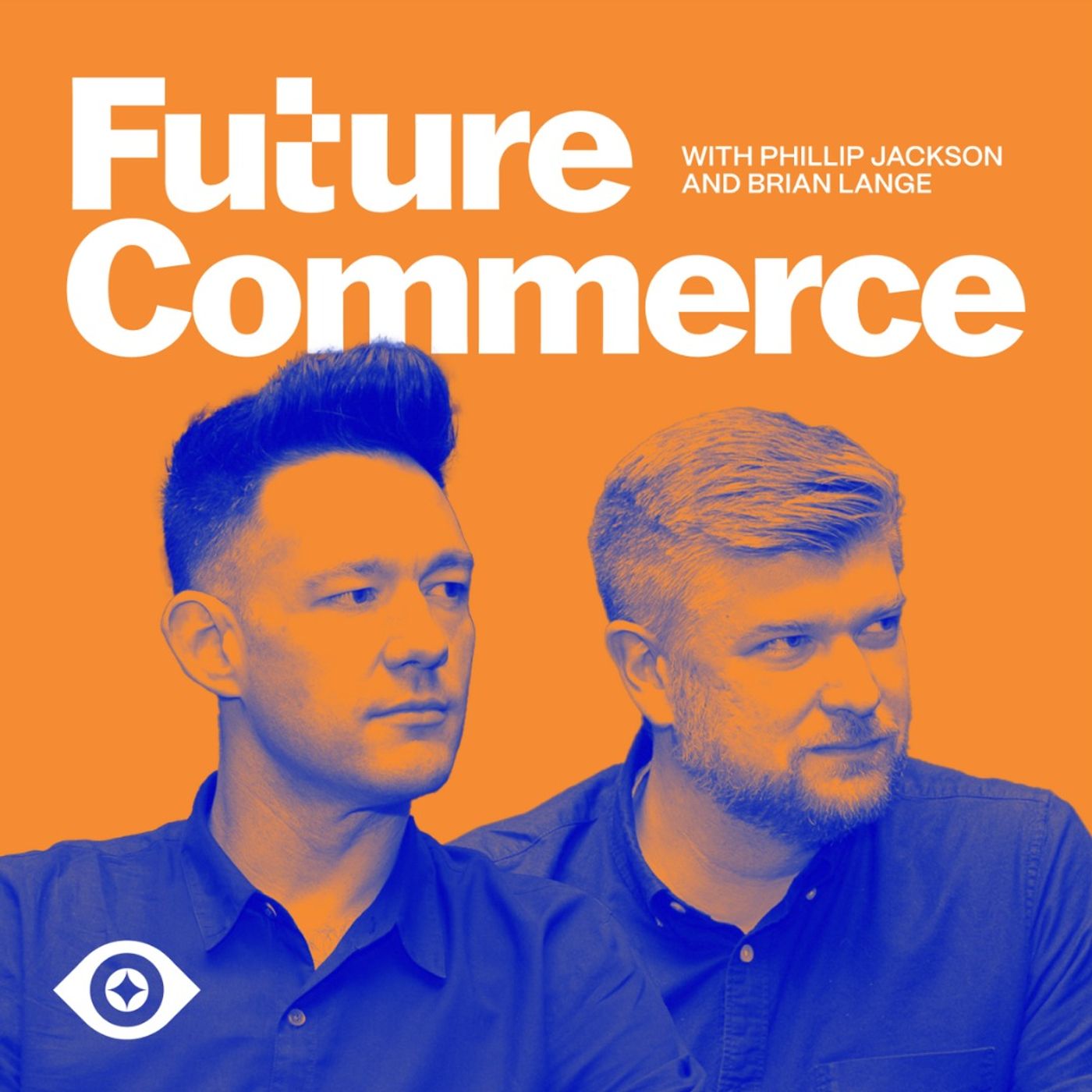
Future Commerce
Phillip Jackson, Brian Lange
Future Commerce is the culture magazine for Commerce. Hosts Phillip Jackson and Brian Lange help brand and digital marketing leaders see around the next corner by exploring the intersection of Culture and Commerce.
Trusted by the world's most recognizable brands to deliver the most insightful, entertaining, and informative weekly podcasts, Future Commerce is the leading new media brand for eCommerce merchants and retail operators.
Each week, we explore the cultural implications of what it means to sell or buy products and how commerce and media impact the culture and the world around us, through unique insights and engaging interviews with a dash of futurism.
Weekly essays, full transcripts, and quarterly market research reports are available at https://www.futurecommerce.com/plus
Trusted by the world's most recognizable brands to deliver the most insightful, entertaining, and informative weekly podcasts, Future Commerce is the leading new media brand for eCommerce merchants and retail operators.
Each week, we explore the cultural implications of what it means to sell or buy products and how commerce and media impact the culture and the world around us, through unique insights and engaging interviews with a dash of futurism.
Weekly essays, full transcripts, and quarterly market research reports are available at https://www.futurecommerce.com/plus
Episodes
Mentioned books

Dec 9, 2019 • 43min
[Step by Step] Retail Funding 101 (Jordan Knapp, Jamie Oliver, Shopify Plus)
Have you ever wondered how to get funding for your retail business? Wonder no more! In a new series from Future Commerce - the number one retail podcast - we walk you through all that you need to know in order to build and exit from a successful retail business. In partnership with Shopify Plus, we'll take you from zero to hero, Step by Step.
#Show Notes
Brian and Phillip are joined by Jamie Oliver and Jordan Knapp from Shopify Plus to discuss funding for your eCommerce store in a new part of the Future Commerce Shopify series.
This series is targeted towards the merchants with online stores between the $1 million and $5 million range and entrepreneurs that want to think through the avenues of raising capital.
How do you choose what type of capital would be the best fit for your brand?
What are the steps my brand should take to attract an investor, and how do I make the investment process easier?
Main Takeaways:
Introductions and Dreams: Helping Merchants Achieve Their Goals:
Jordan leads the Market Development team but has been in eCommerce for the majority of his career.
A year and a half ago, Shopify set out to explore new channels and see where they could place Shopify Plus in the market to expand it in new directions.
One of the ideas between Jamie and Jordan was about the fact that very few of the merchants are selling on Shopify without bigger dreams or aspirations.
Their goal has been figuring out who the investors to empower Shopify merchants to get the funding best suited for their needs, and thus, in the Investor Collective was born.
Scaling and Growth: How Shopify Plus Grew:
Jamie joined Shopify in 2014 on the HR side was responsible for hiring for Shopify Plus just as it was starting.
The needs and wants of the merchants on the platform were pivoting, and the Shopify Plus team scaled in a way to meet these needs.
In 2018, Jamie left the recruitment team and decided to join Jordan's product development team.
The Investor Collective is integrating with venture capital and private equity firms.
Venture Capital vs. Private Equity: What's the Difference?
In terms of investment firms as a whole, the motto is value creation on repeat; their main functions are to source and acquire companies, improve the operations of those companies, and then either sell those companies or go public.
Venture capital tends to look at earlier seed-stage business and often takes a minority stake in the company in addition to offering their expertise and talent pool.
On the private equity side, they are looking to take a bigger stake in the business and will typically provide a lot of capital to take that business to the next level.
Understanding the options available to you is extremely important.
The Reason Behind the Series: Why Partner With Future Commerce?:
After digging into the Shopify Plus merchant base, the Shopify Plus team came to realize that a substantial portion of their merchants had garnered some form of investment throughout their lifetime.
If they can assist merchants looking to obtain capital and provide them with more information, then everyone benefits.
There are a lot of negative rumors and misinformation floating about regarding investing, but arming yourself with knowledge can prevent these.
When it comes down to the contract, it is always negotiable, so knowing what you are trying to do is imperative in the process.
The Investors Collective: Going Beyond the Deal:
The Investors Collective is a partner program that interfaces with venture capital and private equity firms that are actively investing in consumer products in the retail space.
Shopify Plus also hopes to educate investment firms and their portfolio companies about Shopify Plus and the capabilities of the platform.
The collective provides expertise, a lifeline for information, and when investment firms have opportunities, they receive complete white-glove service.
At the end of the day, the objective is not just to build a cool network but to evangelize why Shopify Plus is the right platform for the DTC entrepreneur.
Making the First Step: What is Right for Me?:
Phillip asks Jordan and Jamie to put themselves in the shoes of a merchant who might be looking for capital and to walk them through the beginning steps of choosing what type of funding to pursue.
In any situation, any time you accept cash, you are giving up some control, so if you can fund yourself, try to do that.
Consider an accelerator because you are getting actual resources to assist your growth as opposed to just cash.
The average VC investment in 2019 for an angel seed was about $1.8 million.
Series A refers to the first time you get money, Series B is the second, and so on.
What Comes With Money: Some Advantages of Funding:
Some advantages of accepting money are that success is incentivized for your investor, so they want you to succeed, and an injection of funding can help you achieve your goals.
Operational expertise also comes along with your investor, along with a conglomerate effect that comes with discounts across the parent company's network.
There is a spectrum that ranges from the gross side to the cost reduction side when it applies to your company.
Without early and midstage investments, there wouldn't be any businesses without taking on some risk.
The Struggle of the Firms: Challenges in Today's Investment Environment:
The biggest challenge present today is that there are a lot of new funds, and everyone is trying to raise a new round.
If you are an entrepreneur looking for investment, this is probably the best time to pursue investment due to the influx of funds available to you.
This makes it difficult for VC firms because there is more capital available than there is opportunity.
With this new paradigm of available capital, how do brands know which type of funding is the best fit for them?
Finding the Right Fit: Investor Matchmaking:
Figure out what you want in your firm: do you want a firm that is going to let me be autonomous or do you want a firm to be very hands-on with your business?
There needs to be a firm that links the right amount of capital as well as lines up with your short and long term needs.
Look at the brands that the firm has worked with in the past and see what those brands have done after receiving capital.
A true digital agency is always needed for a DTC eCommerce brand, so some firms are building a suite of services to fit all of these needs.
The New Breed of Merchant: Where is Retail Headed?:
How can investment drive this new age of DNVBs?
Anyone can be anything that they want with all of the resources available today, so it all comes down to a brand's influence and customer service.
This environment puts the power back into the hands of the artist, and none of this would happen if it wasn't for investors empowering creativity.
How would you embrace your entrepreneurial side if you obtained the perfect investment?
Attracting an Investor: What Makes Me Stand Out?:
With the immense opportunity in the retail space, private equity firms are starting to play a significant role in accelerating the growth of brands.
Get out there and make your brand known and make connections that can build connections with private equity firms.
Come to the table prepared with the type of data and information that is required of the firm to do their due diligence, and if not prepared ahead of time, make sure to make time to get this information.
Raising capital is a full-time job, and a lot of brands don't realize just how time goes into the process of raising capital, so set priorities.
Get your hands on a due diligence document and start preparing your data and your company for investment.
Brands Mentioned In This Episode:
Shopify Plus
As always: We want to hear what our listeners think! What are some steps that you can take right now to prepare the road to investment?
Let us know in the content section on Futurecommerce.fm, or reach out to us on Twitter, Facebook, Instagram or Linkedin.
Have any questions or comments about the show? You can reach out to us at info@futurecommerce.fm or any of our social channels, we love hearing from our listeners!
Retail Tech is moving fast, but Future Commerce is moving faster. Hosted by Simplecast, an AdsWizz company. See pcm.adswizz.com for information about our collection and use of personal data for advertising.

Dec 7, 2019 • 1min
Coming Soon: Step by Step, a New Series
Have you ever wondered how to get funding for your retail business? Wonder no more! in a new series from Future Commerce - the number one retail podcast - we walk you through all that you need to know in order to build and exit from a successful retail business. In partnership with Shopify Plus, we'll take you from zero to hero, Step by Step. Hosted by Simplecast, an AdsWizz company. See pcm.adswizz.com for information about our collection and use of personal data for advertising.

Dec 4, 2019 • 55min
"The High and Low Can Exist Together" w/ Jeff Carvalho, Highsnobiety
Zine culture in the 90s bred the digital-first content brands of the 2000s, which have led to thriving online marketplaces where content begets commerce today. The best example we can think of is a digital property called Highsnobiety, which tracks the intersection between urban culture, streetwear, and luxury. In this episode Jeff Carvalho, co-founder of Highsnobiety, joins us to talk about how commerce is their next great investment and how it's bringing their readers closer than ever before. Hosted by Simplecast, an AdsWizz company. See pcm.adswizz.com for information about our collection and use of personal data for advertising.

Nov 22, 2019 • 1h 9min
"Subscriptions Are a Tool, Not a Model" (w/ Mike Lackman - CEO, Trade Coffee)
Two of the smartest people we've ever had the pleasure of interviewing join the show this week! In our main interview, Mike Lackman, CEO at Trade Coffee joins the Future Commerce team to talk about how subscriptions and curation are driving user adoption and repeat business at Trade Coffee. In our "what's new and what's next" segment at the end of the show, Hitha Herzog, retail analyst and author of 'Black Market Billions' joins us to talk Nike's Amazon Exit, Coty's $600MM Kylie acquisition, and the effect of counterfeits on the marketplace during Holiday 2020.
Trade Coffee Coupon Code
Save 30% off your order of Trade Coffee with coupon code FUTURE
Listen now!
Show Notes
Main Takeaways:
Mike Lackman, CEO of Trade Coffee joins Brian and Phillip on today's episode and he brings with him a coupon code.
Trade Coffee is bridging the gap between a marketplace and a retailer, and are making quite the disruption in the process.
Educating customers not only makes them happier with their shopping experiences, but also moves the success up the production funnel.
Hitha Herzog, retail analyst and author of Black Market Billions, joins us to take us through the acquisition of Kylie Cosmetics and other happenings in the world of retail.
Coffee and Vocabulary: Empowering Coffee Consumers:
Phillip was at a hipster songwriting circle in Nashville and four of the ten circle participants said that Trade Coffee was inspiring them recently.
Mike says that Trade Coffee does two things very well: it connects consumers to the country's very best roasters and craft coffee and it also helps roasters across the country reach consumers in a way that has never been done before.
In their research, Trade Coffee found that consumers are completely lacking in the vocabulary that enables them to decide the way they want their coffee to taste.
If people are more aware of their choices, they are going to be in demand of certain things that craft roasters will then be able to supply.
Unexpected Outcomes: Breaking the Mold:
All the CPG professionals that assessed Trade Coffee early on said that it was going to be a tasting journey in which consumers would find their perfect coffee and then have that coffee be delivered repeated.
In actuality, more than 95% of Trade Coffee's consumers have expressed an appetite for continual discover of new coffees rather than the ability to repeat a single SKU.
This consistent desire for discovery is the key to Trade Coffee's business.
Spotify and music streaming services have trained us to go find new things all the time, and that training is extending into consumer goods.
The Coffee Calling: How It Started:
A failed Latin teacher by training, Mike was excited by the small team at Trade Coffee when he first found the brand.
Trade needed someone who not only understood the digital marketing business but also someone who understood the hard operations side of the business.
Mike was also a very frequent drinker of coffee who knew nothing about it and the curistic process of getting to know the Trade Coffee team really highlighted the problem that needed to be solved.
Brian met Mike at Grocery Shop where they discussed marketplaces and the role of a niche marketplace in today's economy.
A Niche Marketplace Hybrid: Blurring the Lines:
The lines between what makes a retailer and what makes a marketplace are getting blurry.
Mike thinks of Trade Coffee more of a retailer because all of their product is made on demand, but there are definitely some marketplace-like dynamics.
Having differentiated inventory with reasonable availability that is unlocked by curation and matching is what Trade labels as the keys to their success.
The coffee drinker who is making coffee at home is likely a grocery shopper that shops at a brick and mortar location, so how do you convince that shopper to buy online?
Changing Habits: Taking Coffee Buying Online:
Trade's mission is to turn coffee drinkers into coffee lovers, not to be the coolest, hip store for people who already know a lot about coffee.
For the first year, establishing credibility to match consumers with their ideal coffee and removing the risk from that has been a focus.
Going one step further, being able to show the way they interpret (with granularity) the answers to the questions that Trade asks is also important.
The story of the roasters, the art on the bag, and the testimonials are all icing on the cake to get people to start trusting their coffee purchases to online retailers.
The Customer Relationship: What Does the Future Hold?:
One of the big trends that Brian and Phillip called at the beginning of the year was guided selling and the education of the customer, something that Trade is excelling at.
By adding what is traditionally considered friction to the purchase process, Trade has broken the mold regarding educating their customers, and they are looking to add even more friction in the future.
If you're figuring out how to partner with great merchants that can make your insights actionable, then all of the data you are collecting won't be used to its full potential.
Trade tests their product extensively so that they provide credible recommendations.
Choose Your Own Depth: Similarities to Spotify:
A lot of comparisons are drawn between Trade Coffee being like Spotify, but Phillip thinks it's more like Stitch Fix.
You can choose how deep you go into Spotify; you can either just push play or you can dig into any of the additional features as well as the artist biographies.
Trade Coffee has customers that run the whole spectrum of involvement of the information at their fingertips.
You have to carefully select what group of customers you design experiences for.
Mistakes Along the Way: Personalization Woes:
With so many different flavor profiles and customer types, one of the first mistakes that Trade made was when they tried to be too exact with their product matches.
Customers like covering as much ground as possible within a tight enough circle and don't necessarily want the same type served to the over and over again.
Trade can use the data they have garnered along the way to empower roasters to create high quality product.
One of the most important forms of feedback that Trade can get from their customers if they keep buying product.
Subscriptions and Partners: Defining Important Roles:
Subscriptions are a tool and not a model and being non-discretionary is imperative to Trade Coffee.
Trade takes the role of matchmaker and the role of the craft coffee producer is to do what they're great at: producing amazing artisan coffee.
You have to recognize the limitations of the matchmaking model; Trade can't use Instagram in the way that others do because photos do not explain what they do.
Recognizing where you fit in the business model and tackling those limitations are keys to success.
Finding the Perfect Fit: Which Model Works for You?:
If you are not upsetting things from a channel conflict perspective at least a little bit, you're probably not trying hard enough.
Mike brings up that he listened to the episode with RXBAR CMO Victor Lee and says that for the consumer that wants different stuff every time, Trade is a very good fit, just like RXBAR fits so well into the grocery store model.
Trade is happy to empower their customers with their power to make their own decisions and doesn't force them to stay in the channel.
Rent the Runway is a great analogous example to what Trade Coffee is trying to do.
Armed With Knowledge: The Power of the Smart Customer:
Consumers don't have a way aside from artwork and buzzwords to differentiate between what coffees are good and which are not.
If Trade can empower their customers to determine what is good for them based on the way it tastes, then growers are roasters are able to distribute their product based on quality of taste in the eyes of the consumer.
You have to move value up the supply change, and educating your customers does just that.
Trade tries to base decisions based on behaviors and not on demographics.
The Millennial Boomer?: Or the Baby Millennial?:
Baby Boomers are starting to adopt practices and habits that they might have turned their noses up towards a few years ago.
The Millennial design aesthetic has become a stamp of approval for brands in regards to what customers are seeking out.
Brands are finding success in older generations by catering towards millennials.
How do you bridge the gap between generations?
The Next Five Years: Predictions for the Future:
Mike predicts that grocery is going to encounter some of the same disruption that retail and other industries have seen.
The model is not going to be disrupted by putting more product on shelves and letting customers sort it out themselves.
By continually improving their processes, Trade is going to be able to deliver consistently enjoyable shopping experiences to their customers.
It all depends on the market and what consumers want, but if you bundle everything under the umbrella term "grocery", you're probably on the wrong path.
Unabashedly Opinionated Opinions: Meet Hitha Herzog:
For the closing segment Brian and Phillip are joined by Hitha Herzog, retail analyst and author of Black Market Billions.
Phillip can't believe that Hitha doesn't like Jerry Seinfeld.
She would take Larry David over Jerry any day.
Hitha is here to talk us through some huge news in the world of online makeup sales.
Coty Acquires Kylie: A Makeup Giant Acquisition:
Coty, Inc. acquired a 51% stake of Kylie Cosmetics for $600 million dollars, valuing the cosmetics company at $1.2 billion.
Kylie is the most followed person on Instagram and the revenue from the makeup company was estimated at $117 million.
Kylie and her team have organized scarcity with their product which has led to an enormous demand.
When the products first launched, the Kylie Cosmetics Lipkits drove a sense of urgency by only releasing a set amount of product.
A Giant Departs: Nike Leaves Amazon:
Nike is about to stop selling on Amazon.
Nike is moving to a more direct to consumer model and cutting out the middleman.
They have the ability to reach and directly market to the consumer base that is buying their product.
Getting off of Amazon also mitigates the possibility of counterfeit product being sold through the platform.
Changing Models: How Shopping Has Evolved:
20 years ago, shopping was a destination so it was an effort to shop, but today, the mall is as close to you as your phone.
We no longer have to go to edifice to buy our stuff.
Brick and mortar is now much more geared toward experiences as opposed to the actual purchasing of products.
Nordstrom just opened a flagship store in Columbus Circle that is all about the experience of shopping.
Brands Mentioned In This Episode:
Trade Coffee
Spotify
Stitch Fix
Rent the Runway
Coty, Inc.
Nike
As always: We want to hear what our listeners think! How can you educated your customers to make them warriors for your brand and increase LTV?
Let us know in the content section on Futurecommerce.fm, or reach out to us on Twitter, Facebook, Instagram or Linkedin.
Have any questions or comments about the show? You can reach out to us at info@futurecommerce.fm or any of our social channels, we love hearing from our listeners!
Retail Tech is moving fast, but Future Commerce is moving faster. Hosted by Simplecast, an AdsWizz company. See pcm.adswizz.com for information about our collection and use of personal data for advertising.

Nov 15, 2019 • 1h 6min
"Local is Power" (feat. Alistair Crane, CEO @ Hero)
We all need Heroes - and Alistair Crane and recurring guest Ingrid Milman Cordy join us today to talk about how any retail business can become a Hero to their customers. PLUS: Shoptalk's own Zia Wigder joins us to talk about their decision to program only female speakers in their 2020 event. Listen now!
Join FC INSIDERS, a newsletter essay with deep insight you need to guide the future of your retail business, technology, or agency. Subscribe today.
Show notes
Main Takeaways:
Ingrid Milman Cordy from e.l.f. and the CEO of Hero, Alistair Crain join Brian on today's episode to talk about Hero.
Bridging the gap between in-store associate interactions and online shopping behaviors is an extremely powerful tool.
There is massive untapped potential in local and smart brands are starting to make moves.
Zia Wigder from Shoptalk joins Brian and Phillip to discuss an enormous announcement about Shoptalk 2020.
A Brief History: Alistair Crain and Hero:
Alistair has always been in technology and he was previously the CEO of a company called Grapple that was acquired by a Visa subsidiary.
He came over to retail about five years ago when an old friend of his had an idea of connecting associates that are in-store with customers that are browsing on the website.
With a standard retail cycle, there are periods when associates in-store have availability to be helping customers but there are no customers in-store.
Hero gives associates and store teams the power to connect live with customers who are shopping on the store's website and gives customers guidance through video and live streaming that gives them a better shopping experience.
The Decline of Footfall: Combining Physical and Digital:
Why is it important to engage both the physical and digital in one place?
Over the past 5-10 years, messaging has become the single biggest use of mobile phones and even before the start of Hero, customers and associates were connecting through means of social media.
In tech, technology usually tries to "create the wave" but Hero filled a need for a trend of communication that was already happening.
Sales that happened from these online interactions were not being attributed to store targets, so Hero provides stores a professional, secure, and trackable method of associate to customer interactions and sales.
Traditionally Luxury: Unlocking High-End Interactions for Smaller Businesses:
Associates connecting on a one to one basis with an online customer is a high-end experience that naturally lends itself to the luxury market.
Traditionally, only bigger brands (usually in the luxury space) would have an eCommerce and online footprint large enough to accommodate direct communication with online customers, but Hero unlocks that potential for smaller brands.
Younger, technology competent people just want to shop and just want the ability to find out quickly if an item is in stock and where they can get it.
Sneaker companies have been adopting this communication trend and have been using it in more and more innovative ways.
The Importance of Local: The Future of Commerce:
There has been a trend on the show highlighting the importance of local when it comes to commerce.
Doesn't it make the most sense to connect with local representatives when customers are interacting online?
You should also put stores where you already have business, and this can be discovered through communication tools like Hero.
How can you make the most of existing online customer interactions?
The Shift of Messaging: The Death of Omnichannel?:
A few years ago, omnichannel was omnipresent at conferences and events, but today, it is a word that is barely mentioned.
Omnichannel communication is now a part of everyday business and not just a sideshow.
Brands with heritage and locations around the world have a big advantage with their physical footprint against online exclusive giants like Amazon because they can provide an actual experience to their customers.
Smart retailers are making local pay with authentic local experiences by making their online customers come into stores.
The Power of Knowledge: Expertise Seals the Deal:
Alistair brings up Ace Hardware as an example of an extremely authentic brand that demonstrates the power of associate expertise when it comes to assisting customers.
Online DIY stores are overwhelming and it is so much more reassuring when an associate with expertise helps you with your questions.
Store influences have the power to serve as local influencers for your brand.
How are you capitalizing on your store associate's expertise?
Lingering Connections: Extending The In-Store Experience:
Customers remember positive in-store interactions long after their time spent physically in the store.
Ingrid mentions how powerful it is when she receives a text from her trusted Lululemon associate that there are new items in store (which she usually ends up buying.)
Brian brings up how impressive the knowledge was of the associates was on a recent trip to Everlane.
Smart brands are brands that are encouraging and rewarding their associates for creating unique and personalized content.
Bringing Local Back: Massive Untapped Potential:
Brands are ignoring the fact that local retail space is reasonably priced and there is so much opportunity in local that is not being tapped.
Brian harkens back to the recent episode with Ishani Gujral in which he came up with the idea of a bidding system for large retailers to bid on local retail space.
Alistair brings up Appear Here that serves as an Airbnb for retail space.
There is a lot of macroeconomic pressure to make your business successful before you even open the doors to your first location.
Bigger brands like Etsy are starting to take advantage of the untapped potential of local.
Your Biggest Assets: Your People and Places:
The people that work for you and the locations where your brand reside are the most important assets you have.
Invest in your employees: give them a living wage, encourage their growth, and empower them to make them the best representations of your brand.
There is a lack of willingness in big retail to take any risk.
Tech players take multiple year strategies, and retailers need to find a way to make some riskier decisions that will pay dividends in the future.
Unselfish Experimentation: Non-Traditional Returns:
Everything you do does not have to have a direct influence on your P&L and there is a reason to do some unselfish experimentation.
You have to try some things that are not going to work because the knowledge of things that don't work is just as important as knowing what is lucrative.
Experimentation is part of Amazon's makeup and they fail quickly and hard, which allows them to constantly be on the cusp of innovation.
How can you unselfishly experiment with something this quarter that you wouldn't normally try to pursue?
Predictions and Inklings: A Postive Recession?:
Alistair has been wondering if we've been heading into a recession and thinks that Q1 and Q2 of 2020 are going to be very interesting.
A recession would flush out the brands that aren't even living up to their own core values and Alistair believes there is too much funding floating around and not being used efficiently.
Alistair wants to turn website traffic into actual footfall in-store and he is going to invest in companies that makes this happen.
There has never been such a good time for product innovation on both the tech side and the retail side so take some risks.
Shoptalk 2020: Women in the Spotlight:
Zia Wigder from Shoptalk joins Brian and Phillip to talk about the big news that Shop Talk 2020 will be 100% female speakers.
There needs to be change in this industry, change is happening too slowly, and Shoptalk is making a stand with this decision to expedite this change.
Zia goes into some of the criticism and opposition that has arisen with this decision but has been surprised that the vast majority of feedback has been positive.
You need a transformational step to drive change because incremental steps are not effective.
A Big Change: Piloting a Shift in the Industry:
In 2021, men will be included again the lineup, but the ration will forever be 50/50 from now on.
This change resonates with the social conscious dynamic in the industry and Phillip predicts it will be massively successful.
Zia is not worried in the slightest about finding the talent for the talks, but the challenge will be to find a list of speakers in the right topics.
You can apply to speak on the Shoptalk website along with many more ways to get involved with the event.
Brands Mentioned In This Episode:
Hero
Ace Hardware
Lululemon
Everlane
Appear Here
Etsy
E.l.f.
Shoptalk
As always: We want to hear what our listeners think! What are some ways that you could unselfishly experiment with your brand? How can you empower your employees to become the best representatives for your brand?
Let us know in the content section on Futurecommerce.fm, or reach out to us on Twitter, Facebook, Instagram or Linkedin.
Have any questions or comments about the show? You can reach out to us at info@futurecommerce.fm or any of our social channels, we love hearing from our listeners!
Retail Tech is moving fast, but Future Commerce is moving faster. Hosted by Simplecast, an AdsWizz company. See pcm.adswizz.com for information about our collection and use of personal data for advertising.

Nov 8, 2019 • 57min
"No Money. No Sales. No Customers. Start From Absolute Zero." (feat. Megan Whitman, CDO @ Kopari Beauty)
Brian bought 5 different mattresses and lives to tell the story. Phillip reviews DTC candle brands. Yes, really. ALSO: the guys sit down for an amazing interview with Megan Whitman, the Chief Digital Officer at Kopari Beauty, who joined us to talk about her experience growing the digital channel from "absolute zero". Kopari today is available everywhere from sample boxes to Ulta and is partnering with the likes of Drybar to reach even more customers.
Show Notes
Main Takeaways:
In today's episode (in a new format by the way), Brian and Phillip interview Chief Digital Officer at Kopari, Megan Whitman at Klaviyo: BOS.
Once a brand reaches a certain level of success, what are the benchmarks for measuring that success past standard KPIs?
Buying a bed online can sometimes not be a smooth process.
Brian and Phillip don't understand the online candle business or how people buy scents without first experiencing them.
Coconuts and Asymptotes: A Brief Introduction and a Fated Meeting:
Brian has a theory about asymptotes and was riffing on this idea with Phillip when he was overheard by Megan who joined in the conversation.
Megan was the first employee at Kopari, a coconut-based beauty company that has been around for about three and a half years that sells mainly on their direct-to-consumer site.
Kopari still mainly focuses on its direct-to-consumer business despite being in large beauty retailers because they care about what their customers want and want to create real relationships with them.
It all started around coconut oil and how this miracle ingredient can enhance various beauty products, but as the company grew, more parts of the coconut began to be used in Kopari's products.
From Nothing To Game-Changer: A Keynote-Worthy Journey:
Megan was one of the keynotes at Klaviyo: BOS and gave a great talk about how to fool your brand's growth one stage at a time.
When Kopari first launched, starting from nothing and bootstrapping everything became the best learning experience for Megan as she had a hands-on connection with all of the technologies used to grow the company.
Tools like Klaviyo have become so good that it makes it possible for brands to go to market quickly and provide great experiences for your customers.
Megan used to work at an agency before she joined Kopari and recounts how tools like Optimizely allowed marketers to create customer experiences easily and on their own.
Two Different Approaches: Nostalgia Brands vs. Modern Brands:
Phillip comments that nostalgia or legacy brands typically approach innovation with a lot of thought and deliberation while planning an intricate series of things, but more modern brands are executing on the fly and learning as they go.
Megan admits to doing things on the fly and the expectation of doing things on the fly is ingrained in the culture.
There has to be a healthy balance of doing things quickly and not doing too many things at one time that might result in conflicting messages to your customers.
Brian points out that technology has set the stage for the expectation of things to be done quickly.
Timing is Key: What Makes Modern Brands Different?:
Modern brands compete in a lot of different channels, while doing a lot of different things at the same time, all while telling different stories; so how do you balance this?
Timing is the key, and it is a very difficult thing to master.
You don't have the attention of customers for a long enough time to tell them everything about your brand, so you have to test to find out what they want to hear.
Which of the stories you are telling actually ties your customers back to your brand?
Evolving Metrics: Going Beyond the Sale:
A brand reaches a turning point once they start looking beyond basic sales metrics to measure whether or not they are successful as a brand.
Kopari has had a tough time deciding what their metric for success is beyond the sale (even though the sale is always the goal).
Soon, Kopari is going to run an experiment with customers who do not know the brand in which they will be shown one specific story via advertising during the test period and at the end of this test period, they will be asked if they know about Kopari.
This test will show what marketing story resonates the most with Kopari's customers as well as to measure other more qualitative KPIs.
The Capture Dilemma: Sales vs. Customers:
Phillip brings up Greats (which was recently acquired by Steven Madden) in a discussion about capturing a sale vs. capturing a customer.
Megan admits that Kopari has been traditionally more focused on the sale, but recently has been shifting from focusing on being a product company to being a brand.
How do you take the stories you have and leverage them to reach your customers in meaningful ways?
If you don't have a thoughtful and socially conscious start to your business in today's social environment, why are you even starting a business today?
Owning It: Connecting With Your Customers:
With today's technologies, it has never been easier to reach out directly to your customers in order to hear their thoughts and opinions.
What's even better is that customers enjoy giving their feedback and participating in the development of brands that they have a connection with.
More than ever, brands are striving for actual relationships with their customers as opposed to just storytelling alone.
How do you create meaningful connections with your customers, and how can you improve those that already exist?
Collaboration Nation: Finding Customers Through Other Brands:
Phillip has noticed that Kopari has been doing a lot of collaborations and asks what a strategy might be to identify potential customers through the existing customers of the brands you are collaborating with.
How deep do you take a partnership with a brand and how do you identify this level of involvement?
Megan gives some background on Kopari's collaboration with Drybar and gives some details on why this collaboration has been successful.
Even if your customers are not the exact same as the customer of the brand you are collaborating with, you have the potential to reach customers in different channels.
Megan's Advice and Predictions: A Future Commerce Sendoff:
Brian asks Megan what she thinks is imperative for DNVBs to be focusing on the next nine months as well as what she sees happening in the space fin the next 3-5 years.
One thing that drives Megan nuts is with the sheer amount of channels used to reach your customers, we need to figure out how to deliver the right message, for the right customer, in the right channel, at the right time.
How do you decide on what message to deliver per channel to your customers?
Is this something that can be solved with a tool, or is this more of a strategical approach?
Sleep Time Woes: The Online Mattress Shopping Journey:
Brian and Phillip both recently purchased some mattresses and take us through their experiences in buying beds online.
Brian originally had a Zinus and eventually bought the Wayfair Sleep mattress (which didn't go well) which they switched for a Nora Mattress (which they also didn't like) and eventually bought a Casper mattress from Costco.
When Brian and his wife inevitably didn't like the Casper mattress either, he had to physically return the mattress to Costco.
Buying mattresses in a store is probably a really good idea, but in case you need to return your bed, Phillip goes into detail on Casper's return process.
Blind Purchasing: Buying Something Online Without Experiencing It First:
There is a whole slew of products out there that simply don't make sense to buy online before physically experiencing them. (According to Brian and Phillip).
Otherland is an online candle brand that Phillip compares with the not digitally native D2C Yankee Candle.
Malin and Goetz, Snowe, and Year & Day are all more examples of online candle brands that Phillip wants to explore because he simply doesn't understand how you can buy a candle without smelling it first.
Brands that already have scents make an easy jump when incorporating that scent into candles.
Brands Mentioned in this Episode:
Kopari
Klaviyo
Optimizely
Greats
Drybar
Zinus
Casper
Tuft & Needle
Otherland
Malin and Goetz
Snowe
Year & Day
As always: We want to hear what our listeners think! Do you like the new format? How can you identify which stories to send to certain customers to reach them in the most impactful way?
Let us know in the content section on Futurecommerce.fm, or reach out to us on Twitter, Facebook, Instagram, or Linkedin.
Have any questions or comments about the show? You can reach out to us at info@futurecommerce.fm or any of our social channels; we love hearing from our listeners!
Retail Tech is moving fast, but Future Commerce is moving faster. Hosted by Simplecast, an AdsWizz company. See pcm.adswizz.com for information about our collection and use of personal data for advertising.

Nov 1, 2019 • 1h 16min
Tracksmith: Unapologetically Premium (feat. Matt Taylor, CEO)
A NEW FORMAT. BOOM! In part 1 of #132: Matt Taylor created something special when he created Tracksmith. Based on heritage and collegiate styles, Tracksmith has redefined outdoor apparel in a space that is dominated by household names and global retailers. In the second half: LVMH bids on Tiffany and Sucharita Kodali of Forrester gives us the low-down on 180-year-old brand.
Show notes
Main Takeaways:
Brian and Phillip are joined in today's episode by Matt Taylor, the Co-Founder and CEO of Tracksmith and they are recording today's episode at the Trackhouse in Boston.
Tracksmith is geared towards dedicated runners and has fostered a dedicated fan base based on those values.
With customer acquisition costs on the rise, where should your brand focus its efforts to make the most out of your hard-earned dollars?
Capturing the passion you have for your brand helps identify your ideal customers, and is invaluable when it comes to developing your brand's identity.
Heritage: An Accurate Description of Tracksmith of a Brand:
Matt recalls the first time the brand was in the Trackhouse back in 2015 when Tracksmith used the building as their first pop-up location.
As a runner for his entire life, Matt has been involved in running since middle school, which makes running a big part of his life.
After college, Matt got more and more interested in running, and before starting Tracksmith, he was the Head of Marketing for the Running and Training categories at Puma.
He built an iPhone game with Usain Bolt before the 2012 Olympics that gave him a bridge to take a year to work and develop Tracksmith.
A Powerful Combination: Fusing Interest and Passion:
Tracksmith is described by Matt as a combination of personal interest and passion, but also a representation of his years of experience in the industry.
There is a lot of talk about timing within the market when it comes to starting a business, but very few people talk about the importance of timing in a founder's personal life.
There is always a risk when starting your business venture and everyone's situation is different.
What personal factors contribute to an ideal environment if you were to leave a corporate job and start your own venture?
That Tracksmith Feel: Diversifying Against a Giant:
Hailed as an Anti-Nike, Tracksmith has developed a unique feel and has a special way they have decided to tell their story.
You can't manufacture authenticity, it has to come from a sincere place and for Tracksmith, that authenticity comes from a genuine passion for running.
As other running brands have grown, they have left behind a void in the market that is comprised of the core, committed running consumer.
Tracksmith has made it a mission to serve the dedicated running audience, and it is something they constantly check in with to make sure they stay on message.
The Pressure to Grow: Navigating a Harsh Environment:
There is a lot of pressure to grow in the current environment, especially if you are venture-backed.
Brian asks Matt if he thinks that it's inevitable for Tracksmith to broaden its horizons given the constant push for growth.
Matt doesn't think that will happen any time soon because there is such a consistent market in the running vertical so there is no pressure to build a multi-billion dollar brand in the immediate future.
Where is the line drawn between staying true to a core customer and growing to reach other customer sets?
Who Is and Who Isn't?: Identifying Your Customers:
There is a very strong feel to Tracksmith, so Brian asks if Matt thinks that this strong feel is exclusionary in any way.
Tracksmith does not view their brand as exclusionary, but rather aspirational which can sometimes feel far away for some people.
People tend to think negatively first instead of coming together to build something up.
Tracksmith is geared towards people that have made running a part of their identity, and overcoming obstacles is especially poignant to that group.
Selective Partnering: How to Choose Compatible Brands:
Phillip is interested to know what Tracksmith's approach is when it comes to partnering with other brands.
Tracksmith partnered with Rowing Blazers after they did a pop-up close to the Trackhouse and quickly realized that both brands shared a passion for their respective sports.
Team endurance sports specifically become harder post-college due to the difficulty of finding a crew, so there was hope for discovery in partnering with Rowing Blazers.
Tracksmith just announced a partnership with outerwear company Boathouse as well as a partnership with Article One Eyewear.
Facilitating Community: How To Foster Relationships With Your Brand:
From the beginning, physical interaction was very important for Tracksmith for their customers to connect with their product.
Most brands in most spaces don't have an opportunity to create a community, but the running community already exists even before they purchase anything.
Tracksmith was hosting runs from inception, but having a location in Boston facilitates the community even further.
Boston is unique in the running world as it holds a special space in the minds of the running community.
CAC On The Rise: What It Costs to Run a Business in 2019:
A connection that is outside of the purchase experience is trending to be the main way that brands are reaching their customers.
There is an opportunity for Tracksmith to build longer-lasting relationships via print due to its very visual nature.
Over time, unselfish content builds a stronger connection with your brand but is very hard to draw a straight line back to your revenue.
Tracksmith's biggest driving force for content is photography; pictures and words drive everything else they do.
Patience is a Virtue: Emotionally Capturing a Brand:
Tracksmith specifically takes extra time to highlight the runner themselves, and that is comprised of more than just the run itself.
If you do care deeply about something, there is a process that you go through that bypasses our current world of instant gratification.
Matt grew up in a family of makers, and when you grow up around that, he was immersed in the value of something that is handcrafted with time and love.
Running is in such stark contrast to the world of today where everything is so instant.
Building Up Your Employees: A Major Key to Success:
Employees are the face of your brand and provide your customers with their experience with the brand.
Relationships with customers are starting to supersede your story when it comes to building brand loyalty.
Tracksmith naturally attracts employees who are passionate about running, and that passion comes across in customer interactions.
Phillip has personally experienced the employee passion at Trackhouse when an employee recognized him from an interaction that was months ago.
Pursuing Your Passion: Advice for Other Founders:
Phillip asks Matt if he has any advice for other founders that are considering taking a risk and pursuing their passion.
A lot of people want to give you advice, but a lot of that advice is specific to their personal experience, and this doesn't necessarily apply to you.
Absorb as much information and advice as you can, but you need to discover what makes your situation unique.
Identifying what makes your brand unique will help you form your voice and brand identity,
Brands Mentioned in this Episode:
Tracksmith
Puma
Nike
Rowing Blazers
Boathouse
Article One Eyewear
As always: We want to hear what our listeners think! How can you capture the passion you have for your brand and impart those feelings in your content and product to truly impact your customers?
Let us know in the content section on Futurecommerce.fm, or reach out to us on Twitter, Facebook, Instagram, or Linkedin.
Have any questions or comments about the show? You can reach out to us at info@futurecommerce.fm or any of our social channels; we love hearing from our listeners!
Retail Tech is moving fast, but Future Commerce is moving faster. Hosted by Simplecast, an AdsWizz company. See pcm.adswizz.com for information about our collection and use of personal data for advertising.

Oct 28, 2019 • 7min
Monday Update #003: Climate Neutral, The Conscious Closet, Launch of Everybody and Everyone
Monday Update #003 in time for evening commute! Billionare heiress Veronica Chou launches Everybody & Everyone, a socially-conscious fashion brand. PLUS: The Conscious Closet by Elisabeth L. Cline, and a review of INSIDERS 011. Listen now!
Learn more about Climate Neutral Certification here: http://climateneutral.org
Join Future Commerce and contribute to the Climate Neutral Kickstarter here. Hosted by Simplecast, an AdsWizz company. See pcm.adswizz.com for information about our collection and use of personal data for advertising.

Oct 25, 2019 • 1h
Ideation as a Discipline (w/ Ishani Gujral, Madrona Venture Labs)
Jump into the world of Madrona Venture Labs! Our deep dive conversation with Ishani Gujral illuminates the ins and outs of a VC Lab. The best part: she guides a fun-sized ideation session on the fly. Get ready for the worst ideas ever! Hosted by Simplecast, an AdsWizz company. See pcm.adswizz.com for information about our collection and use of personal data for advertising.

Oct 18, 2019 • 33min
RXBAR CMO: "No Bullsh*t" is Never Going Away
"The best marketing is when the customer doesn't know they're being marketed to" says RXBAR CMO, Victor Lee. His statement may ruffle some feathers but the truth is that great storytelling transcends marketing and becomes valuable entertainment. Episode 130 of Future Commerce covers lots of ground from the founder story of RXBAR to their broad category expansion in mass market and grocery, and how they have built tremendous brand affinity on a culture of honest, often blunt, simplicity and transparency.
Future Commerce has partnered with eTail to bring our listeners exclusive content and interviews. A huge thanks to the team at eTail for providing the show with such great content and material.
Main Takeaways:
Phillip is joined by the CMO of RXBAR, Victor Lee as part of the Future Commerce Etail series.
RXBAR has created a legacy brand with marketing that is aggressively transparent and honest.
In this day and age, a brand really can't dictate to consumers who they are; consumers tell the brand who they are, but brands like RXBAR can decide for themselves.
Storytelling in commerce has been skewed to mean many different things, but Victor gives us a very real and applicable definition of how to make your brand into a storyteller that matters.
RXBAR's History: Some Insights About Protein Bars:
RXBAR is a whole, real-food protein bar that has been around for a little over six years.
It was created in Chicago by two founders, one of which was an avid CrossFit aficionado who paid attention to what he was putting into his body.
The protein bar industry was booming, but most of the protein bars on the market did not live up to the promises they made when it came to their ingredients.
He then took his food knowledge and created the first versions of RXBAR out of his kitchen.
An Iconic Voice: How RXBAR Developed Their Messaging:
Phillip asks Victor to talk a little bit about the voice and tone that RXBAR has established and how that has become iconic at this point.
There was a problem with the big food industry and manufacturing industry, and RXBAR purposefully set out to not follow the negative standards being set by those industries.
Having a clean label product means that you can produce a label in which your product is made with the fewest ingredients possible.
One of the tones and mantras that RXBAR has held onto is the no BS Law, which can be interpreted as both the aggressive "no bullsh*t" side and the no "bad stuff" side.
Radical transparency and no BS work almost as mission statements for RXBAR.
Broadening Horizons: Not Just a Protein Bar Anymore:
There was a recent campaign featuring Ice T that captured the radical transparency that RXBAR has come to be known for.
In this day and age, a brand really can't dictate to consumers who they are; consumers tell the brand who they are.
RXBAR is maintaining its tone, but they are shifting focus to the product itself and what makes it no BS.
RXBAR also launched a kid's line of bars as well as a line of nut-butters this past year, bot of which maintain the guardrails set in place by the quality of the brand itself.
Expanding Without Dilution: Tips from an Expert:
From a CMO's perspective, how do you approach widening a product line in a way that does not dilute the brand as a whole?
If a product, brand, or company is afraid of a category because that category has been around for years, then that category never innovates.
There are lots of buzzwords regarding disruption and innovation, but RXBAR was able to go into a category to call out kind of what consumers need.
The best part about the truth is you never have to remember it.
The Keys to Success: How Victor Does It:
As a CMO, or at any level, you can't treat your role or job as a role or a job, you have to be a fan of it.
Victor is naturally curious about what other people are doing and why and the behaviors of such, because if he's not, then he's not thinking about his job the right way.
Typically, school rewards you for being right. But life and your career reward you for taking risks.
The average attention span of a human being is less than a goldfish; if Victor can't tell you something in three seconds, he loses, and he is fascinated with the psychology behind that.
Misunderstood Storytelling: The Harsh Truth:
Everybody says, "I want to tell a story," but then when it comes down to the creative execution of it, sometimes it's not a story, it's an ad.
If you tell a good story, and you're honest and forthright about it, and you're not trying to sell something that's not marketing, that's a story.
Brands should want to hear the stories of their consumers and not the other way around.
If a consumer tells a brand the story of why that consumer used a product and why it was more beneficial for their life, then that is the story that needs to be told.
Leaving a Legacy: Things to Strive For:
The end of the whole journey of a brand is the legacy that a brand leaves behind.
If tomorrow this brand did not exist would anybody notice?
Legacy comes in many forms and fashions, and it can be defined in many different ways and calculated with many different formulas.
How would you measure your brand's impact?
Brands Mentioned in this Episode:
RXBAR
As always: We want to hear what our listeners think! Where you aks yourself if tomorrow this brand did not exist will anybody notice? And is that a good barometer of "did you do the right thing and did you resonate"? Did you make an impact? Did you have the all-important legacy? And does this matter?
Let us know in the content section on Futurecommerce.fm, or reach out to us on Twitter, Facebook, Instagram, or Linkedin.
Have any questions or comments about the show? You can reach out to us at info@futurecommerce.fm or any of our social channels; we love hearing from our listeners!
Retail Tech is moving fast, but Future Commerce is moving faster. Hosted by Simplecast, an AdsWizz company. See pcm.adswizz.com for information about our collection and use of personal data for advertising.

