

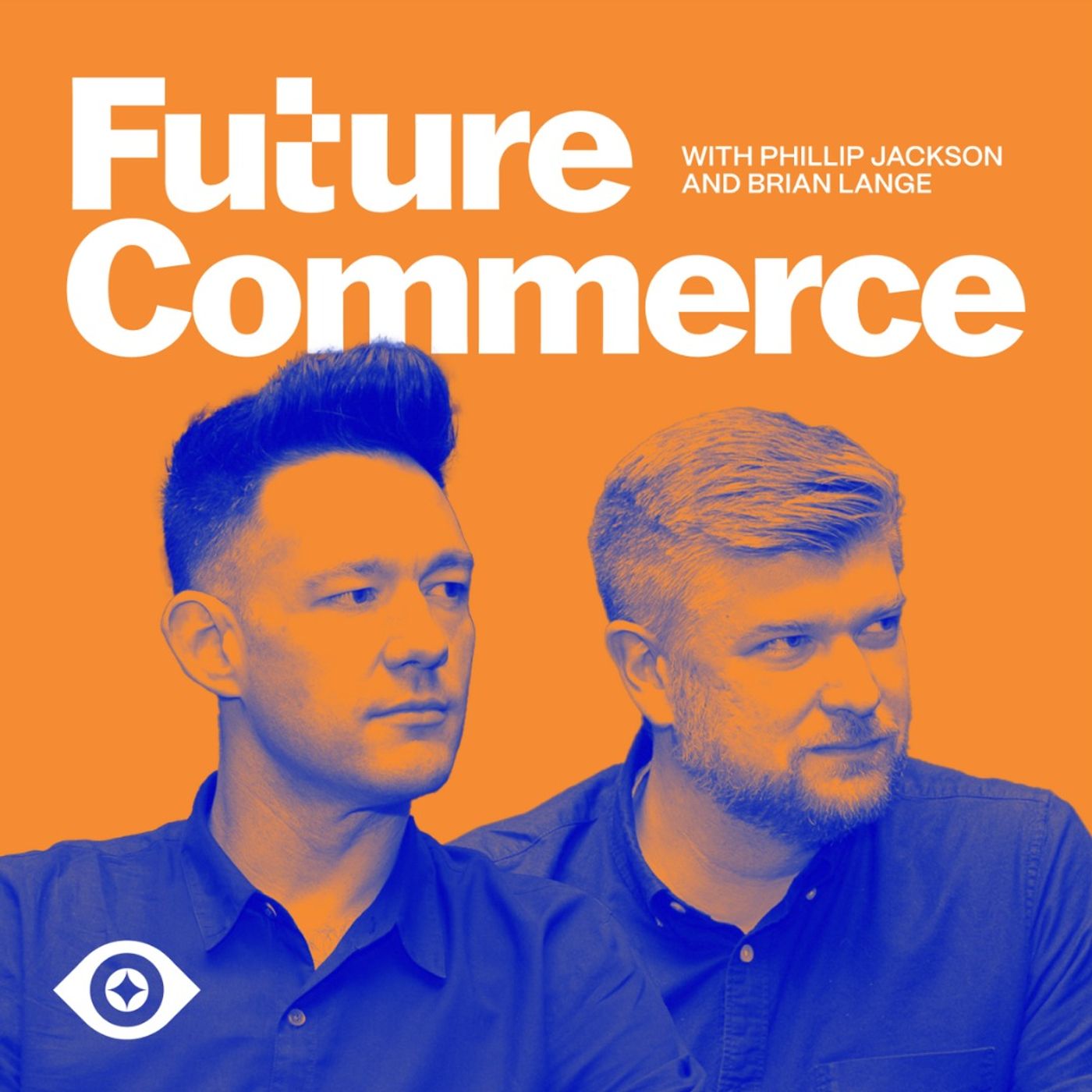
Future Commerce
Phillip Jackson, Brian Lange
Future Commerce is the culture magazine for Commerce. Hosts Phillip Jackson and Brian Lange help brand and digital marketing leaders see around the next corner by exploring the intersection of Culture and Commerce.
Trusted by the world's most recognizable brands to deliver the most insightful, entertaining, and informative weekly podcasts, Future Commerce is the leading new media brand for eCommerce merchants and retail operators.
Each week, we explore the cultural implications of what it means to sell or buy products and how commerce and media impact the culture and the world around us, through unique insights and engaging interviews with a dash of futurism.
Weekly essays, full transcripts, and quarterly market research reports are available at https://www.futurecommerce.com/plus
Trusted by the world's most recognizable brands to deliver the most insightful, entertaining, and informative weekly podcasts, Future Commerce is the leading new media brand for eCommerce merchants and retail operators.
Each week, we explore the cultural implications of what it means to sell or buy products and how commerce and media impact the culture and the world around us, through unique insights and engaging interviews with a dash of futurism.
Weekly essays, full transcripts, and quarterly market research reports are available at https://www.futurecommerce.com/plus
Episodes
Mentioned books

Jan 31, 2020 • 1h 11min
The Skill Set of the Modern CMO (w/ Ian Leslie, Industry West)
This week, Phillip talks with Ian Leslie, CMO at Industry West on topics that every CMO needs to know.
Show Notes:
Main Takeaways:
Ian Leslie, the Chief Marketing Officer at Industry West, joins in on today's episode.
The modern CMO goes beyond just driving awareness for your brand and relies on your knowledge of the tech stack and how to leverage that tech stack to reach customers that you need.
Ian gives some insider perspectives on what is working and not working when it comes to marketing for a successful ecommerce brand.
How can you best arm yourself to be a successful marketer in a world that is oversaturated with content and noise?
What's the Story?: Some Background on Industry West:
Industry West is an eCommerce furniture company that has been around for about ten years and was founded by Jordan England and Anne England.
Jordan and Anne were looking for chairs for their house and went straight to the manufacturer, where they had the idea to sell those products to consumers.
Ten years later, Industry West has furnished many spaces owned by name brands, and you have probably sat on Industry West furniture without knowing it.
Ian has been with Industry West for about five years now.
The Nuts and Bolts: What's Inside Industry West's, Tech Stack?:
Industry West is running Magento 2.3, which is tied into Netsuite that pulls order in real-time into Magento.
Salesforce is being added to the sales team very soon.
On the eCommerce side, Industry West uses Nosto for personalization, onsite search functionality with Klaviyo, dotdigital for journey building and consumer-side email, ShipperHQ, and TaxJar.
Now that they are breaking into brick and mortar, Industry West is using ebizmarts for its POS (which is just a skin for a Magento store).
The Modern CMO: How Times Have Changed:
Ten years ago, CMOS did not have an in-depth knowledge of their tech stacks that is required to be successful in our current climate.
For someone who was raised as a digital native, technology has become engrained in the language of an omnichannel marketer.
Being on the ground with technology and genuinely understanding the functionality behind it is critical in knowing how to implement that technology best.
How can you get to know your tech stack better?
The Trade Market: Acquiring Brands as Customers:
The trade market uses a lot of the same digital platforms that are on the B2C side of the business.
Primarily, trade customers shop as if they are a regular consumer and have a lot of the same questions regarding the products.
Once the trade customer is acquired, the focus shifts to the retention of that client and getting the buyer to purchase for additional clients or locations.
The trade market is still an old-school industry when it comes to the tech stack, and there are emerging companies that are serving this vertical.
New Ventures: InFavorOf.com:
Industry West just launched a new venture called Favor.
Two holiday seasons ago, Industry West noticed a massive uptick in the interest of homewares, so they created Favor to serve this interest.
Favor is a different aesthetic than Industry West and focuses on an altruistic effort of working with real people who work with textiles.
When you are very broad in category, you begin to lose the nice that initially made you stand out, so branching off into a sister company could alleviate that dilution.
What Works and What Doesn't: An Insider's Perspective:
Industry West has seen significant wins with personalization regarding what is being recommended to customers to changing the homepage depending on the buyer.
One to one chat has also proved exceptionally fruitful, and people that chat with a rep online are much more likely to place an order.
There have been some large one-off buys with larger publications that have not proven to be an effective use of funds.
What are some efforts that have proved lucrative to your brand, and why do you think they worked?
The Industry West Outlook on 2020: Projected Wins and Potential Battles:
Industry West is growing quickly but is still entrepreneurial and has a consistent forward push across all employees of the company regardless of position.
The ability of the founder to source products and getting designers to want to work with Industry West is another great strength of the company.
A weakness (but more so an opportunity) is that Industry West is entirely bootstrapped, so everything goes back into the company, which is a fantastic opportunity to not answer to any investors granting a nimble and agile ability to adapt to change.
Industry West is profitable, and a lot of the unicorns that have received tons of venture capital will prove not to be profitable.
A Potential Economic Slowdown: Are You Prepared?:
Is Industry West prepared for a potential economic slowdown within the next 18 months?
Industry West as begun accounting for tariffs by swallowing the costs on some of the pricing.
There is always a swing in the economy during an election year, and Industry West keeps tabs on loan rates and interest rates.
They are so fluid in how they operate at Industry West, but that doesn't mean that they aren't worried about the potential repercussions on an economic shift.
The Next Five Years: What Does the Future Hold for Industry West?:
Strategic growth for both brick and mortar and online business are consistently on the horizon and part of the strategy for Industry West.
For the first time, they are beginning to understand the levers and seeing particular outcomes for actions taken.
Brick and mortar expansion is a goal, and they are looking at presence in Los Angeles within the next few years.
Everything that comes in for business is primarily inbound, and Industry West is going to start exploring trade shows as a potential method of acquisition.
The Future Commerce Wrap Up: From Chipotle Child Slaves to Exciting Newsletters:
Chipotle was fined $1.4 million in a recent child labor case for having dozens of 16 and 17-year-old employees work for longer than 9 hours a day and more than 48 hours per week.
Brian and Phillip think that there will be much more third party validation so that consumers can see what is going on at chains like this in regards to their labor force.
Phillip is consistently impressed by a weekly newsletter from Sari Azout called Check Your Pulse, a tech and startups newsletter designed to make you feel human.
If you're not subscribed yet to the Future Commerce Insiders Newsletter, then you should do that right now!
Brands Mentioned in this Episode:
Industry West
Netsuite
Magento
Nosto
Klaviyo
dotdigital
ShipperHQ
TaxJar
ebizmarts
Favor
As always: We want to hear what our listeners think! As a marketer, how can you arm yourself with knowledge of your tech stack to take your business to the next level?
Let us know in the content section on Futurecommerce.fm, or reach out to us on Twitter, Facebook, Instagram, or Linkedin.
Have any questions or comments about the show? You can reach out to us at info@futurecommerce.fm or any of our social channels; we love hearing from our listeners!
Retail Tech is moving fast, but Future Commerce is moving faster. Hosted by Simplecast, an AdsWizz company. See pcm.adswizz.com for information about our collection and use of personal data for advertising.

Jan 21, 2020 • 60min
Monoculture is Dead: LIVE from NRF 2020
Is Omnichannel really dead? How are niche brands reaching an entirely new (or not so new) generation of customers? And does Coty know what to do with Kylie Cosmetics? Find out during our LIVE NRF 2020 episode where Phillip and Brian are joined by Ingrid Cordy!
Main Takeaways:
Brian and Phillip are joined by Ingrid Cordy live from NRF 2020!
The Future Commerce Vision 2020 Retail Report is out and contains tons of predictions for where commerce is heading in 2020.
The Filter Bubble restricts people from ever seeing content from outside their social circle, but how do we expand our social awareness?
What brands are going to be making exits in 2020 and why?
Is Monoculture Dead?: What is Monoculture?:
There will never be another Michael Jackson in regards to his pop iconography, as many more content creators create content and media.
As the world is becoming more fragmented and more niche, you begin to find your niche community that provides its unique perception of reality.
Forty years ago, everyone shared the same media experiences (such as the moon landing), which became cultural moments of the world.
The visuals we have from mainstream media of pivotal moments in history would never occur today because we now view events through Snapchat and Instagram stories.
The Filter Bubble: The Power of Influence:
Download the Future Commerce Vision 2020 Retail Report to get more insight on the Filter Bubble and other predictions the team has made.
Almost 2.5 billion people participate in the properties that Facebook owns, and with those numbers, Facebook has the power to influence an election.
Television was the first disruptor in politics, and the debate between Kennedy and Nixon swayed the vote in Kennedy's favor and served as a turning point between media and politics.
Facebook will not fact check ads going into the political season, which is an example of a stance that social media platforms can take when it comes to delivering content to their users.
Positive Shifts: Sorting Through the Noise:
How do aspirational brands reach no customers if the world views of potential clients are so limited due to the filter bubble?
Getting people to explore outside of their bubble is a big challenge.
Your social circle and the people around you affect the way that you see the world, so smaller niche brands enjoy an audience that is outside of the mainstream culture.
Aspirational brands can be effective, but Phillip predicts this will be based on word of mouth and the trust you have from your social circle.
Ingrid predicts an increase in the need for social proof and refinement in the next generation of influencers.
Looking Ahead: Shifting from Growth to Staying Power:
We are coming out of a period of brands going through explosive growth, but Brian predicts we are entering a period where brands want to become something that sticks with people for a much more extended period of time.
Everything today seems to be ephemeral, and what happens today doesn't matter tomorrow.
Consumers are starting to get tired of brands always focusing on the "new" and are tired of continually discovering what has changed.
Staying power is proving to be more and more desirable from the consumer base, so brands are shifting their approach to be more dependable.
The Power of Niche: Finding Your Tribe:
The things that matter to you and that you put a value on will become more niche and more local to your tribe.
The social community value of niche brands can be more valuable than broadly recognized brands that everyone has heard about.
If we trend towards how communities interact and care about each other, we will automatically create places for sharing things beyond your internet bubble.
Each city has its own Chamber of Commerce, which is a great place for brands to share their experiences and advice with other brands.
The New Local: Virtualizing the Physical World:
Local isn't just a physical location; it is wherever you happen to be.
There's an emerging trend of very young kids in school who will log onto Fortnite, not to play the game, but to be with their friends for hours at a time in a digital locale.
Taking local online to digital locations virtualizes and redefines everything we know about local.
Most of our shared experiences are very short experiences, and meme culture is rapid and happens in an environment of fleeting recognition.
Coty Buys Kylie: An Enormous Acquisition:
Back in November, Coty Inc. valued Kylie Cosmetics at $1.2 billion and paid $600 million for a majority stake in the company.
Ingrid has doubts that a big legacy brand like Coty knows what to do with a trendy brand like Kylie Cosmetics.
How can Coty leverage their expertise to make the most out of Kylie Cosmetics, and what can they learn from Kylie's ability to capture the attention of a sought after consumer base?
Just because a brand sells the same type of product does not mean that it does the same thing as other brands in the same space.
Commerce Current Events: Rapid Fire Hot Takes:
Casper just filed to go public, and Coty just bought Kylie Cosmetics, but what other large brands could be making an exit this year?
Ingrid predicts that Everlane could be exiting because they have been around for a long time and are doubling their brick and mortar presence this year.
Brian predicts that Cuyana will be purchased or make an exit this year.
Phillip thinks that Glossier has a tremendous amount of brand awareness and thinks that expanding their reach will be easy with their VC money.
A Virtuous Filter Bubble: Changing the Future Through Choice:
Over the next ten years, Phillip predicts that we have the opportunity for technology to enable the consumer to tell the brand how they want to be talked to.
Allowing customers to experience things how they want to experience them is a filter bubble that is virtuous.
If you don't want to see anything that uses animal products while shopping, there should be a filter that applies across all of your online shopping that removes that content.
A more venerated way of the customer telling brands how they want to be interacted with is a future we can strive towards.
Observations and Wishes: NRF 2020:
Omnichannel has shifted to be consumer-focused, and that is the new (and better) way to describe what omnichannel was.
Amazon has not exhibited in as large of a way as they did at this year's conference ever before and are petitioning themselves as a technology stack for retailers to take advantage of.
Ingrid wants to see an interaction with a regular consumer in which they comment on what is happening at the show to get an outside perspective.
Phillip wishes there was a section of the show that was dedicated to sustainable solutions.
And finally, Brian wants to see a metric that shows what solutions or brands are gaining traction at the show.
Brands Mentioned in this Episode:
Snapchat
Instagram
Facebook
Fortnite
Coty
Kylie Cosmetics
Casper
Everlane
Cuyana
Amazon
As always: We want to hear what our listeners think! Do you agree with the predictions made by Brian, Phillip, and Ingrid? What do you think the next year holds for the world of commerce?
Let us know in the content section on Futurecommerce.fm, or reach out to us on Twitter, Facebook, Instagram, or Linkedin.
Have any questions or comments about the show? You can reach out to us at info@futurecommerce.fm or any of our social channels; we love hearing from our listeners!
Retail Tech is moving fast, but Future Commerce is moving faster. Hosted by Simplecast, an AdsWizz company. See pcm.adswizz.com for information about our collection and use of personal data for advertising.

Jan 10, 2020 • 1h 6min
Vision 2020: A Future Commerce Podcast on the State of Retail, presented by Gladly
Download the Vision 2020 Report Right now
The next phase of the growth of your business will be based on your ability to plan for the changes coming over the next 10 years. Things like outsized customer expectations, online behemoths and marketplaces like Walmart and Amazon, Generation Z coming of age, aging of the Millennial population, and a whole lot more there are things to consider in the 2020s that will either put you ahead of the pack in your DTC or retail business or at the back of the pack. In this podcast, we break down what you need to succeed in the next 10 years, from our perspective as analysts.
Show Notes:
Main Takeaways:
It's our annual predictions episode, and 2020 is going to be quite a fascinating year for retail
Relationships between company and customer are crucial to consistent retention
Phillip and Brian cannot go a week without making predictions
GenZ is all about building relevant and exciting skills, even if they can't afford life yet.
Consumers are going to start having expectations that the products they purchase are going to improve their health, and brands are going to have to meet that demand.
Future Commerce partnered with the customer-service platform Gladly to create a report on the future of retail, and it's crazy good.
Vision 2020:
Future Commerce partnered with Gladly to create a comprehensive report on what 2020 retail will look like, and it's available for download.
The report is a buffet of Future Commerce predictions all in one place
Want this report? Of course, you do, click here →
Brian and Phillip cannot go more than a week without making predictions
This is the year where profits are king
Brands Are Going To Have To Better Your Life To Retain Your Business:
Something we've seen at Future Commerce is that the relationships that retailers build with their customers can indicate if they can retain those customers long-term.
And brand trust is super important because it allows brands to take risks and loyal customers to follow that journey.
It's a new world: Zebras > Unicorns
The evolution of health and wellness is going to evolve beyond what we can currently understand.
How can the products that you purchase help make your life better?
Sustainable Skill Learning: Why You Need to Tune In To CARLY:
GenZ is a totally different generation, and GenZers are interested in a very different world than Millenials.
We covered this in our Future Commerce Insiders #18, where we talked about CARLY (Can't Afford Real Life Yet), as the new generation of shopper.
And while CARLY might value a new experience, they're also natural creators, seeking out new marketable skills.
And as Brian said: "CARLYs are learning skills because one, they care about sustainably doing things. They care about the environment. And so they're patching their clothes, and they're making their art, and they're doing things for themselves. We live in a Minecraft world where people want to build out things for themselves and build experiences for themselves and use those experiences."
The Future of Retail: Sustainability is Everything:
As we learned in 2019, sustainability is a lot more than just a buzzword; it's the path forward for retail.
Second-hand commerce is more sustainable, it allows for less waste, and resellers can capitalize on this.
The story for sustainability has to continue in the 2020s
Brands that are leading the way are public-benefit corporations or B Corporations, which is always a significant focus on our show.
Want to hear the rest of the key trends for 2020? Check out our report on the Vision of 2020 with Gladly, it has all of the info that you need to be able to indeed stay on top of the future of retail.
Download the Vision 2020 Report Right Here!
Show notes Hosted by Simplecast, an AdsWizz company. See pcm.adswizz.com for information about our collection and use of personal data for advertising.

Jan 7, 2020 • 58min
How Accurate Were our 2019 Predictions?
It's time to look back on our 2019 predictions to see how accurate we were. Death of Apple? Nope. The departure of Walmart from DTC? Yep. Acceleration of customer expectations? YES. Lots to unpack in our first episode of the year. Listen now!
Show Notes:
Main Takeaways:
Brian and Phillip are journeying back to our 2019 predictions episode, episode 92, to analyze which predictions came true.
As of 2019, Apple is still alive and somehow thriving
Second-hand commerce is growing and will continue to grow, probably forever.
Has social mobility eliminated the middle class?
Epcot is its shadow self, and Phillip is sad about it
Predictions Check: Back To February For 2019 Predictions:
Phillip's first prediction of 2019 was to declare that 2019 was going to be peak Apple, but it looks like the tech company/over-priced lifestyle brand is not slowing down.
Exact prediction: "We're going to start to see the beginning of the end of Apple as a dominant force and a player in both culture and technology.
Some of the best Apple's best moves in 2019: The new MacBook Pro, and the AirPod Pros with noise cancellation.
Phillip has decided to go as far as maybe to go full Apple and switch to an iPhone
Boring Retail is Over: Is The World Better Off?
One of Brian's first predictions of the year was that 2019 would be the end-all-be-all of boring retail
Brian says that it was more of a co-prediction, and was made because of the "retail apocalypse," which is not a real thing.
What the whole fear-mongering around the retail apocalypse was, was an indicator of the end of boring retail (or the boring middle), which is a mixed bag.
What the retail apocalypse is beyond all the talk, is a transformation in the types of retail that will continue to exist
But here's a question to think about: What does boring retail even mean?
Walmart Changed Its Game: Added Fun Brands:
Walmart made significant moves this year, trying to shed it's low-cost, low-quality reputation, and it might have started making waves in that direction.
And maybe to some extent, they did succeed, they've escaped the boring middle, but are they on par with other grocers like Trader Joe's?
Walmart's best quality also tends to hurt them, like endless selection, which produces long lines and cluttered shelves.
Walmart did add some newer brands to its portfolio this year: Eloquii, Bonobos, and Modcloth.
Though all of those brands do seem to be losing Walmart lots of money.
Second Hand Commerce is Rising: And People Are Giving Back:
One of the biggest trends in 2019, was the rise of two things: second-hand commerce and charitable commerce.
These two trends point to a few things: one that more people are comfortable buying second-hand versions of the brands that they love, and that some brands are even willing to encourage that kind of brand engagement.
This is especially prevalent in luxury retail, where the second-hand market allows consumers who may not have otherwise been able to afford luxury brands to get to participate in the brand's conversation.
This prediction came from things like Salesforce CEO Marc Benioff making a massive investment into StockX
We also saw the rise of online resellers like Poshmark and ThredUP, which represents a massive shift in the conversation around re-sellers.
Transportation Repurposing: Building Communities In Travel Hubs:
One of Phillip's prediction's for 2020 was that travel hub would build community-based retail spaces around their locations.
So, was the Virgin USA's move to build a community around their trains indicative of a more significant trend in commerce?
Maybe. Airports have seen massive growth in retail spaces, and have become a hub for shopping, and it's only going to grow as travel becomes more accessible.
And as Phillip points out: it does not just travel hubs, malls are seeing a lot of repurposed space.
Malls are repurposing retail space for movie theaters or waterparks and or a megachurch.
As always: We want to hear what our listeners think! What were your favorite predictions from our 2019 prediction episode? Do you have any predictions of your own for 2020?
Let us know in the content section on Futurecommerce.fm, or reach out to us on Twitter, Facebook, Instagram or Linkedin.
Have any questions or comments about the show? You can reach out to us at info@futurecommerce.fm or any of our social channels; we love hearing from our listeners! Hosted by Simplecast, an AdsWizz company. See pcm.adswizz.com for information about our collection and use of personal data for advertising.

Dec 27, 2019 • 1h 5min
"You See the Glory, But You Don't Know the Story" w/ Audrey McLoghlin, Grayson
After the birth of her daughter, the creator of cult brand Frank and Eileen saw the world a little differently. Women are superheroes and Audrey McLoghlin wanted to create a shirt just for them. Grayson is the result of her 5 year consideration on building a new brand from the ground up. In this episode, we talk about how to create a sustainable business with a B2B component in the new DTC era, how to play the long game, and how to join the “hundred club” — owning 100% of the business. Listen now!
Show Notes
Main Takeaways:
Brian and Phillip are joined by Audrey McLoghlin, Founder & CEO of both Frank & Eileen and Grayson.
Audrey has created a new business model entitled the Sustainably Hybrid Vertical Brand.
How do you navigate today's fast-paced direct-to-consumer marketplace with a wholesale brand?
As a wholesale brand, your partnerships are critical to your success and can turn your distribution channels into customer acquisition channels.
Who Is Audrey McLoghlin?: A Serial Founder in the World of Consumer Brands:
An engineer by training, Audrey admits that she has now become a serial entrepreneur.
Frank & Eileen was founded ten years ago when Audrey fell in love with Italian menswear fabrics and wanted the same fabric available for women.
Over the years, Audrey learned that in business, it is almost more important regarding what you say no to than what you say yes to.
Frank & Eileen has been very diligent in focusing on a single product and has become famous for making an amazing button-up shirt.
A New Venture: The Grayson Story:
Over the past five years, the entire retail landscape has changed, and Audrey wanted a brand that captures what is going on today and speaks to the customer that they wanted to talk to.
Grayson is named after Audrey's four-year-old daughter, Grayson.
Audrey hopes that the quality and reputation of Frank & Eileen's product will assist in reaching a customer base that fits Grayson.
She was inspired by all of the powerful women working around her that thought it ways that are totally different from previous generations.
How Times Have Changed: A Shift in the Retail Landscape:
Ten years ago, social media and eCommerce didn't exist as they do today, so brands launched wholesale as opposed to direct to consumer.
Everything was about having the best product and getting that product to be sold in the right places.
Today, you still need incredible products, but you also have to consider why you are making the product.
In starting Grayson, Audrey spent a lot of time looking at the business landscape and noticed that the path to profitability has become elusive due to the significant costs of being successful in the DVNB space.
The Sustainably Hybrid Vertical Brand: A Whole New Model:
In creating Grayson, Audrey hopes to create a whole new type of go-to-market strategy called the Sustainably Hybrid Vertical Brand.
This model has all of the good qualities of a direct-to-consumer brand but also balances the direct-to-consumer component with the wholesale component of a brand.
In the new retail landscape, you can have strategic wholesale partnerships that can become your customer acquisition strategy.
This is the first example of your customer acquisition strategy, also being a lucrative money center.
Shifting Channels: From Wholesale to Direct:
A healthy ecosystem in which a brand supports its wholesale partner but also supports its customers with an experience that only the brand can bring is key to being successful in this new model.
A brand can also give its customers the freedom to purchase either from its wholesale partners of direct from the brand itself.
Pricing and margin are critical to the health of the brand but also to the partners of the brand.
How do you identify partners that would be strategically valuable to your brand?
The Hunt for Explosive Growth: An Untapped Price Point:
Frank & Eileen discovered a particular niche in the women's button upmarket that was not being covered by any other brand.
It was vital for them to serve this price point while still delivering the quality and experience that the brand was known for.
Finding the right supply chain was imperative for accomplishing this goal.
You have to be very strategic and be patient, see what initiatives work before moving on to the next strategy.
Fundamentally Sustainable: The Power of Wholesale:
Due to the nature of wholesale and receiving funds and purchase orders for your product, you have access to actual capital that can be spent in ways that aren't a risk for your brand.
DTC is just a distribution channel in your strategy, and you have to look at this and other channels in strategic ways to decide when to pursue them.
If you invite wholesale partners who become interested in your product, it serves as instant validation of a need for your product in the market today.
In theory, you don't need much capital to get through your first year through this model.
The Pitfalls of Quick Launches: Costs, Costs, and More Costs:
It has never been easier to launch a brand quickly thanks to today's ecommerce channels and technology, but the costs of this are higher than ever.
Venture Capitalists are looking for unnatural growth, and that, in conjunction with an inexperienced founder, is a particular combination.
Is it sustainable if every new brand needs to raise tens of millions of dollars before they reach profitability?
You see the glory, but you don't know the story as there is a great story behind every entrepreneur, even if they don't achieve large scale success.
Common Misconceptions: The Wholesale Truth:
Wholesale is more complicated than direct-to-consumer brands think it is.
Wholesale and direct-to-consumer businesses are fundamentally different but can be incredibly complementary and powerful together.
If you set it up correctly, have intentional partnerships, and manage those partnerships well, you are guaranteed to be profitable in wholesale.
How does your role change as a leader in an organization that goes through the growing process of a wholesale brand?
The Pressure of Growth: An Unfair Outcome?:
Away CEO Steph Corey recently stepped down as CEO after an investigative article revealed a toxic work environment.
Corey took Away from $0 to $150 million in just three years, which puts her in the same category as Bill Gates, Steve Jobs, and Elon Musk when adjusted for inflation.
While her behavior is not condoned, the unbelievable pace at which Away has grown is a breeding ground for aggressive behavior, but her male peers were not asked to step down.
Do you think this outcome was merited, and if not, what do you think would have been a better solution?
Brands Mentioned in this Episode:
Frank & Eileen
Grayson
Away
As always: We want to hear what our listeners think! How can you make the most out of your strategic partnerships to take your wholesale business to the next level?
Let us know in the content section on Futurecommerce.fm, or reach out to us on Twitter, Facebook, Instagram, or Linkedin.
Have any questions or comments about the show? You can reach out to us at info@futurecommerce.fm or any of our social channels; we love hearing from our listeners!
Retail Tech is moving fast, but Future Commerce is moving faster. Hosted by Simplecast, an AdsWizz company. See pcm.adswizz.com for information about our collection and use of personal data for advertising.

Dec 20, 2019 • 40min
Climate Neutral: The New Minimum Standard for Corporate Responsibility
Measure, Reduce, Offset. That's the simple formula for Climate Neutral, a new label that certifies the commitment of a brand to track, and lower, their carbon emissions. Austin Whitman and Caitlin Drown join us to talk about the future of brand trust, consumer expectation, and even a little bit of speculation on how offsetting today can change the world tomorrow. Listen now!
Show Notes
Main Takeaways:
Phillip is joined in today's episode by Austin Whitman and Caitlin Drown from Climate Neutral.
Climate Neutral is a movement intended to help brands quantify and then reduce their carbon footprints.
Consumers are driving the economic engine, so it's imperative to make your voice heard to encourage positive changes in your favorite brands.
How can you offset your carbon footprint enough to be carbon neutral?
Reducing and Offsetting Carbon Footprints: The Climate Neutral Initiative:
Future Commerce joined the Climate Neutral movement back in October of this year.
Climate Neutral is a young, non-profit organization that exists with the sole purpose of helping businesses understand what their carbon footprints are, take meaningful actions to reduce those carbon footprints, and then offset the entirety of that impact on the environment.
People simply don't understand where carbon emissions come from and what to do about them.
Climate Neutral is creating a label that will be placed on products to let consumers know that brands have gone through the Climate Neutral process.
Why Start at Retail?: Making the Biggest Impact:
Climate Neutral started with retail because consumers are what drive the economic engine by buying products and services.
The two brands that funded Climate Neutral were BioLite and Peak Design who both realized that there are limits to how much they can reduce their carbon footprints, but that's not the limit to what you can do.
There needs to be a strong signal to companies that doing something to reduce your carbon footprint is an economical investment.
Climate Neutral is working with brands that many consumers would already know such as Kickstarter and Allbirds.
Spreading the Message: Making an Impact on Social:
Caitlin has noticed that a lot of large influencers on Instagram that aren't associated with one of Climate Neutral's brands have been promoting Climate Neutral of their own accord.
Sharing the story is encouraging influencers and brands to get involved and taking action in a transparent way.
Transparency is a major factor in gaining the trust of consumers.
The brands that sign with Climate Neutral are validating Climate Neutral as much as the initiative gains credibility from the brands' involvement.
What is the Goal?: Strategic Brand Partnerships:
Goal #1 is to understand and capture a large amount of carbon within the brands that Climate Neutral is representing.
The label will only be provided to companies that have measured their carbon footprint, taken measured action towards things that will reduce that carbon footprint, and finally offsetting the entirety of their measured footprint.
In addition to making a big carbon impact, another goal is to mobilize a new wave of brands to build carbon reduction into their strategies.
When people go through the process, they are going to have a carbon imprint, so a measurable amount of carbon indicates how much that brand should put back into the erasure of their footprint.
Transparency and Education: Armed With Knowledge:
If someone wants to look into the particular actions that a company is taking, that information will be available online.
This data will give brands insight into what other brands are doing to reduce their footprint.
Climate Neutral is going to make it easier for companies to estimate what their carbon footprint is.
Most companies have no idea what their carbon footprint is, and will be able to use a tool via Climate Neutral to get a better understanding.
Real Life Feedback: What are Brands Saying?:
Tapping into the network if reputable and respected brands are helping give Climate Neutral the stamp of approval.
Climate Neutral did their first official launch in June where they had Alex Honnold serving as a moderator for a panel, and he initially didn't believe in carbon offsetting.
Because of Kickstarter and various PR efforts, Climate Neutral has been able to enter the discussion at a higher level and volume that Austin has ever seen.
Even if there are those who are more skeptical about carbon offsetting, the validation from so many sources has led to articles being written on both sides of the debate.
Expanding Reach: Influencing Consumers and Companies:
Consumers need to get excited about the carbon offset label and brands have to get excited about the process and wearing the label.
The main reasons why companies aren't doing carbon offsetting are that it is not in the budget or there is a stigma around offsetting in general.
Smaller companies tend to have fewer levels of approval to approve the initiative, so the goal is to eventually get approved by large, billion-dollar corporations.
We need to do far for than what we are currently doing when it comes to addressing climate change.
Looking in the Past to Move Forward: Learning from the Past:
We are so far from bending the carbon curve to neutrality that we have to start somewhere.
It's possible that neutrality will eventually lead to positivity.
If brands define their footprint far enough, it extends to other brands, and if these overlapping footprints become neutral, then that equates to positivity.
Reduce the barriers for companies trying to get on this path and increase the expectation for what neutrality is.
The Digital Commerce Shift: A Positive Impact?:
One-day shipping is a great convenience, but chances are that that shipment came on an airplane that comes with a much larger carbon footprint.
There is a ton of data to measure against whether there is a larger carbon footprint for traditional retail experiences or online shopping.
We should not assume that just because stores are not physically there that there will be a smaller carbon footprint to accommodate the online shopping experience.
Do retailers that are digitally native have a smaller carbon footprint?
Next Steps: How to Get Involved with Climate Neutral:
First and foremost, if you want to get involved with Climate Neutral, you should back the Kickstarter Campaign.
Contributing at certain levels will actually offset someone else's carbon footprint for the year.
Reach out for any questions you may have to .
As a consumer, call out your favorite brands and ask them to look into the certification and offset their carbon footprint.
Brands Mentioned In This Episode:
Climate Neutral
BioLite
Peak Design
Kickstarter
Allbirds
As always: We want to hear what our listeners think! What are some steps you can take today to get a better understanding of your carbon footprint?
Let us know in the content section on Futurecommerce.fm, or reach out to us on Twitter, Facebook, Instagram or Linkedin.
Have any questions or comments about the show? You can reach out to us at info@futurecommerce.fm or any of our social channels, we love hearing from our listeners!
Retail Tech is moving fast, but Future Commerce is moving faster. Hosted by Simplecast, an AdsWizz company. See pcm.adswizz.com for information about our collection and use of personal data for advertising.

Dec 13, 2019 • 35min
[Step by Step] How Can I Successfully Sell My Business? (Michelle Cordeiro Grant, Lively)
Welcome to Step by Step, a 5-part series from Future Commerce to help walk you through how to launch and grow a successful business. This season, we're talking about funding. Today is episode 5. Phillip & Brian are joined by Michelle Cordeiro Grant, Founder of Lively to chat about her experience working with Venture Capital from a founder's perspective.
Listen Now!
SHOW NOTES
Main Takeaways:
Michelle Cordeiro Grant from Lively is back again to walk us through successfully selling your business.
A strong operation foundation and consistent production costs can help identify where to apply raise capital.
What are the factors that indicate that your brand is ready for an exit?
Breaking through the noise of digital may require physical presence, so how can you achieve this with your brand?
Lively and Michelle: Some Quick Backstory:
Lively is a brand and a community whose sole purpose is to inspire women to live passionately, purposefully, and confidently.
Michelle grew up in a rural area of Pennsylvania and wanted to see what she could do with her life instead of more typically expected career choices.
She eventually found her way into fashion and fell in love with the idea of concept-to-customer and the power of brand.
Eventually, she wound up at Victoria's Secret that led her to decide that there was something missing in the lingerie community which ended up with the creation of Lively.
Pursuing Capital: A Founder's Perspective:
With a story backward to most, Michelle left Victoria's secret with the idea that she could start a brand by having a community to build the brand instead of a company building it.
She knew that she needed to have her supply chain completely under control so her strategy was to partner with an investor that was a manufacturer prior to launching her company.
This allowed her to scale with what her customers wanted as opposed to what was written on a spreadsheet.
Michelle did a $1.5 million convertible note with her manufacturer Gelmart and having the support and experience of a manufacturer in her industry set Lively up for success.
The Next Step: The Need for More Capital:
Lively launched organically without paid media and after 45 days saw that they were able to ship to every state in the United States.
Two months after launch, Lively had captured results that they had planned to do within the first year, which indicated that it was time to fundraise.
Michelle's initial strategy was not to go after Venture Capital money, but rather to pool angel investors, but eventually started getting contact from Venture Capitalist firms.
She wanted to wait for her Series A, but one email in particular from Robin Lee from GGV Capital (who worked for a VC but was also a Lively customer) changed her mind on VC and within a week of conversations, Michelle knew they had found their match.
The Struggles and The Victories: Accepting Venture Capital:
Michelle was very worried about the expectations of her brand before she accepted the term sheet with Robin.
In retail, a brand's growth charts like a roller coaster in regards to its trajectory and Michelle didn't want to be pressured for unrealistic growth.
While her VC was always pushing her forward, Michelle was happy to discover that she had a voice and she could adjust her strategy to favor long-term growth.
How can you preserve your visions of growth when an investor is now sitting with you at the head of your brand?
A Stable Foundation: Knowing Where to Spend Capital:
Lively raised $4 million in its first round when they only set out to raise $2 million so the extra capital fueled the excitement for the brand's growth.
Due to the fact that most monetary aspects of the business were so steady (such as a single price point for products and consistent production costs), Lively was able to clearly decide what to do next.
A clear perspective of what was coming from an operations and a cashflow perspective allowed Lively to easily put the money towards marketing and inventory.
How can you solidify your operations to help pinpoint where to spend your raised capital?
Vertical Integration: The Power of Structure:
Quality was a goal from the outset and Gelmart helped Lively to create a custom manufacturing solution that allowed them to deliver consistently high-quality products.
Because their manufacturer was both their investor and supplier, Lively also had the benefit of getting net terms and was a huge boon when it comes to handling your cash.
Vertical Integration also allows you to be innovative by allowing you to directly address customer needs as opposed to serving just a bottom line.
Lively grew by 300% from year 1 to year 2, so they were able to continually prove that they had the roadmap to success.
The Sale: Building Up to the Exit:
The intent was not to sell Lively in 2019, but the continual success of the brand and the sturdy foundation from the get-go led to Lively's acquisition by Wacoal.
One of the factors that made Lively such a desirable acquisition was its clean board of three investors that raised enough capital without becoming too diluted.
Lively's clean KPIs and financials were a huge benefit to getting through the diligence of the acquisition.
What were the factors that led to Lively's brick and mortar strategy?
Seven Year Cycles: The Digital Deluge:
Are customer acquisition costs for digital marketing forcing brands to adopt local strategies in order to grow their brand?
Digital marketing channels are so saturated that brands need physical presence to break through the noise of digital advertising.
Pure digital brands like Everlane are increasing their physical presence because it is becoming more and more clear that you cannot only do digital in order to succeed.
Generation Z has been raised on screens and is looking for in-person experiences to really connect with brands.
Beyond the Dollar: Further Benefits of Capital:
GGV introduced Michelle to a lot of other founders that were 2-3 years ahead of her in their brand development which gave her a strong group to help answer questions and give advice.
What went wrong is just as important as what went right when it comes to growing your brand.
Conferences like Shoptalk allowed Wacoal to get to know who Michelle and Lively were even before there was any interest in the acquisition.
Michelle would not have been comfortable taking the risks she did without the experience-based knowledge from GGV.
Adversity Along the Way: Not All that Glimmers is Gold:
There was only one person doing customer service with over 2000 customers, so macros had to be designed to alleviate the most common questions being asked by customers.
There was so much time spent on each component of the bras that some of the luxury components led to unforeseen complications.
In October of 2017, Lively rebuilt their site and realized after launch that Google was doing a recrawl that required a rebuild of their organic traffic.
What are some of the obstacles that inevitably led to positive changes for your brand?
Brands Mentioned In This Episode:
Lively
Victoria's Secret
Gelmart
GGV Capital
Wacoal
Everlane
Shoptalk
As always: We want to hear what our listeners think! Are you ready to raise capital to grow your brand? Does Venture Capital or Private Equity sound like a better fit for your brand?
Let us know in the content section on Futurecommerce.fm, or reach out to us on Twitter, Facebook, Instagram or Linkedin.
Have any questions or comments about the show? You can reach out to us at info@futurecommerce.fm or any of our social channels, we love hearing from our listeners!
Retail Tech is moving fast, but Future Commerce is moving faster. Hosted by Simplecast, an AdsWizz company. See pcm.adswizz.com for information about our collection and use of personal data for advertising.

Dec 12, 2019 • 53min
[Step by Step] What is Private Equity and When Do I Need It? (Jeremy Muras, Lion Capital)
Welcome to Step by Step, a 5-part series from Future Commerce to help walk you through how to launch and grow a successful business. This season, we're talking about funding. Today is episode 4. Today, Phillip & Brian are joined by Jeremy Muras of Lion Capital Group to discuss Private Equity.
Listen Now!
Show Notes
Main Takeaways:
In today's episode, Brian and Phillip are joined by Jeremy Muras from Lion Capital to talk about the ins and outs of private equity.
What are some of the major differences between Private Equity and Venture Capital?
Private Equity benefits brands with not only large amounts of capital but a proven track record of successfully growing brands.
How can Private Equity help brands resonate with their ideal customers and tap into previously unexplored channels?
Jeremy's Journey: A Look Into His History:
Jeremy has been in the digital industry since the early 2000s and got interested when he was located in Hong Kong and he got close with the team that built Monster.com.
He worked for a luxury lingerie company called Agent Provocateur, ran TopShop.com for a brief spell, and then made his way to Burberry where he worked as the eCommerce Manager for Europe.
While at Burberry, Jeremy and his journey were the first to execute purchasing directly from the runway, in-store pickup, and various othering pioneering innovations.
From there, he found his way to Lion Capital where he operates as an expert on digital marketing and allowed him to expand his expertise.
Distinct Differences: Private Equity vs. Venture Capital:
Essentially, private equity is equity or shares that represent ownership or an interest in a particular company that is not public.
Private Equity requires companies to prove that they can scale and be able to demonstrate a number of years of profitability.
Part of the challenge that Private Equity firms face in today's ecosystems is that a lot of successful DNVBs have exponential growth, but haven't demonstrated consistent years of profitability.
Lion Capital typically invests over $100 million into a business and tends to not go much go lower than that.
The goal is to achieve a positive return on investment in 5-7 years.
Going Deeper: How Does It Work?:
Private Equity firms typically get their money from large institutional investors such as pension funds, insurance companies, and banks or other accredited investors like high-value individuals.
Large institutions are investing in what is effectively betting on entrepreneurship being a growing portion of economic advantage in the United States.
Unlike Venture Capital, Private Equity is not going to make risky investments that have not proven themselves.
The gates that brands need to get through to acquire private equity are designed to give confidence and assurance to investors that their investment will be profitable.
Hands-On or Hands-Off: How Involved Are Investors?:
Jeremy mentions that the consensus is split pretty evenly amongst investors whether they want to be hands-on in scaling their investment or not.
As the industry has become more competitive, the active investor has started to take dominance in the preferred model of a firm.
Demands are higher with the disruption coming from digital and other verticals.
Brands can factor in the level of involvement that they want from their investors when it comes to choosing the right fit.
When to Seek Private Equity: When is the Right Time?:
At what point in the lifecycle of a business does a private equity firm become involved?
Lion Capital typically becomes engaged with businesses that are in the growth stage of their lifecycle because they need to see years of data proving success yet also need room to grow.
Extending companies into new areas or diverse verticals are also good signs for Private Equity because that is something that capital could assist with accomplishing.
In the United States, a lot of brands are exclusively national and have not gone international yet, which is a prime goal that private equity can accomplish.
Broadening Horizons: Expanding Into New Territories:
There are a lot of companies that never break out of their verticals because they do not have the capital or the expertise to pursue new markets.
A product does not necessarily become a brand without guidance and funding.
Lion Capital looks for a brand within a category that is niche that can then be blown up in regards to growth.
The qualities and endorsements of smaller brands can reach wider audiences with the appropriate injection of capital.
The Work of the Investor: What's the Deal Flow?:
Deal flow is a term to describe the rate at which business proposals and investment pitches are being received and is imperative for Private Equity firms to maintain.
Firms have large amounts of capital that they need to employ, and if they do not have an adequate deal flow, then you will fail in distributing the funds.
It's becoming harder and harder to compete for deals amongst investors because of the high level of current business evaluations.
Sourcing deals through non-traditional means is how firms are competing in today's economy.
The Secret Sauce: What Private Equity Brings to the Table:
A huge differentiator between what Private Equity and Venture Capital bring to the table is that Private Equity brings with it a huge set of experience and skills that has a proven track record of building successful brands.
Operating is difficult and you need to scale within your operating function to really add value.
You need to make a decision whether you are prepared to invest to scale internally or if you want to build out a center of operational excellence that covers key aspects of your business.
The reason you bring in an active investor is to embrace what they offer and to trust their expertise and guidance when it comes to scaling your brand.
Getting Hands-On: Planning and Guidance:
Private Equity needs to be involved with strategic planning and budgeting because they have to account for their bottom line.
Lion tries to bring founders along for the growth journey, and while they would like to keep management teams intact, firms have access to a large network of talented executives that can take the brand to the next level.
There are different definitions of value, so sometimes strategic planning choices can be different than what a founder initially tries to accomplish.
Firms have to be very clear with their intentions and cannot take footing away from the founders because that relationship is what the initial agreement was based upon.
The Brand Journey: Potential Changes for Exponential Growth:
Moving a brand away from its traditional way of expressing itself towards new channels where new storytelling can resonate with customers is the goal.
Brands stay a constant throughout their lifetimes, but their messaging and values can potentially change along the way.
AllSaints has tapped into the zeitgeist of its customers and has made its message resonate amongst them.
Private Equity firms can provide a window for brands to see beyond their traditional messaging and discover ways to truly make the brand shine.
Brands Mentioned In This Episode:
Lion Capital
Monster.com
Agent Provocateur
TopShop.com
Burberry
AllSaints
As always: We want to hear what our listeners think! What are some specific ways that Private Equity can take your brand to the next level that are different from how Venture Capital would help your brand?
Let us know in the content section on Futurecommerce.fm, or reach out to us on Twitter, Facebook, Instagram or Linkedin.
Have any questions or comments about the show? You can reach out to us at info@futurecommerce.fm or any of our social channels, we love hearing from our listeners!
Retail Tech is moving fast, but Future Commerce is moving faster. Hosted by Simplecast, an AdsWizz company. See pcm.adswizz.com for information about our collection and use of personal data for advertising.

Dec 11, 2019 • 50min
[Step by Step] How and When Do I Raise Venture Capital? (Robin Li, GGV)
Welcome to Step by Step, a 5-part series from Future Commerce to help walk you through how to launch and grow a successful business. This season, we're talking about funding. Today is episode 3. Robin Li joins Phillip & Brian, Principal at GGV Capital, to talk about discuss the process of raising venture capital and an initiative called Evolving E.
Listen Now!
Show Notes:
Main Takeaways:
Robin Li from GGV Capital joins Phillip and Brian in the third episode of Future Commerce's Step by Step.
New York is becoming a hotspot for DNVB and retail portfolio companies, and GGV is leading the charge
"Founders have to have their own vision and you as a Venture Capital partner are there to help them execute and make things happen."
Is Shopify the new Main Street?
Robin has some pretty amazing advice for brands who are thinking about finding a venture partner
Introductions And Career Changes: Meet Robin Li From GGV:
Fun fact: Robin actually started her career out as a special education teacher with Teach For America before going to business school.
Then while interning at Qiming, one of the top venture capital firms in China, Robin met Hans Tung, who happens to be one of the most prominent VC's in the world, with a spot of Forbes's Midas List.
This led Robin to learn everything she could about venture capital in both the United States and China, as she spent that entire summer stationed in Bejing.
Robin stayed in venture while being back in business school, leading her to work at Flextronics for the last quarter of business school before ultimately returning back to GGV, where she has worked for the last five year years.
Robin was originally located in Silicon Valley, which was the heart of venture capital for a long time, but is now in New York (since last year) because New York has become the center for DNVB brands and retail portfolio companies.
New York's Ecosystem is Changing: GGV is Leading The Charge:
New York has long been associated with industries like finance and real estate, mostly massive legacy brands, but according to Robin, this is all beginning to change, and New York is being rebranded as a hub for retail, entrepreneurship and tech companies.
In fact, just a few years ago, GGV only had three or four portfolio companies in New York, and now, that number is over thirty.
These companies include fitness brand Peloton, lingerie, and lifestyle brand Lively, and GGV's portfolio companies in New York and everywhere span multiple industries.
Brian says that while New York has always been a bit of a retail hub, GGV has become very invested in DNVB's, or "new retail".
Robin says that retail, especially in e-commerce are massive categories right now, and those tend to be very big in New York, especially because social media, and the talent to power it is very big in New York.
Eevolving E: The Bridge Young Brands Need to Move Forward:
One of Robin's ways of helping brands and entrepreneurs is an initiative called Evolving E (Evolving E-commerce) that she founded Ryan Darnell who is the managing partner at Max Ventures, as a way to connect all the moving parts in entrepreneurship, and the entire thing started as a meetup.
Evolving E has since expanded and has become a bridge for entrepreneurs and young brands in multiple aspects of e-commerce.
Now, Evolving E hosts multiple online and offline series, masterclasses, and events, like the recent summit Evolving E held that is in it's fourth year.
An example of a recent masterclass: Recently Evolving E did a masterclass on TikTok which is one of the fastest-growing social media platforms, and this can really help younger brands with in-house marketing that don't have access to the massive marketing largesse that legacy brands do.
Evolving E has morphed into a massive community consisting of everyone in the e-commerce ecosystem.
Marketplaces Are Changing: Serendipity Can Now Be Found Online:
One topic that Phillip points out that has been discussed on Future Commerce is the idea that malls are dying off and that the old idea of the marketplace is dying.
But new marketplaces are forming, especially in some of GGV's own portfolio companies like Poshmark, and StockX, both companies which host internal communities as well.
And speaking of marketplaces, we are seeing a reemergence of neighborhood-esque shops, both online and in-store thanks to platforms like Shopify.
Brian wonders if Shopify has become the new Mainstreet?
Landing on Venture Capital: Aligning With Portfolio Founders:
Who are the founders that GGV as a firm are looking to work with?
"In many ways, we are the believers behind the believers, we are looking for globally-minded founders who are looking to change the world"
Brands mentioned in this episode:
Poshmark
eBay
StockX
Lively
Amazon
Peloton
As always: We want to hear what our listeners think! Are you at the stage where your brand is looking to partner with a venture capital firm? What are you looking to gain from building a relationship with a venture partner?
Have any questions or comments about the show? You can reach out to us at info@futurecommerce.fm or any of our social channels, we love hearing from our listeners! Hosted by Simplecast, an AdsWizz company. See pcm.adswizz.com for information about our collection and use of personal data for advertising.

Dec 10, 2019 • 58min
[Step by Step] What is Venture Capital, Anyways? (Brian O’Malley, Forerunner Ventures)
Welcome to Step by Step, a 5-part series from Future Commerce to help walk you through how to launch and grow a successful business. This season, we're talking about funding. Today is episode 2. Phillip & Brian are joined by Brian O'Malley of Forerunner Ventures to discuss venture capital.
Listen now!
Show notes
Main Takeaways:
Brian O'Malley from Forerunner Ventures joins Phillip and our own Brian in the second part of the Future Commerce Step by Step Series.
There are many choices when it comes to venture capital, but where do you start the decision process?
How can you make your brand stick out to venture capitalist firms?
Founders are driving the evolution of the economy and are continuing to drive innovation.
Background and Introductions: Meet Brian O'Malley and Forerunner Ventures:
Forerunner is one of the only firms that is dedicated to the journey of the consumer and understanding what is going on in peoples' lives.
By partnering with companies early in their investing journey, Forerunner works with them over the years to build strong businesses that stand the test of time.
Third-party research is available to everyone, and Forerunner does their research to get the exact data that they are looking for that goes beyond reactionary researching.
Brian joined Forerunner about a year ago but has been in the investment field for fifteen years and has worked to translate offline retail experiences to online businesses.
Back to Basics: What is Venture Capital?:
Venture Capital firms tend to provide early round capital to businesses that traditionally wouldn't be getting any outside money.
The Seed Round is the first institutional round of investing where larger firms get involved outside of friends and family putting money into the business.
Series A is when you first establish a board and start to think of your business from a corporate governance perspective. (This is when Venture Capitalists typically get involved.)
While they do put some money into the fund, the majority of the money that Venture Capitalists put into business comes from limited partners.
At the end of the day, you want to make more money for the limited partners than what they initially contributed, so VC firms are beholden to live up to growth promises and owe the money back to the partners.
More Than Just Money: What Else Do VCs Offer?:
At Forerunner, they respect the entrepreneurial process and understand that it's hard to get something off the ground, so empathy is important.
A lot of time is spent understanding the consumer so that the firm can advise the companies in their portfolio how best to reach that consumer.
Strategic guidance is also issued to help do the right thing faster or to avoid doing the wrong thing and saving months of setbacks altogether.
Trying to assemble the right people to accomplish goals is also a unique perspective that VC firms can provide to their portfolios.
Content is King: Brands that Want to Tell Stories:
Some of the well-known brands that are in Forerunner's portfolio are Bonobos, Cotopaxi, Glossier, Outdoor Voices, Stadium Goods, and many more.
Convincing consumers to spend their hard-earned money relies heavily on a brand's ability to tell its story and reach consumers on deeper levels.
Forerunner's portfolio has done an amazing job at content creation, which is why you have probably heard about a lot of the brands contained within it.
How are these companies getting their growth and is their growth something that more capital would accelerate?
A Variety of Reasons: Why Do People Need Capital?:
Are brands seeking capital because they cannot financially compete with the rising customer acquisition costs in social media?
At the most basic level, raising capital is validation for entrepreneurs of the business that they set out to build.
At Forerunner, they want to work with brands that are confident in their ability to grow even without capital but provide good reasoning behind how the capital will accelerate that growth.
Ultimately, raising venture capital isn't for everyone, so firms are looking for the right type of alignment that will make their portfolio grow into household names.
What Are Firms Looking For?: A Desirable Business Model:
Figure out what is going on and how to get your costs in line before you seek capital and don't use capital to "fix things."
Firms have the luxury of looking at businesses that are doing well and are looking for a match where they could have a positive effect on the business.
What are some ways you can demonstrate your business plan to a potential investor in a way that shows how the capital would accelerate your growth?
Different levels of involvement and criteria can highlight where firms can help your brand.
Connecting with a Firm: Some Ins and Outs:
What are some ways that VC firms can connect with founders?
One of the main indications that Forerunner looks for is if a brand has insight into the particular consumer that they are serving.
Founders also have a choice in who they choose to go with when it comes to receiving capital if they have enough interest from investors.
What are some qualities that you would want in an investment firm if you were raising capital for your brand?
Key Factors: The Dos and Don'ts of Due Diligence:
Forerunner looks at many things when it comes to choosing brands to give capital to such as who are the people, what is their vision, what is the state of the stage of the business, and what's the deal?
A lot of the times when an investment firm decides on a company to invest in, that company has other options of investors.
Founders are doing more and more due diligence around firms to make sure that the deal is a good fit.
How do VC firms appeal to prospective investments?
What Type of Investment Do I Want?: Breaking Down the Options:
Founders need to be more wary of who they are working with as well as where the money is coming from.
What are the different types of venture capitalist firms and partnerships?
A lot of the differences in firms stem from where the money comes from thus dictating the results that the investors want to see from their investment in a company.
Be wary of perspectives and keep an eye out for investors who don't just want a quick turnaround for their money.
From Start to Finish: The Time It Takes:
There are always exceptions to the rule, but the timeframes range from a couple of weeks to years of a deeper relationship building for an investment to occur.
From an ownership standpoint, Forerunner wants to own enough of a company for it to matter, so anywhere from 5%-30% ownership.
At the end of the day, investment firms want to own a material part of the company that they helped to build.
Oftentimes, ownership is accumulated over time depending on the success of the company.
Projections and Premonitions: Where is Retail Headed?:
Retail isn't dying, it's just changing and adapting with new customer expectations and technology.
Traditional brands will slowly take a back seat to younger and innovative brands that are embracing change and optimizing of the local experience.
New waves of founders will take their passion and translate that to their companies and change the face of retail.
In 5-10 years, Brian predicts that there will be a bigger emphasis on where things are coming from and convenience in addition to more options on the labor side.
Brands Mentioned In This Episode:
Forerunner Ventures
Bonobos
Cotopaxi
Glossier
Outdoor Voices
Stadium Goods
As always: We want to hear what our listeners think! What are some qualities that you as a brand owner would like to align with an investment firm?
Let us know in the content section on Futurecommerce.fm, or reach out to us on Twitter, Facebook, Instagram or Linkedin.
Have any questions or comments about the show? You can reach out to us at info@futurecommerce.fm or any of our social channels, we love hearing from our listeners!
Retail Tech is moving fast, but Future Commerce is moving faster. Hosted by Simplecast, an AdsWizz company. See pcm.adswizz.com for information about our collection and use of personal data for advertising.

