

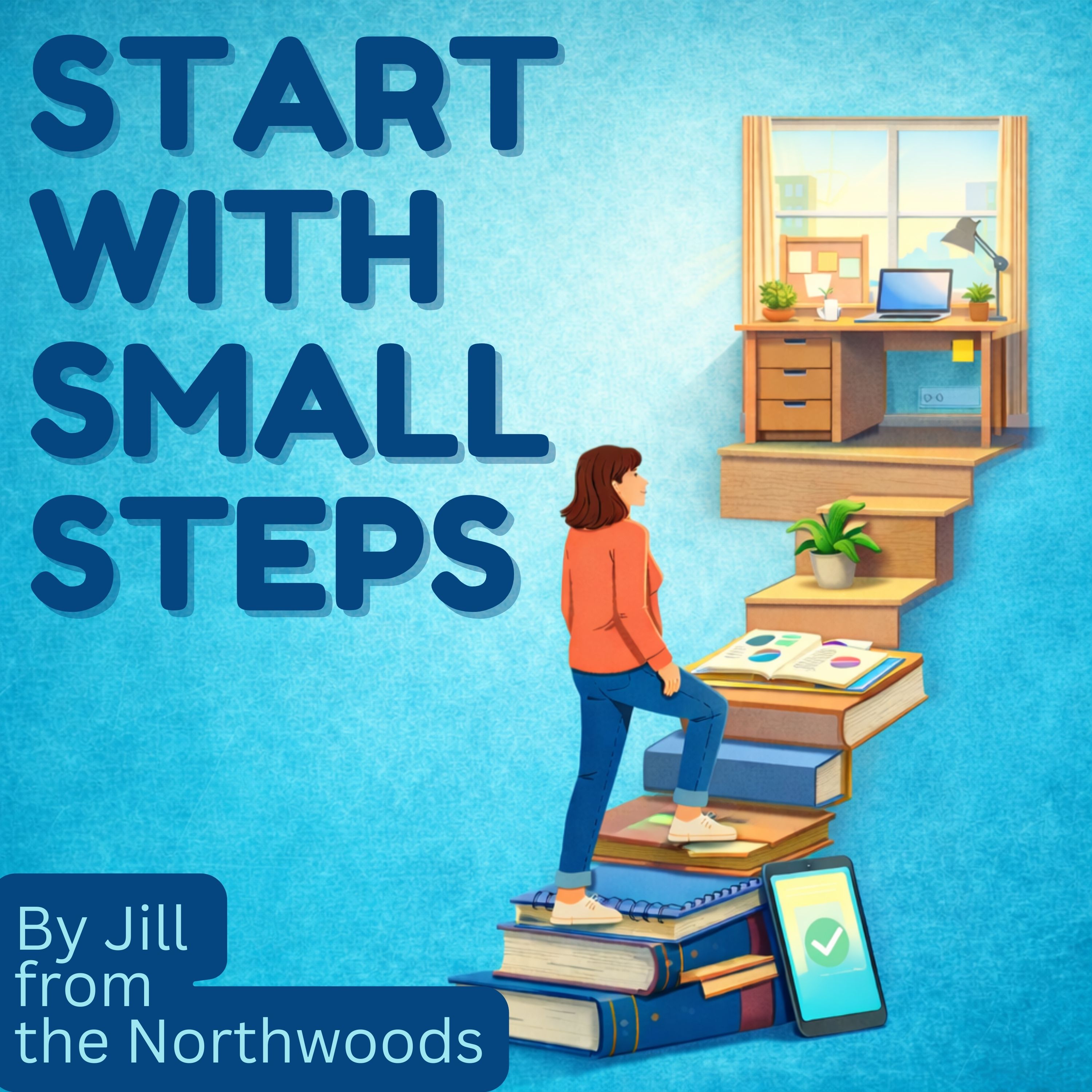
Start with Small Steps
Jill from The Northwoods
Start With Small Steps is a practical, thoughtful podcast about making meaningful progress in everyday life—without overwhelm. Each episode breaks big ideas into small, manageable steps you can actually use, whether you’re working on habits, health, productivity, faith, or personal growth.
Instead of chasing quick fixes or perfect systems, this podcast focuses on steady change, reflection, and realistic action. You’ll hear clear explanations, relatable examples, and simple frameworks designed to help you think better, choose wisely, and keep moving forward—even when life feels complicated or slow.
Start With Small Steps is for anyone who wants growth that fits real life: small actions, honest reflection, and progress that lasts.
Instead of chasing quick fixes or perfect systems, this podcast focuses on steady change, reflection, and realistic action. You’ll hear clear explanations, relatable examples, and simple frameworks designed to help you think better, choose wisely, and keep moving forward—even when life feels complicated or slow.
Start With Small Steps is for anyone who wants growth that fits real life: small actions, honest reflection, and progress that lasts.
Episodes
Mentioned books

Mar 25, 2025 • 23min
223 - Advice from Silly Places
223 - Advice from Silly Places
This episode explores how surprisingly profound life advice can be found in unexpected places—like cartoons, comic strips, movies, TV shows, music, and even bumper stickers. Drawing from a wide range of pop culture references, this episode reveals the timeless truths hidden in the most playful and unconventional sources.
Cartoons with Character and WisdomClassic animated characters like Tweety Bird, Bugs Bunny, Road Runner, and Wile E. Coyote aren’t just entertaining—they offer insights about thinking ahead, handling frustration, and staying true to yourself. Even characters like Yosemite Sam and Elmer Fudd show what happens when anger goes unchecked, while Bugs Bunny reminds us that wit often wins over brute force.
Philosophy Through Comics: Calvin and HobbesThis beloved comic strip is full of wisdom disguised as childhood curiosity. From grappling with fairness and creativity to reflecting on friendship, imagination, and life’s meaning, Calvin and Hobbes present simple truths with emotional depth.
Song Lyrics That Speak to the SoulFrom “Let It Be” to “I Can’t Make You Love Me,” the lyrics of popular songs are filled with lessons about love, patience, heartbreak, and resilience. Whether uplifting or sobering, these messages hit home with their honest reflections on the human experience.
Wise Words from Television and FilmIconic lines from shows and movies like Rocky, The Lion King, Parks and Rec, Ferris Bueller’s Day Off, The Mandalorian, and Buffy the Vampire Slayer provide motivation, emotional strength, and perspective. Quotes like “Just keep swimming” or “Tomorrow is another day” remind listeners to push forward, appreciate the present, and keep hope alive.
Takeaways:Life’s best advice doesn’t always come from books or lectures—it often comes from the unexpected corners of pop culture. Cartoons teach resilience and wit, comic strips bring philosophical insight, music speaks directly to the heart, and films show how to endure and grow. Whether it’s inspiration from Rocky’s determination, comfort in Dory’s persistence, or humor in Homer Simpson’s honesty, wisdom is all around. Sometimes, all it takes is listening closely to the world we already enjoy.
https://startwithsmallsteps.com/223-advice-from-silly-places/
Jill’s Links
https://abetterlifeinsmallsteps.com
https://affiliate.notion.so/NorthwoodsJillday
https://affiliate.notion.so/NorthwoodsAI
https://www.youtube.com/@startwithstartwithsmallstepscast
https://www.buymeacoffee.com/startwithsmallsteps
https://twitter.com/schmern
Email the podcast at jill@startwithsmallsteps.com
Mar 25, 2025 • 23min
223 - Advice from Silly Places
223 - Advice from Silly Places
This episode explores how surprisingly profound life advice can be found in unexpected places—like cartoons, comic strips, movies, TV shows, music, and even bumper stickers. Drawing from a wide range of pop culture references, this episode reveals the timeless truths hidden in the most playful and unconventional sources.
Cartoons with Character and WisdomClassic animated characters like Tweety Bird, Bugs Bunny, Road Runner, and Wile E. Coyote aren’t just entertaining—they offer insights about thinking ahead, handling frustration, and staying true to yourself. Even characters like Yosemite Sam and Elmer Fudd show what happens when anger goes unchecked, while Bugs Bunny reminds us that wit often wins over brute force.
Philosophy Through Comics: Calvin and HobbesThis beloved comic strip is full of wisdom disguised as childhood curiosity. From grappling with fairness and creativity to reflecting on friendship, imagination, and life’s meaning, Calvin and Hobbes present simple truths with emotional depth.
Song Lyrics That Speak to the SoulFrom “Let It Be” to “I Can’t Make You Love Me,” the lyrics of popular songs are filled with lessons about love, patience, heartbreak, and resilience. Whether uplifting or sobering, these messages hit home with their honest reflections on the human experience.
Wise Words from Television and FilmIconic lines from shows and movies like Rocky, The Lion King, Parks and Rec, Ferris Bueller’s Day Off, The Mandalorian, and Buffy the Vampire Slayer provide motivation, emotional strength, and perspective. Quotes like “Just keep swimming” or “Tomorrow is another day” remind listeners to push forward, appreciate the present, and keep hope alive.
Takeaways:Life’s best advice doesn’t always come from books or lectures—it often comes from the unexpected corners of pop culture. Cartoons teach resilience and wit, comic strips bring philosophical insight, music speaks directly to the heart, and films show how to endure and grow. Whether it’s inspiration from Rocky’s determination, comfort in Dory’s persistence, or humor in Homer Simpson’s honesty, wisdom is all around. Sometimes, all it takes is listening closely to the world we already enjoy.
https://startwithsmallsteps.com/223-advice-from-silly-places/
Jill’s Links
https://abetterlifeinsmallsteps.com
https://affiliate.notion.so/NorthwoodsJillday
https://affiliate.notion.so/NorthwoodsAI
https://www.youtube.com/@startwithstartwithsmallstepscast
https://www.buymeacoffee.com/startwithsmallsteps
https://twitter.com/schmern
Email the podcast at jill@startwithsmallsteps.com
Mar 18, 2025 • 14min
222 - The Two Buckets: A Simple Way to Solve Life’s Problems
222 - The Two Buckets: A Simple Way to Solve Life’s Problems
Hi everyone, it’s Jill from the North Woods! In this episode, I’m sharing one of the biggest life lessons I ever learned—the concept of putting problems into two buckets: things I can change and things I cannot. This idea, rooted in the Serenity Prayer, has helped me navigate everything from growing up with an alcoholic parent to financial struggles, career changes, and even weight loss.
I’ll take you through the history of this powerful mindset, from ancient Greek philosophers to modern problem-solving techniques, and share real-life examples of how shifting my focus has made all the difference. If you’ve ever felt stuck, overwhelmed, or unsure of how to tackle life’s challenges, this episode is for you.
The Serenity Prayer and How It Shaped My ThinkingI first learned the Serenity Prayer in my teens while attending Alateen, a support group for children of alcoholics. This simple yet profound message helped me reframe my struggles, allowing me to focus on what I could change instead of feeling powerless over what I couldn’t.
The Long History of This WisdomThe idea of separating problems into what’s within our control and what isn’t has been around for centuries. I share insights from historical figures like Epictetus, Solomon ibn Gabirol, and Shantideva, all of whom recognized the power of focusing on what we can control.
Real-Life Applications of the Two Buckets Approach-Growing Up with an Alcoholic Parent – I couldn’t stop my dad from drinking, but I could create a full, active life outside of that challenge.-Politics & Global Issues – I can’t change everything, but I can vote, volunteer, and contribute where I can.-Financial Stability & Retirement Worries – Social Security’s future is uncertain, but I can prepare by saving more and making smart financial decisions.-Weight Loss & Health – I once thought my weight was out of my control until I found new solutions and the right support.
Re-Evaluating What’s in Your “Can’t Change” BucketSometimes, we assume a problem is out of our hands when it’s really not. I share examples of creative problem-solving—like how a simple change (adding mirrors) made people stop complaining about slow elevators. The key is to step back, get a new perspective, and challenge assumptions.
Takeaways:✅ Put problems into two buckets: Can you change it or not?✅ Focus on action instead of worrying about things beyond your control.✅ Re-evaluate your buckets over time—something that seemed unchangeable might have a solution you haven’t seen yet.✅ Seek outside advice when you feel stuck—sometimes an expert or a fresh perspective can make all the difference.✅ If something is in the "can change" bucket, take the first step today.
This mindset shift has helped me reduce stress and solve problems more effectively, and I hope it helps you too. Now, I challenge you—think about a problem in your life right now. Which bucket does it belong in?
Let me know what you think! Email me at Jill@startwithsmallsteps.com, comment on my channel, or share this episode with someone who might need it. Thanks for listening, and have a great week!
https://startwithsmallsteps.com/the-two-buckets-a-simple-way-to-solve-lifes-problems/
Jill’s Links
https://abetterlifeinsmallsteps.com
https://affiliate.notion.so/NorthwoodsJillday
https://affiliate.notion.so/NorthwoodsAI
https://www.youtube.com/@startwithstartwithsmallstepscast
https://www.buymeacoffee.com/startwithsmallsteps
https://twitter.com/schmern
Email the podcast at jill@startwithsmallsteps.com
Mar 11, 2025 • 20min
221 - Don't Let Anyone Push Your Buttons
221 - Don't Let Anyone Push Your Buttons
In this episode, I share one of the most powerful lessons I ever learned—from a book I discovered as a child. Wayne Dyer’s Your Erroneous Zones completely changed how I saw emotions, reactions, and the way people try to manipulate us. This book helped me navigate a tough home life, stand up to bullies, and, most importantly, stop letting others control how I felt.
I explore the emotional traps that keep people stuck—anger, worry, guilt, insecurity, and perfectionism—and how to break free from them. The biggest takeaway? No one can push your buttons unless you let them. Learning this truth gave me the confidence to take charge of my emotions, and in this episode, I’ll share how you can do the same.
The Book That Changed My PerspectiveI was a little kid in a chaotic home when I first saw Wayne Dyer on PBS talking about Your Erroneous Zones. Something about his message clicked. Even as a child, I realized that emotions weren’t just things that happened to me—I had control over them.
The Emotional Traps That Keep Us StuckDyer identifies five major thought patterns that hold us back:
Anger – Letting frustration control you instead of responding calmly.Worry – Stressing over things that are outside your control.Guilt – Staying stuck in past mistakes instead of making amends and moving on.Insecurity – Constant self-doubt that keeps you from taking action.Perfectionism – Thinking you need to be 100% ready before you start something.I share how I struggled with these emotions and the small steps I took to overcome them.
The Most Life-Changing Lesson: No One Can Push Your ButtonsThis was the biggest revelation: people only have power over you if you let them. I saw firsthand how my father emotionally manipulated my mother. But when I learned to control my reactions, he stopped targeting me. If someone is making you feel bad, it’s because you’re giving them permission to do so.
How to Take Back Control of Your EmotionsIf you struggle with reacting emotionally to situations, try these strategies:
-Pause Before Reacting – Take five seconds to ask, Is this worth my peace of mind?-Reframe the Situation – Most people’s negativity is about them, not you.-Use Humor – Responding with a joke can take the power away from insults.-Practice Inner Silence – Sometimes, the best response is no response.-Find Compassion – Understanding why someone acts a certain way can help you detach.
Takeaways:-Your emotions belong to you. No one else can make you feel something unless you allow them to.-Taking action is the antidote to fear. Perfectionism, insecurity, and doubt all shrink when you start moving forward.-When life squeezes you, what’s inside of you comes out. If you don’t like how you react under pressure, it’s time to work on what’s inside.-The more you control your emotions, the freer you become. People lose their ability to manipulate you when you stop reacting.]If you’ve ever felt like someone else has control over your emotions, it’s time to take that power back. By shifting your mindset and making small changes, you can free yourself from anger, worry, guilt, and insecurity.
https://startwithsmallsteps.com/221-take-control-of-your-emotions/
Jill’s Links
https://abetterlifeinsmallsteps.com
https://affiliate.notion.so/NorthwoodsJillday
https://affiliate.notion.so/NorthwoodsAI
https://www.youtube.com/@startwithstartwithsmallstepscast
https://www.buymeacoffee.com/startwithsmallsteps
https://twitter.com/schmern
Email the podcast at jill@startwithsmallsteps.com
Mar 4, 2025 • 23min
220 - Stop Playing It Safe
220 - Stop Playing It Safe
In this episode of Start with Small Steps, Jill from the North Woods shares a powerful lesson learned from playing chess with her father: the best way to improve is to challenge yourself against stronger opponents. This principle extends beyond the chessboard and applies to personal growth, career development, fitness, and creative pursuits. Jill explores how surrounding yourself with skilled people, finding the right level of challenge, and embracing discomfort can lead to transformation. She also discusses the role of AI as a learning tool and the importance of applying what you observe from others.
The Power of Playing Against Stronger OpponentsJill’s father never let her win at chess, and this tough love approach taught her to embrace challenges rather than seek easy victories. Whether in work, hobbies, or personal goals, true growth comes from learning from those who are ahead of us.
The Right Level of Challenge for ImprovementGrowth requires finding the right balance—not too easy, not too difficult. Jill explains how to assess what level of challenge will push you forward without overwhelming you, whether it's in writing, public speaking, or fitness.
Using AI as a Learning Tool (Not a Replacement)Jill shares how she uses AI to refine her writing rather than replace it. She discusses the importance of maintaining personal effort while leveraging AI for insights and efficiency.
Learning from "Secret Mentors"Sometimes, the best mentors aren’t the ones we formally ask for help, but those we quietly observe. Jill explains how watching skilled colleagues and analyzing their methods has helped her improve in various areas of life.
The Importance of Embracing DiscomfortIf something feels uncomfortable—whether it’s public speaking, learning a new skill, or pushing past fitness limits—it’s often a sign of growth. Jill encourages listeners to lean into discomfort as a necessary step toward mastery.
Applying What You LearnIt’s not enough to listen, read, or watch others—you must put what you learn into action. Jill provides practical steps for tracking progress and continuously improving through observation, reflection, and practice.
Takeaways✅ Challenge yourself by learning from those ahead of you. Staying in your comfort zone won’t lead to growth. Seek out opportunities to be around people who push you to be better.
✅ Find the right level of difficulty. Growth happens in stages—too easy, and you won’t progress; too hard, and you may give up. Identify challenges that stretch but don’t break you.
✅ Leverage AI and technology as tools for improvement. AI can help refine your skills, but real learning comes from effort and practice.
✅ Observe and learn from successful people. Whether it’s a mentor, coworker, or expert in your field, analyze their techniques and apply them to your own journey.
✅ Embrace discomfort as a sign of progress. If something feels difficult, that means you're learning. Stay persistent and celebrate small wins along the way.
✅ Take action. Don’t just consume information—apply it. Growth only happens when you put knowledge into practice.
Challenge for YouThis week, put yourself in a situation where you are the least experienced person in the room. Whether in a meeting, a class, or a fitness session, find someone who is better than you and learn from them. Write down what you observe, practice what you learn, and reflect on your progress.
https://startwithsmallsteps.com/220-stop-playing-it-safe/
Jill’s Links
https://abetterlifeinsmallsteps.com
https://affiliate.notion.so/NorthwoodsJillday
https://affiliate.notion.so/NorthwoodsAI
https://www.youtube.com/@startwithstartwithsmallstepscast
https://www.buymeacoffee.com/startwithsmallsteps
https://twitter.com/schmern
Email the podcast at jill@startwithsmallsteps.com
Feb 25, 2025 • 25min
219 - No Choice Is A Choice
219 - No Choice Is A Choice
Have you ever avoided making a decision, hoping things would just work themselves out, only to realize later that doing nothing made everything worse? I know I have, and in this episode, I’m talking about how no decision is still a decision—just not one you control. I share personal stories about how my own indecision has impacted my career, relationships, and health, sometimes in ways I deeply regret. I also talk about the hidden cost of avoiding choices and why small, intentional steps can put you back in control of your life.
For a long time, I thought that if I didn’t make a choice, I was keeping my options open. But I’ve learned that when I fail to act, life steps in and makes the choice for me—and it’s rarely the one I would have wanted. When I graduated college, I couldn’t decide what path to take, and instead of making an intentional choice, I drifted into a job out of necessity. Years later, I realized I had closed doors to other opportunities simply because I hadn’t been proactive. The same thing happened in my health. I spent years trying and failing to lose weight, pushing off real action because I wasn’t sure what would work. Eventually, my health suffered, and I was forced to take action, but by then, I had fewer choices available to me.
One of the hardest lessons I’ve learned is that inaction has real consequences. Not deciding doesn’t protect you from failure; it often makes things worse. When I ignored problems with my house, I ended up with water damage that could have been avoided. When I stayed in a comfortable but stagnant job, I watched my retirement savings fall behind. It’s easy to think we’ll have more time later, but time moves fast, and before we know it, years have passed without progress.
I also understand why people avoid making choices, because I’ve done it too. Sometimes we’re afraid of picking the wrong option, so we convince ourselves that waiting is better. Other times, we don’t want to take responsibility in case things go wrong. And then there’s the belief that we have all the time in the world, but that’s an illusion. The truth is, the longer we wait, the fewer options we have.
TakeawaysWhat I’ve learned is that even a bad decision is often better than no decision at all. When I finally started taking control of my career, my health, and my finances, things didn’t change overnight, but they started moving in the right direction. The key is to stop waiting for the perfect moment and just take one small step. If you’re stuck in a job you don’t like, start by updating your resume. If your health is suffering, make one simple change today. If a relationship isn’t working, have that hard conversation.
I challenge you to think about one area of your life where you feel stuck. What’s one small action you can take today? It doesn’t have to be huge—just something to move you forward. I’d love to hear from you about the choices you’re facing. You can email me at jillatstartwithsmallsteps.com or leave a comment on YouTube. Remember, doing nothing is still a choice—so why not choose to take control?
https://startwithsmallsteps.com/219-no-choice-is-a-choice/
Jill’s Links
https://abetterlifeinsmallsteps.com
https://affiliate.notion.so/NorthwoodsJillday
https://affiliate.notion.so/NorthwoodsAI
https://www.youtube.com/@startwithstartwithsmallstepscast
https://www.buymeacoffee.com/startwithsmallsteps
https://twitter.com/schmern
Email the podcast at jill@startwithsmallsteps.com
Feb 18, 2025 • 29min
218 - Solve the Right Problem
218 - Solve the Right Problem
In today’s episode, I’m sharing something that completely changed my life—learning to solve the right problem. For years, I kept hitting the same roadblocks, whether it was with my weight, finances, or personal goals. No matter how much effort I put in, nothing seemed to work. And then I realized—I was solving the wrong problem.
Instead of focusing on what really needed fixing, I was throwing solutions at the wrong issues. Buying gym equipment didn’t solve my weight loss struggles. Cutting back on small purchases didn’t fix my income problem. It wasn’t until I stepped back, got clear on what the real issues were, and tackled them head-on that I finally started making progress.
If you’ve ever felt stuck—trying everything but never seeing results—this episode is for you. I’ll walk you through practical steps to help you figure out what’s really holding you back and how to finally move forward.
1. The Trap of Solving the Wrong ProblemI share my personal experience of spinning my wheels for years, fixing surface-level issues instead of the actual root cause. I use the example of fixing the brakes on a broken-down car when the real issue is the engine—no matter what you do, you won’t get anywhere.
2. Defining Your Problem ClearlyOne of the biggest mistakes people make is setting vague goals like “I want to lose weight” or “I need to save money.” That’s too broad! I talk about how breaking problems down into specific, actionable pieces leads to real solutions.
3. Using the Five Whys to Get to the Root CauseEver feel like you’re treating symptoms instead of the real issue? I explain how asking why five times can reveal what’s actually stopping you from making progress. This method helped me understand that my struggles with exercise weren’t about needing gym equipment—they were about my habits and motivation.
4. Identifying Patterns That Keep You StuckI used to think my financial struggles were because of big expenses, but when I started tracking my spending, I realized it was small, recurring purchases that were draining my bank account. I talk about how identifying patterns—rather than focusing on one-time mistakes—can help you see what’s really going wrong.
5. Focusing on What You Can ControlI can’t control my genetics or my past financial mistakes, but I can control what I eat, how often I move, and how I budget my money. In this section, I help you shift your focus toward the things you actually can change.
6. Testing Small Before Going All InBefore making a big commitment, test a small version first! I share why I should have tried a short-term gym membership before buying expensive equipment. The same logic applies to career changes—if you want to start a business, try freelancing first instead of quitting your job overnight.
7. Tracking Data Instead of Relying on FeelingsI used to think I barely spent any money, but my spending journal told a different story. I also thought I wasn’t overeating—until I started tracking my food. I explain how keeping a journal or log can reveal the truth behind your habits.
8. Imagining Future ConsequencesOne of the most powerful exercises I use is asking myself, What happens if I don’t solve this problem? If I don’t start exercising now, will I still be able to hike and travel when I retire? If I don’t fix my finances, will I have enough to live on later? Thinking about my future self has helped me prioritize the most important changes.
9. Learning from People Who Have Been ThereI didn’t figure all of this out on my own—I learned from others. Whether it’s books, podcasts, or mentors, I talk about how studying people who have solved similar problems can help you fast-track your progress.
Key Takeaways:✔️ Define the real problem – Get specific instead of setting vague goals.✔️ Use the Five Whys – Dig deep to find the root cause of your struggles.✔️ Look at patterns, not just one-time mistakes – Track your habits to see what’s really happening.✔️ Focus on what you can control – Stop wasting energy on things outside your influence.✔️ Test before committing – Small experiments can prevent big regrets.✔️ Track data, not feelings – Journaling helps you make smarter decisions.✔️ Think about your future self – Will you regret not fixing this later?✔️ Learn from others – Find mentors, books, or resources that can guide you.✔️ Start small, but start today – You don’t have to fix everything at once. Just take the first step.
Final Thoughts:If you’re feeling stuck, I want you to ask yourself: Am I solving the right problem?
Once I started focusing on the real obstacles in my life, everything changed. My weight loss journey became more effective, my finances improved, and I stopped wasting time on things that didn’t matter.
I hope this episode helps you start thinking differently about the challenges in your life. If you enjoyed it, please share it with a friend who might need it!
https://startwithsmallsteps.com/218-solve-the-right-problem-how-to-break-free-from-repeated-failures/
Jill’s Links
https://abetterlifeinsmallsteps.com
https://affiliate.notion.so/NorthwoodsJillday
https://affiliate.notion.so/NorthwoodsAI
https://www.youtube.com/@startwithstartwithsmallstepscast
https://www.buymeacoffee.com/startwithsmallsteps
https://twitter.com/schmern
Email the podcast at jill@startwithsmallsteps.com
Feb 11, 2025 • 31min
217 - We’re All Walking Contradictions
217 - We’re All Walking ContradictionsHey everyone, it’s Jill from the Northwoods! In this episode, I’m sharing one of the biggest lessons I’ve learned in life: every strength has a weakness, and every weakness has a hidden strength. Understanding this has helped me navigate relationships, improve my leadership skills, and find more balance in my life.
I’ll take you through personal stories—like how my ability to build strong teams made me a great leader but held me back in tough negotiations. I’ll also break down common traits like confidence, empathy, ambition, and adaptability, showing how they can either work for us or against us. And, of course, I’ll share practical strategies for self-awareness, personal growth, and embracing our full selves.
1. We’re All a Coin – Strengths and Weaknesses Are ConnectedI’ve learned that no trait is entirely good or bad—it all depends on context. Confidence can turn into arrogance, perfectionism can cause procrastination, and empathy can lead to emotional exhaustion. Recognizing this has helped me approach life with more balance and understanding.
2. The Hidden Cost of Leaning Too Hard on StrengthsI share a personal experience from my tech career where my leadership style worked well—until I had to handle tough contract negotiations. I was great at team-building but struggled with standing my ground in business. Learning to reframe my perspective helped me find a way to grow in an area that didn’t come naturally to me.
3. Finding Balance in Our Strengths and WeaknessesWe all tend to overuse certain traits, but self-awareness can help us adjust. I’ll share some of my favorite strategies, like journaling, seeking feedback, and partnering with people who complement our weaknesses.
4. Giving Grace to Ourselves and OthersIt’s easy to get frustrated with people who think differently than we do. But when I started seeing people as complex individuals—with both strengths and flaws—it changed how I approached relationships. I’ll share how we can extend more understanding and patience to ourselves and those around us.
5. Practical Steps for GrowthIdentify patterns in your own behavior – What strength do you overuse? Where do you struggle?-Seek feedback – Ask people you trust to help you see your blind spots.-Train the opposite skill – If you’re overly cautious, practice small risks. If you’re a perfectionist, challenge yourself to start before you feel “ready.”-Surround yourself with people who balance you out – A team or friendship built on complementary strengths is powerful.
Takeaways-We all have strengths and weaknesses, and they are often two sides of the same coin.-Self-awareness is the first step to growth—journaling, reflection, and feedback help us adjust.-Context matters—sometimes a strength can be a liability if used in the wrong way.-Giving grace to ourselves and others makes life and relationships a lot easier.-Growth is a process—no one is perfect, and that’s okay.
Your Challenge This WeekTake a moment to reflect on your own strengths and weaknesses. Ask yourself:
What’s a strength I rely on too much?What’s a weakness that actually benefits me in some way?How can I find better balance in my life?I’d love to hear your thoughts! Email me at jillatstartwithsmallsteps.com or leave a comment. And if you enjoyed this episode, please share it with a friend who might need to hear it!
🎙️ Thanks for listening—I appreciate you, and I’ll see you next week!
https://startwithsmallsteps.com/217-were-all-walking-contradictions/
Jill’s Links
https://abetterlifeinsmallsteps.com
https://affiliate.notion.so/NorthwoodsJillday
https://affiliate.notion.so/NorthwoodsAI
https://www.youtube.com/@startwithstartwithsmallstepscast
https://www.buymeacoffee.com/startwithsmallsteps
https://twitter.com/schmern
Email the podcast at jill@startwithsmallsteps.com
Feb 4, 2025 • 18min
216 - Feeling Overwhelmed? Start Small
216 - Feeling Overwhelmed? Start Small
Big goals are intimidating. But breaking them into smaller steps makes them achievable. Here’s how:
Start With the Simplest ActionInstead of thinking about the entire project, focus on the tiniest, easiest step. If your goal is to clean your house, don’t aim for perfection. Just throw out the trash. If you want to start exercising, do one push-up. The key is to start so small you can’t possibly fail.
Use the Snowball EffectOnce you complete a small task, you’ll feel motivated to do another. This builds momentum. When I cleaned my childhood home, I started with the bathroom because it was small. That small success encouraged me to keep going.
Make It a HabitSmall steps aren’t just about getting things done—they’re about forming habits. Productivity expert BJ Fogg recommends starting with "tiny habits" so small they become second nature. For example, if you want to floss daily, just start by flossing one tooth. Once the habit is established, it naturally expands.
Adjust Based on Your LifeOne of the best things about small steps is that they fit into any schedule. When I was busy with school and caregiving, my steps were extra tiny. During summer, I could do a little more. The key is consistency, not intensity.
Stack Small Steps Over TimeOver time, small steps compound into big change. When I started focusing on weight loss, I didn’t immediately jump into an intense fitness routine. Instead, I started walking more, eating slightly healthier, and making gradual adjustments. Now, I’m in a much better place—because I built my success in layers.
Why Small Steps Work for Every Part of LifeThe beauty of small steps is that they apply to anything:
✅ Health & Fitness: Couch to 5K programs work by gradually increasing running time. Small steps make exercise sustainable.✅ Cleaning & Organization: Cleaning one small area at a time prevents burnout and keeps spaces manageable.✅ Work & Productivity: Tackling one email, one meeting, or one task at a time creates steady progress.✅ Mental Health & Personal Growth: One mindful moment, one journal entry, or one deep breath can make all the difference.
Life keeps moving while you take small steps. You don’t have to put everything else on hold—you can still enjoy hobbies, family, and rest while making steady progress toward your goals.
https://startwithsmallsteps.com/216-feeling-overwhelmed-start-small/
Jill’s Links
https://abetterlifeinsmallsteps.com
https://affiliate.notion.so/NorthwoodsJillday
https://affiliate.notion.so/NorthwoodsAI
https://www.youtube.com/@startwithstartwithsmallstepscast
https://www.buymeacoffee.com/startwithsmallsteps
https://twitter.com/schmern
Email the podcast at jill@startwithsmallsteps.com
Jan 28, 2025 • 34min
215 - What Not to Do with ADHD
215 - What Not to Do with ADHD
In this episode, we explore what not to do when managing ADHD—whether it’s your own or that of someone you love. From handling distractions to avoiding harmful self-talk, this conversation is packed with practical strategies and insights. Learn how to set realistic expectations, build ADHD-friendly routines, and foster healthier relationships through understanding and collaboration.
The Scottie Method for Time ManagementInspired by Star Trek, the Scottie Method encourages you to overestimate the time a task might take. This approach helps reframe successes as wins rather than failures, especially when projects take longer than expected.
Eat the Frog or Eat the Cake?We break down the difference between tackling hard tasks first (“eating the frog”) versus starting with easier wins (“eating the cake”). The best strategy depends on your energy levels and when you’re most focused during the day.
Managing DistractionsADHD and distractions go hand in hand. Learn how to block time-wasting websites, create a focused workspace, and find stimulating yet non-distracting ways to stay engaged.
Building ADHD-Friendly RoutinesRoutines may feel stifling, but they reduce decision fatigue and free up mental energy for more important tasks. We discuss how setting small daily habits can lead to greater productivity and stability.
Supporting Someone With ADHDWe delve into the importance of understanding and patience when supporting someone with ADHD. Criticism, unrealistic expectations, or piling on tasks often backfires. Instead, focus on collaboration and leveraging strengths.
Takeaways—Set Yourself Up for Success: Use tools like timers, focus apps, and checklists to combat forgetfulness and stay organized.—Avoid Perfectionism: Aim to complete tasks rather than striving for perfection every time—it’s about progress, not flawless results.—Ask for Help: Don’t be afraid to lean on others for tasks that don’t align with your strengths. Collaboration can improve both productivity and relationships.—Limit Overcommitment: Learn to say “no” when needed to avoid burnout and spread yourself too thin.—Understand ADHD Strengths: ADHD brains bring creativity, problem-solving, and energy. Embrace these qualities while finding systems to manage weaknesses.
A Note for Caregivers and Loved OnesIf you’re supporting someone with ADHD, take the time to ask questions, offer help in areas they struggle with, and celebrate their strengths. Building a supportive relationship creates a foundation for growth and mutual understanding.
https://startwithsmallsteps.com/adhd-survival-guide-what-not-to-do/
Jill’s Links
https://abetterlifeinsmallsteps.com
https://affiliate.notion.so/NorthwoodsJillday
https://affiliate.notion.so/NorthwoodsAI
https://www.youtube.com/@startwithstartwithsmallstepscast
https://www.buymeacoffee.com/startwithsmallsteps
https://twitter.com/schmern
Email the podcast at jill@startwithsmallsteps.com

