

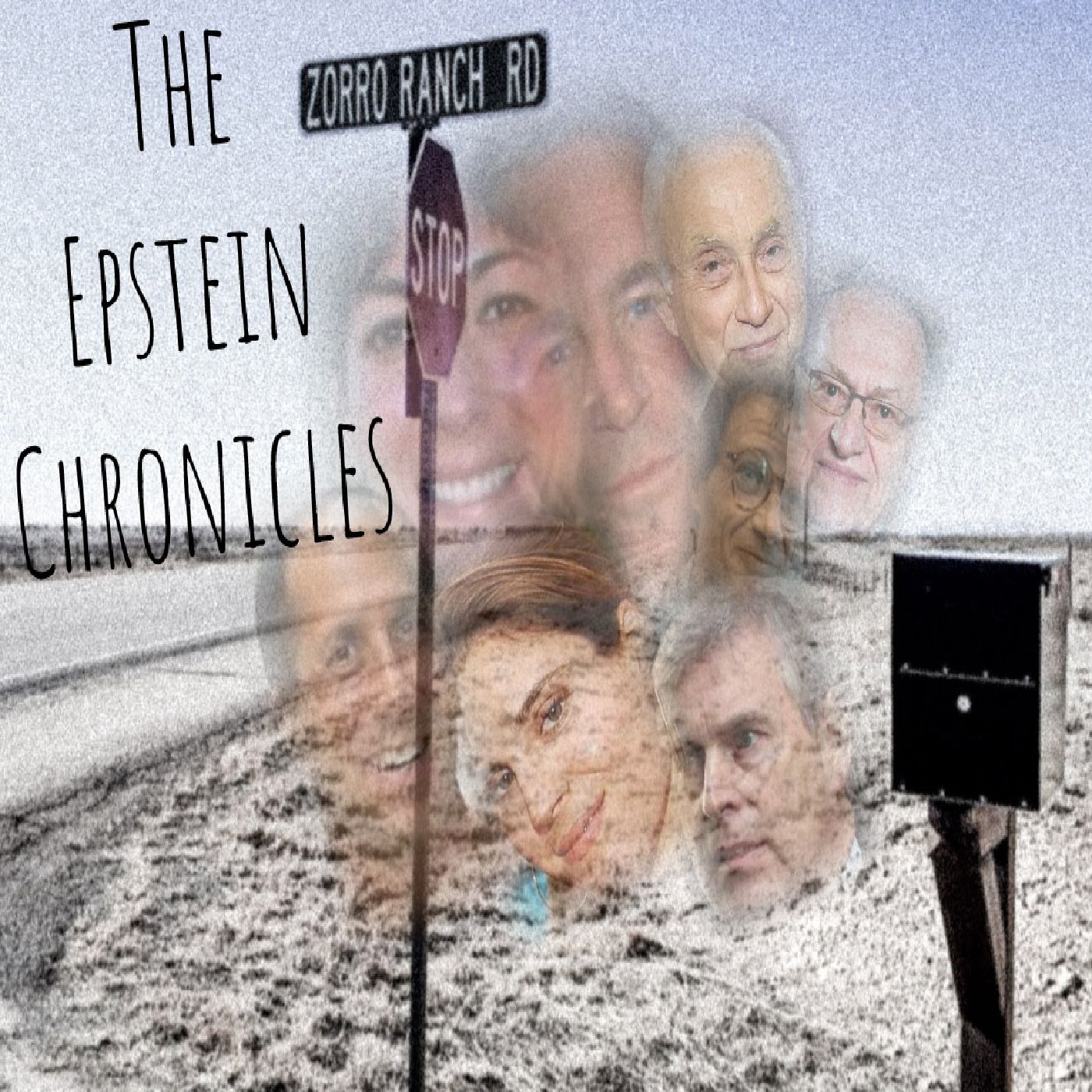
The Epstein Chronicles
Bobby Capucci
Jeffrey Epstein was a multi millionaire who had political and business ties to some of the most rich and powerful people in the world. From businessmen to politicians at the highest levels, Epstein broke bread with them all. Yet for years the Legacy media and the rest of high society looked the other way and ignored his behavior as multiple women came forward with allegations of abuse. Even after he was convicted and subsequently received a sweetheart deal those same so called elites welcomed him back with open arms. Now after his death and the arrest of Maxwell, the real story is starting to come together and the curtain has begun to be drawn back and what it has revealed is truly disturbing. From Princes to Ex Presidents, the cast of scoundrels in this play spans continents and political affiliations leaving us with a transcontinental criminal conspiracy possibly unlike any we have ever seen before. In this podcast we will explore all of the levels of Jeffrey Epstein and his criminal enterprise. From his most trusted assistants to obscure associates, we will leave no stone unturned as we swim through the muck searching for clarity and answers to some of the most pressing questions of the case. From interviews with people directly involved in the case to daily updates, the Epstein Chronicles will have it all. Just like our other project, The Jeffrey Epstein Show, you can expect no punches pulled and consistent content. We have covered the Epstein case daily(everyday since October 1st 2019) and will continue to do so until there are convictions. With a library of well over 1k shows, you can expect a ton of content coming your way including on scene reporting from the Maxwell trial and from places like Zorro Ranch. Thank you for tuning in and I look forward to having you all along for the ride.(Created and Hosted by Bobby Capucci)Become a supporter of this podcast: https://www.spreaker.com/podcast/the-epstein-chronicles--5003294/support.
Episodes
Mentioned books

Apr 9, 2026 • 18min
Harvard and the Epstein Fallout: The Mary Erdoes Decision
Harvard’s decision to install Mary Erdoes — the longtime CEO of the asset and wealth-management arm of JPMorgan Chase & Co. — onto the board of its endowment manager comes at a particularly fraught moment. Recent unsealed documents and public reporting reveal that Erdoes maintained regular contact with Epstein while he was a client, despite numerous warnings and widely known allegations of criminal sexual misconduct. Many of those communications have been described as “highly personal” and show that even after Epstein’s 2008 conviction for soliciting a minor, executives under Erdoes’s supervision continued to handle his accounts — a decision that federal investigators now say reflects possible institutional complicity. With the broader scandal intensifying, Harvard’s choice to elevate Erdoes — rather than distance the university from those links — reads as a tone-deaf move that prioritizes financial pedigree over moral accountability.In making that appointment, Harvard risks underestimating how the optics — not to mention the facts — will land with students, alumni, and the public at large. To many, the decision signals indifference to the victims of Epstein’s crimes and raises serious doubts about Harvard’s commitment to ethical oversight and transparency. By putting someone closely tied to Epstein’s financial network in charge of stewarding the university’s endowment, Harvard has exposed itself to charges of hypocrisy and moral failure — undermining trust at a time when institutions everywhere are being called to answer for their links to abuse and exploitation.to contact me:bobbycapucci@protonmail.comsource:Harvard Endowment Appoints 3 New Directors, Including JPMorgan Exec Who Managed Epstein’s Bank Accounts | News | The Harvard CrimsonBecome a supporter of this podcast: https://www.spreaker.com/podcast/the-epstein-chronicles--5003294/support.
Apr 9, 2026 • 12min
Inside The OIG Interview: The Warden's Statement Detailing The Death Of Jeffrey Epstein (Part 4) (4/9/26)
Lamine N'Diaye, in his interview with the Office of the Inspector General, essentially tried to turn the Metropolitan Correctional Center into a scapegoat while positioning himself as a bystander to its failures. He leaned heavily on the narrative that the facility was already broken—staff shortages, overtime abuse, infrastructure decay—as if that somehow absolved him of responsibility rather than underscoring the urgency of his role. What stands out is not just what he admitted, but what he avoided: there is little evidence in his account of decisive leadership, no clear record of aggressive intervention, and no meaningful acknowledgment that the buck was supposed to stop with him. Instead, he described a system failing in slow motion while he remained at the helm, fully aware of the cracks but unwilling—or unable—to reinforce them before they gave way.Even more troubling is how his interview reflects a pattern of deflection that mirrors broader institutional behavior in the wake of Jeffrey Epstein’s death. N’Diaye pointed to correctional officers missing rounds, falsifying logs, and working under extreme fatigue, but failed to explain why those conditions were tolerated under his command, especially after Epstein had already been flagged as a high-risk inmate following a prior incident. The responsibility didn’t disappear into the system—it sat squarely in his office, and his testimony reads less like accountability and more like damage control. The overall picture is not of a warden overwhelmed by circumstances, but of a leader who allowed a known crisis environment to persist unchecked, then attempted to retroactively frame it as inevitable once the worst-case scenario unfolded.to contact me:bobbycapucci@protonmail.comsource:EFTA00119019.pdfBecome a supporter of this podcast: https://www.spreaker.com/podcast/the-epstein-chronicles--5003294/support.
Apr 9, 2026 • 13min
Inside The OIG Interview: The Warden's Statement Detailing The Death Of Jeffrey Epstein (Part 3) (4/9/26)
Lamine N'Diaye, in his interview with the Office of the Inspector General, essentially tried to turn the Metropolitan Correctional Center into a scapegoat while positioning himself as a bystander to its failures. He leaned heavily on the narrative that the facility was already broken—staff shortages, overtime abuse, infrastructure decay—as if that somehow absolved him of responsibility rather than underscoring the urgency of his role. What stands out is not just what he admitted, but what he avoided: there is little evidence in his account of decisive leadership, no clear record of aggressive intervention, and no meaningful acknowledgment that the buck was supposed to stop with him. Instead, he described a system failing in slow motion while he remained at the helm, fully aware of the cracks but unwilling—or unable—to reinforce them before they gave way.Even more troubling is how his interview reflects a pattern of deflection that mirrors broader institutional behavior in the wake of Jeffrey Epstein’s death. N’Diaye pointed to correctional officers missing rounds, falsifying logs, and working under extreme fatigue, but failed to explain why those conditions were tolerated under his command, especially after Epstein had already been flagged as a high-risk inmate following a prior incident. The responsibility didn’t disappear into the system—it sat squarely in his office, and his testimony reads less like accountability and more like damage control. The overall picture is not of a warden overwhelmed by circumstances, but of a leader who allowed a known crisis environment to persist unchecked, then attempted to retroactively frame it as inevitable once the worst-case scenario unfolded.to contact me:bobbycapucci@protonmail.comsource:EFTA00119019.pdfBecome a supporter of this podcast: https://www.spreaker.com/podcast/the-epstein-chronicles--5003294/support.
Apr 9, 2026 • 20min
From Transparency to “Move On”: The Collapse of the Comer Epstein Probe (4/9/26)
The committee chaired by James Comer was presented as a serious effort to expose the truth behind the Epstein scandal, but in practice it operated more like a containment mechanism than a genuine investigation. Instead of aggressively pursuing the deeper financial, institutional, and international networks surrounding Jeffrey Epstein, the committee stayed confined to surface-level material that had already been widely reported. Its pacing was slow to the point of being strategic, releasing limited information in controlled bursts that drained public momentum rather than building pressure. Key lines of inquiry were avoided altogether, particularly those that could implicate powerful institutions or expand the scope beyond a manageable narrative. This was not oversight in any meaningful sense—it was narrative management disguised as accountability, designed to give the illusion of action while ensuring nothing truly destabilizing came to light.The shift from promises of “full transparency” to a quiet push toward “moving on” was not accidental—it was enabled by the committee’s own conduct. By dragging out the process, narrowing its focus, and controlling what was released, Comer and his colleagues created the conditions for public fatigue, making it easier to justify closing the book before the real questions were answered. The fact that a discharge petition was required to force additional material into the open exposes just how resistant the committee was to genuine transparency. Without that external pressure, the public likely would have been left with a sanitized, incomplete version of events presented as the final word. Far from uncovering the truth, Comer’s committee functioned as a gatekeeper, protecting the boundaries of the narrative and ensuring the most consequential aspects of the Epstein network remained out of reach.to contact me:bobbycapucci@protonmail.comBecome a supporter of this podcast: https://www.spreaker.com/podcast/the-epstein-chronicles--5003294/support.
Apr 9, 2026 • 18min
Jena Lisa Jones Discusses Her Jeffrey Epstein Nightmare (4/9/26)
Jena Lisa Jones says she was just 14 years old when she was first abused by Jeffrey Epstein, describing how she was recruited with the promise of money and brought into his orbit while still a minor. She explains that what initially seemed like a simple opportunity quickly turned into sexual exploitation, and that she was too young to fully understand or resist what was happening at the time. Her account emphasizes how vulnerable she was and how easily she was drawn into the situation under false pretenses.She also describes how the experience followed her long after it happened, shaping her life in ways that didn’t end when she left that environment. By speaking publicly, Jones adds to the growing number of firsthand accounts that illustrate not just what occurred, but how it was allowed to continue for years without meaningful interruption. Her account underscores both the personal toll and the larger systemic failures that enabled Epstein’s activities to persist despite repeated warning signs and opportunities for intervention.to contact me:bobbycapucci@protonmail.comsource:'Jeffrey Epstein abused me when I was 14 and hadn't even kissed a boy' - The Mirror USBecome a supporter of this podcast: https://www.spreaker.com/podcast/the-epstein-chronicles--5003294/support.
Apr 9, 2026 • 12min
Bondi Refuses to Appear for Deposition Despite Subpoena in Epstein Investigation (4/9/26)
Former Attorney General Pam Bondi will not appear for a scheduled House Oversight Committee deposition related to the government’s handling of the Jeffrey Epstein investigation, despite being subpoenaed. According to the Justice Department, the subpoena was issued to Bondi in her official capacity as attorney general, and because she no longer holds that position, she is not obligated to testify. DOJ officials formally asked the committee to withdraw the subpoena, arguing that she cannot testify in a role she no longer occupies.However, lawmakers on the House Oversight Committee are pushing back, insisting the subpoena applies to Bondi personally and remains valid regardless of her employment status. Members of both parties have emphasized that her testimony is critical to understanding the DOJ’s handling and release of Epstein-related files, which have faced heavy criticism over delays, redactions, and potential mishandling of sensitive information. Some lawmakers have warned that if Bondi refuses to comply, she could face contempt of Congress proceedings, while Epstein survivors have also urged that her testimony move forward without further delay.to contact me:bobbycapucci@protonmail.comsource:Bondi won't appear for April 14 deposition in Oversight Committee's Epstein probe - CBS NewsBecome a supporter of this podcast: https://www.spreaker.com/podcast/the-epstein-chronicles--5003294/support.
Apr 9, 2026 • 47min
Mega Edition: The OIG Report Detailing The Investigation Into Epstein's NPA (Part 55-58) (4/9/26)
The Department of Justice Office of the Inspector General (OIG) report into Jeffrey Epstein’s 2007 Non-Prosecution Agreement (NPA) presents a disturbing portrait of federal cowardice, systemic failures, and deliberate abdication of prosecutorial duty. Instead of zealously pursuing justice against a serial predator with dozens of underage victims, the U.S. Attorney’s Office in the Southern District of Florida, under Alexander Acosta, caved to Epstein’s high-powered legal team and crafted a sweetheart deal that immunized not just Epstein, but unnamed potential co-conspirators—many of whom are still shielded to this day. The report shows that career prosecutors initially prepared a 53-page indictment, but this was ultimately buried, replaced by state charges that led to minimal jail time, lenient conditions, and near-total impunity. The OIG paints the decision as a series of poor judgments rather than criminal misconduct, but this framing betrays the magnitude of what actually occurred: a calculated retreat in the face of wealth and influence.Critically, the report fails to hold any individuals truly accountable, nor does it demand structural reform that could prevent similar derelictions of justice. It accepts, without sufficient pushback, the justifications offered by federal prosecutors who claimed their hands were tied or that the case was too risky—despite overwhelming evidence and a mountain of victim statements. The OIG sidesteps the glaring reality that this was not just bureaucratic failure, but a protection racket masquerading as legal discretion. It treats corruption as incompetence and power as inevitability. The conclusion, ultimately, feels like a shrug—a bureaucratic absolution of one of the most disgraceful collapses of federal prosecutorial integrity in modern history. It is less a reckoning than a rubber stamp on institutional failure.to contact me:bobbycapucci@protonmail.comsource:dl (justice.gov)Become a supporter of this podcast: https://www.spreaker.com/podcast/the-epstein-chronicles--5003294/support.
Apr 9, 2026 • 43min
Mega Edition: The OIG Report Detailing The Investigation Into Epstein's NPA (Part 52-54) (4/8/26)
The Department of Justice Office of the Inspector General (OIG) report into Jeffrey Epstein’s 2007 Non-Prosecution Agreement (NPA) presents a disturbing portrait of federal cowardice, systemic failures, and deliberate abdication of prosecutorial duty. Instead of zealously pursuing justice against a serial predator with dozens of underage victims, the U.S. Attorney’s Office in the Southern District of Florida, under Alexander Acosta, caved to Epstein’s high-powered legal team and crafted a sweetheart deal that immunized not just Epstein, but unnamed potential co-conspirators—many of whom are still shielded to this day. The report shows that career prosecutors initially prepared a 53-page indictment, but this was ultimately buried, replaced by state charges that led to minimal jail time, lenient conditions, and near-total impunity. The OIG paints the decision as a series of poor judgments rather than criminal misconduct, but this framing betrays the magnitude of what actually occurred: a calculated retreat in the face of wealth and influence.Critically, the report fails to hold any individuals truly accountable, nor does it demand structural reform that could prevent similar derelictions of justice. It accepts, without sufficient pushback, the justifications offered by federal prosecutors who claimed their hands were tied or that the case was too risky—despite overwhelming evidence and a mountain of victim statements. The OIG sidesteps the glaring reality that this was not just bureaucratic failure, but a protection racket masquerading as legal discretion. It treats corruption as incompetence and power as inevitability. The conclusion, ultimately, feels like a shrug—a bureaucratic absolution of one of the most disgraceful collapses of federal prosecutorial integrity in modern history. It is less a reckoning than a rubber stamp on institutional failure.to contact me:bobbycapucci@protonmail.comsource:dl (justice.gov)Become a supporter of this podcast: https://www.spreaker.com/podcast/the-epstein-chronicles--5003294/support.
Apr 9, 2026 • 50min
Mega Edition: The OIG Report Detailing The Investigation Into Epstein's NPA (Part 48-51) (4/8/26)
The Department of Justice Office of the Inspector General (OIG) report into Jeffrey Epstein’s 2007 Non-Prosecution Agreement (NPA) presents a disturbing portrait of federal cowardice, systemic failures, and deliberate abdication of prosecutorial duty. Instead of zealously pursuing justice against a serial predator with dozens of underage victims, the U.S. Attorney’s Office in the Southern District of Florida, under Alexander Acosta, caved to Epstein’s high-powered legal team and crafted a sweetheart deal that immunized not just Epstein, but unnamed potential co-conspirators—many of whom are still shielded to this day. The report shows that career prosecutors initially prepared a 53-page indictment, but this was ultimately buried, replaced by state charges that led to minimal jail time, lenient conditions, and near-total impunity. The OIG paints the decision as a series of poor judgments rather than criminal misconduct, but this framing betrays the magnitude of what actually occurred: a calculated retreat in the face of wealth and influence.Critically, the report fails to hold any individuals truly accountable, nor does it demand structural reform that could prevent similar derelictions of justice. It accepts, without sufficient pushback, the justifications offered by federal prosecutors who claimed their hands were tied or that the case was too risky—despite overwhelming evidence and a mountain of victim statements. The OIG sidesteps the glaring reality that this was not just bureaucratic failure, but a protection racket masquerading as legal discretion. It treats corruption as incompetence and power as inevitability. The conclusion, ultimately, feels like a shrug—a bureaucratic absolution of one of the most disgraceful collapses of federal prosecutorial integrity in modern history. It is less a reckoning than a rubber stamp on institutional failure.to contact me:bobbycapucci@protonmail.comsource:dl (justice.gov)Become a supporter of this podcast: https://www.spreaker.com/podcast/the-epstein-chronicles--5003294/support.
Apr 9, 2026 • 18min
Ohio State, Donor Dollars, and the Wexner-Epstein Connection
Jeffrey Epstein’s ascent into elite financial and social circles was not accidental, according to sustained criticism aimed at retail magnate Les Wexner, who is widely regarded as a central early enabler of Epstein’s power and legitimacy. Epstein, despite lacking conventional financial credentials, was granted extraordinary authority over Wexner’s assets, including sweeping power of attorney, access to properties, and control of finances. Critics argue this patronage gave Epstein the money, credibility, and institutional cover that allowed him to embed himself among political, academic, and royal elites for decades. Wexner, they contend, was not a passive bystander but a key architect in Epstein’s rise, with his financial backing serving as the foundation upon which Epstein built his broader influence and protection.The criticism extends beyond Wexner himself to the institutions that continued to honor him while avoiding scrutiny of his ties to Epstein. Universities, particularly Ohio State University, are accused of prioritizing donor relationships and endowments over accountability, despite past failures to address sexual abuse allegations in other contexts. Observers argue that Wexner’s philanthropy and political donations helped deflect investigation and shield him from serious congressional inquiry, even as Epstein’s crimes became undeniable. Calls have grown for Congress to compel Wexner to testify under oath, framing his continued avoidance of direct questioning as emblematic of how wealth and institutional power have delayed accountability in the Epstein case.to contact me:bobbycapucci@protonmail.comsource:OSU alumni hold photos of billionaire Les Wexner with Jeffrey Epstein while demanding testimonyBecome a supporter of this podcast: https://www.spreaker.com/podcast/the-epstein-chronicles--5003294/support.

