

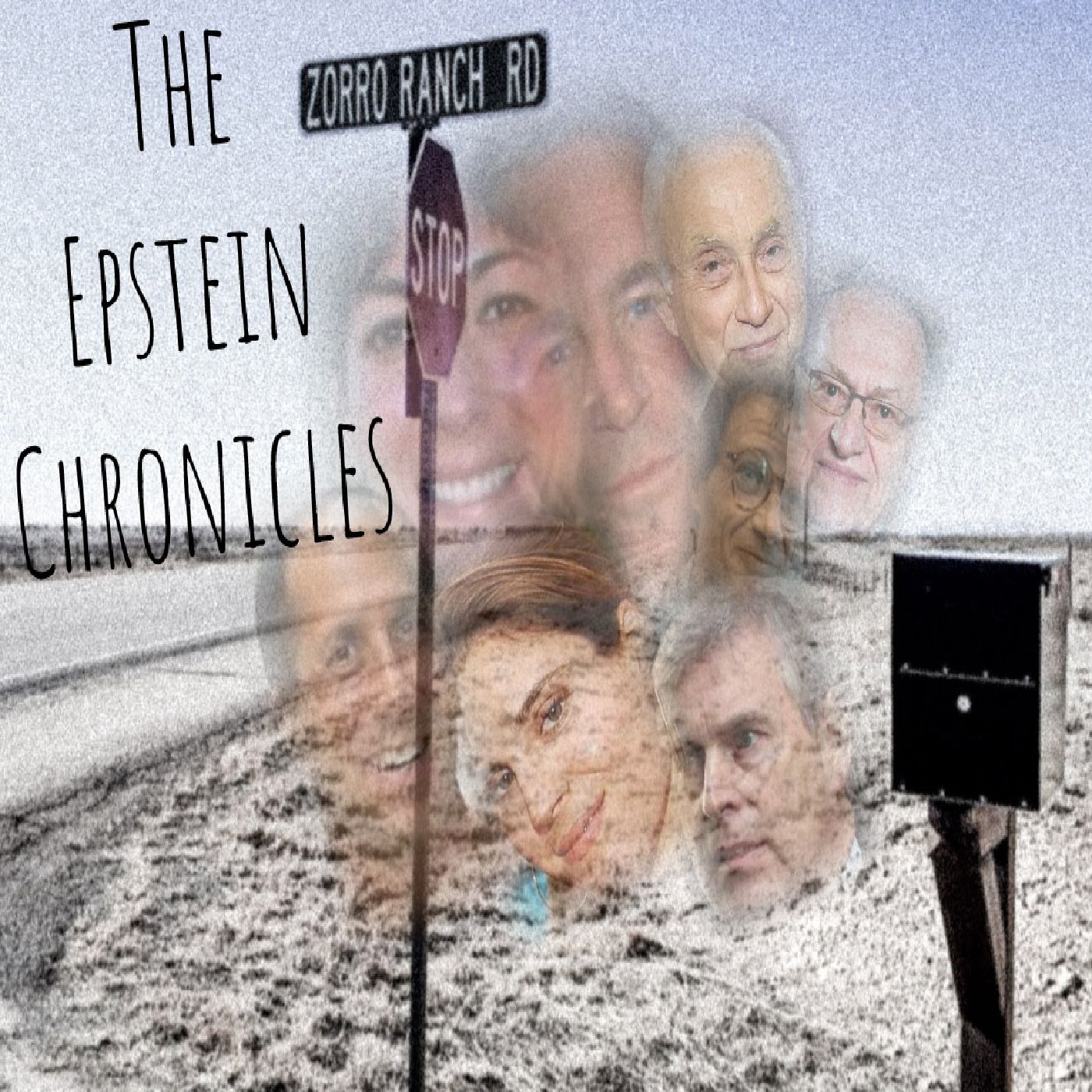
The Epstein Chronicles
Bobby Capucci
Jeffrey Epstein was a multi millionaire who had political and business ties to some of the most rich and powerful people in the world. From businessmen to politicians at the highest levels, Epstein broke bread with them all. Yet for years the Legacy media and the rest of high society looked the other way and ignored his behavior as multiple women came forward with allegations of abuse. Even after he was convicted and subsequently received a sweetheart deal those same so called elites welcomed him back with open arms. Now after his death and the arrest of Maxwell, the real story is starting to come together and the curtain has begun to be drawn back and what it has revealed is truly disturbing. From Princes to Ex Presidents, the cast of scoundrels in this play spans continents and political affiliations leaving us with a transcontinental criminal conspiracy possibly unlike any we have ever seen before. In this podcast we will explore all of the levels of Jeffrey Epstein and his criminal enterprise. From his most trusted assistants to obscure associates, we will leave no stone unturned as we swim through the muck searching for clarity and answers to some of the most pressing questions of the case. From interviews with people directly involved in the case to daily updates, the Epstein Chronicles will have it all. Just like our other project, The Jeffrey Epstein Show, you can expect no punches pulled and consistent content. We have covered the Epstein case daily(everyday since October 1st 2019) and will continue to do so until there are convictions. With a library of well over 1k shows, you can expect a ton of content coming your way including on scene reporting from the Maxwell trial and from places like Zorro Ranch. Thank you for tuning in and I look forward to having you all along for the ride.(Created and Hosted by Bobby Capucci)Become a supporter of this podcast: https://www.spreaker.com/podcast/the-epstein-chronicles--5003294/support.
Episodes
Mentioned books

Apr 7, 2026 • 14min
The DOJ's Darling Ghislaine Maxwell Is Moved To A Low Level Camp In Bryan, Texas
Ghislaine Maxwell has been quietly moved from the low-security federal prison in Tallahassee, Florida to a minimum-security facility in Bryan, Texas—a shift that has raised serious questions. The timing of her transfer, which occurred shortly after a closed-door meeting with senior officials at the Department of Justice, is especially suspect. That meeting, reportedly centered on Maxwell providing names connected to Jeffrey Epstein's trafficking network, was followed by this abrupt relocation to a prison camp known for its lighter restrictions and more comfortable conditions. It’s not hard to see this for what it looks like: a reward, not a coincidence.The prison camp in Bryan, Texas is a far cry from even the modest constraints of Tallahassee. Dormitory housing, no perimeter fencing, minimal supervision—this is not where you send someone convicted of trafficking girls to billionaires. While survivors continue to fight for accountability and answers, Maxwell is being eased into a facility that resembles a quiet retreat more than a prison. Critics argue this reeks of backroom deals and institutional privilege—further proof that in the American justice system, those with connections can still trade secrets for comfort while the people they helped exploit remain invisible and unheard.to contact me:bobbycapucci@protonmail.comsource:Epstein accomplice Ghislaine Maxwell quietly moved out of Fla. prisonBecome a supporter of this podcast: https://www.spreaker.com/podcast/the-epstein-chronicles--5003294/support.
Apr 7, 2026 • 13min
Priced For A Prince: Virginia Roberts Received 15 K After Allegedly Being Trafficked To Andrew
Virginia Roberts Giuffre has consistently stated that after her encounter with Prince Andrew in London, she was paid $15,000 through Jeffrey Epstein’s network—a detail that underscores how transactional and controlled the entire system was. According to her account, the payment came shortly after the meeting and reflected the same pattern used across Epstein’s operation, where victims were given cash following encounters with powerful individuals. This wasn’t framed as a gift or optional arrangement—it was part of a structure designed to reinforce compliance, maintain silence, and normalize exploitation. Within that framework, the payment stands as a concrete example of how Epstein’s network operated behind the scenes.For Prince Andrew, this detail is deeply damaging because it directly contradicts the narrative he has tried to maintain about his limited involvement. The $15,000 payment fits squarely within the broader, well-documented pattern of Epstein’s methods, making it harder to dismiss or isolate. Rather than being a distant associate, this places Andrew in direct proximity to the same system of exploitation and control that defined Epstein’s network. It reinforces the perception that his connection was not incidental, but embedded within a structure that used money, influence, and access to facilitate abuse while shielding those involved from immediate scrutiny.to contact me:bobbycapucci@protonmail.comsource:Jeffrey Epstein 'paid Virginia Giuffre $15K to have sex with Prince Andrew at 17,' latest bombshell docs claim | The SunBecome a supporter of this podcast: https://www.spreaker.com/podcast/the-epstein-chronicles--5003294/support.
Apr 6, 2026 • 16min
If You Want To Know The Truth About Jeffrey Epstein You Have To Follow The Money
The real path to understanding the Jeffrey Epstein scandal has always been through the money trail, not the headlines. Forget the flight logs and the gossip; the truth is buried in wire transfers, offshore accounts, and the banks that made his lifestyle possible. Institutions like JP Morgan and Deutsche Bank weren’t just passive observers—they were the arteries of his operation, moving, cleaning, and protecting the cash that bought him influence and silence. Every payment, donation, and “investment” was a breadcrumb leading back to the people who enabled him, the ones who used wealth to hide their involvement and distance themselves when the walls started closing in.Because money doesn’t lie—people do. The ledgers, the trusts, the financial filings—they’re the fingerprints no one can wash off. That’s why so much effort went into sealing records, cutting massive settlement checks, and painting Epstein as an isolated monster. But the paper trail tells a different story: a web of bankers, politicians, and institutions that thrived off the same rot. Epstein wasn’t the source of corruption—he was its broker. And if you truly want to know who was involved, you don’t chase the headlines or photos—you follow the money.to contact me:bobbycapucci@protonmail.comsource:Epstein records requested from Jamie Dimon, bank CEOsBecome a supporter of this podcast: https://www.spreaker.com/podcast/the-epstein-chronicles--5003294/support.
Apr 6, 2026 • 17min
Asset First, Predator Second: The Truth About Jeffrey Epstein
Jeffrey Epstein wasn’t merely a wealthy predator—he was a protected government asset, strategically positioned within elite circles to gather intelligence through blackmail and sexual exploitation. His 2008 sweetheart deal wasn’t a fluke; it was part of a larger intelligence arrangement, confirmed by language in legal documents explicitly stating his cooperation with federal authorities. Former U.S. Attorney Alex Acosta even admitted that he was told to “back off” because Epstein “belonged to intelligence.” Epstein’s homes were rigged with surveillance equipment, and his guest lists read like a Who’s Who of global power. He didn’t climb the ladder—he was placed. His value came not just from money or perversion, but from the secrets he collected and the people he compromised. His immunity, lenient sentence, and the broad protection extended to his associates all point to a system designed to protect the operation—not to stop it.Epstein’s death in federal custody—under conveniently broken cameras and sleeping guards—wasn’t the end of a scandal, but the trigger for a cover-up. The government and media have worked tirelessly to control the narrative, keeping client lists sealed, minimizing Maxwell’s trial, and reducing the scope of civil suits. But the paper trail is undeniable: Epstein was a tool of intelligence, not an outlier. His silence was purchased not with a bribe, but with erasure. The public is expected to believe in coincidence, not corruption, even as the evidence continues to leak from beneath sealed records and redacted pages. The Epstein operation wasn’t just a disgrace—it was a blueprint for how power protects itself. And until that blueprint is confronted, the machine that enabled him will keep grinding, unpunished and untouched.to contact me:bobbycapucci@protonmail.comBecome a supporter of this podcast: https://www.spreaker.com/podcast/the-epstein-chronicles--5003294/support.
Apr 6, 2026 • 22min
Inside The OIG Interview: MCC Captain's Statement Detailing The Death Of Jeffrey Epstein (Part 17) (4/6/26)
This deposition comes from an unnamed captain at the Metropolitan Correctional Center and provides a detailed account of how Jeffrey Epstein was managed inside the facility, particularly in the Special Housing Unit. The captain describes Epstein’s status following his prior suicide incident, including the decision-making process around his housing, monitoring level, and classification. The testimony highlights that Epstein had previously been placed under suicide watch but was later removed from those heightened precautions, despite ongoing concerns about his mental state. It also addresses Epstein’s resistance to having a cellmate and the facility’s shifting responses to that issue, revealing a pattern where known risks were acknowledged but not consistently acted upon.The deposition also exposes broader operational failures within MCC, particularly regarding supervision, communication, and adherence to protocol. The captain’s account suggests that while staff were aware of Epstein’s vulnerability, the systems in place failed to ensure continuous and effective monitoring. Decisions around staffing, inmate placement, and observation procedures appear fragmented, with lapses that ultimately left Epstein in a position that contradicted earlier risk assessments. The testimony reinforces the larger picture of institutional breakdown, where responsibility was diffused across personnel and safeguards that should have been firmly in place were instead inconsistently applied.What makes this account difficult to accept at face value is how neatly it shifts the burden onto procedural gray areas rather than confronting the glaring contradictions in custody decisions. The captain’s testimony acknowledges that Epstein was a known suicide risk, had already experienced a prior incident, and required heightened oversight, yet still attempts to frame the subsequent downgrade in monitoring as routine or justified. That explanation strains credibility when measured against the totality of circumstances, particularly the repeated deviations from established suicide prevention protocols and the failure to enforce basic safeguards like consistent observation and appropriate cell assignments. Instead of clarifying responsibility, the deposition reads more like an exercise in institutional self-preservation—where systemic failures are reframed as isolated judgment calls, and accountability is diluted across layers of bureaucracy. In that context, the official narrative begins to look less like a coherent explanation and more like a patchwork defense designed to explain away decisions that, taken together, point to a breakdown that should never have occurred in a high-security federal facility.to contact me:bobbycapucci@protonmail.comsource:EFTA00059973.pdfBecome a supporter of this podcast: https://www.spreaker.com/podcast/the-epstein-chronicles--5003294/support.
Apr 6, 2026 • 12min
Epstein’s MCC Incident Report: A Record of Action Without Explanation (4/6/26)
The document presents a clean, procedural account of how staff at the Metropolitan Correctional Center responded after Jeffrey Epstein was found with neck injuries in July 2019, quickly classifying the situation as a suicide risk and placing him on suicide watch. On paper, it reads like a textbook example of protocol being followed—medical evaluation, heightened observation, and formal documentation of risk. But the tone is almost sterile to a fault, reducing what should have been a high-alert, high-scrutiny incident involving one of the most high-profile inmates in federal custody into a series of checkbox responses. There’s little in the way of urgency, escalation, or deeper inquiry reflected in the language, which stands out given the gravity of the situation and the obvious implications of what had just occurred inside that cell.More importantly, the report feels incomplete when viewed against what followed. It documents the recognition of a serious risk but offers no meaningful justification for how that risk was later downgraded or why Epstein was removed from suicide watch so quickly. That gap is hard to ignore. If the situation warranted immediate classification as a suicide concern, then the reversal of those precautions should have been equally well-documented and rigorously explained—but that clarity is absent here. Instead, the report reads like a narrow snapshot, capturing just enough to show protocol was initiated, while sidestepping the larger question of whether those protocols were sustained or taken seriously over time. In that sense, it doesn’t resolve concerns—it reinforces them, highlighting how critical decisions around Epstein’s safety were made with little transparency and even less accountability.to contact me:bobbycapucci@protonmail.comsource:EFTA00019348.pdfBecome a supporter of this podcast: https://www.spreaker.com/podcast/the-epstein-chronicles--5003294/support.
Apr 6, 2026 • 19min
How Epstein Maintained Access to France’s Elite After His Criminal History Was Public (4/6/26)
Jeffrey Epstein cultivated relationships within segments of France’s political and cultural elite, using wealth, connections, and social access to move comfortably among influential figures. Central to the scrutiny is Jack Lang, a longtime French political figure whose ties to Epstein are detailed in newly surfaced materials showing years of communication, meetings, and requests for assistance. The interactions suggest a relationship built on access and mutual benefit, raising questions about how someone with Epstein’s known criminal history was able to maintain such proximity to prominent individuals. Lang has maintained that he was unaware of Epstein’s past offenses, though that claim has been increasingly questioned given how widely known those issues had become.The situation has drawn attention from French authorities, who have opened financial inquiries examining potential irregularities connected to Lang and his family. More broadly, the episode highlights how Epstein operated internationally—not necessarily through overt criminal activity in every location, but by leveraging influence, funding, and personal connections to embed himself within elite circles. It underscores a recurring pattern seen across multiple countries: individuals in positions of power maintaining relationships with Epstein despite warning signs, contributing to a wider failure of scrutiny and accountability that extended far beyond the United States.to contact me:bobbycapucci@protonmail.comsource:Epstein in Paris: How a Sex Offender Hustled for Access to France’s Elite - The New York TimesBecome a supporter of this podcast: https://www.spreaker.com/podcast/the-epstein-chronicles--5003294/support.
Apr 6, 2026 • 11min
Meet the New Boss, Same as the Old Boss: Todd Blanche Declares the Epstein Files Closed (4/6/26)
Todd Blanche, stepping in as acting Attorney General after Pam Bondi’s removal, made it clear almost immediately that he wants the Department of Justice to move on from the Epstein files altogether. He claimed that the DOJ has already released everything of significance related to Epstein, framing the issue as effectively closed despite ongoing criticism that millions of pages remain unreleased or heavily redacted. His position signals a sharp shift in tone—not toward deeper transparency, but toward shutting the door on further scrutiny, even as lawmakers and survivors continue to demand full disclosure.That stance has only intensified concerns about how the Epstein case is being handled at the highest levels. Blanche has also defended Bondi, rejecting the idea that her firing was tied to the Epstein controversy, even though her tenure was widely criticized for delays, incomplete releases, and mishandling of sensitive material. Instead of addressing those failures head-on, Blanche’s approach appears to double down—treating the Epstein files as a settled matter while critics argue the most important pieces are still missing. The result is a continuation of the same pattern: leadership changes at the top, but no meaningful shift in transparency or accountability when it comes to Epstein’s network.to contact me:bobbycapucci@protonmail.comsource:Blanche says DOJ should move on from the Epstein filesBecome a supporter of this podcast: https://www.spreaker.com/podcast/the-epstein-chronicles--5003294/support.
Apr 6, 2026 • 15min
Disguises and Escape Plans: The Jeffrey Epstein and Henry Jarecki Emails Examined (4/6/26)
Newly released DOJ documents reveal a 2009 email exchange between Jeffrey Epstein and his longtime associate, psychiatrist Dr. Henry Jarecki, outlining a detailed plan for avoiding law enforcement if he were ever caught. The message, framed as notes for a potential book, laid out a multi-step strategy that included avoiding traceable financial activity, strengthening computer security, going into hiding domestically or overseas, and preparing escape logistics. More striking elements included suggestions for using disguises, obtaining fake identification documents, undergoing plastic surgery, and even collecting damaging information on alleged victims or witnesses to undermine potential cases.The documents also highlight the close relationship between Epstein and Jarecki, showing regular communication and social ties, including travel and personal exchanges around the time Epstein was released from custody in 2009. Additional context in the files notes that Epstein had previously possessed a fake passport, stockpiled cash and valuables, and maintained international connections—details that align with elements discussed in the email. Jarecki’s representatives later claimed the message was meant as a joke and said he would have distanced himself had he known the full extent of Epstein’s crimes, while also noting his current medical condition.to contact me:bobbycapucci@protonmail.comsource:Exclusive | Jeffrey Epstein and NYC psychiatrist Henry Jarecki emailed about 'trouble avoidance': docsBecome a supporter of this podcast: https://www.spreaker.com/podcast/the-epstein-chronicles--5003294/support.
Apr 6, 2026 • 53min
Mega Edition: The OIG Report Detailing The Investigation Into Epstein's NPA (Part 24-27) (4/5/26)
The Department of Justice Office of the Inspector General (OIG) report into Jeffrey Epstein’s 2007 Non-Prosecution Agreement (NPA) presents a disturbing portrait of federal cowardice, systemic failures, and deliberate abdication of prosecutorial duty. Instead of zealously pursuing justice against a serial predator with dozens of underage victims, the U.S. Attorney’s Office in the Southern District of Florida, under Alexander Acosta, caved to Epstein’s high-powered legal team and crafted a sweetheart deal that immunized not just Epstein, but unnamed potential co-conspirators—many of whom are still shielded to this day. The report shows that career prosecutors initially prepared a 53-page indictment, but this was ultimately buried, replaced by state charges that led to minimal jail time, lenient conditions, and near-total impunity. The OIG paints the decision as a series of poor judgments rather than criminal misconduct, but this framing betrays the magnitude of what actually occurred: a calculated retreat in the face of wealth and influence.Critically, the report fails to hold any individuals truly accountable, nor does it demand structural reform that could prevent similar derelictions of justice. It accepts, without sufficient pushback, the justifications offered by federal prosecutors who claimed their hands were tied or that the case was too risky—despite overwhelming evidence and a mountain of victim statements. The OIG sidesteps the glaring reality that this was not just bureaucratic failure, but a protection racket masquerading as legal discretion. It treats corruption as incompetence and power as inevitability. The conclusion, ultimately, feels like a shrug—a bureaucratic absolution of one of the most disgraceful collapses of federal prosecutorial integrity in modern history. It is less a reckoning than a rubber stamp on institutional failure.to contact me:bobbycapucci@protonmail.comsource:dl (justice.gov)Become a supporter of this podcast: https://www.spreaker.com/podcast/the-epstein-chronicles--5003294/support.

