

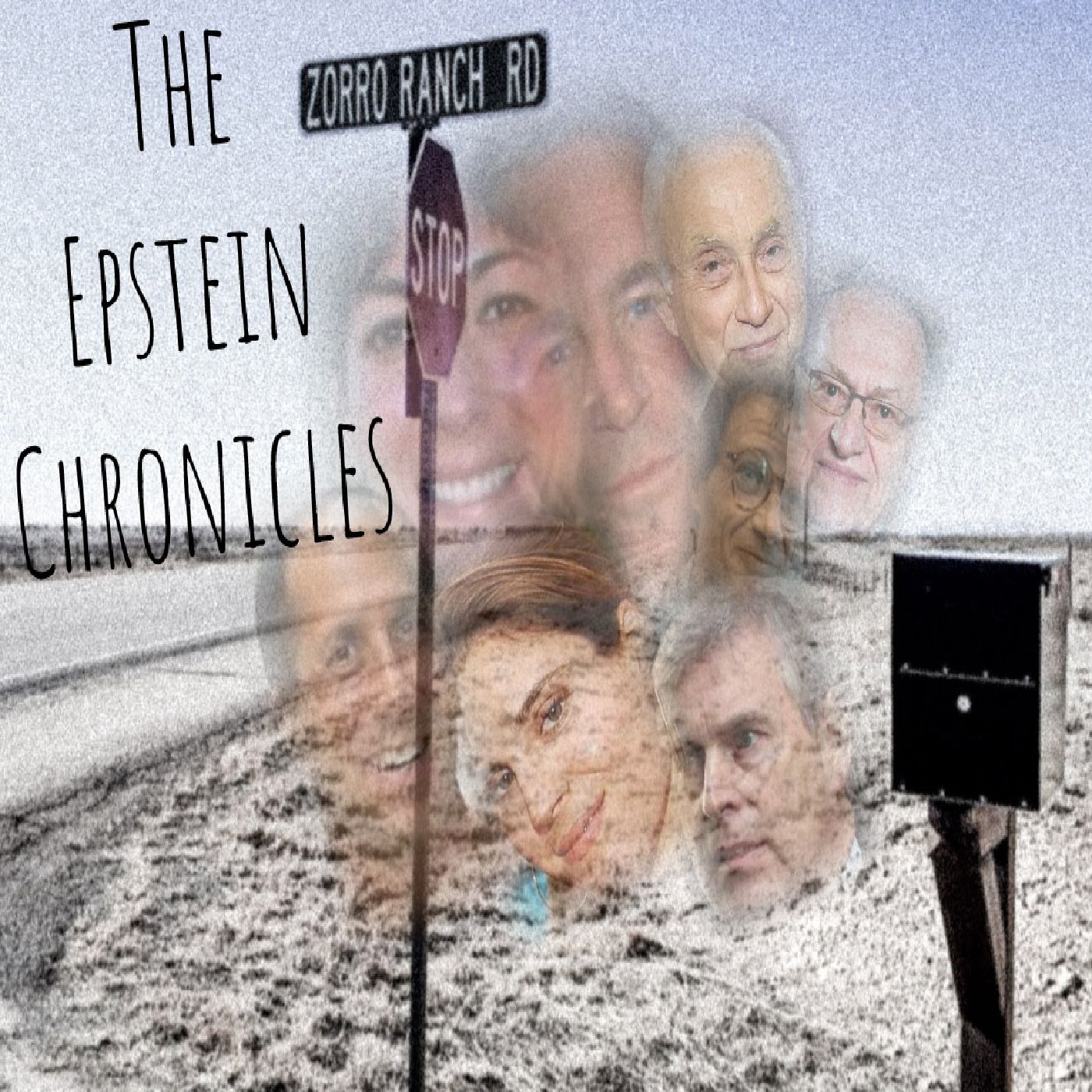
The Epstein Chronicles
Bobby Capucci
Jeffrey Epstein was a multi millionaire who had political and business ties to some of the most rich and powerful people in the world. From businessmen to politicians at the highest levels, Epstein broke bread with them all. Yet for years the Legacy media and the rest of high society looked the other way and ignored his behavior as multiple women came forward with allegations of abuse. Even after he was convicted and subsequently received a sweetheart deal those same so called elites welcomed him back with open arms. Now after his death and the arrest of Maxwell, the real story is starting to come together and the curtain has begun to be drawn back and what it has revealed is truly disturbing. From Princes to Ex Presidents, the cast of scoundrels in this play spans continents and political affiliations leaving us with a transcontinental criminal conspiracy possibly unlike any we have ever seen before. In this podcast we will explore all of the levels of Jeffrey Epstein and his criminal enterprise. From his most trusted assistants to obscure associates, we will leave no stone unturned as we swim through the muck searching for clarity and answers to some of the most pressing questions of the case. From interviews with people directly involved in the case to daily updates, the Epstein Chronicles will have it all. Just like our other project, The Jeffrey Epstein Show, you can expect no punches pulled and consistent content. We have covered the Epstein case daily(everyday since October 1st 2019) and will continue to do so until there are convictions. With a library of well over 1k shows, you can expect a ton of content coming your way including on scene reporting from the Maxwell trial and from places like Zorro Ranch. Thank you for tuning in and I look forward to having you all along for the ride.(Created and Hosted by Bobby Capucci)Become a supporter of this podcast: https://www.spreaker.com/podcast/the-epstein-chronicles--5003294/support.
Episodes
Mentioned books

Mar 29, 2026 • 16min
Jeffrey Epstein And The Criminal Enterprise The DOJ Pretended Didn’t Exist (Part 1)
The Epstein–Maxwell prosecutions stand out less for what was done than for what wasn’t. Despite running what clearly looked like an organized criminal enterprise—complete with recruitment networks, financial laundering, and systemic intimidation—neither faced RICO charges, the statute designed specifically for dismantling such operations. Prosecutors routinely use RICO against gangs, cartels, and fraud rings far smaller and less sophisticated, but in this case, they chose narrow charges that framed Epstein as a lone predator and Maxwell as his assistant, rather than leaders of a syndicate. That omission not only limited the narrative but also shielded institutions, banks, and high-profile associates from exposure.This deliberate restraint strengthened suspicions that Epstein was more than just a criminal—that he may have been an asset whose utility outweighed the government’s appetite for full justice. A RICO case would have forced prosecutors to map out the entire enterprise, exposing networks and potentially implicating powerful figures. By avoiding it, the system preserved secrecy, contained fallout, and maintained protection for those in Epstein’s orbit. In the end, justice was partial, and the silence around RICO became the loudest clue of all.to contact me:bobbycapucci@protonmail.comBecome a supporter of this podcast: https://www.spreaker.com/podcast/the-epstein-chronicles--5003294/support.
Mar 29, 2026 • 13min
Inside The OIG Interview: MCC Captain's Statement Detailing The Death Of Jeffrey Epstein (Part 8) (3/29/26)
This deposition comes from an unnamed captain at the Metropolitan Correctional Center and provides a detailed account of how Jeffrey Epstein was managed inside the facility, particularly in the Special Housing Unit. The captain describes Epstein’s status following his prior suicide incident, including the decision-making process around his housing, monitoring level, and classification. The testimony highlights that Epstein had previously been placed under suicide watch but was later removed from those heightened precautions, despite ongoing concerns about his mental state. It also addresses Epstein’s resistance to having a cellmate and the facility’s shifting responses to that issue, revealing a pattern where known risks were acknowledged but not consistently acted upon.The deposition also exposes broader operational failures within MCC, particularly regarding supervision, communication, and adherence to protocol. The captain’s account suggests that while staff were aware of Epstein’s vulnerability, the systems in place failed to ensure continuous and effective monitoring. Decisions around staffing, inmate placement, and observation procedures appear fragmented, with lapses that ultimately left Epstein in a position that contradicted earlier risk assessments. The testimony reinforces the larger picture of institutional breakdown, where responsibility was diffused across personnel and safeguards that should have been firmly in place were instead inconsistently applied.What makes this account difficult to accept at face value is how neatly it shifts the burden onto procedural gray areas rather than confronting the glaring contradictions in custody decisions. The captain’s testimony acknowledges that Epstein was a known suicide risk, had already experienced a prior incident, and required heightened oversight, yet still attempts to frame the subsequent downgrade in monitoring as routine or justified. That explanation strains credibility when measured against the totality of circumstances, particularly the repeated deviations from established suicide prevention protocols and the failure to enforce basic safeguards like consistent observation and appropriate cell assignments. Instead of clarifying responsibility, the deposition reads more like an exercise in institutional self-preservation—where systemic failures are reframed as isolated judgment calls, and accountability is diluted across layers of bureaucracy. In that context, the official narrative begins to look less like a coherent explanation and more like a patchwork defense designed to explain away decisions that, taken together, point to a breakdown that should never have occurred in a high-security federal facility.to contact me:bobbycapucci@protonmail.comsource:EFTA00059973.pdfBecome a supporter of this podcast: https://www.spreaker.com/podcast/the-epstein-chronicles--5003294/support.
Mar 29, 2026 • 14min
Bank of America Settles Epstein Victim Lawsuit for $72.5 Million (3/29/26)
Bank of America agreed to pay approximately $72.5 million to settle a civil lawsuit brought by women who accused the bank of playing a role in enabling Jeffrey Epstein’s sex trafficking operation. The case alleged that the bank failed to flag suspicious financial activity tied to Epstein and his associates, despite what plaintiffs described as clear warning signs, and that it financially benefited from maintaining relationships within Epstein’s network. The lawsuit was filed as a proposed class action and covered a period after Epstein’s 2008 conviction, focusing on whether the bank ignored red flags in order to continue doing business. A federal judge had previously allowed key portions of the case to proceed, including claims that the bank may have knowingly benefited from Epstein’s activities.As part of the settlement, Bank of America denied any wrongdoing and maintained that it did not facilitate Epstein’s crimes, framing the agreement as a way to resolve the matter and provide compensation to victims rather than an admission of liability. The deal still requires court approval, but it follows a broader pattern of major financial institutions paying large sums to settle similar allegations tied to Epstein, including earlier payouts by JPMorgan and Deutsche Bank. The case also highlighted financial ties between Epstein and powerful figures moving money through the banking system, reinforcing ongoing concerns about how elite financial networks may have intersected with—and potentially enabled—his operation even after his criminal history was widely known.to contact me:bobbycapucci@protonmail.comsource:Epstein victims get $72.5M from Bank of America settlementBecome a supporter of this podcast: https://www.spreaker.com/podcast/the-epstein-chronicles--5003294/support.
Mar 29, 2026 • 11min
Inside the Epstein Files: Modeling Agent’s Disturbing Outreach to Jeffrey Epstein (3/29/26)
The communications in question center on a modeling agent who maintained a long-running relationship with Jeffrey Epstein, during which he repeatedly attempted to introduce young women to him under the guise of modeling opportunities. The exchanges span years and show the agent pitching women based on their looks, age, and financial vulnerability, often framing the introductions as mutually beneficial arrangements. In one especially disturbing message, the agent explicitly encouraged Epstein to “try” a woman sexually, reducing the interaction to a transactional proposition. The tone of the correspondence suggests a level of familiarity with Epstein’s preferences and a willingness to cater to them, even after Epstein’s prior legal troubles were already public knowledge.Beyond the individual messages, the broader implication is the role that parts of the modeling world may have played in feeding Epstein access to young women. The emails reflect a system where aspiring models—many seeking financial stability or career opportunities—were positioned in proximity to a powerful and predatory figure. While the agent has since attempted to distance himself and downplay his intent, the language and persistence captured in the exchanges have fueled criticism that enablers within the industry either ignored warning signs or actively facilitated Epstein’s behavior. The revelations add another layer to the ongoing examination of how Epstein’s network operated and how he continued to maintain access to vulnerable women despite widespread rumors and prior convictions.to contact me:bobbycapucci@protonmail.comsource:Modelling agent told Epstein about girl 'desperate for cash' as he begged paedo to 'try her in bed', emails showBecome a supporter of this podcast: https://www.spreaker.com/podcast/the-epstein-chronicles--5003294/support.
Mar 29, 2026 • 44min
Mega Edition: The Almost Impossible Battle To Stop Epstein Like Laundering Operations (3/29/26)
American lawmakers have long struggled to keep pace with the scale and sophistication of offshore financial networks used by figures like Jeffrey Epstein. These systems rely on shell companies, layered trusts, and jurisdictions with strict secrecy laws—places like the British Virgin Islands or the Cayman Islands—making it difficult to trace ownership, follow money flows, or establish jurisdiction. In Epstein’s case, investigators and civil litigants have pointed to a web of offshore entities and accounts that obscured how funds moved between his businesses, properties, and associates. Lawmakers have responded with hearings, proposed legislation, and pressure on regulators to tighten anti–money laundering rules, increase beneficial ownership transparency, and compel greater cooperation from foreign financial centers. Still, enforcement has often lagged behind the reality that capital can move instantly across borders while legal processes remain slow, fragmented, and dependent on international cooperation.The challenge is compounded by competing priorities and institutional limits. Financial privacy, diplomatic relationships, and the interests of major banks and investment firms often complicate efforts to impose stricter controls. Even when new rules are introduced—such as requirements to disclose beneficial owners or expand reporting obligations—critics argue they are either too narrow or inconsistently enforced. In high-profile cases like Epstein’s, this has led to frustration among lawmakers and the public alike, as the full financial picture remains incomplete despite years of scrutiny. The broader concern is that without stronger, coordinated global standards and more aggressive domestic enforcement, offshore structures will continue to provide a shield for wealth, influence, and, potentially, illicit activity—leaving Congress perpetually reacting rather than staying ahead of the problem.to contact me:bobbycapucci@protonmail.comBecome a supporter of this podcast: https://www.spreaker.com/podcast/the-epstein-chronicles--5003294/support.
Mar 29, 2026 • 37min
Mega Edition: Pam Bondi And Her Oversight Of The Jeffrey Epstein Coverup (3/29/26)
Pam Bondi’s appearance before Congress on Epstein-related matters drew sharp criticism for its tone and substance, with lawmakers pressing her on past decisions, her handling of the case while serving as Florida’s attorney general, and her public posture since. Rather than offering clear, detailed answers, she was widely viewed as evasive and combative, leaning on narrow legal defenses and distancing language instead of addressing broader concerns about oversight failures and missed opportunities for accountability. The exchange amplified long-standing questions about whether key officials treated Epstein as an ordinary defendant or as someone afforded unusual deference. For critics, the hearing underscored a pattern: when pressed on the record, officials revert to technicalities and memory gaps, leaving major questions about prosecutorial judgment, victim notification, and investigative scope unresolved.At the same time, the involvement of figures like Jay Clayton has fueled skepticism about the integrity of the process. Clayton’s prior ties to Apollo Global Management—an institution that has faced scrutiny over connections to Epstein—have been cited by critics as a glaring conflict or, at minimum, an appearance problem that undermines public confidence. Even if no direct impropriety is established, placing individuals with links to firms entangled in Epstein-related controversies into positions touching the investigation invites doubts about independence and rigor. To detractors, it looks like a familiar loop: the same circles of finance, law, and government overseeing matters that intersect with their own networks, making assurances of impartiality harder to accept and reinforcing the perception that the system is policing itself.to contact me:bobbycapucci@protonmail.comBecome a supporter of this podcast: https://www.spreaker.com/podcast/the-epstein-chronicles--5003294/support.
Mar 29, 2026 • 55min
Mega Edition: The DOJ And Their Decades Long Epstein Related Dereliction Of Duty (3/29/26)
For decades, the Department of Justice has been criticized for a pattern of decisions in the Jeffrey Epstein matter that consistently narrowed exposure rather than expanded it. The most cited example is the 2007–2008 non-prosecution agreement (NPA) negotiated out of the Southern District of Florida, which resolved federal liability with a single state charge, minimal custodial time, and broad immunity language that extended beyond Epstein himself to potential co-conspirators. That agreement was reached without notifying victims, triggering years of litigation under the Crime Victims’ Rights Act and reinforcing the perception that federal prosecutors opted for expediency over a full accounting. Subsequent opportunities to revisit the scope—whether through broader federal charges, coordinated multi-district investigations, or financial-crimes theories—never materialized in a comprehensive way, leaving large portions of Epstein’s network, logistics, and financing structures insufficiently examined. Even after Epstein’s 2019 arrest in New York, the case ended without trial following his death in federal custody, compounding concerns about institutional failure, evidence preservation, and the inability to deliver a complete public record.What continues to draw scrutiny is the Department’s ongoing posture toward the NPA itself. Despite sustained arguments from victims’ counsel and some legal observers that there are grounds to challenge or limit the agreement—ranging from alleged violations of victims’ rights during its formation to questions about the breadth and enforceability of its immunity provisions—the government has repeatedly defended its validity in court. Critics argue that this stance prioritizes preserving a controversial deal over testing its limits, especially given evolving evidence, additional civil litigation, and disclosures about the scope of Epstein’s activities. They contend that, at minimum, the NPA’s reach could be more aggressively contested in cases involving third parties or conduct outside its geographic and temporal bounds. The result is a persistent perception that the Department is maintaining a defensive legal position that constrains accountability, rather than using available avenues to reassess a deeply disputed agreement in light of the full record that has emerged since.to contact me:bobbycapucci@protonmail.comBecome a supporter of this podcast: https://www.spreaker.com/podcast/the-epstein-chronicles--5003294/support.
Mar 29, 2026 • 57min
Mega Edition: Jeffrey Epstein, The Wall Street Journal And The 50th Birthday Book (3/29/26)
The controversy surrounding Jeffrey Epstein’s 50th birthday book—sometimes described as a birthday “album” or “card”—centers on a collection of messages, letters, and drawings assembled by close associate Ghislaine Maxwell and presented to Epstein in 2003. The book reportedly included contributions from a wide circle of powerful friends, business figures, and celebrities, some of whom later claimed little to no meaningful relationship with Epstein. What ignited public outrage is the tone of many entries: several were described as overly familiar, flattering, or suggestive, with at least one contribution allegedly including a crude drawing of a nude woman. In hindsight, these messages were interpreted as evidence of how normalized Epstein’s behavior may have been within elite circles at the time, raising questions about who knew what—and when.The fallout has been fueled by denials, distancing, and credibility disputes from those allegedly connected to the book. Some individuals have rejected the authenticity of their purported contributions, while others have argued their messages were innocuous or taken out of context. The existence of the book itself has become symbolic of a broader issue: the extent to which Epstein was socially and professionally accepted among powerful figures despite long-standing allegations about his conduct. Critics argue that the birthday collection underscores a culture of willful blindness—or worse—among elites, while defenders insist that inclusion in such a book does not equate to knowledge of criminal activity. Either way, the controversy continues to feed into the larger narrative about Epstein’s network and the institutional failures that allowed him to operate for years without meaningful accountability.to contact me:bobbycapucci@protonmail.comBecome a supporter of this podcast: https://www.spreaker.com/podcast/the-epstein-chronicles--5003294/support.
Mar 29, 2026 • 2h 25min
Mega Edition: Jeffrey Epstein And His Black Book (s) (3/28/26)
Jeffrey Epstein’s so-called “black book” was less a contact list and more a grotesque monument to power shielding power. It wasn’t filled with your everyday acquaintances; it was a who’s who of billionaires, politicians, royalty, celebrities, and Wall Street heavyweights—names that had no business being in the same Rolodex as a convicted sex offender. The book exposed just how deep Epstein’s tentacles reached, how many doors he could knock on, and how many influential people were willing to at least tolerate, if not outright embrace, his presence. Whether every name in there was complicit or simply embarrassed by association, the sheer scale of it laid bare how Epstein weaponized access to the elite as both shield and currency.The real stench of the black book wasn’t just who was in it, but what it represented: a roadmap of complicity and cowardice. It proved that Epstein didn’t thrive in isolation—he thrived because powerful people answered his calls, opened their homes, and boarded his planes. It’s a reminder that the “Epstein problem” wasn’t just Epstein; it was the system of enablers, gatekeepers, and opportunists who kept him socially viable long after his crimes were known. The black book is less a curiosity and more a ledger of shame, an artifact that shows how the elite protect each other, even when the cost is justice for survivors.to contact me: bobbycapucci@protonmail.comSource:https://www.motherjones.com/politics/2020/10/i-called-everyone-in-jeffrey-epsteins-little-black-book/Become a supporter of this podcast: https://www.spreaker.com/podcast/the-epstein-chronicles--5003294/support.
Mar 29, 2026 • 17min
Jeffrey Epstein And His Male Accuser
In April 2021, the Epstein estate became the subject of a new lawsuit brought by an individual identified only as “M.H.” The accuser, a male who worked as a high school intern for Epstein between the summer of 2013 and spring 2014, claims he was under the age of 17 when Epstein forced him into a “sexual performance.” The complaint, filed in New York state court, highlighted this as the first documented allegation from a minor male against Epstein—a significant development in the broader landscape of reported abuse and abuse patterns.to contact me:bobbycapucci@protonmail.comBecome a supporter of this podcast: https://www.spreaker.com/podcast/the-epstein-chronicles--5003294/support.

