

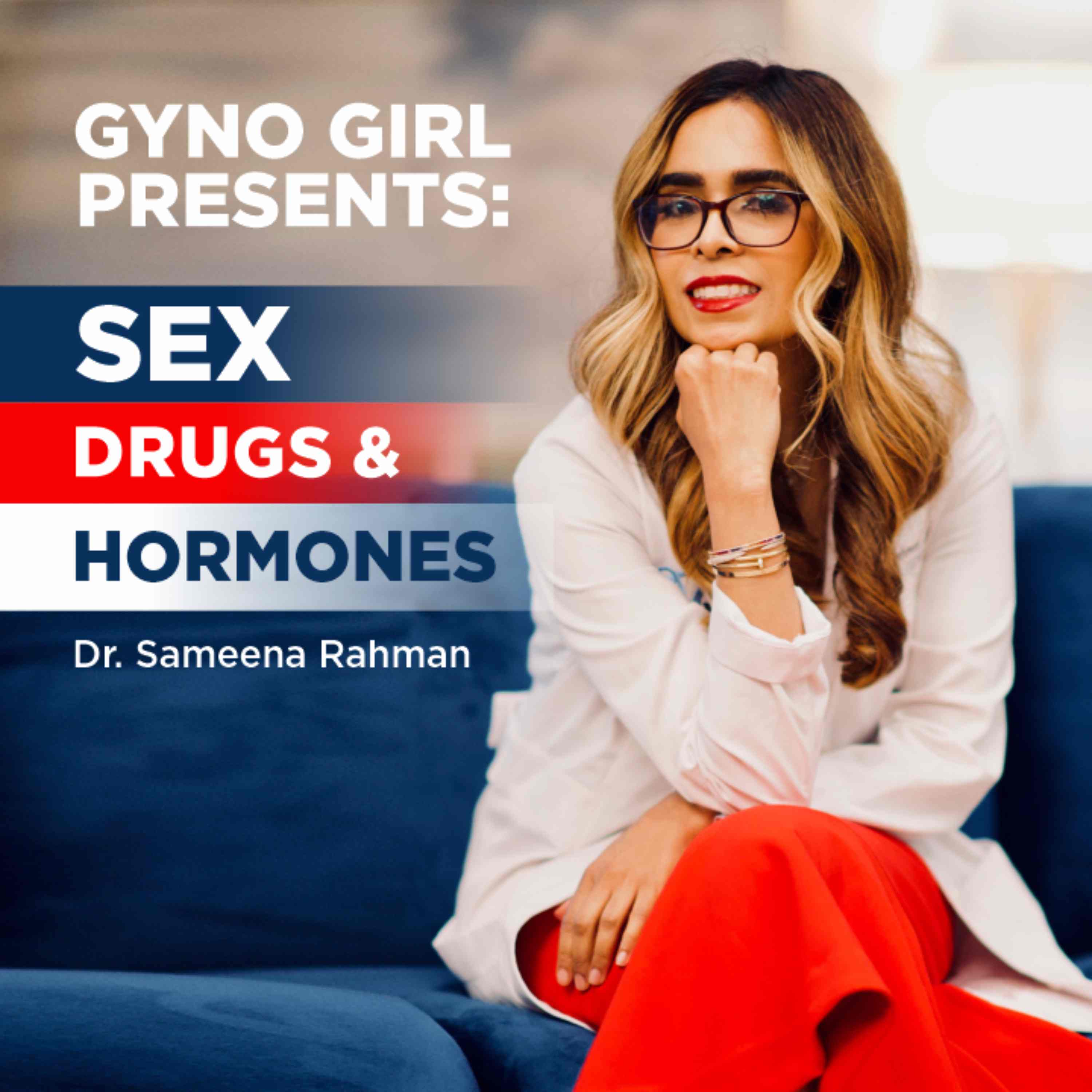
Gyno Girl Presents: Sex, Drugs & Hormones
Dr. Sameena Rahman
As a fierce champion for women empowering women (and the people that love them), GynoGirl provides the knowledge and education to help you advocate for yourself so that you can live your best life!
Dr. Sameena Rahman curates a space for exploring hormonal changes, sexual health, and pelvic wellness, while also emphasizing self-love and life improvement. Through collaborations with leading experts and the personal stories of patients, she provides a platform for knowledge-sharing while also addressing healthcare issues that have impaired women’s quality of life.
A board-certified, South-Asian Muslim-American gynecologist who specializes in sex medicine and menopause, Dr. Rahman highlights the influence of religion, culture, racial bias, and societal factors on sexual health experiences.
Dr. Sameena Rahman curates a space for exploring hormonal changes, sexual health, and pelvic wellness, while also emphasizing self-love and life improvement. Through collaborations with leading experts and the personal stories of patients, she provides a platform for knowledge-sharing while also addressing healthcare issues that have impaired women’s quality of life.
A board-certified, South-Asian Muslim-American gynecologist who specializes in sex medicine and menopause, Dr. Rahman highlights the influence of religion, culture, racial bias, and societal factors on sexual health experiences.
Episodes
Mentioned books

Jan 23, 2026 • 59min
Are You Getting All Your Options? The Truth About Hysterectomies with Dr. Kameelah Phillips
Hysterectomy is one of the most common surgeries for women 600,000 are performed every year in the United States. But are women truly getting all their options? Board certified OBGYN Dr. Kameelah Phillips joins me to discuss her groundbreaking book The Empowered Hysterectomy and why understanding the full history and context of this surgery is essential for every woman.In this powerful conversation, I sit down with Dr. Kameelah Phillips to discuss hysterectomies from every angle the good, the bad, and the historically traumatic. Dr. Phillips, author of The Empowered Hysterectomy, shares why she wrote a book that isn't anti-hysterectomy, but rather pro-information and pro-choice.From her origin story working at Planned Parenthood at age 15, to understanding the disturbing history of gynecology built on the experimentation of enslaved women, to counseling patients through one of the most significant decisions of their lives this episode covers it all. We also discuss the importance of true informed consent, the impact on sexual function, and why women of color are disproportionately offered hysterectomies over other treatment options.HighlightsThe birth control pill has such a bad reputation that patients reject it even though it could be the thing that helps their symptoms.The racist history behind hysterectomies continues today Black women are still being steered toward them at a much higher rate than their white counterpartsYou may not realize that your orgasm is actually coming from your cervix, which is why a conversation about sexual function should happen before surgery.Education and income doesn't protect Black women from maternal mortality.Explaining medical concepts in everyday language isn't "dumbing it down" it's ensuring patients actually understand what's happening to their bodies.Properly counseled patients who freely choose hysterectomy often experience profound liberation not just physically but sexually too.If you're considering a hysterectomy or have been told you need one, get Dr. Kameelah Phillips' book The Empowered Hysterectomy to ensure you have all the information you need to make the best decision for YOUR body. And remember you deserve time, information, and advocacy. Don't settle for less.I have an incredible lineup of guests coming up, so make sure you subscribe and leave a review so you never miss episodes like this one!Get in Touch with Dr. Phillips:WebsiteInstagramLinkedInBook Get in Touch with Me: WebsiteInstagramYoutubeSubstack
4 snips
Jan 16, 2026 • 59min
Estrogen Matters: Fighting Decades of Fear with Dr. Avrum Bluming
The FDA told him no in 1992. They said giving estrogen to breast cancer survivors would put women at "unacceptable risk." He did the study anyway.Dr. Avrum Bluming is a medical oncologist, emeritus clinical professor of medicine at USC, former senior investigator for the National Cancer Institute, and co-author of Estrogen Matters. He's been fighting estrogen fear for over 30 years long before it was safe or popular to do so.His origin story starts with his wife. At 45, she developed breast cancer. The chemotherapy he gave her threw her into premature menopause. She couldn't sleep. She had hot flashes, night sweats, painful urination, palpitations. She couldn't remember what she'd read two pages back. And he an oncologist who had induced menopause in countless breast cancer patients—had been sympathetic but didn't know how to help them until he saw what was happening with his wife.So he started a study in 1992 to give estrogen to breast cancer survivors. The FDA denied him twice. He did it anyway. By 1997, he presented his data to 8,500 oncologists from around the world. The National Cancer Institute said it was "irresponsible" to study this. The audience challenged them. Dr. Bluming's data showed no increased risk of recurrence.We talk about the Women's Health Initiative, how the media misinterpreted the data, why the estrogen alone actually decreased breast cancer by 23% and breast cancer death by 40%, and why the box warning that just came off in November 2025 never should have been there in the first place. There are now 26 studies in the English literature on giving estrogen to breast cancer survivors. Only one showed increased risk. Four showed decreased risk. Twenty-five showed no difference.Highlights:The FDA denial story: "Don't shoot me, I'm just the messenger".Why tamoxifen works better in premenopausal women (even though it raises estrogen 4-5x).The DCIS patient whose oncologist changed their tune after the box warning came off.The FDA committee member who asked "most of your patients are going to die anyway, aren't they?"showing how little some understood about breast cancer survival.When he asked if the FDA actually read his research before denying it: "Don't shoot me, I'm just the messenger"—a quote that reveals everything.What actually causes breast cancer (spoiler: nobody knows).If you've been denied estrogen or hormone therapy, share this episode with your provider. Share Estrogen Matters with its 555 references. Share the data. At this point, there's overwhelming evidence showing HRT is safe and beneficial for most women. But some clinicians are still using outdated information from 2002. You deserve care based on current science, not decades-old fear.Get in Touch with Dr. Bluming:WebsiteInstagramStudyGet in Touch with Me: WebsiteInstagramYoutubeSubstackMentioned in this episode:GSM CollectiveThe GSM Collective - Chicago
Boutique concierge gynecology practice
Led by Dr. Sameena Rahman, specialist in sexual medicine & menopause
Unrushed appointments in a beautiful, private setting
Personalized care for women's health, hormones, and pelvic floor issues
Multiple membership options available
Ready for personalized women's healthcare? Visit our Chicago office today.
GSM Collective
Jan 9, 2026 • 58min
80 Million Women Over 40, But Most Still Don't Know Their Options: Dr. Kelly Casperson
There are 80 million women over 40 in America. Only 4,100 menopause certified clinicians. The gap is real. And my guest is working on changing that. Dr. Kelly Casperson is a urologist, sexual medicine physician, and bestselling author of The Menopause Moment and You Are Not Broken. She's been leading the charge on women's health advocacy from serving on the FDA panel that removed the box warning on estrogen to pushing for testosterone deregulation. She has a large following, but as Kelly says: it's just a drop in the bucket. HThere are 80 million women over 40 in America. Only 4,100 menopause certified clinicians. The gap is real. And my guest is working on changing that.Dr. Kelly Casperson is a urologist, sexual medicine physician, and bestselling author of The Menopause Moment and You Are Not Broken. She's been leading the charge on women's health advocacy from serving on the FDA panel that removed the box warning on estrogen to pushing for testosterone deregulation. She has a large following, but as Kelly says: it's just a drop in the bucket.We talk about the women who aren't on social media, who aren't listening to podcasts, who don't know their options exist. How we need to reach people in the community churches, community centers, libraries. We discuss why grassroots education matters, why testosterone is locked behind 1980s doping laws. We discuss why grassroots education matters, why testosterone is locked behind 1980s doping laws, and Kelly shares the real reason for menopause.This is a conversation about what's changing in women's health and what still needs to change.Highlights:Why grassroots advocacy in the community matters as much as social media.Why 30% of women prescribed vaginal estrogen won't use it (the box warning effect).Frailty isn't inevitable it's what happens when you don't maintain your health.The biopsychosocial model: how culture shapes your menopause experience.Kelly's philosophy: you have to advocate for yourself, but you're not alone.Don't be afraid to start conversations with friends and loved ones about menopause, hormones, and the options available. You might be the only person in their life talking about this and that conversation could change be life changing.Get in Touch with Dr. Casperson:WebsiteInstagramPodcastGet in Touch with Me: WebsiteInstagramYoutubeSubstack
Jan 2, 2026 • 47min
PMDD and Perimenopause: Symptoms, Diagnosis, and Treatment
What happens when your family stages an intervention because they've been avoiding you 10 days every month?I'm sharing the story of a patient who had a complete breakdown at Christmas dinner. She snapped at her husband, her kids, her mom, her in-laws—everyone. A few hours later, her family told her: "We love you, but for 10 days every month, we actively avoid you."She came to me asking: Am I bipolar? Am I manic? What's happening to me?This is PMDD premenstrual dysphoric disorder. And when it collides with perimenopause, it becomes a perfect storm. This is not just PMS. This isn't you being dramatic. It's a real biochemical thing happening in your brain an abnormal response to normal hormonal changes.I discuss the science of PMDD: how GABA receptors respond to progesterone metabolites, why some brains are change sensitive, and why the hormonal volatility of perimenopause (erratic estrogen, declining progesterone, unpredictable timing) makes everything exponentially worse. I explain treatment options from luteal-phase SSRIs to Yaz to Duavee for refractory cases, and why tracking your symptoms for at least two cycles is critical for diagnosis.Highlights:Why "I feel like I'm watching myself burn down my life and can't stop it" is the hallmark of PMDD.The DRSP tracking tool: why you need 2 cycles to diagnose PMDD properly.Why Vitex (chasteberry) might help mood swings and breast pain.What Duavee is and why it works for women who can't tolerate progestins.Why Dr. Tammy Rowan calls PMDD a progesterone sensitivity issue.Ulipristal: the emergency contraception drug being studied for PMDD.If you've ever felt like your brain gets hijacked on a schedule, if you've felt completely out of control, this episode is for you. Track your symptoms. Find a clinician who takes cyclic mood symptoms seriously. You don't have to live like this. Please share this episode with someone you know might be experiencing this or a clinician you think would benefit from it.Resource:DRSPDr. Tami RowenGet in Touch with Me:WebsiteInstagramYoutubeSubstackMentioned in this episode:GSM CollectiveThe GSM Collective - Chicago
Boutique concierge gynecology practice
Led by Dr. Sameena Rahman, specialist in sexual medicine & menopause
Unrushed appointments in a beautiful, private setting
Personalized care for women's health, hormones, and pelvic floor issues
Multiple membership options available
Ready for personalized women's healthcare? Visit our Chicago office today.
GSM Collective
Dec 26, 2025 • 44min
2025 Women's Health Year in Review: From FDA Changes to Menopause Breakthroughs
What does it mean when 6,000 women a day enter menopause but there are only 4,100 certified clinicians to treat them?In this year end solo episode, I'm reflecting on 2025 in women's health. It was a year that felt heavy at the start personally for me after losing my mother, and globally with so much suffering and injustice. But even in all of that, women's health moved forward in meaningful ways. Not perfectly. Not fast enough. But enough that it deserves reflection.I'm covering the moments that shifted conversations this year from the FDA removing the black box warning on estrogen to new cervical cancer screening guidelines allowing self-collection HPV tests. From Addyi finally being approved for women under 65 to the release of comprehensive GSM guidelines that make genitourinary syndrome everyone's business, not just gynecologists'.And I'm getting personal about why I launched a concierge practice this year, what it taught me about the broken healthcare system, and why sexual health cannot be practiced in 10-minute appointments.Highlights:Why you're not too old for screening and what "safe exit criteria" really means.Menopause certification jumped from under 1,000 to over 4,100 practitioners in 2025.Menopause divorce vs. midlife clarity: Why hormonal chaos shouldn't decide your marriage.DARE to PLAY is a new, topical sildenafil launching in 2026 for female arousal disorder.Treating male partners reduces recurrent BV by 50% (New England Journal of Medicine).Hormone therapy for prevention: The nuanced conversation about bone health and cardiovascular risk.Why I launched a concierge practice and what it revealed about what women actually need.Thank you for being here for another year of Gyno Girl Presents: Sex, Drugs & Hormones. Your support, your messages, and your stories are what keep me going you are my why. If this year-in-review resonated with you, please share it with someone who needs to hear that they're not broken, not dramatic, and not asking for too much. And keep following the show in 2026 we've got incredible conversations lined up.Get in Touch with Me: WebsiteInstagramYoutubeSubstack
Dec 19, 2025 • 36min
What Ozempic Does to Your Sex Drive (Nobody's Talking About This)
What happens when a medication designed to help you lose weight also changes what brings you pleasure?In this solo episode, I'm doing a deep dive into what nobody's discussing about GLP-1 medications (Ozempic, Wegovy, Mounjaro, Zepbound) and what they do to your sex life.These medications have been absolutely transformational for metabolic disease, obesity, and cardiovascular health. But they don't just work on your gut and pancreas they work centrally in your brain, in your reward pathways, in your pleasure centers.I'm sharing stories from my practice: the glamorous patient who suddenly didn't want to shop anymore. The wine connoisseur who lost interest in drinking. The foodies who can't stand restaurants. And yes, the patients whose sexual desire completely disappeared because their brain stopped experiencing reward the same way.Highlights:Why GLP-1 medications are actually anti-inflammatory powerhouses (and what that means for PCOS, endometriosis, even PGAD).How these drugs modulate dopamine and serotonin the same pathways that control sexual desire.Why improving body image doesn't always improve sexual function (the biopsychosocial model).The emerging science on GLP-1s reducing alcohol cravings, substance use, and compulsive behaviors.What SHBG changes mean for your free testosterone and libido.Why your brain doesn't compartmentalize pleasure food, shopping, alcohol, and sex all use the same reward circuits.The informed consent conversation every doctor should be having (but isn't).If you're on a GLP-1 medication or considering starting one, ask your doctor about how it might affect what brings you pleasure including sex. With great power comes great responsibility, and sexual health is health. Period.Get in Touch with Me:WebsiteInstagramYoutubeSubstackMentioned in this episode:GSM CollectiveThe GSM Collective - Chicago
Boutique concierge gynecology practice
Led by Dr. Sameena Rahman, specialist in sexual medicine & menopause
Unrushed appointments in a beautiful, private setting
Personalized care for women's health, hormones, and pelvic floor issues
Multiple membership options available
Ready for personalized women's healthcare? Visit our Chicago office today.
GSM Collective
Dec 12, 2025 • 39min
Lichen Sclerosis: A Patient's Story from Misdiagnosis to Treatment Success
One of my brave patients shares her story with lichen sclerosis from being dismissed and told it was "all in her head" to finding proper treatment and relief.I'll never forget the day Jess walked into my office. By the time she found me, she'd already been dismissed by multiple doctors including specialists at what was supposed to be one of Chicago's premier women's health centers. They told her the severe pain and skin changes she was experiencing were "all in her head." Two different physicians suggested she needed a therapist, not medical treatment. Her depression history was weaponized against her, used as proof that she was just being hysterical.But Jess wasn't hysterical. She had advanced lichen sclerosis, and her vulvar skin was literally fusing together. Had she not found proper treatment, she would never have been able to have penetrative sex again. Even worse, without treatment, her risk of vulvar cancer would have climbed from 1% to 3-5%. Yet nobody had explained any of this to her. She'd been handed a tube of clobetasol and essentially told to figure it out herself which she did, on YouTube, learning the proper application technique that her doctors never bothered to teach her.In this episode, Jess bravely shares her journey living with lichen sclerosis—from the devastating experience of being gaslit by female physicians to finding relief through injectable steroids and surgical lysis of adhesions. We talk about how her symptoms worsened when she entered menopause in her mid-40s (common with autoimmune conditions), the complete loss of libido that left her sobbing when a doctor said "it's never coming back," and the body changes that made her feel like a "potato."But this conversation is about more than just lichen sclerosis. It's about the failures of our healthcare system, the importance of advocating for yourself even when you're furious and exhausted, and learning to accept yourself exactly where you're at. Jess's story will resonate with anyone who's ever been dismissed, anyone struggling with vulvar health issues, and anyone navigating the chaos of menopause while trying to hold onto their sense of self-worth.Highlights:Why most gynecologists miss lichen sclerosis (hint: they're not actually looking at your vulva).The proper way to apply clobetasol that doctors don't teach.How vaginismus became a catch-all diagnosis for any woman with painful sex.The We Do Not Care Club movement and redefining your value at midlife.What it means when influencers are the face of menopause marketing.If you've been dismissed or told your vulvar symptoms are "all in your head," this episode validates your experience and shows you're not alone. And if you're a clinician, this is your wake-up call we can no longer dismiss women's symptoms as psychological when real physical disease is staring us in the face. Please share this with someone who needs to hear that their symptoms are real and treatment is available.Get in Touch with Me: WebsiteInstagramYoutubeSubstack
Dec 5, 2025 • 50min
Trauma, PTSD, Childbirth Trauma, and Sexual Dysfunction with Erika Kelley
Have you ever wondered why trauma seems to "live" in the body? Or why so many women struggle with sexual dysfunction after difficult childbirth experiences that they're told they should just be "grateful" for?Join me as we explore the profound connection between trauma and sexual health with Erika Kelley, an award-winning clinical psychologist who specializes in women's sexual medicine and trauma treatment.Erika Kelley is revolutionizing how we understand and treat the intersection of PTSD and sexual dysfunction. Winner of the prestigious Irwin Goldstein Award at ISSWSH for her groundbreaking research on childbirth-related PTSD, Erika shares insights from her years of experience helping women reclaim their bodies and sexuality after trauma.Together, we discuss the often overlooked reality of "smiling PTSD" the postpartum trauma that women hide behind societal pressure to appear only joyful after childbirth. Erika explains how trauma becomes physically embedded in the body through the fight-flight-freeze response, creating real physiological changes that impact everything from pelvic floor function to sexual desire.She also shares the evidence based psychotherapies that are proven to help, including Prolonged Exposure Therapy and Cognitive Processing Therapy, and how these treatments can be integrated with pelvic floor physical therapy and sexual medicine approaches for comprehensive care.Erika's commitment to building trust with marginalized communities through community-based participatory research demonstrates how we can address healthcare disparities while advancing trauma care. Her work with Black women and perinatal mental health is paving the way for more inclusive and effective treatment.This episode is essential listening for anyone who has experienced trauma, healthcare providers who work with trauma survivors, and anyone interested in understanding how our bodies truly do "keep the score." By listening, you'll gain crucial knowledge about recognizing trauma symptoms, accessing appropriate treatment, and advocating for yourself or your patients.TRIGGER WARNING: This episode contains discussions of sexual assault, traumatic childbirth experiences, medical trauma, PTSD symptoms, and obstetric complications. Please listen with care and reach out for support if needed.HighlightsHow PTSD manifests physically in the body and affects sexual health.Dr. Kelley's award-winning research on childbirth trauma and sexual dysfunction.Why "smiling PTSD" prevents women from getting help after traumatic births.Evidence-based treatments that work: Prolonged Exposure Therapy, CPT, and EMDR.How to prepare for subsequent pregnancies after traumatic childbirth.Trauma-informed care and why communication during emergencies is critical.Healthcare disparities affecting BIPOC women and community-based solutionsIf this episode resonated with you, please rate and review the show on Apple Podcasts or Spotify it helps other women find this life changing information. Share this episode with someone who needs to hear that their trauma is real and treatment is available.Get in touch with Erika:WebsiteInstagramGet in Touch with Me: WebsiteInstagramYoutubeSubstack
Nov 28, 2025 • 36min
Episode 100: A Major Win for Women's Health & Answers to Your Top Questions
It's our 100th episode! I celebrate this milestone with Karen Bradley, NP, discussing the biggest wins, most common questions, and key themes from nearly two years of podcasting about women's sexual health and menopause.We dive into the FDA's recent decision to remove the boxed warning from vaginal estrogen a huge victory for women's health advocacy. This warning has prevented countless women from getting treatment for painful sex, recurrent UTIs, and other symptoms of genitourinary syndrome of menopause. I share a powerful story of a patient with breast cancer history who was denied hormone therapy by her oncology team, only to have them completely reverse course once the boxed warning was removed.The conversation covers the most frequently asked questions from listeners: Is it perimenopause or just stress? (It's both.) Why is my libido gone? (Biology, psychology, and life circumstances all play a role.) Why do I keep getting UTIs after sex? (Often it's vestibulodynia or changes in the vaginal microbiome from estrogen deficiency.) How do I talk to my partner about sex? (Communication is key, and sometimes you need a sex therapist to help.)We also discuss the reality of midlife weight gain, the role of GLP-1 medications like Wegovy and Zepbound, and why building muscle matters more than endless cardio. This episode is a celebration of how far we've come and a reminder that you don't have to suffer through menopause.Highlights:The FDA removed the boxed warning from vaginal estrogen—what this means for access to careThe biology behind midlife low libido and why it's not "all in your head"Why recurrent UTIs after sex might actually be vestibulodynia or vaginal microbiome changes.How to talk to your partner about sex when you've never had those conversationsThe truth about midlife weight gain and what hormones can and can't doGLP-1 medications: FDA approvals for weight loss, cardiovascular protection, MASH, and sleep apneaThank you for being here for 100 episodes. Honestly, there have been times I've wanted to stop, but then I get a DM from someone saying they heard something on the podcast that changed their care, or a patient tells me they finally found answers here. That's what keeps me going.The biggest way you can help me keep doing this work is simple: share this show with someone who needs it and hit subscribe. When you share an episode with a friend who's struggling, a family member who's been dismissed by doctors, or post about it on social media, you're helping me reach more women who deserve better care.Thank you for listening, for learning, and for advocating alongside me. Here's to the next 100.Get in Touch with Me: WebsiteInstagramYoutubeSubstack
Nov 21, 2025 • 38min
Why Stress Management Actually Changes Your Biology | Dr. Noor Al-Humaidhi
Dr. Noor Al-Humaidhi is a general practitioner from New Hampshire who discovered a massive gap in midlife women's healthcare. After experiencing perimenopausal symptoms herself and realizing how little she understood about the connection between hormones and chronic disease, she started Lifestyles by Dr. Noor a multidisciplinary practice focused on prevention, metabolic health, and helping women stop suffering through menopause.We discuss why stress management isn't just "woo woo" but creates measurable biological changes in blood sugar and cardiovascular health, how continuous glucose monitors reveal the real-time impact of stress on your body, and why women in the Middle East face unique barriers to hormone therapy access. Dr. Noor shares her approach to building a practice with dietitians, mind-body therapists, and weightlifting programs because hormones alone aren't the answer it's about addressing sleep, muscle, nutrition, and stress together.The conversation covers why sleep is so under treated in perimenopausal women, the cultural differences in how menopause is experienced across the world, and why there's such a high tolerance for women's suffering. Dr. Noor explains why she refuses to give up on helping women access care, even when hormone therapy isn't available in their countries.Highlights:Why stress creates measurable biological changes in blood sugar and blood pressure.How continuous glucose monitors show real-time impact of stress on your health.The importance of CBTI (cognitive behavioral therapy for insomnia) over sleeping pills.Why weightlifting with proper form matters more than endless cardio.Cultural differences in menopause experience between the Middle East and the US.Why suffering through menopause isn't noble you deserve to feel better.You're part of a growing community of women who refuse to accept suffering as inevitable. If you found value in this conversation, subscribe and help us spread the message that midlife women deserve comprehensive, compassionate care.Get in Touch with Dr. Noor:WebsiteInstagramLinkedInGet in Touch with Me: WebsiteInstagramYoutubeSubstackMentioned in this episode:GSM CollectiveThe GSM Collective - Chicago
Boutique concierge gynecology practice
Led by Dr. Sameena Rahman, specialist in sexual medicine & menopause
Unrushed appointments in a beautiful, private setting
Personalized care for women's health, hormones, and pelvic floor issues
Multiple membership options available
Ready for personalized women's healthcare? Visit our Chicago office today.
GSM Collective

