

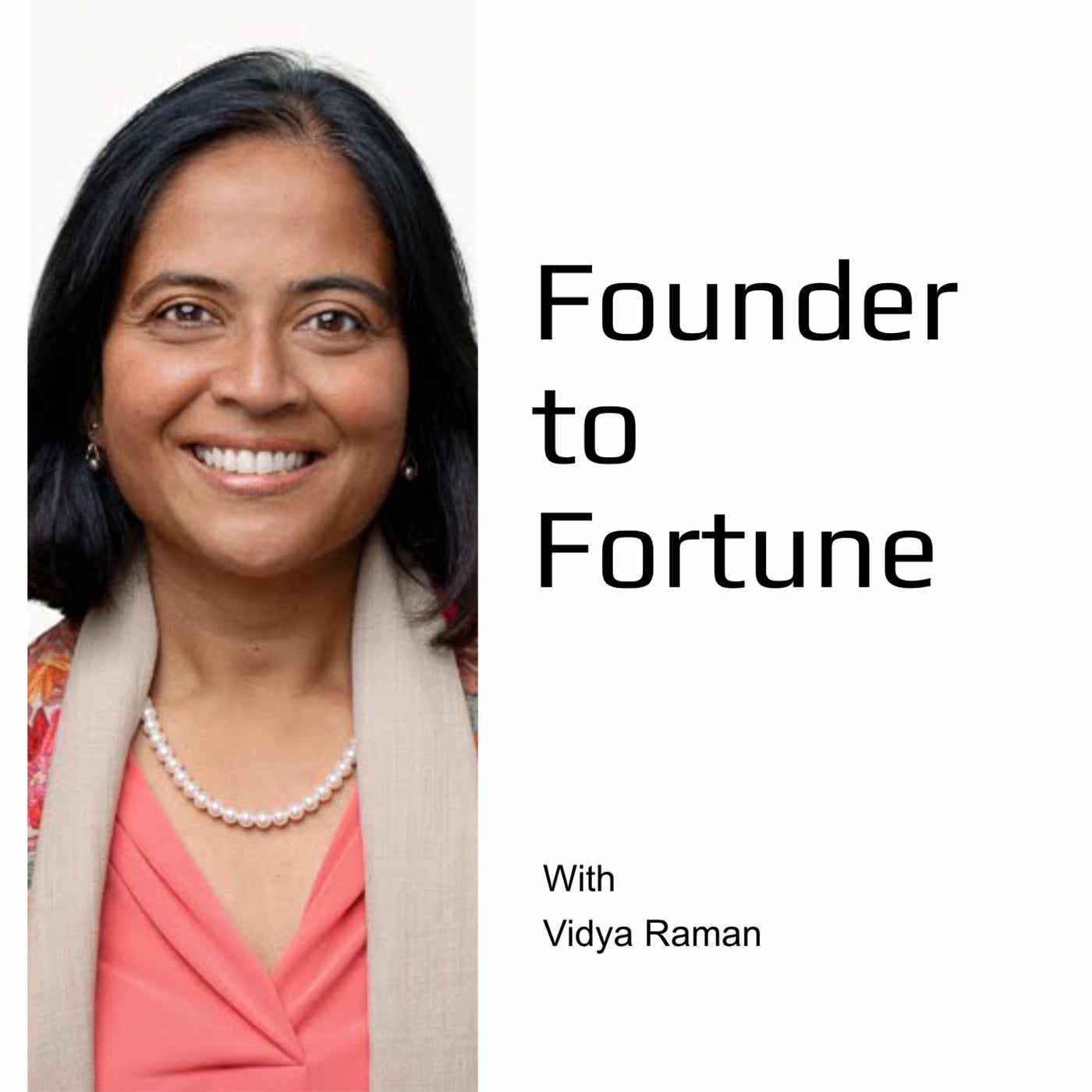
The Founder to Fortune Podcast
Vidya Raman
The Founder to Fortune Podcast unpacks how great companies—and fortunes—are built. Hosted by VC and former AI product leader Vidya Raman, with real-world insights from founders, execs, and investors shaping the future of startups and enterprises. www.foundertofortune.org
Episodes
Mentioned books

18 snips
Sep 20, 2024 • 30min
How to Sell to Enterprises with Bharathi Rajan
Bharathi Rajan, Vice President of Enterprise Data and Analytics at Swire Coca-Cola, shares invaluable insights for founders looking to sell to enterprises. She emphasizes knowing your customers and their KPIs for tailored solutions. Bharathi discusses the relevance of transferable KPIs across industries and the pivotal role of continuous engagement with clients. She also highlights the power of reference selling and the complexities of the competitive landscape, including decision-making factors like pricing and ROI. Her perspective on vendors as partners is a game changer.

Aug 23, 2024 • 44min
Founder-led Sales with Leslie Venetz
Founder-led sales are common in early-stage startups. But, they could be much more effective with a deeper understanding of sales fundamentals. Joining us today is Leslie Venetz, founder of The Sales-Led GTM Agency to discuss how founders can level up their skills and transform their sales. Drawing on her extensive history in B2B sales, which includes over 250,000 cold calls, Leslie covers everything founders need to know, from earning the right to your prospect’s attention to efficiently managing your time during the sales process. She shares her top tips on crafting concise, value-driven emails, how to use AI in sales without over-relying on it, and how to strategically time your demos. Leslie also shares her unique perspective on objections, including how to figure out which objections are worth addressing, and why you should always lead with curiosity.Key Points From This Episode: * Some background on Leslie Venetz and her extensive background in sales.* Improving founder-led sales, especially in early-stage startups.* The key to developing active listening skills and why it is essential in sales.* Cold emails: best practices and common mistakes.* Key components of highly relevant messaging and how to audit your emails.* What your initial email outreach should look like.* Why you need to earn the right to write longer emails.* Leslie’s advice on how to use AI in sales – and how not to use it.* The importance of personalized outreach in the age of AI.* How to strategically time your product demos in a prospective customer call.* Recognizing different types of objections and how to address them.* Utilizing events as part of a multi-channel marketing approach.* Leslie answers our rapid-fire questions on AI, cold-calling, and more!Quotes:“Founder-led sales, which is usually the norm for early-stage startups, can be so much more effective if only founders could better understand some of the foundational aspects of sales.” — @veenormous [0:04:17]“It is your responsibility to earn the right to your prospect's time” — @LeslieVenetz [0:11:41]“We want to do everything that we can to reduce the cognitive load – and make it easy for them to scan and digest that email.” — @LeslieVenetz [0:15:16]“Especially for early-stage founders. You all are busy. – You do not have the time to spend an hour sending an email to a prospect that doesn't actually want you to email them.” — @LeslieVenetz [0:34:05]Links Mentioned in Today’s Episode:Leslie VenetzLeslie Venetz on LinkedInJill KonrathSnap SellingTim Zonca on LinkedInTim Zonca on XVidya Raman on LinkedInVidya Raman on X This is a public episode. If you would like to discuss this with other subscribers or get access to bonus episodes, visit www.foundertofortune.org

Jul 26, 2024 • 49min
The Role of Sales in Early-Stage Startups with Barry Dauber (Databricks/Mosaic ML)
Barry Dauber is the VP of Sales and Business Development at MosaicML (recently acquired by Databricks) which is centered on making generative AI easy to use and widely accessible. Today, Barry joins us to discuss the role of sales, marketing, and business development in early-stage startups with a specific emphasis on MosaicML. Key Points From This Episode: * Barry Dauber walks us through the evolution of MosaicML's core offering. * His thoughts on sales and in particular, how to know when it's time to scale. * Barry's protocol for when the scaling plan includes bringing in new partners.* How to stay in your lane as a startup with great ambitions, and why this matters. * Our guest unpacks the differences and similarities between market adoption of big data and generative AI. * The major roadblocks that slow and prevent the evolution of ML and GenAI.Quotes:“As we learn in sales, especially in the startup world, 'no' is almost as exciting as ‘yes.’” — @barrydauber [0:15:07]“The easiest way to drive a partnership, especially as the small company, is you need to bring a customer.” — @barrydauber [0:19:27]“If an early-stage startup positions themselves as a platform, it would be disqualified by enterprises” — @barrydauber [0:23:31]“Gen AI SaaS will win over DIY efforts in large enterprises.” — @barrydauber [0:42:32]“Business users will be the primary users of ML/AI tools 5 years from now.” — @barrydauber [0:48:38]Links Mentioned in Today’s Episode:Barry Dauber on LinkedIn Barry Dauber on XMosaicML Databricks Tim Zonca on LinkedInTim Zonca on XVidya Raman on LinkedInVidya Raman on X This is a public episode. If you would like to discuss this with other subscribers or get access to bonus episodes, visit www.foundertofortune.org

Jun 24, 2024 • 37min
The Essence of Building Enduring Tech Companies with Chet Kapoor
In this episode, three-time tech company founder Chet Kapoor joins us to offer his insights on finding the right tech waves to ride and timing them well. Chet shares the principles that underpin his professional identity and decision-making process and highlights the importance of creating and maintaining momentum. Chet provides some timeless advice on how to approach enterprise sales for developer tools, the right kinds of partnerships to prioritize, his outlook on competition, and so much more. He also answers a number of rapid-fire questions that reveal his predictions for the future of data infrastructure, LLMs, data engineering, and more!Key Points From This Episode: * Introducing Chet Kapoor and his experience launching three tech companies. * Experiences that have defined his professional identity, from growing up in Calcutta to working alongside Steve Jobs.* The two key principles that inform all of Chet’s decisions.* Why momentum is so important in startups. * A simple yet powerful framework to create a large company.* Datastax’s place in the current AI landscape and what it aims to do. * Why Chet looks most forward to transformative use cases. * Advice for approaching enterprise sales.* Two ways that Chet classifies partnerships. * Applying caution to partner relationships.* Chet's evolving relationship with competition. * The importance of leaning into your uniqueness and modifying your approach as needed.* Predictions for how data infrastructure will change in the next five years. * Why he believes that LLM agent-based applications are geared to reinvent most of the enterprise software landscape as we know it. * Perspectives on which players stand to gain the most with the development of AI. * Whether or not the demand for data scientists and engineers is going to increase. Links Mentioned in Today’s Episode:Chet Kapoor on LinkedInChet Kapoor on XDatastaxTim Zonca on LinkedInTim Zonca on XVidya Raman on LinkedInVidya Raman on X This is a public episode. If you would like to discuss this with other subscribers or get access to bonus episodes, visit www.foundertofortune.org

7 snips
May 2, 2024 • 43min
The Developer-Facing Startup with Adam Frankl
Adam Frankl, a seasoned marketing strategist and former VP of Marketing at multiple developer-facing unicorns, shares valuable insights on navigating the tech startup landscape. He discusses the unique mindset of developers and why traditional marketing fails to resonate with them. Frankl emphasizes the importance of addressing real pain points and leveraging social proof in marketing strategies. He also critiques conventional sales funnels, introducing the DREAM sequence to better engage developer audiences. This conversation is a must-listen for startup founders aiming for success in the development tool space.

Mar 29, 2024 • 48min
The Business of Open Source for Infra and Dev Tool Founders
In this episode, we discuss what it means to build a business based on open source for infra and dev tool founders. Sharing her broad and deep insights with us is Emily Omier, the world’s leading expert in positioning OSS companies for success.Key Points From This Episode:* The Perennial and fundamental challenge for an OSS company is building a business while still having an OSS project that delivers clear value in and of itself and is entirely free to the world!* Understand the difference between project-market fit and product-market fit. (Hint: assume them to be the same at your peril).* Most founders and investors expect that a sure % of their OSS users will, over time, become paid customers. It is dangerous to assume a linear relationship between the two. Instead, it is best to truly engage in customer discovery and understand what your users might be willing to pay for. It is common for your OSS and commercial offering to cater to two different personas and markets–this makes customer discovery vital. Done right, startups will not just assume that there is naturally a market for their SaaS offering. So, first, test the hypothesis instead of spending expensive resources to build a SaaS offering on the back of an OSS project.* OSS business models are often tricky for early-stage startups because of the inevitable spread of resources between completely different offerings, customers, and sales and marketing efforts.* OSS companies do not need to build a community. Similarly, a community of users can be built even if the company doesn’t have an OSS offering. So, it is essential to be clear about your goals with OSS, community building, and everything that goes with initiatives that require a reasonably long timeline.* The business of OSS continues to evolve as we speak. Rather than being an OSS purist or zealot, it helps to continuously evaluate the value OSS offers over a business’s existence.* Bonus! Insider details about an exciting upcoming open-source conference.Quotes:“You have project market fit, and then you have product market fit, and having one does not mean you have the other.” — @EmilyOmier [0:07:28]“OSS companies are already spreading themselves thinner than non-OSS companies. One of the biggest risks for OSS companies is taking on too much” — @EmilyOmier [0:21:00]“Open Source is often idolized, especially by leaders drawn to large companies' attractive aspects. Large adoption, a thriving community that advocates on their behalf, and the assumption that it's an easy flip of the switch from adoption to commercialization” — @TimZonca [0:25:00]“Community building is a long game.” — @EmilyOmier [0:37:55]Links Mentioned in Today’s Episode:Emily OmierEmily Omier on LinkedInEmily Omier on XThe New StackThe Business of Open SourceOpen Source Founders SummitTim Zonca on LinkedInTim Zonca on XVidya Raman on LinkedIn This is a public episode. If you would like to discuss this with other subscribers or get access to bonus episodes, visit www.foundertofortune.org

Feb 8, 2024 • 48min
How Are World-Class Engineering Teams Setting Up For Success with AI?
Now that AI has been fully integrated into our lives, the question among developers, engineers, and even end-users is no longer “What is AI?” but rather “How can I use AI in the best possible way?” We are joined today by Sushant Hiray, the Senior Director of Machine Learning at the business communications platform, RingCentral, and Guhan Venguswamy, the Head of Platform at Jasper – a marketing-focused AI copilot. The pair are here to discuss how their companies have adapted to the explosion of LLMs, beginning with what their businesses are all about, the products they offer, and the customers they aim to serve. In our conversation, we learn about the common challenges that are found at the platform and engineering layers, how the adoption of LLMs has changed the way data, engineering, ML, and data science teams are structured, and why the title “Full-Stack Engineer” will need to be revisited moving forward.Key Points From This Episode:* Jasper:* Developer experience is paramount for the platform team at Jasper AI. Rapid onboarding, and providing a scalable and flexible platform are their key tenets.* The landscape in AI is changing so rapidly that it's hard to be too opinionated on platform level choices.* Enabling their larger enterprise customers to bring their own model or giving them the choice to pick and choose models off-the-shelf has been key for customer acquisition.* A constant theme for his team is to be thoughtful about what they make part of their platform versus use something that is off-the-shelf. You don’t want to build something into your platform when a pure-play infra player is better positioned to do it 100x better.* Ringcentral:* Ringcentral is infusing product after product with AI and Sushant’s team is a key enabler for that.* Some of the engineering challenges that Ringcentral faces include tapping into troves of multi-modal data, building on a platform that is at least a decade old, and driving a streamlined customer experience while doing so.* Privacy and regulatory challenges are an entirely different kind of challenge that Ringcentral faces in infusing their products with AI.* Team composition and skill sets:* Embedding someone with deep AI expertise into an engineering team working on a feature has worked out for Jasper AI. For Ringcentral, a more central AI team is the way to go but collaboration is very strong cross-functionally.* Our guests predict which job title will be the most glamorous by 2026.Quotes:“Our goal from a developer experience is to onboard new engineers and get them ready to commit code within the first day or two of being in the company” — Guhan Venguswamy [0:07:39]“Historically, communications [was] as simple as pick up the phone and call somebody. Now, you have made it a lot smarter but at the cost of a lot of data privacy along the way.” — @SushantHiray [0:18:58]“The pace is changing so rapidly that you cannot be really opinionated about what tech stack you’re using because very soon, within six months maybe, something is going to change.” — @SushantHiray [0:23:35]“Focusing on rapid iteration in the short-term, with a long-term vision to hang our hat on, is what helps us adapt to challenges.” — Guhan Venguswamy [0:34:02]“A core skill set for any engineer, regardless of where you are in the organization, is to have the ability to work with large language models. And when I say work with, I mean, utilize and apply the large language models to whatever use case you have..” – Guhan Venguswamy [0:35:21]Links Mentioned in Today’s Episode:Sushant HiraySushant Hiray on LinkedInSushant Hiray on XRingCentralGuhan Venguswamy on LinkedInJasperTim Zonca on LinkedInTim Zonca on XVidya Raman on LinkedInVidya Raman on X This is a public episode. If you would like to discuss this with other subscribers or get access to bonus episodes, visit www.foundertofortune.org

Dec 20, 2023 • 44min
Lessons from Building Thoughtspot and Nutanix with Ajeet Singh
Ajeet Singh is the founder of not one but two unicorns– Ajeet founded Nutanix in 2009 which went public in 2016 and was the largest tech IPO of that year. It is today a public company making well over 1B in ARR and has more than 23K+ customers worldwide. Nutanix is a leader in the hyper-converged infrastructure space. Ajeet also founded Thoughtspot in 2012 which is valued at over 4B+. Thoughtspot is in the Business Intelligence space, taking on incumbents such as Tableau, Microsoft PowerBI, and many others.Topics we discuss:* How should founders think about risks in their business? This is a super valuable framework to have!* Taking care of your mental health (especially in a market like today).* How to think about AI and how they did that at Thoughtspot as super early adopters (hint: it’s not about the tech).* What to do when you the wrong customer wants your product.* His biggest learning and advice for founders. And yes, its about your people!* How important is “move fast and break things”?Quotes:“It’s a great time to start a company – Anytime is a great time to start a company if that is what one wants to do.” — @ajeets [0:04:50]“When things change, you have to adapt; you have to have a culture that is adaptable.” — @ajeets [0:05:50]“I find that market risk is not something you can control to any extent, it’s beyond you. Execution risk is something you can control by building a great team, culture, empowering people, being ambitious, [and] being adaptable. So, I like low market risk and high execution risk.” — @ajeets [0:07:37]“You have to be conscious of [market risk and execution risk]. Whatever type of risk you’re taking, make sure that you then take action to mitigate that and actually thrive on that – value doesn’t get created without taking risks.” — @ajeets [0:09:44]“2023 is the year in which the whole world is in a big hackathon. It’s a big hackathon, we’re all experimenting, we’re all learning. Nobody really knows exactly how some of these things are going to play out – So, I think it’s a great time to experiment; try; learn; [and] fail.” — @ajeets [0:29:32]Links Mentioned in Today’s Episode:Ajeet Singh on LinkedInAjeet Singh on XThoughtspotNutanixOpenAITim Zonca on LinkedInTim Zonca on XVidya Raman on LinkedIn This is a public episode. If you would like to discuss this with other subscribers or get access to bonus episodes, visit www.foundertofortune.org

Nov 1, 2023 • 35min
The Story of Building Armorblox (Cisco Exit)
Welcome back to The Enterprise GTM Podcast! Today, we are joined by the CEO of Armorblox, DJ Sampath. Armorblox was a cybersecurity startup that built the world’s first natural language understanding platform to intelligently detect, alert, and protect identity-related attacks and data loss.DJ is the quintessential engineer turned CEO. He has a PhD in computer engineering and started his career as a software engineer before starting Armorbox.Tuning in, you’ll hear about his startup journey, the most challenging part of being a CEO, why everyone can sell, how he knows when a product is ready for market, the importance of dissecting the rejections and having conviction in your work as an entrepreneur, and so much more! AI…Key Topics From This Episode: * Being part of an early-stage startup is incredibly valuable in preparing you to be a startup founder.* DJ shares some advice on overcoming the fear of selling, including amazing mental hacks. * How do you avoid the trap of over-building or delaying the launch of your MVP? DJ provides a concrete framework for this and shares some concrete examples. * The importance of having conviction in your work as an entrepreneur.* A crucial point about unpacking ‘nos’- whether they are from customers, investors, and others. DJ talks about primary and vital skills to unpack the ‘nos.’ * DJ tells us about the lessons he learned when engaging with enterprises. Putting yourself in the enterprises’ shoes is a big part of it!* Why timing is important for building the right partnerships and channel relationships and how it is crucial for success. * How AI is affecting the creation of products all comes down to connecting with real humans over a beer in the Bay Area!* Small models are the future of AI.Quotes:“As a CEO, you never have an off button. You don’t just go to your home and be with your kids and watch Netflix or something. You are always thinking about what you need to do next”. — @djsampath [0:06:00]“If an engineer comes to you and tells you that they don’t know how to sell, they’re flat out lying” — @djsampath [0:07:00]“Everybody is a salesperson, and once you accept that, things start to change.” — @djsampath [0:08:00]“The best salespeople can build a personal relationship and rapport with who they are selling to.”— @djsampath[0:22:00]Links Mentioned in Today’s Episode:DJ Sampath on LinkedInDJ Sampath on XArmorbloxTim Zonca on LinkedInTim Zonca on XVidya Raman on LinkedInVidya Raman on X This is a public episode. If you would like to discuss this with other subscribers or get access to bonus episodes, visit www.foundertofortune.org

Oct 4, 2023 • 40min
Building AI Products for Enterprise Users
With the release of ChatGPT, AI has caught everyone’s attention and we are seeing it in more and more consumer and enterprise products. As leaders in the field of AI who have been working with AI before it became a rage, we have some of the best minds to share advice to founders who are building products using AI.Our guests today include:* Saurabh the VP of engineering at Uniphore, which is a leading conversational AI company. Saurabh shares his experience building emotion AI, which is an industry-leading multi-modal AI model that helps their end customers literally “read the room”.* Tamar, the VP of engineering at Box, a well-known document storage company. Tamar has deployed LLMs in interesting use cases that unlock productivity benefits as well as drive business processes at a scale that was not possible before–at least not at scale.* Mandar, the head of Machine Learning at Doordash in the Ads platform team. They are famously customer-obsessed in his team and are using LLMs to deliver value to their end users in innovative ways.Key Points From This Episode:* At Uniphore, Saurabh talks about how it is hard enough to use computer vision models to accurately identify emotions real-time but they actually combine facial expressions along with other aspects such as tone and run them through multiple specialized models before “stitching” them together to help users “read” the sentiment in the room.* At Doordash, Mandar’s team has automated at least a big part of the cumbersome data labeling process by using LLMs. Another very exciting area they are exploring is whether they can generate more data to feed their recommendation model using LLMs. Both these areas have proven to be quite promising for them. Beyond that, Mandar touches upon some foundational work he and his team are doing at Doordash including shoring up basic processes around model serving, GPU access, cost management among others.* Tamar at Box underscores the importance of being realistic with AI within the enterprise context by making sure they meet the requirements of businesses for security, access control, compliance, and auditability. They started by publishing an “AI policies for Box” that they adhere to for everything that they build. Not only that, they shared it with the community and customers alike. Their commitment to giving customers control and assuring privacy is core to their strategy. Finally, Tamar brings up the importance of building sound observability into these systems so that engineering teams can effectively manage costs.Links Mentioned in Today’s Episode:Uniphore Emotion AITamar BercoviciSaurabh SaxenaMandar RahurkarTim Zonca on LinkedInTim Zonca on XVidya Raman on LinkedInVidya Raman on X This is a public episode. If you would like to discuss this with other subscribers or get access to bonus episodes, visit www.foundertofortune.org

