

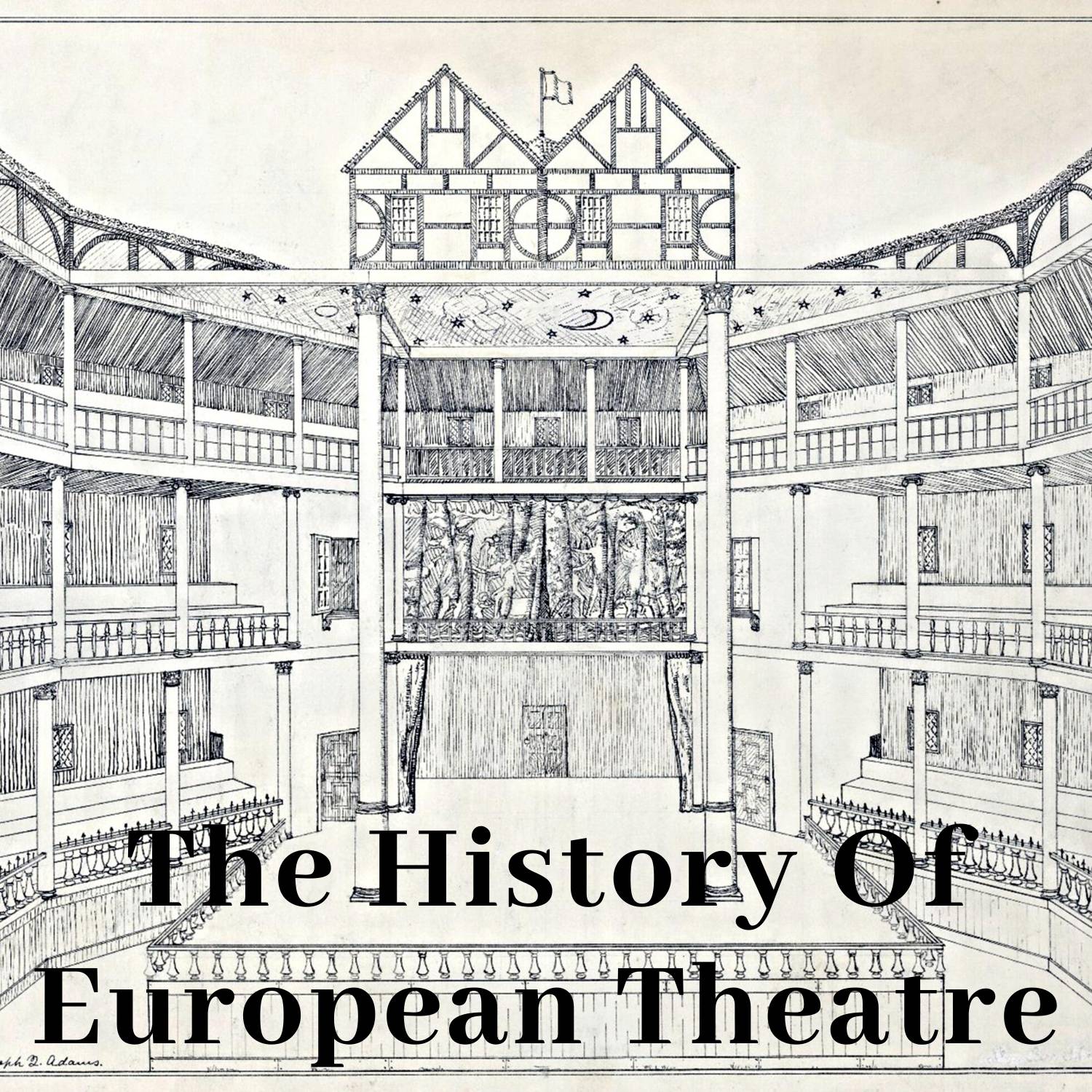
The History Of European Theatre
Philip Rowe
A podcast tracing the development of theatre from ancient Greece to the present day through the places and people who made theatre happen. More than just dates and lists of plays we'll learn about the social. political and historical context that fostered the creation of dramatic art.This podcast uses the following third-party services for analysis: Chartable - https://chartable.com/privacy Hosted on Acast. See acast.com/privacy for more information.
Episodes
Mentioned books

Sep 9, 2024 • 43min
Shakespeare, the Bible and Dorothy L Sayers: A Conversation with Jem Bloomfield
Episode 134:Author Jem Bloomfield joins us to talk about his recently published book, ‘Allusion in Detective Fiction’, which looks at how and why allusion to Shakespeare and the Bible was used by the masters, or I should say mistresses, of golden age detective fiction. This may not seem like an obvious area when considering the pervasive influence of Shakespeare, but as you will here the connections that Jem has made can tell us a lot about how knowledge and use of Shakespeare is constantly changing.Warning – Spoilers present!Jem discusses major plot points of several classic detective novels, but we thought that they can hardly be counted as spoilers up to about a century after they were first published, but you have been warned.Link to Jem's book on the publishers website:https://link.springer.com/book/10.1007/978-3-031-58339-1 Support the podcast at:www.thehistoryofeuropeantheatre.comwww.patreon.com/thoetpwww.ko-fi.com/thoetp Hosted on Acast. See acast.com/privacy for more information.
Sep 2, 2024 • 39min
The Taming of the Shrew: ‘No Profit Grows Where No Pleasure Is taken’
Episode 133: The complications with dating the play and it’s relationship with a similar Elizabethan playThe sources for the playA short summary of the playThe Christopher Sly framing deviceSwitching of roles in the playThe disguise motifThe motivations of the leading charactersThe implication of the falconry images in the playThe Elizabethan idea of a proper wife and correct behaviourSimilarities with Elizabethan ‘wife taming’ balladsThe play as an inheritor of Roman comedyThe protagonists as stock charactersKatherine’s imbalance of the humoursAre Petruchio and Katherine a matched couple?Do the three marriages resolve the play?Does the play make a serious point about gender relationships in Elizabethan England?The ‘difficult’ final speech by KatherineSupport the podcast at:www.thehistoryofeuropeantheatre.comwww.patreon.com/thoetpwww.ko-fi.com/thoetp Hosted on Acast. See acast.com/privacy for more information.
Aug 26, 2024 • 22min
Richard 3rd at Shakespeare's Globe
Episode 132My thoughts on seeing a recent production of Richard 3rd at Shakespeare's Globe, starring Michelle Terry in the titular role. The production and the cotrovercy that surrounded it raises questions about gender fluid casting, the nature of leadership and the casting of able bodied actors in this famous portrayal of deformity.Support the podcast at:www.thehistoryofeuropeantheatre.comwww.patreon.com/thoetpwww.ko-fi.com/thoetp Hosted on Acast. See acast.com/privacy for more information.
Aug 19, 2024 • 34min
Richard 3rd: 'And Thus I Clothe My Naked Villainy'
Episode 131: Richard 3rd: ‘And Thus I Clothe My Naked Villainy.’Shakespeare dramatises the life of the last Plantagenet king and create one of theatre's most spectacular villains. The dating of the playThe quarto editions of the playWhen is a history play a tragedy, or not?The sources of the playThe influence of SenecaOther contemporary versions of the Richard 3rd story.The centrality of the character of RichardA brief plot summaryThe boldness of Richard’s actionsRichard as prologue and then guide in the playLady Anne and her reaction to Richard’s proposalThe influence of Marlowe on Richard 3rdThe role of the female characters in the playHow should we view the presence of Margaret in the play?The curses and prophecy of MargaretHow deformity and old age can be seen to link Richard and MargaretRichard afflicted by guiltThe theatricality of the playDoes our liking for Richard affect the morality of the playWhat the lay can tell us about players and changes in Tudor societySupport the podcast at:www.thehistoryofeuropeantheatre.comwww.patreon.com/thoetpwww.ko-fi.com/thoetp Hosted on Acast. See acast.com/privacy for more information.
Aug 12, 2024 • 40min
The search for Richard 3rd: A Conversation with Mathew Morris
Episode 130:Mathew Morris talk to me about the archaeological dig that resulted in the discovery of the final remains of Richard 3rd, which serves as a prelude to the next episode which will be all about Shakespeare’s take on the final Yorkist king. Towards the end of our conversation, we spoke about the differences between the Richard of the play and what the skeletal remains that were uncovered tell us about the real-life king, but most of the conversation is about how the remains were discovered, recovered for analysis, and how they were proved to be the remains of Richard 3rd.Mathew Morris is a Project Officer at the University of Leicester Archaeological Service with over a decade of archaeological experience, having excavated a wide range of rural and urban archaeology across the Midlands, from the prehistoric period through to the Second World War. His specialisms include urban archaeology, community archaeology and Roman and medieval archaeology.Mathew graduated from the University of Leicester in 2003 with a BA in Archaeology and an MA in Landscape Studies, joining ULAS in 2004. Notable projects include a massive multi-period urban excavation at Highcross in Leicester that included excavation of Roman town houses, commercial buildings, two lost medieval churches and medieval cemeteries and a Roman cemetery at Western Road in Leicester, and, of course in 2012 he directed the successful archaeological search for the lost grave of King Richard III. Recently, he has been digging up more Roman buildings and mosaics in Leicester, at the former Southgates Bus Depot and All Saints' Brewery sites and is currently leading the archaeological work for the Leicester Cathedral Revealed project.He has co-authored the most comprehensive book ever written on the archaeology of Leicester - 'Life in Roman and Medieval Leicester' (2021) and three popular archaeology books: 'Visions of Ancient Leicester' (2011), 'Richard III: The King under the Car Park' (2013) and 'Roman Leicester: Life in the Roman World' (2018). He is actively involved in promoting archaeology to the general public, regularly providing talks to local societies, and is a Committee member of the Leicestershire Fieldworkers, and a Branch Leader for the Leicestershire Young Archaeologists’ Club. He also currently leads the Castle Hill Community Archaeology Dig and the Bosworth Links Community Dig. Hosted on Acast. See acast.com/privacy for more information.
Aug 5, 2024 • 33min
Henry 6th part 3: ‘How sweet a thing it is to wear a crown.’
Episode 129:A brief recap on the dating and sources of the playA brief synopsis of the playThe problem of multiple battlefield scenes and the depiction of violenceHow language in the play is used to underline the changing fortunes of the two sides.The depth of strong characterisation in the playWarwick, the would-be kingmakerHenry as an early humanistFathers and sons at war with each otherThe revenge motive running through the playA brief recap on the role and character of MargaretThe development of the character of RichardThe question of the extent if Richard’s deformityDid the play resonate with the contemporary audience?Support the podcast at:www.thehistoryofeuropeantheatre.comwww.ko-fi.com/thoetpwww.patreon.com/thoetp Hosted on Acast. See acast.com/privacy for more information.
Jul 29, 2024 • 40min
John Hall of Stratford-Upon-Avon: A Conversation with John Taplin
Episode 128:Author John Taplin discusses researching the Stratford families of Shakespeare's time and particularly the ancestry of John Hall, Shakespeare's son-in-law.John Taplin spent the majority of his career in management in the telecommunications industry until 2001 when he joined the Shakespeare Birthplace Trust at Hall’s Croft and Nash’s House/New Place in Stratford-upon-Avon, until retiring in 2010. A historian, genealogist and biographer, he has published articles on Shakespeare, his contemporaries and associates in and around Stratford, including the families directly associated with New Place.Shakespeare’s Stratford home, before and after Shakespeare’s lifetime. In 2011 he published his book Shakespeare’s Country Families - A Documentary Guide to Shakespeare’s Country Society. He was a member of the Advisory Board for the Trust’s Dig for Shakespeare project at New Place between 2010-2015, and in 2018 he published a revised and updated edition of his 2011book. He has a Masters degree in historical studies from the University of Leicester.Links to John's ebook:https://www.amazon.co.uk/Twenty-first-Century-Shakespeare-Gleanings-Taplin-ebook/dp/B0CC633JY2/ref=sr_1_1?dib=eyJ2IjoiMSJ9.UlnFY8UInwIYfhuJf0AiXmtXTQSRHcN9Ativ9cOIX_PGjHj071QN20LucGBJIEps.4xAoLuO1JQQ2o0LumK9U_Hjq703MON6NOQVolv2BSr4&dib_tag=se&qid=1721225584&refinements=p_27%3AJohn+Taplin&s=digital-text&sr=1-1&text=John+TaplinSupport the podcast at:www.thehistoryofeuropeantheatre.comwww.ko-fi.com/thoetpwww.patreon.com/thoetpThis podcast uses the following third-party services for analysis: Chartable - https://chartable.com/privacy Hosted on Acast. See acast.com/privacy for more information.
Jul 22, 2024 • 34min
Henry 6th part 2: ‘The Fox Barks Not When He Would Steal the Lamb’
Episode 127:A recap of Henry VI part one and the potential involvement of Christopher MarloweA word on methods of authorship attribution in the context of Shakespeare and MarloweThe dating and sources of the playA synopsis of Henry VI part twoThe characterisation of the War of the RosesThe decline of England mapped out in the playThe main characters in the playThe weakness of the king as portrayed in the playThe powerplay between Gloucester, York and MargaretMargaret as a central character in the playThe use of language to define different charactersThe contrast between Henry and MargaretThe Jack Cade rebellion and the utopia of a classless societyGloucester and the view of justice-based governmentHow the world depicted in the play might have been viewed by the first audiencesThe historical accuracy of the playThe arrival of Richard, future king, on stageThe performance history of the playSupport the podcast at:www.thehistoryofeuropeantheatre.comwww.ko-fi.com/thoetpwww.patreon.com/thoetpThis podcast uses the following third-party services for analysis: Chartable - https://chartable.com/privacy Hosted on Acast. See acast.com/privacy for more information.
Jul 15, 2024 • 46min
Shakespeare’s Borrowed Feathers: A Conversation with Dr. Darren Freebury-Jones
Episode 126:A conversation with Dr. Darren Freebury-Jones, author of 'Shakespeare’s Borrowed Feathers' about the influence of early modern playwrights on Shakespeare where we talk about Marlowe, Kyd, Greene and others and the role of data analytics in modern author attribution studies.Dr Darren Freebury-Jones is author of several works on early modern theatre including: Reading Robert Greene: Recovering Shakespeare’s Rival Shakespeare’s Tutor: The Influence of Thomas Kydand his latest work Shakespeare’s Borrowed Feathers, will be published in October 2024.Darren is Associate Editor for the first critical edition of The Collected Works of Thomas Kyd since 1901. He has also investigated the boundaries of John Marston’s dramatic corpus as part of the Oxford Marston project and is General Editor for The Collected Plays of Robert Greene published by Edinburgh University Press. His findings on the works of Shakespeare and his contemporaries have been discussed in national newspapers in the UK and on BBC Radio. His debut poetry collection, Rambling published by Broken Sleep Books, was published in 2024. In 2023 he was elected a Fellow of the Royal Historical Society in recognition of his contributions to historical scholarship. Links to 'Shakespeare's Borrowed Feathers'https://manchesteruniversitypress.co.uk/9781526177322/shakespeares-borrowed-feathers/https://www.amazon.com/Shakespeares-borrowed-feathers-playwrights-greatest/dp/1526177323/ref=sr_1_1?crid=94S4BGF6FW1K&dib=eyJ2IjoiMSJ9.pfj-18kdWvHO-sbFvYC3sw.Bx51-kXl5CIuz42hJHAOTCZs4KerccNu9A8tK9wC0Tc&dib_tag=se&keywords=shakespeare%27s+borrowed+feathers&qid=1720274180&sprefix=shakespeares+borrowed+feathers%2Caps%2C163&sr=8-1Link to Darren's on-line talk on Robert Greene 22nd July 2024 in aid of the Rose Playhousehttps://www.trybooking.com/uk/events/landing/63856?Support the podcast at:www.thehistoryofeuropeantheatre.comwww.ko-fi.com/thoetpwww.patreon.com/thoetpThis podcast uses the following third-party services for analysis: Chartable - https://chartable.com/privacy Hosted on Acast. See acast.com/privacy for more information.
Jul 8, 2024 • 33min
Henry 6th part 1: ‘My Thoughts Are Whirled Like a Potter's Wheel’
Episode 125:A detailed look at the first Shakespearean history play 'Henry 6th part 1'The problems with dating 1 Henry VIHow much of the play did Shakespeare write?The relationship of the play to parts 2 and 3The sources of the playA brief summary of the playThe play in relation to other history plays of the timeCriticism of the battle scenesThe theme of the loss of the English Empire and the end of chivalryThe portrayal of Joan and the FrenchThe portrayal of the English aristocracyProblems with the structure of the playSupport the podcast at:www.thehistoryofeuropeantheatre.comwww.ko-fi.com/thoetpwww.patreon.com/thoetpThis podcast uses the following third-party services for analysis: Chartable - https://chartable.com/privacy Hosted on Acast. See acast.com/privacy for more information.

