

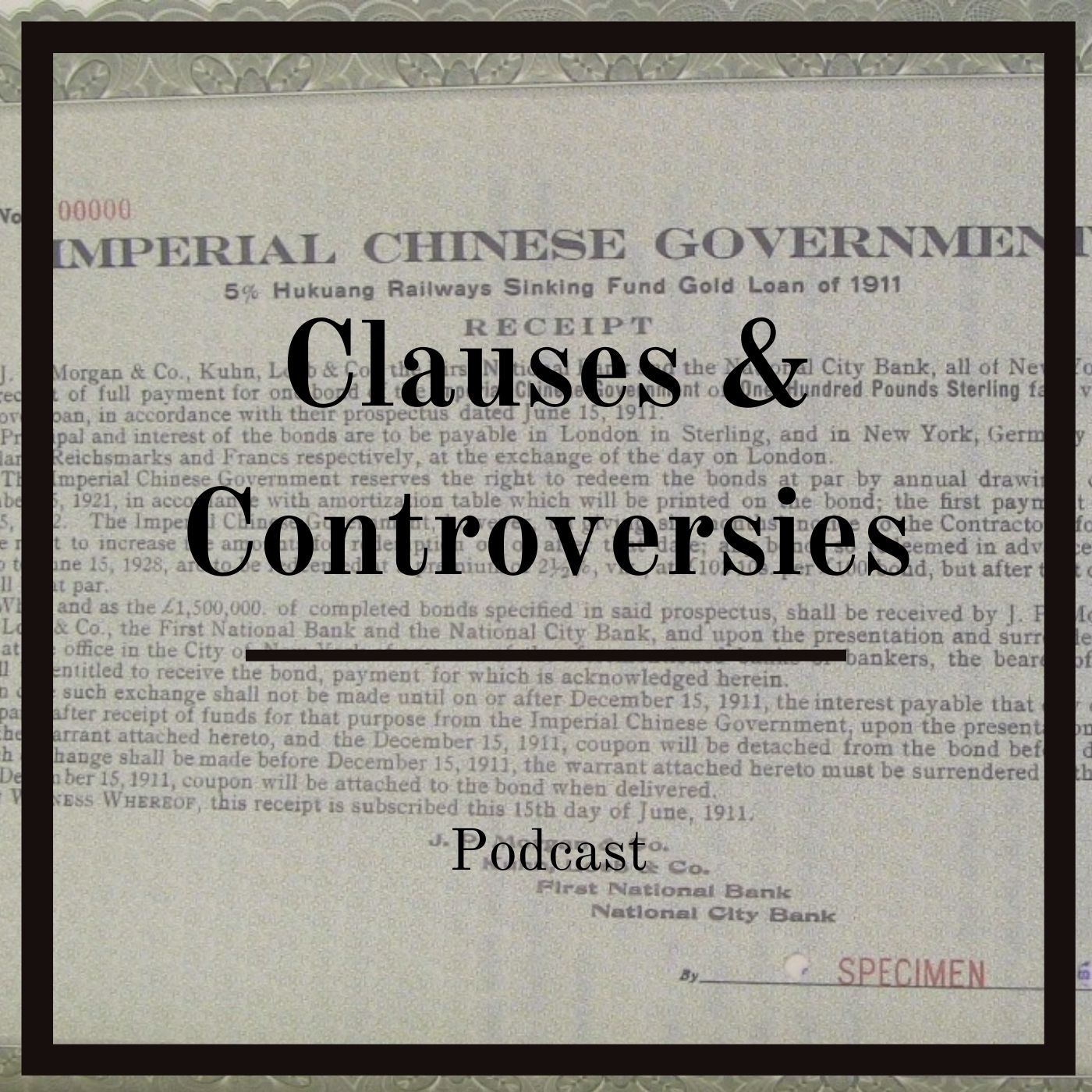
Clauses & Controversies
Mitu Gulati & Mark Weidemaier
Clauses and Controversies: A Podcast about International Finance, Contract Clauses and the Controversies Surrounding These Clauses
Episodes
Mentioned books

Mar 9, 2026 • 40min
Ep 171 - The $500 Million American “Financial Aid” to China
The $500 Million American “Financial Aid” to China
In 1942, the Americans provided $500 million in financial aid to Chiang Kai-shek’s Nationalist government in China. Described as a “financial counterpart” to Lend-Lease aid, the credit — intended to help stabilize the Chinese economy and support its war effort — did not provide for principal repayment, interest payments, or state a maturity. The apparent intent was to negotiate terms in a post-war settlement of accounts, when the parties could agree on the “benefits to be rendered the United States in return” for the credit. That agreement never happened and, as best we can tell, the status of the credit remains unclear. (Was it a loan? A conditional grant? If the latter, were the conditions fulfilled?) The US doesn’t seem to have ever asserted a right to collect, but we also haven’t seen anything formally relinquishing the potential claim or formally acknowledging the credit as a grant.
Producer: Leanna Doty

Feb 23, 2026 • 31min
Ep 170 - Ethiopia and Senegal: Debt Shenanigans?
They dig into opaque debt maneuvers in Ethiopia and Senegal and why big players might be reshaping deals behind the scenes. They explore how hidden disclosures and domestic buyers can shut countries out of markets and create moral hazard. They speculate about legal fights, creditor leverage, and weaknesses in the Common Framework that leave disputes messy and unresolved.
Feb 2, 2026 • 43min
Ep 169 - Can We Say Anything Meaningful About a Venezuelan Debt Restructuring?
They debate whether a true Venezuelan debt restructuring can be arranged quickly given a tangled web of claims and massive debt. They explore U.S. priorities, possible preference for oil companies, and the legal and political complications of controlling oil revenues. They consider IMF involvement, neutral claims processes, and what institutional capacity would be needed for a comprehensive workout.
Jan 12, 2026 • 41min
Ep 168 - Are CACs Unilateral Modification Clauses?
Are CACs Unilateral Modification Clauses?
We have always understood the collective action clause (CAC) in a sovereign bond to allow the bond issuer to propose a modification to the bond, which will bind everyone if approved by the requisite proportion of holders. Typically the sovereign is proposing to restructure its debt. This is more or less what bonds governed by NY law say, but bonds governed by English law appear to allow bondholders to gang together to modify the bond without the issuer's consent. Can that be right? We don't really think so, but we don't see anything in the text of the standard CAC in English law bonds that requires issuer consent. Imagine a Euro area issuer is nearing crisis and holders of its local law debt decide to switch their bonds to, say, English law. Can they do this unilaterally? Maybe so.
Producer: Leanna Doty
Jan 5, 2026 • 34min
Ep 167 - Will the Flip Clause Enter the Canon?
Contract innovation in sovereign debt is rare, sparking interest around the new 'flip clause.' This clause allows investors to bypass selected governing laws, coming from concerns over New York legislation. The duo explores the origins of this idea through early attempts in Sri Lanka and Suriname, highlighting its complexities. They share skepticism about its real-world effectiveness, viewing it as more symbolic than practical. A discussion on alternatives reveals simpler solutions, while weighing the costs and implications for investors wraps up their analysis.

Dec 1, 2025 • 32min
Ep 166 - Imperial (Defaulted) Chinese Bonds (Again)
A new legal case about defaulted Imperial Chinese bonds has ignited interest once more. The hosts explore intriguing plaintiff identities and the entertaining context behind them. They dive into the old bond structures and propose a modern interpretation involving pari-passu clauses. Key discussions include overcoming statute of limitations hurdles and the complexities of U.S. courts' reach under the Foreign Sovereign Immunities Act. Historical evidence, like U.S. bank participation, adds depth to the argument, sparking frustration over the dismissive judicial opinions.
13 snips
Nov 24, 2025 • 30min
Ep 165 - Total Return Swaps
Total Return Swaps are at the center of a heated discussion about sovereign borrowing. The hosts dive into how these derivatives are used by governments like Angola, raising questions about their impact on existing creditors. Is collateralized sovereign lending a new threat to transparency in debt management? They explore the mechanics of these deals, the potential for dilution, and the implications for pricing in the market. With a nod to historical trends and moral hazard, the conversation underscores the classic challenges of sovereign lending.
Nov 10, 2025 • 45min
Ep 164 - Cambodia’s “Dirty Debts” to the US — Redux
Cambodia’s “Dirty Debts” to the US — Redux
In the 1970s, the US allowed Cambodia to finance the importation of rice and other agricultural commodities. The debt remains unpaid. One version of this story is that successor Cambodian governments have refused to pay these “dirty” debts. In this telling, the US used the loans to prop up a friendly but illegitimate Cambodian regime. Although the US shipped food, loan proceeds mostly financed the Cambodian military, which the US used as a proxy in the fight against the North Vietnamese and Khmer Rouge. Meanwhile, the US was bombing the Cambodian countryside, destroying domestic food production and contributing to a humanitarian crisis. To make matters worse, it turns out most of the food was sent to countries other than Cambodia. To some observers, the US bears a significant share of responsibility for the Khmer Rouge’s ultimate rise to power. Decades later, after indescribable suffering (caused at least in part by US interference) the US wants money back. The contours of this story are largely true, but the real story of the PL-480 “Food for Peace” program is more complicated. Today’s episode is about what we have found so far and the questions that still remain open.
https://papers.ssrn.com/sol3/papers.cfm?abstract_id=5561161
Producer: Leanna Doty
Oct 20, 2025 • 36min
Ep 163 - What if POTUS wanted an OBBD?
What if POTUS wanted an OBBD?
Let us say, purely hypothetically, that there is a point at which some combination of the spending excesses of the One Big Beautiful Bill, the government shutdown, a rejection by the Supreme Court of tariff mania, and more, result in a shortfall of revenues for the current administration. And let us also say that POTUS goes to his brains trust to ask how best to do an OBBD/R (One Big Beautiful Default/Restructuring). What path might the brains trust take? And what about the option of taxing the treasury holdings of foreign governments, which the administration has already signaled its interest in?
Producer: Leanna Doty
Oct 6, 2025 • 45min
Ep 162 - The Invasion Tax
The Invasion Tax
The lawsuit over Ukraine's $3 billion bond debt to Russia seems to be on hold (maybe forever) in the English courts. And maybe there is no way for the Russian government to force repayment. Still, the debt is a minor cloud hanging (along with many bigger ones) over Ukraine. It would be nice if there was a way to make it go away permanently. Might there be? We talk about a common provision in a sovereign bond's Taxation section — we aren't sure how common, but it certainly isn't unique to Ukraine — that lets the issuer tax investors who have a connection to it other than simply holding its bonds. As written, this provision would allow Ukraine to impose a 100% tax on bond payments to Russia. This may not be what the drafters had in mind, and it opens the door to some unsavory tax shenanigans, but an Invasion Tax doesn't seem too objectionable.
Also: "Whatever it takes" means "whatever it takes!" Except when it means something else.
Producer: Leanna Doty

