

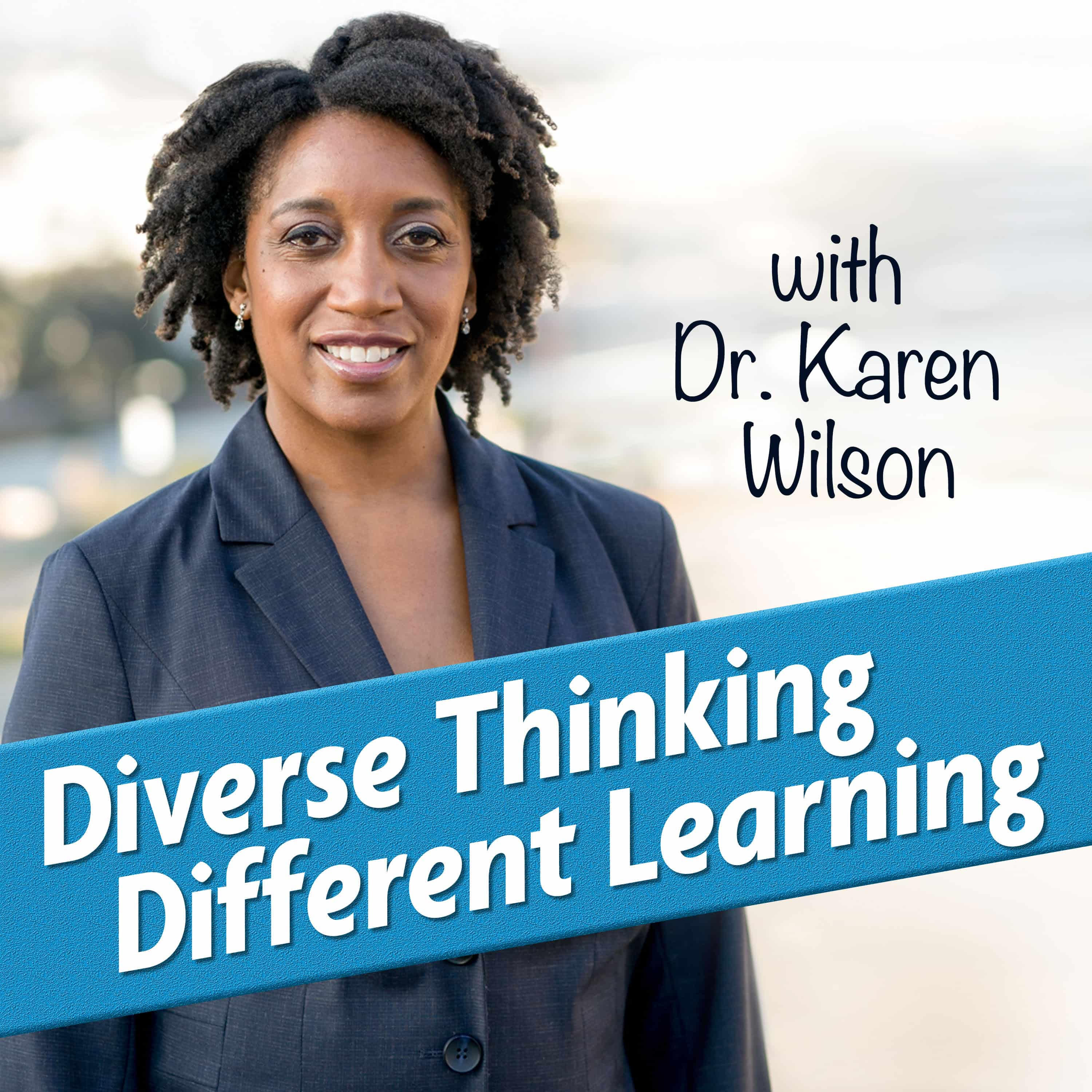
Diverse Thinking Different Learning
Dr. Karen Wilson
Diverse Thinking · Different Learning is hosted by pediatric neuropsychologist and mom of two, Dr. Karen Wilson. Each week, Dr. Wilson shares expert insights, science-based strategies, and conversations with leading specialists to help parents and educators better understand ADHD, dyslexia, autism, executive functioning challenges, learning differences, and youth mental health.
Through engaging interviews and practical guidance, the podcast translates research into real-world tools that empower adults to support neurodivergent children, struggling learners, and students with learning and thinking differences.
Trusted by families and professionals alike, Diverse Thinking · Different Learning is a go-to resource for reliable information and actionable strategies to help children learn, grow, and thrive.
Explore episodes and resources at https://diversethinkingpodcast.com/
Through engaging interviews and practical guidance, the podcast translates research into real-world tools that empower adults to support neurodivergent children, struggling learners, and students with learning and thinking differences.
Trusted by families and professionals alike, Diverse Thinking · Different Learning is a go-to resource for reliable information and actionable strategies to help children learn, grow, and thrive.
Explore episodes and resources at https://diversethinkingpodcast.com/
Episodes
Mentioned books

Feb 8, 2022 • 35min
Ep. 67: Your Child's Anxiety: When to Worry with Dr. John Piacentini
We know that anxiety is common and many of us have experienced some level of anxiety. But there are many myths and misunderstandings about anxiety that could be preventing a child from getting the care and treatment they need. One of the myths you might have heard is that "kids will grow out of it." While stress and fear are normal components of childhood development, 80% of children who are experiencing problematic anxiety are not getting treatment. Dr. John Piacentini joins me today to help us understand what anxiety is, how it differs from stress, and how to help your child if they are struggling with anxiety. For children and adults alike, stress levels continue to be high as we are still dealing with the uncertainty of the pandemic. But there are things we can do to validate a child's feelings and help them through mild anxiety. And for those who are experiencing severe anxiety, Dr. Piacentini explains different types of treatment and support that can positively impact the trajectory of a child's development. Show Notes: [2:25] - There have been and continue to be concerns about the impact of anxiety on childhood development. [3:26] - Stress is a physical reaction in response to something difficult or even exciting. [4:29] - When stress becomes chronic, it is cause for concern. [5:04] - Alternatively, anxiety is related to fear. Fear is a response to something that is threatening. [6:31] - Dr. Piacentini gives an example to show the difference and similarities between stress, anxiety, and fear. [7:58] - There are times in development when anxiety and fear are normal. [10:30] - The intensity of the anxiety and anxious behaviors is something that is looked at and is cause for concern. [12:04] - Avoiding the thing the child is fearful of can intensify the anxiety. [13:34] - Dr. Piacentini explains the difference between positive and negative reinforcement and how each kind impacts behavior. [15:43] - A parent's nature is to want to protect their child from stress, but Dr. Piacentini reminds us that their independence needs to develop. [17:05] - Missing out on social situations has a negative impact on anxiety. [18:51] - There are higher levels of mental health issues associated with the pandemic. Children with anxiety are even more sensitive. [20:10] - When schools closed, many children with anxiety and OCD felt validated, but the return to school has caused more stress, fear, and anxiety. [21:30] - Avoid having young children watch the news and catastrophizing the pandemic and provide as much structure as you can. [23:26] - Don't accommodate the anxiety. [25:15] - Dr. Piacentini describes Cognitive Behavior Therapy and discusses how effective it can be. [28:50] - About 10% of kids meet criteria for problematic anxiety. Only 2 out of 10 are getting the treatment they need. [30:01] - A common physical symptom of anxiety are frequent headaches and stomachaches. [31:48] - The mission of UCLA CARES is to increase awareness and to help identify early signs of anxiety. About Our Guest: Dr. John Piacentini is a board-certified clinical child and adolescent psychologist and Professor of Psychiatry and Biobehavioral Sciences in the David Geffen School of Medicine and Semel Institute for Neuroscience at UCLA. He is also the Director of the UCLA Child OCD, Anxiety and Tic Disorders Program and the Center for Child Anxiety, Resilience, Education and Support. Dr. Piacentini's research focuses on the development of science-based treatments for child anxiety, OCD, tic, and related disorders. Through UCLA CARES, he and his team have implemented a number of school and community-based education and prevention programs to reduce the burden of child anxiety. Dr. Piacentini has authored over 300 scientific publications, including seven books, and his research has been funded by the National Institute of Mental Health and other leading foundations and philanthropic organizations. Dr. Piacentini is a frequent lecturer, and with his team has trained hundreds of mental health clinicians around the world in cognitive-behavior therapy and other evidence-based treatments and provided care to over 1000 children, adolescents, and their families. Connect with Dr. John Piacentini: UCLA CARES Center Website Dr. Piacentini on Twitter Links and Related Resources: Anxiety and the Family Anxiety and Depression in Adolescents How Social Anxiety Differs From Shyness and How to Help Your Child Episode 8: Mindfulness with Dr. Kathleen Carroll Wray Episode 6: Managing Family Stress and Anxiety with Dr. Stephanie Mihalas Join our email list so that you can receive information about upcoming webinars - ChildNEXUS.com The Diverse Thinking Different Learning podcast is intended for informational purposes only and is not a substitute for medical or legal advice, diagnosis, or treatment. Additionally, the views and opinions expressed by the host and guests are not considered treatment and do not necessarily reflect those of ChildNEXUS, Inc or the host, Dr. Karen Wilson.

Feb 1, 2022 • 36min
Ep. 66: How to Parent with More Compassion and Confidence with Sari Goodman
Parenting can be hard. And, parenting a child who thinks or learns differently has its own unique challenges. But there's so much joy in parenting. Many parents express wanting to experience that joy more frequently and that's where a parent coach comes in. Today's podcast guest is a parent coach with a lot of tips and strategies that can give parents the confidence to experience the joy of parenting. Sari Goodman is a Certified Parent Educator and in this episode, we discuss the needs of parents in navigating challenges with their children. As we know, kids don't come with instruction manuals and every parent experiences struggles. So, no matter your style of parenting or the unique needs of your children, this episode will provide you with the information you need to put aside judgment and find the confidence you need. Show Notes: [1:50] - Welcome to the show, Sari! [3:20] - Right now, parents are under a lot of stress. Adding the stress of not knowing how to support their child creates an overwhelming situation. [4:31] - Sometimes the fear of being judged affects how we parent. [6:01] - The perfect family photos on social media are a cover up. Every parent has their challenges. [7:18] - Sari says juggling work, family, and school (including sudden school closures) are all adding to parent stress and making it hard to maintain a schedule. [8:35] - Structure provides comfort. [9:34] - Sari shares that she often explains to parents what is normal to help parents be calm about their child's behavior. [11:00] - We need a "village" of "our people" to help support each other. [12:07] - Especially with neurodiverse children, we have to try strategies that differ from the norm. Sari shares that trying new things is brave. [14:01] - The parents that Sari coaches can call her any time and that support and availability make a huge difference. [15:08] - Parents judge themselves more severely than others and that creates undue stress. [15:59] - Sari shares some strategies and things she observes in the home. [17:50] - Authentic compliments to other parents can create an alliance and far less judgment. [20:40] - The fear of a child looking different and needing accommodations has hindered many parents from giving their child what they need to learn. [22:44] - It is not wrong to be different. [23:12] - Sari shares a personal story to demonstrate that sometimes we think we are being judged when we really aren't. [26:18] - Special events in class and field trips change structure. Parents can and should prepare the child who needs that structure. [28:39] - Accommodations that help at school could be utilized at home as well. [30:18] - Every parent has experienced struggle. Sari's work normalizes that. [32:40] - Positive structure and predictability is calming. [34:10] - Email Sari at Sari@TheParentalEdge.com for Sari's list of tactics parents can use to keep from feeling judged. About Our Guest: Sari Goodman is a Certified Parent Educator and Trainer who is an avid cheerleader for the most significant people in a child's life - the parents. She supports parents and guardians by developing a comprehensive understanding of family dynamics to create a customized action plan that reduces chaos and brings calm. She has been an educator of students, teachers, and parents for over 30 years: Administrator & Teacher (preschool-grade 8) Adjunct faculty for Teacher Training (Department of Education, Mt. St. Mary's College) Special Education (Masters Degree and teaching credentials) Parent Education and Coaching (individual family coaching, parenting workshops, professional development on parenting for teachers and administrators) Connect with Sari Goodman: The Parental Edge Website Email: Sari@TheParentalEdge.com Phone: 818-538-9696 ChildNEXUS Provider Profile: Sari Goodman Links and Related Resources: Parenting During Stressful Times (AKA Covid-19 Pandemic) Supporting Parents of Children with Language Based Learning Disabilities Bond, Learn, and Be Active with Your Child What is Your Parenting Style? Join our email list so that you can receive information about upcoming webinars - ChildNEXUS.com The Diverse Thinking Different Learning podcast is intended for informational purposes only and is not a substitute for medical or legal advice, diagnosis, or treatment. Additionally, the views and opinions expressed by the host and guests are not considered treatment and do not necessarily reflect those of ChildNEXUS, Inc or the host, Dr. Karen Wilson.

Jan 25, 2022 • 36min
Ep. 65: Identifying and Supporting Kids with Concussions with Dr. Talin Babikian
Impulsivity and distractibility seen in some kids who learn and think differently puts them at greater risk for injuries and accidents, including head injuries. Now that sports games and practices are back in action following pandemic cancellations, it is important to talk about these risks and what to do to support kids who experience concussions. Today's guest, Dr. Talin Babikian, explains concussions, which are mild traumatic brain injuries. She also shares with us what to look for in the event of an injury. There are many mental health challenges and environmental stressors related to head injuries, and Dr. Babikian inspires us to focus on what we can control - being the caring adult that a struggling child can connect with. Show Notes: [2:51] - This topic is something Dr. Babikian is very passionate about. [3:49] - Most concussions in children happen while playing recreational sports. Dr. Babikian explains what a traumatic brain injury is. [5:14] - Our physiology is designed to be able to handle some brain movement within the skull. There are different levels of brain injury. [6:57] - Most of the time, kids will fully recover from mild brain injuries, but they should all be taken seriously. [9:00] - Dr. Babikian shares what symptoms to look for, mainly changes in behavior. [11:40] - Helmets are incredibly important, but they give people a false sense of security because they don't prevent concussions. [13:08] - Brain scans are not tools to detect concussions. [14:38] - There is a window of time that doctors look for in which kids should recover from a concussion. There are chronic symptoms that could happen past that window. [17:01] - There are different paths to recovery for each child. [18:12] - Anxiety can be concerning after concussions. [19:56] - Kids with ADHD tend to be more likely to have accidents that could result in concussions. [22:01] - Some kids show symptoms of ADHD after a head injury. [24:40] - There will be a level of emotional response to the injury as well as seeing emotional changes as a result of the injury. [26:30] - Caregiving, peer interactions, mentorships, and other environmental factors make a huge difference in moving forward. [27:51] - Dr. Babikian discusses mental health risk factors in youth. [30:29] - Dr. Babikian shares a story from early in her career that shows the importance of having a connection with a caring adult. [33:40] - There are many things we can't change, but we can offer the connection children truly need. About Our Guest: Dr. Talin Babikian is a board-certified clinical neuropsychologist with over 16 years of experience in both private practice and academic settings working with a broad spectrum of children and young adults, and their families. She is Associate Clinical Professor in the Division of Child and Adolescent Psychiatry at the David Geffen School of Medicine at UCLA and Associate Director of BrainSPORT at UCLA, an inter-departmental and multi-disciplinary program for identifying and treating brain injuries — including concussions — in youth and professional athletes, where she oversees the Sports Neuropsychology Fellowship training program. Dr. Babikian earned a doctoral degree in Clinical Psychology with an emphasis in Neuropsychology from Loma Linda University in 2005. She completed a combined research/clinical postdoctoral fellowship in pediatric neuropsychology at the UCLA School of Medicine, specializing in general pediatric neuropsychology and a research focus in brain injuries in youth. Dr. Babikian is actively involved in research using novel neuroimaging techniques to understand neurocognitive outcomes and the course of repair and recovery following a brain injury in childhood. She has authored and presented several publications on this topic in journals, book chapters, and professional seminars nationally and internationally. Connect with Dr. Talin Babikian: Dr. Babikian's Website Phone: 310-855-4552 Links and Related Resources: Navigating Brain Injuries Including Concussions in Children and Adolescents: A Guide for Parents and Caregivers A Bang to the Brain Recovery Time for Sports Concussions Join our email list so that you can receive information about upcoming webinars - ChildNEXUS.com The Diverse Thinking Different Learning podcast is intended for informational purposes only and is not a substitute for medical or legal advice, diagnosis, or treatment. Additionally, the views and opinions expressed by the host and guests are not considered treatment and do not necessarily reflect those of ChildNEXUS, Inc or the host, Dr. Karen Wilson.

Jan 18, 2022 • 43min
Ep. 64: How Technology Can Be Used to Facilitate Communication with Rachel Madel M.A., CCC-SLP
TV shows, cartoons, YouTube videos, and even game apps can be used to facilitate communication. There is so much amazing technology available and at our fingertips that can change the lives of children and teens who struggle communicating, and the best part about using these technological tools is that they are also very engaging. Today's guest is Rachel Madel and her passion for technology shines in this episode all about how technology can be used to facilitate communication. She even hosts her own podcast on this exact topic called Talking With Tech. In this episode, Rachel shares how and why technology helps support students with communication difficulties and she gives us a ton of great ideas that will get students motivated. Show Notes: [2:21] - We live in a time that has so much available in technology, especially to communicate. [3:24] - People's comfort levels with tools have improved in the last two years. [4:51] - Rachel's passion is in how to use existing tools to improve student learning. She describes the types of students she sees in her private practice. [8:10] - Regarding visual supports, it's never a bad time to use them. Devices to assist children in speaking does not hinder their learning to communicate. [10:11] - Rachel explains the typical trajectory of speech development and why there is such a focus on speech. [12:10] - Consistent access to verbal speech is key. [14:31] - Communication is more than understanding what is being said. [16:20] - Rachel emphasizes the need for early AAC use and visual support to avoid falling so far behind. [18:01] - In many cases, students appear to not be listening, but it could be that there is a language processing issue. [20:12] - Language processing issues create a lot of frustration and anxiety. [22:10] - Developing the skill of asking for help is also important. [23:40] - Rachel normalizes these experiences through modeling. [25:44] - Using technology is not giving a child a device and walking away. There are strategies Rachel uses to help support communication. [28:01] - When we are using technology to support communication, we need to slow down the process. [29:00] - Videos are oftentimes moving extremely fast and Rachel suggests changing the playback speed. [30:02] - We can use technology strategically to get kids engaged. [31:49] - There are many students who know the rules but don't understand "the why." [32:59] - Rachel loves using animated shorts without dialogue to talk about clues. [35:40] - There are so many speech therapy apps and tools. Rachel shares some of her favorites. [37:36] - Some apps can also be used specifically for motivation. [39:01] - Pepi Wonder World is one of Rachel's favorite game apps that give students a lot of opportunities to solve problems and use specific language. About Our Guest: Rachel Madel M.A.,CCC-SLP is a LA-based speech-language pathologist dedicated to coaching parents and professionals on how to incorporate technology to best support speech and language development. Rachel presents both nationally and abroad on the use of augmentative alternative communication (AAC) for children with complex communication needs and coaches clinicians, teachers and parents on integrating technology in classrooms and at home to support communication. She co-hosts a weekly podcast called Talking With Tech and creates educational resources, therapy materials and training videos to help support parents and professionals. Connect with Rachel Madel: Rachel Madel's Website Instagram | Facebook | LinkedIn | Pinterest Talking With Tech Podcast Links and Related Resources: Talking With Tech Episode Featuring Dr. Karen Wilson Episode 13: Assistive Technology for Students with Learning Disabilities with Avlyn Kotton My Child Isn't Listening: How Working Memory Could Be to Blame Top 5 Signs You Need a Speech and Language Pathologist Assistive Technology for Students with Learning Disabilities Join our email list so that you can receive information about upcoming webinars - ChildNEXUS.com The Diverse Thinking Different Learning podcast is intended for informational purposes only and is not a substitute for medical or legal advice, diagnosis, or treatment. Additionally, the views and opinions expressed by the host and guests are not considered treatment and do not necessarily reflect those of ChildNEXUS, Inc or the host, Dr. Karen Wilson.

Jan 11, 2022 • 42min
Ep. 63: Supporting Youth with Autism AND ADHD with Holly Blanc Moses
We are kicking off the new year with new topics and a lot of incredibly knowledgeable guests. This new episode is all about youth with both Autism and ADHD. We've had several episodes on them separately and while Autism and ADHD do have a lot of overlapping qualities, children who have both have unique differences. Today's guest is the perfect expert not only professionally, but personally as well because she is a parent to two differently wired boys. Holly Blanc Moses joins the podcast today as everyone's favorite behavior expert and licensed mental health therapist. She has over 23 years of experience in ADHD, Autism, and anxiety and is the host of The Autism ADHD Podcast. Listen on to find out ways we can not only support youth with Autism and ADHD, but also find the support we need as parents and educators. Show Notes: [2:45] - How are kids with both Autism Spectrum Disorder and ADHD different from those with one or the other? [3:29] - In the past, people were not allowed to be diagnosed with both. [4:38] - Autism and ADHD have a lot of overlapping characteristics. [6:20] - Dysregulation is a major topic of concern. [8:07] - Many parents may feel at a loss when it comes to needing support. Holly reminds us that you are not alone. [10:40] - Once you have your support in place, you can better regulate yourself and find the support and mentors for your child. [11:32] - There are many groups on social media full of parents in need of support. [13:11] - Parents are better parents when their own needs are met too. [16:43] - Be in tune to the reason behind behaviors observed. You have to address the reason before you can address the behavior. [18:09] - Holly tells a personal story that illustrates the reason behind a behavior. [21:50] - Children might be confused and afraid to ask questions due to anxiety, which can lead them to appear defiant or give up. [25:10] - With autism and ADHD, students are more likely to exhibit high anxiety and depression, and experience loneliness. [29:12] - Holly has an online course for setting your child up for social success. [30:50] - Be flexible in changing interventions if something isn't working. [31:40] - Once per year IEP meetings may not be sufficient. If something needs to change, parents should ask for additional meetings to review progress. [33:12] - Don't punish a child for poor grades or for things they cannot control. [35:15] - With differently wired kids, there is an emphasis on the challenges, but remember that everyone's wins are different. [36:40] - Practice shifting your mindset to one of celebration. [38:36] - Their wins are going to be different. As a parent or educator, it is important to celebrate every win possible. [40:36] - Holly has many resources on her website, hosts the Autism ADHD Podcast, and has a lot of groups to connect with her and other parents. About Our Guest: Holly Blanc Moses is a Licensed Psychological Associate, a Licensed Clinical Mental Health Counselor, and an ADHD Certified Clinical Services Provider with over 23 years of experience in ADHD, Autism, and anxiety. She understands from both a professional standpoint and a personal one as a mother of two differently wired boys. She is also the host of the Autism ADHD Podcast. Connect with Holly Blanc Moses: Holly Blanc Moses Home Page The Autism ADHD Podcast Free Behavior and Social Success Guides Autism/ADHD Facebook Group for Parents Links and Related Resources: Episode 34: Key Principles for Raising a Child with ADHD with Dr. Russell A. Barkley Episode 40: Lifestyle Activities That Can Improve ADHD Symptoms with Dr. Joel Nigg Episode 44: Understanding Autism Spectrum Disorder with Lisa L. Hancock Episode 25: Raising Differently Wired Kids with Joy and Confidence with Debbie Reber Join our email list so that you can receive information about upcoming webinars - ChildNEXUS.com The Diverse Thinking Different Learning podcast is intended for informational purposes only and is not a substitute for medical or legal advice, diagnosis, or treatment. Additionally, the views and opinions expressed by the host and guests are not considered treatment and do not necessarily reflect those of ChildNEXUS, Inc or the host, Dr. Karen Wilson.

Jan 4, 2022 • 10min
Ep. 62: How Lessons Learned in 2021 Can Help All Students
As we enter 2022, many people continue to feel the lasting effects of 2020, especially students. But, by navigating through major disruptions in education during the last two years, we've learned many lessons that we can bring into the new year to help all students thrive. In this quick episode, let's kick off the new year with some reminders of what we've learned that can help us improve the way we support our students both academically and beyond. Show Notes: [1:00] - 2021 was similar to 2020 for many people. [1:43] - The challenges children face these days are harder to navigate. [2:34] - Many students did very well with remote learning. How can we use this knowledge to help them thrive? [3:36] - We need to broaden our goals beyond academics. [4:31] - Spending time with peers is important. Many students need to catch up socially. [5:09] - The focus on mental health is a silver lining from the last two years. [6:06] - Practicing gratitude can reduce anxiety. [7:03] - The pandemic has helped many people develop empathy and that can help people be more positive. Empathy can be taught and cultivated. [8:20] - We have an opportunity to improve education based on what we have learned through adapting to major disruptions in learning. [9:18] - Dr. Wilson shares her commitment to ChildNEXUS and the Diverse Thinking Different Learning podcast for the new year. Links and Related Resources: Science of Gratitude: Time to Give Thanks Cultivating Empathy Episode 28: Why We Need to Celebrate and Continue to Build Our Kids' Resilience ChildNEXUS Website ChildNEXUS on Instagram Join our email list so that you can receive information about upcoming webinars - ChildNEXUS.com The Diverse Thinking Different Learning podcast is intended for informational purposes only and is not a substitute for medical or legal advice, diagnosis, or treatment. Additionally, the views and opinions expressed by the host and guests are not considered treatment and do not necessarily reflect those of ChildNEXUS, Inc or the host, Dr. Karen Wilson.

Dec 28, 2021 • 35min
Ep. 61: Slow Processing Speed with Dr. Ellen Braaten
When it comes to slow processing speed, I knew I wanted an expert to help us better understand what it is and why it occurs. That expert is Dr. Ellen Braaten. Throughout her career and her research for her book Bright Kids Who Can't Keep Up, Dr. Braaten has a plethora of information to share on the topic in today's episode about slow processing speed. Slow processing speed impacts many of the children I see in my practice and can exist alongside other issues. What makes slow processing speed unique, however, is that it can exist in isolation and shows up in many different forms. It was once considered an executive function in and of itself, and Dr. Braaten explains how processing speed impacts all other executive functioning skills. She also shares many ways that parents and educators can help children with slow processing speed manage their thinking and understand their needs as self-awareness and advocacy are crucial for this struggle that cannot be "fixed." Processing speed is not indicative of the level of understanding one has and in many ways, slower speed may actually be a good thing. Listen to learn why Dr. Braaten thinks so and learn ways to help support those who are struggling with processing speed. Show Notes: [2:09] - Welcome to the podcast, Dr. Braaten! [3:21] - Processing speed is how long it takes for us to get something done. [4:20] - Dr. Braaten explains the neuroscience behind slow processing speed. [5:53] - Simple things to process have larger implications in other areas. Slow processing speed can take different forms. [7:26] - Timed tests are very challenging for these students not, because they don't understand the information but because they are slower in accessing it. [8:32] - For parents and educators, it appears that these students are lazy. [10:20] - Slow processing speed can exist with other underlying issues, but can also exist in isolation. [12:50] - For real world problems, slower thinking is probably a good thing, but in our education system speed is important. [14:01] - The speed in which information is processed is not an indicator of how well or poorly the information is processed. [15:40] - Initially, processing speed was seen as an executive functioning skill. Dr. Braaten describes the difference. [18:10] - Assessments are important for using the proper intervention. [19:34] - There is nothing that can be done to fix processing speed. [20:33] - There are some things that help manage processing speed, including understanding time. [22:03] - Speech and language services are helpful to help students organize their thoughts. [23:01] - In school, students can receive extended time on tests but often don't know what to do with that additional time. [25:26] - Processing speed is closely connected with anxiety. [26:52] - Self-awareness and advocacy are the best treatments for managing slow processing speed. [29:10] - Research showed that slow processing speed impacts social skills. [32:01] - In social situations, these students sometimes get themselves into trouble as a result of not understanding cues. [33:10] - In our society, we think that to be smart you have to be fast, but it's not true. About Our Guest: Dr. Ellen Braaten is the founder and executive director of the Learning and Emotional Assessment Program (LEAP) at Massachusetts General Hospital, the Kessler Family Endowed Chair in Pediatric Neuropsychological Assessment, and associate professor at Harvard Medical School. She is widely recognized as an expert in the field of pediatric neuropsychological assessment, particularly in the areas of learning disabilities and attentional disorders. She has published numerous papers, chapters, and reviews on topics related to ADHD, learning disorders, child psychopathology, processing speed, and intelligence, and written and edited numerous books for parents and professionals, including Bright Kids Who Can't Keep Up. Dr. Braaten has a strong interest in educating the public on topics related to child mental health. She maintains an active speaking schedule and contributes regularly to local and national news outlets such as NBC and the New York Times. She received her PhD in Psychology at Colorado State University and completed her psychology internship and post-doctoral fellowship at MGH. Connect with Dr. Ellen Braaten: The Learning and Emotional Assessment Program at Mass General Ellen Braaten's Website Links and Related Resources: Slow Processing Speed: An Overlooked Problem in Children The Intersection of Executive Function, ADHD, and Other Learning Differences What is Executive Functioning? Bright Kids Who Can't Keep Up by Dr. Ellen Braaten Join our email list so that you can receive information about upcoming webinars - ChildNEXUS.com The Diverse Thinking Different Learning podcast is intended for informational purposes only and is not a substitute for medical or legal advice, diagnosis, or treatment. Additionally, the views and opinions expressed by the host and guests are not considered treatment and do not necessarily reflect those of ChildNEXUS, Inc or the host, Dr. Karen Wilson.

Dec 21, 2021 • 34min
Ep. 60: A Multisensory Intervention for Kids Who Struggle with Math with Adrianne Meldrum
Following the previous episode's topic of math disorders, we're continuing the math conversation with Adrianne Meldrum. Now that we know how math disorders can impact a student, we can better take a look at what successful interventions look like and Adrianne is perfect for this task. Adrianne is the CEO of Made for Math, an all-online multisensory math intervention service. Their website describes it as clutter-free, compassionate, radiant, and research-based; services are aimed at helping neurodiverse students thrive in math. Math difficulty often gets overlooked or intentionally pushed aside. But struggles in this subject area are just as important as any other subject. With Adrianne's help, we learn today that math is truly a language and it's often only spoken at school. What can we do as parents, caregivers, and educators to reduce anxiety, increase access to math through different modalities, and provide opportunities for all students to succeed? Show Notes: [1:54] - Adrianne shares an observation she has made in recent months of parents learning new terminology and seeing the struggles their children are having. [4:10] - It's common to attribute math difficulty with just not being "good at math." [4:56] - Math is a language that is really only taught at school. We don't talk about math in conversations as a society. [5:40] - Made for Math uses a multisensory intervention and Adrianne describes the approach. [7:04] - The multisensory approach increases multi-access points to the curriculum using different modalities. [8:34] - When students see themselves as being able to be successful at something, it increases their motivation to work hard. [9:33] - At Made for Math, teachers are trained in how the brain works. [10:43] - Students can retain the information taught in this way, but are not always retaining the content taught in school. [12:10] - Math is not something that has to be endured, but rather something that can be used. [13:46] - Regarding word problems, Adrianne and her team use research to create a new framework for students to recognize patterns. [15:30] - Oftentimes, students with a language based learning challenge like dyslexia, struggle with math as well. [17:52] - All interventions take time, but once students experience learning in a way that's wired for them, they become curious about other things. [19:14] - Adrianne shares some things you can do at home including clearing negative emotions. [20:35] - When anxiety is so overwhelming, Adrianne gives a hack that helps reset emotions. [22:06] - Create a clutter free space which could also mean to put one problem at a time on the paper. [25:04] - When processing speed is fast, but hands cannot keep up, parents can be a "scribe." [26:11] - If you have the means, seek help and support for your child in math. [27:13] - Let's Go Learn has online assessments that may help determine some gaps in learning. [29:36] - If you have to pick a skill that a child is struggling with, choose reading because reading skills are needed to succeed in math. Focusing on both initially may be overwhelming. [31:38] - When a child is overwhelmed and emotionally dysregulated, learning just isn't going to happen. About Our Guest: Adrianne Meldrum is the CEO of Made for Math, an all-online multisensory math intervention service aimed at helping neurodiverse students thrive in their pursuit of mathematics. Currently, she's enrolled as a Master's Student at Bridges Graduate School of Cognitive Diversity. She lives in Mesa, AZ with her husband and three boys. You'll find Adrianne spending her down time walking, listening to podcasts, and daydreaming about her future home library. Connect with Adrianne Meldrum: Made for Math Website Made for Math on YouTube Phone: 208-871-8458 Links and Related Resources: Episode 41: How to Inspire Kids to Love Math with Allison Dillard Important Components of Effective Math Intervention Episode 2: Demystifying the Assessment Process Signs Your Child May Have a Learning Disorder Join our email list so that you can receive information about upcoming webinars - ChildNEXUS.com The Diverse Thinking Different Learning podcast is intended for informational purposes only and is not a substitute for medical or legal advice, diagnosis, or treatment. Additionally, the views and opinions expressed by the host and guests are not considered treatment and do not necessarily reflect those of ChildNEXUS, Inc or the host, Dr. Karen Wilson.

Dec 14, 2021 • 34min
Ep. 59: What is Dyscalculia (AKA Math Disorder)? with Monica Grillo
In the next two episodes, we are focusing on math. We often hear the phrase "I'm just not a math person," but you never hear that with reading or other subjects. While math may not be a strength of every student, there are some students who have a learning disorder called Dyscalculia. Today's guest is Monica Grillo. She has extensive experience in research-based math interventions and instructional practices. She is an educator, researcher, and mother with an extreme bias toward inclusive practices and a need for better teacher preparation in special education and mathematics pedagogical content knowledge (PCK). Her experiences have opened her eyes to inequities and she is eager to share her expertise and insights in order to make this world a better place. In this episode, Monica explains the science of math and effectively describes the way a child's brain develops with and without Dyscalculia. She compares Dyscalculia with Dyslexia and gives parents and educators some actionable tips on determining if there could be something more going on than a weakness in math. Show Notes: [2:08] - Welcome to the show, Monica! Monica shares how she found herself working in the area of math education. [3:50] - After the birth of her son, Monica became even more interested in Special Education and is pursuing a Phd. [5:02] - With Math, people tend to say "I'm not a Math person." We don't do that with reading. Math is just as important. [6:00] - Monica defines Dyscalculia and the research of rates in school aged children. It commonly coexists with other issues. [7:29] - There is no exclusive assessment to detect Dyscalculia. [9:14] - There is substantial evidence that Dyscalculia is a brain based disorder. Monica describes how this is determined in neuroscience. [11:23] - Studies have shown that children with Dyscalculia have persistently reduced gray and white brain matter. [12:06] - Monica explains a study on what the brain looks like and compares those with and without Dyscalculia. [14:36] - There is some overlap and similarities in the brain between Dyscalculia and Dyslexia. But they manifest differently. [16:01] - Monica advises having students talk through what they are thinking during a math word problem to help determine where their struggle is. [18:02] - There are a wide variety of skills that can fall under the umbrella of Dyscalculia. [20:31] - When early skills are not developed, later math concepts become seemingly impossible and error prone. [21:49] - Explicit instruction in math is important. This sets the stage with context. [22:47] - There is modeling, guided practice, and then independent practice. [24:50] - For those with Dyscalculia, explicit instruction is crucial rather than inquiry based instruction. [27:03] - This is a highly relevant concept. Math is a significant component of knowledge in our technological age. [27:56] - Monica is an advocate for improved teacher preparation especially in the field of Special Education. [30:50] - Don't wait to support a child who is struggling even as early as preschool. [31:40] - Advocate for specific research based interventions for Dyscalculia. [32:30] - Don't pass on negativity around math skills and math phobia. About Our Guest: Starting her career with the goal of becoming an elementary teacher, Monica Grillo found herself securing a position teaching middle school math and then pursuing a masters degree to become a K-8 Math Specialist. She then became a math interventionist and math coach for 5 years and fell in love with coaching teachers. During her 5th year in this position, she found out that her first child would need special care and she left full time employment to raise him to the best of her abilities. That is when she embarked on a journey into the world of Down Syndrome and special education. Monica is currently working towards a doctorate in Special Education and is a staunch proponent of inclusion and adequate teacher preparation. Connect with Monica Grillo: Email: grillom@vcu.edu Links and Related Resources: Important Components of Effective Math Intervention What Are the Indicators of Learning Disabilities? What Are the Treatments for Learning Disabilities? Episode 14: How to Inspire Kids to Love Math with Allison Dillard Join our email list so that you can receive information about upcoming webinars - ChildNEXUS.com The Diverse Thinking Different Learning podcast is intended for informational purposes only and is not a substitute for medical or legal advice, diagnosis, or treatment. Additionally, the views and opinions expressed by the host and guests are not considered treatment and do not necessarily reflect those of ChildNEXUS, Inc or the host, Dr. Karen Wilson.

Dec 7, 2021 • 33min
Ep. 58: How a Floortime Approach Benefits Kids with Jake Greenspan
Researchers at Duke University and Penn State have found significant associations between social emotional learning in Kindergarten and important young adult outcomes in education, employment, and mental health. Today's guest also points out that social emotional health is a driving force behind academic success. So how can we support all children in this area? Jake Greenspan is an expert and he joins Diverse Thinking Different Learning to guide us in the impact a floortime approach can have. Jake Greenspan has authored several books on the topic and alongside his father, developed the Greenspan Floortime Approach. In this episode, Jake shares what floortime is, what it isn't, and how the approach is used to strengthen skills needed in school and in life. Show Notes: [2:01] - Welcome to the podcast, Jake! Jake explains what floortime is and what it isn't. [3:23] - The goal of floortime is to habilitate social emotional health and in the long run achieve high levels of self-awareness. [4:49] - Jake's father created a floortime model and Jake outlines how he integrated different psychological development theories. [6:20] - Greenspan Floortime was created as an intervention and is both an integrated and standalone intervention. [7:55] - Following a child's lead is getting down on their level. [9:15] - Many children with communication struggles need to feel like they have some control and feel empowered. [10:12] - Through successful floortime, modeling is great, but telling children exactly what to do or say is not allowing them to do their own thinking. [12:09] - As rewarding as this is, Jake is clear that it isn't always easy. [14:02] - Floortime is not a framework for special needs. It is a framework for natural social emotional health and is beneficial for all children. [16:18] - There are so many kids who are in a "grey area" that still need support but don't fall into a diagnosis. [17:29] - Jake's practice also supports parents and guides them to help their children with floortime at home. [19:19] - Any amount of floortime is beneficial, but success and improvement happens with consistency. [21:50] - There is an age range that is best for floortime games that are developmentally appropriate. [24:00] - Jake shares an experience with an 18 year old he worked with and how following his lead made a huge difference. [26:34] - Social emotional skills are driving forces for academic success. [29:01] - It's important to have all frameworks be similar in a child's interventions to avoid confusion and stress. [31:31] - There are a lot of free resources on Jake's websites. About Our Guest: Jake Greenspan started working with his father, Dr. Stanley Greenspan in 1998. Together they authored the Functional Emotional Developmental Questionnaire which was published in the Journal of Developmental and Learning Disorders, 2002. In 2004 Jake, with Tim Bleecker, founded The Floortime Center®, and in 2009 he was the co-author, with Dr Stanley Greenspan, of Overcoming ADHD: Helping Your Child Become Calm, Engaged, and Focused. In 2017, he authored The Floortime Manual™. He is the former Chairman and current Board member for All The Difference Inc., a Greenspan Floortime non-profit in Wilmington DE and is a Founding Member of Creative Minds Public Charter School in Washington DC. Connect with Jake Greenspan: The Floortime Center Website The Greenspan Floortime Approach Phone: 301-657-1130 Links and Related Resources: Episode 9: How Occupational Therapy Helps Kids with Leah Hiller Episode 45: How Sensory Processing Impacts Communication with Jessie Ginsberg Episode 20: How Speech and Language Difficulties Affect a Child's Life with Carol Karp Join our email list so that you can receive information about upcoming webinars - ChildNEXUS.com The Diverse Thinking Different Learning podcast is intended for informational purposes only and is not a substitute for medical or legal advice, diagnosis, or treatment. Additionally, the views and opinions expressed by the host and guests are not considered treatment and do not necessarily reflect those of ChildNEXUS, Inc or the host, Dr. Karen Wilson.

