

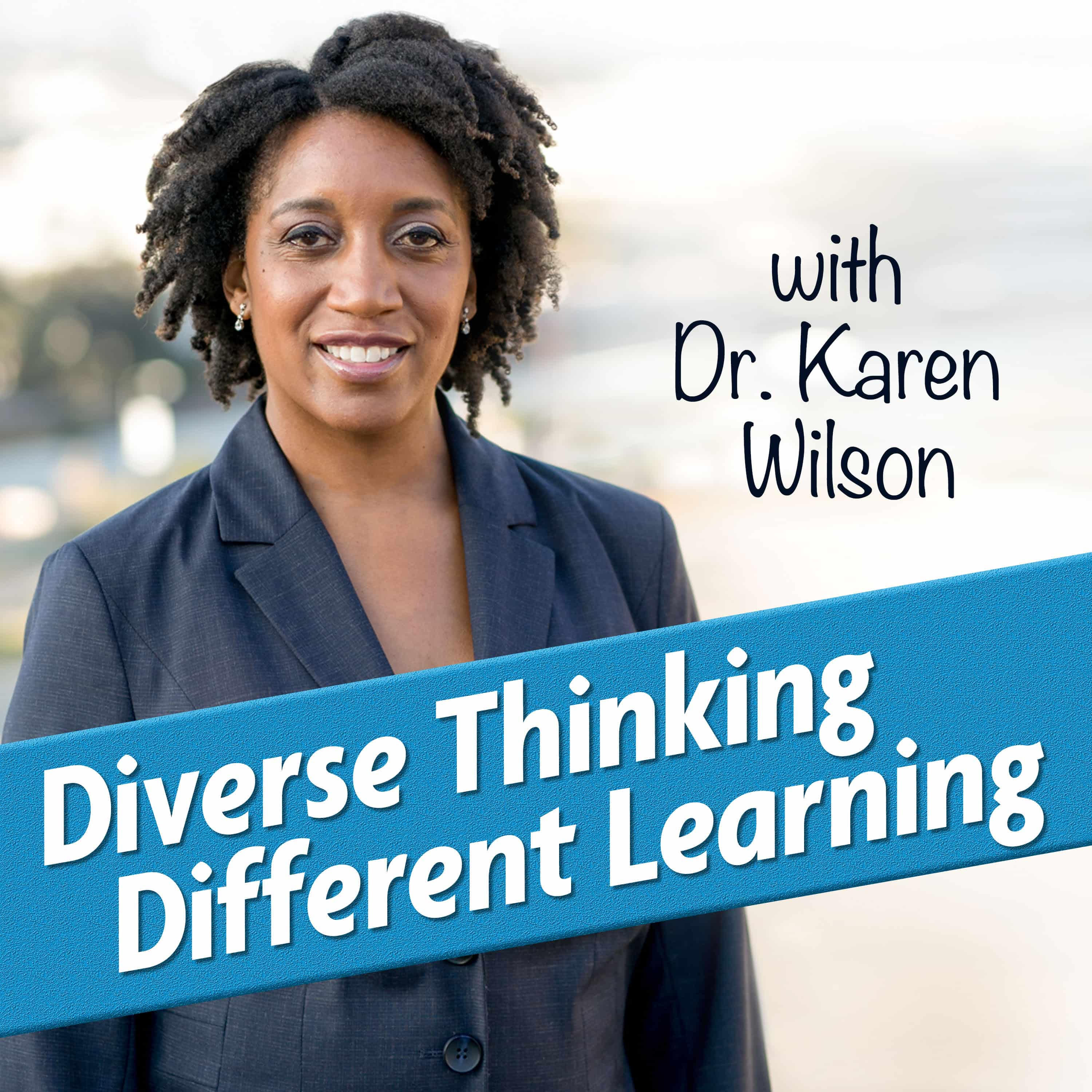
Diverse Thinking Different Learning
Dr. Karen Wilson
Diverse Thinking · Different Learning is hosted by pediatric neuropsychologist and mom of two, Dr. Karen Wilson. Each week, Dr. Wilson shares expert insights, science-based strategies, and conversations with leading specialists to help parents and educators better understand ADHD, dyslexia, autism, executive functioning challenges, learning differences, and youth mental health.
Through engaging interviews and practical guidance, the podcast translates research into real-world tools that empower adults to support neurodivergent children, struggling learners, and students with learning and thinking differences.
Trusted by families and professionals alike, Diverse Thinking · Different Learning is a go-to resource for reliable information and actionable strategies to help children learn, grow, and thrive.
Explore episodes and resources at https://diversethinkingpodcast.com/
Through engaging interviews and practical guidance, the podcast translates research into real-world tools that empower adults to support neurodivergent children, struggling learners, and students with learning and thinking differences.
Trusted by families and professionals alike, Diverse Thinking · Different Learning is a go-to resource for reliable information and actionable strategies to help children learn, grow, and thrive.
Explore episodes and resources at https://diversethinkingpodcast.com/
Episodes
Mentioned books

Aug 22, 2023 • 12min
Ep. 147: 5 Tips to Help Students Transition Back to School
A new school year is upon us! This can be an exciting time but it can also be challenging for parents and their children especially for those who think and learn differently. This quick episode is designed to help ensure a smooth start for these students and their families. These five tips can help navigate this period successfully. It's not an exhaustive list, just a few tips to get the ball rolling for a great new school year. Show Notes: [1:52] - Tip #1: Establish a predictable routine. [3:02] - Plan for adequate amounts of sleep. [4:20] - Tip #2: Prepare well in advance. [6:14] - Tip #3: Foster open communication. Schedule a meeting with your child's teacher. [8:08] - Trust your gut. Don't hesitate to take an active role. [8:35] - Tip #4: Break tasks into manageable steps. [9:52] - Tip #5: Focus on strengths and self-care. Celebrate success and encourage hobbies. Connect: Get on our Email List Book a Consultation Get Support and Connect with a ChildNEXUS Provider Check out some amazing schools for incredible students Links and Related Resources: Episode 146: How Parents and Educators Can Collaborate to Help Students Thrive with Shelley Lawrence Episode 142: How to Help Neurodivergent Kids Manage Social Media The Diverse Thinking Different Learning podcast is intended for informational purposes only and is not a substitute for medical or legal advice, diagnosis, or treatment. Additionally, the views and opinions expressed by the host and guests are not considered treatment and do not necessarily reflect those of ChildNEXUS, Inc or the host, Dr. Karen Wilson.

Aug 15, 2023 • 34min
Ep. 146: How Parents and Educators Can Collaborate to Help Students Thrive with Shelley Lawrence
Shelley Lawrence, a seasoned school administrator, discusses the importance of collaboration between parents and educators. She emphasizes understanding why a child is struggling, leveraging strengths, and boosting confidence. The episode highlights the significance of early evaluations and interventions, personalized learning experiences, and fostering supportive collaboration for student success.

Aug 8, 2023 • 52min
Ep. 145: Advocating for Children with Special Needs with Heather Zakson
Are you concerned about whether your child has made meaningful progress over the last year in school? Today's guest is an incredible special education attorney who is passionate about advocating for children and adults. You can hear the passion in her voice throughout this entire episode and she brings to light a lot of concerns as we begin the transition to heading back to the brick and mortar classroom environment. Our guest, Heather Zakson, is a special education attorney. She answers a plethora of questions in this episode, shares staggering statistics, explains legislation and federal funding, and encourages all parents to strongly advocate for their children. Show Notes: [3:01] - The transition going back to school is a front and center concern for a lot of families. [5:10] - Distance learning unlocked more tools and opportunities for many students. [7:57] - Data is our stock and trade in special education. We need the information to compare data over time to see what's working. [8:59] - A lot of work is done on screen and not kept in a paper format. Heather recommends always taking a screenshot of work to archive a child's progress. [11:49] - Don't think of assessments as something dictated only by schools. [12:46] - A psychological assessment will give us information on what intervention and support is needed. [13:44] - When seeking a private assessment, you have the control on who to conduct the testing and who to share the information with. [14:33] - If you are unable to have a private assessment done, Heather explains how it works through the school system. You can ask for a second opinion. [17:20] - Although we have seen the good things that have come from distance learning, there are many students who have suffered with great educational loss. [18:25] - Heather advises that if you think there is something wrong, follow your gut. [19:40] - All public schools have the ability to assess. [21:38] - When a child is behind, moving forward without support will just make them fall farther behind. Early intervention is crucial. [23:10] - When you are out there advocating for your child, don't take no for an answer. [27:53] - We know how to support children with social difficulties and with appropriate support, they can have a completely different educational experience. [30:54] - Heather explains what recoupment means and how this affects the near future of special education. [32:46] - Children with learning disabilities are legally entitled to remediation. [34:22] - When there is a reading and/or language delay, there needs to be evidence-based targeted reading instruction. [37:18] - Information doesn't hurt anyone. It doesn't put labels on anyone. [40:28] - Dyslexia screening should be a mandatory part of assessment early on for every student. [41:10] - What is SB 488 and how will it affect university programs for teachers? [44:50] - The Right to Read Project and Decoding Dyslexia are highly recommended to look into by both Heather and Karen. [46:27] - Every year is different when it comes to funding. Heather explains the push for federal funding for special education. [48:19] - The real test of our educational system is how we support our students who struggle the most. [49:02] - Every child is entitled to an appropriate education and remediation of learning disabilities when appropriate. About Our Guest: Heather Zakson represents children and adults in special education, Regional Center and discrimination cases and provides expert consultation on complex custody and guardianship matters. She is widely recognized for her creativity and tenacity on behalf of those whose rights have been violated and needs have gone unmet. She is a graduate of UCLA School of Law and Brandeis University, and has been practicing law for 18 Years. Connect with Heather Zakson: Zakson Law Home Page Phone: (424) 369-9529 Heather Zakson on LinkedIn Heather Zakson, Attorney on Facebook Links and Related Resources: Get on our Email List Book a Consultation Get Support and Connect with a ChildNEXUS Provider Check out some amazing schools for incredible students Join our email list so that you can receive information about upcoming webinars - ChildNEXUS.com

Aug 1, 2023 • 35min
Ep. 144: Raising Differently Wired Kids with Joy and Confidence with Debbie Reber
If you have a child who thinks, learns, or experiences the world differently than others, this episode is for you. Parents of differently wired kids may face a negative stigma, uncertainty, and may make decisions from a place of fear, especially in regards to education. But today's guest shares her experience and encourages parents to change their mindset and make decisions from a place of possibility. I am thrilled to welcome Debbie Reber as today's guest on the Diverse Thinking Different Learning Podcast. Debbie inspired me to begin this podcast journey and as a parent of a differently wired child herself, she comes to the podcast today with personal stories, many years of experience, and open arms to welcome other parents on the same journey. Debbie is a parenting activist, author, keynote speaker, and founder of TiLT Parenting. The resources and community she offers through TiLT Parenting are helping parents around the world connect and support each other in raising differently wired children. We could talk for hours, but on today's episode with Debbie we focus on what it means to be "differently wired," how Debbie grew from making decisions from fear to making decisions from love and possibility, and how parents can use their voices to make positive change in the education of their children. Show Notes: [1:35] - Debbie really leans in to embracing the fact that your child may be differently wired. [3:26] - Debbie never intended to walk this path, but as her son received diagnoses, it made things more challenging. [5:01] - Sharing the challenge in finding the right environment for her son, Debbie explains that they bounced around to different schools and then homeschooled for 6 years. [6:00] - This experience was the catalyst for her to start her own podcast and help other parents in similar situations. [7:58] - As she observed her son learning at home, Debbie made the realization of why traditional schooling had not been a success. [9:16] - There needs to be a shift in how we educate children. [11:00] - Debbie demonstrates that the traditional school model does not teach kids to be critical thinkers. [15:57] - Learning loss is of course a concern, but Dr. Wilson believes that social, emotional, and mental health support is more important. [18:49] - Debbie talks about her book Differently Wired: Raising an Exceptional Child in a Conventional World. [20:04] - There is no clear path for parents, especially when raising a differently wired child. [21:07] - Debbie provides some reflection questions to ask yourself as a parent to find out more about choosing love and possibility. [22:23] - If we, as parents, have a negative idea of what a child with a diagnosis looks like, we will not make decisions that are best for the child. [24:38] - The idea behind Debbie's podcast and the community she has built is to help support parents. [28:21] - Dr. Wilson and Debbie talk about the IEP process and the changes that need to be made to the educational system. [30:10] - Debbie references a book that she recommends called The End of Average by Todd Rose and how there really isn't any such thing as "average." [31:23] - Karen highly recommends Debbie's book and her TEDtalk. About Our Guest: Debbie Reber is a parenting activist, New York Times bestselling author, keynote speaker, and the founder of TiLT Parenting, a top podcast, community, and educational resource for parents raising differently wired children. Her book, Differently Wired: Raising an Exceptional Child in a Conventional World, came out in June 2018. After living abroad in the Netherlands for five years, Debbie, her husband, and 16-year-old son relocated to Brooklyn, NY in 2019. Connect with Debbie Reber: TiLT Parenting Home Page TiLT Parenting Podcast Links and Related Resources: Get on our Email List Book a Consultation Get Support and Connect with a ChildNEXUS Provider Check out some amazing schools for incredible students Join our email list so that you can receive information about upcoming webinars - ChildNEXUS.com

Jul 25, 2023 • 26min
Ep. 143: How Virtual Reality Helps Neurodivergent Individuals Develop Important Skills with Vijay Ravindran
With different types of technology becoming more and more accessible, today's guest has found the surprising and amazing benefits of virtual reality on neurodivergent individuals. As the father of a child on the autism spectrum, Vijay Ravindran discovered first hand what the technology can provide for those who think and learn differently. Vijay's positive experience led him to create Floreo, a research-based and effective therapy that uses virtual reality (VR) to teach social, behavioral, and life skills to neurodivergent individuals. This technology is not only effective, it is also engaging and exciting. Floreo is available to anyone to use and in today's episode you'll learn more about the technology and what it offers learners. Show Notes: [2:07] - Vijay's inspiration for Floreo came from his experience as the father of a child on the autism spectrum. [3:24] - Virtual reality is special because it is fully immersive and accessible. [4:45] - The environments created are very engaging. [6:17] - Virtual reality is a technology that allows someone wearing a headset with screens built in to feel a sense of presence in a different place. [7:33] - Floreo's VR content is designed to help develop skills. [9:04] - They recreate scenes with animations and supervision to have social interactions as an intervention. [11:21] - This platform incorporates lessons on a vast number of skills including those for adults. [13:01] - Floreo offers the program through video conferencing and telehealth therapy. [15:22] - Floreo provided so much support for children in need of services during the COVID-19 pandemic. [18:24] - Situations can be recreated for individuals with anxiety to practice before experiencing them in person. [20:15] - Floreo is focusing on partnering with health care providers and special education administrators. [24:45] - Visit Floreo's website to see what it is all about. About Our Guest: Inspired by his experience as an autism father and his child's first experience with VR, Vijay Ravindran founded Floreo. Vijay started his career as an engineer and leader at Amazon in its early retail days before dedicating himself to impact-oriented leadership opportunities that have taken him from building key voter technology used by the Obama campaign in 2008 to Chief Digital Officer at The Washington Post Company. Vijay lives in Washington DC with his wife, two Star Wars obsessed kids, and hundreds of Transformers robots which he doesn't let his kids play with. Outside of work, when he's not rooting on his beloved Oklahoma Sooners, you can find him on the tennis courts. Connect with Vijay: Floreo for Providers Floreo for Education Floreo for Families Links and Related Resources: Episode 80: Turning Kids' Passions and Enthusiasms Into Superpowers with Barry Prizant Episode 63: Supporting Youth with Autism and ADHD with Holly Blanc Moses The Diverse Thinking Different Learning podcast is intended for informational purposes only and is not a substitute for medical or legal advice, diagnosis, or treatment. Additionally, the views and opinions expressed by the host and guests are not considered treatment and do not necessarily reflect those of ChildNEXUS, Inc or the host, Dr. Karen Wilson.

Jul 18, 2023 • 10min
Ep. 142: How to Help Neurodivergent Kids Manage Social Media
In this short summer episode, we're talking about social media. There was a recent health advisory issued by the US Surgeon General on social media use in adolescence and ways to mitigate risks. The findings on excessive social media use are not entirely surprising, but it is important to keep in mind the added risks for neurodivergent kids. Today, we'll talk about what those risks are and six ways to help manage social media use by kids and teens. Show Notes: [2:10] - Increased stress, anxiety, and depression have been associated with excessive social media use. [2:56] - Neurodivergent kids may be more vulnerable to these risks. [4:04] - Excessive screen time can lead to poor sleep and even greater difficulty with attention. [5:44] - Establish clear rules and boundaries. [6:06] - Establish open communication channels to discuss online experiences and concerns. [6:34] - Create technology-free spaces. Talk about online safety. [7:12] - Encourage balance. [7:51] - Monitor social media use. [9:06] - There are some benefits of social media, and it can be a powerful tool. Connect: Get on our Email List Book a Consultation Get Support and Connect with a ChildNEXUS Provider Check out some amazing schools for incredible students Links and Related Resources: The Surgeon General's Advisory can be downloaded in full HERE Episode 98: Managing Technology Use at Home with Dr. Joe Dilley Episode 140: 10 Ways Parents Can Support Their Child's Mental Health Over the Summer Clarifying Gray Areas in Family Tech Use Family Tech Use Part 2: Resolving Common Dilemmas The Diverse Thinking Different Learning podcast is intended for informational purposes only and is not a substitute for medical or legal advice, diagnosis, or treatment. Additionally, the views and opinions expressed by the host and guests are not considered treatment and do not necessarily reflect those of ChildNEXUS, Inc or the host, Dr. Karen Wilson.

Jul 11, 2023 • 32min
Ep. 141: The Link Between Language and Auditory Processing - Lois Kam Heymann, M.A., CCC-SLP
Auditory processing and language processing are two subjects that overlap, but not everyone understands how they are related and how they impact children who struggle with both of them. Joining me today to help me discuss this is Lois Kam Heymann, a speech and language pathologist with over four decades of experience with auditory processing disorder and auditory language processing challenges. Parents often come to Lois saying that their children aren't listening, and if you are someone who feels that their child or children don't listen, then this episode is definitely going to be worthwhile for you as Lois explains what could be going on. She also explains the difference between auditory processing disorders and ADHD, which are often confused even by medical professionals. The only way for parents and professionals to intervene appropriately is for a thorough assessment to be done. We need to know exactly where the problem lies so that we can intervene appropriately, especially since these problems can lead to frustration and low self-esteem in the child. I love the work that Lois is doing, so I hope that you will tune in as she discusses all of these topics and more! It's never too late to address auditory processing disorders. Show Notes: [2:39] - Auditory skills don't usually start in the ear but in the brain. [5:11] - Some kids with language difficulty are misdiagnosed with something like ADHD. [6:39] - The difference between an auditory processing disorder and ADHD. [9:28] - Lois lists off and explains the different parts of auditory processing. [11:39] - How auditory processing difficulty can affect behavior. [14:14] - What can parents do to help their children succeed in school? [17:19] - The only way to build pathways is with auditory input. [19:42] - It is not generally a teacher's job to teach auditory skills. [20:39] - Adults can have auditory processing disorders, and it's never too late. [21:27] - What can parents do during summer months? [24:56] - Modeling language and behavior is the best way a parent can teach. [25:40] - Lois shares information with us about her company ListenLoveLearn. [28:54] - Hear about Lois' main objective. Links and Related Resources: Get on our Email List Book a Consultation Get Support and Connect with a ChildNEXUS Provider Check out some amazing schools for incredible students Ep. 49: Understanding Auditory Processing Disorder with Dr. Bea Braun ListenLoveLearn Website Email Lois: lois@listenlovelearn.com Lois Kam Heymann - The Sound of Hope: Recognizing, Coping with, and Testing Your Child's Auditory Processing Disorder The Diverse Thinking Different Learning podcast is intended for informational purposes only and is not a substitute for medical or legal advice, diagnosis, or treatment. Additionally, the views and opinions expressed by the host and guests are not considered treatment and do not necessarily reflect those of ChildNEXUS, Inc or the host, Dr. Karen Wilson.

Jul 4, 2023 • 9min
Ep. 140: 10 Ways Parents Can Support Their Child's Mental Health Over the Summer
Explore 10 tips to support your child's mental health over the summer. From maintaining a routine to promoting independence, these strategies aim to foster well-being. Dr. Karen Wilson emphasizes the importance of addressing mental health challenges in children. Learn how to encourage physical activity, social connections, and self-care for a holistic approach to mental wellness.

Jun 27, 2023 • 45min
Ep. 139: Environmental Changes You Can Make to Support a Child's Learning with Lindsay Astor Grant
The end of a school year is a great time to reimagine learning environments for the next academic year. While that may seem like a topic only applicable to teachers and their classrooms, these redesign ideas are amazing additions to a child's home as well. Today's guest is Lindsay Astor Grant, a pediatric occupational therapist and founder of Learning Redesigned. At Learning Redesigned, Lindsay helps teachers and parents reimagine the learning space with the mission of partnering with schools to help create and sustain the optimal learning potential of their students. In our conversation today, Lindsay describes what changes we can make to a child's environment to ensure that the brain is in the readiness stage for learning. And while we are preparing for the next academic year, this is the perfect time to start thinking about what we can do to help support the needs of our children and students. Show Notes: [2:52] - The learning environment is often overlooked but it is so important and could contribute to dysregulation. [4:34] - Lindsay did a great amount of research and observation about the classroom environment impacting student behavior. [6:01] - Behavior is communication. [7:38] - When beginning the redesign process, Lindsay starts small in creating spaces that help children stay as even as possible internally. [9:12] - Rather than focusing on the behavior itself, we need to think about the sensory issue that contributes to the behavior. [11:01] - Everyone, including neurotypical adults, have a threshold on how much we can handle before we are in sensory overload. [12:41] - Understimulation can also cause behavioral reactions from children. [15:27] - In classroom and even home environment redesign, Lindsay creates a space that is not punitive that allows a child to come down from overstimulation. [17:24] - Providing a safe space also gives students validation for their feelings. [20:28] - It's not white walls and white furniture, it's more neutral colors that are calming and peaceful in the classroom. [22:16] - Let the background be neutral and the color come from the artwork. [23:48] - The majority of problems come from transitions. [24:50] - Visual schedules are not only helpful in the classroom but in the home as well. [28:01] - Creating a "zen zone" is something that Lindsay has done for students in as early as pre-k classrooms. [30:02] - Many teachers are worried that students will just spend their whole day in the zen zone, but Lindsay says that if it is done in conjunction with others, that won't be a problem. [33:24] - When a kid is uncomfortable, they won't be able to take in the information you need them to learn. [35:18] - Using the same or similar supports as the classroom at home creates consistency for the child. [38:29] - Sometimes, the entire school will adopt this approach and the impact is noticeable especially over time. [41:06] - Another effect of this is a classroom culture that fosters acceptance and understanding. About Our Guest: Lindsay Astor Grant is a licensed pediatric occupational therapist and owner of Learning Redesigned. She earned her M.A. in Occupational Therapy from the University of Southern California and has advanced training in Sensory Integration, Executive Function, Motor Skill Development, and Classroom Design. Lindsay has more than two decades of experience in the field. She began her career as an OT for the Los Angeles Unified School District and in 2007, she started Children First Therapy, providing private in-home and school-based occupational therapy services. In 2018, Lindsay founded Learning Redesigned, working as an independent consultant for schools. She leads staff professional development sessions, as well as parent education seminars on topics including Executive Function, Sensory Integration, Classroom Layout and Design, Movement-Based Learning, and Motor Development. Connect with Lindsay Astor Grant: Email LindsayAstor@gmail.com Learning Redesigned Home Page Consult with one of our Occupational Therapists here Links and Related Resources: Episode 133: How Occupational Therapy Can Help Address Picky Eating with Dr. Ellie Bendetson and Leah Hiller Episode 117: How Surf Therapy Helps Neurodivergent Kids with Naomi Matanick Episode 9: How Occupational Therapy Helps Kids with Leah Hiller Trying to figure out next steps in supporting your child? Book a 1:1 consultation with Dr. Karen Wilson - https://www.childnexus.com/consultation Join our email list so that you can receive information about upcoming webinars - ChildNEXUS.com The Diverse Thinking Different Learning podcast is intended for informational purposes only and is not a substitute for medical or legal advice, diagnosis, or treatment. Additionally, the views and opinions expressed by the host and guests are not considered treatment and do not necessarily reflect those of ChildNEXUS, Inc or the host, Dr. Karen Wilson.

Jun 20, 2023 • 46min
Ep. 138: Bullying, Learning Differences, and Anxiety with Kayla Taylor
In today's episode, we have the author of an incredible book called Canaries Among Us, Kayla Taylor. And in our conversation today, we are tackling three topics at once: bullying, learning differences, and anxiety. Canaries Among Us is a raw and honest exploration of the everyday lives of children challenged by learning differences, anxiety, and bullying. Author Kayla Taylor blends science and poignant storytelling to create this necessary, timely, and stigma-tackling resource for anyone interested in child well-being. Kayla writes to address important issues plaguing families, and she uses a pseudonym to protect the identities of minors and other vulnerable individuals. She supports organizations that promote mental health, neurodiversity, and bullying prevention. This is a conversation that will resonate with many families, especially those of children with learning differences. Show Notes: [2:26] - Kayla shares that she never saw herself as a writer, but had an experience that rocked her and her family's world which drove her to write Canaries Among Us. [4:05] - After journaling, writing creates meaning for Kayla. [5:07] - She felt alone for a very long time, but she realized how many families were dealing with the same thing. She felt a moral obligation to pay it forward. [7:17] - We have a huge societal issue with how we treat children with learning differences. [8:05] - When something is seemingly wrong, we try to fix the kid. But we don't look at how broken the system is. [9:10] - We strip the joy out of life when we put people into boxes. [10:29] - Kayla explains the title of her book Canaries Among Us. [12:18] - If we just see a child based on their weakness, we miss so much about them. [15:09] - As a society, we are not equipping teachers with the tools and strategies they need to support all students in their classes. [17:12] - This is also impacted by the healthcare system. [19:28] - There are so many points where we can improve the systems we have. [21:28] - Kayla shares a story about a child who very clearly needed support and was denied everything. [23:38] - Average doesn't bring out the strengths in anyone. A child may appear average when it comes to testing, but is filled with anxiety and struggle. [25:55] - When we focus on average and not everyone's individual strengths and weaknesses, not only does the individual suffer, but society as a whole does as well. [28:41] - Kayla explains why bullying is a major topic of her book in addition to learning differences and anxiety. [30:39] - Marginalized children are unfortunately the most targeted for bullying. [33:55] - Bullying is not a right of passage. [36:47] - Kayla describes an experience with an administrator that denied bullying exists in elementary school. [39:32] - There are different reactions to bullying and Kayla shares that the people who are the most helpful and empathetic are those who have had struggles themselves. [41:45] - We need to shine a spotlight on the children who are making the effort to show their differences and celebrate the differences of others. [43:52] - One way Kayla models acceptance to her own children is to strip her vocabulary of words like "strange" and "weird". About Our Guest: Kayla Taylor is a best-selling writer, researcher, advocate, and parent. She recently published Canaries Among Us, an exposé blending poignant storytelling and groundbreaking research to empower those caring for the millions of kids challenged by learning differences, bullying, and anxiety. This heartrending chronicle bravely tackles harmful stigmas and proposes new ways of thinking about how we raise and teach our children. Throughout her story, Taylor reveals both the exquisite joy and painful heartache inherent in raising children who don't fit society's definition of "normal." Connect with Kayla Taylor: Instagram Kayla Taylor Home Page Canaries Among Us: A Mother's Quest to Honor Her Child's Individuality in a Culture Determined to Negate It by Kayla Taylor Links and Related Resources: What Are the Consequences of Bully Victimization on Children and How Can You Help Them Cope? Bully Proofing Strategies for Teens with Autism Spectrum Disorder and Other Social Challenges Episode 43: Building Social Competence and Enhancing Social Skills with Dr. Elizabeth Laugeson What is a Comprehensive Evaluation and How Can It Help Support My Child's Learning? Episode 132: Social Justice: A Framework for Equity in Education with Charles A. Barrett Trying to figure out next steps in supporting your child? Book a 1:1 consultation with Dr. Karen Wilson - https://www.childnexus.com/consultation Join our email list so that you can receive information about upcoming webinars - ChildNEXUS.com The Diverse Thinking Different Learning podcast is intended for informational purposes only and is not a substitute for medical or legal advice, diagnosis, or treatment. Additionally, the views and opinions expressed by the host and guests are not considered treatment and do not necessarily reflect those of ChildNEXUS, Inc or the host, Dr. Karen Wilson.

