

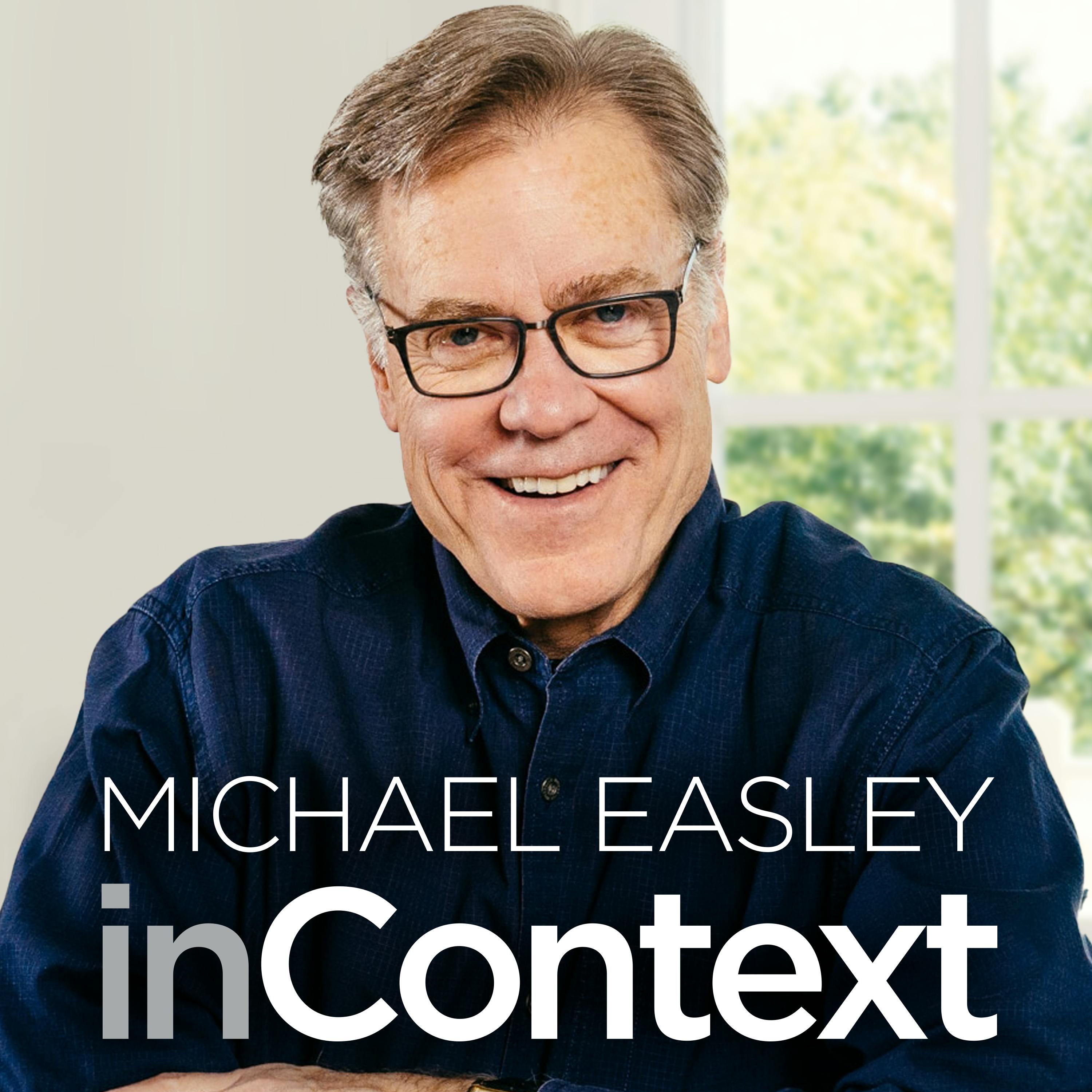
Michael Easley inContext
Michael Easley
Michael Easley inContext is designed to help you form a Biblical worldview through sound Biblical exposition and real-life insights.
Episodes
Mentioned books

Mar 31, 2026 • 39min
The Story of The Trinity with Dr. Bryan Litfin
Was the Trinity invented in the fourth century? Or was it always there in Scripture?
On this episode of inContext, Michael Easley sits down with church historian Bryan Litfin to discuss his book, The Story of the Trinity: Controversy, Crisis, and the Creation of the Nicene Creed.
Together they explore why the Trinity was not created at First Council of Nicaea, but clarified there. From the Shema in Deuteronomy to the Son of Man in Daniel, and from the Gospels to Pentecost, Scripture consistently reveals one God in three persons—Father, Son, and Holy Spirit.
Chapters
00:00 Why the Trinity Matters for Salvation
03:00 Why Evangelicals Are Rediscovering the Nicene Creed
08:00 What Is a Creed? (And Why It’s Not Above Scripture)
14:00 Monotheism in a Polytheistic World
22:00 Theophanies and Christ in the Old Testament
30:00 Jesus as the Son of God and Son of Man
36:00 The Holy Spirit and the Fulfillment of the New Covenant
42:00 Was the Trinity Invented at Nicaea?
Key Topics Discussed:
-Why creeds matter for modern evangelicals
-How Jesus understood Himself as the Son sent by the Father
-The Holy Spirit’s role in fulfilling the New Covenant
-Why theology is essential—not optional—for salvation
-If God is not truly Trinitarian, there is no incarnation, no atonement, and no indwelling Spirit.
Links Mentioned:
The Story of The Trinity by Dr. Bryan Litfin
More About Dr. Litfin
Follow on Instagram and Facebook:
https://www.facebook.com/MichaelinContext
https://www.instagram.com/dreasley/
For more information on Dr. Michael Easley and Ask Dr. E
Visit: https://www.michaelincontext.com
Mar 24, 2026 • 50min
The Miracle of The Kurds with Dr. Stephen Mansfield
What’s really happening with the Kurds—and why does it matter right now?
In this episode of inContext, Michael Easley sits down with author and geopolitical expert Dr. Stephen Mansfield to unpack one of the most overlooked stories in the Middle East.
The Kurdish people are one of the largest ethnic groups in the world without their own nation. They’ve fought alongside Western powers, helped defeat ISIS, and built a rare model of stability in northern Iraq—yet they’ve repeatedly been abandoned in global politics.
This conversation explores the Kurds’ history, their role in current conflicts involving Iran, Iraq, and Syria, and why their future remains uncertain. If you’ve ever felt confused by Middle East headlines, this episode brings clarity to the people, the politics, and the deeper human story behind it all.
Chapters
00:00 Intro
02:00 Who Are the Kurds?
06:00 Why Most People Don’t Know Their Story
10:30 Kurdish Military Strength & Loyalty
14:45 A History of Betrayal
20:15 Why the Kurds Don’t Have a Nation
25:30 Iraq, Iran, and Regional Tensions
31:00 The Syrian Conflict & Aleppo
36:45 U.S. Involvement and Withdrawal
42:30 Ethnicity, Identity, and Division
47:30 Younger Generations & Cultural Shifts
52:00 Could the Kurds Ever Have a Country?
57:00 Final Thoughts on the Middle East
Key Topics Covered
-Who the Kurdish people are and where they live
-The Kurds’ role in Middle East conflicts
-Why the Kurds don’t have their own country
-U.S. foreign policy and Kurdish alliances
-The impact of war in Iraq, Syria, and Iran
-Ethnic identity and division in the Middle East
-Generational shifts and the future of the region
Links Mentioned:
Stephen’s Website
The Miracle of The Kurds by Dr. Stephen Mansfield
Mar 17, 2026 • 40min
The Origin of Hymns with Robert J. Morgan
Robert J. Morgan joins Michael Easley for a powerful conversation about the history, theology, and enduring influence of Christian hymns. Why have these songs lasted for centuries? What are we losing when churches abandon them? And how can we recover the richness of hymnody without rejecting modern worship?
Drawing from his book The Origin of Hymns, Morgan traces the story of congregational singing from the song of Moses in Book of Exodus, through the golden age of English hymnody with writers like Isaac Watts and Charles Wesley, to the modern era. He shares the powerful backstory behind “It Is Well With My Soul” by Horatio Spafford, and how that hymn connects to the film I Can Only Imagine 2.
This episode challenges pastors, worship leaders, and believers to rediscover hymns not as nostalgia—but as theological formation. Hymns teach us how to worship, how to suffer, and how to endure.
Chapters
00:00 Why We Need Hymns Again
02:00 Robert Morgan’s Ministry Journey
05:00 The Story Behind The Red Sea Rules
09:00 The Biblical Origins of Hymnody
14:30 The Golden Age: Watts & Wesley
20:30 Theology vs. Repetition in Modern Worship
26:00 “Come Thou Fount” and Teaching Lyrics
30:00 The Story Behind “It Is Well With My Soul”
37:00 Hymns, Suffering, and Enduring Faith
42:00 Why the Church Must Recover Both Old and New
Key Topics Discussed:
The biblical roots of congregational singing
The theological depth of historic hymns
Isaac Watts and the birth of English hymnody
Charles Wesley and revival-driven worship
The problem of disposable worship music
Teaching hymn lyrics to modern congregations
The tragic story behind “It Is Well With My Soul”
Hymns as spiritual formation across generations
Combining historic hymns with modern worship songs
Links Mentioned:
The Origin of Hymns by Robert J. Morgan
Watch the highlights and full version of this interview on our Youtube channel.
For more inContext interviews, click here.
Mar 10, 2026 • 49min
A Basic Guide to Biblical Theology with Dr. Alan Thompson
How does the entire Bible fit together? In this episode of inContext, Michael Easley sits down with New Testament scholar Alan Thompson, author of A Basic Guide to Biblical Theology, to explore how Scripture unfolds as one unified story.
They unpack the difference between exegesis, biblical theology, and systematic theology—and explain why context is king when reading the Bible. You’ll learn how the major covenants (Abrahamic, Mosaic, Davidic, and New) progressively reveal God’s redemptive plan, how Jesus fulfills those promises, and what He meant when He said the Kingdom of God was “at hand.”
They also explore the “now and not yet” tension in the New Testament, the meaning of inheriting the Kingdom, the Exodus as a pattern of redemption, temple imagery throughout Scripture, and the breathtaking vision of the holy city in Revelation 21.
If you want to grow deeper in your understanding of Scripture—and think theologically about your faith—this conversation will strengthen your confidence in God’s Word.Subscribe for more in-depth biblical conversations.
Chapters
00:00 Introduction & Prayer
02:00 What Is Biblical Theology?
05:30 Exegesis vs. Systematic Theology
09:00 The Kingdom of God Explained
14:00 What First-Century Jews Expected
18:00 The Major Biblical Covenants
26:30 The New Covenant & the Lord’s Supper
32:00 Exodus, Temple & God’s Presence
38:30 The “Now and Not Yet” Framework
44:00 Inheriting the Kingdom
47:00 The Holy City & Final Transformation
52:00 Why Theology Matters for Every Christian
Key Topics Covered
Biblical theology vs. systematic theology
Why context is essential in Bible study
The Abrahamic, Mosaic, Davidic, and New Covenants
Jesus and the fulfillment of covenant promises
The Kingdom of God: present and future
The “now and not yet” tension in Scripture
Exodus as a model of redemption
Temple imagery from Eden to Revelation
Revelation 21 and the holy city
Final transformation and eternal hope
Links Mentioned:
A Basic Guide to Biblical Theology by Alan J. Thompson
Mar 3, 2026 • 43min
How Christians Should Think About Israel? with Dr. Michael Rydelnik
In the aftermath of the October 7 attacks and the global response that followed, many Christians — especially younger believers — feel confused about Israel, Palestine, Zionism, and anti-Semitism. How should followers of Christ think about these issues biblically rather than politically or culturally?
In this episode of InContext, Michael Easley sits down with Dr. Michael Rydelnik, professor emeritus of Jewish Studies at Moody Bible Institute and host of Open Line. As the son of Holocaust survivors and a lifelong scholar of Scripture and Jewish history, Dr. Rydelnik brings both personal insight and biblical clarity to a complicated conversation.
Together, they discuss God’s covenant promises to Israel, the difference between the people of Israel and the modern state of Israel, the history of replacement theology, and why anti-Semitism continues to resurface in every generation. This conversation helps Christians think carefully, compassionately, and truthfully about Israel in light of Scripture.
If you want to understand Israel’s role in the Bible and today’s world, this episode will help you anchor your thinking in God’s Word rather than social media narratives.
Chapters
0:00 Introduction and prayer
0:32 Why Christians are confused about Israel today
2:45 Dr. Michael Rydelnik’s background and story
3:38 Media influence and biblical misunderstanding
5:03 God’s promises to Israel in Scripture
6:00 Replacement theology explained
13:00 The meaning of Israel in the Bible
23:04 What Zionism really means
31:22 When criticism of Israel becomes anti-Semitic
35:43 God’s providence in preserving the Jewish people
39:15 Israel’s role in future prophecy
Key Topics Discussed
October 7 and the global response
Anti-Semitism in modern culture
Replacement theology vs. biblical covenant theology
Zionism and Jewish self-determination
The Abrahamic covenant and Romans 9–11
God’s preservation of the Jewish people
Israel in biblical prophecy
Links Mentioned:
How Should Christians Think About Israel? By Dr. Michael Rydelnik
Follow on Instagram and Facebook:
https://www.facebook.com/MichaelinContext
https://www.instagram.com/dreasley/
For more information on Dr. Michael Easley and Ask Dr. E
Visit: https://www.michaelincontext.com
Feb 24, 2026 • 37min
How Bible-Centered Churches Transform Lives with Daniel Batarseh
In this episode of InContext with Michael Easley, Pastor Daniel Batarseh shares his journey from studying creative advertising to planting Maranatha Bible Church in Illinois — a growing, multi-ethnic church built on prayer, discipleship, and the faithful teaching of God’s Word.
Daniel explains how a revival moment among young adults led to long-term ministry, why Scripture must remain central in church life, and how simple biblical practices still produce deep spiritual transformation today. This conversation encourages pastors, leaders, and believers to trust the sufficiency of God’s Word rather than ministry trends or complex programming.
When churches gather around Scripture, prayer, and authentic community, God faithfully builds His people.Subscribe for more conversations that help you understand God’s Word in context and live it out in everyday life.
CHAPTERS
0:00 Introduction
1:55 Daniel’s background and testimony
7:13 Seeds of faith and returning to Christ
8:44 The conference that changed everything
13:48 Moving to Chicago and ministry beginnings
16:09 Planting Maranatha Bible Church
20:06 Building multi-ethnic community through Scripture
21:43 A simple model of church life
24:05 Handling expectations and church programs
25:27 Young men pursuing godliness
26:15 What a real prayer meeting looks like
29:11 The sufficiency of God’s Word
32:08 How Scripture revives God’s people
KEY TOPICS DISCUSSED
• Church planting and discipleship
• The sufficiency of Scripture
• Prayer in the local church
• Multi-ethnic church community
• Raising up young leaders
• Evangelism and pastoral calling
• Returning to a biblical model of church
• Spiritual revival through God’s Word
Links Mentioned:
Maranatha Bible Church
Watch the highlights and full version of this interview on our Youtube channel.
For more inContext interviews, click here.
Feb 17, 2026 • 59min
Why the Lord’s Prayer Changes Everything with Brad Gray and Brad Nelson
The Lord’s Prayer may be the most familiar prayer in Christianity—and the most overlooked.
In this episode of InContext, Michael Easley sits down with Brad Gray and Brad Nelson of Walking the Text to uncover the depth, power, and biblical context behind the prayer Jesus taught His disciples.
Drawing from years of study in Israel, pastoral ministry, and personal experiences of grief and suffering, Brad and Nelson show how the Lord’s Prayer is not just something Jesus taught—it’s the prayer He lived. From Exodus imagery and the “heavens” language to forgiveness, grief, and the kingdom of God, this conversation reframes the prayer as a daily blueprint for discipleship.
Whether you’ve prayed the Lord’s Prayer for decades or rarely stop to think about its meaning, this episode invites you to hear it with fresh ears—and to rediscover how it shapes our understanding of God, ourselves, and our purpose in the world.
Chapters
00:00 – How Michael First Met Brad & Nelson in Israel
03:40 – From Sports & Business to Studying Scripture
07:50 – Why Biblical Context Changes Everything
10:45 – Why the Disciples Asked Jesus to Teach Them to Pray
13:55 – Rediscovering the Lord’s Prayer
17:20 – Grief, Liminal Space, and Prayer That Holds Us Together
22:30 – “Our Father in the Heavens” Explained
27:10 – Creation, Cosmos, and God’s Nearness
30:40 – Why Stillness Helps Us Hear God
34:10 – “Forgive Us Our Debts” and the Cost of Forgiveness
39:00 – Forgiveness vs. Reconciliation
44:00 – The Dead Sea, the Sea of Galilee, and Grace
49:30 – Why Forgiveness Is Ongoing Work
53:40 – The Lord’s Prayer as a Blueprint for Daily Life
Key Topics
The Lord’s Prayer in biblical and historical context
Why familiarity can dull spiritual formation
Exodus imagery and the kingdom of God
God’s nearness and authority in “the heavens”
Grief, suffering, and liminal space
Forgiveness as daily soul care
Forgiveness vs. reconciliation and healthy boundaries
Why prayer shapes how we live, not just what we say
Links Mentioned:
Bringing Heaven Here by Brad Gray and Brad Nelson
Watch the highlights and full version of this interview on our Youtube channel.
For more inContext interviews, click here.
Feb 10, 2026 • 38min
What We Get Wrong About The Gospels with Dr. Craig Evans
What if some of the most familiar Gospel stories aren’t quite what we’ve imagined?
In this episode of Michael Easley in Context, Michael is joined by renowned New Testament scholar Dr. Craig Evans to explore why historical and cultural context is essential for understanding Scripture. Drawing from his book Wow, I Didn’t Know That, Dr. Evans helps everyday believers move past assumptions and into a clearer, richer reading of the Gospels.
From the birth of Jesus and common nativity misconceptions, to repentance, Pharisees, John the Baptist, and the healing ministry of Jesus, this conversation shows how context doesn’t complicate faith—it strengthens it. You’ll discover why Jesus’ call to repentance is about renewal, not escapism, and how careful scholarship serves spiritual growth, not just academic knowledge.
If you love the Bible and want to understand it more deeply—without feeling overwhelmed—this episode is for you.
Chapters
00:00 – Introduction & prayer
01:00 – Why Dr. Craig Evans wrote Wow, I Didn’t Know That
03:45 – Making scholarship accessible for everyday believers
05:20 – Who this book (and conversation) is for
06:45 – Why misconceptions form when we ignore context
08:30 – The truth about the manger, the inn, and the nativity scene
11:15 – Why modern assumptions distort ancient texts
13:30 – Rethinking Pharisees and first-century Jewish life
16:10 – John the Baptist, family connections, and Gospel chronology
19:30 – Repentance: what Jesus really meant
22:15 – Renewal vs. end-times escapism
25:00 – The woman with the hemorrhage and ritual purity
28:10 – Jesus vs. Roman power and false healers
31:45 – Why context deepens faith instead of weakening it
34:45 – Final reflections and encouragement
📌 Key Topics Covered
Understanding Scripture in its original context
Common Gospel misconceptions explained
Repentance as returning, not earning forgiveness
Jesus’ ministry within Jewish history
Why the Gospels are historically grounded and spiritually rich
How good scholarship serves the church
Links Mentioned:
Wow! I Didn’t Know! By Dr. Craig Evans
Watch the highlights and full version of this interview on our Youtube channel.
For more inContext interviews, click here.
Feb 3, 2026 • 47min
The Secret to Lasting Spiritual Growth with Hanna Seymour
What if spiritual growth didn’t require more intensity—but more consistency?
In this episode of Michael Easley InContext, Michael is joined by Hanna Seymour to discuss her book Everyday Spiritual Habits and the powerful idea that spiritual disciplines are meant to become reflexes, not burdens.
Drawing from Scripture, spiritual formation theology, and the science of habit formation, Hanna explains how small, daily practices—what she calls “seed habits”—can lead to lasting spiritual maturity over time. Rather than chasing an idealized version of quiet times or comparing ourselves to pastors and scholars, this conversation reframes spiritual disciplines as accessible, grace-filled rhythms for real life.
Together, Michael and Hanna explore prayer, Scripture, joy, gratitude, celebration, solitude, and practicing the presence of God in ordinary moments—while also addressing distractions, comparison, and the pressures of modern life. This episode offers a hopeful vision for anyone longing to walk tethered to Jesus in the middle of busy, demanding seasons.
Chapters / Timestamps
00:00 – Introduction & Why Habits Matter
02:45 – The Survey That Sparked the Book
05:10 – Atomic Habits Meets Spiritual Formation
08:30 – Consistency vs. Intensity
12:10 – Reframing Spiritual Disciplines for Real Life
15:20 – Prayer as a Daily Reflex
18:45 – Habit Triggers and Spiritual Cues
22:40 – Technology, Distraction, and Attention
26:50 – Joy, Gratitude, and Celebration
31:20 – Practicing the Presence of God
36:10 – Seed Habits and Spiritual Growth
41:45 – Closing Encouragement
Key Topics Covered
-Spiritual disciplines as habits and reflexes
-Why consistency matters more than intensity
-Habit formation and Christian growth
-Prayer in busy seasons of life
-Scripture intake without overwhelm
-Gratitude, joy, and celebration
-Practicing the presence of God
-Technology, distraction, and attention
-Spiritual formation for ordinary believers
Links Mentioned:
Everyday Spiritual Habits by Hanna Seymour
Follow on Instagram and Facebook:
https://www.facebook.com/MichaelinContext
https://www.instagram.com/dreasley/
For more information on Dr. Michael Easley and Ask Dr. E
Visit: https://www.michaelincontext.com
Jan 27, 2026 • 39min
Transform Your Thoughts with Jon Gauger
In this episode, Michael Easley sits down with Jon Gauger, author, radio personality, and lifelong lover of Scripture, to explore how the Psalms can transform the way we think and speak to ourselves. From anxiety and impatience to sleepless nights and moments of regret, Jon shares how memorizing and meditating on Psalms reshapes our self-talk, helps us navigate life’s challenges, and strengthens our relationship with God.
Jon shares his personal journey of replacing negative thoughts with Scripture, including practical examples from his daily life, work, and travels. Michael and Jon also discuss the life of David—the ultimate example of a man after God’s own heart—and how his Psalms provide guidance, encouragement, and hope for us today.
If you’ve ever struggled with self-doubt, worry, or mental fatigue, this episode will show you the power of Scripture to renew your mind and bring peace to your soul.
What You’ll Learn in This Episode:
-How to use the Psalms to combat negative self-talk and anxiety
-Practical steps for memorizing Scripture and making it a daily habit
-Ways Scripture can bring calm during sleepless nights and stressful days
-Lessons from the life of David on repentance, humility, and faith
-How to respond wisely and peacefully in moments of crisis
-Why worship, patience, and praise are choices that shape our thinking
-Real-life stories of mentors, travel experiences, and moments of faith in action
Timestamps & Topics Discussed:
0:00 – Opening prayer and welcome
0:29 – Michael’s love for the Psalms and teaching them
1:27 – Introduction of Jon Gauger and Powerful Self-Talk from the Psalms
3:12 – Why Jon wrote the book: transforming negative self-talk
7:31 – Understanding constant self-talk and what Scripture says about it
10:21 – Using Psalms for rest and sleep
13:19 – Waiting patiently and trusting God (Psalm 27)
18:12 – “Relax, He’s Doing the Doing” and committing your soul
19:41 – Choosing worship and praise in daily life
20:56 – How social media affects self-talk
25:36 – Pausing and trusting God in crises
28:46 – Brag on God: encouraging others through our response
33:58 – How Scripture memorization influences thought, speech, and action
35:16 – David’s life as a model for self-talk, repentance, and faith
38:16 – Psalm 51: turning to God in moments of sin and regret
39:15 – Closing reflections and encouragement to engage with Scripture
Links Mentioned:
Powerful Self-Talk From The Psalms by Jon Gauger
Follow on Instagram and Facebook:
https://www.facebook.com/MichaelinContext
https://www.instagram.com/dreasley/
For more information on Dr. Michael Easley and Ask Dr. E
Visit: https://www.michaelincontext.com

