

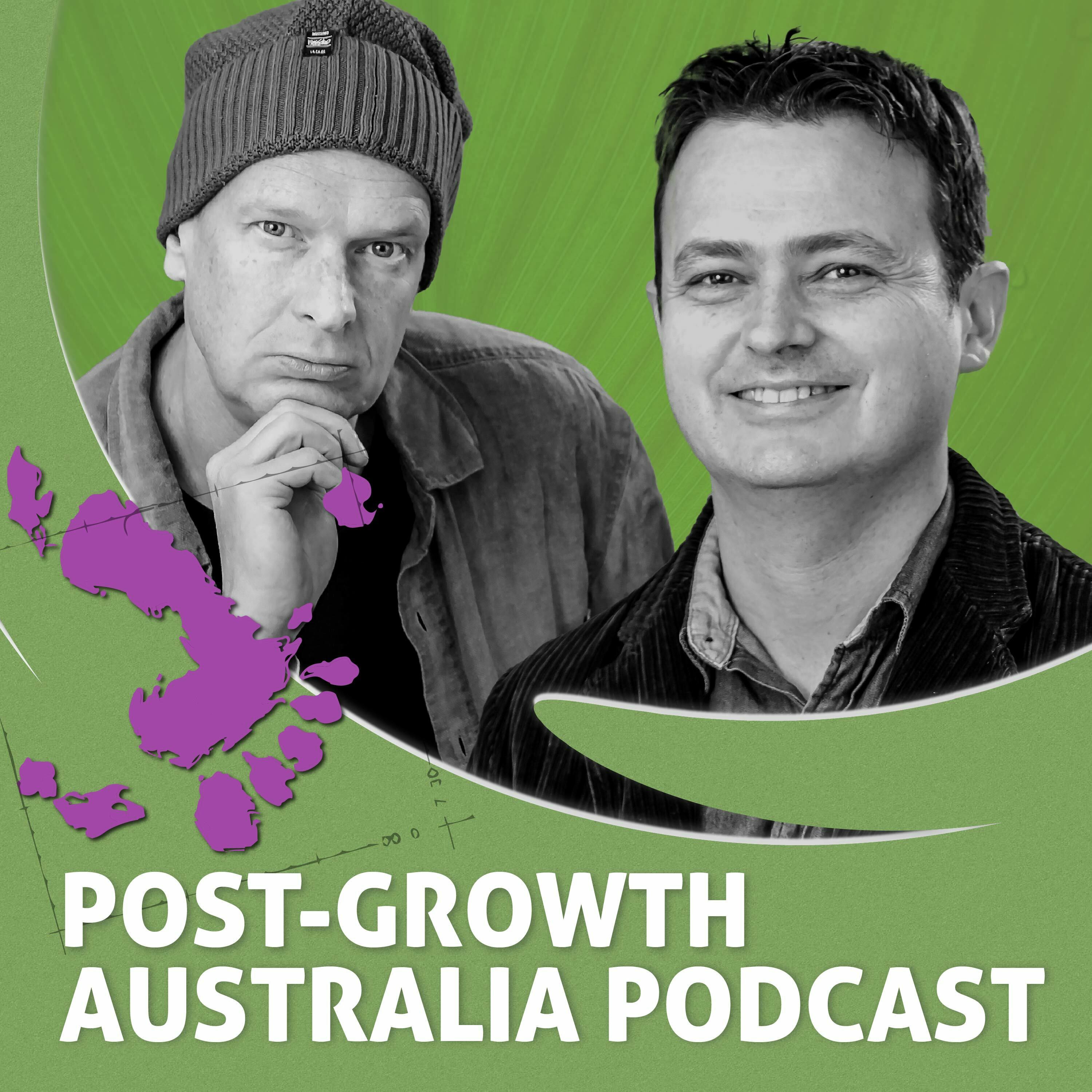
Post-Growth Australia Podcast
Michael Bayliss
The podcast where better is definitely better than bigger.
Do you think growing infinitely on a finite planet is an oxymoron? If the answer is yes, then this podcast is for you.
In each episode of the Post-Growth Australia Podcast (PGAP), host Michael Bayliss talks to experts to unpack the notion of post-growth societies and what this means for us, for future generations and for the planet.
Each episode will also play an environmental themed song from local artists.
PGAP is made possible by the support of Sustainable Population Australia (SPA).
Do you think growing infinitely on a finite planet is an oxymoron? If the answer is yes, then this podcast is for you.
In each episode of the Post-Growth Australia Podcast (PGAP), host Michael Bayliss talks to experts to unpack the notion of post-growth societies and what this means for us, for future generations and for the planet.
Each episode will also play an environmental themed song from local artists.
PGAP is made possible by the support of Sustainable Population Australia (SPA).
Episodes
Mentioned books

Mar 26, 2026 • 57min
Meet the host of new NENA podcast -Tiyana Jovanovic
This year, the New Economy Network Australia (NENA), launched a new podcast, ‘Voices of the New Economy’ hosted by Dr Tiyana Jovanovic. For this very special episode of PGAP, we catch up with Tiyana to tell us more about this new exciting podcast series, and how podcasting is an important storytelling tool to encourage and facilitate change.
Also in this episode:
Tiyana explores her journey within NENA over the past three years, including her coordination roles on the board of directors, strategic direction group, coordination hub, and storytelling hub. She also shares her work and advocacy beyond NENA, as founder of the of Humanitarian Changemakers Network and host of the Changemaker QandA podcast.
Tiyana discusses her recent PHD work, in which she redefined concepts such as ‘empowerment’, ‘resilience’ ‘adaptability’ and ‘sustainability’. She describes how her work with women and communities in rural India informed her research. We discuss how the broader post-growth movement can benefit from a deeper understanding on the dynamics of empowerment and resilience.
Finally, Tiyana shares with us her personal vision for a day in the life in a new economy, post-growth world.
Did you know - PGAP host Michael Bayliss was also a recent guest on the ‘Voices of the New Economy’ podcast. You can even watch the conversation on YouTube.
In this episode, I invite listeners to hold one face to face conversation with at least one other person who is new to degrowth. Please CONTACT US on PGAP if you would like any tips before your conversation. Otherwise, let us know how your conversation went. It is very important that we all do what we can to make post-growth a mainstream issue, as the world is on brink of disaster. If you can, we would appreciate you taking the time to share this and other episodes of PGAP with your networks, or rate and review us on Apple Podcast.
*Links for further exploration: *
Tiyana’s non-linear approach to change/growth is discussed in the context of rethinking sustainability at the Australian Earth Laws Alliance conference last year: https://youtu.be/9XvAJyn0Gc0?si=KNiVxCwgLdRLwY8T
Tiyana’s empowerment framework (which can be applied to how we think about the role of an economy): https://youtu.be/4z1e6EM2GOk?si=qXI4TXPOP0uqk9Mb
You may be interested in the past NENA themed PGAP episodes:
Reimagine a Earth Centered Economy with Michelle Maloney
PGAP live at the NENA conference: Life After Capitalism
PGAP is made possible through the support of Sustainable Population Australia. All perspectives, views and legacies of PGAP guests are exclusively theirs and do not always reflect those of PGAP or SPA.
Timestamp:
Intro: Start – 05:10
Interview part 1: 05:10 – 32:47
Intermission: 32:47 – 35:05
Interview part 1: 35:05 – 56:46Special Guest: Tiyana Jovanovic.

Mar 12, 2026 • 42min
The Post Fossil-Fuel Era with Scott Witheridge
Recent events have brought to the surface how vulnerable Australia is to energy shortages with only 30 days of stockpiled oil reserves. Within the context of these tentative times, it is important that we re-explore alternative energy options.
Scott Witheridge is an Environmental Engineer and Author of the book "The Post Fossil Fuel Era". The book is a deep investigation into the next frontier of energy—exploring decentralised power, hydrogen innovation, and the intersection of conventional and emerging technologies. In this interview, Scott discusses the possibilities of abundant, perpetual and non-conventional energy.
All views, opinions and legacies of guests on Post Growth Australia Podcast are exclusively theirs and do not necessarily reflect the views and opinions of PGAP. This is especially true for this episode as host Michael Bayliss remains cautiously neutral on this issue. From a post-growth perspective, the idea of abundant energy offers a fascinating hypothetical. If abundant energy is possible, how does this challenge our notion of energy scarcity and our response to this (such as planned degrowth and voluntary simplicity)? On the other side of the coin, does abundant energy give humanity a free pass to continue expanding unchecked and do post-growth principles still apply? All this and more are explored under the hypothetical microscope in this special episode of PGAP.
“THE POST FOSSIL-FUEL ERA: A Blueprint for a Boundless Future” is available for purchase on Amazon HERE.
You can check out Scott’s videos, including the full length “The Story of the Joe Cell” documentary, on the Post Fossil Fuel Era YouTube channel HERE.
If you would like to hear host Michael Bayliss’ most recent interview on Pulse, representing Sustainable Population Australia, link HERE (go to the third chapter starting at 2:00:00).
If you enjoyed this episode, please share with your networks. We encourage you to rate and review PGAP on Apple Podcast. CONTACT US with your thoughts and suggestions for future episodes and guests.Special Guest: Scott Witheridge.

Feb 18, 2026 • 1h 3min
By Disaster or Design: A Degrowth Answer to Finance with Matt Orsagh
“By disaster or design a Post Growth world is coming…because if we don’t do anything, the systems we depend on will collapse. Let’s not let that happen, let’s design our way to a better system.”
In this episode of Post Growth Australia Podcast, we welcome special guest Matt Orsagh, from the Arketa Institute for Post Growth Finance, and author of the blog ‘Degrowth is The Answer’. Matt and his colleagues at Arketa have been working to align to financial sector with environmental and wellbeing needs, culminating in the 2025 research paper: “By Disaster or Design: How finance can evolve to avoid the worst of the ecological challenges we face and enable the transition to a better economic mode.” The paper proposes many degrowth solutions to the finance sector, to which Matt explores further in this interview.
We also explore Matt’s own written work at his Substack blog, 'Degrowth is the Answer'. Big themes include wealth inequality, the loneliness epidemic, and collapse. These articles exemplify Matt’s storytelling skills. While describing our current predicaments with unflinching realism, Matt reminds us that the future remains hopeful if our global society transitions toward practical, planned Degrowth solutions.
This episode of PGAP is dedicated to the memory of Tristan Sykes, co-founder of Just Collapse, who recently passed away
Change the World through Changing Economics with Marcus Champ: The premiere episode of season 8 is a great companion episode, as it similarly explores economics and finance.
Planning for a Just Collapse with Kate Booth: Our interview with ‘Just Collapse’ co-founder remains one of our most listened to episodes.
We also encourage you to read the PGAP blog article To populate or not to populate? How we can come together around the eternal debate of everyone’s favourite vexed issue.
This interview explores the following three articles from Matt’s Substack Blog ‘Degrowth Is The Answer’:
Americans Don’t Know How Good They Don’t Have It
Collapse: Don’t Look Down
Everyone I Know is Lonely
You can find the Arketa institute publications HERE, where you may read the report ‘By Disaster or By Design.’
_Enjoyed this episode? Please feel welcome to show your support for PGAP by sharing this and other episodes with your friends, family and networks. Leave a review for us on Apple Podcast or your favourite podcast platform. Contact us anytime with your thoughts and suggestions. _
Time stamp
Introduction:
Start – 00:04:19
Interview Part 1:
00:04:19 – 00:32:06
Intermission:
00:32:06 – 00:34:27
Interview Part 1:
00:34:27 - EndSpecial Guest: Matt Orsagh.

Jan 26, 2026 • 1h 1min
Change the World through Changing Economics with Marcus Champ
“The foundational elements of neoliberal economics is false” – Marcus Champ
Welcome to 2026 and a brand-new season of Post Growth Australia Podcast!
With co-host Mark Allen on travel leave, host Michael Bayliss (with his degrowth cap on) opens the episode with some mixed feelings in welcoming the new year. Since 2025, humanity has breached planetary boundaries, shifted more of our collective wealth into the hands of oligarchs and added 70 million to the population. Each new year brings a new appreciation of the magnitude to the scale of the human enterprise, which makes turning things around that more difficult (we keep trying, however!)
Our first special guest to open Season 8 of PGAP is Marcus Champ. With a professional background in psychology, Marcus is studying at the one-of-a-kind Masters of Economics of Sustainability degree through Torrens University. Along with fellow students, Marcus has started an economics advocacy group called “Public Money. Public Good.”
Marcus was also a presenter at the 2025 New Economy Network Australia (NENA) conference. His presentation was titled: “Pathways through a crisis: wartime experience and lessons for the coming climate catastrophe.”
In this episode, Marcus draws from his presentation to compare Australia’s economy during World War II to that of our economic system today. In his words: “It’s amazing how much our understanding of economics and finance has changed in the last 50 years or so.”
With panache and passion, Marcus shares a new economic vision for Australia. Informed from the achievements of the past, it eschews the current neoliberal paradigm to create a future where social and environmental wellbeing is prioritised over GDP, profits for the few and endless growth on a finite planet.
Post Growth Australia Podcast (PGAP) is made possible with the support of Sustainable Population Australia (SPA). All opinions and legacy of PGAP guests are their own and do not necessarily reflect those of PGAP or SPA.
Enjoyed this episode? Please feel welcome to show your support for PGAP by sharing this and other episodes with your friends, family and networks. Leave a review for us on Apple Podcast or your favourite podcast platform. Contact us anytime with your thoughts and suggestions. Want to explore more episodes on this theme? Links below:
Finding The Money with Maren Poitras
PGAP live at the NENA conference: Life After Capitalism
MMT for Activism with Gabrielle Bond
Ecological Economies and MMT with Steve Williams
Time stamp:
Intro - 00:06:20
Interview part 1 - 00:06:20 - 00:27:20
Intermission - 00:27:20 - 00:29:05
Interview part 2 - 00:29:05 - 01:00:55Special Guest: Marcus Champ.

Nov 19, 2025 • 22min
Last Episode for Season Seven
In this final episode for Season Seven, co-hosts Mark Allen and Michael Bayliss catch up for a short, freewheeling conversation to wrap up a busy year.
In June 2025, Michael and Mark participated in a community consultation weekend on the future development of North Albany. Michael later presented his observations at the Albany Community Environment Centre forum ahead of the City of Albany elections in September. His presentation explained to prospective councillors and fellow environmentalists why urban planning matters for both social wellbeing and ecological resilience. It also invited attendees to reflect upon the long‑term consequences of unchecked growth for the city’s future.
For this episode, Michael reads out this talk for posterity, which can also be read on the PGAP blog HERE. This prompts an open discussion with Mark around issues such as:
Albany’s growth pains and the impact this has for future planning, housing security and the natural environment;
How face to face community consultation, including Citizen Assemblies, can encourage cooperative debate and discussion, in contrast to the divisiveness which is so common in online or social media debates;
How holistic approaches to debate can ensure that everyone can find common ground and navigate difference of opinion across many critical issues, including overpopulation;
The importance of including post-growth thinking into our conversations, to encourage people to think about the bigger picture and act proactively as well as reactively;
Finding the time to be in a space outside of language and narrative. An article, written by Michael in 2023, argues why the pursuit of growth makes this all the more difficult. Link HERE;
Election fatigue in which it seems to be a case of the trees voting for the axe at federal, state and local levels, and:
Finally, on a darkly humours note, we imagine what kind of apocalypse we face when world coffee stocks run out.
As we draw a close to season seven, we reflect on a very good year for PGAP. This has been our longest season to date, beginning as far back as November 2024, when we broadcasted the radio documentary ‘Rethinking Sustainability’. Since then, Season Seven has covered many topics across fifteen episodes, such as steady state economics, techno dystopia, regenerative agriculture and a panel discussion on Degrowth at the University of New South Wales. This year, PGAP was recognised by the site MillionPodcasts as being in the top ten global podcasts that covers overpopulation and in the top fifty podcasts on Sustainable Living. This is very encouraging news to hear as we take a break over the festive season and plan for season eight.
While we are on our break, we encourage you to share this and other episodes of PGAP with your friends, family and networks. We are grateful to anyone who takes the time to review and rate us on Apple Podcasts or your favourite podcast platform. We are also appreciative when people take the time to contact us directly with feedback and suggestions for future episode topics or guests. Many of our interviews this season came about from community suggestions or from prospective guests who emailed us. Reaching out is so important, not just for building connection but for helping us to broaden our range of episode topics and guests.
Last, but certainly not least, we extend our gratitude to Sustainable Population Australia (SPA), which has supported PGAP since its inception in July 2020. This season, we also bid farewell to John Coulter, a long-time leader of SPA and the wider post-growth movement in Australia who sadly passed away last year. We welcomed SPA’s new patron, Anne Poelina, and spoke with Isaac Kabongo, the Ugandan CEO of the Ecological Christian Organisation, who has represented SPA at COP events. You can learn more about SPA here.

Nov 5, 2025 • 45min
Building a circular solar future with Darren Johannesen
Did you know that in 2024/2025, 3.4 million solar panels were decommissioned? Did you also know that up to 99% of solar panel material is recyclable? In this episode, we welcome Darren Johannesen, Executive General Manager of Sustainability at Smart Energy Council. We discuss the recent success of Smart Energy Council’s Solar PV Recycling and Products Stewardship Program as an example of urban mining and go on to examine how this could be rolled out on a national scale.
The Solar PV Recycling and Products Stewardship Program is one working example of how a ‘circular economy model’ would work. Darren however cautions that circular economy models are limited in light of the loss in energy and resources that are implicit with recycling. We at PGAP argue that this is all the more reason why a circular based economy must go hand in hand with a post-growth economic system. Finally, Darren shares his personal vision for a possible post-growth future and what it might look like.
Co-host Michael Bayliss is joined by Mark Allen for the introduction and outro for this episode, where they reflect on this great initiative from Smart Energy Council. They also discuss the imperative for a planned degrowth transition in a world that is drowning under ever growing piles of aggregate consumer waste. Mark and Michael also discuss some recent developments and current affairs as ‘post-growth’ and ‘collapse’ enters mainstream discourse.
Did you enjoy this episode? Feel free to show your appreciation by rating and review PGAP on Apple Podcast or your favourite platform. Or write to us through our contact form with your feedback and any ideas you might have for future episodes. We also appreciate guest recommendations! Please feel free to share this and other episodes of PGAP within your networks. We rely exclusively on word of mouth.
PGAP is made possible with the support of Sustainable Population Australia. Please check out SPA on their website and consider signing their position statement or even signing-up as a supporter or member.
Want to explorer deeper into the themes raises by this episode? Here are some links:
The following webinars explore the Smart Energy Council ‘Solar PV Recycling and Products Stewardship Program’ in detail:
Solar Recycling & Material End Markets – Stewardship Webinar I Smart Energy Council
slides here
Webinar Renewable Sector Stewardship Enablers
slides here
Solar Panel Reuse I Stewardship Webinar Series - Smart Energy Council
slides here
The episode refers to two past episodes of PGAP. These include: “Save our Soils: Regenerative Farming with Louis De Jaeger” and; “Working Toward a Circular Economy Future in Australia with Phil Jones”.
One of our previous guests, Kate Booth from Just Collapse, was a panellist in the ABC debate: “We’re F'ed! It’s too late to avoid civilisational collapse." Kate Booth was special guest on the PGAP episode “Planning for a Just Collapse”.
You can find more about the work of PGAP co-hosts Mark Allen HERE and Michael Bayliss HERE.
The opinions of PGAP guests, including any legacies past or present, are exclusively theirs and do not always reflect the views of PGAP or SPA.Special Guest: Darren Johannesen .

Sep 28, 2025 • 1h 7min
Save our Soils: Regenerative Farming with Louis De Jaeger
The clock is ticking as we face an imminent agricultural crisis. It is likely that we only have around sixty global harvests left until the world's top soils are depleted. Regenerative agriculture offers many potential and practical solutions toward a more sustainable relationship between food production and environmental stewardship. However, sustainable farming is a broad church with many different and sometimes contradictory methodologies, from mob cattle grazing to veganic farming practices to precision fermentation. Which ones do we choose?
Louis De Jaeger, author of “SOS: Save Our Soils”, asked this question as he travelled the world to explore the whole gamut of regenerative farms and land management practices. Louis’ holistic, non-judgemental and open-minded approach is very refreshing. As far as we’re aware, he is the only person who has managed to endorse veganic farming while also enjoying an enthusiastic introduction to his book by Allan Savory, figurehead of the holistic grazing movement. Louis concludes that all regenerative farming methods have their place, depending on context, so long as the soil is kept healthy with its precious microbiome intact.
Louis de Jaeger is a Belgian based eco-entrepreneur, landscape consultant, speaker and author. You can find out more at his WEBSITE. “SOS: Save Our Soils”, launched in June 2025, is an impressive blend of research told through a conversational, easy-to-read style which makes it an essential addition to the growing wealth of regenerative literature. To purchase your own copy of SOS, visit HERE.
Industrial agriculture is a top global driver of environmental change. A post-growth future requires us to completely reimagine how we approach agriculture, not only with regard to methodology, but also to the size and scale of our food growing enterprises. Following the interview with Louis, co-hosts Mark Allen and Michael Bayliss engage in a ‘panel discussion’ where Louis’ book and interview are discussed (along with the broader regenerative movement) from a post-growth perspective. We encourage you to stick around to the end of the interview.
Many thanks to West Australian permaculture band ‘Formidable Vegetable’ for the inclusion of their song ‘Earthworm Bill.’ You can find out more about Formidable Vegetable at their Bandcamp page HERE. Michael recently made a short video on a Johnson Su method composting workshop which also includes this song. It may be watched HERE.
We highly recommend watching the debate between George Monbiot (precision fermentation advocate) and Allan Savory HERE. If you would like to listen to more episodes on the theme of regenerative agriculture, you may enjoy PGAP’s interview with Charles Massy HERE. We also recommend several episodes on permaculture, including special guests David Holmgren HERE or Shane Simonsen on Zero Input Agriculture HERE.
In other news, we are pleased to share an online trophy awarded to us by Million Podcasts, an aggregate podcast site. PGAP sits in the top 50 of global ‘Sustainable Living’ podcasts, which is very encouraging. This is made possible by the PGAP community and word of mouth. Please consider sharing this and other episodes of PGAP with your networks. Alternatively, you can rate and review us on Apple Podcast or your favourite podcast platform.
You can find out more about co-hosts Mark Allen HERE and Michael Bayliss HERE
Time stamp -
Introduction with Mark Allen and Michael Bayliss
00:00:00 to 00:05:28
Interview P1 with Louis De Jaeger
00:05:43 to 00:35:21
Intermission + 'Earthworn Bill' from 'Formidable Vegetable'
00:35:38 to 00:38:20
Interview P2 with Louis De Jaeger
00:38:20 to 00:53:42
Panel Discussion and Outro with Mark Allen and Michael Bayliss
00:53:57 to 01:07:30Special Guest: Louis De Jaeger.

Sep 7, 2025 • 44min
Conversations with CASSE NSW Inc with Matthew Washington
For part two of our conversations with the Centre for the Advancement of the Steady State Economy (CASSE) we welcome special guest Matthew Washington, co-director of CASSE NSW INC. This episode is a freewheeling conversation across a variety of post-growth issues, most pertinently how we can advocate for Steady State Economies in a time of global instability and tension. This episode refers to an honours the past legacy of both the late Herman Daly and the late Haydn Washington, two leading figureheads of the steady state movement.
Matthew and Michael discuss a spectrum of topics in under an hour, and we felt that some of the issues discussed only brushed the surface. If you would like a 'deeper dive' into the issues discussed, Matthew has kindly contributed to a guest blog on the PGAP website, where he provides substantial written responses to each of the question topics of the interview. You can read Matthew's guest blog HERE.
Liked this episode? Check out our previous episode with Phil Jones, Treasurer/Secretary of CASSE NSW Inc., discussing the progress toward the Circular Economy in Australia.
Sign the CASSE NSW Inc. petition to establish a Federal government inquiry into the steady state economy.
You can also support PGAP by sharing this or other episodes with your networks. Encourage the online community to listen to PGAP by rating and reviewing us on Apple Podcast. On the PGAP website, you can subscribe or contact us, as we appreciate your invaluable feedback and suggestions.
PGAP is supported by Sustainable Population Australia. You can sign their position statement, calling for an end to population growth policies in Australia.
All perspectives of PGAP guests, including legacy past, present and future, are exclusively theirs and do not always reflect the perspectives or working of PGAP or SPA.Special Guest: Matthew Washington.

Aug 24, 2025 • 42min
Working Toward a Circular Economy Future in Australia with Phil Jones
Across the next two episodes of PGAP, we will be showcasing the good work from CASSE NSW Inc., who are advocating for the steady state economy in Australia.
For this episode, we interview Phil Jones, Treasurer and Secretary, as he shares with us the progress of government reports and inquiries into the Circular Economy. Furthermore, why it is crucial that we encourage the government to take serious action in implementing the circular economy, rather than letting their reports gather dust in Canberra.
We discuss two reports in particular:
The Circular Economy Ministerial Advisory Group, established in 2023, and:
The Productivity Commission “Opportunities in the Circular Economy” interim report
The circular economy is defined by Wikipepdia as: “a model of resource production and consumption in any economy that involves sharing, leasing, reusing, repairing, refurbishing, and recycling existing materials and products for as long as possible.”
Phil is positive with the potential for the rollout of the circular economy in Australia, especially in its capacity to catalyse existing initiatives such as recycling programs, repair cafes, second hand exchange initiatives, etc. However, he cautions that the circular economy is alone insufficient in achieving true sustainability unless it is coupled with the Steady State Economy. That is, "an economy made up of a constant stock of physical wealth (capital) and a constant population size, which does grow over the course of time".
The episode concludes with a call to action to get some real and action in response to these reports. A good place to start is by signing the CASSE NSW INC petition to establish a Federal government inquiry into the steady state economy.
Did you like this episode and want to explore further?
You may be interested in PGAP’s first ever episode with Steady State ACT, or with CASSE’s international director Brian Czech. We also discussed the New Economy Network Australia on the episode, so you may be interested in PGAP’s coverage of the 2023 NENA conference (sadly, I didn’t get around to recording Phil’s excellent talk).
You can find out more about Phil and CASSE NSW in the Sustainable Population Australia Newsletter November 2024. Speaking of SPA, who proudly support PGAP, please consider signing their position statement, calling for an end to population growth in Australia.
You can also support PGAP by sharing this or other episodes with your networks. Encourage the online community to listen to PGAP by rating and reviewing us on Apple Podcast. On the PGAP website, you can subscribe or contact us, as we appreciate your invaluable feedback and suggestions.
All perspectives of PGAP guests, including legacy past, present and future, are exclusively theirs and do not always reflect the perspectives or working of PGAP or SPA.Special Guest: Phil Jones.

Jul 9, 2025 • 15min
World Population Day 2025 with Valorie Allen
In the lead up to World Population Day (WPD) 2025, we welcome back Val Allen, who was previously a panel guest for the PGAP episode “3 Women 2 Countries 1 Message: World Population Day 2022.”
Three years later, Val has a new book out – “HOW MANY IS ENOUGH?” -just in time for World Population Day 25. She is also in the process of finalising a new documentary “TICK TOCK BOOM BANG” due later this month, which she has produced along with Nick Bohle of HatChap productions.
In this mini episode, Val shares her recent very busy journey in creating content across multiple media and her reflections on a world that has changed immensely in the three years since Val was last guest on PGAP.
Valorie Allen has been an activist for 35 years in the environmental, population and animal rights movements, receiving the Canadian Volunteer Award. Her first award-winning book “Growing Pains—A Planet in Distress” was published in 2010.
A trailer for ‘Tik Tok Boom Bang’ may be watched at the HatChap productions website HERE
Valorie Allen’s latest book ‘How Many Is Enough?’ is available from Amazon for Kindle HERE.
You can keep up to date with Val’s latest projects from her website Population In Sync.
Sustainable Population Australia, who support PGAP, have launched a media release in anticipation for World Population Day, which may be read in full from the SPA website. It includes quotes from SPA patrons Prof. Anne Poelina and Dr. Paul Collins, both previous guests on PGAP.
During this episode, Val refers to the chilling article from the Independent, “There could be billions more people on Earth than previously thought” which could be a consequence as a result of under counting rural populations.
PGAP will never run ads and our success depends on word of mouth from our dedicated community. Please consider sharing this and other episodes of PGAP with your networks. Or rate and review PGAP on Apple Podcast. We welcome you to subscribe or to contact us with your feedback, opinions and topic recommendations for future episodes.Special Guest: Valorie Allen.

