

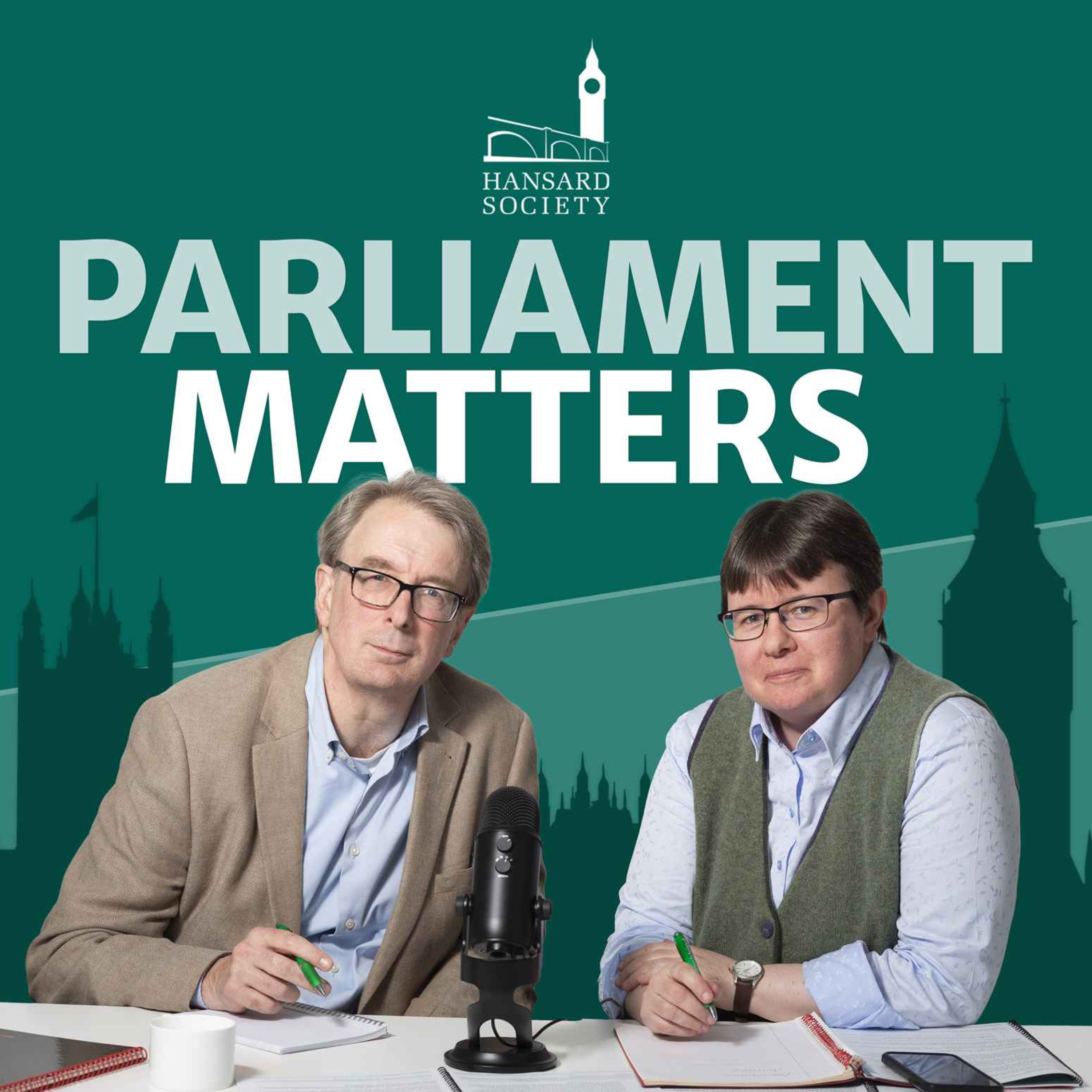
Parliament Matters
Hansard Society
Join two of the UK's leading parliamentary experts, Mark D'Arcy and Ruth Fox, as they guide you through the often mysterious ways our politicians do business and explore the running controversies about the way Parliament works. Each week they will analyse how laws are made and ministers held accountable by the people we send to Westminster. They will be debating the topical issues of the day, looking back at key historical events and discussing the latest research on democracy and Parliament. Why? Because whether it's the taxes you pay, or the laws you've got to obey... Parliament matters!Mark D'Arcy was the BBC's parliamentary correspondent for two decades. Ruth Fox is the Director of the parliamentary think-tank the Hansard Society.❓ Submit your questions on all things Parliament to Mark and Ruth via our website here: hansardsociety.org.uk/pm#qs📱 Follow us across social media @HansardSociety and...✅ Subscribe to our newsletter for all the latest updates related to the Parliament Matters podcast and the wider work of the Hansard Society: hansardsociety.org.uk/nl.Parliament Matters is a Hansard Society production supported by the Joseph Rowntree Charitable Trust • Founding producer Luke Boga Mitchell; episode producer Richard Townsend. Hosted on Acast. See acast.com/privacy for more information.
Episodes
Mentioned books

Oct 3, 2025 • 34min
Former Prime Ministers: The role of Parliament in life after No 10
In this episode, we speak with Peter Just, author of a new book, Margaret Thatcher: Life After Downing Street. Peter explores how Thatcher reinvented herself after her departure to maintain her status as an international figure, and how she remained a parliamentary thorn in John Major’s side. We also compare her parliamentary afterlife with that of other Prime Ministers, and consider the value that former leaders can bring to the institution of Parliament. ___ Please help us improve Parliament Matters by completing our Listener Survey. It will only take a few minutes.Go to: https://podcastsurvey.typeform.com/to/QxigqshS Peter Just’s new book, Margaret Thatcher: Life After Downing Street, explores the political afterlife of Margaret Thatcher, once she had left No. 10. Peter explains how Thatcher reinvented herself as a global political figure, championing British business abroad, and how she exerted a continued influence on domestic politics and parliamentary life. We also compare her legacy with that of other ex-Prime Ministers, including the unusually active parliamentary role of Theresa May, and consider what value former Prime Ministers bring when they stay engaged in the work of Parliament. Peter explains how, after her personally devastating departure, Thatcher built a new role with the support of trusted aides. Though her interventions in the House of Commons were rare, her mere presence in Parliament carried weight. She became a political irritant to John Major’s Government – encouraging rebels over Maastricht and criticising the Government’s policy on Bosnia – yet behind the scenes she was often a diplomatic and commercial asset. ____ 🎓 Learn more using our resources for the issues mentioned in this episode. ❓ Send us your questions about Parliament: ✅ Subscribe to our newsletter. 📱 Follow us across social media @HansardSociety / @hansardsociety.bsky.social £ - Support the Hansard Society and this podcast by making a donation today. Parliament Matters is a Hansard Society production supported by the Joseph Rowntree Charitable Trust. Presenters: Mark D’Arcy and Ruth Fox Producer: Richard Townsend Hosted on Acast. See acast.com/privacy for more information.
Sep 26, 2025 • 38min
What are the Usual Channels? A short history of Westminster whipping
In this episode, we talk to political journalist Seb Whale about his new book The Usual Channels, which reveals the hidden world of Westminster’s whips. Seb charts how party discipline has evolved – from the stormy politics of the 1970s and the Maastricht battles of the 1990s to the legendary “black book,” the Brexit showdowns and the short-lived Liz Truss premiership. He explains how the whips’ office has adapted to a modern Parliament—especially with the influx of women MPs—and why, even today, whips still wield decisive influence over MPs’ careers and remain indispensable despite the pressures of contemporary politics.___ Please help us improve Parliament Matters by completing our Listener Survey. It will only take a few minutes.Go to: https://podcastsurvey.typeform.com/to/QxigqshS Political journalist Seb Whale's new book, The Usual Channels: Inside the Mysterious World of Political Whips, takes us inside the famously secretive world of Westminster’s whips. It lifts the lid on how these behind-the-scenes powerbrokers have shaped British politics for decades.Seb shares how he interviewed dozens of current and former whips to piece together the real story – tracking their evolution from the days of Humphrey Atkins, Walter Harrison and Jack Weatherill in the stormy 1974–79 Parliament, through the Maastricht battles of the 1990s, the Brexit upheavals under Theresa May and Boris Johnson, and the dramatic downfall of Liz Truss.We explore how the arrival of many more women MPs under New Labour, the rise of social media, and a more independently minded generation of backbenchers have forced whips to adapt their tactics – without losing their grip on ministerial careers or party discipline. Seb also reveals the truth behind the legendary “black book” of MPs’ secrets and the enduring mix of “carrot and stick”.The conversation highlights why the relationship between the Government whips’ office and Number 10 has been decisive – from Margaret Thatcher’s exit to Liz Truss’s collapse – and looks ahead to the whips’ future in a Commons marked by high turnover, a commanding majority and ever-fractious politics. Despite these pressures, Seb argues, the whips remain the unseen grease that keeps the machinery of Parliament running. 🎓 Learn more using our resources for the issues mentioned in this episode. ❓ Send us your questions about Parliament: ✅ Subscribe to our newsletter. 📱 Follow us across social media @HansardSociety / @hansardsociety.bsky.social £ - Support the Hansard Society and this podcast by making a donation today. Parliament Matters is a Hansard Society production supported by the Joseph Rowntree Charitable Trust.Producer: Richard Townsend Hosted on Acast. See acast.com/privacy for more information.

Sep 19, 2025 • 35min
Assisted dying bill: Peers give the bill a Second Reading, but progress is paused for committee evidence
The Terminally Ill Adults (End of Life) Bill has cleared another key hurdle: it was given a Second Reading in the House of Lords without a formal vote. But Peers have agreed to set up a special select committee to hear evidence from Ministers, professional bodies and legal experts before the Bill goes any further. That decision pushes the detailed clause-by-clause scrutiny back to mid-November and could shape the Bill’s prospects in unexpected ways. In this episode we explore the procedural twists and political manoeuvring behind that decision. ___ Please help us improve Parliament Matters by completing our Listener Survey. It will only take a few minutes.Go to: https://podcastsurvey.typeform.com/to/QxigqshS To help unpick what happened and what it all means, we are joined this week by Dr Daniel Gover, Senior Lecturer in British Politics at Queen Mary University of London and an authority on Private Members’ Bills, and Matthew England from the Hansard Society, whose briefings on the Bill have tracked everything from procedure to delegated powers. The debate at Second Reading showcased powerful speeches and some striking personal interventions. Beyond the moral arguments, Peers zeroed in on the Bill’s constitutional and procedural implications – especially the sweeping delegated powers that drew sharp criticism from the Delegated Powers and Regulatory Reform Committee. Lord Falconer, the Bill’s sponsor in the Lords, signalled his support for amendments to the Bill to address some of the Committee’s concerns. The Government’s role also came under the spotlight. Some peers bristled at the cancellation of the Lords’ recess to complete the Second Reading debate, and critics accused ministers of tilting the timetable to favour the Bill. We consider whether those claims really hold up. The biggest twist, though, was the compromise deal negotiated between Lord Falconer and Baroness Berger to establish a temporary select committee. It will gather evidence from ministers, the medical and legal professions and the hospice sector, and publish its findings by 7 November, far earlier than originally proposed. Crucially, the committee will not be required to recommend whether the Bill should proceed or be amended, but the evidence it collects will frame the clause-by-clause scrutiny that is now expected to begin in mid-November, with four sittings scheduled before Christmas. The committee’s membership and witness list are still to be decided, but the stage is set for a short, sharp inquiry whose findings could shape the next—and most testing—phase of this landmark legislation.🎓 Learn more using our resources for the issues mentioned in this episode. ❓ Send us your questions about Parliament: ✅ Subscribe to our newsletter. 📱 Follow us across social media @HansardSociety / @hansardsociety.bsky.social £ - Support the Hansard Society and this podcast by making a donation today. Parliament Matters is a Hansard Society production supported by the Joseph Rowntree Charitable Trust.Producer: Richard Townsend Hosted on Acast. See acast.com/privacy for more information.

Sep 13, 2025 • 51min
Assisted dying bill: The bill makes its debut in the House of Lords
As Peers embark on a marathon two-day Second Reading debate on the Terminally Ill Adults (End of Life) Bill – the measure that would legalise assisted dying in England and Wales – we are joined by former Clerk of the Parliaments, Sir David Beamish, to decode the drama. With more than two hundred members of the House of Lords lining up to speak, Sir David explains why, despite the intensity of the arguments, no one expects the Bill to be rejected at this stage. Instead, the real fight will come later, after Peers get into the clause-by-clause detail and see what defects can be remedied.___ Please help us improve Parliament Matters by completing our Listener Survey. It will only take a few minutes.Go to: https://podcastsurvey.typeform.com/to/QxigqshS___We look ahead to the second half of the Second Reading debate next week to unpack the procedural chess moves. One amendment calls for a special select committee to examine the issue in depth, but there’s a risk that such a referral – while attractive in principle – would delay progress and could be seen as an attempt to derail the bill altogether. We also discuss a constitutional concern: the bill’s heavy use of delegated legislation, including “Henry VIII powers” allowing ministers to amend primary legislation by delegated legislation which is subject to less parliamentary scrutiny. Critical reports from the Delegated Powers and Constitution Committees have already put ministers on notice, and even the bill’s sponsor, Lord Falconer, concedes that some amendments will be unavoidable.It has been a tumultuous political week, which has seen the departure of Deputy Prime Minister Angela Rayner, and Britain’s Ambassador to Washington, Lord Mandelson, as well as a major ministerial reshuffle. Ruth and Mark look at the implications for Parliament. Will Lord Mandelson return to the House of Lords? Will the churn amongst ministers and the appointment of a new generation of MPs to posts in government disrupt the scrutiny of legislation and the work of select committees? And amidst increasing mutterings against Sir Keir Starmer, how might backbench Labour discontent manifest itself in the House of Commons?____ 🎓 Learn more using our resources for the issues mentioned in this episode. ❓ Send us your questions about Parliament: ✅ Subscribe to our newsletter. 📱 Follow us across social media @HansardSociety / @hansardsociety.bsky.social £ - Support the Hansard Society and this podcast by making a donation today. Parliament Matters is a Hansard Society production supported by the Joseph Rowntree Charitable Trust. Presenters: Mark D’Arcy and Ruth FoxProducer: Richard Townsend Hosted on Acast. See acast.com/privacy for more information.
Sep 5, 2025 • 1h 7min
Is Parliament at the root of the country’s problems?
Does Parliament itself lie at the root of some of Britain’s political and economic difficulties? Lord Goodman argues that it does and so makes the case for urgent parliamentary reform. This week we also examine the implications of a Downing Street reshuffle that has created a “Chief Secretary to the Prime Minister,” raising new questions about accountability in the Commons. The discussion ranges from Angela Rayner’s uncertain position, Nigel Farage’s controversial US appearance, and the Greens’ leadership contest, to the growing use of artificial intelligence in parliamentary work.______Please help us improve Parliament Matters by completing our Listener Survey. It will only take a few minutes.Go to: https://podcastsurvey.typeform.com/to/QxigqshS______This week we ponder the creation of a post unprecedented in modern government: Darren Jones as Chief Secretary to the Prime Minister. Ruth and Mark analyse what this role might mean for scrutiny, Commons procedure, and the balance of power at the heart of government, particularly with Angela Rayner’s future unresolved. From there, they turn to Nigel Farage’s decision to criticise Britain’s free speech laws before a US Congressional committee – an intervention that may weaken rather than strengthen his position – and to the Greens’ choice of a leader outside Westminster, with all the opportunities and risks that entails. They also consider how artificial intelligence is beginning to shape the way MPs work, from the appearance of formulaic phrases in Hansard to pilot schemes using AI tools for correspondence and drafting. Finally, in an extended interview, Conservative peer Lord Paul Goodman argues that economic renewal cannot be achieved without reforming Parliament itself: fewer, better-prepared bills, more serious scrutiny, and more experienced Ministers, including some drawn from outside Parliament._____ 🎓 Learn more using our resources for the issues mentioned in this episode. ❓ Send us your questions about Parliament: ✅ Subscribe to our newsletter. 📱 Follow us across social media @HansardSociety / @hansardsociety.bsky.social £ - Support the Hansard Society and this podcast by making a donation today. Parliament Matters is a Hansard Society production supported by the Joseph Rowntree Charitable Trust. Presenters: Mark D’Arcy and Ruth FoxProducer: Richard Townsend Hosted on Acast. See acast.com/privacy for more information.
Aug 29, 2025 • 40min
Prime Minister’s Questions: Westminster’s weekly gladiatorial combat
Every Wednesday at noon, the House of Commons chamber comes alive with Prime Minister’s Questions (PMQs), the loudest, most theatrical half-hour in British politics. To some it’s democratic accountability; to others, a raucous playground of yah-boo antics. Loved and loathed in equal measure, PMQs is Parliament’s weekly shop window, offering a revealing glimpse of how Britain does politics. In this episode, we explore its history, purpose, and international impact, including why France briefly trialled it last year only to drop the idea.___ Please help us improve Parliament Matters by completing our Listener Survey. It will only take a few minutes.Go to: https://podcastsurvey.typeform.com/to/QxigqshS___Each week, Prime Minister’s Questions turns Westminster into a spectacle of jeers, cheers, and gladiatorial verbal combat. Is it serious accountability, or just political theatre?Joining us this week is Dr Ruxandra Serban, Lecturer in Comparative Politics at UCL, whose research compares PMQs with questioning sessions around the world.Together, we explore:why it matters that the Prime Minister faces MPs each week;how PMQs evolved from dry “engagements questions” into today’s noisy clash;what the public really thinks of when they watch MPs jeering, cheering and point-scoring; andwhether PMQs could ever change, or if the ritual is too entrenched.Dr Serban also explains how other countries view Westminster’s weekly spectacle – sometimes as a model of democratic accountability, sometimes as a cautionary tale. She compares PMQs with similar sessions in Canada, Australia, and Ireland, and reflects on why France’s National Assembly briefly adopted its own PMQs-style experiment in 2024, before quietly abandoning it months later.___🎓 Learn more using our resources for the issues mentioned in this episode. ❓ Send us your questions about Parliament: ✅ Subscribe to our newsletter. 📱 Follow us across social media @HansardSociety / @hansardsociety.bsky.social £ - Support the Hansard Society and this podcast by making a donation today. Parliament Matters is a Hansard Society production supported by the Joseph Rowntree Charitable Trust. Presenters: Mark D’Arcy and Ruth FoxProducer: Richard Townsend Hosted on Acast. See acast.com/privacy for more information.

Aug 13, 2025 • 35min
Assisted dying bill: Understanding the legislative process in the House of Lords
On Friday 12 September, the House of Lords will debate the Bill to legalise assisted dying in England and Wales. We explore what lies ahead for the Bill in the Upper House with Sir David Beamish, former Clerk of the Parliaments – the Lords’ most senior official. Sharing an insider’s guide to the Chamber’s unique, self-regulating procedures, Sir David explains how the legislative process differs from the Commons, and what that could mean for the Terminally Ill Adults (End of Life) Bill’s potentially long and contested passage.____ Please help us improve Parliament Matters by completing our Listener Survey. It will only take a few minutes.Go to: https://podcastsurvey.typeform.com/to/QxigqshS____The process may look similar to that in the Commons, with a Second Reading debate, Committee and Report stages and then a Third Reading, but the way Peers handle legislation is very different. The Lords is a self-regulating House, with no Speaker to select amendments or decide who speaks next. Instead, a largely invisible web of conventions shapes proceedings and guides behaviour. Sir David predicts these customs, reinforced by “peer pressure”, will discourage maverick Peers from filibustering or using procedural tricks to block the bill.Nonetheless, the bill’s progress in the Upper House could be long and demanding. Past assisted dying bills have drawn huge speakers’ lists, marathon debates and a flood of amendments. This one already has 88 Peers signed up to speak at Second Reading on 12 September, with more likely to join in the remaining days before the debate. Significant amendments – particularly on constitutional questions, delegated powers and safeguards – are likely. Any such changes would send the Bill back to the Commons for at least one, and potentially several, rounds of parliamentary “ping-pong”.Sir David explains the timetabling challenges, the scrutiny role of the Lords Constitution Committee and the Delegated Powers and Regulatory Reform Committee, and the informal but powerful influence of Peers with critical areas of expertise. From seasoned legal voices to vocal campaigners on both sides, the debate will cut across party lines, test the chamber’s self-regulating culture, and could keep Peers engaged in lengthy Friday sittings for many months to come.____🎓 Learn more using our resources for the issues mentioned in this episode. ❓ Send us your questions about Parliament: ✅ Subscribe to our newsletter. 📱 Follow us across social media @HansardSociety / @hansardsociety.bsky.social £ - Support the Hansard Society and this podcast by making a donation today. Parliament Matters is a Hansard Society production supported by the Joseph Rowntree Charitable Trust. Presenters: Mark D’Arcy and Ruth FoxProducer: Richard Townsend Hosted on Acast. See acast.com/privacy for more information.
Aug 1, 2025 • 33min
The day the King marched on Parliament: King Charles I, five MPs and the road to civil war
In this episode we speak with historian Jonathan Healey about one of the most extraordinary days in parliamentary history when King Charles I entered the Commons Chamber with soldiers aiming to arrest five MPs. This dramatic moment, vividly recounted in Healey’s new book The Blood in Winter, marked a crucial turning point toward civil war. We explore the power struggles, propaganda, and the geography that shaped the fate of a nation and the Westminster Parliament.___ Please help us improve Parliament Matters by completing our Listener Survey. It will only take a few minutes.Go to: https://podcastsurvey.typeform.com/to/QxigqshS___January 4th, 1642: King Charles I enters the House of Commons with armed soldiers to arrest five MPs – Pym, Hampden, Haselrig, Holles, and Strode. It's a scene etched into British constitutional memory, echoed today in the symbolic slamming of the Commons’ door during the State Opening of Parliament. But what led to this unprecedented royal intrusion?In this special Summer recess episode, we are joined by historian Professor Jonathan Healey, author of The Blood in Winter: A Nation Descends 1642, to unpack the political, legal and emotional drama behind that fateful day.We explore the rising tensions over Parliament’s role in securing consent for taxation to fund the King’s wars, controversial religious reform, and the escalating political crisis – including the moment when MPs used the parliamentary process to force Charles to agree to the execution of his powerful ally and chief enforcer, the Earl of Strafford. Healey reveals how political passions were stirred by the new technology of pamphlet-printing, city mobs, and the role of the great nobles in backing MPs who resisted the King.Jonathan also sheds light on the crucial role geography played in 17th century Westminster, with the royal palace of Whitehall just a short walk from Parliament, and both set along a public thoroughfare that left them exposed to rioting crowds from the City of London.We learn about Speaker William Lenthall’s defiant stand, the fate of the elusive five MPs, and how figures like John Pym and Denzil Holles helped redraw the lines between Crown and Commons. Plus, a look at how near-unknown backbencher Oliver Cromwell was just beginning to appear on the scene.It’s a gripping account of how political missteps and personal rivalries pushed the nation to civil war and shaped the parliamentary democracy we have today.🎓 Learn more using our resources for the issues mentioned in this episode. ❓ Send us your questions about Parliament: ✅ Subscribe to our newsletter. 📱 Follow us across social media @HansardSociety / @hansardsociety.bsky.social £ - Support the Hansard Society and this podcast by making a donation today. Parliament Matters is a Hansard Society production supported by the Joseph Rowntree Charitable Trust. Presenters: Mark D’Arcy and Ruth FoxProducer: Richard Townsend Hosted on Acast. See acast.com/privacy for more information.
Jul 18, 2025 • 52min
Parliament gagged by super-injunction?
This week we examine one of the most troubling intersections of Government secrecy, national security, and parliamentary accountability in recent memory. Thousands of Afghans who had worked with British forces were placed at risk of Taliban revenge attacks after a catastrophic Government data leak in 2022 exposed their details. In response, ministers secured a “super-injunction” – so secret that even its existence could not be reported – effectively silencing public debate and preventing parliamentary scrutiny for almost two years. The breach, only revealed this week, has already cost taxpayers millions of pounds as part of a covert resettlement scheme. Legal expert Joshua Rozenberg joins us to unpack the legal and constitutional ramifications.___Please help us improve Parliament Matters by completing our Listener Survey. ___Joshua Rozenberg explains the legal context to the granting of the super-injunction and how it persisted under both Conservative and Labour governments. We discuss how parliamentary privilege meant those MPs aware of the breach could have raised the issues in the House of Commons Chamber because they were protected by parliamentary privilege, but any MP who knew about the issue would have had to weigh national security concerns and respect for the courts against their right to free speech.This case raises profound questions about ministerial accountability to Parliament. In light of the constitutional implications, we discuss whether the chairs of key select committees should in future be confidentially briefed when national security results in court action that blocks normal parliamentary scrutiny processes in order to provide some degree of democratic oversight. We also explore the political and constitutional fallout: How many current and former MPs were subject to the super-injunction? Was the National Audit Office subject to the super-injunction and was it made aware of the costs of the secret Afghan relocation programme? Should there be a new Joint Committee of both Houses or a sub-committee of the overarching Liaison Committee to look at the issues and draw the constitutional threads together? The case was not raised at Prime Ministers Questions so is there a risk that MPs will simply shrug off such a significant breach of accountability? And has this set a precedent for future governments to shield embarrassing or costly errors behind injunctions?Sticking to the theme of parliamentary privilege we also discuss the sensitive issue of whether unpublished evidence given to the Northern Ireland Affairs Committee in 2009 should be released to the Omagh bombing inquiry. Joshua Rozenberg explains how parliamentary privilege protects witnesses who give evidence to MPs, allowing them to speak freely, often in confidence. We then turn to other parliamentary controversies, including Labour’s decision to withdraw the whip from welfare rebels. Will this help Keir Starmer to restore his authority or deepen internal rifts within his party? And we discuss the Government’s plan to lower the voting age to 16, a move some hail as democratic renewal while others question whether it will truly engage younger voters.❓ Send us your questions about Parliament Presenters: Mark D’Arcy & Ruth FoxProducer: Richard Townsend Hosted on Acast. See acast.com/privacy for more information.
Jul 11, 2025 • 1h 1min
One year on: How is Parliament performing?
In our 100th episode, we take stock of Parliament one year after the 2024 general election. With a fractured opposition, a dominant Labour government, and a House of Commons still governed by rules designed for a two-party system, how well is this new Parliament really functioning?___Please help us improve Parliament Matters by completing our Listener Survey. It will only take a few minutes.___We examine the rise in political defections — is this the social media age at work, making it easier for MPs to leave their parties and harder for party leaders to keep control?One year after the King’s Speech, we also explore how Keir Starmer’s government is echoing the habits of its predecessors—rushing through vague “skeleton bills” that grant ministers wide powers with little oversight. Meanwhile, MPs continue to be sidelined from properly scrutinising major international agreements, and Parliament still lacks a mechanism for keeping track of the UK’s evolving relationship with the EU.This episode looks ahead at the challenges facing scrutiny and accountability as 10% budget cuts loom across the Commons. We reflect on the experiences of a new generation of MPs — many frustrated by outdated rules, creaking infrastructure, and a political culture badly in need of renewal.Can the House of Commons modernise itself before crisis forces change? Plus: the assisted dying bill as a crash course in lawmaking for new MPs, and why Prime Minister’s Questions remains as theatrical — and infuriating — as ever.___🎓 Learn more using our resources for the issues mentioned in this episode. ❓ Send us your questions about Parliament: ✅ Subscribe to our newsletter. 📱 Follow us across social media @HansardSociety / @hansardsociety.bsky.social £ - Support the Hansard Society and this podcast by making a donation today. Parliament Matters is a Hansard Society production supported by the Joseph Rowntree Charitable Trust. Presenters: Mark D’Arcy and Ruth FoxProducer: Richard Townsend Hosted on Acast. See acast.com/privacy for more information.

