

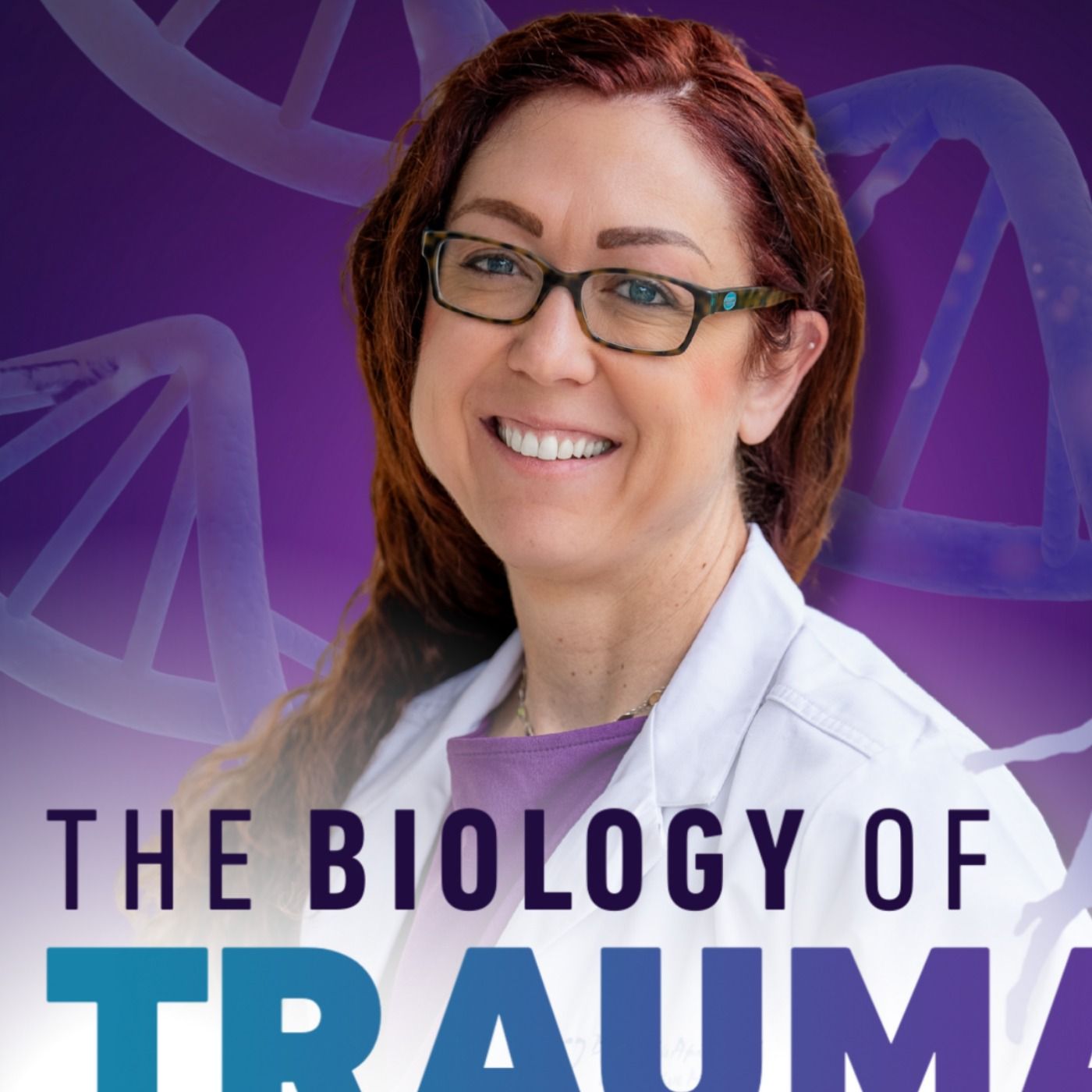
The Biology of Trauma® With Dr. Aimie
Dr. Aimie Apigian
People are done dancing around the topic of trauma. They're ready to face this square-on. None
of the current systems are getting to the root of the issue in the current model. Their biology has
been affected on a cellular level, and that is now what's preventing the important work that
they're trying to do.
The Biology of Trauma® podcast is the missing piece to that puzzle. It's a practical living manual for the human body in a modern, traumatizing world. Join your host, Dr. Aimie Apigian—a medical physician and expert in attachment, trauma, and addiction—as she challenges outdated trauma paradigms and introduces a new model for healing.
of the current systems are getting to the root of the issue in the current model. Their biology has
been affected on a cellular level, and that is now what's preventing the important work that
they're trying to do.
The Biology of Trauma® podcast is the missing piece to that puzzle. It's a practical living manual for the human body in a modern, traumatizing world. Join your host, Dr. Aimie Apigian—a medical physician and expert in attachment, trauma, and addiction—as she challenges outdated trauma paradigms and introduces a new model for healing.
Episodes
Mentioned books

May 12, 2026 • 43min
EP 173: What Sugar, Bread, and Salt Reveal About Your Nervous System in Menopause
Food cravings are not a willpower problem. They are messages from a nervous system trying to survive. In this episode, Dr. Aimie Apigian maps the cortisol, blood sugar, and inflammation patterns behind cravings, why menopause makes them louder, and how stored trauma in the body keeps the loop running.
➡️ Full show notes: EP 173: What Sugar, Bread, and Salt Reveal About Your Nervous System in Menopause
In This Episode You'll Learn:
01:00 — What does it mean that cravings are a survival strategy?
02:30 — Why do hormone shifts in menopause make cravings louder?
03:30 — How does blood sugar trigger the nervous system's danger response?
05:30 — What is actually happening at 3 PM when sugar cravings hit?
07:30 — Why does cortisol stop following its normal rhythm?
10:00 — Why does gluten bind the same receptors as opiates?
12:30 — How did Dr. Aimie's own bread cravings reveal childhood programming?
16:30 — How does gut inflammation reach the brain through the vagus nerve?
18:30 — What do salt cravings reveal about adrenal function?
22:30 — Why did Maria's grandmother's cookies become a craving in midlife?
27:00 — What is the neural pathway behind comfort foods?
28:30 — Why does food become emotional regulation when other tools are missing?
30:30 — Why does everything biological get louder in menopause?
34:00 — Why is chronic stress different from a chronic trauma response?
36:30 — How do leptin, ghrelin, and sleep loss feed the craving cycle?
38:00 — What is the path forward when cravings are running the show?
Resources/Guides:
Read The Biology of Trauma, Chapter 14: Support: Building Regulation Through Repair. Goes deeper into the neurotransmitter, blood sugar, and gluten science discussed in this episode.
Program: Foundational Journey — A six-week online process working directly with the nervous system. Where course members practice the exact survival-strategy awareness, somatic tools, and pacing skills that have to come first before the deeper work with stored trauma can hold.
Steps to Identify and Heal Trauma — A Roadmap for Healing. A 23-page guide and assessment quiz to help you recognize whether your body is carrying stored trauma. Use cravings as one of the windows. Download the guide
Related Podcast Episodes:
Episode 171: Is Your Chocolate Holding Your Marriage Together? | With Luis Mojica
Episode 168: What Stored Trauma Does to Your Hormones?
Episode 164: Could Your Trauma Be Disrupting Your Metabolism? The Weight Health Conversation
May 7, 2026 • 49min
Mother Hunger: The 3 Qualities of Maternal Love with Kelly McDaniel
Mother hunger is what the body carries when it missed one of three essential elements of maternal care: nurture, protection, or guidance.
On this Mother's Day Bonus Episode, Dr. Aimie sits down with Kelly McDaniel — author of Mother Hunger — to map the biology underneath. They walk through how unmet nurture shapes adult eating patterns, how unmet protection leaves a nervous system that never learned to settle, and how unmet guidance can leave a daughter inheriting the wound her mother could not heal.
This is not about blaming any mother. It is about giving language to what the body has been holding so the work of repair can begin.
➡️ Full show notes: Mother Hunger: What the Body Carries When Nurture, Protection, and Guidance Are Missing
In This Episode You'll Learn:
[00:00] Why a high-functioning life can still carry a hunger for maternal love
[02:00] Why is the biological mother described as your 'first home'?
[09:00] What are the three essential elements of maternal love?
[15:00] How does unmet nurture show up in adult eating patterns?
[22:00] What does protection actually mean for an infant nervous system?
[28:00] Why does the embodiment of rejection persist into adult life?
[32:00] What is guidance, and why does it look different for daughters than for sons?
[36:00] What happens when a daughter becomes her mother's confidant?
[41:00] What does it mean to reclaim the tender parts of yourself?
[44:00] Why mother hunger requires relational repair to heal
Resources/Guides:
Mother Hunger: How Adult Daughters Can Understand and Heal from Lost Nurturance, Protection, and Guidance — by Kelly McDaniel
Free Guide: Attachment Trauma Roadmap — Dr. Aimie's free guide on how the nervous system shapes attachment and where repair begins ·
The Biology of Trauma by Dr. Aimie Apigian — the underlying science of how attachment patterns become biology
Kelly McDaniel's website
Related Podcast Episodes:
EP 69: How Attachment Shapes Our Biology and Behavior with Dr. Aimie Apigian
EP 167: Did Attachment Trauma Start Before You Had Memories?
EP 171: Is Your Chocolate Holding Your Marriage Together? | With Luis Mojica
May 5, 2026 • 53min
The 3 Hidden Costs of Being the Strong One - Burnout's Real Biology
➡️ Get the full show notes and episode breakdown at Biology of Trauma® Podcast - The 3 Hidden Costs of Being the Strong One - Burnout's Real Biology
You've been the strong one. The one who keeps everything running. The one others lean on when things fall apart.
Your body has been keeping score. And the bill has three items.
There is a specific biology behind the pattern of holding everything together. It is not a personality trait. It is a nervous system response — and it carries three hidden costs most people never connect to the same source.
In this episode of The Biology of Trauma® Podcast, Dr. Aimie Apigian — double board-certified physician and author of The Biology of Trauma — takes you inside the biology of what actually happens when a nervous system crosses from stress into overwhelm, and names the three hidden costs of a body that never resets back to safety.
One is the reason you cannot rest, even when you are exhausted. One is the reason you no longer recognize yourself. And one is the reason your body has stopped repairing the way it is built to repair.
The episode ends with a map. Three phases. A sequence. And the reason the sequence matters more than any single tool.
In This Episode You'll Learn:
[01:00] What happens inside the body when a lifetime of holding everything together becomes the default setting?
[02:22] What is the body's full response to danger — from startle to stress to the critical line of overwhelm?
[04:31] What is the specific threshold where the body shifts from stress into shutdown — and why is that line so important?
[06:56] Why does the body lock into a survival loop when no full reset to safety occurs?
[08:49] How does the body signal that it is stuck in the Body-Trauma Loop — and what does that feel like from the inside?
[13:00] What is the first hidden cost — and why can't the body access real rest in survival mode?
[23:20] What is the second hidden cost — the survival strategies that quietly replace who you really are?
[29:23] What is the third hidden cost — and why do survival mode and repair mode block each other at the biological level?
[37:57] What would actually happen if you stopped holding everything together — and what is the body protecting against?
[42:12] How does the Recognize → Reasons → Repair framework apply to the pattern of over-functioning?
[46:00] What are the three phases of the healing journey — Safety → Support → Expansion — and why does the sequence matter?
Resources/Guides:
Free Guide: Steps to Identify and Heal Trauma by Dr. Aimie Apigian — This 23-page guide includes the quiz Dr. Aimie references in the closing of this episode. A starting place for recognizing stored trauma in the body.
Book: The Biology of Trauma by Dr. Aimie Apigian — Chapter 9 covers neuroception. Chapter 11 covers how attachment and early life shape neuroception. Chapter 12 lays out the Safety → Support → Expansion sequence referenced in this episode.
Program: Foundational Journey — A six-week online process working directly with the nervous system. Where course members practice the exact exercises and sequence that establish a biology of safety that has to come first before anything else can hold.
Related Podcast Episodes:
Episode 48 — How to Heal Bracing and Hypervigilance with Cat Dillon
Episode 68 — Struggling with Sleep? How to Regain Restful Nights with Suzie Sink
Episode 79 — How Chronic Health Challenges and Your Work Impact Each Other with Sally Riggs
Episode 126 — Neuroception Explained: How Your Nervous System Decides What's Safe and Why It Matters for Healing
Episode 127: Why Your Body Is Wired for Danger: Understanding Trauma's Impact on Your Nervous System
Episode 129 — Why You're Still in Survival Mode (Even After Years of Therapy and Healing Work)
Episode 134 — The Biology of Overwhelm: Why Small Demands Feel Impossible
Episode 135 — The Hidden Difference Between Stress and Trauma in How the Body Keeps Score
Episode 138 — Why Your Body Holds On When Your Mind Has Healed with Dr. Aimie Apigian
Apr 28, 2026 • 36min
Is Your Chocolate Holding Your Marriage Together? | With Luis Mojica
➡️ Get the full show notes and episode breakdown at Biology of Trauma® Podcast - Is Your Chocolate Holding Your Marriage Together? | With Luis Mojica
Three women walked into Luis Mojica's nutrition practice with the same chocolate habit. When he asked each one what would happen if they stopped, the answer was identical — "I'd leave my husband." That moment became the birthplace of food therapy.
In this episode, Dr. Aimie Apigian and somatic nutritionist Luis Mojica break down the three unmet needs driving food choices — emotional, relational, and nutritional — and how stimulants, depressants, and balancing foods each shape the stress response.
In This Episode You'll Learn:
[00:00] Introduction to food-induced stress
[02:30] Why Luis wrote Food Therapy — the gap he saw in the trauma and nutrition fields
[03:54] Why food can create a stress response — not just numb one
[04:54] Why does insulin trigger adrenaline — and what that means for chronic stress
[05:20] How do stimulants, depressants, and balancing foods each affect the nervous system?
[06:29] How a functional freeze pattern shows up in your food choices
[07:54] Why coffee energy is really adrenaline in disguise
[10:41] What are the three categories of unmet needs behind every food craving?
[18:13] What question unlocks the real unmet need behind a food pattern?
[20:34] What food addiction actually is through a nervous system lens
[23:07] Why cold-turkey dietary changes can feel like a threat to the body
[24:44] What "food sobriety" actually requires of the nervous system
[27:37] Why weight after trauma has biological logic — and what releasing it feels like
[28:56] The three answers Luis kept hearing when he asked women about chocolate
[30:11] Inside Luis's book Food Therapy — who he wrote it for and the one question it all comes down to
Resources/Guides:
Food Therapy by Luis Mojica: Conscious Eating to Navigate Anxiety, Stress, and Trauma
Luis Mojica's website — For more on somatic nutrition and reading your body's response to food
Book: The Biology of Trauma by Dr. Aimie Apigian — Chapter 9 covers the patterns of stored trauma in our behaviors, and Chapter 15 covers the biochemistry of dysregulation explored in this episode
Related Podcast Episodes:
EP 164 — Your Best Shot: Weight, Metabolism & GLP-1 with Ashley Koff
EP 163 — Growing Up with Addiction with Dr. Tian Dayton
EP 153 — The Biology of Burnout: Why Pushing Through Stops Working
EP 150 — Frozen in Success: The Biology of Staying Stuck in Survival
EP 134 — The Biology of Overwhelm: Why Small Demands Feel Impossible
EP 129 — Why You're Still in Survival Mode (Even After Years of Therapy)
Apr 21, 2026 • 34min
What If Safety Is What Your Body Was Taught to Fear?
➡️ Get the full show notes and episode breakdown at Biology of Trauma® Podcast - EP 170: What If Safety Is What Your Body Was Taught to Fear?
You learned to assess the mood of a room before you walked into it. To listen to the sounds in the house before you got out of bed. To become whoever was needed — quickly, automatically, without being asked. Your nervous system built that skill before you had language for it. And it has been running ever since.
In this episode, Dr. Aimie Apigian explains what growing up in an emotionally unsafe or narcissistic household actually does to the developing nervous system — why hypervigilance, people-pleasing, and the inability to fully rest are biological adaptations rather than personality traits, why genuine safety can feel more threatening than the chaos the body learned to navigate, and what it takes to teach a body that has never fully rested that it is now allowed to.
This is the biology behind something many people have spent years trying to understand about themselves. Not what happened to them. What happened inside them — and what it will take to change it.
In This Episode You'll Learn:
[00:00] Why is it so hard to relax even when nothing is wrong — and what is actually happening in the body?
[01:40] What is the biological definition of trauma — and why does the event matter far less than the body's response?
[04:00] What does unpredictable parenting do to a child's developing nervous system?
[06:04] Why do people-pleasing and overachieving become biological survival strategies — not personality traits?
[07:28] What happens in the body during chronic hypervigilance?
[08:43] When does relational stress start to register as a life threat — and why does this persist into adulthood?
[11:00] How does dissociation develop as a biological coping mechanism — and why can't we selectively numb pain?
[12:26] Why we cannot feel joy when we learn to numb pain?
[17:00] Why is seeking safety not the same as finding it?
[19:15] What is true safety? Why does true safety feel unsafe?
[21:04] What is microdosing safety — and how does it reprogram a nervous system that has never fully rested?
[23:42] Why is it important to create a cellular level biology of safety?
[26:00] Why safety needs to be done in a structured way
[31:31] Why not analyzing and feeling what we feel can be so challenging?
Resources/Guides:
Free Guide: Steps to Identify and Heal Trauma by Dr. Aimie Apigian — A 23-page quiz-based guide to help you recognize the patterns of stored trauma in your life, your relationships, and your physical health.
Book: The Biology of Trauma by Dr. Aimie Apigian — Chapter 11 covers the biology of toxic and narcissistic parenting. Chapter 4 explains the Cell Danger Response and how the body encodes early experiences.
Program: Foundational Journey® — A six-week online process working directly with the nervous system. Builds the biological foundation of safety that has to come first before anything else can hold.
Related Podcast Episodes:
Episode 69 — How Attachment Shapes Our Biology and Behavior
Episode 126 — Neuroception Explained: How Your Nervous System Decides What's Safe and Why It Matters for Healing
Episode 127 — Why Your Body Is Wired for Danger: Understanding Trauma's Impact on Your Nervous System
Episode 135 — The Hidden Difference Between Stress and Trauma In How The Body Keeps Score
Episode 138 — Why Your Body Holds On When Your Mind Has Healed
Episode 146 — How Attachment Affects Us for Life: 6 Childhood Pains and How to Repair
Episode 163 — Growing Up With Addiction Left a Trauma Your Body Still Carries
Episode 167 — What Your Nervous System Learned Before You Could Speak
Apr 14, 2026 • 50min
Is Your Body Still Running a Trauma Response?
➡️ Get the full show notes and episode breakdown at Biology of Trauma® Podcast - Is Your Body Still Running a Trauma Response?
What if the anxiety that will not settle, the fatigue that sleep does not fix, and the chronic health conditions that appeared out of nowhere are not separate problems? What if they are the same pattern — the nervous system running a stored trauma response it was never able to complete?
In this solo episode, Dr. Aimie Apigian walks through the biology of how trauma gets stored in the nervous system, why the event matters far less than what the body did with it, and what the body actually needs to begin to update. She covers the five physiological steps into a trauma response — from startle through shutdown — the four patterns stored trauma produces in daily life, what true resilience looks like in biological terms rather than the push-through performance most people were praised for as children, and the practical things that shift the biology: adrenaline discharge, magnesium, zinc, sleep, movement, and specific supplements that support what the nervous system is trying to do. In her study of somatic therapy participants, the group doing somatic exercises alone — before any supplementation — reduced depression by 30%.
She also traces the origin of the ACE study — which began in Dr. Vincent Felitti's obesity clinic in San Diego when patients who were losing weight started dropping out, and shared that the overeating was not the problem. It was the solution. And what it was a solution to was the trauma the body had been holding long before the weight arrived.
This episode is for anyone who has been managing symptoms for years and is ready to understand what the body has actually been holding — and what it needs.
In This Episode You'll Learn:
[00:00] Why do you keep struggling even when you have done so much to feel well?
[03:28] What is the biological definition of trauma — and why does the event matter far less than the body's response?
[05:09] How does the nervous system store a trauma response — and why does incomplete trauma physiology persist in the body?
[09:53] What are the five physiological steps the body takes into a trauma response?
[15:54] Why does carrying stored trauma cost so much energy?
[17:54] What is the ACE study — where did it begin and what does it reveal about childhood and adult chronic illness?
[26:00] What are the four patterns of stored trauma — and what is a survival strategy actually doing?
[33:47] What is true resilience — and why does being praised for resilience sometimes mean the opposite?
[40:37] What can you actually do about adrenaline — zinc, magnesium, movement, lentils, specific supplements?
[45:29] What is the biological connection between stored trauma and disrupted sleep — and what drives it?
Resources/Guides:
Free Guide: Steps to Identify and Heal Trauma by Dr. Aimie Apigian A quiz-based guide to help you recognize the patterns of stored trauma in your life, your relationships, and your physical health.
Book: The Biology of Trauma by Dr. Aimie Apigian — Chapter 1 covers the five physiological steps of the trauma response. Chapter 9 covers the four patterns of stored trauma. Chapter 12 covers the Biology of Trauma® framework and the essential sequence.
Program: Foundational Journey®— A six-week online process working directly with the nervous system. Builds the biological foundation of safety that has to come first before anything else can hold.
Related Podcast Episodes:
Episode 69 — How Attachment Shapes Our Biology and Behavior
Episode 135 — The Hidden Difference Between Stress and Trauma In How The Body Keeps Score
Episode 146 — How Attachment Affects Us for Life: 6 Childhood Pains and How to Repair
Apr 7, 2026 • 41min
What Stored Trauma Does to Your Hormones?
➡️ Get the full show notes and episode breakdown at Biology of Trauma® Podcast - Why Menopause Is When Your Stored Trauma Finally Surfaces
What if the anxiety, the depression, the rage, and the emotional floods did not begin with perimenopause and have been there all along? And menopause is simply when the body can no longer hold them? What if your childhood ACE score is one of the strongest predictors of how severe your menopause experience will be?
In this episode, Dr. Aimie talks with Dr. Betty Murray, hormone metabolism expert and functional medicine PhD, to connect two things medicine has kept separate for too long: stored trauma and hormonal health. Estrogen has receptors on every cell in the body except two. When it declines, every cell registers it — and for women carrying decades of chronic stress and stored trauma, that decline removes part of the biological buffer that was holding everything together.
Dr. Aimie brings the trauma biology (as referenced in the ACE research, the PTSD and estrogen study) and the Biology of Trauma® framework that explains why menopause is the moment when what the body has been holding finally surfaces. Dr. Murray's hormone science confirms what that framework predicts: how a trauma-informed approach can actually help, why bioidentical hormones and the right labs matter, what the 10-million-woman study actually found, and how the Women's Health Initiative misrepresentation changed women's care for decades.
This episode is for every woman who has been handed a prescription instead of a conversation about her hormones.
In This Episode You'll Learn:
[00:00] Why are hormones, buried emotions, and stored trauma connected — and why is menopause when it all surfaces?
[04:45] What is the new lens for reading hormone labs — and why does dosing one-size-fits-all fail 75% of women?
[08:00] What is actually happening biologically when a woman in perimenopause feels rage, anxiety, brain fog, and emotional sensitivity?
[8:49] How do estrogen’s receptors on every cell in the body explain the scope of menopause symptoms?
[10:51] What did a 6,000-woman PTSD study reveal about the relationship between estrogen levels and trauma symptom severity?
[14:14] What labs should be tested, when should they be tested, and why does the phase of perimenopause change what you are looking for?
[21:21] Is the depression diagnosed during menopause actually depression — or a hormone picture being handed an antidepressant?
[22:36] How do adverse childhood experiences raise the risk for first-episode major depression during menopause?
[27:35] What is the difference between bioidentical and synthetic hormones — and why does delivery mechanism matter?
[31:44] What does the 10-million-women retrospective study actually show about hormone replacement and all-cause mortality?
[36:41] What did the Women’s Health Initiative actually find — and how was a non-statistically significant finding turned into a 25% headline?
[38:42] What does Dr. Betty Murray want every woman to know before she leaves this conversation?
Resources/Guides:
Dr. Betty Murray — Hormone metabolism expert and functional medicine clinician with over 20 years of experience in women's hormonal health, host of the Menopause Mastery podcast, and founder of The Menrva Project — an AI-powered telemedicine platform personalising menopause care across all 50 states.
Free Guide: Steps to Identify and Heal Trauma by Dr. Aimie Apigian to help you understand what your body has been holding and how to begin working with it.
The Biology of Trauma Book by Dr. Aimie Apigian — Where you can read Chapter 11 on how early life experiences become the preexisting filter through which every subsequent stress — including the hormonal shifts of menopause — is experienced.
Foundational Journey — If this episode made you realize that stored trauma may be part of what you are experiencing in perimenopause, the Foundational Journey® is where we begin. A six-week online process working directly with the nervous system — building the biological foundation that has to come first
Related Podcast Episodes:
Episode 69 — How Attachment Shapes Our Biology and Behavior
Episode 135 — The Hidden Difference Between Stress and Trauma
Episode 146 — How Attachment Affects Us for Life
Mar 31, 2026 • 39min
Did Attachment Trauma Start Before You Had Memories?
➡️ Get the full show notes and episode breakdown at Biology of Trauma® Podcast - What Did Your First Year of Life Teach Your Body About Safety?
What if the patterns you've called personality — the distrust, the hyper-independence, the certainty that your needs are too much — were never personality at all? What if they are the nervous system doing exactly what it learned to do before you had a single memory to show for it?
Attachment trauma persists in the body as implicit survival programming — not as memory, but as an operating assumption the nervous system keeps running long after the original environment has changed. In this episode, Dr. Aimie Apigian traces the attachment and trust cycle — the precise biological sequence in the first year of life that either builds or disrupts the nervous system's capacity for safety and connection. When that cycle breaks down, the body adapts. Those adaptations don't feel like adaptations. They feel like identity.
Using the Biology of Trauma® framework, Dr. Aimie unpacks why attachment trauma patterns feel like personality rather than learned survival strategies, how children lose themselves to preserve the bond — the attachment vs. authenticity tension — and what that costs the body decades later. She also addresses why adrenaline, not cortisol, is the real driver of the stress response, and what the biological link between early attachment trauma and adult chronic illness actually looks like in the nervous system.
This episode is for anyone whose body has been holding patterns that predate any story they can tell about themselves.
In This Episode You'll Learn:
[00:00] What does it mean when your body learned danger before you had words?
[02:00] What happens to a nervous system that doesn't get held enough — and what does a baby's body conclude about the world?
[02:59] What does being born premature, adopted, or with a cord around your neck do to a nervous system that has no words yet?
[06:18] What is the attachment and trust cycle — and is your first year of life still running your relationships today?
[09:00] What does it do to a nervous system when needs are met with joy — versus met with burden?
[13:49] What are the five steps the body takes into a trauma response — and how do you know which one you're in?
[18:31] What is the attachment versus authenticity tension — and what does a child abandon to stay connected?
[22:00] What does it look like when a nervous system loops between stress and overwhelm — and never actually feels safe?
[25:45] How did Dr. Aimie recognize her own stored trauma — even when she didn't think she'd had any?
[29:00] What is the difference between stress and trauma — physiologically, not just emotionally?
[33:17] What does cortisol actually do in the stress response — and why is targeting cortisol the wrong place to start?
[38:33] Where do you go from here — the Attachment Trauma Roadmap, the book, and what your nervous system needs next?
Resources/Guides:
Free Guide: Attachment Trauma Roadmap — Learn how your nervous system's early attachment experiences affect your sense of safety in relationships now, and where to begin.
Book: The Biology of Trauma Book by Dr. Aimie Apigian — Chapter 9 covers the patterns of stored trauma; Chapter 11 explores how attachment becomes the lens through which we see the world.
Related Podcast Episodes:
Episode 69 — How Attachment Shapes Our Biology and Behavior
Episode 59 — How to Parent Adopted Children with Early Life Trauma with Robin Karr-Morse
Episode 135 — The Hidden Difference Between Stress and Trauma In How The Body Keeps Score
Mar 24, 2026 • 23min
What Does Overwhelm Have To Do With Chronic Pain?
➡️ Get the full show notes and episode breakdown at Biology of Trauma® Podcast— What Does Overwhelm Have To Do With Chronic Pain?
If you have chronic pain, you've probably been told that stress is making it worse. But here's what the biology actually shows: by the time your pain is flaring, you're past stress. You've crossed into overwhelm — and that changes everything about what your body can do.
In this episode, Dr. Aimie Apigian — double board-certified physician and author of The Biology of Trauma® — explains why chronic pain and chronic trauma follow the same biological pattern, and exactly how the body gets stuck in cycles that feel impossible to interrupt.
Once the nervous system crosses the critical line of overwhelm, three survival strategies take over: dissociation, immobilization, and energy conservation. Healing goes offline. That's not a failure of your approach. That's a shift in operating mode — one where the body only has enough energy to survive.
What determines whether a flare happens is neuroception — the nervous system's subconscious safety scan, running below conscious awareness at all times. When it reads threat, the physiology shifts. That shift is where chronic pain lives.
What moves this pattern is building capacity through five specific nervous system skills — so the body spends more time below the line, where healing is actually possible.
In This Episode You'll Learn:
[00:00] Why chronic pain is an overwhelm problem — not a stress problem
[01:34] How pain becomes chronic and why it follows the same biological pattern as trauma
[03:06] Stress is not trauma and trauma is not stress
[03:20] What the critical line of overwhelm is — and why the body stays braced long after the danger is gone
[05:59] The Loop and what it does to the body's healing mechanisms
[08:11] How adrenaline suppresses pain during stress — and what happens when it's removed in overwhelm
[08:49] What microglia are and why they follow the same threshold pattern as the nervous system
[09:30] The three survival strategies the body activates past the critical line — dissociation, freeze, and energy conservation
[11:40] What neuroception is and why it controls whether a pain flare happens
[13:42] Why capacity — not stress — determines where your critical line sits
[15:10] The five nervous system skills that build capacity before the line is crossed - that every adult and every person with chronic pain needs to know — what each skill does and why it matters
[17:44] Why we only go as fast as the slowest part of me feels safe to go
[18:44] How to interrupt a chronic pain cycle before it crosses the line
[20:52] The Three Rs framework — how to recognize, understand, and repair a chronic pain pattern
[22:40] Key Takeaways And Guide
Resources/Guides:
Book: The Biology of Trauma®Book by Dr. Aimie Apigian— Chapter 1 covers the body's trauma response, the critical line of overwhelm, and the steps by which both trauma and pain become chronic. The Nervous System Journal is available at: biologyoftrauma.com/book
Free Guide: A Guide For The Chronic Freeze Response — Learn what to do (and what to avoid) when your body gets stuck in freeze mode, including the survival strategies covered in this episode.
Mar 17, 2026 • 45min
Is Being "Good" a Trauma Response? The Biology of Proving Worth
➡️ Get the full show notes and episode breakdown at Biology of Trauma® Podcast - Is the Need to Always Be “Good” a Trauma Response?
What does your body do with guilt it can never undo?
Have you ever done everything right — and still felt something unresolved living in your body?
Maybe it's not a dramatic story. Maybe it's just a moment you can't stop replaying. A decision you can't forgive yourself for. A version of you that acted against your own values — and your nervous system never got the memo that it's over.
That's what this episode is about.
Gregg Ward accidentally took someone's life at 18. For 46 years, it lived in his body — flushed skin, tense shoulders, a loop that no amount of success, service, or self-improvement could stop. In this conversation with Dr. Aimie, he shares what moral injury actually is, why the body keeps reliving a story with no ending, and how movement became his nervous system's path through what therapy alone couldn't reach.
This is not a story about grief resolved. It's a story about grief metabolized. And the moment the burden finally lifted — not when the pain disappeared, but when the purpose stopped being about him.
If something in you has never fully quieted — no matter how much work you've done — this conversation was made for you.
Gregg Ward is the founder and Executive Director of the Center for Respectful Leadership. He is a global speaker, thought leader, and bestselling author. Gregg’s TEDx San Diego talk has been selected for TED Global publication.
Resources/Guides:
Centerforrespectfulleadership.org — Gregg Ward — Center for Respectful Leadership
Confessions of An Accidental Killer — Gregg Ward — TEDx San Diego
hyacinthfellowship.org — Hyacinth Fellowship
The Biology of Trauma®Book by Dr. Aimie Apigian — Where you can read Section 2 — starting with chapter 6 which explains the mechanism by which the body keeps score, even of regret.
Free Guide: Steps to Identify and Heal Trauma by Dr. Aimie Apigian
Related Podcast Episodes:
Episode 35: 5 Ways How Polyvagal Theory Helps With Trauma Work with Stephen Porges
Episode 76: Polyvagal Theory: Become an Active Operator of Your Nervous System During Grief with Deb Dana
Episode 114: The Science Behind Why We Can't 'Get Over' Loss And How to Grieve with Dr. Mary-Frances O'Connor
Episode 124: Grief and Gut Health: Is It Just Emotional or Something More?
Episode 126: Neuroception Explained: How Your Nervous System Decides What's Safe and Why It Matters for Healing
Episode 127: Why Your Body Is Wired for Danger: Understanding Trauma's Impact on Your Nervous System
Episode 135: The Hidden Difference Between Stress and Trauma In How The Body Keeps Score
Episode 138: Why Your Body Holds On When Your Mind Has Healed with Dr. Aimie Apigian

