

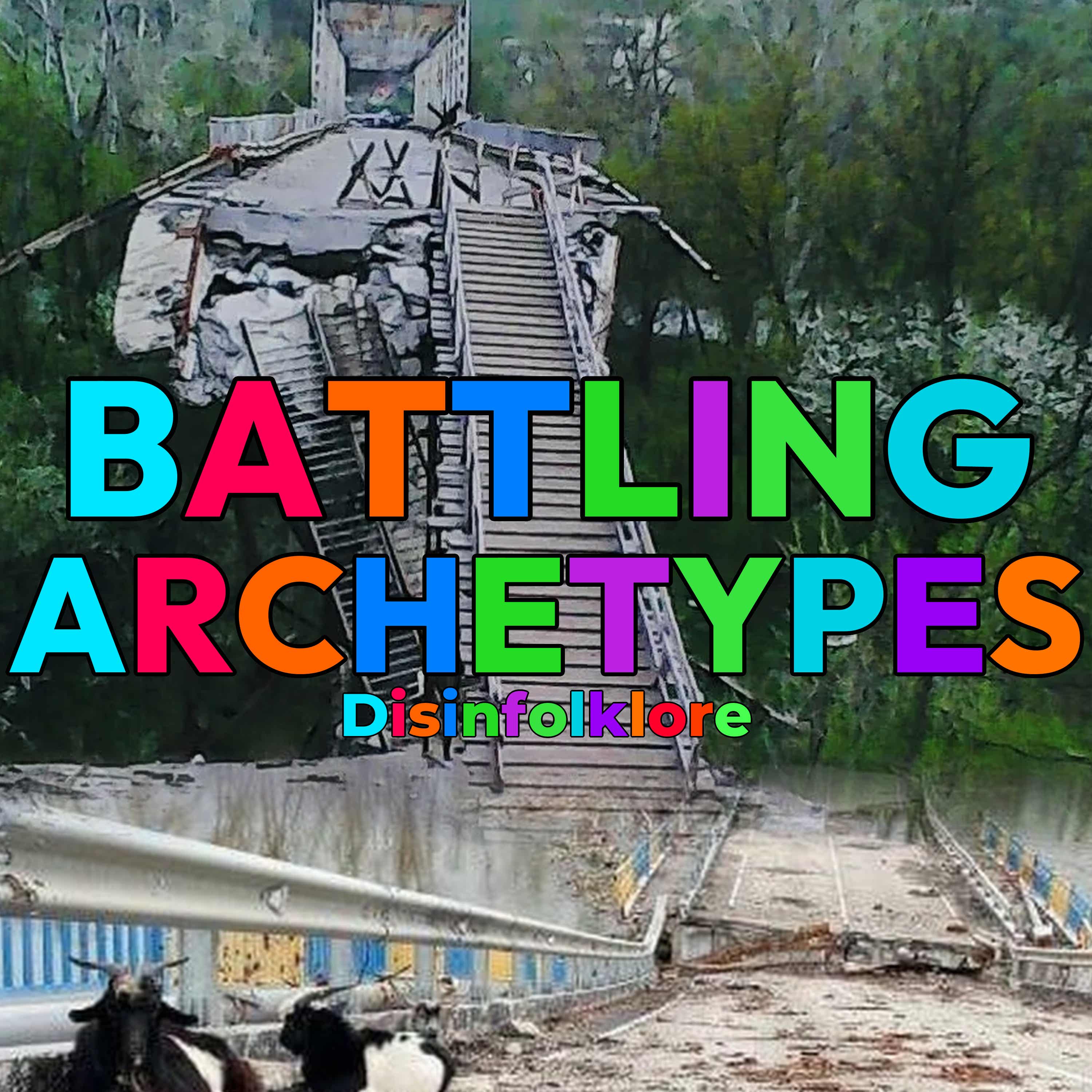
Battling Archetypes
Disinfolklore
Battling Archetypes applies the Twelve Tools of the Disinfolklore analytical method to the folkloric structures hiding inside modern propaganda, memes, and geopolitics. Each episode decodes how Russia, MAGA, and other Disinfolklorists archetype reality — and how Counter Disinfolklore can unmask the wolf in sheep’s clothing. www.disinfolklore.net
Episodes
Mentioned books

Jan 15, 2026 • 1h 5min
Podcast | What's 'Folklore' about Disinfolklore?
Last week I was right back at the bridge at Stanytsia Luhanska and I went through the luxury sausage troll saga and the complicity between the activities which the Russians, and indeed the Ukrainians, create on the ground, but then the complicity between these actual activities and how the Russian Disinfolklore apparatus, the propaganda apparatus, then spins these actual events.What I wanted to talk about today was the folkloric dimension of the bridge, because that’s obviously quite fundamental to Disinfolklore. I’m aware that most of us haven’t thought too much about folklore since we were children. I wanted to bring us through how I had this intuition — unwrapping that intuition that there was something folkloric about that situation — into what has now become the Disinfolklore analytical method.The saga of me and my Russian colleague featured in a whole array of Disinfolklore stories spun by the Russians. But there’s another aspect of the bridge and that situation I was in that struck me almost the first moment I was there.One thing I’ve noticed, by listening to Chuck Pfarrer since the Maria days, and Alan as well — I’ve actually learned quite a lot of how he thinks, how a Navy SEAL thinks and computes data. Every now and again, someone in my real life who doesn’t pay that much attention to Ukraine but is interested in what’s going on, I find myself speaking about what’s going on — like, for instance, about Pokrovsk in November — being able to channel what I was learning from Chuck Pfarrer and how he was looking at the battlefield. He didn’t think it would fall that easily. I realised I’ve actually learned quite a lot. A certain part of my mental architecture, the way I compute data, especially battlefield stuff, has really developed and evolved a great deal as a result of listening for three or four years to Chuck Pfarrer.By analogy, that’s what I’m trying to do with the Disinfolklore analytical method. I’m grateful for these opportunities, these shows, which is just to give an idea of how I think about this kind of data and how I control it going into my mind.But I didn’t start out that way. I forged the word Disinfolklore out of disinformation and folklore in February 2023. I established a folder on my computer in February 2020 called “Folklore.” That folder is where I was putting all these texts that I was reading to try and understand what trolls and trolling was about. Out of that initial attempt to look at how those terms were being used in the media, tracing them back — that led me on this massive journey, which I’m still on, into the origins of Indo-European languages, but also particularly through this data set I got from Factiva of tens of thousands of references to trolls and trolling.I had that folder on my computer called Folklore, and then disinformation, obviously, was one of the words. It could be misinformation or disinformation. In February 2023, I was trying to think of a way of how I can archetype everything I have learned since being on the bridge. That was February 2023, a year into the war as well, where I realised — because of my experience on this bridge from February 2015 onwards, seeing and looking at patterns and data — that I had a particular way of perceiving the daily diet of information we were receiving through X and through Telegram. At the time I was on Telegram and looking at it for the full-scale invasion.I spent the first month of the full-scale invasion collecting information for the OSCE’s Moscow Mechanism mission, which then in April 2022 produced the first report. It was charged by 44 countries, nation states, to inquire into Russia’s conduct of the war in Ukraine for the first month. That report was then cited in the definitive, historic, comprehensive 600-page judgment delivered by the European Court of Human Rights about three months ago on Russia’s violations of the European Convention on Human Rights.I was collecting this data initially to help these four jurists who were producing this report. But I found that I had a particular perspective on it that was worth sharing. I was looking for a means of naming it, naming what I was doing. I consciously sat down one day and wrote down “disinformation” and then “folklore.” Disinfolklore was then pretty obvious because of the F in disinformation overlapping with folklore. That’s where the moniker, the branding, was born.Instead of including the word folklore, I could have chosen song, or folk song, propaganda, stories, narratives, or a heap of other words to describe the new phenomenon I’ve identified. Folklore, however, captures best the way of seeing — in the sense of that brilliant book by Berger, Ways of Seeing, ways of looking at art. I think it’s from the early 70s. That title, that idea from Nietzsche as well — all knowledge is perspective. This idea of ways of seeing is as valid today, to see what I describe as Disinfolklore, as folklore was in Jacob Grimm or Herder’s times.I mentioned Herder’s call last week, in 1777, where he said: we’re under occupation by the French and we need to unite the 10 Germanic tribes. In order to do this, we need our Shakespeare. Where is our Shakespeare? We have no Shakespeare. He launched the folklore collection movement in Germany, which recruited the Grimm brothers later and Goethe.It’s quite amusing in a very nerdy way that one of the origin stories of the folklore movement is in Macpherson’s Ossian tales, which turned out to be faked. From the 18th century, they brought into the consciousness of all of Europe — Europe was basically convulsed by these stories of peasant wisdom and the found document, which is a trope across Indo-European culture, including in Tibetan Buddhism, of these documents which are suddenly found somewhere under a rock.Macpherson is the archetypal Disinfolklorist because he did communicate something very authentic — they’re mainly based on Irish folklore — but he did it in a deceptive manner. But who can blame him, because it was that work which then inspired Herder to realise: we can create a sense of national self-identity by collecting stories and finding the archetypal stories of the German people.For three years I had been researching Indo-European mythology and folklore — the three years before 2023, a year into the full-scale invasion. For three years I had been researching Indo-European mythology and folklore as a means of seeing how Russia and MAGA were using stories to create community. I was looking for that moniker, and then Disinfolklore just suddenly came to me — a bit like all those famous Eureka moments.When I arrived, the reason I had this folder called Folklore on my computer was, yes, I was trying to look at trolling and trolls. But from almost the very first moment I arrived at the bridge in Stanytsia Luhanska — which is on the Donets River, in a biosphere reserve area, beautiful forestry either side of the river, weeping willows whose leaves are falling into the river and whose boughs are bowed towards the river, and a bridge across it — on either side of the bridge were the Russian occupiers on one side and the Ukrainian defenders on the other, separated by a kilometre and a half. There were all these old houses, beautiful old wooden houses. Typically the architecture around that part of Ukraine is brick-built first storey, and then they have wooden tops.This didn’t fit my archetype of Russia or the Soviet Union, where I thought everyone lived in these horrible apartment blocks. That’s from the perspective of a bourgeois Westerner, where these apartment blocks generally seem like the equivalent that Americans see as projects. But now, having travelled a lot around central and eastern Europe, I realise that that archetypal meaning of these places is not consistent with the data — you have lovely, well-looked-after apartment blocks. To the untrained eye, they just look like a council estate in South London or something. But when you get close to them, you see a whole community of people looking after them, with people from all parts of society living in them.At the time, it was quite surprising to me that people in the former Soviet Union would live in these kinds of houses — I’d learned about collectivisation and getting rid of the kulaks. But eastern Ukraine, as we’ve probably all seen in these images, is a beautiful, amazingly beautiful place. There’s something folkloric about it, and I saw that the moment I arrived there, because my only reference point when I arrived was folklore and stories I had read in Ladybird books, or Hansel and Gretel, or from Disney films. A lot of the scenes I saw there — my only archetype in my consciousness was folklore. I had that intuition.I’m not going to say the first time I went to the bridge at Stanytsia Luhanska — we gradually moved there, closer there. The first day I arrived in Severodonetsk in this hotel called the Mir Hotel, which is now no longer with us, like so many buildings I know in Ukraine that have been destroyed and looted. I was only there for seven years. I often reflect on this: if so many places dear to me — including hotels I stayed in and my own house in Severodonetsk, which was destroyed, and my next-door neighbour was torn to pieces by Russian artillery, and then his friend went to rescue him and he was torn to pieces too — if I have had this experience, even though I only lived there for seven years, then what it must be like for Ukrainians to have whole cities and towns disappear from them. It often gives me an idea of the scale of the destruction.Sitting in the Mir Hotel in Severodonetsk, where I lived for my first year there, we gradually moved closer to Stanytsia Luhanska from Severodonetsk. It’s about 180 kilometres, and there were terrible roads. We would drive there each day, there and back. About a month after I arrived, we finally got to the bridge for the first time.Pretty early on, I intuited there was something folkloric about the situation. I had an intuition that folklore was connected to it. There’s this idea of a bridge — in folkloric tales, something mediating between worlds and other worlds. The bridge was both a metaphor and an actual fact.On the Russian-occupied side of the bridge, they were Wagner soldiers guarding it. Not only had they — by that time, this was before the mythology of the Wagner Group had really entered the mainstream. It’s probably a bit hard for us to remember this, but the Wagner Group really didn’t — most normal people didn’t know anything about Wagner Private Military Company until about 2022, 2023. People paying attention to Russia and Syria would have known about them. But in 2015, this was very close to their beginnings.From my earliest times there, I was coming across mythical stories about these guys, these amazing mercenaries. But what I was seeing in actuality was scrawny, scruffy mercenaries in really bad, unkempt uniforms. I was aware that something cynical was going on to create out of them this mythology about elite forces.While I was there, as all of us know, the initial resistance — and the hint that Ukraine would defeat Russia — was already visible in the period from April 2014 to September 2014. It was a ragtag group, mainly a couple of groups — Azov and Pravyi Sektor — composed out of football supporters’ clubs, mainly based in Kyiv, who became magnets for resistance to the Russians. With the help of some oligarch cash — in the case of the Dnipro 1 and Dnipro 2 battalions, which were paid for by Kolomoyskyi and Dnipro’s Jewish community who armed them and got them up — the storied second army in the world was already on the back foot by September 2014 by this ragtag group of people who became soldiers and now obviously are part of the Ukrainian military.A mirroring process went on in Russia-occupied Luhansk, where you had a lot of community groups of people just protecting their local community. Either they had believed the Disinfolklore about the Ukrainians coming to kill them, or they saw the rapacious mafia-run militias and wanted to protect their neighbourhoods. The Wagner Group were given the job of eliminating these groups of armed resisters and people who just wanted to protect their neighbourhood in Russia-occupied Luhansk. I was there while that was going on.Then, as I realised, they took their mythology from this guy who was supposedly killed in the aeroplane that supposedly killed the Chef. Again, another moniker from folklore, another archetypal moniker — Prigozhin, the Chef. He’s just Putin’s chef. He’s a restaurateur. He’s in catering. And yet he financed the operation which got Donald elected and got Brexit done.They took this ideology of Wagner — the German composer, who was part of Herder’s project. He was much later and Herder was well dead by then. But he continued, he was responding to Herder’s 1777 plea: where is our Shakespeare? We have to create songs. They weren’t even talking about stories like the Grimm brothers were collecting. Herder was talking about songs. Wagner helped create that sense of German identity with his songs and operas and shows, which were based on mythology that really only existed because the Roman historian Tacitus had collected these stories and published them in Latin in about 80 CE.A lot of what we know about the origins of the Germanic people — that Mannus had three sons — and a lot of the material I deal with in my Finding Manuland project comes from this Roman historian, recorded in Latin. Wagner the composer went back to this and created this sense of pride and unity in the German people.But the guy, Utkin, who supposedly formed the Wagner Group — he was fond of the aesthetics of the Nazis. Again, that’s the Russian account from 2016, which I preserved: “Who are the Wagner militaries?” And it’s like: “He’s not really a Nazi, he just likes the aesthetics of the Nazis.” But of course, the aesthetics of the Nazis — the uniforms and such — were very much part of how they brainwashed people and created their sense of identity. You can’t separate the aesthetics of the Nazis from what they do.They deliberately take this German composer, this high-art composer, which again trolls people into pronouncing it “Wagner.” You’ll notice I haven’t pronounced it “Wagner” because I don’t want to give it any positive connotations and I don’t want to communicate that I appreciate Wagner’s operas. Of course Wagner is a great composer. He can’t be blamed for Hitler. I’m not interested in that. What I am interested in is how, from the very early beginnings, the Russians were using this mythology about the Wagner Group — this elite force whose name came from someone whose entire intellectual project was to weave, out of mythology, out of archetypal Germanic mythology, a sense of collective identity — and how these operatives became characters inside Russia-occupied Ukraine and executed enormous numbers of people.In February 2022, they were given the job. It was the Wagner Group. I think it was Nile once who persuaded us on Volya, or on Maria at the time, that we should be subverting this and calling them “Wanger.” I’m happy to hear Mokrushyna has stuck with that, and I’ve stuck with it as well. Every now and again someone points out, “No, it’s not Wanger, it’s Wagner.”They create this mythology about a private military company. There’s something folkloric about that. There’s something folkloric about the whole structure of the position — the bridge, as I mentioned, dividing other worlds. One world from another: Russia-occupied Ukraine from government-controlled Ukraine, paradise from hell.In daily life on that bridge, most days I would speak to dozens of people and hear dozens of stories. Through my interpreter, through my amazing translators, I’d ask them: “Tell me about your journey today. How was it?” Luhansk City is about 14 kilometres away, but it might take them seven hours to travel that 14 kilometres. Russia specialises in creating these border zones. One of their unique skills is just to create hell on earth.The bridge was dividing other symbolic worlds — in folklore and in folktales — but also in actuality. The tales people spoke of, travelling from Russia-occupied Ukraine into there. That particular spot has been a boundary zone for millennia. The Donets, the Don River, is the dividing line according to Isidore of Seville, who was the Wikipedia of the 6th century. Your monastery was nothing if you didn’t have a copy — or it was everything if you had a copy — of Isidore of Seville’s Etymologies.The Don River, according to Isidore of Seville, is the dividing line with Asia. Everywhere east of the Don, the Tanais as Isidore calls it, is Asia. The Donets River itself, as the Little Don River, has been a boundary zone for millennia. And here it was a boundary zone again from 2015 onwards.In the Second World War — this always really blew my mind — it was also a boundary zone. The Nazis and the Soviets fought right there. In the forestry all around it was rusty old shrapnel from that time. Here it was again. It was paradise between 1945 and 2014. No one in 2013 would have predicted this was going to become a boundary zone again.Then there were the events, like I talked about last time — the luxury sausage troll saga — that almost led to war. These are folklore-like events.Recently I visited this amazing place in Turkey, Göbekli Tepe, which is often described as the first monumental site — basically three stone circles with lots of orthostats and designs from 12,000 years ago. It was discovered a decade or two ago. On these orthostats, on these stones, there are carved animals. The thing which affected me most was seeing birds — vultures with their wings spread. This same motif was in Babylon, the Hittites, and now many countries, including Russia, have the double-headed bird. I’ve seen the double-headed bird in Hittite art from about 1400 BCE on orthostats. Poland and loads of countries, America, have the eagle. To see that this was important enough in human culture 12,000 years ago totally blew my mind.They also had these boars — wild boars carved on the stones. This amazing wild boar which clearly had significant religious significance to these people living 12,000 years ago. And this really intricately designed boar’s head, with still the red paint on it, that was buried in this place, discovered maybe a bit by chance.That also added to my understanding of the luxury sausage troll saga, because you have this connection with pigs and boars going right back through folklore. Three little piggies going to market. We heard Putler describing Western politicians as piggies, basically lambs to the slaughter, using folkloric tropes. The luxury sausage troll saga itself had folkloric resonances, even though at the time I didn’t know about Göbekli Tepe. I was aware of the significance of pigs in Three Little Piggies and in folklore. That struck me at the time, and then obviously the weaving of this event — all of this archetypal Disinfolklore in Russian occupying media — was used to brainwash Ukrainians in Russia-occupied Ukraine into thinking that I, as a representative, as a diplomat from the international community sent there by 57 member states of the OSCE to help establish the facts in relation to particular incidents and to try and de-escalate the conflict — that they created Disinfolklore out of my presence there.Then there was the everyday heroism of ordinary people managing an extraordinary situation. It was mainly women, children, and older people of pension age who crossed this bridge every day — 10,000 civilians at the height going each way. At various stages over my three years there, we went through lots of different phases. Sometimes people would have to wait seven or eight hours, or overnight, on one side of the bridge.The main motivating factor for people from Russia-occupied Luhansk was that they came over the bridge to collect their pensions from the Ukrainian state in Stanytsia Luhanska and then return. In April 2014, about a million and a half people saw the writing on the wall and left Russia-occupied Ukraine and Crimea immediately. I met and got to know many who made that choice — they just left their apartments and never went back because they understood what was going to happen.But a lot of people didn’t leave. They may have had older parents, or they didn’t have the foresight. Maybe culturally they were closer to Moscow than to Kyiv. They might have just had a comfortable life there. Or maybe they were just stubborn, obstinate — who could have foreseen what was going to happen? So they decided to stay. Pensioners then had access to their pensions in Ukraine still. They crossed the bridge to physically collect them and go back.In my naivety at the time, I thought they’d come over to the other side of the bridge and see that Ukrainians aren’t devils. Therefore the Disinfolklore they were being subjected to, the brainwashing Disinfolklore, wouldn’t brainwash them as deeply in Russia-occupied Ukraine, because they were coming over to Ukraine, seeing normal people, and collecting their pension.But now I realise the power of Disinfolklore — and we see this with MAGA as well — it’s so powerful that it becomes the filter through which you perceive the entire world. People are willing to sacrifice their children or their family or their longest relationships. We see with anti-vax stuff: they’re willing to subject themselves to death because they believe RFK Jr.’s ideas — that eating raw meat, having a raw deer every day, eating dogs with brain worms inside them, is actually going to make you a lot stronger.Ideas are so strong — and this is the power of Disinfolklore. It’s a more common idea today for me to say this. It’s less controversial than it would have been before COVID or 10 years ago, because I would have always had this romantic notion that the will to survive would overcome ideas. But now I think we’ve seen enough of how people can be brainwashed to not need to be convinced that Disinfolklore can ruin lives, ruin families, and ruin Russia and Ukraine as well.The everyday heroism of ordinary people managing an extraordinary situation — mothers bringing children across the hellscape. That really struck me. Speaking to people about their experiences there every day and collecting those stories, which I wrote up faithfully in my reports — not that many people read them, even in my own organisation. But I did the best job I could to record their stories. Maybe one day I’ll publish them all.It was just very ordinary people, but the heroism of the mother, the young mother pretending to the child that this was completely normal, trying to coax the child across this one-and-a-half-kilometre stretch of land with the detritus of bullets and old artillery shells — just really grim stuff.I’m going to post now in the Purple Pill just some photos. I had to be careful about which photos I took there. But one Christmas, Christmas 2016, I systematically recorded the entire situation. You’ll see the apocalyptic scene I was dealing with and some of the heroic scenes — mothers with their children. There’s this picture I’ve just posted: a man looking at me very suspiciously as I took the photograph of him, pushing his mother in a wheelchair across this terrible space. You see the stone — “be careful of the mines.” This is common in folklore, where you just have ordinary people, archetypal normal people, in extraordinary situations.I never ceased to be amazed, especially because you didn’t have men of military age — generally speaking, they didn’t want to be in that space. You had a lot of smuggling going on, porters carrying things who were often young guys. There was a whole sub-economy there. But it was mainly older people who couldn’t be press-ganged or tortured or captured.I always used to think of my mother: imagine if she had to go across there.Then there was the idea of trolling of emotions — emotion-moving. Over the course of being there for three years, you become attached. I felt I owned the place in many respects, because no one else was witnessing it in the same way that I was. My team was, and when I left, it was time to leave because I would get emotional.The Russian occupiers were also looking at our internet profiles. By that time I had deleted my internet profiles. I didn’t appear on the internet again until I established a Medium account in the autumn of 2019, and then I started using Twitter in June 2021 after I had created Decoding Trolls and had an idea of the Code of Positive Trolls — so that I wasn’t just randomly tweeting stuff, but that it all adhered to this communications technique.The Russian occupiers — we had to cross and speak at multiple checkpoints. They were always trolling us, playing hardball, being mean, spinning wheeling tales. They were also looking at our internet profiles. Some of my colleagues hadn’t deleted theirs — I was told to delete my Facebook and everything when I started that job, and I dutifully did that. But most of my other colleagues didn’t. In some respects they paid a price, because it helped the Russians run operations against individuals.Then the link with artillery barrages as well, where I realised they’re about trolling people’s emotions. This whole discussion of the Oreshnik in Lviv the other day — I’m quite happy that now those who’ve paid attention to it, on the Times broadcast or the Telegraph podcast, are looking at it in the sense that this is an information attack, not a military strategy. I’m really happy about that level of awareness, because that was one of my main foundational intuitions in eastern Ukraine: sometimes these days of thousands of ceasefire violations by the Russians had exactly the same emotional impact on me as trolling by the Russian occupiers or online — where someone attacks you online and you feel this sense of “someone’s attacking me, I’m in danger.”That’s quite a sophisticated idea. We shouldn’t forget that Russia only said the purpose of this Oreshnik is to add weight to the mythical, mythological, disavowable attack on Putler’s residence. Note the posh term they use. And in response to that, “we fire the Oreshnik,” and then we’re supposed to go, “Oh, that adds credibility to the Disinfolklore.”I’m quite satisfied now that this idea — that Russia’s attacks on civilian infrastructure in Ukraine should mainly be understood on the level of Disinfolklore — is gaining traction. Going back to why I’m careful about sharing stuff: if that is their intention, they want to create horror, and somehow out of that horror — we saw ISIS doing this as well — that horror attracts people, like my Turkish colleague or my Kazakh colleague, into watching these horrible things. They’re keeping the trolls’ energy alive. Trolls, as far as I conceive of them now, die if no one keeps them alive. I try to be careful about perpetuating them.Then there was the other aspect: mythical happenings that only existed in Russian Disinfolklore. The Russian occupying media would talk about attacks which the Ukrainians had carried out. Often I was there when these mythological attacks appeared in their media, and they’d talk about them for weeks afterwards. I’d get a call from Kyiv or our operations team saying, “Tell me about this attack.” And it’s like: it didn’t happen. Because I was there. I know, or my colleague was there, and we know it didn’t happen.I realised that these things can be real even if they’re just in the information space. That’s the folkloric element — something feels so real and so vivid that you’re not quite sure whether it happened or not. Like a child getting really scared by a story, so scared they can’t sleep. Then they begin to think — even though they saw it in a film, a Disney film, a horror film, or on TikTok — you can’t really remember: is that real or not? Did it happen? It melds into our consciousness.Russia riffs off this — implanting artificial memories of what the USSR was like. Noticing that you can create prosthetic memories in people’s minds. We’ve talked about that before.The other folkloric aspect was this concept in art, especially in classical stories, called in quite posh Latin, locus amoenus. The definition of a locus amoenus is a pleasant spot — a phrase used by modern scholars to refer to a set description of an idyllic landscape, typically containing trees and shade, a grassy meadow, running water, songbirds, and cool breezes. The tradition goes back to Homer’s descriptions of the Grotto of Calypso and the Garden of Alcinous.This folkloric aspect: even though it was hell on earth a lot of the time, I never lost sight of the beauty of that place. I longed to return there after the de-occupation because it was a pleasant spot. It had the birds, the grassy meadows, the running water, the cool breezes, the trees, the shade. I had that intimation the first time I was there.Another dimension of that situation was the people who themselves were archetypes. The leader of the Russian occupiers, until he went missing — someone said, “Oh, he’s probably gone on leave,” and it’s like, no, you don’t go on leave — you get eliminated. He used to spin these tales. Every morning I would go down there and say, “So what happened last night?” and he’d always have a story for me, knowing I would then put it word for word in my report. He described himself as “a simple forester.” That’s a classic archetype from folklore.Soldiers, knights, nurses, villagers, knaves, damsels in distress, invaders, trolls, villains, mercenaries, defenders, and animals of all kinds being led across the bridge — it was like a living folktale. Like Mokrushyna’s front room when she’s doing her show and the cats are having all these adventures. Great stories are being created all the time.There were these archetypes there. That’s a narrow meaning of archetype by comparison to how I now use the idea of archetyping — where Russia uses archetypes of national identity. For instance, it knows a certain proportion of the population will be antisemitic, so it stirs them up and gets everyone fighting. That’s the wider view of archetyping which I use.Then there were very story-like switches, always there every day — interzone tripping. Russian occupiers describing themselves as defenders, Ukrainians represented as usurpers, as occupiers. We see that all the time in these Telegram stories. The Russians are still at it. They’re trying to re-archetype reality — saying they’re trying to liberate Kupiansk from the occupiers. But international law is the standard against which we decide what is liberating and what is not.These fairy-story-like switches, reversals, are quite confusing for many of us until we get our eye into them. Even the idea of “peace” — “We’re just looking for peace” — but actually peace means war.Mists, often rising above the river especially in the morning — in Welsh mythology, and particularly in Irish mythology, mists are a portal into another world.The passage to other worlds — and I’ll finish here — the afterlife is across bridges and rivers. The Styx River, the Acheron in Greek mythology. Odysseus passes into the underworld through the Kerch Strait, believe it or not, interestingly enough.In early Iranian religion — and hopefully, if they can get rid of the mullahs, we’ll get a bit of Zoroastrianism back — Daena, again D-N, same as in Don, river, meaning river. Daena controls passage across Chinvat Bridge. To the saved, Daena appears as a beautiful woman, and you will pass into the House of Song. But to the damned, Daena appears as a witch, and you will pass into the House of Lies.This goes back to Luhansk. Russia-occupied Luhansk was a House of Lies. Archetyping it as a House of Lies is substantiated by the Disinfolklore apparatus and how they used Disinfolklore to brainwash people. But this goes right back to the common heritage — whether it’s Donald using Truth Social and trying to re-archetype lies as truth, going back to the federal January 6th indictment, where it is the usurper Donald telling lies about the election being stolen to generate a rationale for the January 6th insurrection.That goes all the way back to the inscriptions of Behistun — which I will be the first to visit if Iran is liberated from the mullahs — where we have Darius the Great, who founded the Achaemenid Empire, which ruled most of Anatolia and Mesopotamia and all the way to Greece for roughly 400 years until Alexander the Great came on the scene. The inscriptions of Behistun, where he talks about all the usurpers he has overcome who promoted the Lie. They promoted the Lie that they were the rightful monarchs of their areas. These inscriptions are in three languages and enabled the decryption of cuneiform — basically the key to cuneiform.Going back to what I promised I would get to, the point we’re moving towards: this idea of truth and the Lie. Going right back to the Zoroastrian religion — whether you call him Zarathustra or Zoroaster, either works — he lived around 1400 BCE. As far back as then, this idea of a House of Lies is hell, basically. That was the other side of the bridge, where the Disinfolklore apparatus was going on. And the House of Song was the Ukraine part of the bridge.Those are all the different dimensions — folkloric dimensions, if you like — of that scene. Next week we’ll move along, move away from the bridge. But I wanted to give you that deep dive, both parts: the luxury sausage troll saga, but also this aspect, because I know folklore is quite hard for us perhaps to relate to outside of the nursery and outside of our experience of it, either as parents or as children ourselves.This was me exploring my intuition — that just occurred to me — that there was something folkloric about the situation. Today I’ve described all the actual dimensions of the folkloric aspects of it, which led me to Disinfolklore. I’ll leave it at that for today.**Wendy:** This has struck me on so many different levels. First, I certainly appreciate the Disinfolklore term because it really helps understand that this is about going back to the archaic — things that we think of as the first things we know about as kids, as societies. And the “dis” in front of it really means that somebody’s rewriting those for us, and they’re quite often successful in doing that.I appreciate how you chose that word. I think it’s a very good word. It’s disarming as well — to use a word like folklore, because it sounds kind of weak. It’s not a history textbook, right? It’s folklore. But it catches on sometimes more easily.You talked about your recognition of the danger of Disinfolklore, and so I wanted to borrow from another source to add to this discussion.**James:** John C. Lilly wrote a book called Programming and Metaprogramming in the Human Biocomputer, and he had two postulates or theorems. The first involves individuals. He says: “In the province of the mind, what one believes to be true is true or becomes true within certain limits to be found experimentally and experientially. These limits are further beliefs to be transcended. In the mind, there are no limits.”The other postulate is about society — a corollary of the first: “In the province of connected minds, what the network believes to be true either is true or becomes true within certain limits to be found experientially and experimentally. These limits are further beliefs to be transcended. In the network’s mind, there are no limits.”I found that helpful to compare to what you’re talking about. I think it really does represent well the risk to us — that these things become true once we believe them. When I was a child, my first dream that I remembered was a two-foot-long ant in the backyard. I didn’t know what a dream was, so I was convinced I had seen a two-foot-long ant. I didn’t know the difference between the two worlds.**Wendy:** I remember dreaming about stepping on tomato worms. It was gross. But thankfully that never happened in real life as a child.I wanted to point out — and Decoding does a great job of this — from an anthropological viewpoint, we’re programmed to respond to folklore, to respond to people’s stories, to respond to these kinds of tropes. That’s part of our heritage as social animals. We tend to want to believe our close associates more than somebody who’s far away. Social media has in many ways short-circuited this way of being that we’ve evolved as human social animals. It’s something we’re really struggling to catch up with. That’s a lot of why we do these segments — to learn ways to cope with these rapidly changing challenges to our ways of thinking.**Stephen:** Thank you for both those things. I’ll re-listen — hopefully this will go up on Spotify and then I can re-listen to those quotes from James, because I love that use of the term “network” as well. Ukrainians, I noticed when you auto-translate stuff — certainly the work I was doing on Telegram for the first months of the war — they often use the term “network” in a way we don’t really use in English. They would say “such-and-such has appeared on the network.” That’s quite a colloquialism for them that we don’t really have among normal people in our world. The way James was using that term, network, reminded me a lot of studying hypermodernism and the idea of the network and network activities.And Wendy, on that point about learning — I think this is the value of the work I did looking at the impact of trolls and trolling as keywords in the Dow Jones Factiva database, getting these thirty-three-thousand responses and then going through them. From the early 70s onwards, and then just suddenly this eruption in 2007, 2008 on social media. You have a lot of early computer culture and alternative stuff from the 80s onward in Oakland and other places. That comes through a little bit in this data set. But there is just this step change that happens with Facebook and Twitter.For most of us, it feels quite recent. I remember when we all discovered Facebook — whenever it was, probably 2007 — and within two weeks everyone you knew was on it. It produced this big change. And we see now this battle that’s in the national security strategy of the United States, which is basically: “We don’t want to deal with European governments and the European Union. In fact, we’ll go to war with Europe over our provincial, recent idea of free speech” — which, by the way, benefits them because “I own Truth Social” or “I own X.” They use these mechanisms to brainwash and create, using Disinfolklore, their adherents, their cult followers. They mobilise them to get more power and abolish democracy.But thankfully, because of the Macron judgment and these new rules in Australia and the European Union’s work on the Digital Services Act, it’s still a contested space and the battle is not over yet. I try to never lose sight of that.What you’re talking about, Wendy — the stakes, and how children have been taught to do things or not do things through storytelling. Being afraid to go to the forest, being afraid to go into town because of the child snatcher. Social media is the modern form of it.Modern folklore theory, as I learned in that course I did, does encompass social media, although there is a conservative bias towards what we might easily recognise as folklore — Hansel and Gretel type stuff — but also towards songs, working men’s songs, and the appellations. But definitely, for me, war lore and what we’re subjected to by these so-called milbloggers — who are really highly cultured, highly trained, brilliant, academically trained people in the most part. People like Zarina Zabriskie, who as part of her linguistics degree in St Petersburg was taught a module on combat propaganda.All of these people — they’re not just some guy with a phone, which you kind of imagine. It’s quite disarming to be called milbloggers or whatever. They’re actually very clever, for the most part, propagandists who are merely voicing very complex, manipulative ideas that take advantage of folklore and how it works on our brains.The fight is on. Thank you, Wendy, for hosting the space with James, and for helping us surface these ideas. We deal with these stories all the time anyway — with M.ockers and all the different shows on Volya, Will’s Absurdistan. It’s good to have a bit of theory underneath them.Continued from:First in series: Get full access to Disinfolklore at www.disinfolklore.net/subscribe

Jan 10, 2026 • 52min
Podcast | Paradoxes' brainwashing qualities in ordinary news
What I look at in Disinfolklore is particularly the system effects of specific memes. I’m also interested in the moment — how they affect us, how they affect our motivations, our intentions, our attitudes. But the whole thing, what’s special about the Disinfolklore universe, is that when I set this out in February last year in Munich, just as Vance was making his speech, I said that what I feared would happen is this.For those of us who know people who have gone MAGA, I suppose it’s a bit like our Ukraine war universe by comparison to people we know who live a normal civilian life, who think about Ukraine maybe once a week, if that. It’s an all-encompassing system where you wake up in the morning — a bit like being in love or something — and it’s all you think about. Or being in grief.But the Disinfolklore universe that Donald wields, that he was trying to wrap the world up in, which I witnessed in eastern Ukraine where the Russians wrap everyone up in it — that’s what’s unusual or unique or not that common in how I look at the system effects of particular memes: the aggregation of particular memes in a certain way, so that before you know it, you’re in the cult. Or you begin to think that Greenland belongs to America, or that Venezuela belongs to America, or that Ukraine belongs to Russia. That would be the result of an aggregation of thousands, millions of memes that transform your mind.In a minute, I’m going to go back to the bridge at Stanytsia Luhanska, which I talked about in the last show on Christmas Eve. Amazing — we did a show on Christmas Eve. I think this is our 32nd show, by my count. We’ll go back to that bridge in a minute.What I’ve noticed is this idea I’ve been working on, what I call paradoxical brainwashing. “I’m a Ukraine supporter, but Ukraine will lose.” We had this caller on the show — I’m glad I wasn’t the only one who noticed them — who joined the show about a week ago. Will and I think James, you heard them as well. They were a total downer about any argument which was given as to why — actually, it was Alan Brewer and Will who were dealing with this person. They were speaking the whole time about how Ukraine was going to lose. Any argument from the reservoir of many good arguments, factually based, that Will or Alan Brewer offered, this person was like, “Yeah, but...” They were just going on and on with the negative vibe.The paradox is: I’m a Ukraine supporter, but Ukraine will lose. That structure, that energy, was in everything they were talking about. Some of us sometimes need to be reminded — we get in a rut, a mental rut, a mental routine — and we need to be reminded: “Yes, but this. Yes, but that.” That’s the value of Volya Radio. It’s the value of Mokrushyna’s show, and hopefully the value of this show as well for people — that when we’re in these mental ruts, as perhaps some of us have been about Venezuela or about Greenland or about other aspects of this, or something going on in Ukraine at the moment, by having different people talking to us, we get out of the rut.Because we’re genuinely Ukraine supporters, we’re not trying to fool or trick people. We’re not concern trolling to get into someone’s mind, to bring them down and demotivate them and fill them with dismay. Because we’re like that, we’re relatively easily able to move out of a particular mood, out of a particular attitude or state of motivation. But this person who was on the show couldn’t be moved. I found it a really interesting case study.Another paradox recently was “Putler wants Ukraine to succeed.” This is something I’ve begun to notice everywhere. It’s an aspect of cult formation — these apparent contradictions which people say. For instance, when Donald was talking about Putin wanting Ukraine to succeed, he also said, “Oh, and Russia, Russia, Russia.” Then in almost the same breath, he goes on to talk about how Putin wants Ukraine to succeed.He introduces this formula, this mantra, which is supposed to mean to his supporters that there is this big conspiracy against him about Putin — even though, as previously discussed, the Mueller report found six or seven different ways in which his campaign was purposefully adulterated and influenced by the Russians. And then we have all of these other bits of evidence. But he uses this mantra to diffuse and as a shorthand to dismiss anyone who references that. Then the paradox is: in the very same breath, he says Putin wants Ukraine to succeed, even though that very day he’s trying to bomb Ukraine. Paradox rolled over, folded into another paradox.Now that I draw your attention to these apparent contradictions in speech — from Putler as well: “I love you, so I’m going to hit you” — those kinds of apparent contradictions which people speak, I see as characteristic not just of particular instances of Disinfolklore, but of particularly powerful instances of Disinfolklore that have the potential to have system effects. They’re part of a brainwashing. It’s not the one story which brainwashes you. It’s hundreds, it’s thousands, it’s day after day after day which does it.Once you begin to see these paradoxes, I think they’re more than a rhetorical tick — they’re actually a powerful weapon. It sounds a little strange, but again, an apparent contradiction: you’re disarmed, you go in. That was from Donald. Before he says “Putin wants Ukraine to succeed,” he says, “It sounds a little strange, but...” — another paradox. And yes, it’s totally strange that Putin wants Ukraine to succeed. This hesitancy on Donald’s part is the indication that even he understands this is a paradox that will be too much for many, but the most willingly gullible in that moment, to swallow.In certain moments, all of us are vulnerable to Disinfolklore and to paradoxes. Imagine how susceptible someone exhausted from two years of nights in a bomb shelter in Ukraine would be: “Oh, if Ukraine just surrenders all of Donetsk, peace will follow.” Again, another paradox. If you surrender, peace will come, even though you’re surrendering to the big bad wolf.Donald said, “I was explaining to President Zelensky here — President Putin was very generous in his feeling towards Ukraine.” We all saw President Zelensky’s endearing response where he goes into character — his actor character — and draws the whole of Ukraine and all of us into his mind, looking at Donald, and manages to pull it off without annoying Donald. The generosity that Donald was talking about there is the generosity of a wife-beater and of Epstein’s greatest friend — of Donald himself towards his own sexual assault victims. We know there have been many.The main point here is the use of apparent contradiction, of paradox, to brainwash, to assuage, to soothe. Over the short term, we may not fall for this troll. However, over the long durée, we become habituated to such contradictions and apparent contradictions, to such paradoxes. When the same trolls are repeated, amplified ad nauseam, they take on a truth of themselves. “Ukraine made Russia invade.” “Ukraine was wearing a short skirt.”This guy called Andrey, a long-term KGB agent and author of numerous intelligence-related publications, argues that Russian cultural heritage, linguistic structure, perception of paradox, and abstract thinking provide Russia with a competitive advantage to successfully use socio-humanistic technologies, which he sees as the main weapon to control people in the digital age.This charge of hypocrisy, which I characterise as part of these paradoxes — I’ve spoken about before how I’ve noticed that the charge of hypocrisy is very often immanent in Telegram posts that Mokrushyna reads out on Twitter, on the Volya shows, or from Simonyan and the other Russian propagandists. So much so that I began to notice a pattern and began to wonder: what are they doing? What are they trying to do with this?There are a number of objectives, but really what they’re trying to do is get people used to paradoxes and inconsistencies. This week we’ve seen so many people, including many of us probably, including me as well when I’m not fully energised, going: “Oh, if America does this, then Putin will be that, or Taiwan will be invaded.” We’ve seen these mental routines in some of this old guard of commentators.Famously this week, we saw the FT guy talking about how Putin will be energised by the Venezuela thing. Really, what they’re trying to do is sort through a lot of confusing, brain-sapping data through this rhetorical flourish. Because of Twitter, we see them putting it into a tweet. In this case, Gideon Rachman, the FT foreign affairs editor — some of us will remember seeing the responses to this from Ukrainians, because again, this shows how little attention people whose job it is to pay attention to these matters and to be able to interpret them in a way that’s better than the ordinary person.They clearly haven’t been paying any attention. They just see perhaps Ukraine as a news story. They still don’t understand that everything going on in the United States, in my humble opinion, is a function of Russia’s decision to go all in on Ukraine in February 2014. When someone like Gideon Rachman responds to the raid or invasion, the occupation of Venezuela, in this way, it reveals so much of what a certain class of commentator hasn’t been paying attention to. They’re just pointing out the hypocrisy of something in such a stupid way that reveals so much.These hypocrisies and paradoxes which they point out — “European politicians say they’re interested in human rights, but look, they won’t let Russian newspapers in — this is such hypocrisy” — I just draw attention to this everywhere. Once you get your eye into this, you begin to notice it everywhere, and something’s going on. A lot of people just do it as a matter of habit. They haven’t thought it through. I’m making a plea to pay attention to this and perhaps avoid it if we can, unless it’s really an interesting paradox, because it has these brainwashing effects, I believe.“All politicians are corrupt.” “Europeans are corrupt.” “Russia just wants peace.” “Archaeologists are hiding something.” There’s a lot of conspiracy theories about archaeology which at the beginning my feed was giving me. If we can scan for the structure of paradoxes and contradictions inside memes, I think it’s a valuable discipline and can help us interpret data a bit more insightfully.I gave the 2025 Positive Trolling Award to @TweetforAnna_NAFO, mainly because her long comprehensive threads struck me as being a really good example of what I theorised as positive trolling in February 2020 — being any communication that conforms to at least one or all of the six elements in the Code of Positive Trolls: generosity, ethical discipline, patience, joyous perseverance, focus, and insight.These six elements, which we can use to determine what’s folklore from what’s Disinfolklore, and what’s positive from negative trolling — every single one of her threads has immanent in it this positive trolling energy. As indeed does Mokrushyna’s work, whether it’s these stories which I actually love. It really helps me come to terms with the fact that maybe my three cats aren’t getting on, but hearing Mokrushyna’s stories about her cats helps me see that’s quite normal. I like the interjection of these really horrific, awful things we’re coming across each day with the quotidian, with a bit of humour, with a bit of mocking laughter. That is the epitome of positive trolling. Mokrushyna should probably get the Positive Troller of the Entire War award from me. But @TweetforAnna_NAFO got the 2025 Positive Trolling Award — hopefully a more sustainable award than the Nobel Peace Prize.Another idea I’ve had for quite some time, which I still think is on: this Ukraine bridge drop backstop. Putin’s residence troll was a premature ejaculation — that was Magyar Bird’s brilliant branding of that Putin’s residence troll. A premature ejaculation born of panic by the pretend-we’re-surfing-relaxedly Rushists.If any of us missed that: the Russians were a bit scared that this peace process thing was going a bit fast. Instead of waiting for Ukraine to sabotage it, they decided they would sabotage it. But they did it — not only did they do it in a way that really worked two years ago, which almost looked like it was going to work with Donald and may well work with Donald in time to come. But the premature aspect of it was brilliant, because I had that sense as well.I always believed that if anything close to peace came — if anything close to Donald or Putler’s 28-point plan, or 20-point so-called peace plan, was close to being forced on Ukraine — Ukraine would do something like drop the Kerch Bridge in order to sabotage it. It’s laughable that Russia ejaculated first, and such a pathetic, narcissistic, please-the-tsar-with-our-troll Putin’s residence troll as well. It was so obviously to please him that they came up with this specific one. It wasn’t like “Ukraine bombed a hospital” or something like that, which may still happen — we’re waiting for that.Meanwhile, Ukraine’s relentless destruction of Russia’s capacity to operate as a state continues. This is a once-in-a-millennium opportunity to complete what was begun in 1990 — the destruction of Russia’s capacity. Five to six sovereign states will succeed the Russian Federation, whether Donald, Xi, or any number of Russia experts like it or not. I don’t think Ukrainians are going to surrender this opportunity to strike into the heart of Russia and every Russian position until Russia’s capacity to operate as a state is done.On the 30th of March 2022, I wrote that “Let’s compare trolls” tweet: President Zelensky is a 21st-century troll operating on communications frequencies 20th-century trolls like Donald and Putler can’t even conceive. For instance, like that wonderful moment in the press conference with Donald, when Donald says that Putler wants Ukraine to succeed and Zelensky does that amazing, just like Charlie Chaplin, amazing expression with his facial expressions. We’ve all seen it in his art as an actor, and then we see it in him as a president, so we recognise what it means and all Ukrainians recognise what it means.That’s what I mean by a 21st-century troll — moving emotions just with an eyebrow, with a funny expression. Rather than getting really annoyed by such a d*****s statement, he just flicks his eyebrows and distances himself from it, keeps his integrity intact, and ensures that everyone watching — especially 42 million Ukrainians watching — understands that he’s not subjecting himself to this idea that Putler just wants success for Ukraine.Dropping the bridge is still in Ukraine’s bank account, for use to tickle the Rushists so the Rushists can’t save face in so-called peace plans. That backstop is still there. I did think today, every day is a good day for us — we really need something pretty mega to shake us out of whatever’s going on. So that backstop bridge-stop is still there.In response to that particular piece of writing, someone replied and said everything I say about Russia could be said about the West. I responded: well, then we have the Code of Positive Trolls. The second element is ethical discipline — is right. It’s the post-World War II legal order which determines what is right. What is right is that Ukraine has territorial integrity. We’ve seen all those tweets about Greenland. You can both-side the issue all you want, but once you apply what is right according to this standard that humanity decided after World War II, then you know Ukraine is in the right, and indeed Denmark and Greenland are in the right.I still think about the danger of American troops in Ukraine. It’s looking very unlikely, obviously, but that was worrying for me. Russia’s weakness perhaps is a good security guarantee to not have Erik Prince run a mercenary force of 20,000 barrier troops with Ukrainians between them. I’ve had that on my mind this week — that Volodymyr Zelensky said Kyiv was discussing with Washington a possible presence of US troops in Ukraine as part of security guarantees. Certainly in the draft we’ve seen in the last day or two, it’s not in there. Unlikely, but just keeping an eye on that.The shape-shifting aspect of the invasion rationales for the Venezuela operation always reminded me of — going back to the brainwashing, the system-wide effects of things — the Don’s shape-shifting Venezuela trolls disorientate, confuse, disarm. Their linguistic circumlocutions and enemy-making rhetoric: “Look at those weak Europeans.” Dominate the weak.I spoke before about how I had seen this theme. What I remember from spending a lot of time in America in the mid-80s, particularly with a family I lived with — a close family that my mother grew up with, who then went MAGA — is how practically everyone talked about parts of the cities as no-go areas. That for me is a good solid reference point, from 1986, 1987. This idea of creating this dark forest, this part of the forest, and saying “Oh, you can’t go there” — that’s what they’re trying to do with Europe at the moment.This is what MAGA was doing with Ukraine: archetyping Ukraine as a weak woman, with the characteristics of a weak woman that a MAGA masculinist, a particular form of masculinist paleoconservative, defines as weakness. When we look at MAGA Mike Johnson — certainly when I look at them — I just think you are the world’s weakest-looking person. Or Vance. But they adopt these particular routines to try and seem as if they’re strong. Obviously on an animal level, they’ll never convince me that they’re strong. They just seem weak, weak, weak.They project this sense through their rhetoric onto whole countries, onto Ukraine. This is the value of looking at the archetypes and the archetyping in Disinfolklore, I believe. Because I see they’re doing it to Europe as well. Now we can see what they’re up to. They’re trying to prepare Europe to have part of the European Union occupied militarily and violently taken away. The European Union’s territorial integrity disturbed, with all the issues that would have for the euro and for everything.I noticed that when they shapeshift — when Donald is talking about why he wants to invade Greenland — there’s constant switching. A good metaphor for that is the EW systems. While this constant switching between motivations plays out, with all these old guys writing for the FT using their 20th-century concepts and their understanding of Russia as a great power, unadulterated by data — the data we see every day — while all that’s going on, we’re being wrapped up inside a MAGA global Disinfolklore universe.The disorientating, confusing, disarming shapeshifting — shapeshifters in folklore. Donald is an archetypal shapeshifter: the shaman, the trickster, the Odin character, the Indra character, the salesperson. They’ve always been shapeshifters. They model shapeshifting by giving different shapeshifting explanations for why they’re doing things.Some of us here will have been listening to the show the other morning after the Venezuela operation. Somebody called in and you could tell they were quite excited by the whole thing. They even repeated this nonsense, this mythical nonsense, which I remember hearing in the context of the First and Second Gulf Wars, about these magical machines which the United States Army used. I could see in that how effective the Disinfolklore about the raid was.Then I saw the polling that 60% of Republicans who yesterday said they wanted no more wars now need Greenland. There was 18% of Democrats as well. They’ve resisted so much over the past few years and then suddenly, five minutes after an invasion of Venezuela, they’re like, “Yeah, great, let’s do it.” Totally forgotten that five minutes ago they were saying no more wars and they only voted for Donald because he promised to get them out of Afghanistan and Iraq — and now he’s invading everywhere.That’s quite unusual. But we should treasure when we see this happening to people in our lives and around us — it’s really good data. It’s like a mirror to the Disinfolklore universe that MAGA and Donald are trying to wrap us up inside. You’re like, “Wow, that’s really quick.” They’ve only done this raid a few hours ago and now this guy’s really excited about it. If I’d said to him yesterday, “We’re going to invade Venezuela,” he probably would have said, “That would be a terrible idea.” But now, within an hour of watching CNN or whatever, he was really excited and aroused by it. I found that really interesting. That told me something.Seven years of thousands of Disinfolklore vectors in eastern Ukraine — I saw at the beginning of that in Russia-occupied Luhansk — you can see how that will really work on things. We’re on year nine of MAGA at the moment.It’s really the complicity — there’s this great theatre company in London called Complicité. I went to some of their stuff 20 years ago, but it really stuck with me: the complicity between the audience and the artists, the artistry. This is the whole point of it. The complicity of Disinfolklore. The Don’s shape-shifting folksy stories about Venezuela, Greenland, moving you along, different reasons for doing it. The complicity between the storytelling and the actual events themselves, staged like invading Venezuela, goes back to what I talked about last time — the luxury sausage troll saga, that experience on the bridge where the staging of the event and then its reporting are like a spiral, a mutating double helix like DNA, twisting between the reality and creating these new realities in people’s minds.That complicity we saw on Sunday — that’s a great case study to try and work out what’s going on and how it impacts people we know. MAGA was founded nine years ago: America First, no foreign entanglements. They’ve just spent the last four years ruining their country’s promise to Ukraine in the Budapest Memorandum because “we don’t want any foreign entanglements.” And then in the space of a few days — invading Venezuela, then invading Greenland, coming up with this vast trove of ready-made Disinfolklore, all these stories, all of these shape-shifting reasons for doing it, and now claiming sovereignty over part of the European Union and indeed over the whole of another continent, South America.That kind of battering is again going back to the paradoxes, going back to the brainwashing, the cult-forming aspect of it. What I’m trying to do is give us a bit of a frame for looking at these events that lets us look at them from a bit of distance. Hopefully it’ll have some psychological impact on us in a positive sense, because we’ll be able to look at it as a piece of art on a wall rather than something visceral that we feel — because I’m sure all of us do feel it viscerally. It’s a real downer. The whole thing is a big downer. I’m also looking for ways of helping us understand what’s going on but deal with it in real time. Ways that we can use to stop us becoming overcome by it, because we’ve still got a long war ahead of us.A good bit of humour was that picture of Hegseth with Twitter. Someone pointed out that there was a smiley character — not George Smiley, but a smiley meme — on the photograph when they were trying to recreate their Bin Laden Situation Room photographs in Mar-a-Lago.So let’s take the joy where we can and get back to the bridge in Stanytsia Luhanska and the Donets River. The Russian occupiers on one side of the bridge, of the river, and us on the other side. I used this illustrative story, the luxury sausage troll saga, where two and a half tons of sausages were dumped, somehow mysteriously — never got to the bottom of it — in the middle of the night. The Russians said they were going to annihilate them with artillery. Just at the last minute, they decided not to. There was going to be a war, a huge escalation over these sausages.I found out about this on my way down to the bridge that day with a Russian colleague I was working with as a monitoring officer in the OSCE. We navigated this very difficult situation which could have turned into a really ridiculous war and escalation. Then we got filmed, and then we became part of the Disinfolklore of the Russian occupiers, which was used as part of their brainwashing process: “Oh, look what the OSCE is doing — it’s smuggling sausages.” Then: “The sausages are poisonous.”I use this as an illustrative example of how this complicity between the stories, the storytelling, the way they’re spun, and actual real-world events works. I remember a very experienced French army officer I was working with at the time. We were speaking about the sausage troll saga incident, trying to work out what did go on. His reasoning was very good for how the sausages hadn’t been planted there to provoke this huge system of trolls which went on for weeks — because nobody would have sanctioned buying two and a half tons of sausages. He was looking at it purely from a bureaucratic point of view, and that really quite helped me understand.What he did say was that after whatever had gone wrong with some sort of smuggling operation, after the two and a half tons of sausages had been dumped there, the Russians then had their ways of dealing with it — spinning out of what had accidentally happened events they could use to help brainwash the occupation, transforming their identities through this storytelling.This was just one of thousands, tens of thousands of stories which I was part of, became part of, and encountered, that helped me see into the archetypal and original Disinfolklore universe — the entire information system that the Russians built inside the occupation. I didn’t understand its purpose until the full-scale invasion. The real purpose of all this storytelling, as with Donald’s, as with the MAGA Disinfolklore universe, is to transform people from the inside out by affecting moods, motivations, intentions, and attitudes in the short term and in the long term.That, again, is a way of seeing the Venezuelan operation — seeing how particular people’s attitudes become transformed. They voted for MAGA for no more wars, and now suddenly they’re really excited, aroused by the war. When we see that going on, that is what is going on. That’s what I mean by a Disinfolklore universe.Obviously, one story, one operation, isn’t enough to change someone’s identity. To change someone’s identity from the inside out — for those who’ve seen family members go MAGA or Brexit, for instance, or the way our identities have been changed in permanent ways — many of us who follow the minutiae on a daily basis of the Ukraine war, our identities have also been changed. We will not go back to the people we were on the 24th of February 2022. We’ve had too much training.I called the last show, the one we did on the 24th of December when I published the podcast, “The Training Set, the Data Set” — because we’ve had this really intense training data set. We can sense, we can see an energy in memes which other people can’t.I mentioned Gideon Rachman earlier. Until the 24th of February 2022, he would have been way out there in terms of being able to recognise and write about geopolitical events. But now all of us, just normal ordinary people who have subjected ourselves to this training data set — every day, day after day, reading what’s coming from the Russians, seeing the patterns, finding people who have insights, particularly people from central and eastern Europe whose perspectives on these kinds of data, on what the Russians do, we may not have encountered before — we’re permanently changed by it.Certainly there are people in my life who we were equals when it came to Russia, even though I’d lived and worked there in eastern Ukraine for so long. Now they can’t see through the situation. What’s going on at the moment is really confusing for them. They can’t see a way through. This is the importance of understanding how Disinfolklore — which is the aggregation of all of these stories — can change our identities and how it does it to other people.For instance, what we would have seen in people in England between January and July 2016, and then as we went through all of the sagas as they tried to Brexit — whether it was the suspension of parliament saga — we saw people’s identities changing, but then most people have snapped back. Even though people couldn’t speak about anything else apart from the European Union between January and July 2016, and then for periods after that, now I’d say it would be pretty hard to get anyone to talk about the European Union, and certainly not in a negative way. People just put it out of their minds. COVID as well — it’s a similar thing. People haven’t been changed by it one way or the other.But when this is directed Disinfolklore, strategically directed, using the kinds of memes that the Russians use and which MAGA is using, this isn’t just a series of different stories and then everyone snaps back to the way they were before. This is actually a deliberate operation, I believe. This is what I spoke about at the Munich meeting when I talked about battling archetypes and the Disinfolklore universe and the danger we faced as a civilisation unless we understood how these stories concatenate, aggregate to change our identities — in the same ways that the Ukrainians living inside the occupation had their identities changed.But then, as we saw, the Soviet Union operated on this level as well. And it didn’t manage to get rid of Ukrainianness, even though it really tried so hard. So it demonstrates, as does the work on cults, that you can escape it with the right tools. I try myself to provide user-friendly tools to help us deal with it in real time, but also over the long duration.When I say our identities will be changed by the Ukraine war — when it’s over and when Russia de-occupies Ukraine — I hope it will be not in a negative way. We’ll have to find ways of gently speaking to people who weren’t paying attention so that they can begin to understand what’s going on. Perhaps the Venezuela and Greenland situations are so attention-grabbing that everyone is paying attention now.I remember M.ockers saying something recently about her Christmas dinner with her brothers, who used to laugh when she’d say, “The Russians are going to attack us.” Now she mentioned how one of her brothers was saying, “Oh, apparently the Russians were flying those drones at Barrow and Furness,” which was one of the places that Medvedev talked about attacking, which would be attacked in any war. Get full access to Disinfolklore at www.disinfolklore.net/subscribe

Dec 25, 2025 • 49min
Podcast | Færy Tale Beginnings - the Training Data Set
This is episode three, where I’m keeping a grip on where we are. This is episode three of a series I started four weeks ago. As some of us might remember, there were technical issues in the second week. I’m going through the piece which I delivered, the paper I delivered at the Pirate Party Security Conference at the time of the Munich conference in Munich last February. And the words from the United States Vice President at that conference are continuing to resonate with new policies being released all the time. Most recently, the attempt to sanction several senior European Union officials for so-called free speech crimes. So this is the Disinfolklore universe that I had an intimation we were moving towards, and it’s provoked into being by such actions as we have seen today.I’m also aware of my promise to Iona about six weeks ago that we would deal with truth, and I’m moving towards that as well. It’ll be a few more episodes where I move towards that point.But last week we saw the continued reference to the territorial integrity of Ukraine. Some of us might remember in the prehistoric past — which when I looked back on my writing over the past few months was actually only a month ago, believe it or not — five weeks ago, I got the first intimation that this new round of so-called capitulation or peace talks was beginning and the pressure was on. My first intimation of it, some of us will remember picking this data point up on our timelines, was when the United States had attempted to take the term “territorial integrity” out of the annual United Nations resolution in support of Ukraine’s war of independence and against Russia’s aggression.At the time, that stood out to me like a sore thumb. The reference to sovereignty without the reference to territorial integrity. And the sound RT, RIT, is in both those terms — territorial and integrity. It’s also in sovereignty, but it’s disguised as the REIGN element — reign, reine in French — originating from this idea of straight, straightness, truth, and the rod which, for instance, President Zelensky held in his right hand when he was inaugurated as president in the Verkhovna Rada. And the current English king who is sovereign — there’s only one sovereign on the island of Britain, and that is the king — he also holds a rod, a straight rod in his right hand when he was inaugurated as monarch.These are very old Indo-European rites and they are integrated into our language and the way we as Indo-European communities govern ourselves, going right back to Mykhailivka village in Zaporizhzhia, where the Yamna community — who spread Indo-European languages, religions, and forms of governance into the area between Ireland and India — lived between 4100 BCE and 3500 BCE.So when I see today the President of the European Commission, the President of France, and Indo-European civilisation’s greatest leaders, particularly in Europe, referencing in almost identical terms the term sovereignty and digital sovereignty, it pleases me enormously. We’re moving forward towards the relationship between these concepts and trying to define what is rightful and what is truthful, which is what we try to do every day in real time on our timelines.I am a great admirer of postmodern philosophy. I studied as a postgraduate at Georgetown. But I am also a little old-fashioned insofar as I do believe there is truth, and truth is not merely a mobile army of metaphors. It can be, but it’s not merely that. There is truth — when we sit on a chair, we’re sitting on the chair.As we previously discussed about emptiness with Wendy — the idea of emptiness, that ultimately nothing does matter. However, in conventional reality, we have elaborated and established certain rules, certain regulations, and certain rights. And in that conventional reality that we’re living in, for me the preeminent rights are those established after World War II: the legal order, the international legal order for which 8 million Ukrainians died, including 1 million Ukrainian Jews. 8 million European Jews died, and however many tens of millions of others died. We established this set of rules and regulations after World War II, and for me that is the truth — the standard against which we measure any speech trying to incite hatred or division.Sadly, we see the lack of respect for territorial integrity and sovereignty, which China for instance practised when it invaded and occupied Tibet, and which Russia has denigrated a billion times. And which, sadly, we are seeing now with the serious threats against Greenland — military threats against Greenland, part of the Kingdom of Denmark — and also against the European Union’s digital sovereignty. These concepts and ideas are more important than ever.How I see all of this is part of the Disinfolklore universe, which the MAGA administration, as well as Russia, as well as the CCP, the Communist Party in China, are attempting to wrap us up inside. And thankfully, for the time being — and I see no clouds on the horizon on this front — the European Union is holding up what’s right, as indeed is Australia and Japan.One of the main means we can use to determine who is upholding right — meaning the post-World War II legal and social order in today’s world — is how they are supporting Ukraine. Some of us might well have friends who don’t necessarily support Ukraine, or who have had their minds contaminated by Russian Disinfolklore so that they think they can challenge for the sake of debate or argument and argue Russian information warfare tropes, either knowingly or unknowingly — just to épater la bourgeoisie, to cause a bit of problems, to have an intellectual debate about it. That’s where it begins.And then on the other end of the scale, it’s what the Trump administration is doing — withholding aid or not doing what it should be doing to defend Ukraine’s territorial integrity. It’s not enough to defend its sovereignty, because the three archetypes which are central to Indo-European communities since the time in Mykhailivka, Zaporizhzhia, between 4100 BCE and 3500 BCE, when the Yamna lived in one community before they spread out and established all the different Indo-European cultures — Celtic, Germanic, Indic including Iranian and Hindu, Slavic, and all the rest — they had these three archetypes in their community: sovereignty, security, and prosperity/fertility.These three elements are represented today, for instance, in our memory of the Indian, the Hindi caste system, where you have priests, soldiers, and farmers. The priests are one aspect of sovereignty, the soldiers are an aspect of security, and the farmers are an aspect of prosperity or economy or fertility.And again, the RIT sound is in those — security, fertility as prosperity, and sovereignty as well. So we have these archetypes very deeply embedded into our language, into the way we think, into how we govern and organise ourselves.It really tickles me to have come across this whole literature, which is from this amazing French philosopher Georges Dumézil, who discovered these three archetypes — sovereignty, security, fertility/prosperity — immanent in all the Indo-European traditions in the 1930s. We’re going to move towards that point.It really excites me to see how present and important, how primary and fundamental, these concepts are even today in these statements of resistance to this attempt to infringe on other countries’ sovereign rights to determine what is and what is not hate speech. Germany’s lead in all of these matters — I recognise it and I celebrate it, because obviously, because of their history, they are. And Merz is very much, as a self-declared rightist, very much part of the post-World War II generation which believes in never again.I did this piece, some of you might remember, about six months ago, where I spoke about rescuing the right. I never myself identified on the political right. But when I look at how Meloni and Merz and President Zelensky are defending the identity of rightness — meaning truth, meaning our post-World War II legal order — with all of their utterances, with, as far as we’re aware, most if not all of their actual actions, putting their money where their mouth is. I saw Ursula von der Leyen, the president of the European Commission, this evening tweet that since the beginning of the war, the European Union has provided Ukraine with the equivalent of 193 billion euros worth of aid, and now this 90 billion euros worth of aid. This is the kind of reminder of actions matching words.I find it particularly disappointing that people I know — I’m not even asking for a commitment from them. I’m just asking for them to recognise how many terrible things have happened in Ukraine. On the other hand, I celebrate so many other people, including family members, who not only because they realise it’s very important to me, but have this sense of rightness. And even though they don’t think about Ukraine all day long, like most of us do, and spend most of our time trying to come up with ways we can help Ukraine in whatever ways we can — the time and the energy we can spare, the money we can spare — just normal people, they make a rhetorical commitment to support Ukraine and to try to understand the conflict. They celebrate Ukraine’s victories and Russia’s losses. I celebrate those people just as much as I get a bit sad when other people don’t recognise what’s going on.For many of you, you’ll know I spent time, from 2015 to 2018, in this particular part of eastern Ukraine, in Stanytsia Luhanska, which is the only official crossing point from Russia-occupied Ukraine into government-controlled Ukraine. I worked for the Organisation for Security and Cooperation in Europe, which was founded after the Berlin Wall fell but comes from the CSCE — the Conference on Security and Cooperation in Europe — from 1975, the Helsinki Final Act. I had cause to read it this week, and territorial integrity is in every clause.Russia signed up to it and has violated sovereignty and territorial integrity. Because when you think about it, you can be a sovereign individual yourself, but you need an area — aria, which eventually finds its way into Aryan. You need an area, which is a modern English word but comes from the same root and the same idea. You need an area in which to exercise your sovereignty. For most of us as individuals, that’s our personal space, but it might also be our house, our apartment, our family, our community, our background, our intellectual hinterland, our education, our class if we think in those terms. Our identity as Ukraine supporters is part of our territorial integrity as individuals.When people infringe on your territory, they’re also automatically infringing on your sovereignty and your security. So I see territorial integrity as sitting between these two fundamental Indo-European archetypes of sovereignty and security. And then the whole purpose of all of this is fertility — meaning making the community bigger and prosperous, prosperity. Once you have this secure area where certain rules are sovereign, probably with elite leaders and community, you can then get about to farming, or train your horses and make your wheels and farm your sheep — or indeed your digital identities.This package of measures and concepts and manifestations of them is particularly fundamental to Indo-European communities. Other linguistic and cultural communities have different priorities. But for us, it is this package which, for good or for ill, has become embedded in international law, in the UN Charter, and in the Helsinki Final Act, which founded the OSCE.While I was there in eastern Ukraine, in Stanytsia Luhanska, I encountered what I call the first Disinfolklore universe. For those who weren’t there, it’s akin to perhaps what you saw with MAGA affecting people that you knew. It goes from being a joke to actually being an identity-forming element for people who go MAGA. Some of us might have relatives or friends who have gone properly MAGA, and maybe some, like Marjorie Taylor Greene, have gone full MAGA and now seem to be emerging from that spell — and I celebrate that.I engineered the term Disinfolklore from my experience as a diplomat on this bridge in Stanytsia Luhanska in eastern Ukraine. The scene itself was a biosphere reserve, forested. The Donets River, a very famous river since antiquity. The Donets is part of this series of DN-sounded rivers. In my work, there are three sounds which are really important and which are immanent in almost every sentence I speak. They’re on purpose now, but I notice them in other people’s speech.Of these fundamental vocabularies, the most important is the MN sound. The second sound is the RT/RIT sound. The earliest attestations of that RIT sound we get in arta, meaning truth, in ancient Iranian, the Avestan language — arta — and in Vedic, which is the first attested Indic language, ṛta, from 1100 BCE. R-T-A. So you’ve got this right, RIT, meaning truth; arta meaning truth — A-R-T, RIT. That sound is still in the words we use for sovereignty — droit in French, law, or roi — and it’s also in territorial integrity.The rivers — the third sound is the DN sound. We’ve got the Don River, which marked the border between the area protected by the goddess Europa and Asia. We have this map from Isidore of Seville from about the 6th century. Isidore of Seville was basically the Encyclopaedia Britannica of the pre-Middle Age world. And there’s this famous book — it’s called the Book of Druim Snechta in Irish Celtic. Unfortunately it’s lost. We only know about it through various references. The lore goes that the last copy of it was swapped for a copy of Isidore of Seville’s Etymologies, which I’m sure was very important to have in rural Ireland at the time. But we’ve got tons of copies of Isidore of Seville’s Etymologies and none left of the Book of Druim Snechta.Isidore of Seville defines the area protected by the goddess Europa as being the area west of the Tanais — the Don, Tanais, Don. East of the Don River is Asia, and east of the Nile River is also Asia, according to Isidore of Seville.Then you have the Donets River, which is the Little Don River. Then you have the Dnieper River, the Dnipro as we call it now in English transliteration from the Ukrainian — the Upper Don River. If you’re looking at that from Crimea, from the perspective of Crimea, it’s the upper one. Then you have the Dniester, the Dniester River. And then you have the Danube.You have these great rivers of Europe, all with the DN sound in their moniker. In ancient times, actually, the Danube in Ukraine was called the Danistris as well. So those three sounds.I was on the Donets. I didn’t know any of this while I was there, thankfully, because I probably would have bored to tears my fellow diplomats with all of this stuff had I discovered it there. But it made such an impact on me — this whole setting. Beautiful forests going either side of the river, willows hanging over, and this road, this bridge, this iron bridge, which is very important in folklore.On one side of the bridge, about a kilometre north of the bridge, north of the river, was the Ukrainian Armed Forces position defending the bridge and defending Ukrainian government-controlled territory. On the south side of the bridge was where the Russian occupiers were. In May 2016 — I arrived there in February 2015, just after the bridge itself had been blown up, but you could still cross the river. It was a very difficult passage, like in a computer game or something.A distance of maybe a kilometre and a half between the Ukrainian Armed Forces position on this road to the Russian occupier position, which was just on the other side of the Donets River, just on the south side. It was about 15 kilometres to Luhansk City, which was and is under occupation by the Rushists.In this whole scene — it was a beautiful halcyon bucolic location. A lovely place with birdsong and trees and wild animals who often would set off landmines in the forestry. Before the war, before 2014, it was really sleepy. It had played a starring role in World War II. In the forests and the areas either side of the river, colleagues would show me shrapnel from the Second World War. There was an enormous amount of ordnance — so much so that there was rusty shrapnel all over the forestry.While I was there, each night there were massive amounts of artillery strikes from one side to the other, usually trying to avoid people and soldiers. They were marking territory, saying “we’re here,” or maybe responding to imagined threats. Often soldiers would tell me, or people would say, “We get paid,” or “The other side gets paid to fire its artillery.” This is like an archetypal Disinfolklore fable. I never got to the bottom of it, but it’s plausible that that was why they were firing at each other. Some nights I catalogued thousands of ceasefire violations and filled very dutifully my Minsk form, which was then signed by my supervisor — and then who knows where it is.Each morning I would go down to the bridge and go first to the Ukrainian Armed Forces position and speak to the commanding officer. After a while we got into a routine and they would tell me stories of what had happened the night before, which I would write down. Then I would pass by the sometimes thousands of ordinary civilians who were just waiting in queues on this borderline, this border territory.A lot of folktales are about borders — between this world and another, between a liminal world, between truth and fiction, between fantasy and amusement. There was this liminal world. The Russians are fantastic at creating these borders wherever they go, and controlling people through starvation and famine and murder, but also through borders and queues.Then I’d cross the bridge and go and speak to the occupiers. Often the stories they would tell me would be the exact opposite, the mirror opposite of what the Ukrainian soldiers were telling me.At the same time, I was also doing an MBA at Oxford and travelling back there every six weeks. I was engaged in this other world there in Oxford where we were studying Silicon Valley and entrepreneurial finance and internet companies and various things. I made the conceptual link between trolling in computer culture and trolling as what the Ukrainian Armed Forces on one side of the bridge and the Russian occupiers on the other side were doing to me. They were trolling my emotions with these stories. I could never tell whether they were right or wrong.I also noticed this phenomenon of how the internet and internet lore interacted with the reality on the ground. The Disinfolklore universe which I saw being created inside Russia-occupied Ukraine is my training set, as it were — like if you’re training an artificial intelligence neural network algorithm, you use masses of data to try and train the artificial neurons to process data. If you want to train it to identify cats, you put in lots of pictures of cats.The training data set for me is these three years of going and hearing these stories and then watching how the stories that I was dealing with on the bridge interacted with the reality created inside the information space inside Russia-occupied Ukraine, which I went into every day. I spent periods of time — I spent six weeks in Luhansk City over the Christmas of 2016. At all times, including for the four years after I left there, I was very engaged in the information space of Russia-occupied Ukraine.It was just such a strange phenomenon. It stimulated a lot of intellectual labour on my part to work out what they were doing.An example: one day, a Russian colleague — because the OSCE, I was embedded with Russians, which added an extra level of complexity to my work there — a Russian colleague and I went to the bridge and there were several tons of sausages in white bags which had just been dumped at exactly the halfway point between the Ukrainian Armed Forces position and the Russian occupiers’ position.The Ukrainian Armed Forces guys said, “We don’t know anything about this, they just appeared overnight.” Then the Russian occupier said, “When we first saw this appearing, we thought it was a new Ukrainian Armed Forces position. So we trained all our weapons on it. But we’d like you to try and arrange for this stuff to be removed. Otherwise, we’re just going to destroy it all.” And it turned out it was sausages.Kharkiv sausages, which have a particular mythological significance in the minds of people who lived in the Soviet Union, where sausages were a great luxury. To me as a vegetarian, it’s pretty gross, basically, the whole thing.I and my Russian colleague spent about an hour with the armed Russian occupiers inspecting the sausages. They were showing me the sausages and cutting them open. I have photographs of it all. And then there were drones around filming us.For the next three weeks, me and my Russian colleague were appearing in Disinfolklore stories in the Russian occupation. The stories developed from: we were smuggling it. They had no compunction, no problem with dropping their own operative in this by saying the OSCE was basically smuggling sausages into Russia-occupied Ukraine to make a bit of money on the side.Then various other iterations of this. The story featured every day for a few weeks, eventually becoming: this was the Ukrainians trying to poison us, so we’ve destroyed all the sausages — they’ve blown them all up.This was a classic, archetypal experience for me, where I personally featured in a whole vector or instance, an observable — a whole system of trolls on one theme, on one temnik. I call it the luxury sausage troll saga because it went on. It’s the mundane interacting with the slightly annoying, because I did have to explain to my boss, “No, I had nothing — I wasn’t, I didn’t do any of this.” As a new story would come out, they’d ask, “Well, what are they saying?” Some people immediately dismissed it. Others began to believe it.I had other instances like that. There would be an explosion and I would go to try and find out what had exploded — had someone fired something or not. I passed one particular occasion, I passed a Ukrainian soldier who was just polishing his RPG, his weapon which fired grenades. He was polishing it. I said, “Did you hear that explosion?” He said, “No, didn’t hear anything.”Then I go on another 500 metres to the Russian occupiers and I say, “Did you hear that explosion?” The senior Russian officer — the most senior officer I had knowingly dealt with at that point — suddenly took me on this whirlwind tour of damage to the bridge, showing me clearings in the forest where the Ukrainians’ diversionary group had apparently fired at them. Then he shows me blood on the ground. But actually, it’s blackberry season and raspberry, and loads of tons of blackberries are being transported across this bridge from Ukraine into Russia-occupied Ukraine. So I wasn’t quite sure whether it was real blood or not.The next day our team was there and they were shown injured people who were still around. And then others. And then stories were saying there were crisis actors. This whole new system of trolls again.That’s my training set. When I’m reading about accusations in MAGA lore about crisis actors, or Pizzagate, or practically every day we’re reading about bizarre stuff on Twitter since the full-scale invasion — most of us have a good nose for it now — but this was the origins of my training set. That’s where I came up with the idea of Disinfolklore, which is this form of narrative akin to folklore, using the same, triggering the same emotional impacts as folklore, but which has real-world impacts on how you perceive reality.All of this took place in an area which, for me, I associated with folklore the moment I arrived there because of the forest. These houses. I’ve spoken before about the Mother and Maiden in the Woods tale, which was another of these archetypal moments when I understood what was going on and the Russian use of archetypes in their Disinfolklore.Our only reference point — we perceive reality through folklore much more than we’re consciously aware of. I’m aware of it because I’ve spent the last eight years of my life trying to make sense of my experience there during the three years.Victoria Amelina had written about the Executed Renaissance, which is this phenomenon of the 1920s in Ukraine. I’m sure this has been in other segments. The Russians decided they were going to have to brainwash the Ukrainians, but they couldn’t do it through Russian because they only spoke Ukrainian. So let’s pretend we’ll support their culture, but we’ll give them 10 years of Ukrainianisation.Putler constantly bangs on about this — he’s on record many times saying he wants to correct Lenin’s mistake. By that he means Ukrainianisation. You had this great flowering of Ukrainian culture during the 1920s. And then, naturally, the Rushists executed all of them — hundreds, thousands of Ukrainian writers in different ways. In this forest in Finland, but also in Kharkiv.Victoria Amelina — I learned about it from her writing. Then, of course, she was going around Ukraine collecting stories about the violence for the war crimes tribunals. She published her diaries before she was murdered. Again, murdered. The Russians are really thorough about how they try to destroy Ukrainian culture. And they will be thorough about trying to destroy our cultures if we give them the chance. Just look what they are doing to American political culture at the moment, and America’s reputation, just by dint of this bizarre spectacle of Witkoff and co.This is what the Russians do. They pollute and contaminate everything.One of Victoria Amelina’s short stories was “A Shell Hole in a Fairy Tale.” The fairy tale kindergarten I knew well in Stanytsia Luhanska. In one of the first salvos in the war, it was the Wagner group — who I encountered in Stanytsia Luhanska in 2015 — they were first given the job of invading the rest of Ukraine from there on the 24th of February 2022, and they fired a shell into the fairy tale kindergarten in Stanytsia Luhanska.I have this great photo, because it was on the front page of the New York Times: “A whistling sound, then an explosion — shelling hits a kindergarten in Ukraine.” You can tell, you don’t really need to be an expert in understanding how missiles work, to know that the entry point is from the southern end into this kindergarten. I think that was around the 22nd of February — before everyone recognised the full-scale invasion.When I saw that, and when I saw them also bombing the Shastia power plant, I knew the whole war was imminent in those two actions. Destroy the kindergarten and try to kill children. No one was killed in that. And the otherworldliness of the photograph — the kindergarten is really important, even more so than in Ireland where I grew up or in Western countries. I would postulate that it was very much part of the culture in the Soviet space. Brainwashing began in the kindergarten, I suppose.But what Ukrainians did after 2014, in each of their villages with this decentralisation, they invested huge efforts into bringing their kindergartens and these institutions — which they had inherited from the Russian occupation — up to European standards. Going around, particularly in the years from 2018 to 2022, when I was based in Dnipro and mainly ranging around Dnipropetrovsk and Zaporizhzhia oblasts, particularly the area of southern Zaporizhzhia oblast around Huliaipole. They had European-standard schools, with massive amazing sports facilities that had all been built using money coming from USAID, from the European Union, and from Kyiv.The desecration of these symbols of Ukraine’s post-2014 emergence from its Soviet cloud — which the Russians of course still have never achieved. There’s probably a few elite places in Leningrad or Moscow where you have top-class European-standard schools, but the rest is just rubbish everywhere. But Ukraine had these. Firing a shell into the fairy tale kindergarten.Everywhere I look are these folkloric references. You have this fusion, this melding — the sausage troll saga, this bizarre situation which could have caused a war, could have been the war if the Russians had destroyed these two tons of sausages in these white bags that Saturday afternoon. I never got to the truth of what had happened. I presumed it was some sort of smuggling operation, even though I was there.Out of that, the Russians create all of this Disinfolklore — all of these stories to help implement in the brains of Ukrainians living inside the occupation the idea that they were under threat. The international community was trying to poison them with poisonous sausages. We were just these hypocrites here trying to monitor the peace, yet all we were interested in was smuggling sausages.The symbolic significance of sausages — to a Westerner like me, I learned. But sausages, especially Kharkiv sausages, luxury sausages, in the minds of people of a certain age in Russia-occupied Luhansk, were still this great luxury. It has this resonance, this symbolic resonance, which may be invisible to us.All the elements of what I now understand to be Disinfolklore — this fusion of reality with fiction, with folklore, which has a really strong emotional connection — it’s more than merely watching a film or reading a good book which has no strategic intent behind it. It’s a method of changing how we actually perceive reality. It has the effect of brainwashing people, whether they’re in MAGA or in Russia-occupied Ukraine.Maybe now we’re seeing the high point of MAGA. I hope so. And I hope the relentlessness of these tens of millions of Epstein documents, which explode the foundation — the main foundation myth in MAGA — that perhaps this will have the power to wake everyone up from their spell. But we can’t be sure.The sound “right” or “writ” is in both those terms: territorial and integrity. It is also in sovereignty, but it is disguised as the “reign” element—reine in French—originating from this idea of straightness, truth, and the rod. For instance, President Zelenskyy held a rod in his right hand when he was inaugurated as president in the Verkhovna Rada. The current English King, who is sovereign—there is only one sovereign on the island of Britain, and that is the King—also held a straight rod in his right hand when he was inaugurated as monarch. Get full access to Disinfolklore at www.disinfolklore.net/subscribe

Dec 18, 2025 • 59min
Podcast | Disinfolklore Universe Episode 2
Two weeks ago, I ended at the point where I was talking about how what I was most concerned with in my Munich speech in February 2025 was that we would be wrapped up inside what I call a Disinfolklore universe, made up of different discrete galaxies all coalescing. Sadly, the attempt to re-engineer humanity through this is ongoing. We see it every day throughout this so-called peace process.How it manifests in our minds and in our timelines is exactly what we’re experiencing at the moment: a constant battering of our senses and emotions — our emotions most importantly — with hope and with feelings that maybe, for instance, in the case of one of the main characters at the moment, the war in Ukraine, many people are commenting on it as if peace is going to arrive in a month or two, or is imminent.I’m not going to go through why I don’t think this is true. I could go through each of the peace agreement’s elements and demonstrate it’s not true. But I probably will get to that later, in a few weeks, when I get to the point about my experience in eastern Ukraine.US presidents could always archetype at scale. By archetyping, I mean something bigger than branding. It’s not a mere imprinting of ideas in our consciousness. It’s something akin to attaching something in the quotidian, in our timelines, to very deep structures within our cognitive frameworks — on an individual, but also on a micro and macro level.When President Trump was talking about immigrants eating our dogs, that can be understood on a literal level: immigrants are eating our dogs. Many of us would have spent time fact-checking this. Lo and behold, we discover immigrants aren’t eating our dogs.But when I heard that, it reminded me of one of my great supervisors, Anna Lo, who was a member of the Northern Ireland Assembly. Sadly she died about a year ago. She was the first ethnic Chinese member of a legislature in Europe. I worked for her in Northern Ireland when I was General Secretary of the Alliance Party of Northern Ireland, an anti-sectarian political party.There is a tradition among those supposedly loyal to the British crown of lighting bonfires in July. Some of us might remember seeing lots of bonfires. And I remember seeing “Anna Lo ate my dog” on a sign on one of these bonfires, and wondering what they were talking about.I thought of that immediately when Donald was talking about migrants eating our dogs. There is this element of an archetypal relationship between dogs and migrants — being eaten, eating our pets — somehow othering. That’s quite conventional in far-right circles. I happened to come across it once by accident in Northern Ireland, and then it popped up in Donald Trump’s speech, and suddenly everyone is going.That’s also an archetypal structure. But it also sounds so bizarre to us as normal human beings who support Ukraine — it’s like a hidden code, an unhidden code. Somehow it connects with deep psychological fears of people in their inner minds and motivates them to hate migrants. Enough of a set of people that it was worth Donald airing this in his campaign. It was worth these so-called loyalists attaching a poster of Anna Lo to their bonfire and then burning it — the effigy and the sign: “Anna Lo ate my dogs.”This is the kind of thing I’m talking about with archetypal Disinfolklore literacy. We don’t have to learn all of these tropes, because honestly I think we could end up being brainwashed.But when we see the Wagner — the Wagner propagandist who was killed by one of the first HIMARS strikes in Popasna in July 2022 — some of us will remember that incident where he was visiting the front line as a tourist. It was in Popasna, a city I know well from when I lived in eastern Ukraine. He was photographed on arrival, it was put up online, there was a label on the building behind him, and HIMARS came to visit, and he was killed.The person who took over the Grey Zone Telegram channel wrote: “So-and-so has gone to Odin.” This is a very deep archetype in Indo-European history. In ancient Germanic thought, surfaced by Tacitus, recorded first in the first century of the Common Era, and then used by Wagner the composer as part of this project to create a German national consciousness movement — a response to the call by Herder in 1778 to unify the ten German tribes that Tacitus had recorded existed.Odin became part of that. Wagner the composer played his role, as did Goethe and many other great artists and writers, in forming this culture — which is akin to what MAGA and Russia are trying to do using all these different means.When they use archetypes, like in this case Odin — “he’s gone to Odin” — these are very deep structures. They attach not just into our culture but into, for instance, “Wednesday.” Every time you say Wednesday, you’re unknowingly perhaps making a dedication to Odin. Wōdanaz is the Germanic way of calling Woden the god, but Odin is another name for it. The Wagner military guys — it was part of their lore, their inner lore, and it is still part of their lore.When you pick these up, they’re not mere tropes. They’re not accidental. There’s something more about them. That’s what I mean about archetypes. It’s bigger than branding. It’s more than representation. It’s something much deeper. And that’s what I’m most concerned about.This week we saw — well, two weeks ago, and we talked about it last week — the new national security strategy. What I noticed from my previous work, which I’ve talked about before, is how Putler archetypes Ukraine as a woman — a woman from the perspective of the masculinist. From the perspective of Hegseth, who also — or the head of the FBI, who incidentally when he talks about Valhalla, that’s tapping into those white supremacist Germanic lore archetypes. So it’s not just the Wagner military.What I noticed they’re also trying to do in the national security strategy is archetype Europe in the same way they’re archetyping Ukraine — turning the concept of Europe away from its power, its economic power, and into a character in Disinfolklore with the characteristics of a weak woman. A weak woman is an archetype from the perspective of masculinists like Putler, like Hegseth, like Donald, like all of these palaeo-male, palaeo-conservatives. They’re trying to create a sense of disgust about it.One friend of mine wrote to me from the United States: “How is Europe these days? It sounds very sick to me, everything going on there. You’re just ailing.” This is the mood which has been spread.I talk about how Disinfolklore works on our mana, our energy, from which all our motivations come, our attitudes, our moods emanate. This is the secret sauce. We’re looking at the meme, the peace talks, the so-called peace talks, and our mood is being affected. Mood is a much longer-term mechanism to brainwash us and demotivate us. “What’s the point in voting? They’re all the same.” That’s the way they use memes, and that can be effected by archetypes.When we’ve had previous US presidents who’ve seen value in trying to inspire us, for good or for ill — this is not what we have at the moment. There are similarities, but US presidents could always archetype at scale. That doesn’t mean what we’re experiencing today in our minds and in the mind war is a facsimile version of the past.Because now they have the capacity to re-encode our minds into their Disinfolklore universe. If the media repeats your trolls, then people truly will believe migrants are eating your pet dog. If you own X or Facebook, you can convince at scale that we are not living in a Disinfolklore universe. But we are. The signs are everywhere once you get your eye in.That is my job: to try to help us get our eyes in, and to remind myself of the real purpose of all this peace-talk Disinfolklore, quite apart from the daily quotidian ebb and flow of “will they, won’t they.”Most of us listening right now — that’s one particular Disinfolklore galaxy which isn’t wrapping us up inside. But I see it even in the Kyiv Independent: “As we move closer to a peace process.” Then you see other journalists, European leaders talking about how we’re as close as we’ve ever been to a peace process. But I think most of us are pretty clear we’re not.So what is the purpose? What is the effect of all this trolling with Witkoff and Kushner? It’s to wrap us up inside my premonition of a Disinfolklore universe. And of course, it’s only one of thousands of different Disinfolklore galaxies or sub-galaxies going on at the moment. We’ve got the Epstein thing, the Susan Wiles thing, and in each of our individual countries any number of stories — maybe a conservative television channel in Poland reported as wanting to establish a MAGA TV station there, or a movement based around Palestine, animus towards Israel, or migrants, or both, or Ukraine, or any number of issues.This is what I talked about a few weeks ago, with the great insight from this amazing article by the Ukrainian historian Tetiana Boriak in InformNapalm, where she talks about the mental war the Russians have declared against us, and how Surkov himself — Vladislav Surkov, the former deputy prime minister of the Russian Federation, who was in charge of Ukraine from I think 2012 to February 2020 — I kind of laugh because I remember his nemesis.Surkov’s nemesis was the moment in December 2019 when President Zelensky refused to surrender Donetsk and Luhansk to Putler, despite Macron and Putin and then-Chancellor Merkel and Surkov promising that this newly minted president would give Russia control, enable them to hold elections. It was reported that Yermak almost came to blows with Surkov at that Paris meeting. Then Surkov left.The really insightful thing from Tetiana Boriak’s piece in InformNapalm, which helped me a lot, was Surkov’s statement in his writings about how Russia uses the archetypes of national consciousness as fig leaves to disguise their mental imperialism. In the context of Russia and Russkiy Mir — which as an idea has been around for centuries probably — he realised he could use this as a fig leaf to disguise Russia’s naked imperial ambition and to brainwash so many people into thinking there’s a problem with Russian-language speakers in Ukraine — just Russian-speaking places and all these mad excuses, convenient fictions trotted out.Surkov himself talks about archetypes in a different way than I do — in one sense quite narrowly, but in another it helps us understand how in Britain during Brexit, they were able to attach the political campaign to the archetype of England alone, Ireland alone, independence — a very deep sense of being different from Europe — and over six months brainwash people.I do note, and this could be amazing: the British Prime Minister and ruling party have announced an immediate inquiry into foreign interference in elections on the island of Britain. Many of us may have signed the petition calling for this. We’ve been calling for it since basically the results of Brexit came out. The whole thing seemed a bit mad, a bit weird. Then when we learned about Cambridge Analytica and various other things. So now it’s possible some of this will come out, and the motivation to make a military intervention in Ukraine is perhaps growing.We saw this in Kosovo in 1999: when France, the United States and Britain decided they would go to war, they made sure the information space created a motivation for that. I’ve been calling for this since about April 2022 — trying to get the troops in there.That’s what I mean by the use of archetypes. Once you get your eye in, you can find them all over the place. You know then that this is what MAGA is trying to do with Europe — make Europe seem weak. By understanding what I call the Disinfolklore universe, we can engage in conscious memetic warfare. We can consciously counter Disinfolklore. We won’t necessarily get caught on the facts of matters, but will understand what they’re doing, what’s the effect.I’m not saying the people in MAGA who wrote the national security strategy — Vance and the people around him — sat around and used the word “archetypes”: “We’re going to archetype Ukraine as a woman, and we’re going to talk about how all this equality in Europe, its laws against discrimination, its laws against brainwashing because of the Holocaust — because of all that, we’re going to archetype Europe as weak, promote this trope inside Europe, divide people so they’ll submit to America.” Well, actually, that probably is kind of what they’re doing. It’s the same trick Putler did with Ukraine and still does.But it has its limits, as we see with Ukraine. I’m 99.9% confident Ukraine’s not going to lay down arms, for a large number of reasons most of which we in this community understand.The Disinfolklore universe is a place where up has been archetyped as down. Peace means war. The person — Donald Trump — whose entire career is characterised by creating conflict and benefiting from chaos is apparently looking for a Nobel Peace Prize. An urge to force Ukraine to capitulate is archetyped as “peace,” a “peace process.”Most of our friends who don’t spend all day thinking about Ukraine — normal people say, “Do you think there’s going to be peace soon?” I always have to judge: do you have 10 hours? Because I’ll tell you. But the bottom line is no, because America doesn’t have the leverage. Russia doesn’t occupy the territory it thinks it occupies. The ceasefire is not — there were thousands of ceasefire violations in the summer of 2016 when I was monitoring it, which I certified. Minsk, which was signed by my boss, gathered dust. The ceasefire was violated every day, thousands of times by the Russians, and no one did anything.We see today this mad stuff about security guarantees — America is now offering Ukraine Article 4 or Article 5 security guarantees, cast iron, but Ukraine has to agree in the next few days. You’re like, how cast iron are they? I’m not buying a t-shirt in a shop. You want me to surrender my territory and my people in return for cast-iron security guarantees which are presumably supposed to last 100 years. And yet if I don’t agree in the next two weeks, they’re not cast iron. It’s insane.For all these reasons, this so-called peace process isn’t a peace process. The substance of it isn’t. But once we realise that the word “peace” is being used to archetype something in our minds, to connect with something — the Russians use this word “peace” all the time. It’s in mir — Russkiy Mir. Interestingly, in Ukrainian, mir translates to “measure.” The hotel I lived in in Severodonetsk was called the Mir Hotel. The rocket is called Mir. Mir is everywhere all over Russia. Meanwhile they were always threatening us with nuclear annihilation.Once you see that, it’s pretty easy to see: every time Donald talks about peace, or the apparatchiks around him — this is the same mind game the Soviets used. Trying to archetype the opposite as peace.What I saw in eastern Ukraine was that it took Russian Disinfolklore seven years to change the identities through brainwashing of the population of Russia-occupied Ukraine — using Disinfolklore, thousands of stories every day, with this energy of confusion, archetyping, inner-outer realm switching, and with a conscious and purposeful objective of turning Ukrainians into thinking they were Russians and to prepare them to participate in what we now know as meat assaults.The process began around the same time in America, around 2015, turning normal right-wing Americans into MAGA cult members — a subset of them.What I feared, and what I spoke of in February 2025 at the Pirate Party security event held at the same time as the Munich Security Conference, is that this process, which was unleashed inside three provinces of Ukraine — Crimea, Luhansk and Donetsk — and at the same time on people with certain personality inventory characteristics (low conscientiousness, high neuroticism on the OCEAN scale: openness, conscientiousness, extroversion, agreeableness, neuroticism) — these were the two dimensions which Cambridge Analytica used to identify their recruits, whom they then indoctrinated into MAGA using the same techniques every cult has ever used — unleashing all of this on us is what I feared most.When I was writing this and setting it out from November to February 2024–25, and actually as I was delivering this paper at the Pirate Party Security Conference, Vance — the couch guy — was at that time giving us the first draft of the national security strategy. He was in a German city criticising Germany for its post-World War II legal mechanisms to ensure “never again” means never again in Germany.Then the White House visit happened about a week later. When it happened, I remember reading it — most of us will probably all remember the moment we saw it and the feeling, the mood, the disappointment. It wasn’t clear which way European leaders would go. Would they follow blindly the United States’ approach to Ukraine as they’d done basically during the Biden presidency? Or would they strike a pose, reject it, and support President Zelensky?What we saw was, happily, they all, one by one, that very day, supported President Zelensky. We’ve seen this again and again. It’s very consistent. And why wouldn’t it be when Ukraine is the most powerful army on the continent and upon whose good offices all of our security now depends?After seven years in Russia-occupied Ukraine, the Ukrainians there were not only convinced their fellow Ukrainians across the river were outer-realm, dehumanised bogeymen — like Europeans are to MAGA, weak, other, like the migrants who eat dogs. Russian Disinfolklore brainwashed them to such an extent — and this I didn’t see at the time, why they were doing it — but after the full-scale invasion, I saw: the practical outcome is that they will participate in meat assaults against their fellow Ukrainians.Some of us will have seen some of these attacks last week — those two attacks on Pokrovsk where Ukraine turned everyone into ghosts in the vaunted VDV. And another one today, or yesterday, where Russian soldiers just suddenly stop because they think they’re in Russia-occupied territory but they’re not, because the maps they’re given are lies. Then they’re all annihilated.This kind of brainwashing is what I saw happening in eastern Ukraine. I didn’t understand it was brainwashing at the time and didn’t know the objective. That’s why when we hear these warnings from Chancellor Merz and Pistorius and in Britain from the head of MI6 and the Admiralty about war and that we are very close to it — this process of brainwashing many of our friends into thinking peace is really close, “if Ukraine would just surrender the territory” — you’re like, no, it’s the exact opposite. Because they will then turn those Ukrainians into warriors, into meat, and they will invade Poland. The whole thing is so predictable and was predicted and forecast by many of us from almost the first moment Crimea was occupied in 2014.Today, Russia uses Telegram to create communities characterised by division, anti-immigrant, far-right and far-left militancy that spill onto our streets and politics to wreak havoc. Now we see new techniques where children — when we listen to Zdena and JTS’s great SBU snooping and pooping once a week, the Ukrainian internal security service’s latest unmasking of Russian attempts to recruit agents inside Ukraine to sow chaos. Insider did that great piece last year in Lithuania where they’re doing likewise.I suspect at least some of the Palestine-action-related events and spectacles have a family resemblance to the things I saw in Ukraine. We know as a matter of fact that Surkov himself — because we have his email inbox, obtained by InformNapalm and published in 2017 — that these are the kinds of events organised to cause problems and division. Now they’ve got Telegram, X, and various other instruments which weren’t even available at that time.I’ll leave it at that on that part for today. That’s episode two, and we’ll keep going on it in the future.But I wanted to talk about a couple of things I’d written this week. Probably the most important: I talked a bit before about cultural psychology and this law of opposites — these mental laws that anthropologists like Lévi-Strauss and scholars like Marcel Mauss and great thinkers had discerned within what they thought were universals in humans. As I’ve previously mentioned, I don’t think we have to say they’re universals, but they may be necessary in particular Indo-European thought systems: the law of association, the law of similarity, and the law of opposites.I had this intuition that something is going on with opposites. Donald is the opposite of peace. He has always been the opposite of peace — there’s a lot of shame in it. But he’d be the first to admit when he was lucid that he loves to cause a bit of chaos, a bit of conflict. For him to then go for the exact opposite — a peace prize — there’s a pattern there.For instance, the way the Russians in Russia-occupied Ukraine talk about “liberating” territories. This was all over the dataset I collected from 2015 onwards. My eyes would roll. I couldn’t get through any article from Russia-occupied Ukraine without my eyes rolling three million times. Every single article — more eye-rolling than Mokrushyna manages of a morning.This is also what I mean by re-archetyping, rebranding reality, but doing it in a way that connects to the Second World War. When we talk about them “liberating” Pokrovsk, we roll our eyes and use air quotes. It’s a bit of a joke because we know. But the Russians use it — and this is why I try to be careful with terms like that — they use it to describe annihilation.The standard against which liberation or occupation is measured, in terms of the Geneva Conventions, is international law — the post-World War II legal and social order, which we know Donald and Putler are committed to overcoming and destroying. They want no constraint on their power.These opposites: hybrid war versus conventional war, inner-outer realm switching. I had this intuition about opposites. “It’s the vaccine which causes the harm, not the virus.” They’re basically selling paradoxes. The Russians take paradoxes like “Western politicians are all hypocrites, therefore it doesn’t matter if Putler is also corrupt.”These accusations of hypocrisy, I believe, are a gateway drug to Russia’s fake-paradox brainwashing trolls. Liberation is occupation. Your mind begins to get used to paradoxes. Then when you come across entirely false paradoxes — that the destruction of a Ukrainian city is a “liberation” — you can fall for these trolls, or certain personalities can.“Hybrid war isn’t conventional war” — it’s something less than it is. Yet psychological warfare has always been part of war. We’ve just taken on this phrase. Russian information warfare memes familiarise their consumers with paradoxical structures. These, I believe, are one of the mechanisms used to brainwash people and brainwash us in particular areas of our lives.It’s an element in coercive control, which is one of the key energies in Russian and MAGA Disinfolklore. Coercive control, now illegal in English law, is exerting power over someone. The classic archetypal situation is where a man is controlling his spouse or girlfriend — checking her phone messages, not letting her have friends. There’s a whole list I’ve written about, taken from English law. It’s this sense of controlling someone through brainwashing. “I love you, I hate you” — which Donald actually does in his fundraising requests.Ben Meiselas, a journalist at MeidasTouch, often reads these out so we don’t have to receive them. They tell his supporters he loves them. It’s coercive control: “I love you, I hate you. I’m only hitting you because I love you.” Just like Putler says, “We love Ukraine, this is why we’re doing it. Surrender and you’ll get peace.” But we know they’ll get slaughtered. “Elect a billionaire to make things affordable” — it makes no sense. Yet so many people have fallen for it. “Brexit will make England’s economy stronger by erecting obstacles between it and 55% of its export-import market.” Lo and behold, it hasn’t happened that way.It’s in homeopathic medicine: a tiniest smidgen, an essence, can have the same impact a proper dose can have. The vaccine, not the virus, causes the harm. If we see this structure in memes, it takes advantage of the element of surprise — one of the key motivators that gets people’s interest in plots, whether in art, movies, or Disinfolklore. When we see these paradoxes in memes, that’s an interesting dataset. Someone may be trying to manipulate us. When we see accusations of hypocrisy, especially from Russians — Simonyan, for instance, is always doing that — this is a pattern. “Europeans say they believe in justice, but they’re going to take our 200 billion dollars. Such hypocrites.”I think it’s a gateway drug to getting used to paradoxes. “Russia may be invading Ukraine and killing all these people, but it doesn’t mean us any harm — it’s just going to do it to the Ukrainians.” This is a powerful pattern which I’m getting closer to setting out.We’ve seen more this week: the campaign against Ukraine’s chief negotiator. We saw the podcasters in charge of the FBI — Kash Patel, who won Donald’s heart by co-producing the January 6th anthem with convicted seditionists and insurrectionists, which Donald played instead of the national anthem at his rallies. A brainwashing device.Then the Pizzagate troll, which managed to connect in many people’s brains the idea of Hillary Clinton with disgust and child exploitation. It was attached to a pizza because cultural psychologists believe the strong emotion of disgust was originally generated through food as a means of stopping us from poisoning ourselves.When we see these campaigns — I believe there’s one going on against Ursula von der Leyen. There’s one certainly in Britain against Keir Starmer, which is quite successful. The Pizzagate conspiracy guy, Dan Bongino — he’s deputy director of the FBI. They were both shaking down Rustem Umerov, and let it be known to the Washington Post.Many people saw this as a straight article, rather than — as I interpreted it — these two podcast guys in charge of the FBI using the leverage the FBI has over Ukraine’s anti-corruption bodies, because of cooperation during the Biden presidency, to put the squeeze on Rustem Umerov. That disgusts me.Then this bizarre idea that apparently Ukraine is willing to give up Enerhodar nuclear power plant. I just think: no, it’s not. People who don’t know anything about Ukraine, or the fact that this is a nuclear fort — the US wants to gift it to Russia. A space on the planet in Europe, Europe’s largest nuclear power plant, from which Russia has fired thousands of missiles and drones, mostly at Nikopol across the water — a city I know well. I know Enerhodar well. Thousands of people killed using this as an impregnable fort.According to the draft peace agreement, America and Russia are proposing that Ukraine would give it away. That will never happen in this universe. It may happen in a Disinfolklore universe. And that’s exactly where it is happening — in these articles written by people who don’t know anything about it.Will Thiel was brilliant on this. He was like: so they’re going to get the nuclear power plant and have some data centres? Why don’t they build the data centres now? They can do that in Ukraine. They’ve got loads of funding. They don’t need this elaborate, crazy plan.The thing about ceasefires — we always think it’s black and white. Someone shoots and then the F-35s come in and carpet-bomb them. But the lived reality of people like me — and thankfully people like Macron, because he went through all of this — is that Russia will constantly provoke reactions from the other side. Then you have to decide: is this going to tip us over the edge?To the normal person listening to the news, it seems completely doable to have a ceasefire, and that if breached, we’ll do X, Y and Z. But if you’re not that motivated to do X, Y and Z anyway, you’ll find excuses not to react. The original 28-point peace plan — it was up to Donald to certify the breach of the ceasefire. Much like under the justification for the second Iraq war, where the British Prime Minister reserved the right to determine whether the 1991 ceasefire — the UN Security Council resolution ending the first Gulf War — was violated. The PM took it upon himself to certify it, and that justified, legally speaking from their perspective, the war. Many international lawyers didn’t think that legal advice was right.It’s a highly complicated process. Where Russia is occupying these territories, a ceasefire violation may involve violence against a member of the population. Is it a bullet going off? Was it an accident?If you don’t have the will to enforce the ceasefire absolutely, the other side — particularly Russia, as a matter of fact — will always breach it. Every night there were ceasefire violations where I was in Stanytsia Luhanska in eastern Ukraine. Some nights up to 10,000 ceasefire violations.You would assess: was that the Russians? Was that the Ukrainians reacting? Were they trying to hit each other? Were they just marking territory? And absolutely nothing happened. We had a formal procedure where I would certify them. I’d have to stay up all night and count them and decide: is that artillery? Bullets? Small arms? Which direction? Russians? Ukrainians?Some days I would go to places where the Ukrainian positions would be built. I’d come back the next morning and they’d be like an Aero — that chocolate with holes in it — because all night the Russians were firing heavy machine guns to pepper them.Each morning I would speak to the Ukrainian army defenders, who’d tell me their stories from the night before. Then I’d cross the river and speak to the occupiers, and they’d tell their stories. Both sides would always talk about “provocations.” This is the origin of my understanding of what I call provocation logic, where every act has a pretext. For Putler: NATO expansion. Ukraine was wearing a short skirt. Ukraine said this, the West said that. There’s always a pretext.Many days it was impossible to discern who started it. But I never lost sight of the fact that Russians were occupying sovereign Ukrainian territory. Not everyone was able to keep that focus.When they talk about a demilitarised zone inside Ukraine — if I thought there was a remote chance of it happening, I’d be very annoyed. This is Ukrainian sovereign territory and the Russians should just leave. If we’re talking about a demilitarised zone 15 miles or 100 miles on each side of the Russian border, that’s a parity of esteem, that’s dignity. But a so-called demilitarised zone inside Ukraine is exactly what we went through. And it didn’t work, because as a matter of military strategy and mental warfare, Russia will constantly breach any ceasefire in myriad ways — imprisoning someone inside the occupation, hitting them, beating them, firing off a heavy machine gun. Then you have to decide: we’re not going to react, like Obama in Syria with chemical weapons.This is the reality of so-called ceasefires. Ukraine often would have responded to gunfire and artillery strikes, but very often didn’t because they had very strict orders not to rise to the provocations. But Russia was mostly responsible. These were reported in the OSCE’s public reports, published every day, but it was never allocated to one side or the other. It would say something like “three kilometres northeast of Stanytsia Luhanska, a gun was heard firing” — or actually southwest where the Russians were.You had to know where the line of contact was and where the various forces were. Very few people apart from those of us on the ground knew this. I’d spoken to NATO people in Vienna who used to read our daily reports and found them gobbledygook. At my level, I could attribute who it was, but that would be cleaned out later. It was all part of this idea of the Minsk thing: keep it on tense, Ukraine should pipe down, everything will be fine, the Russians won’t invade.When they say no Minsk Three — President Zelensky has said it about 94 times over the last four years — Ukrainians who understand Minsk know: this whole thing we’re going through at the moment, even the Europeans’ response, is exactly what we went through with Minsk.I happen to believe, without any secret knowledge, that the Europeans — Macron and others — understand this and are just playing along because they know the Russians will refuse it anyway. So I’m 99.9% confident, and I don’t get exercised by it.But this was before the era of drones. There were drones in our area, but my job would be impossible now because of these 50-square-kilometre areas on the contact line. When I hear the Americans saying they’ll give geospatial or remote sensing — “we’ll do this remote” — we went through this from 2014 onwards. At the end of the day, if there’s no political will to eject the Russians from Ukraine, then they’re not going to do anything about a ceasefire violation. Get full access to Disinfolklore at www.disinfolklore.net/subscribe

Dec 4, 2025 • 29min
Podcast | Disinfolklore Universe - Episode 1
It’s exactly a year since I detected the system-wide effects of the aggregatation of MAGA and Russian Disinfolklore artifacts invading our minds, information space and reality. In February in Munich at the Pirate Party security conference I declared what by then I had archætyped as a “Disinfolklore Universe” to be operating inside all of our minds and cultures. Today I want to begin a series of several parts of the “Battling Archetypes” paper I conceived for the first time exactly a year ago and which I spoke about in embryonic form at the Munich meeting in February.I wanted to go through the four — or five parts rather — over the next week or two, to remind us of the system so that we can apply it to this idea of a peace process of which Ukraine isn’t a voluntary part. It’s obviously sticking in there as long as it can to maintain intelligence support.As I understand it, Ukraine last year spent 5 billion euros on drones, and 70 or 80 percent of Russian casualties were caused by those drones. So the amounts of money and the technical needs of Ukraine — they have everything they need, basically, at a minimum. It would be very nice if they can maintain intelligence support and other particular munitions. But even the Patriots — we see these things, the SAMP/T, the anti-aircraft system that the Italians make, I think with the French — seem to be doing very well. The United States is no longer the indispensable ally.I totally admire the patience of the Ukrainian side. They want to keep America on board, mainly because the deep state, if there is one, and the people who will succeed Donald — God willing — will expect Ukraine to maintain its politeness. It’s an investment in Ukraine’s future, but I don’t see it as an existential need for them.So what are the Americans and the Russians doing? They are altering our culture, changing our approach to international law, trying to return us to the social conditions of the 1930s. This has always been the plan of the people behind MAGA and Donald: that municipal law should trump international law.If you were to say to me, “What is Russia’s game? What is the project by invading and occupying Crimea?” — that’s what I would say. It’s to replace the international law which constrains individual sovereigns from certain activities. It proscribes a certain set of activities: contravening human rights, contravening various laws — laws of the sea, laws of armed conflict, the Genocide Convention. These are all constraints on the sovereign. Both MAGA and Russia and many oligarchs around the world don’t want any constraint on sovereigns.When we hear them trying to talk about recognising Crimea, recognising the taking of a territory — on the one hand, it will be America doing what Russia did when it brought Zaporizhzhia into its constitution. It just ruins the entire constitution of America, as it would with Russia. It will have no effect on other countries like the European Union, or powerful countries like Japan, in terms of recognition. They’re not going to suddenly recognise it. But Taiwan and everyone will accelerate their nuclear weapons programmes, and it will have real-world effects.Apart from all of that, what I see happening, almost imperceptibly, is it changes our realities and normalises what was previously impossible. This is what I talk about as the Disinfolklore universe. This is why, Wendy, when I see articles particularly like this one about recognising Crimea, it just jumps out: they are going to do this, and these are the implications. In my own small way, I try to lay those out. But I hope people who have power are trying to lay this out too. And I hope there’s a plan. Maybe the plan involves leaks. Maybe that’s why Witkoff looked so terrible in Miami — because he was spending nights going through all his conversations for the last six months, which someone perhaps has, and they’re all going to leak.I declared our Disinfolklore universe in February in Munich. I thought it was appropriate to be talking about that at a Pirate Party security conference event, because those who founded the Pirate Party get what I’m about to speak to you about. There’s a flow between, on the one hand, culture, art, films, literature about pirates, and geopolitical security. This is especially apt as we see these attacks on Russia-connected cargo vessels.Those whom we entrust with securing our conditions of civilised life don’t seem to understand this flow between culture, art, films and literature, and geopolitical security. Donald, of course, does — because he talked incessantly about Al Capone, about Hannibal Lecter. He brought in these archetypal characters from art. He archetypes himself as the Joker, or as a Magus or seer. He gets it. But many of our leaders don’t. President Zelensky certainly gets it, and that’s part of my argument.This is partly why they’re such easy marks for Russian and MAGA Disinfolklore. I’m talking about the straight-laced geopolitical actors and commentators who don’t really get this flow between art, culture, films and security. For them, they can’t really understand Donald as an artist, as an archetyper, someone who archetypes at scale. Same obviously with Duncy Putler. They get wrapped up so easily in Russian or MAGA trolls, like flies in a spider’s web. It’s very hard for them even to understand that they’re trapped inside old thinking.I’m not saying I don’t get trapped. I get wrapped up in these trolls all the time. I’m just trying to develop tools that help me escape the spider’s web. When I find myself in a state of confusion — for instance, when I saw last Friday night about America recognising Crimea — I don’t go into despair or put out tweets going, “This is terrible.” I just try to think it through: what will happen if this happens? What are they up to? Is it likely to happen?Today I’m going to offer a perspective on what I call our Disinfolklore universe. I’m also going to offer a means to escape the trolls, the memes that wrap us up inside when we fall for MAGA or Russian Disinfolklore.None of this is easy. I don’t have all the answers. Whenever you hear anyone talk about disinformation or Disinfolklore as if it happens to other people, as if only stupid people fall for trolls — whenever you hear chatter like that, be certain these people are easy marks for trolls, for MAGA and Russian Disinfolklore. You’ll have heard me say this a lot, most recently with President Biden and his “we’re not going to go for World War III over Ukraine.” We talked about that three weeks ago.Today we live in a true Disinfolklore universe. The fabric of every dimension of our lives — our work, personal relationships, life choices, fates — are fused with aspects of Druidy Don and Duncy Putler’s memetic onslaught. That is as true today as it was in February when I first spoke about this in Munich.You’ll all remember the White House visit happened a few days after my Munich speech. It affects all our moods, motivations, intentions and attitudes. Increasingly I’m focusing on moods, because it’s the moods which are affected by this news about peace plans, about Ukraine being forced into capitulation. “Can they do that? Is it going to be?” And we’re just depressed by it. The aggregate of us all being depressed is: “Ukraine can’t win.” This is really what they’re attacking on a civilisational scale, on a country scale — this fear, this malaise they’re trying to create.These moods are being formed by what I call Disinfolklore — directly through the media memes we consume, or indirectly through our own minds working through these memes and those of others influencing us, from archetypes created and evolving from Disinfolklore.We had all of the archetyping of Elmo and Druidy Don in the White House those days in January. The totality of our information space was occupied by memes like the Department of Government Efficiency — named after a meme coin, but also after the class of oligarchs who ran, I think, Venice into the ground — and the baseless meme coins. But it’s had real-world impacts. Some studies have talked about millions of people dying as a result of the cancelling of USAID. It’s hard to see these institutions being restored.This is what I mean by the permanent change in our culture, the permanent change in the architecture of our lives and millions of lives by these people. Even though we might win certain battles and the Supreme Court might rule this or that, the real-world impacts are in many cases permanent. We never return to the world the way it was before. Obviously all of us hope some deus ex machina will come on stage and we’ll just go back to how things were. But that’s never going to happen — how things were in 2014. We just have to try to keep control of our perceptions of how things are developing and evolving.The totality of our conception of America now is occupied by actors playing leaders in superhero costumes. This character Jared Kushner — who is he? Did he get Epstein’s business, and Epstein got Maxwell’s business? I don’t know, but it’s a whole character set. They bring them on stage and we gaze at them and think it’s a bit weird — especially given they were going on about Hunter Biden, who was never really on stage, for so many years. And now they’re completely Zen with this guy.He’s married to a gangster’s moll. Or he is a gangster. He’s a gangster’s son-in-law who happens to be president. His father was in prison, was a gangster, but now he’s US ambassador to France. Just odd archetyping of different characters who are part of our lives with these weird powers over us in the information space.We had Elmo as Robin and Druidy Don as Batman — dressed up in Marvel Cinematic Universe costumes, all that black, the black coat that Elmo was wearing. They use AI and real-life costumes. They’re memeing a Disinfolklore universe using Marvel-universe-inspired memes as a means of creating a Disinfolklore universe in our minds and in real life.I focus on this because there we can see it — I can draw attention to it more easily than when you see talking heads on TV talking about a peace process, or Jared Kushner walking across Red Square with Witkoff, going to talk to Putler about peace. It’s hard to see how abnormal that is because it’s portrayed as normal.I try to get our eye in: when you see Elmo dressed in a costume, or Donald dressed in his costume with his red hat or his bizarre golf clothes — they’re using their controlled Disinfolklore propagation network, X or Telegram. America buying TikTok from China and compelling other oligarchs to do likewise with theirs — so they own the memes of production and the means of reproduction of the memes of production of this Disinfolklore universe.We’re being embedded in it, just as Russia embeds Ukrainians inside the occupation in Disinfolklore. By Disinfolklore I mean, briefly: stories that purposefully affect our moods, intentions, attitudes and motivations in ways that repurpose us to serve the Disinfolklorists’ memes and means to transform our world.Of all the crimes that Donald and his crew are committing, one of the worst is the way they can bring the moods of Ukrainians — 42 million Ukrainians in the very worst moment of their lives — down. If they tune in to this mad news, they just become deflated. On the one hand defiant, but on the other, they think: is everyone going to abandon us again? It happened in 1918. It happened during the Holodomor. It happened during the Second World War. Is it going to happen again? The Russians are playing on that. For me, that is one of the worst things they do.We saw Melania wearing her meme-chic costume designed by a Ukrainian fashion label, DressX. We remember her dressed as the gangster’s moll with her big hat, standing behind Don, who was archetyping as Al Capone. But really, it’s not the Italian mafia — it’s the Russian mafia.Two Ukrainian fashion designers founded DressX in Los Angeles. They, like the Pirate Party and me with Disinfolklore, noticed the porousness between in-real-life and memes in our cultural space. DressX identified a market for real-world clothes that mimic and riff off a Marvel or Disney aesthetic. Archetyping through haute couture — not just through news, but through clothes. Elmo dressed as a superhero wearing DressX. Melania doing the same.By clothing Druidy Don’s wife — the actual memester-in-chief’s first lady — that’s what the Ukrainians are doing. Good luck to them, for they’ve seen what I see and what the Pirate Party sees: we’re living in a Disinfolklore universe made up of memes.The first lady chose DressX to model Druidy Don’s vision of a Disinfolklore universe: Al Capone, the gangster’s moll, 1930s — the social conditions that preceded and provoked World War II. That’s what they’re modelling, that’s what they’re archetyping. We’re battered daily by a million hitherto unsayable and hitherto undoable things. The abnormal becomes the normal.America recognises armed aggression, the taking of another state’s territory — even though the United States didn’t recognise Latvia, Lithuania or Estonia as part of the Soviet Union for the entire 45 years. Now suddenly it’s going to recognise part of Ukraine. The abnormal becomes the normal. We have no anchor except the memester-in-chief’s next whim to latch on to.The power to archetype at will belongs to all of us. But if you own the memes of cultural production, exchange and distribution of memes — the main means through which archetyping outside our minds occurs — then you can archetype at scale. We on Twitter and in Volya — in the Volya shows, Mokrushyna and Will and Iona and others, James and Wendy and everyone and Zdena and Denys Davydov — are all archetyping and disrupting archetypes and using the power we have, such as it is, to change reality and transform each other’s minds and pass around information.I don’t in any way minimise what we’re doing and what NAFO does. These are really powerful. And of course all the people with the big accounts are doing it too. But if you own the memes of cultural production, exchange and distribution, you can archetype at a scale and intensity which others can’t — which affects people, especially low-information people.By archetyping in this context, I’m speaking about an aspect of cognition. We model the world, our context. Our mental ideals help us navigate. We create stereotypes — aggregates of phenomena being archetyped as this or that. Then new data is bounced off these archetypes, like “peace.” Does it look like peace when Russia is bombing? Absolutely not. You think about it for a millisecond. And yet every newsreader in the world is archetyping Russia’s “peace efforts” or this bizarre spectacle: “Does Putler really want peace?”Druidy Don himself, the most non-peaceful person — and I’m on record saying I don’t really believe this Nobel Prize troll, I think that’s an alibi. He’s trying to archetype as peace, but we know everything he’s ever done is about conflict and creating conflict and chaos. We know that because we’ve seen his history. Now suddenly we believe he’s archetyping himself as peace because he wants a Nobel Peace Prize. None of it sustains more than five seconds’ thought, even by the people promoting these trolls.These aggregates of phenomena become archetyped. Then new data is bounced off them. The missile comes in. Russia sends a missile into Dnipro at rush hour. People lost their eyes. They lost their hands. They were killed. These archetypes — which in some cases are fluid and dynamic — but sometimes we form what I call data-resistant archetypes. And this is one of the main goals, I think, of this information attack, the so-called “peace process”: to archetype Russia as strong at a time when we know it’s at its weakest, and to archetype Ukraine as weak, as a supplicant — needing big daddy America to come in and save it.Although all of us who are tuned in closely — I’m not seeing any signs of Ukraine genuinely wanting to engage in this travesty of a peace process. I just see incredible pressure on Ukraine.By declaring our Disinfolklore universe, I’m archetyping the current moment in civilisation. Our values, reputations, modelling, mental architectures, characters, personalities, interpretations, algorithms, stereotyping — these are all forms, all dimensions of archetyping as I’m using the term. Defining something is also a form of archetyping. I’ll come back to this next week, but I’ll leave it at that for now.You might well ask that question, as the English might say. I think it goes back to this idea of might is right.Trenin, who was the doyen of the Russia experts — I think he ran Carnegie Moscow and was in Valdai — he wrote recently that Russia has now re-established the supremacy of national legislation over international treaties. Those who followed the Brexit debate will remember how it was all about getting this one clause — the Single European Act — which said that European law has supremacy over national law in areas of reserved competency by the European Union. And that was used as the excuse: “We’re not sovereign.”They think they can overcome the law. And it’s the law in the same way the mafia runs on laws and conventions. Perhaps that’s it. Now you have all these New York Russian-mafia-adjacent Brighton Beach people trying to hoist Ukraine, trying to take a whole state. They think they can get away with it because everyone understands the laws — you just watch a few episodes of The Godfather.I don’t wonder too much at what they think they’ll get away with, because it is just nuts. We can become paralysed. You just think it’s so mad. Even Putler’s thing about taking Ukraine — it’s insane. What’s he after? Who cares? We just need to stop him and them.But it’s also a psychological thing. For certain kinds of personality — people with certain personality inventories, as I’ve talked about before, especially right-wing authoritarian followers and social dominators, which have scientific means of determining where you sit on those particular psychological inventory scales — the idea of being a sovereign individual really appeals. Even though you’re using language to think, your mummy and daddy helped you, all the people who make your amazing house — you depend on so many people. But the idea of being a sovereign individual has a good campaigning effect for these people. Then they project that onto the international legal sphere.Ultimately, the constraints on people like Pete Hegseth are the Geneva Conventions, as we’ve seen. He’s such an idiot. How many people has Donald got convicted of crimes? On January 6th — I can’t remember the number, but it’s a very significant number of people who’ve actually gone to prison for Donald.Now Pete Hegseth and the rest of them, unless they manage to completely upend and transform reality — which I’m not ruling out — they’re all going to go to prison. They’re all going to die in prison: Witkoff and the rest of them. And they must be looking at that. But international law is the constraint, because that provides the standard against which they’re judged.They can mess around with the US Supreme Court all they want, and indeed the International Criminal Court. But ultimately, the standard has been set by 184 states in the UN Charter: you cannot be a state and not recognise the territorial integrity and Ukraine’s right to self-defence and all of those things. Get full access to Disinfolklore at www.disinfolklore.net/subscribe

Nov 29, 2025 • 24min
Podcast | Human Safari Disinfolklore
Disinfolklore is Russia using First Person View Drones on human prey to train its drone pilots. Then the Russian state publishes the footage of these murders, from the perspective of the First Person view drone pilots as they close in on their human prey. This is archetypal Disinfolklore: create the event (in this case murder), then publicise it using different memes and means of storytelling. Russia’s only in Ukraine to create social media content, which it uses to troll its own population and America’s leaders into perpetuating Ukraine’s annihilation. Disinfolklore always has a purpose. Infolklore (such as this podcast), by contrast, has an opposite purpose.After detailed investigations into 200 of the 2,800 murders of civilians by Russia using First Person View drones in Kherson, the UN Commission of Inquiry has determined these are Crimes Against Humanity.The UN Commission of Inquiry based in Vienna has issued a report on the human safaris in Kherson that all of us are aware of, which have been going on since July 2024. It has established that these are crimes against humanity.Part of the indictment of Russia and those participating in the prosecution of these crimes against humanity — interesting to use the word “prosecution” there — is that Russia, the Russian state, is sharing these videos of their human safaris, of the 140 people they’ve murdered using first-person-view drones. The Commission of Inquiry determines that because they are first-person-view drones, the operators are hunting individuals, chasing them, watching as they murder them, and then sharing these on what I call the Disinfolklore apparatus: Telegram, X, Facebook, Instagram, and now sadly the White House press room.These videos themselves are a perfect example of Disinfolklore. They breach all ethical guidelines — which is the second of the six criteria I use to determine whether a story constitutes Disinfolklore. The second criterion is “right” or ethical discipline. Obviously it’s morally wrong to engage in human safaris. There’s no law anywhere, moral or otherwise, which allows this.Now we have a determination by a UN commission specifically established by 184 UN member states to inquire into Russia’s war crimes in Ukraine. It determines that these are crimes against humanity — there is no greater crime in the human family. Therefore, the breach of the second element in the Code of Positive Trolls, which I use to distinguish between a unit of Disinfolklore and a unit of folklore or any other kind of story or narrative form — now we have this determination. That’s a perfect example of Disinfolklore.Much of what is on Telegram — and of course Telegram features in Russian combat propaganda, in Russian military strategy, where you have this concept of “information confrontation” in which informational units and the environment are engaged in a confrontation — here we have Telegram, specifically leveraged by the Russian state, to communicate Disinfolklore into the inner minds of humanity. Very successfully. It is acting in concert with the military apparatus in Kherson.It’s not just killing these people. It is spreading the stories, spreading the images of these people being murdered, as part of its plan to dominate the inner minds of humanity and create terror — not just in the minds of the people of Kherson (and this is not me, this is the inquiry), but inside the minds of humanity as people gradually become aware of what’s going on.That’s a good example of what Disinfolklore is in practice.What helped me see this pattern — this is what I really do, I hunt for patterns in data. I assimilate, as many of us do who participate in X, because X, as we now know from the third report on Foreign Information Manipulation and Interference by the European Union, released a couple of weeks ago — I highly recommend reading it along with the first two reports — X is where, on a dataset of I think over 40,000 FIMI instances collected by the European Union, X was involved in 86% of them.This is where we all are. I know many of us have ethical dilemmas about whether we should be here. Most of us are also on Bluesky and other places. But the fight is here. The examples are here.I saw Margarita Simonyan tweeting again in her folksy Disinfolklore way — she does this a lot, telling these stories, as indeed does Donald. They tell stories of frankly horrifying things. This goes to your question, James.For instance, the way Donald communicated — I think it was March 2024 — that if the head of a major NATO country said to him, “We can’t pay for our NATO membership, would you protect us?” he said, “I’d say, you know, do whatever the hell they want with you.” This unit of information was then reported by CNN as a fact — that Donald had told this head of state that America wouldn’t protect him. But we’re not clear whether this ever happened. It was reported as a fact by CNN. And so you see these folksy stories get taken up.Simonyan tonight — she’s talking about how “people in the offices in Moscow” are saying that if Germany gives weapons to Ukraine, Ukraine won’t be able to do anything with them without Germany’s help, therefore Germany is complicit, and so they’ll have to strike Berlin. This is a classic piece of Disinfolklore.There’s a distancing device in the narrative form. It’s presented as a folksy story: “people in the offices of Moscow” — as if she’s just heard this gossip. She’s said this before, when she spoke at the St Petersburg International Economic Forum in June 2022. Many of us will remember this. She said: “People in Moscow are saying that all our hope is in the famine.” And then she interprets what these folksy people are supposedly saying.She’s sitting beside the head of state. She’s sitting beside Putin himself on the dais at the St Petersburg Economic Forum, dressed in green — which is why I call her Maid Marian Simonyan, like a reverse Robin Hood. This is an aspect of the Disinfolklore analytical method: we can use these folklore archetypes to interpret those who are themselves using folksy archetypes, and to combat them.She said: “All our hope — the people in Moscow are saying — all our hope is in the famine. And what they mean by that is” — this is her interpreting what the ordinary folk in Moscow are supposedly saying — “there will be famine in Africa and the migrants will come to Europe, and then the European Union will release the sanctions because it’s impossible for us not to be friends.”This is the folksy banter of the schoolyard. This is your seven-year-old child speaking to their best friend after an argument: “It’s impossible not to be friends.” But this isn’t a micro chat in a schoolyard. It’s a conversation sitting beside the head of state of a country at war, which is planning to starve millions of people in Africa in a madcap attempt that you’d only see in literature — in Don Quixote or in some folktale.The madcap plan to win in Ukraine is to starve millions of Africans. That will provoke the Europeans into lifting the sanctions. Then Russia will become friends with Europe and Ukraine will be abandoned. The way she tells the story, it’s solid Russian strategy, but told in a folksy way. It’s absolutely horrifying when you analyse what it’s saying. But it passes most people by. It enters their inner minds.As indeed does this stuff archetyping the former president of Russia as drunk. Many sensible people were tweeting today the content of Medvedev’s tweet, once again threatening World War III if something happens — I think related to the Germans. These are folktale archetypes, folksy stories which communicate really horrifying things when you parse the data. It’s a pattern they use. And it’s really effective, because people like us share these because they provoke something in our emotions. Even if we think we’re harming the former president by archetyping him as drunk, we’re still repeating the meme. The horrifyingness is slyly communicated, the energy continues, and it pings around the world.Thankfully, today, as many of us know because we’re tuned in, we see great advances in our political leadership over what we’ve experienced since February 2022.But this method of communication has had impact. President Biden’s policy — “don’t poke the bear” — is the Disinfolklore meme, probably the most successful one ever, that actually impacted foreign policy. It stopped America properly helping Ukraine.International relations itself, the entire discourse, is full of these metaphors and Disinfolklore — “don’t poke the bear” being one — Disinfolklore memes that are represented as a means of communicating foreign policy and strategy affecting the lives and deaths of millions of people. Whereas in fact, these strategies are only communicated by means of these memes, and through these memes.What I have spotted, which as far as I’m aware no other writers have really noticed, is this continuity across multiple narrative forms and discourses. It’s obvious in anthropology, folklore studies, or Jungian psychology, when they’re referencing myths and archetypes and storytelling. But the same dynamic is at play inside international relations discourse, inside the speeches — until recently — of many of our leading politicians. And obviously everything Donald says: he speaks Disinfolklore fluently.It’s these folksy stories: from the January 6th anthem of the January 6th insurrectionists, organised by the current head of the FBI, to the songs used at his rallies, to the folksy way of speaking about Al Capone, to the archetyping of Melania as Al Capone’s wife — wearing haute couture clothes made by Ukrainian fashion designers in LA, DressX, who supply haute couture interpretations of comic-book aesthetics for people like Elon Musk and Melania Trump, who want to archetype themselves as characters in our information space by referencing through their clothes superheroes or characters from folklore, from our contemporary folktale.That’s a sample of the scale of what I believe I’ve identified with Disinfolklore as a narrative form.To answer your question, it’s basic. I took the idea of archetypes from — I’m a Buddhist — from Tibetan Buddhism, where the entire practice is about embedding archetypes in our minds: very scary images of the Lord of Death, Yama. What I noticed in Jung’s work: he says he took the idea of archetypes from St Augustine. Again, it’s the similar idea of trying to embed these tropes.I use the term — so for me, the fundamental metaphor is “troll,” the fundamental unit of information. That’s another term I use: “units of information” or “meme.” Those three are synonymous for me and I use them interchangeably. I’m very happy to use the word “meme” — visual, audible, it’s an informational unit of any size. It could be a whole book or it could be just a flash of colour. In my conception, archetypal identities can be attached to these memes.In my philosophical anthropology, for want of a grand term — but we’re among anthropologists here — the archetypes can be identified with these memes.For Jung, he didn’t have access to the same archaeology, linguistics and ancient DNA that we have. When Jung was writing about Tibetan Buddhism, he wrote the introduction to the second edition of the Tibetan Book of the Dead, which was found by Evans-Wentz, who wrote his PhD thesis at Oxford on fairy tales in Yeats’s work, and who was a follower of Madame Blavatsky — who’s from Dnipro in eastern Ukraine. Blavatsky created the religion of Theosophy, which fused ancient Egypt and ancient Tibetan and made up a lot of stuff. But she would have picked up a lot of it from Ukraine.What we know now, but Carl Jung couldn’t know, is that what he considered universal and part of the collective unconscious of humanity — actually, all the examples he gives are from Indo-European languages and religions. He didn’t know this then. He didn’t really understand, and many people still don’t understand, Tibetan Buddhism, for instance, because it was transmitted from the Vedic into the Sanskrit into the Tibetan. Now it’s coming back, preserved in Tibetan, a non-Indo-European language. But basically its content is Indo-European.In all of my work, I am only ever talking about archetypes that work on Indo-European-structured minds — the minds of those whose native tongue is an Indo-European language. That’s the only claim I’m making. I’m not talking about the collective unconscious of humanity.But what I can say from my own experience of watching, observing and experiencing propaganda from the first moments on that archetypal bridge in eastern Ukraine, where I spent three years in a forest, is that I perceive the world through archetypes. When I read information that contains what I call archetypal identities — characters — so Ukraine can be archetyped as a weak woman. Putin does this. He did this four days before the full-scale invasion, when he said: “Like it or not, take it, my beauty.”International lawyers noticed — I’m also a lawyer by training — they didn’t use the word “archetyping,” but they intuitively understood it. They said what Putin was doing was representing Ukraine as a corpse.Putin got this particular phrase, which means a lot to Russians, because it featured as a song lyric. Songs are very much part of the beginning of folklore, which led to the foundation of nation-states. The first unified German state, the first modern Irish state, the first modern Greek state — these are all the products of purposeful campaigns based around mythology and folklore to establish a unified identity that helped create community and resist occupation.When Herder in 1777 launched the German folk-song movement and inspired Goethe, and the Brothers Grimm — who all of us will remember as children — to collect folktales, and inspired Wagner, leading to the first unified German state 90 years later, they set out purposefully to collect common culture in the form of stories.The same in Ireland. The Irish Cultural Revival — the first president of Ireland was a folklore collector. He, among others, created this sense which was empirically true, but Irish people didn’t understand until a 30-year campaign revived Celtic culture as a distinct culture from the Germanic-English occupier.Germany under occupation in 1777 by the French — French generals actually living in Goethe’s house in Frankfurt, which I visited — a very different kind of occupation to the one we’re all aware of. Same thing in Greece against the Ottoman Empire. They collected these stories to create a sense of community.This is what I realised the Russians were doing, and what MAGA is doing. Creating these archetypal in-jokes. If you’ve listened to any of Donald’s campaign speeches — and I’m sure you have, James and Wendy — where he’s talking about Hannibal Lecter, a fictional character, using an archetypal character in our modern culture that people of a certain age will understand. People today between probably the ages of 50 and 70 will remember Hannibal Lecter as a film character.What Donald is doing is not linking into archetypes embedded in all of humanity, in my humble opinion. He is ripping off the archetypes of which the cognition of a certain subset of Indo-Europeans, at a certain moment in a certain culture, are aware. Hannibal Lecter in that case. Al Capone for obvious reasons — the man who was found guilty of 34 felony counts, and of acts tantamount to, I won’t mention a horrible word, against E. Jean Carroll.Donald is counter-archetyping, which is what I try to do as well when I call him Duncy Putler or Druidy Don. But what I believe they’re trying to do, and successfully doing — and this ties into my understanding of deep Indo-European religion — the Lord of Death is one of the primary, primal, primordial archetypes inside Indo-European cognition. Whether represented as Jesus Christ, or Yama in Hindu religion and Vedic before it and in Buddhism, or Odin — Woden’s Day, Wednesday — these are all self-sacrificing first monarchs.Basically, I think what they’re effectively doing is saying — and this resurrection of Stalin is saying — “I control your death.” This is what Donald is doing, whether it’s vaccines or anti-vaccines or all of these terrible policies that lead to people’s deaths. The same with Putin and Stalin. They’re saying: “We control the time of your death.” This is a very old, ancient, tried-and-tested formula for exerting psychological control over people.I guess this is partly connected to the drone safaris. What the Kherson situation is — we see this as a harbinger of what is to come. They can do this through various means. There are almost infinite stories that can be used to communicate these fears into people’s inner minds. And that’s what I believe they’re doing.Watch this great documentary by Zarina Zabrisky:https://khersonhumansafari.com/#card-6ewvucrvz5dt2uy Get full access to Disinfolklore at www.disinfolklore.net/subscribe

Nov 20, 2025 • 53min
Podcast | Are We Complicit in Concealing Russia's War Against Us with Euphemisms like 'Hybrid War'?
Rearchetype “acts of war” as “hybrid warfare” or “Active Measures.” Then, get the most knowing people in your chosen enemies’ chains-of-command to take on that Archetyping.While they earnestly, sincerely, confused and proudly model their knowingness (by explaining to others the intricacies of Russia’s own re-Archetyping of actual “War” with euphemisms) Russia continues its war by all means. The delicious irony is that by subverting the signifier (War) that properly describes Russia’s attacks on our countries and implementing a new meaning (Hybrid War), Russia is proving that it is at war against us. Concealing its war against us from Russia’s chosen enemies’ perception IS an instrument of contemporary warfare. It’s the very definition of Mental War which that now is 3/4s of War. We all think we’d recognise a genocide or war, yet our mental models of war that’s forged through films about Napoleon or this or that kinetic battle in World War Two have not caught up with how war today manifests.Here we see the full power of Russia’s Archeytypal Disinfolklore. It contaminates the very concepts we need to communicate war and threats and invasion. That is, it substitutes “hybrid warfare” for war. Then we see events on the ground we would otherwise characterise as “armed attacks” as “not war.” Note too how cleverest most strategic thinkers in our security architecture earnestly fall for this troll. Archetypal Disinfolklore literacy can help us perceive the Mana/energy inside such euphemisms and instruments of war.Today I wanted to go right back to where we were at the beginning. This is our 26th episode — for those who are counting, and even for those who aren’t, it’s still our 26th episode.Disinfolklore is an analytical method with 12 tools. The second six tools are basically the Code of Positive Trolls, which I’ve talked about. The very first tool — some might remember — is called Archetypal Disinfolklore Literacy. I haven’t talked about that for a while, so I wanted to go back to basics.To understand what I mean by archetypes, understanding what NAFO does is a perfect example of what I call counter-archetyping. Firstly, individuals archetype themselves with a nom de guerre, or in the form of a visual meme as a dog, and the endless creativity and self-expression involved in choosing one’s avatar — the NAFO avatar is in itself really charming, beautiful, lovely, agreeable, kind, not egotistical, humbly joyous. Some of us remember many people’s avatars and the way they’ve archetyped themselves.But what NAFO does itself is an act of counter-archetyping. The 100,000 or maybe more people who spontaneously self-identified from May 2022 onwards into this amazing decentralised organisation of pro-Ukraine supporters — it de-archetypes, if you like, what the Russians tried to do.The foundational meme, from the late NAFO Fellas — very sad that he passed before the liberation of Crimea. His engagement with the archetypal nasty Russian ambassador based in Vienna, where he summed up what Russia’s casus belli was, along the lines of, from memory: “So basically, a few Russian-language speakers in Ukraine were being discriminated against, and you decided to go in and kill everyone.” And as we all remember, the ambassador — the actual ambassador, archetypal villain — responds very negatively: “You pronounce this nonsense, not me.”That is the foundational meme of NAFO. What it does is undermine the normal play of things. You have an actual ambassador, a country’s ambassador — this is probably one of the lows in any Russian ambassador’s time in Vienna — and he engages with a cartoon dog, with a guy in America, and he loses the engagement.As an act of counter-archetyping, that’s quite typical. There have been millions, probably hundreds of millions of attempts to counter-archetype. We see it all over our timelines. Any time a Russian diplomat or figure attempts to re-archetype reality to favour Russia, oodles of NAFO members go in and in a very humorous way undermine what the Russians are trying to do.In general terms, that is what I mean by archetyping. It can be conscious or unconscious. It’s actually an aspect of our cognition. In my understanding, we archetype the world when we resolve the booming, buzzing sensation that is external reality into items. We navigate it, and we archetype this as that or that as this. We take a risk when we get onto this aggregation of atoms and quarks we’ve aggregated into an aeroplane, sit down, and travel to a country — which itself is an archetype, an archetypal entity. It doesn’t exist in any way apart from in our heads. “This is Spain.” “This is America.” These are archetypal identities of highly complex systems of trillions of sentient beings and different memories and history.That’s really what I mean by archetyping. It can be purposeful or accidental. In the case of NAFO Fellas and that engagement — the foundational moment of NAFO — that was completely accidental. He didn’t expect to found a movement. I don’t think Kama, the person who created the organisation around it, thought he was going to create this decentralised entity. And NAFO has been sustainable.But what Russia does is purposeful archetyping. I talked about this in about the fourth episode, when I discovered the Mother and the Maiden in the Woods — this mission I was sent on in eastern Ukraine as a result of a report from Russia’s security service in Russia-occupied Ukraine: that a mother and her underage daughter, the maiden, were about to be chopped into tiny pieces by another character in Russia’s archetypal Disinfolklore arsenal — the mythical Ukrainian Nazi. That was when I discovered that Russia was archetyping on purpose, using those forms of archetypes, or what Jung calls primordial archetypes.What I now understand as archetyping is this: we have mobile armies of archetypes, some of which are primordial archetypes invested with new meanings and attached to particular policy choices that Russia or China or MAGA or other movements which wish to manipulate our minds invest them with.In the context of what’s happened this week: this term “hybrid war.” We see today Italy’s defence minister describing Russia’s targeting of infrastructure, elections, public opinion and supply chains as a “hybrid war.” He says Western inaction is absurd. Polish Prime Minister Tusk slams the explosion on the Warsaw-Lublin line as unprecedented, sabotaged by a foreign state. Russia’s fingerprints all over it. “Hybrid war is here.”Two leading NATO members’ senior politicians are recognising that Russia is behind these acts of war. But both are archetyping what are acts of war as “hybrid war.” At the Berlin Security Conference, NATO’s Ingo Gerhartz warned that the West is not at war but no longer at peace due to Russia’s threat, and noted Russia exploits Europe’s bureaucracy, slow weapons production and divisions to weaken the West.We have senior leaders recognising attacks, recognising that Russia is behind them — which is a huge advance, no shilly-shallying about this. However, they’re quite comfortable archetyping these attacks, these acts of war, as “hybrid war.”We saw this week — and I know this pains me, obviously not as much as Joanna because it’s her country affected — a Turkish-owned, NATO-flagged LNG tanker was hit by a Russian drone and set on fire. Romanian officials evacuated two villages, approximately 250 people, and as the owner pointed out during the week, all of their animals. These are not hybrid war attacks. These are acts of war.Many of us will remember how we reacted when, I think, part of the German consulate in Kyiv was hit in maybe May 2022. We thought: this is Article 5 stuff. Now none of us have any expectation that Article 5 will be raised.I want to try to explain what I believe is going on through the prism of the Disinfolklore analytical method — to help at least the people who listen to this understand what is going on, and the sense of indignation I feel and all of us feel that these acts of war are being archetyped as “hybrid war.” They’re recognised as such by senior leading politicians. The culprit is identified. And yet Article 5 is not being triggered, nor is, as far as we are aware, a Kosovo-esque NATO or non-NATO intervention force to go into Ukraine.I cannot listen to any non-Ukrainian speak about the problems and the scandal around Mindich without asking first: are you calling out America for all of its scandals and all of the scandals in our countries? Why are you archetyping Ukraine in this condescending way, as if the aid you are giving is some sort of gift and gives you the right to determine what Ukraine should be doing — when the amount of corruption in the United States and with the current president and the Epstein debacle is extraordinary? I have no time to listen to any of them lecture Ukraine.The “special military operation” — that’s another form of archetyping. And archetyping acts of war as “hybrid warfare” or “active measures” is an aspect of the way Russia wages its mental war.I myself remember when I first encountered the phrase “hybrid warfare,” and it was pretty hard to get my head around it, even though I was involved in eastern Ukraine on this bridge in Stanytsia Luhanska between 2015 and 2018 — a grey zone, we called it. This was an area of a kilometre and a half between the Russian occupiers’ positions south of the Donets River and the Ukrainian defenders’ positions north of the river. About 10,000 civilians passed through this grey zone each day. I and my colleagues provided what’s known in human rights work as protection by presence and got embroiled in all these stories, involved in the Disinfolklore there.The use of “grey zone” as a metaphor has a very real meaning to me, because it is an actual physical space where acts of war are happening: explosions, people being killed, people being injured all the time, people being threatened. At night, artillery duels going on in this very space. In the morning, going there, cataloguing the ordnance and determining from which direction it was fired.That being characterised in London or Berlin or Washington at the time as “hybrid war” always seemed ridiculous to me, because it was war. And now here we are, several hundred thousand dead Ukrainians later, a million and a half dead Russians later, hundreds of billions of euros spent and trillions owed by Russia to Ukrainians. And we are still hearing, after Russia has blown up a train line and tried to do even worse damage, the Prime Minister talking about “hybrid warfare.”To get the most knowing people in Russia’s chosen enemies’ chain of command to take on Russia’s own archetyping of how it conducts war — to persuade someone with the knowledge and experience of Prime Minister Tusk to describe the blowing up of his country’s railway line as “hybrid war” — is the height of Russia’s success in its campaign of archetyping.These knowledgeable people, while recognising apparently the seriousness of the actual kinetic attacks against Europe — targeting infrastructure, killing people, hacking the health system in Ireland and other countries, the biggest crime of all: adulterating elections, adulterating the information space in ways that have never been done before — have normalised this in their minds with the use of “it’s just hybrid warfare.” Even if their tone is “Russia is conducting hybrid war, what are we going to do about them?” — that is an aspect of Russia’s success.While earnestly and proudly we model our knowingness by explaining to others the intricacies of re-archetyping actual war with euphemisms — “hybrid warfare” is just a euphemism for war, for kinetic war, for armed attacks against our people, our culture, the persistence of our democracies and our right to free and fair elections, upon which all our other rights depend — Russia continues its war by all means.While we’re engaged in indulging ourselves by discussing this kinetic war using Russia’s archetypes, its invented archetypes — all going back to Gerasimov’s 2013 paper on hybrid warfare, which itself is an example of how Russia conducts its war: it creates concepts which then flow into the minds of the people supposed to protect us, and those concepts act to prevent them responding to kinetic acts of war which have been going on on the European continent and in America at least since 2014.“Hybrid war” is an act of successful archetyping by Russia — communicating those archetypes to us and persuading us with these seductive archetypes to parse and see reality in a way that doesn’t correspond to the actual substance of what is going on, which is kinetic war. Russia managed to conceal itself from its enemies’ perception.Italy’s defence minister and Poland’s prime minister — I’m not picking on them, any number of people this week, and all our timelines are full of very experienced people characterising these acts of war as “active measures” or “hybrid warfare.” I’m using them as an example. Here they’re actually recognising Russia is doing it, and they’re still not identifying it as warfare.These are extreme examples of how concepts are introduced into language, we take them on — and it’s the height of irony, because “hybrid warfare” is a term invented to conceal war, and it’s successfully doing so.I go back to my origin story in Disinfolklore. As I was monitoring very closely the information space in Russia-occupied Luhansk over those three years, I encountered oodles of stories, some featuring me and my colleagues, all full of archetypes: Polish mercenaries, “punishers” — a lot of archetypes from the Second World War.This archetypal Disinfolklore, in the form of thousands, millions of stories and memes, fed through the minds of the million and a half people in Luhansk and Donetsk and temporarily occupied Crimea. As I’ve spoken about, I didn’t know what they were doing. I just knew this was odd. It became most obviously odd when I saw the Mother and the Maiden — when I was brought to participate in this enactment of a piece of Disinfolklore.My chain of command had been trolled into tasking me and my colleagues to go to this cottage in the forest and check on the mother and the maiden who were about to be chopped into tiny pieces by this mythical Ukrainian Nazi. Then our participation in this operation became further food for Disinfolklore — stories promoted inside Russia-occupied Ukraine which had the effect, when aggregated with millions of similar stories over years, of brainwashing the people there into thinking the West was ridiculous, people like me were ridiculous, we shouldn’t have been there, and anyway everyone across that river, the Donets River, was a Nazi and deserved to die.At the time, I didn’t know what was going on. And I wasn’t even thinking — even though I was trained as an international lawyer — in terms of the very definite, legally established archetype for Russia-occupied Ukraine: that it was under occupation, as defined by the 1949 Geneva Conventions. Arising from that designation, a whole number of requirements arose that Russia as the occupant needed to observe.However, Russia managed not only to conceal its occupation but to re-archetype what is a bog-standard traditional occupation of territory — definable in international law, and which, for instance, Israel has always talked about in terms of occupying territory — Russia re-archetyped that as a whole confusing mess of “civil war” and what have you. It trolled leaders in Europe and leaders in my organisation, the OSCE, and its 57 member states, into participating in the troll and avoiding the correct archetyping of the occupation as an occupation. It was just this confusing mess of an issue that Russia managed to put into our minds.It was only when I was doing the work for the Moscow Mechanism mission in March 2022, helping to catalogue the minutiae of the occupation of Zaporizhzhia and the parts up near Kyiv, that I understood: I, despite having an education in genocide studies and international law, hadn’t even noticed the genocide — what I now call a stealth genocide — going on from 2014 onwards, because they were preparing people to participate in a genocide.I’m not picking on Prime Minister Tusk or Italy’s defence minister, because I was part of all this and I didn’t see it. I was subject to the same archetypes and archetyping by the Russians and the institutions I worked for. This is the full power of Russia’s archetypal Disinfolklore: it contaminates the very concepts we need. It substitutes the meaning of what it is.The meaning of war is an armed attack — and this is what has been going on. People are dead. The meaning of war is interference in other people’s government, in how they determine who is in government. That meaning has been changed by calling it “hybrid warfare” or “just the Russians.” It substitutes “hybrid warfare” for “war,” and that becomes a contagion in our minds, leaving us more open to war. We see events on the ground we would otherwise characterise as armed attacks as “not war.” Even the cleverest, most strategic thinkers in our security architecture fall for this troll — as I spoke about last week with President Biden, who fell for it.When I talk about archetyping, it’s empirical. I’ve talked about my own lived experience. We all have the lived experience this week of watching our timelines, the attacks in Poland and all of these events.This is where I come to these mobile armies of archetypes. There are heaps of different concepts. There are archetypes of national identity invested with new meanings — which I mentioned the other week — and that is the main strategy Russia uses to influence our countries in ways that bamboozle and confuse us into inaction.In the case of MAGA, they go to archetypes of national identity like slavery, discrimination against Black or Brown people, or they subvert the meaning of the flag. Donald and his crew also used the same strategies with the January 6th anthem, co-produced by Kash Patel, which replaced the national anthem at Donald’s election rallies.It’s the same in all our countries. When you get your eye into this, whenever you come across aspects of national self-identity being weaponised — for instance, Georgescu’s campaign in Romania, sticking to this nostalgic idea of the past and using nationalist tropes to hack people’s minds — we can look at this archetyping as suspicious. Of course there is positive nationalism. We see it in Ukraine, have seen it since 2014, where archetypes of national self-identity have not been subverted. But the idea of corruption or Nazis — Russia is constantly throwing these archetyping linguistic weapons.Someone this week sent me one of these graphic representations of the history of the world. The Histomap is one of the most famous, which still stands the test of time from the 1930s. It shows the last 3,000 years in various colours, different civilisations: when they rose and abided and when they fell. Someone who I don’t think had seen the Histomap before sent me one, and relatively little is happening before 1000 BC — just Babylon, Indus Valley. Then suddenly Persia and Greece arise. But there’s nothing about Ukraine, ancient Ukraine, and the beginnings of Indo-European culture. That graphic representation is again an archetyping of our civilisation with ancient Greece and Persia as the most ancient, coming out of nowhere at a certain time — which we know is not true from an empirical standpoint.I don’t mean to say that archetyping as an act is wrong. But the Russians use it in subversive ways. Two weeks ago, I talked about how Vladislav Surkov, the former deputy prime minister of Russia, wrote about this when he was designing Putin’s presidency after the disaster of the transition of power from Medvedev back to Putler and those big protests. Surkov was under enormous pressure because he’d founded this fascist youth movement, Nashi — basically a Hitler Youth — who were supposed to protect against protests, and yet there were protests all over Russia.Russkiy Mir as an idea had been around for a hundred years or so. What Surkov described was that he realised he was looking for a fig leaf to disguise what they were really doing: the imperialism, planning to occupy Crimea, planning to execute more wars, and brainwashing and transforming the mentality of Russians, which has happened since 2010.He decided to choose Russkiy Mir as a fig leaf. But in all our countries the Russians use different fig leaves, different ideas. In Ireland: neutrality. By their very essence, they take what you as a nation — and also what you as an individual — this is where the micro meets the macro. What I saw in Russia-occupied Ukraine was individuals’ identities transformed from being Ukrainian to being Russian.Most of us think this could never happen to us. And yet we’ve seen it happen to people in MAGA, or anti-vax people, or people we know whose actions are so unusual they’ve actually transformed their self-identity, usually as a result of interaction with social media.We’ve had our identities transformed since 24th February 2022. But how we differ is that what we’re trying to promote is completely consistent with the post-World War II legal order and international law: Russia out of 100% of Ukraine. If you are promoting a position inconsistent with that, then according to my Code of Positive Trolls, that would be a breach of the “right” or ethical discipline part of it.So: archetypes. We’ve got the Jungian primordial archetypes like the Mother and the Maiden, and meanings can be disconnected from archetypal characters of this kind who appear in items of Disinfolklore and memes.A NAFO member wrote to me recently to remind me that Joseph Campbell in the 1980s spoke of Star Wars and how the use of myths is — as she put it — bidirectional, not unidirectional. The current bidirectional mythology and history deserve the same treatment. We’re talking about updating these archetypes. Most people today don’t understand anything about Greek myth and the significance of those gods, but they do about Star Wars.Then we have the Joseph Campbell archetypes, the Hero’s Journey, which a lot of screenwriters are interested in — Greek myths, which Campbell based a lot of his work on. These are archetypal structures. But they’re not the totality, or even a significant part, of what I mean by archetypes. They’re useful, but they don’t help explain what Russia is doing with memes and the “hybrid warfare” framing or labelling.We can’t really see these archetypes — the characters, the memes — without the stories necessarily. That’s why I told the story about the Italian defence minister and Tusk and those quotes. The archetypes are in there: this “hybrid war” bit.A very important aspect of the Disinfolklore analytical method — some of the tools for seeing Disinfolklore, parsing it and countering it — are different archetypal structures. Like inner-outer realm switching: I use the example of what was happening in Mariupol when Russia murdered the 600 people sheltering in the drama theatre. Most of them, if not all apart from the babies, were native Russian-language speakers.However, as soon as the bombs dropped, they were cast — from Moscow’s perspective — from the inner realm into the outer realm. They became “Nazis,” “dead Nazis” who deserved to be dead. They actually metamorphosed in Russian information space from mothers and maidens into dead Ukrainian Nazis. We have this inner-outer realm switching, transformations of people through storytelling, through Disinfolklore.Even my concept of mana energy is a form of archetyping, of defining things. And then those three great archetypes which Iona so clearly helped me see: Russia is invincible, Russia is indispensable, and Russia has the right to interfere in its neighbouring countries’ destinies — and in fact in all our countries’ destinies. We talk about normalising election interference. That Italian defence minister is complaining about it. But somehow it’s being executed without us reacting appropriately, apart from Romania and Moldova.I’m not seeing too many other countries really understanding the significance of those two examples in protecting the foundational structure of our communities. The Moldovan government and intelligence services released their findings, and the Romanians did the same. But the Moldovan one sticks in mind because they really went through all the different dimensions of Russia’s interference: training people so they could cause riots in Bosnia, bringing them under the care of the Church, with priests and cards, and all these very different dimensions of affecting the information environment — all with a view to affecting elections. This is a form of imperialism, an execution of power by Russia inside our countries.While people in our communities argue over whether this is “hybrid war” or whether Russia would attack us, the actual attack is happening. Many people would argue Russia isn’t an empire, and yet it’s executing imperium inside our communities — as it did in America in 2016, and in all the elections since. Until we get rid of this thing — which is partly what I’m trying to do with my work.I’ve talked before about how characters in stories help archetypal Disinfolklore take hold of our minds. Ukraine can be a character. For us, it’s the plucky David against Goliath. We’ve watched its archetypal identity in people’s minds change, transform. The last ten days have been a nightmare from that perspective, but we press on and trust that President Zelensky will find the way through.These characters appear as solid concepts with fixed meanings — “Russia is invincible,” “Russia is indispensable” — and yet those of us who listen to Mokrushyna and Denys Davydov and Will and Iona and others each day understand: Russia is on its last legs and may only have a month or two left of existence. We must never forget this. It’s a source of great joy in all our lives, even when we see the attacks on Chernihiv and such.Good luck to the Russians with election interference when millions of Russians over the next few months are without internet access — even fixed-line internet access is gone from many parts of Russia, where they can only access government websites. Good luck to them as they starve and freeze with continuing these attacks, or thinking they’re getting anything from them.The absurdity of Russia’s persistence in trying to take Myrnohrad or Pokrovsk when it’s falling apart at the seams is — well, I suppose Jung would have something to say about it.What Russia does is legislate its archetypes through historical memory. I did a podcast this week with Betty, Heidi, Kuba, and the author — this brilliant Ukrainian academic who wrote the “mental war” piece which I talked about before and will talk about again — where she highlights what Russia has really done to legislate for historical memory inside Russia. This is a form of archetyping that is key to its success in brainwashing its own population. And indeed the people we know who are caught up in this idea of Russkiy Mir or “the great Russian culture.”A really insidious form of archetyping, which I’ve only really got my head around recently, is this use of the word “opposition.” Most of us, probably all of us listening to this, understand: whenever we see the Russian opposition, so-called opposition — that’s how we should call it — it’s eyes raised.There’s something about Navalny. And this is what the Russians do — they did it in Ukraine in February 2014. Paul Manafort — Trump’s adviser, who had advised Yanukovych, and whose work there had been paid for by oligarchs: Akhmetov, who seems to have seen the light; Deripaska, who hasn’t as far as we can see; Firtash, who’s still hiding from American justice in Vienna; and one other whose name escapes me — Manafort reborn, renamed, re-monikered, re-archetyped the Party of Regions as “Opposition Bloc.” This party, even in 2019, had about 30% of the vote and had entire TV stations run by Medvedchuk, which were very successful at brainwashing. Even people I knew, people who worked with me, married to Ukrainians, watched this nonsense until it was banned. The entire brainwashing apparatus was banned.But “Opposition Bloc” — this is archetyping a part of the people who are against the government as the whole of the opposition, and then they can be controlled. It’s an old trick the Russians use, and many of us fall for it because we think: they must be the opposition.Other archetypes: “Banderites,” “neutrality,” “Moldovan language.” One thing I learned this week from this great historian now at Vilnius University: Russia consciously used the word “Soviet” to conceal the domination of the USSR by Russia. They were looking for a fig leaf. Again, the same form of archetyping that Surkov employed in 2009–2010 with Russkiy Mir. Documents demonstrate that “Soviet” is a cynical imposition, imprinted over “Russia” to conceal Russia and convince people they weren’t being dominated by these Nordic and Slavic Russians from Moscow, an imperial entity.“Punishers” — from World War II — that was in every newspaper article, every day, that I saw in Russia-occupied Ukraine. It meant nothing to me, but it triggered memories, complex systems of thought, in the minds of the people who read it, and acted to brainwash them.“Fake news” is of course Donald’s way of archetyping the truth as fake. And then people who don’t understand this refer to items of propaganda as “fake news.” These are smear-tactic forms of archetyping.That is really all I had to say about archetyping. That’s how I see “hybrid warfare” fitting into it. Our own identities are made up of endlessly dynamic, mobile matrices of interlocking archetypes. Almost the first barrier in research on Disinfolklore, as I often say, is to convince people that their identities are up for grabs.Once you accept that your identity is itself the product of mobile armies of metaphors, of truths, of archetypes, then we can begin to look more critically at how our minds and identities can be affected by Disinfolklore and manipulative people — whether it’s so-called pickup artists negging you to try to provoke you into pleasing them, or Russians trying to convince you, as they attack us and try to break the very sinews of our culture and our countries, that they’re not engaged in war, so that we’re not aware of what they’re doing.Wealth, intelligence, access to information is no barrier to Russia’s use of weaponised archetypes. Russia and all con persons have the same tactics, tropes, procedures and strategies for the whole spectrum of cognitive frames. That’s why David Birkenhead’s work on scams was really helpful, really useful — because again, this is the micro, but what we see is exactly the same strategies used by Putin and Donald to change our realities and change our minds.I’ll leave on this: Russia has declared the war. It’s there in the documents. We have them, signed by Putin himself. InformNapalm has exposed them — not only Surkov’s email inbox but a document from 30th November 2023, which Vladimir Putin himself signed: “Accordingly, to solve the problem of social entropy in such a system of social relationships, the most obvious solution is to continue the policy of exporting chaos abroad — that is, diffusing internal tensions through external expansion.”Russia has declared war. For me, it’s simple: we are at war. Any obfuscation of that through the use of the term “hybrid warfare” is to fall for the troll. It is a declared war, so even talking in euphemisms... We can see its substance with the attacks against Romania, against Poland, against Ireland, against Britain — hundreds and hundreds of kinetic attacks and murders and assassinations. It’s part of a system of 150,000 war crimes on the European continent. It’s war.This is probably what we have to get used to in our minds. But the concept of “hybrid war” and all of these euphemisms are very useful for Russia. That’s our vulnerability — because we don’t want to face it. Not us necessarily, because we spend all our days in this. But Tusk doesn’t want to face it. He doesn’t want to get the tanks out or put everyone on alert. Nor does the Italian guy. So they talk about it as if it’s something happening elsewhere, something that isn’t happening. And it’s that vulnerability the Russians are very good at exploiting.I will leave on the positive note: I still don’t see what Russia gets out of any of this. We clearly don’t get anything out of it. Ukrainians aren’t getting anything out of it. But the Russians aren’t getting anything out of it either. That is a source of great joy to me.While they’re engaged in exporting chaos through these kinetic activities, their own place is absolutely falling apart. I really look forward to Fridays this week — “In Absurdistan” and Mokrushyna’s accounts — because very few people really understand what is going on in Russia at the moment. They’re still captured by these archetypes.That’s the positive note. I’ve got to go. Thank you so much. Bye.Recent podcast: Get full access to Disinfolklore at www.disinfolklore.net/subscribe

Nov 16, 2025 • 26min
Podcast | Contaminating our Information Environment
I’m 100% comfortable with using the term ‘meme.’ I use the term ‘meme’ interchangeably with the term ‘informational unit’ and also with the term ‘troll,‘ where troll is describing the item of Disinfolklore or the item of information. So ‘meme,’ for me, is more than simply the visual image that we have come to think about it as being. Obviously, when the term ‘meme’ was coined in whatever was 1976 by by that English philosopher Dawkins, it described ‘informational unit.’ What I call informational units (which are communicated in cultures in the same way that genes, or the genome are communicated biologically). I discovered Disinfolklore as a narrative form in eastern Ukraine, where I gradually realized—while working in Russia-occupied Ukraine between 2015 and 2018—that what I was observing were particular items of Disinfolklore, usually recurrent memes or “units of information.” The quotidian, daily ebb and flow of news and “newsey” content made me wonder: was there a system behind it?As I looked more deeply, I realized that Russian military strategy includes the concept of Information Confrontation. According to Russia’s military doctrine, Information Confrontation comprises two elements:1. The means (instances of information such as memes, trolls, and informational units).2. The Information Environment.This led me to what I now call a Disinfolklore galaxy—a system Russia created inside occupied Ukraine. Every thought, every movement, every aspect of reality—from where you work to how you commute, to the people you talk to, whether family or colleagues—is injected with what I call Disinfolklore. Ideas meld with the texture of life itself.Unless you profess certain memes, beliefs, or informational units, you risk consequences. If you get it wrong, you might lose your job—like the ABC News journalist who called Donald Trump’s deputy chief of staff, Stephen Miller, “full of hate.” That journalist lost his job. This is a perfect example of how the Information Environment impacts every aspect of life: you say something, and you lose your job.That was eastern Ukraine, where I discovered what I now call the Disinfolklore galaxy. Today, I conceptualize the Disinfolklore universe as being made up of many different galaxies. The MAGA Disinfolklore galaxy shares many continuities and similarities with what I saw in Russia-occupied Ukraine.In early November 2024, just after the U.S. presidential election—which Donald Trump reportedly won—I had a vision. What happened to MAGA, to those who are part of MAGA, was going to happen to all of humanity, starting with America. This vision became the basis of my talk at the Pirate Party Conference in Munich during the Munich Security Conference: Welcome to Our Disinfolklore Universe. Today, we see the same melding of reality in America’s relationship with Ukraine, which is why we’re here. We want Ukraine to win, but most of us understand America will never tip the scales in Ukraine’s favor. Now we just hope it doesn’t tip them against Ukraine. Ukraine has been central to U.S. politics since 2016.The Republican National Convention in August 2016 marked a turning point. Paul Manafort, whose work contributed directly to this war in Ukraine, was later imprisoned for operating as an unregistered agent for Ukraine’s former president. Manafort had the commitment to deliver military support for Ukraine removed from the Republican platform. I have posted before about the exact moment when MAGA shifted to a pro-Russia stance. Recently, Reuters reported evidence that the United States may not fund Ukraine militarily next year. This path—from secretive policy changes to mainstream acceptance—illustrates how thousands of memes invade our information space, forming what I call the Disinfolklore galaxy.My main teaching, for lack of a better term, is that when we tune into individual memes and informational units daily, we fail to see the larger structure: a Disinfolklore galaxy as powerful as the one that surrounds those who embraced MAGA. This phenomenon is not about intelligence or education; it is a deliberate attempt to hack minds and surround people with an information environment designed to influence behavior.Paul Manafort remains a dark force behind much of Ukraine’s division between 2004 and 2014. The irony is stark: those he worked for—and MAGA—claim the Maidan uprising was engineered by the U.S., even though Manafort supported Yanukovych, who, according to leaked texts from his daughters, arranged the massacre on the Maidan in February 2014. At that time, European leaders were in Kyiv urging demonstrators to accept a deal with Yanukovych, but he fled. Manafort later worked for Donald Trump. Though not prominent publicly, he appeared at the national convention, and his influence persists.Today, figures like Tulsi Gabbard amplify narratives reminiscent of Russian disinformation playbooks. Her recent video about nuclear war exemplifies Disinfolklore: carefully crafted aesthetics, deliberate archetyping, and messaging designed to evoke fear. The imagery—dark tones, ashes, and even her gray hair—suggests archetypes of witches and doom. This is not accidental; it is psychological warfare.Applying my Disinfolklore analytical method, I interpret her message as a statement of power: surrender to us, and we will protect you from elites who allegedly seek nuclear war. For those who resist, the underlying message is intimidation—“You are powerless.” This aligns with decades of narratives portraying cities as lawless and elites as corrupt, themes deeply embedded in American discourse.The method I use draws on cognitive models like Paul Ekman’s Atlas of Emotions: trigger, experience, reaction. Every day, we undergo countless emotional journeys triggered by stimuli—tweets, images, videos. Separating experience from reaction helps us resist manipulation. Gabbard’s video triggered curiosity in me; my reaction was analysis, not amplification.Ultimately, Disinfolklore thrives on fear, negativity, and archetypes. Whether through memes, videos, or orchestrated spectacles like Russia’s missile strikes or human safari footage shared on Telegram, the goal is the same: to create a distorted reality. This is what I observed in eastern Ukraine, and it is what we see now globally. Unless more of us wake up to these tactics, their influence will deepen.Elon Musk dresses up in superhero costumes, the Pirate Party began as a party of protest, and pirates from literature, from art became their part of their their moniker, their folk the folk heroes of pirates. They were going to be the pirates. So it was appropriate, but I made the speech there, and then, since then, I’ve worked carefully on detailing the whole idea, this whole aspect of the Disinfolklore narrative method / narrative form and Disinfolklore, analytical methods. So it’s many different things, which concerns the Disinfolklore universe.When I saw Tulsi Gabbard’s “Nuclear Ashes” speech in the run-up to America’s bombing of Iran, I decided to apply the method—a 12 tool algorithm designed to help us interpret any Informational Unit. Any meme, whether it’s a photograph or an image circulating in the English information space. We’re likely seeing similar patterns in Northern Ireland right now, where riots have erupted following allegations that two immigrants allegedly attempted r***. This turmoil reflects a perennial theme in Disinfolklore—and in Indo-European thought—where outsiders enter the inner realm and threaten its fertility, sovereignty, or security. These three archetypes recur across Indo-European societies, as noted by leading theorists of language, linguistics, and religion.Since recognizing this pattern, I’ve used it as a tool for analysis—whether examining riots in Ballymena or other unrest. I wouldn’t be surprised if Telegram is involved in amplifying hatred. Applying these methods helps us understand what leaders and influencers are trying to do—whether in Ukraine, Russia, or elsewhere. Russia demonstrates the endgame: a nightmare reality, mirrored by the CCP, North Korea, and Iran—societies deeply embedded in Disinfolklore, using stories to hack minds.Tulsi Gabbard’s video is archetypal Disinfolklore. The aesthetics immediately reminded me of a strange artifact a Ukrainian friend sent me during the war: a man in 1970s-style visuals discussing hypermodern issues like global warming and environmental catastrophe. Gabbard’s video evokes a similar mood—dark, foreboding, like being lost in a forest. It is cynically and carefully produced, down to details like her gray hair strand, reminiscent of a character from The Munsters. This deliberate archetyping casts her as a witch, placing viewers in a negative psychological space.The imagery—dark backgrounds, ashes—reinforces this mood. For someone like me, who filters what enters my mind, the video felt abrupt and unsettling. Was it responding to something in the news cycle, or was it simply injected into our space as a deliberate artifact? Either way, it signals intent. Combined with events like the activation of the National Guard and military parades in D.C., it suggests escalation—a coup in motion since the disputed 2020 election, now accelerating.Applying the Disinfolklore literacy tools, I see deliberate archetyping: Gabbard as a witch-like figure, invoking nuclear war, ashes, and elites. The message is layered but clear: fear. This negative mood bypasses rational filters, embedding itself in our minds and triggering routines and traumas. Coming from someone tied to U.S. intelligence circles, the irony is striking—she positions herself as anti-elite while claiming elites want nuclear war because they have shelters. This is nonsense, of course, but effective as psychological manipulation.The third tool—finding the Mana in the meme—asks: what energy does this convey? So Mana, for me is an energy, and the energy in the meme. So you just look for what it what is the energy? The different levels. Layers. Is it negative? Positive? What’s it saying? What’s it doing? What’s the intention? Mens rea. For me, the intention there is to say, we are going to protect you. If you surrender to us, we’ll protect you from this nuclear war which the elites, which the outer realm people, want to spark. For those of us who don’t fall for that, the message is: we’re so powerful that there’s nothing you can do. There’s nothing you can do anymore. You’re powerless. We will arrest you. The army will shoot you. For me, the ultimate energy is a statement: “We will protect you if you surrender.” For those who resist, the message is intimidation: “You are powerless.” The fourth tool—inner/outer realm immanences—reveals another layer. Every Disinfolklore artifact plays on this tension: Insiders versus Outsiders. Fertility versus Threat’s to your community’s children. It’s women. Guarantors of any community’s persistence over time. Migration tropes in English info-space often depict outsiders as corrupting the Inner Realm’s purity. Gabbard’s message embeds this archetype: elites as the Outer Realm, stirring chaos. Yet, she’s as elite as it gets: Director of National Intelligence. And she’s archetype herself as One of Us. If you didn’t have the dark forest end of the world aesthetic provoking your emotions about the end of the world, you might just laugh off the attempt to hack our emotions. Yet, I repeat, this actor is actual director of National Intelligence.She could have blamed Russia or China, but she didn’t. Leaving interpretation open aligns with decades of narratives portraying cities as lawless and elites as corrupt—deeply ingrained in American discourse. that she and the people she’s working for are all working together, whether it’s her boss, the Chinese, the Russians, Iranians, the North Koreans, all of these nuclear all of these nuclear powers. So she could have said that they were the ones who were threatening us, you know, Ronald Reagan type thing, where these are our enemies, or even Axis of Evil type thing. But she didn’t use this. She left it to the interpretation, to the Maga interpretation. And this has been very deeply built on decades of this idea, especially in America, of the cities being lawless lands, where the Maga Maga base living in safe communities, generally speaking, in nice or certainly, the people I know, or my relatives who’ve gone Maga are quite wealthy and quite safe. But even from a young age, they’ve been banging on about how unsafe the cities are. And now I see what’s happening in in LA, or in the information space about LA is built on this decades-long idea that have those in the cities are Outer Realm there and then. The Inner-Outer Realm switching is dizzying. Yet characteristic of Disinfolklore.The fifth tool—adapted from Paul Ekman and the Dalai Lama’s Atlas of Emotions—maps emotional journeys: Trigger, Experience, Reaction. Social media bombards us with triggers, and our reactions often amplify Disinfolklore. My reaction was analysis, not amplification—a conscious choice.So then the fifth tool is this idea, which I got from the Dalai Lama and the great psychologist Paul Ekman, who did this amazing work, which is available online, called Atlas of emotions. And in it, they have this, this system, which I adapt into the Disinfolklore analytical method called trigger experience reaction.So any of the emotional journeys that we go on each day… We go on 1000s of emotional journeys, millions, perhaps each day, whether it’s as we’re going down our timeline is an obvious way of illustrating this. We see pictures. I mean, all of us who are experts at filtering and responding to information in a way that perhaps we don’t understand how, how amazing we are at this. Now, by just being on simply being on Twitter, we have so many different algorithms to filter out things in our mind and not to let them into our Inner Mind, where they might contaminate our own Mana. but Ultimately, we’re being brought on oodles of emotional journeys. Obviously this also goes In Real Life as well. In work. With our spouses or children. Even with our pets or just walking down the street as different stimuli bounce off us. It’s this timeline of emotions that the Ekman Dalai Lama cognitive model of Trigger Experience Reaction. So there’s a Trigger - a meme. We Experience a feeling of Anger, Fear, Disgust, Sadness, and/or Enjoyment. Then we React to them. Obviously the Disinfolklore Analytical Method’s message is that you can separate the Experience, the Sadness, from the Reaction. You can avoid actively falling from the trolls. Or, you know, sharing that Disinfolklore. Sharing that image. As we talked about last time of someone who’s trying to, you know, at the moment, there’s a lot of stuff about Elon Musk’s father. This conference in Moscow. Where these famous people have gone to. A lot of us have shared the pictures of them, for instance, which is, from my perspective, part of the purpose of the conference. By sharing that nonsense we’re contributing to Russia’s motivation to stage such events as a means of continuing to wrap us up inside a Disinfolklore Universe. So we choose to react to this experience by sharing it. So with the Tulsi Gabbard thing, for me, the experience I had was curiosity. My reaction to it is this conversation here today that I’m having with you. Not really a conversation that’s the monologue. Hopefully, maybe we might have questions or reactions to what I’ve triggered. For me, it was when I as soon as I saw it, I was like, Okay, let me apply the Disinfolklore analytical method to it. Then the other six tools, which I won’t go through now, the Code of Positive Trolls. The most important element of the Code of Positive Trolls really in for me is Generosity. There was nothing generous in what she was she was saying. There was nothing positive about it. It wasn’t even a cynical attempt to please us. It was a, was a, it was a cynical attempt to put us at dis-ease. For that reason, it’s a perfect example of Disinfolklore. And what I mean by Disinfolklore. As indeed is what we see when Russia sends missiles into Ukraine and then it shows its own murders and destruction. Russia showing its human Safari training of drone pilots in Kherson on hunan prey, including small children. Russia has killed 1,800 civilians in Kherson then published the First Person View footage of these Crimes Against Hunanity on Russia’s own state controlled social media platform/Disinfolklore propagation apparatus Telegram. Boasting about, creating Disinfolklore. I saw this process in its primitive form in Russia-occupied Ukraine. I’ve spoken about how Russia filmed me and my colleagues then spun bizarre takes for months on end about mythical events. So this is the same thing which I saw in eastern Ukraine, where reality becomes the pictures of burning cars in the tiny area of Los Angeles where MAGA is trying to conjure into being a civil war. Being used and repeated, repetitively, repeatedly or by the mainstream media, and used as pretext to create what I call the Disinfolklore Galaxy.Ultimately, Gabbard’s video exemplifies Disinfolklore: fear-driven, archetype-laden, and manipulative. Similar tactics appear in Russia’s missile strikes and Telegram’s “human safari” videos—spectacles designed to distort reality. This is what I observed in eastern Ukraine, and it is spreading globally. Unless we wake up to these methods, their influence will deepen. Get full access to Disinfolklore at www.disinfolklore.net/subscribe

6 snips
Nov 9, 2025 • 20min
Podcast | Peppercorns, Mana, Early Roman Religion (Numenism), Communism and Seeing Life in Memes
Dive into the intriguing world of peppercorn rent and contract law, where the host uncovers the deeper meanings behind legal terms. Explore Marcel Mauss's ideas on reciprocal obligations linked to personal pledges. Discover how communal feasts symbolize energy transfer and the concept of mana. The discussion takes a fascinating turn, comparing memes to ancient deities, showcasing how cultural notions of life energy persist. Finally, the host connects linguistic patterns to age-old beliefs, revealing the intertwining of magic and social organization.

Nov 8, 2025 • 57min
Podcast | Touching on Contagion in Disinfolklore
Today I wanted to talk about the continuation of what we had spoken about before. This involves a few different ingredients in the analytical theory that I invented, which is called Disinfolklore. Disinfolklore is both an analytical theory and a way of seeing. It’s a description of a new form of narrative. It’s also a way of cutting through Russian disinformation, in particular in the context of the Ukraine war. However, it is an aspect of our culture which can be used in different contexts.As ever, I thought I would quickly go through some of the things I wrote this week.I wrote earlier in the week — which is quite apt today because I see a couple were arrested and charged by the Polish police, one or both of whom are associated in some respects with the Navalny opposition campaign. I don’t think it’s going to be very surprising to many of us who operate in the Ukrainian information space. It would have been a surprise to me a couple of years ago. I don’t think it would have been a surprise to many Central Europeans a couple of years ago, but it certainly is no surprise to me today.I’ve written a lot on the so-called Russian opposition and the mechanism which Russia, and really all trolls and con people, use — which is to establish trust. In the context of the Russian opposition, they generally persecute them, torture them, kill their family members, put them in jail. And then our political leaders spend very scarce political capital getting them released. This dance goes on constantly.We saw a variety of so-called Russian oppositionists being warned not to go to Russia. And if they go to Russia, they’ll be killed or imprisoned. Lo and behold, they go to Russia and they are killed and imprisoned. And then our leaders swap KGB people in our prisons for KGB Russian oppositionists. I just find the whole thing absolutely maddening — that we can’t see through this, or that many of our leaders can’t see through this.I’ve referred to these Russian oppositionists as a perennial Russian opposition Disinfolklore character, because the Russian secret police has been using the same tactics for 150 years to break up groups.I wrote a piece on “Russians Panic About Their Ethnos Disappearing.” I hadn’t actually come across this word “ethnos” until about a year ago, when Putler himself was doing one of his characteristic grievance-mining trolls, trying to explain why Russia had to attack Ukraine — that if they didn’t do it first, NATO and Ukraine would attack them. Putler was saying: “I don’t even know if such ethnos as the Russian people can be preserved as it is today.” That’s supposed to scare people.But actually, as Russia disintegrates into five or six sovereign states over the coming months, Russians worrying about their ethnos disappearing ought to be reassured — and here I am concern-trolling — that China assimilated the Manchu so successfully that today it’s hard to find anyone in China who identifies as Manchu, even though the Manchu Qing dynasty ruled China from 1644 to 1912. Similarly, the so-called Russian ethnos will be subsumed into Chinese identity quite quickly. So Russians have no need to worry about that. Staying warm and fed this winter — now that’s something to worry about.It often is a tragedy when particular minority groups in the human community disappear. But only about 194 of them, if we take the nation-states recognised as nation-states, of the thousands — probably tens of thousands, hundreds of thousands perhaps — of identifiable human cultures have existed over the past 10,000 years. The Russians have had a good run of it. They had 300 years. And honestly, if they go the way of the Manchu and are subsumed by the Chinese, I don’t think they’ll find many tears in the pro-Ukraine information space. I’d like to run this campaign, which I started here. I don’t know whether it’s going to catch fire, but we’ll see.“How NATO Can Prepare for Today’s Wars.” Probably the only way militaries will innovate, commensurate with the challenge facing them, is if — as I still maintain might well happen — Ukraine, Poland, maybe Turkey, Baltic states, aided by Finland, Scandinavians and Nordics, and who knows what way Donald’s going to swing in the end anyway — they might all unite and eject Russia from 100% of Ukraine. Otherwise, our militaries appear to be wishing drone warfare will just disappear.Military leaders, mostly retired, I read a lot of these days — like General McRaven — understand virtually everything: from institutional procurement, structure of units, electronic warfare — everything needs to be transformed within NATO armies. Naturally, conservative armies don’t change unless they’re at war.So we have Magyar, for instance, pictured today — or maybe yesterday, I saw the photo today — having medals presented to his Birds by President Zelensky in their command HQ somewhere in the east. That’s the kind of stimulus we need for innovation in our militaries. The era of the gamer soldier is nigh.We saw over the weekend Magyar’s Birds had this incredible operation in Tuapse, a port for exporting oil. And across Russia there were all of these other attacks. No other army in the world has that capability — all the while eliminating hundreds of Russian invaders across a 1,400-kilometre contact line every day with thousands of drones.Frankly speaking, none of our militaries appear to be doing anything commensurate with the demands of future warfare. And maybe the only way they’ll be able to is by helping Ukraine eject the Russians from Ukraine — “for the sake of information,” as the English newspaper The Economist put it in 1854, when it wrote about the First Crimean War and the four perennial weaknesses in the Russian army. It suggested that Britain should go to war against Russia then. There was a lot of chatter. It took a year or two — a long time — for all the allies to unite: the Sublime Porte Ottoman Empire, the Austrian Empire, Sardinia, Great Britain and Ireland, and France.At that point, this Economist article begins: “It’s about time we went to war with Russia for the sake of information.” And it tells the same story Russia has today. We’ve talked about it before with archetypes. Russia has archetyped itself as strong, invincible. And this is in many ways the big troll.The last piece I wrote this week is quite a serious one: “Russia’s Core Competency: Industrialisation of Suicide Bomber Creation.” Sculpting suicide bombers out of ordinary humans used to be an artisan trade. Russia learned it from Assad’s father, who perfected the art. Every day since March 2023, 1,000-plus Russian soldiers, knowing they will be killed, have executed assaults in Ukraine which are doomed to fail. How does Russia get ordinary humans to participate?We have seen thousands of videos of such assaults — ghosts crossing no-man’s-land, turned to dust by Ukrainian drones. We’ve read hundreds of first-hand accounts like this one: a Russian soldier fighting in Chasiv Yar says the new recruits sent to the front die almost immediately, with his own unit taking over 90% casualties. The fields are strewn with rotten corpses, RIP. To avoid having to pay compensation to relatives, collecting IDs is banned. Drugs, of course, help.Yet it’s the systems inside Russia’s army — and this is the MBA in me speaking — which have enabled Russia to turn the artisan-workshop-created suicide bombers of ISIS, Hamas and al-Qaeda into a mass production industry. At every point in the assembly line between recruitment and death on a hopeless meat assault in Ukraine, Russia’s corruption system propels recruits forward towards their inevitable death.You go to buy eggs for your dinner in Russia. You wake up still drunk on a train to Ukraine. In a stupor, you’ve signed a mobilisation contract. Multiple Russians have already pocketed segments of your sign-on bonus. At training, you’ll die unless you bribe the sergeant. You’ll starve unless you bribe the cook. On the way to the front, you’ll freeze unless you bribe someone else for a blanket. You’ll be put in a carriage with the next prisoner convicted of cannibalism — I think we’ve seen three or four cases of Russian criminals convicted of cannibalism being sent to Ukraine. Wouldn’t fancy sharing a bunk with one of them.The list of iterations and market opportunities for Russia’s army of parasites is endless. Guilty of corruption? Pay your way out of jail with the corruption proceeds by spending the rest of the war in a boarding house in Berdiansk. At the position, you’re tied to a tree as a sacrifice to a Baba Yaga drone until you hand over your money card to the commander. Eventually you end up in a video like the one I posted — a horrific video which some of us might have seen.I generally don’t watch them, but this one I did, and it shows vast numbers of Russian invaders being killed. I don’t celebrate their deaths or anyone’s death in any way, and I hope they rest in peace. But I do want to alert the world to this core competency that Russia has perfected.It’s a system. And it grew out of the system which The Economist in 1854 wrote about. I found this piece a couple of years ago, before the full-scale invasion. After the full-scale invasion, I quite quickly saw how many of the perennial weaknesses in the Russian army were coming to the fore. I posted this amazing article from 1854 from The Economist and it was picked up by the Washington Post, which was great because it got out there.1854: “Every pair of shoes or greatcoat intercepted from the wretched Russian soldier is a bottle of champagne for the ensign or major. Every ammo wagon which is paid for by the government but not provided is a handsome addition to the salary of the captain or the contractor.”We see this soul, this energy, this mana — appropriate given what I’m going to talk about in a minute — in the Russian institution. This isn’t a mystical construct. It’s simply that institutions, almost by definition, whether it’s my family or your family or companies, have distinct energies that are a product of their functions and how they execute those functions, and they persist over time. If any of us went to an old university, we see the way these institutions endure.The Russian army has had this core for a very long time, as evidenced by this article from the First Crimean War, and things like Gogol’s Dead Souls, where they faked the population numbers — and now we see that in the army as well. But what we are seeing now is the perfection of this system.I would like to re-archetype what we are seeing as what it is: suicide bombing. We associate suicide bombing with niche artisan practices. I think I’ve heard — it was Adam Curtis, the brilliant English documentary maker who did a brilliant documentary on suicide bombers — and my reference for Assad’s father being the first to create them, I think in Lebanon. It was an artisan trade, but now we’re seeing millions of them. I don’t see that much talk about this and what’s going into it. It’s so grisly for most people that only those of us in the pro-Ukraine information space are tuned in enough to watch these horrific videos.That’s a nice segue into what I was going to talk about today. I ended last week on something I’d written in March 2022 about President Zelensky and President Putler being comparative trolls, and archetyping them both as Magi — but obviously President Zelensky is the positive Magus.I first came across the term “Magi” when I was very young, in the New Testament in the Christian Bible, where it talks about the three kings who arrive and give great gifts. And then that brilliant song by Frankie Goes to Hollywood, “The Power of Love” — the power, the mana of love — and the video depicts the three Magi.That association between monarchs and leaders and Magi is not something we associate that much today. We think of magicians as illusionists, TV magicians, or pick-up artists as they call themselves. The idea that Magi and governance and monarchs go together is one of the core aspects of Indo-European sovereignty, found still when you talk about “majesty” and “magistrate” and “magister” as distinct from “minister.” The magister is the master. The Master and Margarita — a book that reportedly horrifies President Putler, you’re not allowed to talk to him about it apparently, interesting — and the master, magister, Magi: these are all part of the same semantic field and signifying field, all part of this sovereignty going back a very long time.I mentioned last week trying to find the roots of the sound — the “mag” sound — and finding them in Greek, in Herodotus and a couple of other plays, where originally the first depiction is of nations with strange powers. In another case, a father accuses his son of being a goës (G-O-E-S) because he’s trying to troll him into doing something he doesn’t want to do, trying to manipulate him. I mentioned the Tales of Woe, which were sung by the Magoi.And here we are two and a half thousand years later, and I’m talking today about the laws of sympathetic magic. What I’m trying to do is demystify the idea of magic, demonstrate that it is not just what we used to watch on television. If you come from England or Ireland, you might have watched Paul Daniels in the ‘70s or ‘80s. Or if any fans out there of Arrested Development — where GOB, I think his name is, he’s an illusionist and always trying to do these tricks.I’m trying to demonstrate that this idea of magic is very central, from very ancient times, to our conceptions of governance. So when this great Franco-Italian author wrote the book which is now a film, The Magus of the Kremlin, about Vladislav Surkov — translated into English as The Wizard of the Kremlin — we tend to see these as metaphorical descriptors. But actually they’re really on-point descriptors of the priest-like aspect of sovereignty. As I archetyped very early on in “Let’s Compare Trolls,” archetyping both President Zelensky and Putler as Magi, in the sense that they’re able to use words to instil emotions in others which motivate those others to do things.Certainly part of why we do have these suicide bombers, as I would love to re-archetype Russia’s army — just to try and scare the horses, to try and wake up our fellow citizens to what Russia is and how it manages to send these people on these suicidal assaults. I think doing that takes a number of different approaches — we all do it in different ways, sharing memes, trying to talk to people. I try to reframe the reality, and reframing them as suicide bombers is quite important.This isn’t charge-of-the-light-brigade stuff or really inspiring speeches. From what I hear from Mokrushyna’s great stories, from Chris Whitwicke and various others, the Russian army’s system of suicide bomber creation is a whole set of interlocking systems of corruption and fear — instilling fear using words and violence, ultraviolence.But there is something quite mystical and magical about it. Why I’m interested in the laws of sympathetic magic is I think they help us look at this aspect — which I’ve talked about before, which in the cultural psychology literature is called contagion. I call it mana energy. It’s this which runs between a source and a target.When we’re looking at disinformation and trying to analyse what is actually going on when we pass around memes or hear these same memes being talked about, we often have this intuitive sense that there’s something similar about two different memes. For instance, we might hear one Russian oppositionist talking about how there should be sanctions relief. Then another Russian oppositionist is talking about how we need to stop Russians suffering and somehow we can’t win over the Russians if we keep up these sanctions.You hear it once, you take it at face value. You hear it twice, and then you start to see this energy in all sorts of memes. Then you can use that energy to associate the people who are saying these things. Once you get your eye in and you’ve identified this as really a Russian state-run campaign to get the sanctions lifted, and it’s using these puppets, these ventriloquist dummies which we have archetyped as “Russian opposition” — now, most of us in the pro-Ukraine information space can smell this stuff a mile away.But many of the people we live with, our friends — many people with impeccably pro-Ukraine credentials, thinking of you Michael McFaul, or Anne Applebaum, or even Francis Fukuyama, who are all on the board, or some of them I think are on the board, of this Navalny Anti-Corruption Foundation. Obviously I have blind spots as well. It just so happens I may be able to see through this one.What we have in common with all of these different manifestations of the same phenomenon is what I call energy and mana, or what in the literature of cultural psychology they call contagion.What particularly interested me about this literature: the laws of sympathetic magic contain two laws really, which are the law of contagion and the law of similarity, which also includes the law of opposites. They’re mainly used in terms of consumer research, which is very mundane. But it also chimes with how one of the MAGA founders — Christopher Wylie — came up with the same idea around the same time as Steve Bannon. And then by chance met Steve Bannon on an aeroplane. They got talking and then they founded Cambridge Analytica, which created MAGA — the mana in MAGA as well. I think that’s just an acronym, an interesting coincidence, but I don’t think there’s anything magical or causal about it.It was Christopher Wylie’s insight about fashion: how your tastes change according to how your chosen leaders change what they’re wearing. And then he thought, what if we applied that to politics? We could change people’s tastes, provoke disgust and really strong emotions in exactly the same way it’s done in the fashion industry.Most of the literature on the laws of sympathetic magic is pre-MAGA. There’s a seminal text from 2019, but it’s not even referencing misinformation and disinformation. So that’s what I’m doing. That’s my innovation.There have been a few generations of scholars looking at this, and they’ve really examined how contagion is passed between people. The two great scholars, Nemeroff and Rozin — one of whom is at the University of Pennsylvania — they have this idea that the entity producing the contagion is the source (so that’s RT). The entity that has changed as a result of some kind of contact with the source, with the contagion or the mana, the energy, is the target or recipient. And the entity that may intermediate between them is the medium. The medium can be the contagion — which could be us, for instance. If I share a troll, if I share a meme, a linguistic or audible meme from someone else, that turns out to be good, bad or neutral — I’m the medium. The contagion is inside me and I’m sharing it.There are a couple of dimensions to it, which I think actually all apply to memes. And by memes, as I talked about before, I mean any informational unit, whether it’s visual, audible or auditory, or linguistic and textual. I mainly deal with textual, although most of my textual memes also have a visual component.**One: Physical contact.** Physical contact is necessary between the source and the target, whether direct or indirect. When a meme goes into your mind, it really becomes part of you. You can’t unknow it, you can’t unsee it. That’s why I usually don’t watch any of these films. There are a few people in the pro-Ukraine information space who are great — I think it’s DefMon, he seems to watch anything. And Chuck Pfarrer — he’ll watch anything and happily describe it for us. I’m quite satisfied with his description. I don’t need to watch a video of 200 people dead.Although, as a very rare occurrence, because I was trying to make a serious point with my suicide bombing piece, I did share this horrific video. But physical contact in the meme sphere and information space is different from picking something up. When I reflected deeply on it, it is actually kind of the same. It touches me. It goes into part of my body. I could pick up a meme and look at the leaflet as a physical object. But there’s really no difference between that and looking at a meme which goes through my eyes.The image — again, the M-A-G is in “image” itself — it goes into my brain and affects my intentions, my motivations, my moods, and my attitudes. These four elements I use in the model I use in Disinfolklore as an analytical method: any data artefact, any meme, any informational unit that impacts my moods, my attitudes, my intentions and my motivations — that’s the trigger for understanding I’m being trolled. And then the issue is I have to work out: is this positive, negative or neutral? We all do this thousands, millions of times a day with all sorts of data, whether it’s at work, with our family, our children, with our cats.What we’re mainly concerned with in the pro-Ukraine information space is Disinfolklore in the sense of the Russian information warfare technique of flooding the zone with lots of stories. Inside those stories is this energy, this mana, which affects our motivations, our attitudes, our moods and our intentions.But this doesn’t need to be a physical stimulus in the way many of us would think of it. When we’re talking about contagion between two people which might contaminate your mind in a good way or a bad way, there needs to be some physical contact between me and the meme, and then I share it, and then you see it and it goes into your head.**Two: Permanence.** Once contagion has been transmitted, it is resistant to purification. Indeed, the target may be permanently changed by the contact.I’m forever interested in the language. For instance, I saw this week — some of us might have seen this — Solovyov was quoted. I think I got it from Anton Gerashchenko. He posted this film of rather old-looking Solovyov. I always have great sympathy for Mokrushyna when she’s trying to pronounce these names.This is Solovyov talking about Ukrainians and Kyiv: “You’ve no right to be here because you are demons. No, I’ll tell you this — leave Kyiv, it will be easier. You have betrayed your history and your faith. Purification by water and fire.”This is part of the importance of getting a Disinfolklore perspective, or of trying to access a mythological, religious perspective — ancient Indo-European religions — because the language the Russians use, whether it’s the KGB or the propagandist Solovyov or Dugin, draws on these tropes and images and concepts from religion, from Indo-European culture, and also from pop culture. He’s probably getting this from an American horror movie, or from Ukrainian authors like Bulgakov and The Master and Margarita.We saw, about six months after the war began, they started appealing to Satan and calling Ukrainians Satanists. In order to critique — in the sense of understand — what they’re doing and have an answer to it, it’s quite helpful if you can get around it and see: “Oh, I see what he’s doing there. He’s picking up these tropes from popular culture and trying to cast a spell.”President Zelensky also casts spells on Putler, who’s very superstitious. That great video — some of us may remember it — from Victory Day in 2022, when President Zelensky stood in Khreshchatyk, in the very centre of Kyiv. It must have been filmed very early in the morning. He cast a spell on Putin and said: “You’re doomed, because you invoked the souls of the millions of Ukrainians and Ukrainian Jews that the Nazis killed as your reason to invade, and became worse than the Nazis.”We have this fight at this meta, really meta-meta level on the information space, which I think is actually the essential, the core fight. Everything else is almost ancillary to that, including the violence on the front line, because it is this war between archetypes. Ukraine, as it’s doing now before our very eyes, is re-archetyping itself as strong, as having the power to convince Donald that Ukraine is the good side.But Solovyov is trying to archetype Ukraine as demons. This idea of purification by water and fire — the idea of sacrifice, which is intrinsic in most Indo-European religions, and the idea of purification of sin — this borrowing of that vocabulary by Solovyov... But it turns out from this literature, they did loads of tests of different ways of contaminating, how to remove contaminants from people: whether it’s a virus, a contagious physical virus like COVID that you can see with electron microscopes, going into people’s bodies, which can be stopped by a physical mask; or whether it’s a meme which goes in.The idea of purification — we watch cat videos. I saw someone saying today, and it’s so true, I’d watched a couple of cat videos recently, I don’t generally watch them — someone said AI has completely ruined them. And it totally has. So we can no longer use cat videos to purify ourselves.This is the vocabulary the Russians are using: that they are purifying the Ukrainians by water and fire. Some of you might have noticed in my profile on Twitter: “Mana is permanent. Communicate positive mana.” This quality of contagion as set out in the literature is something I worked out too — that there is this permanence. There are things none of us will ever forget as long as we live about Lisa, for instance. The contagion there has so many different layers: the day it was done, what Russia did, her mother, the photo of her — all of these things are permanent and have a permanent impact on our conscious and unconscious. Therefore, we should be careful.**Three: Dose insensitivity.** Contagion tends to behave in an all-or-nothing fashion, such that only minimal contact is necessary to accomplish a substantial contagion effect.There’s this really attractive idea, which is so true. It’s in homeopathic medicine. One account of the dose insensitivity of contagion is that the transmitted essence is holographic, such that each piece of a person, no matter how small, contains the full range of attributes of the source — much like the DNA in each cell.We see this in Russia. Whenever we say “this is the essence of Russia” — even when I, as I said at the beginning, note that the description of the Russian military in 1854 is quite similar to the Russian military today — I’m using the vocabulary of contagion, of mana. I’m saying there was this essence in 1854, as noticed by The Economist, where the officer would much rather buy a bottle of champagne than buy a greatcoat for his men. No nobility there. And now every day we hear, especially through Mokrushyna or various stories, exactly the same essence is there.We see it also in individual Russians — whether it’s Putin having a grievance or a real moan about how many times he’s been betrayed by the West — but it’s also in every milblogger. When you hear the subaltern voices from the field complaining about how 99% of the people sent on an assault were killed — this guy who’d made this heroic run across the field where everyone’s dead, across dead bodies, and then he gets back to base and he’s tied to a tree because he shouldn’t have survived — that essence is still in there. It’s not good, bad or indifferent. It’s just there.That’s an aspect of how in the Russian institution and the army there is this contagion, this energy which has lasted — because we have documents hundreds of years old. If we’re looking for a reason why Russia needs to be encouraged to dissolve, it’s probably this.**Four: Negativity dominance.** The idea that contagion is necessarily bad. A lot of the literature I read when I first started looking at trolling — what it meant, what trolls are — focused on the negative parts. It focused on what I mentioned a few weeks ago: the Facebook trolling, these horrid people who used to go on the memorial websites on Facebook or Twitter around 2008, 2009, 2010. There was a big phenomenon.It was always seen as negative, and trolls were seen as dark triad in certain personality inventories: high neuroticism, low conscientiousness, low agreeableness. Obviously many trolls are negative. But I worked out pretty early on that there is something the same — the same energy — in advertising, for instance, as there is in what we consider to be trolling on Facebook.And there’s something similar, the same energy, the same mana, in you trying to troll your partner into going for a run with you — which is something positive, unless they get a heart attack — or between your cat trolling you into feeding them. It’s the same: trying to provoke an emotional response. It’s not negative. I mean, obviously you’re half asleep and just want to rest, but ultimately it’s another sentient being trying to make contact with you, trying to engage with you, trying to exchange energy with you. It can be described as negative, but it’s not negative. Yet it has a family resemblance to people who are trying to get you to do negative things.I was interested to see that these two scholars, Nemeroff and Rozin, in the first papers they wrote on the laws of sympathetic magic, talked about it always being negative. But then after 20 or 30 years of research, they found it’s positive too. And they found this great quote — I think from Pittsburgh — from a mechanic. Because they did a lot of social scientific research, asking people things like: “Would you buy second-hand clothes? Would you buy Hitler’s sweater? Or would you buy Angelina Jolie’s sweater?” Trying to work out what it is about... even though it’s washed, a lot of people have these reactions. I have a friend who said he’d never buy second-hand shoes. You have this idea of something contaminating which isn’t there in fresh clothes.This mechanic pointed out: “A drop of sewage will ruin a barrel of wine, but a drop of wine does nothing for a barrel of sewage.” This is a brilliant example of how Disinfolklore — how a story — can slightly mislead us. We take from this that it confirms the idea that the negative, a drop of sewage, will spoil everything. “This Is Why We Can’t Have Nice Things” was the name of one of the early books I read on trolling, which looked at internet culture, saying trolling ruins everything.But “a drop of wine does nothing for a barrel of sewage” — that completely goes against what I try to do in my work, through positive trolling. It’s what a lot of us are doing: trying to counteract the bots and the Russian vectors of disinformation, bolster Ukrainian spirit, and maximise the positive impact our elected officials and our countries can have on the future course of the war. If we indulged ourselves with the idea that a drop of wine does nothing in a barrel of sewage, none of us would be on Twitter.But it’s not just that. With my communications practice of positive trolling — I’ve been testing it since June 2021, when I established this account on Twitter with zero followers and zero people. I haven’t had that much trouble at all from people. It’s been really nice, really positive. In a sense, I’ve empirically tested this idea: that if I try to imbue everything I do with generosity, with ethical discipline, with patience, with tolerance, if I look for the mana in every meme, trying to come up with interesting ways of parsing data, focus on what many of us are focused on and try to make it insightful — those six elements from the Code of Positive Trolls have worked well for me.If we’re trying to work out what is a positive drop of wine, what is a drop of wine in a barrel of sewage — for me, that’s the Code of Positive Trolls.**Five: Backward contagion.** Contagious influence can be transmitted in a direction that is the reverse of normal cause and effect. This is a real head-melt. Basically, when Mokrushyna said the other day she was talking about the Taurus missiles and said, “Look, I’m not going to talk about them too much now because I don’t want to jinx it” — this is the idea that we can somehow affect reality across space and across time. I wouldn’t rule it out.In the laws of sympathetic magic, these are mental models which have been found in many different kinds of minds. First in what they used to call primitive minds — but actually these are little mental algorithms many of us have in Indo-European cultures. So it does have that quality. I wouldn’t rule out that if there is this energy we are tapping into, it can have this impact.**Six: Late onset.** Contagion is a form of magical thinking that has been grown into rather than grown out of.As I mentioned last week, I first came across the idea of magical thinking in the context of the Brexiteers who drove the whole of England doolally over six months from January 2016 to June 2016. The BBC platformed them the whole time — these really posh, public-school-educated guys who were always on from the ruling party but pretending to be opposition, telling all sorts of great things that would happen if the United Kingdom left the European Union. Their magical thinking was: “We’re going to abandon 52% of our incoming and outgoing market, and we’re going to get richer.”Psychologists talk about a stage of children going through magical thinking until they work out cause and effect. But actually, the result of these scholars’ work is — and I’d worked this out myself — that magical thinking is quite a positive thing; innovation comes from it.What they found was that awareness of contagion and the contaminating effects on clothes and things is grown into in children, not grown out of. It is not manifested in children less than four years of age and first appears in most children ages four or five. At the age of reason, suddenly they become more careful. This has been demonstrated in American, Australian and Hindu Indian children — but again, these are all Indo-Europeans.**Seven: Universality.** Contagion is present in a great many ethnographies and has recently been demonstrated in hunter-gatherer groups and various others.**Eight: Different models of contagion’s essence.** For me, my model is mana — I look for the mana in the meme. Contact is universal, but the specific nature of what is transmitted appears to have several variants. They did thousands of interviews over decades to find different models of contagion.The one I’m most concerned with is obviously memes in the context of disinformation. But there’s also: physical material transfer of germs, where you’re afraid to touch something and scrub your hands; bodily residues and blood, which people get really freaked out about for good reasons; transfer akin to personal spiritual vibes — not impacted by physical purification but more what I mean by mana and energy, a non-material thing that can take on material effect if it’s in a meme, for instance, or if as a result of it you get arrested and end up in prison, or you meet the most amazing person and get married and have children. There is this flow between the physical and the non-physical.And then there’s a model of symbolic, often public, meaning — do you remember that time Putin kissed the kid’s belly button in public? There’s this religious aspect of trying to pass something on and take something in.I’ll leave it at that for today. Thank you so much for being here.This basically involves a few different ingredients into the analytical theory that I invented, which is called Disinfolklore. Disinfolklore is both an analytical theory.Part Two:It’s also a way of seeing. It’s a description of a new form of narrative. It also is a way of cutting through Russian disinformation and in particular in the context of the Ukraine war.Part Three: Get full access to Disinfolklore at www.disinfolklore.net/subscribe

