

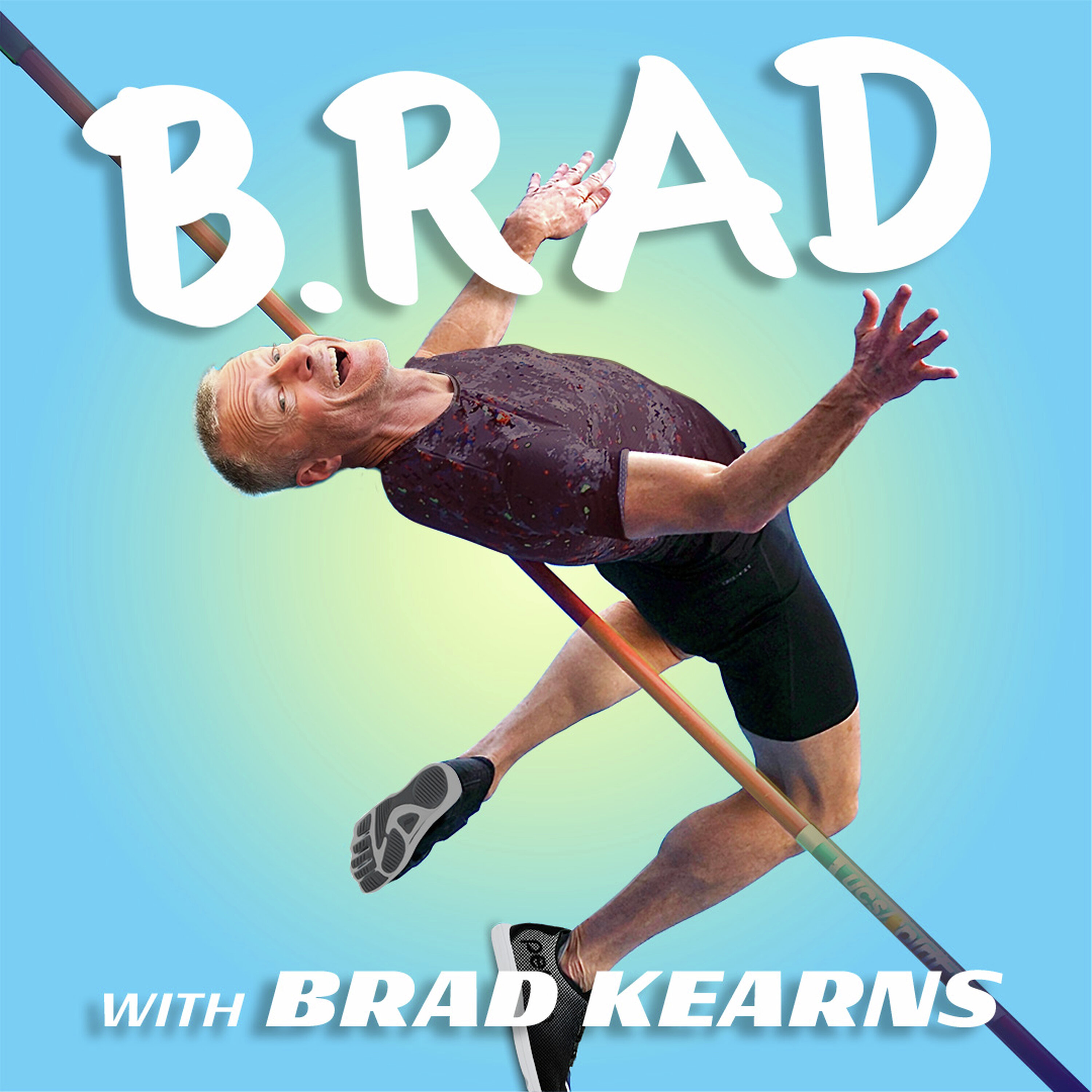
The B.rad Podcast
Brad Kearns
Join Brad Kearns, New York Times bestselling author, world #1 ranked masters 60+ high jumper, Speedgolf world record holder, and former world #3 ranked pro triathlete, in pursuing peak performance with passion throughout life. Brad delivers an engaging mix of step-by-step education on important health topics like staying fit, strong and powerful as you age; transforming diet to lose body fat and increase energy; sort through hype and misinformation to make simple, sustainable lifestyle changes; and broaden your perspective beyond a fit body to experience happy relationships, nonstop personal growth, and ultimately sail to 100 with a happy, healthy, long life. Let’s explore beyond shortcuts, hacks, and crushing competition to laugh, have fun, appreciate the journey, and not take ourselves too seriously. It’s time to B.rad!
Episodes
Mentioned books

May 10, 2019 • 41min
Basic Life Changing Insights Part 1 (Breather Episode with Brad)
This episode is all about how we need to devote some time and energy in order to get more time and energy. Shopping one evening at Whole Foods in my hometown led to a chance encounter with a friend from high school, Mindy. It’s been 36 years - oh my gosh! Yes, time flies, and we quickly progress from young, carefree and taking health for granted to having to deal with real life stuff such as aging. I promise Mindy I will cough up some basic step-by-step tips to implement some healthy lifestyle practices, and hence the inspiration for a two-part show. Part 1 is about getting your mindset right and recognizing its time to make some changes against the unhealthy forces of modern life. Speaking with Mindy really got me thinking about the aging process. I noticed she had a tattoo that read, “Love ya more than life,” which she explained to me was done in memory of her beloved, lifelong pet who she recently had to put down. It is so fortunate that with our pets, we are to be able to decide when it is time to end their suffering....too bad it doesn’t work like that in real life! When you hit your 40s and 50s, you realize it is never too early to start making the right choices for your health. Thankfully, the little changes are the ones that make the biggest difference, which leads me to the compressed morbidity theory. Introduced in 1980 by Dr. James Fries of Stanford University’s School of Medicine, compressed morbidity means delaying the onset of debilitating illness for as long as possible, such that whatever hits will arrive around the time you might be expected to die anyway! I have long promoted a similar concept, albeit with a little spicier description: “Live Long, Drop Dead!” The number one change you have to make first is with your MIND. Yeah, there are great advantages to modern life, but it’s also trouble: your body has to deal with hypoconnectivity, EMF, processed foods, sedentary patterns, how light affects your system after dark, constant stimulation (and constant stimulation of stress hormones). Next, get your energy levels up by changing your DIET. Clean out 70% junk (grains, sugars, oils) and just eat colorful, wholesome, nutritious foods. Meals are a celebration and relaxed, calm, and slow, not rushed and gobbled down in a manner of minutes. The parasympathetic system is also referred to as “rest and digest” for a reason. The goal here is to escape carb dependency and get fat adapted. Can you skip a meal and feel great? Then, you gotta MOVE. Moving isn’t the same as working out, which can be time-consuming, stressful, and exhausting. But frequent movement helps fat burning, brain function, and stress hormones. It’s not about calories because “metabolic compensation theory” suggests as you burn more, you eat more, and get lazier. The right kind of EXERCISE is integral. Life can be so sedentary, making it easy to avoid scheduling workouts. Primal keeps it easy with 3 laws: 1. Lift Heavy Things 2. Run Really Fast Every Once in A While and 3. Move Frequently at a Slow Pace. No matter what, be sure to avoid chronic exercise: it is crucial to respect your body’s natural fight or flight response and consider recovery pie slice. The harder you train, the harder you recover. And finally, SLEEP. Sleep deficiency will throw you back to carb dependency. We are so locked in these artificially lengthened days and it puts us in a sugar craving, fat storing mode because of our genetic hardwiring. Make choices that improve your sleeping patterns: Minimize light and stimulation after dark. Try making your sleeping environment your personal sanctuary: Mellow, simple, cool, and totally dark. Being awakened by direct sunlight, versus your phone, also helps. Finally, consider how comfortable you are with being uncomfortable. The body actually likes being stressed and challenged (in an appropriate manner). I heard an interesting idea on a cold exposure show recently: Basically, when we constantly keep ourselves at a comfortable temperature, we are eliminating that hormetic stressor on the body, which compressed our longevity accordingly. Dr. Art DeVany is a big proponent of healthy hormetic stressors as they send a “renewal” signal to your genes. Doing a cold plunge, going to the gym or the sauna, all result in hormetic stressors: brief, positive, natural stressors that promote health and longevity by sending a renewal signal to your genes. Making the decision to turn the handle all the way to ‘COLD’ in the last few minutes of your shower isn’t easy, but it is really, really good for you, and once you change your mindset, it’s easy to choose the option that gives you longevity and good health over the so-called “easy” road. Pay now, or pay later: it’s your decision, but these basic life-changing insights are here to empower you to make the right choices so you enjoy your life, instead of experiencing a steady decline once you hit your 50s or 60s! TIMESTAMPS: Don't tell people they need anything or they will be immediately closed off rather than open. [02:41] Compressed morbidity means delaying the onset of debilitating illness for as long as possible. [08:04] We want to get unstuck and be aware of all the health challenges in daily life. [10:13] When we constantly keep ourselves temperature comfortable, we are eliminating the hormetic stressor upon the body. [13:59] We don't have to go to excess to receive the joy and the pleasures of modern life. [15:27] Clean up your diet. [17:29] JUST MOVE!! [21:02] We want to keep things comfortable with our cardiovascular exercise for the most part. [22:58] If you cannot hit the bare minimum standards in a mile run, or pushups, you have a very high increased mortality risk. [26:58] Don’t forget sprint workouts. [28:45] Sleep in a dark, quiet room is a priority. [30:03] Brad summarizes the points for basic longevity. [35:06] Support this podcast at — https://redcircle.com/the-get-over-yourself-podcast/donationsAdvertising Inquiries: https://redcircle.com/brandsSee omnystudio.com/listener for privacy information.See omnystudio.com/listener for privacy information.

May 7, 2019 • 1h 14min
Gabby Reece: Balancing Wife, Mother, Athlete, Celebrity Life, Including Insightful, Humorous, and Life-Changing Relationship Insights
Enjoy this wide-ranging and deep conversation with international fitness celebrity, supermodel, and former professional beach volleyball player, Gabrielle Reece. Gabby is a former women’s beach volleyball star, television host, supermodel, fitness expert, and author, columnist, and podcast host. She was named one of the “20 Most Influential Women in Sports,” by Women’s Sports and Fitness, and one of the top five most beautiful women in the world by Elle magazine. Gabby and her husband Laird Hamilton have been celebrated as America’s fittest couple and have spent many years in the public eye as innovative fitness leaders. What Gabby is perhaps most appreciated for is being the real deal – a breath of fresh air in the celebrity world of manufactured image and branding. While lunching with my main man Mark Sisson in Malibu, I have enjoyed meeting Gabby and Laird on a few occasions over the years. What struck me each time was how open and authentic and fun-loving Gabby is in real life. We chatted only briefly, but she offered up some deep reflections about athletes dealing with injuries and adjusting competitive goals over time and dealing with hectic modern life and her various roles of mother, celebrity, athlete, and coach. After our first meeting, I was drawn to Gabby’s 2013 book titled, My Foot Is Too Big For the Glass Slipper: A Guide To A Less Than Perfect Life. She was raw, vulnerable, very funny, and very thoughtful. The book description sets the tone nicely: “With hilarious stories, wise insights, and concrete takeaways on topics ranging from navigating relationship issues to aging gracefully to getting smart about food, My Foot Is Too Big for the Glass Slipper is the brutally honest, wickedly funny, and deeply helpful portrait of the humor, grace, and humility it takes to survive the happily ever after. I think you will absolutely love this interview with a peak performer who knows how to enjoy life, strive to keep things in balance, not take herself too seriously, and especially become a better person every day! TIMESTAMPS: Gabby is a very accomplished woman and well known in her field. She talks about finding a balance between fame and her real self. [09:33] Does Gabby's 6’3” height affect how she thinks she's perceived? [13:52] Once we forgo living up to others’ expectations, it is liberating. [16:09] How do you parent your kids to deal with having such well-known parents with well-known friends? [18:18] Kids need to learn to navigate this world on their own. [22:26] People need a place to express themselves…who they are. [26:04] Gabby’s background wasn’t free and easy and she wasn’t groomed to be successful. [30:13] It’s important to put the past behind you and move on. [32:34] There’s a lot of beauty if life. You have to be willing to recognize it. [37:55] Create a system that helps you navigate life. [43:19] When in disagreement, even if you are “right,” it is important to listen to the other person’s point. [47:16] Think about how you can be better today and you can be in charge of that. [49:21] If you are ‘triggered,” figure out why you are triggered. [51:39] As a parent, it is difficult not to put your crap on the kids. [55:24] It’s really powerful as a parent to give space to the child. [56:57] How does fitness commitment help achieve balance your life? [1:01:23] In a relationship, you bring both independent commitment and then nurture that in the partnership as well. [1:04:43]Support this podcast at — https://redcircle.com/the-get-over-yourself-podcast/donationsAdvertising Inquiries: https://redcircle.com/brandsSee omnystudio.com/listener for privacy information.See omnystudio.com/listener for privacy information.

May 3, 2019 • 30min
Brad: Reflections About Seth Godin's "This Is Marketing" Book, and The New Economy (Breather Episode with Brad)
After my great interview with Seth, I offer some further reflections about the breakthrough insights in his recent book, This Is Marketing. This show is a bit of a departure from the podcast theme of health, fitness, peak performance, happiness, and longevity subject matter, but it can provide valuable insights for how you can best make an economic contribution in most careers, and how to be a healthy, strategic consumer instead of succumbing to marketing manipulation. Seth’s premise is that we are in the middle of a shift from the dated old-time marketing-driven economy to a market-driven economy. In the old-time vertical economy, consumers had few choices (only 3 TV channels, the comparatively few books on the shelf at the bookstore, the morning newspaper or weekly news magazine, etc.) The corporate giants of old subjected us to aggressive, manipulative marketing messages trying to get us to buy their offerings. Today, consumers have massive choice and freedom and are one click away from a lower price and better service. Seth says the “race to the bottom” (who can be more aggressive, slick and clever to extract a purchase) was worth winning in the old days, but not anymore. Today we are obligated to listen to the hopes and needs and dreams of the market we wish to serve—a market-driven economy. Instead of trying for bigger numbers and broader territories, Seth argues persuasively that you are better off focusing on the “smallest viable audience.” Offer them a breakthrough product or service that establishes you as the single best resource to meet your customer’s hopes and dreams. I offer examples of the changing dynamics of the real estate broker, who used to provide privileged information as their main value. Today, with Zillow and the rest giving everyone the same information, realtors are obligated to raise their game to something different. They must meet the emotional needs of the client by engaging their hopes and dreams. Seth calls this the “difficult work we signed up for.” He distinguishes it from the hustle of trying to fill a market niche, which will leave you constantly in fear, driven by scarcity, looking in the rear-view mirror at the competition. Relatedly, touting your honest, reliable, high-quality product or service is pretty much ridiculous these days, because these things are assumed and expected. TIMESTAMPS: Seth Godin’s book This is Marketing transforms our thinking about marketing. [04:05] There are five steps to effective marketing. [07:24] We must understand the irrational forces that drive us. [09:03] When in doubt, assume people will act according to their current irrational urges. [11:24] Serve the smallest viable market. [16:55] With a new marketplace with tremendous consumer choice and freedom, we must be different. [20:09] Authenticity is overrated. [22:56] Support this podcast at — https://redcircle.com/the-get-over-yourself-podcast/donationsAdvertising Inquiries: https://redcircle.com/brandsSee omnystudio.com/listener for privacy information.See omnystudio.com/listener for privacy information.

Apr 30, 2019 • 42min
Seth Godin: Reflections On Marketing, Being Great, Serving Society, and Overcoming Distraction
Seth Godin is one of the great thinkers of modern times, known for his string of 18 international bestselling books on topics relating to personal productivity, time efficiency, and evolved marketing philosophy and strategy. He calls himself a teacher first and foremost, and his Akimbo online learning center and alternative MBA course offer revolutionary approaches to online learning. He writes one of the most popular blogs in the world at Seths.blog, in a unique short form style that will give you a daily reminder to be the best you can be with profound and pithy insights. Type “Seth” into Google and you’ll find his blog, with 7,000 posts and one million readers – you absolutely must join the party!! Seth’s most recent bestseller is called This Is Marketing, with the main take away message being that we are all marketers in every way that we make an economic contribution to society. The essence of marketing is transforming congruently with the changes in the information economy. The dated model of slamming an aggressive (and often manipulative) message down our throats is being replaced with what Seth calls a “market-driven economy,” where we are compelled to engage with and serve our audience. His insights about focus, discipline, strategic thinking, and pursuing the highest expression of your talents have changed my life, and I ponder tips from his blog every day. On the show, I shared my pain point of distractibility, hopefully speaking for many listeners. We have the constant ability to become entertained and amused with digital stimulation, which can distract from our priority objectives, like writing a book for example! Seth keeps it real with some point-blank insights that we can all take inspiration from. You absolutely must sign up for Seth’s daily email newsletter/blog post – the messages are short and profound and will get you thinking about better ways to work and live life. Seth calls out what is wrong and lame in the economy and society and offers a strategy to think differently. After the interview, I read a couple of Seth’s recent blog posts to get you even more acquainted with this one of a kind thought leader. Check out his links and subscribe to his blog, you will be very satisfied. TIMESTAMPS: Seth tells how to keep focused and guarded against hyper-connectivity and overstimulation. [3:40] What is the difference between MARKETING DRIVEN and MARKET DRIVEN? [6:19] A book is a socially acceptable way to talk about yourself. [07:29] No one's going to buy a book as a favor to you. They're going to buy a book as a favor to themselves. [09:39] The smallest viable audience is what you are shooting for. [10:53] Ideas spread horizontally, not vertically. [14:05] There is a concern that technology will eliminate many of today’s professions. Get ready for change. [18:32] In his book, The Dip, the basic concept is of persevering what you are passionate about. [20:50] What does it mean to be the best? [21:18] Actors have to depend on luck as compared to athletes. [23:23] Don't sign up for a mismatch to live one life am expect it differently. [28:47] The way jobs used to be is gone. Now we have to exert ourselves. [31:00] It is hard to focus on your contribution when you are inundated with outside distractions. [32:58] Support this podcast at — https://redcircle.com/the-get-over-yourself-podcast/donationsAdvertising Inquiries: https://redcircle.com/brandsSee omnystudio.com/listener for privacy information.See omnystudio.com/listener for privacy information.

Apr 23, 2019 • 45min
Introducing Heart Rate Variability and The BradBeat iPhone App
Incredible benefits come from measuring Heart Rate Variability, one of the most valuable biofeedback information available today, which is why I am so excited to introduce the BradBeat iPhone app! Measuring HRV gives you a direct window in the functional state of your autonomic nervous system, so you can accurately observe your stress levels, recovery rate and readiness to train, and make better decisions to balance stress and rest in daily life. This is the age of high tech testing and wearable devices, but it seems like most of it is just gimmick or for entertainment value. HRV is different. HRV measures the beat to beat intervals between heart rates—the data you see as spikes on the graph of your EKG test in a hospital or laboratory. More variation indicates a harmonious balance between sympathetic (fight or flight) function and parasympathetic (rest and digest) nervous system function, and delivers a higher HRV score on the 1-100 HRV scale. A metronomic beat indicates you are stressed, overtrained, or have poor cardiovascular health, delivering a low HRV score. Recent technology innovation enables you to track HRV in real time using the BradBeat HRV iPhone app, which has been custom designed to my specifications by Sweetwater Health, leaders in mobile HRV technology. Yes, I had a ton of fun getting super technical with Jo Beth and Rhonda to develop this awesome app, and also go through an incredibly rigorous application process with Apple to get onto the App Store (nice to know there is no lame stuff on the App Store). For only $9.95, the BradBeat HRV app is easy to use by athletes or anyone else interested in monitoring stress/rest balance. The BradBeat HRV (and other mobile HRV apps if you have Android), pair with a wireless chest transmitter to reveal real-time data on your iPhone, which you can archive online or download to a spreadsheet. My podcast guest Joel Jamieson tells me the HRV machines he used on athletes back in the day cost $30,000 and required 11 electrodes placed all over the body. This show gets a little technical as you learn about the important nuances such as additional readings of low frequency (LF) and high frequency (HF) autonomic nervous system function, but you will come away with an excellent understanding of the benefits of HRV and how to use them to your maximum advantage to make better decisions and learn to gain more control over your stress response. For example, when you are cruising along on a stress hormone buzz, you might feel “great” and take on a stressful day or a hard workout, but you’re amped up state will deliver a low HRV reading. Consequently, you will be compelled to build in rest periods in pursuit of healthy stress/rest balance. It has been a great experience to bring this product to market, and I believe HRV can help you more than any other biofeedback metric or wearable device. HRV goes beyond the long-established tracking of resting heart rate to determine state of recovery and readiness to train. Visit the App Store to order and learn more about the features and benefits, including which chest transmitters work with the BradBeat. Support this podcast at — https://redcircle.com/the-get-over-yourself-podcast/donationsAdvertising Inquiries: https://redcircle.com/brandsSee omnystudio.com/listener for privacy information.See omnystudio.com/listener for privacy information.

Apr 19, 2019 • 30min
Pacific Northwest Recap (Breather Episode with Brad)
Like most people who grew up in Southern California, I understand that when you’re blessed with constant sunny skies, it’s way too easy to get used to that kind of climate and start to take it for granted. But what happens when you don’t have 365 sunny days every year? You have to get creative. You have to figure out how to live and enjoy the outdoors in relation to your current climate. I reflect on this while sharing some highlights from my trip to the Pacific Northwest - I visited Seattle, where I had enjoyed some delicious "Salty Caramel Ash” flavored ice cream aka activated charcoal vegan ice cream, as well as Eugene and Portland. One of the most important things I took away from my trip was how the Pacific Northwesterners really know how to make the most of their time. They use the summer months as an opportunity to cram in a ton of activities into their day, and I know people who take trips to warmer climates during colder weather to make sure they’re getting their recreational time in. I was so happy to be able to meet up with some cool people, like Debbie Potts, host of the Whole Athlete, to discuss her career and journey into holistic medicine, and High Intensity Health founder Mike Mutzel, who shared some amazing insights about recovery: “The harder you train, the more energy you need to devote to recovery.” We think in terms of ‘go go go’ and then collapse on the couch or into bed – but this doesn’t even qualify as recovery time. Mike’s concepts for recovery are way more sophisticated than that and he is a big proponent of Rebound Training. Another important piece of advice from Mike: When your HRV number is extra high you may think you’re recovering well, but it can mean the opposite – that your body is still fighting to recover fully, so you need to rest. It was great to finally meet Dr. Tommy Wood (of Nourish Balance Thrive) face to face after having recorded (remotely) so many podcasts with him. Tommy is great company and super stimulating to speak with because he offers such interesting views on a wide variety of subjects. While he’s super academic and into studying scientific research, he’s also always making a sincere effort to brings things back to the simple, practical stuff - like emphasizing the importance of having a dog to literally boost your health because it forces you outside and makes you engage play. Another gem from Tommy: “You’re liquidating your assets when you overstimulate the flight or fight response with your hectic, busy life or extreme training regimen that’s too much for you.” This is so important to consider. After seeing Tommy, I hopped on the train to head on over to the beautiful town of Eugene, Oregon. I met up with my Speedgolf mentor Christopher Smith at the Eugene Country Club, and we ran all over town, checking out the updated University of Oregon campus and the Prefontaine Memorial, and just enjoying some great conversation. We talked about his incredible training concept “Train to Trust” and the importance of context specificity when practicing golf or any other performance endeavor. This means simulating your competitive experience in practice so it actually transfers into effective brain learning when it’s time to perform. I also had the chance to catch up (over Skype) with author Scott Carney, author of What Doesn’t Kill Us: How Freezing Water, Extreme Altitude, and Environmental Conditioning Will Renew Our Lost Evolutionary Strength. As an investigative journalist, Carney was originally assigned to cover the famous ‘Ice Man,’ Wim Hof, meeting up with him at his training center in Poland, but soon enough he was participating in training, and performing amazing feats like climbing a snowy mountain in running shorts in the middle of a freezing winter in Poland. My last stop was Portland, and I had a great time with Brian McAndrew, who masters all the audio and video content for Primal Blueprint’s YouTube channel. We had a great time discussing how he went from veganism and chronic cardio to finding strength training and the Keto diet. Brian has had such an interesting life at only 31 years old, and has great insights and stories to share about his career journey and pursuing your passions. I had such a fun time having incredible, stimulating conversations with so many great people, and I left the trip feeling so inspired. Support this podcast at — https://redcircle.com/the-get-over-yourself-podcast/donationsAdvertising Inquiries: https://redcircle.com/brandsSee omnystudio.com/listener for privacy information.See omnystudio.com/listener for privacy information.

Apr 16, 2019 • 1h 28min
Googling Big George
I visit beautiful Lake Tahoe to hang with the mysterious and magnificent Big George, aka Dr. Ray Sidney. Ray was the fifth employee hired at a Silicon Valley startup named Google, which later gained prominence for taking over the world. Today he is Lake Tahoe’s most prominent philanthropist, enthusiast of the epic sport of curling, and master of trickery and gravity-defying stunts on the wake surfboard. Ray has had a wild ride, emanating from a lifelong fascination with mathematics and peak performance in general. He hails from the highest levels of academia, having graduated from Harvard and then grabbing a Ph.D. from MIT in math), then headed west to land on the ground floor at Google. His first workplace was sharing a bedroom in a Palo Alto duplex; later he was the guy in charge of ordering fitness equipment for an early corporate campus! He was in charge of database security, and once (unknowingly) blocked the CIA from doing Google searches because they were flaunting the rules! Feeling burnt out from the crazy pace of Silicon Valley startup life, he took a sabbatical of a few months, which is stretching into a few hundred months, most of which have been spent on the water or frozen water with his tremendous passion for athletics. An important takeaway from Ray’s story, especially in today’s era of celebrity worship, wealth obsession, and social media posturing, is that he never intended to strike it rich in the romanticized fable of the dotcom world. Rather, he enjoyed math, and academics, and solving software engineering problems for the pure challenge. In fact, Ray reveals that his plans during sabbatical were to work on some personal math projects! Alas, transitioning to sudden wealth and expanded opportunities have Ray diverted from the singular focus of software engineering to become involved in a dizzying number of causes, programs, and athletic interests. He is a competitive curler who funded Lake Tahoe’s fledgling curling club and travels around North America for camps and competitions. He is widely recognized (or barely recognized, depending on his attire) as Lake Tahoe’s leading philanthropist. He has donated millions to create fabulous athletic facilities around Tahoe and down in Carson Valley, including a new football/track stadium at Douglas High School and a championship running track at the middle school. His seven-figure donation supported free bus service to transport Tahoe casino workers to and from Carson Valley. He was the founding sponsor of Brad Kearns’s kids fitness charity called Running School. He supports a variety of academic causes like giving back to the Hertz Fellowship program that supported his academic journey and the X Prize Foundation. He recently earned an MBA degree from UC Berkeley just for fun! This show will get your reflecting on the beauty of a pure motivation for life goals, the value of a focused, precise mathematical approach to peak performance, and the importance of getting over yourself even if you are a heavy hitter. Indeed, George takes none of this stuff too seriously, as evidenced by the nickname he bestowed on his eco-friendly architecturally wondrous home on the lake: Tahizzle—of course a nod to Snoop Dogg, who has yet to visit but has a standing invitation. Cruise on his boat named Jorge Mucho (como “Big George” in Español) and you are more likely to get Borat impersonations than Warren Buffet stock tips. One can agree that Ray is living the good life and doing a great job giving back to all whom he encounters, but he also reveals that for all his freedom and folly opportunity, he struggles with overstimulation and a tendency to distraction like the rest of us. Brad and Ray agree to a future show addressing these matters of importance.Support this podcast at — https://redcircle.com/the-get-over-yourself-podcast/donationsAdvertising Inquiries: https://redcircle.com/brandsSee omnystudio.com/listener for privacy information.See omnystudio.com/listener for privacy information.

Apr 12, 2019 • 26min
Insights Inspired By Dr. Art DeVany; How To Go For It In Life and Set Yourself Free! (Breather Episode with Brad)
Dr. Art DeVany, ancestral health forefather and author of The New Evolution Diet, delivers some of the most profound life advice I’ve ever heard during a 2017 podcast interview on the Align podcast with Aaron Alexander. At 81, DeVany is retired from his professor career and is pretty minimal on the interview/podcast/lecture scene, so please listen to the whole podcast and reflect carefully on the following commentary that came at the end of the show (Aviso: I did a bit of cleansing and paraphrasing from the audio transcript): Of course, you have to work at whatever you’re doing, you have to have high standards for your work. But you also have to realize that there’s a lot of stuff that you make too big of a fuss over. And when you stop that - it doesn’t mean you don’t care - but when you stop beating yourself or beating someone else up over it when you stop ruminating about it, you’re free. And you gotta set yourself free - set yourself free from your old mistakes and things that happened to you. And even set yourself free from people, thoughts, foods, and habits that bring you down. That’s when you’re free! Then you can start anew. You can renew every day. Granted, you can’t forget the past. Then you wouldn’t have any memories. Appreciating your history as strength and wisdom gained and getting a move on is necessary for good health. Brad Note: Realize that beyond his health interests, DeVany was an economics professor specializing in the complex aspects of how to predict how Hollywood movies make money. In that context, he often emphasizes the importance of random, explosive, life-changing events that apply not just to the economic realm, but in all areas of life. This will help you process a vital comment about “…it’s not the drip, drip, drip.” Can you reference explosive random events that altered your life path more so than plugging away day after day on a linear way? Pay attention to opportunities of all kinds and don’t be afraid to go for it! Here is one of his choice quotes, from his professional realm as an economics professor: “In any organization, half the work is done by the square root of the total number of workers. E.g., 100 workers, half the work is done by 10 workers.” Here are DeVany's recommendations to deal with depression: “Starve and exercise. The starvation part of it is to eat up some of these dysfunctional synapses. My saying is, for every damaged molecule, there’s a damaged thought. Those are injured neurons inside the brain, and you just need to get rid of the dysfunctional molecules that are causing those neurons to malfunction. Then, heal the brain with neurotrophic factors. Be outside. New thoughts, new patterns of behavior. When my first wife was declining from a host of other things, I’d take her walking as much as I could. I would tell her bad jokes. Change her surroundings. The typical things people have to do. Being outside is enormously effective. There are stimuli you can’t even relate to, but you perceive them. Your unconscious brain is what’s going to heal you first.” Here is a great show he did on the Tim Ferriss podcast. I’m taking the starve and exercise thing to heart with an intuitive approach to keto. Some days I will wait till I’m hungry to finally eat at between 12 and 2 pm. I’ll do 10-15 min workouts, walking by deadlift bar. He has said ‘don’t jog it’s too dangerous’ and that one I have really begun reflecting upon. In November through January, I was playing too much speedgolf. I had classic burnout symptoms and can’t keep below 130! Now I play cart speedgolf for wind sprints. At over 50, it’s easy to become unhealthy with endurance training. Be sure that you are performing aerobically and that your metabolism has minimal stress. Pursue a shorter, more intense competition to avoid chronic overstimulation of stress hormones. Support this podcast at — https://redcircle.com/the-get-over-yourself-podcast/donationsAdvertising Inquiries: https://redcircle.com/brandsSee omnystudio.com/listener for privacy information.See omnystudio.com/listener for privacy information.

Apr 9, 2019 • 1h 12min
Brian McAndrew: The Backstage Keto King
Brian McAndrew, the man behind the scenes of the Get Over Yourself podcast audio production, as well as Primal Blueprint’s audio and video production efforts, takes the stage as the honored guest on this wide-ranging and thoughtful discussion about life, peak performance, exploring your passions and dreams, learning from failure and setbacks, and of course ketogenic eating. At the age of 31, Brian has had quite a healthy journey of vast exploration and deep immersion. He’s been hard-core keto for over two years, all the while pursuing ambitious goals in the weight room. Brian’s life experiences include: dealing with a serious parasite infection contracted while swimming in an African pond (hey it’s hot in Sierra Leone for an Oregon coast boy!); plunging into the trendy LA juice bar health scene and digging a hole of veganism and chronic cardio; getting big into the familiar combo of Paleo and Crossfit; getting a burnt out on Crossfit and transitioning into a pattern of MAF pace cardio workouts along with high-intensity strength training; and finally gracefully pairing ketogenic eating with athletic training. Brian offers some thoughtful insights while Brad intersperses several cameos for Brian’s amazing viral YouTube video that he made in college that was the genesis of his current career. Search YouTube for “I Love My Ducks,” and you will see a masterpiece of filmmaking and positive energy for the beloved Oregon Ducks football club. Brian is constantly tweaking and testing on our behalf and today has a very groovy rhythm of simple, delicious meals, eating enough food to fuel his ambitious workouts, not stressing about testing his ketone numbers, and enjoying occasional departures from keto followed by effortless recalibrations. There is much talk about how athletes should optimize carb intake. Brian offers a sensible recommendation to calm down: “Life will give you refeeds,” Brian says. Brian also conveys the benefits of a simplified approach, where you don’t get overwhelmed by excessive choice or temptation because you are honoring a distinct commitment to dietary guidelines without any will power or decision fatigue involved. This is a very informative show where Brian shares insights from many resources; he consumes a ton of podcasts and has 14,000 followers on his Instagram account despite rarely writing anything more than, “I’m eating this” or showing pictures of his cute one-year-old daughter. Brian describes the magic and effectiveness of a simplified approach to ketogenic eating—the motto on his WholeDoods Instagram site is, “Eat boring food. Live an interesting life.” Brian believes one of the highest benefits of keto is the pleasure of a simplified approach. You don’t get overwhelmed by excessive choice or temptation, because you are honoring a distinct commitment to dietary guidelines without any will power or decision fatigue involved. Psychological studies confirm that when we are presented with too many choices, it compromises our enjoyment and increases our stress levels, likely due to FOMO – fear of missing out. Brian relates some wild stories during the show, such as his wilderness survival retreat where things got dicey due to a flash flood leaving participants without food for 6 days. Oh, this was when he was parasitic and “wasting away” at a buck twenty! There are numerous insights about formulating an effective training program and avoiding the perils of overtraining that plague Crossfit athletes, endurance athletes, and even recreational fitness enthusiasts trying to be consistent about their 6am Spin classes. Brian says he “hates rest days” but emphasizes the importance of purposeful light days or weeks in the gym to keep blood flowing and hormones optimized. Regarding the ethical dilemma we face when eating animals, Brian was obliged to slaughter a sheep during his survival school and offer up the profound insight that if you are going to take another life to support your life, you best make the most of your existence. Particularly for a younger listener, this will be a memorable story of exploring your passions and dreams, avoiding the pitfalls of fitness trends, and soul-sucking jobs in the world of advertising, and pursuing career excellence along with optimal health and fitness. Also, a reminder to appreciate your partner because Brian had to wait a freakin’ year to secure permission for his wife to join him in the crazy nation of America. These two voices on the show have talked at length during their long days filming content for Primal Blueprint digital courses, trying to sort out hype from effective tips for athletic training, healthy living, and the best approach to a healthy, sensible, whole foods, whole doods diet. They have figured out almost everything for your listening pleasure, so don’t miss this show. Brian’s meals on Instagram, and Brad’s underground recipe videos have become so popular that the duo are working on a top-secret book for lazy doods who want to cook keto but can’t be bothered to follow complex recipes. Support this podcast at — https://redcircle.com/the-get-over-yourself-podcast/donationsAdvertising Inquiries: https://redcircle.com/brandsSee omnystudio.com/listener for privacy information.See omnystudio.com/listener for privacy information.

Apr 5, 2019 • 32min
Appreciating Tiger Woods's Amazing Comeback and How To Model His Competitive Intensity (Breather Episode With Brad)
Today’s episode is all about the legendary Tiger Woods and his incredible comeback. Most of the world is well aware of the scandals and very public downfall that affected Tiger’s life and career. What I am focusing on today is how he handled himself after his public scandal. He has had the greatest comeback in the history of sports – but how? How did Tiger manage to achieve such a feat? I cite Jeff Benedict’s Tiger Woods book – the first comprehensive, in-depth book on the athlete’s life. The book traces and highlights the influences and experiences that shaped him, notably his father, Earl Woods. He was instrumental in crafting Tiger’s public persona, as well as the driving force behind his son’s initial ambition. How many “Helicopter Parents” have you encountered over the years? We all know parents like this – they are singularly focused on how to make their child a success. Unfortunately, the person who suffers most from this pressure is the child. Years ago, a friend of mine, an Olympic athlete who knows Tiger, shared an insight with me that I’ve never forgotten. He remarked, “Tiger rose to the highest competitive plane than any human has ever risen to. No one compares to what he has done.” Putting the circumstances of his daily life into context is crucial to understand both his public and private persona - the global level of his celebrity, the attention and scrutiny that accompanies worldwide fame, not to mention the money.... How else could he deal with it? He was driven, by necessity, to foster this extreme, obsessive personality and become absolutely insatiable for achievement and conquest. I draw parallels between Tiger and Michael Milken – remember him, the “junk bond” King of the 80s? He too was going and going and going, until he finally went off the rails. Like Tiger, he spiraled, and he couldn’t turn it off. I wrote a book, How Tiger Does It, many years ago, in which I detail the three factors that have made him such a successful athlete. 1) Focus. 2) Work-Play Ethic. And 3) A Balanced Approach (or so I thought at the time). The book is all about how to banish self-limiting beliefs through hard work, believing in yourself, and focusing on your peak performance goals. Under the first topic, “Focus,” I talk about the importance of feeling absolute freedom from fear of failure or insecurity. I highlight how intense Tiger’s focus was, how he was working on his swing – even when he was already at the top – his only competition was himself, his only goal – to get better for himself. Support this podcast at — https://redcircle.com/the-get-over-yourself-podcast/donationsAdvertising Inquiries: https://redcircle.com/brandsSee omnystudio.com/listener for privacy information.See omnystudio.com/listener for privacy information.

