

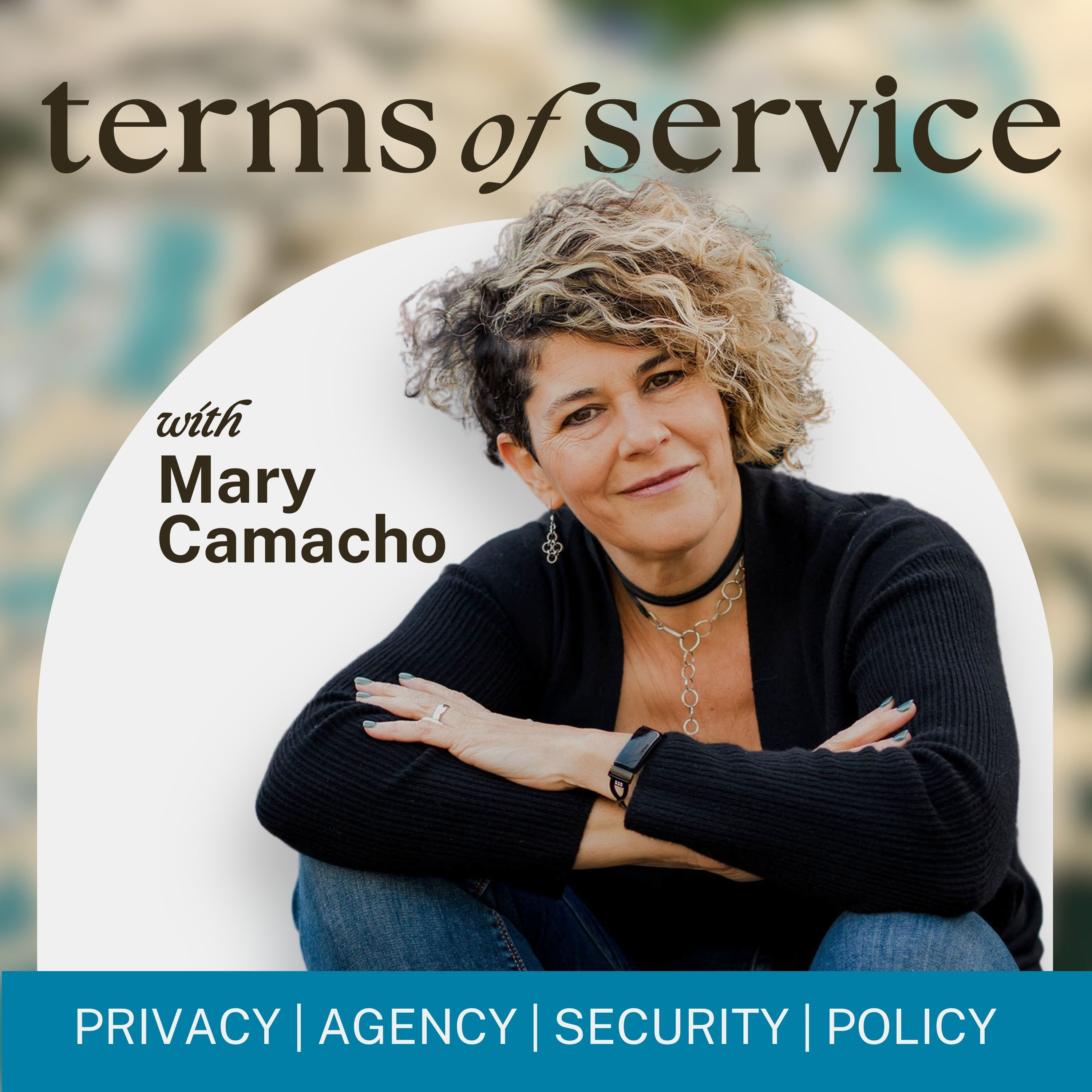
Terms of Service Podcast
Mary Camacho
Subscribe, rate, and share to support the show on Apple Podcasts, Spotify, PocketCast or wherever you listen.Follow us on LinkedIn for updates and join the conversation.Welcome to “Terms of Service,” the podcast that dives deep into the fine print of our digital lives. Every time we check the box on an app, website, or online service, we’re making choices—often without knowing the full story. From giving away our privacy to navigating complex security settings, we’re all part of a digital landscape that’s constantly evolving.Join us as we unpack the themes that shape our online experiences: privacy, security, safety, and the everyday permissions we grant without a second thought. We’ll explore how AI, agency, and decentralized technologies are reshaping our digital world, often in ways that fly under the radar. And because no conversation about our digital lives would be complete without it, we’ll tackle the legal and policy implications that come with our clicks, swipes, and taps.Whether you’re tech-savvy or just trying to keep up, “Terms of Service” invites you to join the conversation about the hidden costs of convenience in the digital age. Tune in to explore, question, and rethink the terms we often accept without a second thought, and let’s challenge the norms of our digital lives together.CreditsProduced by Mary Camacho & Nicole Klau Ibarra. Music and sound production is by Arthur Vincent at Sonorlab.Behind the MicCo-founder of Holochain, and CEO of Holo, Mary leads the development of peer-to-peer and decentralised technologies that empower users and redefine digital interactions. With over 20 years in tech and telecom, her career has been dedicated to enhancing user control, privacy, and digital autonomy.Mary's educational background as a social scientist grounds the explorations at intersection of sociality and technology, exposing the trade-offs in privacy, security, and agency inherent in our digital choices. On “Terms of Service,” she invites listeners to rethink these everyday interactions and the broader implications of AI, distributed tech, and legal frameworks on our digital lives, advocating for a future where individuals have greater control over their data and decisions.https://www.linkedin.com/in/maryfcamacho/Nicole is a visionary entrepreneur with a diverse background, she is passionate about social system design and has helped multiple ventures, Including the IKIGAI Project, her non-profit helping people build essential 21st-century skills- many of which intersect with the topics discussed in Terms Of Service.https://www.linkedin.com/in/nicole-klau-ibarra-b26818137/Arthur Vincent is a seasoned Music and Audio Producer with a passion for pushing the boundaries of music technology. As a music producer and sound designer, he has crafted innovative audio experiences for global brands like Heineken, Philips, and Cupra. Alongside his creative work, Arthur is also an expert in audio technology, mastering both hardware and software tools to deliver high-quality, immersive sound. https://www.linkedin.com/in/arthur-vincent/
Episodes
Mentioned books

Mar 11, 2025 • 55min
Breaking the Binary: Rethinking Law, Power, and Possibility
Episode SummaryIn this episode of Terms of Service, host Mary Camacho speaks with Helen Slottje, an award-winning attorney and co-founder of the Regenerative Law Institute. Helen shares her journey from corporate law to leading a groundbreaking legal movement against fracking, which earned her the Goldman Environmental Prize. They discuss the deeper patterns of power and control in legal systems, how governance structures enforce extractive models, and the need for transformative legal frameworks that align with natural systems. Helen’s work challenges conventional legal thinking, moving beyond fixing broken systems to designing entirely new paradigms for governance and community resilience.Key TakeawaysBeyond Extractive Systems: Legal and governance structures often reinforce power imbalances, prioritizing control over coherence.The Fracking Fight as a Model for Change: Helen’s legal strategy helped shift an "inevitable" industry into an impossible one, leading to New York’s fracking ban.Predator-Prey Dynamics in Law: Legal systems replicate extraction-based power structures, often reinforcing historical violence rather than challenging it.Regenerative Law vs. Sustainability: The goal is not just to sustain broken systems but to design new legal structures that support thriving, decentralized communities.Reframing Ownership and Control: From nonprofit governance to alternative currencies, emerging models challenge the idea that control must always be centralized.Topics Covered / Timestamped Sections01:19 - Introduction to Helen Slottje and her shift from corporate law to environmental law.03:19 - The fight against fracking in New York: How legal strategy led to a statewide ban.07:42 - The Power of Patterns & Systemic Control – How binary thinking limits our ability to create real change.10:07 - The Role of Narratives in Governance & Social Change – The importance of redefining governance beyond the current nation-state model.13:45 - Challenging the Predator-Prey Dynamic: How society reinforces power imbalances and why we must shift toward mutual thriving.22:38 - Hope, Community Building, & Mobilizing Change: The lessons from the fracking fight on organizing and redefining what’s possible.33:09 - The Evolutionary Leap: Shifting Consciousness – Why we need new frameworks to break conventional thinking and evolve. 35:50 - The Process of Creating Transformational Change – The importance of starting with small groups before scaling change. 40:40 - The Future of Law & Governance: Quantum Thinking – Applying nature, physics, and alternative governance models to drive systemic change..42:33 - Helen’s "magic wand" wish: Creating language and legal tools to make transformative governance accessible.Guest Bio and LinksHelen Slottje is a Harvard-educated lawyer and a recipient of the Goldman Environmental Prize (‘Green Nobel’). As the founder of the Regenerative Law Institute, Helen helps leaders navigate high-pressure challenges with coherence and emergent design rather than brute force. At the core of her work is the conviction that real solutions emerge by leveraging pressure as a catalyst, embracing coherence with nature’s patterns, and making quantum leaps beyond the limits of conventional thinkingRegenerative Law InstituteGoldman Environmental PrizeLinkedIn IG Resources MentionedFracking and Local Bans - The legal strategy that led to New York’s statewide fracking prohibition.Alternative Governance Models - Expanding democratic decision-making structures.Rene Girard’s Mimetic Theory - Understanding power through hidden cycles of violence and control.Further Reading / Related EpisodesEpisode 1: "From AI Anxiety to IP Integrity: Navigating Rights in a Tech-Driven World"Episode 3: "Dynamics of Digital Spaces: Rethinking Democracy Online"Episode 5: "Regenerating Social Fabric & Innovating Governance"Call to ActionCan legal systems evolve beyond extractive models? Listen to Helen Slottje’s transformative insights on law, governance, and power—and explore how regenerative law might shape the future.🎧 Listen now: Episode LinkCreditsHost: Mary CamachoGuest: Helen SlottjeProduced by Terms of Service PodcastSound Design: Arthur Vincent and Sonor LabCo-Producers: Nicole Klau Ibarra & Mary Camacho

Feb 18, 2025 • 43min
Constitutional Rights, Tech Governance, and Power Structures
In this episode of Terms of Service, host Mary Camacho welcomes Nora Mbagathi, Executive Director of the Katiba Institute, for a deep dive into constitutional rights, technology governance, and power dynamics in Kenya and beyond. They explore how constitutions function as the "terms of service" of a society, shaping citizen rights and responsibilities. Nora highlights the risks posed by centralized digital identity systems, the role of transnational corporations in shaping the digital landscape, and the importance of grassroots activism in defending constitutional protections.Key TakeawaysConstitutions as Societal Contracts: Just like digital terms of service, constitutions define the relationship between citizens and power structures.Kenya’s 2010 Constitution: A strong rights-based document that emerged from political unrest, yet faces implementation challenges due to literacy gaps and power imbalances.Tech Governance in the Global South: Digital ID systems, centralized data collection, and lack of local tech solutions create unique vulnerabilities.Extractive Tech Models: Nairobi is often called "the Silicon Valley of Africa," but many systems prioritize corporate interests over community empowerment.Listening as a Solution: Instead of imposing external solutions, policymakers and tech companies need to engage meaningfully with affected communities.Topics Covered / Timestamped Sections00:49 - Introduction to Nora Mbagathi and her journey from human rights law to constitutional implementation.05:33 - The role of constitutions in protecting citizens and the Katiba Institute’s mission.07:46 - Kenya’s 2010 Constitution: A turning point in governance after election violence.12:31 - Constitutional literacy: Why some citizens benefit while others remain unaware of their rights.16:23 - The intersection of constitutional rights and technology governance.20:25 - The role of centralized digital ID systems and their risks.25:14 - The myth of Nairobi as the "Silicon Valley of Africa"—who really benefits?30:53 - The dangers of centralization vs. the potential of decentralized identity solutions.36:04 - The importance of designing technology with privacy, transparency, and equality at its core.40:25 - Building international coalitions to challenge corporate and governmental overreach.Guest Bio and LinksNora Mbagathi is the Executive Director at Katiba Institute in Kenya. She is a qualified lawyer in multiple jurisdictions and has worked in human rights campaigning and strategic litigation for over ten years. Nora has participated in cases relating to digital ID, platform accountability, criminal justice, and the right to nationality in Kenya. Prior to joining Katiba Institute, Nora was a senior lawyer with the Open Society Justice Initiative, based in London.Nora Mbagathi on X Katiba Institute WebsiteKatiba Institute on XResources MentionedKenya’s 2010 Constitution - A landmark rights-based document.GovZero - A movement in Taiwan promoting citizen-driven government accountability.Digital ID Systems - Centralized identity databases and their risks in Kenya.Further Reading / Related EpisodesEpisode 4: "Dynamics of Digital Spaces: Rethinking Democracy Online"Episode 5: "Regenerating Social Fabric & Innovating Governance"Call to ActionHow can we ensure technology serves citizens rather than undermining their rights? Listen to this thought-provoking conversation with Nora Mbagathi and join the discussion on tech governance, rights, and digital power structures.🎧 Listen now: Episode LinkCreditsHost: Mary CamachoGuest: Nora MbagathiProduced by Terms of Service PodcastSound Design: Arthur Vincent and Sonor LabCo-Producers: Nicole Klau Ibarra & Mary Camacho

Jan 28, 2025 • 38min
Regenerating Social Fabric & Innovating Governance
In this episode of Terms of Service, host Mary Camacho speaks with Glen Weyl, founder of the Plurality Institute and Radical Exchange Foundation. They explore transformative ideas such as quadratic voting, collaborative governance, and the importance of regenerating the social fabric in a polarized world. Glen shares insights from his work with Taiwan’s innovative digital governance models and his collaboration with Audrey Tang, offering a vision for a more interconnected, pluralistic digital future.Key TakeawaysSocial media should shift from being divisive to regenerative, so as to rebuild the social fabric that sustains it.Quadratic voting enables nuanced decision-making, fostering consensus while embracing diversity.Taiwan’s digital governance innovations demonstrate the power of collective action and participatory design.Technology must integrate with human communities to create sustainable systems that enrich rather than erode social foundations.The Plurality framework focuses on bridging divides and creating richer, interconnected digital ecosystems.Topics Covered / Timestamped Sections01:20 - Introduction to Glen Weyl and his interdisciplinary work.04:33 - Regenerating social media to build stronger, pro-social networks.07:43 - Glen’s personal journey and the power of embracing contradictions.12:00 - Quadratic voting: How it works and its applications in blockchain and governance.17:50 - Collaboration with Audrey Tang and the creation of Plurality.24:26 - Reimagining social media to foster community awareness and connection.27:22 - Taiwan’s transformative governance practices: GovZero, Polis, and digital competence education.34:14 - A magic wand for change: Connecting global leaders with Audrey Tang to inspire collaborative solutions.Guest Bio and LinksGlen Weyl - Founder and Research Lead of the Microsoft Research Plural Technology Collaboratory, Founder and Board Member of the RadicalxChange Foundation and Founder and Chair of the Plurality Institute. Co-author with Eric Posner of Radical Markets: Uprooting Capitalism and Democracy for a Just Society, with Audrey Tang and dozens of open source collaborators of ⿻ 數位 Plurality: The Future of Collaborative Technology and Democracy and with Puja Ohlhaver and Vitalik Buterin of "Decentralized Society: Finding Web3's Soul". Executive Producer of "Good Enough Ancestor"Resources MentionedPlurality WebsiteQuadratic Voting - A voting method allowing individuals to express preferences with intensity.GovZero - A movement creating open-source alternatives to government services.Polis - A participatory platform for identifying shared values across divides.Good Enough Ancestor Film TrailerFurther Reading / Related EpisodesEpisode 4: “Dynamics of Digital Spaces: Rethinking Democracy Online”Call to ActionDiscover how collaborative governance and innovative tools can shape a pluralistic future. Listen to Glen Weyl’s vision for social regeneration and join the Plurality movement to help build a better digital world.X: @glenweyl🎧 Listen now: Episode LinkCreditsHost: Mary CamachoGuest: Glen WeylProduced by Terms of Service PodcastSound Design: Arthur Vincent and Sonor LabCo-Producers: Nicole Klau Ibarra & Mary Camacho

Jan 7, 2025 • 51min
Dynamics of Digital Spaces: Rethinking Democracy Online
In this episode of Terms of Service, host Mary Camacho engages with Nathan Schneider, assistant professor of media studies at the University of Colorado Boulder and director of the Media Economies Design Lab. Together, they explore the challenges of building digital communities, the nuanced relationship between decentralisation and centralised power, and the need for democratic practices in online spaces. Nathan shares insights from his latest book, Governable Spaces, and explains how governance, technology, and collective action intersect to create better digital futures.Key TakeawaysDecentralisation often coexists with centralszed structures, creating power dynamics that require deliberate accountability mechanisms.Early internet protocols left governance vacuums, enabling centralised economic powers to dominate the digital landscape.Treating online spaces with the same intentional governance as offline communities can empower users and address systemic challenges.Democratic practices and community-driven governance frameworks can build resilient and equitable online spaces.Tools like community rules and open protocols provide pathways for collaborative decision-making in digital environments.Topics Covered / Timestamped Sections01:05 - Introduction to Nathan Schneider and the Media Economies Design Lab.03:58 - From religion to technology: Nathan’s journey to studying decentralised governance.08:38 - Lessons from Occupy Wall Street and Ethereum: Empowering movements with digital tools.13:14 - Implicit feudalism in online spaces: How admin power structures shape digital governance.17:52 - The interplay between decentralisation and centralised authority in online systems.25:01 - Friction as a teacher: Why democratic governance in tech requires investment and experimentation.34:27 - Imagining equitable online sovereignty and collaborative digital communities.36:50 - Local control in digital spaces: Lessons from social movements and cooperative models.Guest Bio and LinksNathan Schneider is an assistant professor of media studies at the University of Colorado Boulder, where he leads the Media Economies Design Lab and the MA program in Media and Public Engagement. He is the author of four books, most recently Governable Spaces: Democratic Design for Online Life, published by University of California Press in 2024, and Everything for Everyone: The Radical Tradition that Is Shaping the Next Economy, published by Bold Type Books in 2018. He edited Vitalik Buterin’s book Proof of Stake: The Making of Ethereum and the Philosophy of Blockchains and co-edited Beautiful Solutions: A Toolbox for Liberation and Ours to Hack and to Own: The Rise of Platform Cooperativism, a New Vision for the Future of Work and a Fairer Internet. Recent scholarship has been published in New Media & Society, Feminist Media Studies, the Georgetown Law Technology Review, and Media, Culture & Society, among other journals. He has also reported for publications including Harper’s, The Nation, The New Republic, The Chronicle of Higher Education, The New York Times, The New Yorker, and others, along with regular columns for America, a national Catholic magazine. He has lectured at universities including Columbia, Fordham, Harvard, MIT, NYU, the University of Bologna, and Yale. He serves on the boards of Metagov, Start.coop, and Waging Nonviolence. Resources MentionedSection 230 - A pivotal U.S. policy shaping platform liability and governance.Media Economies Design Lab - CU Boulder initiative fostering equitable governance models for online communities.Further Reading / Related EpisodesEpisode 2: "Beyond Honeypots: Privacy, Security, and the Future of Distributed Webs"Episode 3: "Empowerment Tech: Unlocking Customer Data for Better Choices and Better Business"Call to ActionWant to explore how we can build better digital communities? Listen to Nathan Schneider’s vision for governable spaces and find out how collective action can shape the future of the internet.Nathan’s WebsiteGovernable Spaces – Learn more about his latest book.🎧 Listen now: Episode LinkCreditsHost: Mary CamachoGuest: Nathan SchneiderProduced by Terms of Service PodcastSound Design: Arthur Vincent and Sonor LabCo-Producers: Nicole Klau Ibarra & Mary Camacho

Dec 17, 2024 • 48min
Empowerment Tech: Unlocking Customer Data for Better Choices and Better Business
In this episode of Terms of Service, host Mary Camacho welcomes Jamie Smith, founder of Customer Futures Limited, to explore the concept of empowerment tech. They dive into how giving customers control over their digital identities, data, and verified credentials can reshape customer experiences, unlock new business models, and enhance trust. Jamie shares practical examples and insights on digital wallets, identity attributes, and how AI intersects with customer empowerment in a rapidly evolving digital landscape.Key TakeawaysEmpowerment Tech: Tools that allow individuals to control, manage, and share their data, creating better outcomes for both customers and businesses.Digital Wallets: Evolving from payments to storing verified credentials like identity, loyalty status, and permissions – enabling trusted, seamless experiences.Trust vs. Privacy: Addressing concerns over big tech dominance while advocating for open-source, trusted wallet solutions.AI and Identity: The rise of AI agents will require wallets and digital identity systems to defend against fraud and ensure trust.Empowering customers with data reduces fraud, improves personalization, and stitches together fragmented experiences across businesses.Topics Covered / Timestamped Sections01:47 - Introduction to Jamie Smith and his 15-year journey into digital identity and empowerment tech.04:00 - From "big data" to "little data": Shifting focus to customer-controlled data and its business value.08:50 - Defining empowerment tech: Digital identity, verified facts, and better business outcomes.11:16 - Creating new business models that benefit customers while improving governance and trust.16:03 - The power shift: Why businesses can now trust data presented by individuals.23:14 - Digital wallets: What they are, how they work, and the growing ecosystem of wallet providers.32:55 - Trusting wallet providers: Big tech dominance, regulation, and open-source alternatives.37:42 - Metadata, privacy, and how wallet usage may inadvertently expose patterns of behavior.44:53 - The intersection of wallets and AI: Preparing for agent-centric AI and identity verification.Guest Bio and LinksJamie Smith is the Founder of Customer Futures Ltd, an advisory firm helping businesses seize the opportunity around disruptive and customer-empowering digital propositions. He has been working at the forefront of digital identity and customer-controlled personal data for nearly 15 years, and has led breakthrough innovation across a range of digital ventures at both large enterprises and startups. He brings a breadth of experience across product, commercial, technology and strategy. Jamie is passionate about creating new value with personal data, and empowering the consumer with new digital tools that work for them. He writes about the next billion-dollar market category - Empowerment Tech - at www.customerfutures.com.Jamie’s LinkedInCustomer Futures Newsletter – Deep insights on digital identity, data empowerment, and emerging trends.Resources MentionedEuropean eIDAS 2.0 - A regulatory framework for digital identity and wallets in the EU.Open Wallet Foundation - An initiative to build secure, open-source digital wallets.Anthropic’s Claude AI - Agent-centric AI capable of automating workflows.Strava Case Study - Revealing metadata risks in location-based apps.Further Reading / Related EpisodesEpisode 1: "From AI Anxiety to IP Integrity: Navigating Rights in a Tech-Driven World"Episode 2: "Beyond Honeypots: Privacy, Security, and the Future of Distributed Webs"Call to ActionWant to know how digital identity and AI are shaping the future? Listen to the full episode and subscribe for more insights on tech, trust, and innovation. Don’t forget to follow Jamie’s newsletter for expert perspectives on digital empowerment!CreditsHost: Mary CamachoGuest: Jamie SmithTerms of Service Podcast produced by Mary Camacho & Nicole Klau Ibarra

Nov 26, 2024 • 45min
Beyond Honeypots: Privacy, Security, and the Future of Distributed Webs
In this episode of Terms of Service, host Mary Camacho interviews Liz Steininger, CEO of Least Authority, to discuss privacy, security, and decentralization in the tech space. They explore the principles of least authority, the challenges of security in blockchain and Web3, and the delicate balance between convenience, transparency, and privacy. Liz shares insights into security-by-design, user empowerment, and the journey of implementing zero-knowledge proofs.Key TakeawaysThe principle of "least authority" minimizes access to prevent vulnerabilities in tech systems.Transparency vs. privacy: striking a balance is key to user trust and security.Zero-knowledge proofs (like those explained in the MoonMath Manual) offer powerful tools for encryption without sacrificing usability.Distributed systems reduce the risks of centralized honeypots but increase the responsibility of endpoints for security.Marketing can overshadow security concerns in blockchain projects, highlighting the need for better industry standards.Topics Covered / Timestamped Sections01:15 - Introduction to Liz and Least Authority’s mission of "security and privacy for all."02:40 - Origins of the company and the principle of least authority.08:52 - Decentralization and its impact on user agency and security.10:40 - Common misconceptions about internet security and privacy.19:32 - Designing security that balances user convenience with effectiveness.23:00 - The MoonMath Manual and its role in democratizing zero-knowledge proofs for developers.35:11 - Evaluating blockchain projects: signals for trustworthy security practices.42:50 - Liz’s "magic wand" wish for the tech industry: fostering openness about security failures.Guest Bio and LinksLiz Steininger is an advocate for privacy and security in technology and she leads efforts to create tools that empower users while pushing for stronger security standards across the industry. Liz is the CEO and managing director of Least Authority, a leading Web3 security consulting company and builder of privacy enhancing technology products. The company focuses on cutting edge security and empowering users to control their right to privacy and they specialize in securing Web3 products, consulting and auditing for capability based security, and implementing advanced cryptography, especially zero knowledge proofs and multi-party computations.Liz is an experienced entrepreneur, growing least authority over the last seven years. And prior to that, she was the senior program manager at the Open Technology Fund. She has over 22 years of experience in the tech industry, working on numerous projects at the edge of innovation. She has an MS in management and technology and a bachelor's degree in digital media. LinkedIn ProfileLeast Authority WebsiteTwitterResources MentionedZero-Knowledge Proofs - Advanced encryption technique enabling data validation without revealing the data itself.MoonMath Manual guide for creating zero-knowledge snarks with only high school math: Read MoreCall to ActionDid this episode get you thinking about privacy and security? Subscribe to Terms of Service for more conversations like this, and share your thoughts with us using #PrivacyMatters and #TermsOfServicePodcast.CreditsHost: Mary CamachoGuest: Liz SteiningerTerms of Service Podcast Produced by: Mary Camacho & Nicole Klau Ibarra

Nov 8, 2024 • 40min
From AI Anxiety to IP Integrity: Navigating Rights in a Tech-Driven World
In this episode, host Mary Camacho sits down with Van Lindberg, a legal expert in technology and intellectual property, to explore the shifting landscape of AI and creator rights. They dive into how generative AI impacts the rights of creators, the legal nuances behind content training, and the fears surrounding AI’s growing influence on creative industries.Key TakeawaysAdobe's generative AI tool, Firefly, initially raised concerns about user content being used for AI training, sparking debates about trust and IP rights.Many fears around AI stem from potential shifts in traditional business models, not just direct copying.Generative AI doesn't "store" works but uses statistical measurements to create new content, distinguishing it from traditional copyright infringements.The implications of AI extend beyond just art or writing; technology disrupts industries by altering skill demands and business models.Topics Covered / Timestamped Sections00:01 - Introduction to Van Lindberg and the legal changes with AI00:47 - Adobe’s Firefly and controversy over AI training on user-uploaded content03:43 - Subscription-based business models and user trust05:19 - The difference between business model shifts and AI-specific issues07:51 - Copyright law’s stance on learning from existing works vs. copying10:03 - The need for defining AI in nuanced terms for clearer policiesGuest Bio and LinksVan Lindberg is an intellectual property attorney with Taylor English specializing in the intersection of computer technology and law. Mr. Lindberg has been named one of “America’s Top 12 Techiest Attorneys” by the American Bar Association Journal and was recognized as one of the world’s top IP strategists by Intellectual Asset Management magazine.Mr. Lindberg specializes in open-source law and strategy, which has been his major focus for more than twenty-five years. He is the author of O’Reilly’s “Intellectual Property and Open Source,” and co-editor of the Open Source casebook. He also serves with many open-source foundations as a board member and legal counsel.Mr. Lindberg is an expert in the emerging field of AI law, where he helps clients with the legal issues associated with creating and training machine learning models, using machine learning models to develop systems with novel capabilities, and using inference to generate new works.In addition to Mr. Lindberg’s legal work, he is the founder of OSPOCO, the Open Source Program Office-as-a-Service company that pairs technical and community expertise with legal oversight and expertise. He develops natural language processing tools in his spare time and prefers programming in Python.LinkedIn ProfileTwitterResources MentionedAdobe's Firefly and Adobe Stock Photo LibraryLegal definitions of AI in policy and IP lawHistorical context of AI since the 1950sCall to ActionEnjoyed this episode? Subscribe, rate, and share to support the show on Apple Podcasts, Spotify, PocketCast or wherever you listen.Follow us on LinkedIn for updates and join the conversation.CreditsHost: Mary CamachoGuest: Van LindbergTerms of Service Podcast Produced by: Mary Camacho & Nicole Klau IbarraMusic, Sound & Editing: Arthur Vincent at Sonorlab

Oct 1, 2024 • 3min
Sample - Terms of Service Podcast
Welcome to the Terms of Service PodcastIn this sample-trailer, Mary is chatting with Catherine Stihler, former MEP from Scotland and former Executive Director of the Creative Commons.

