

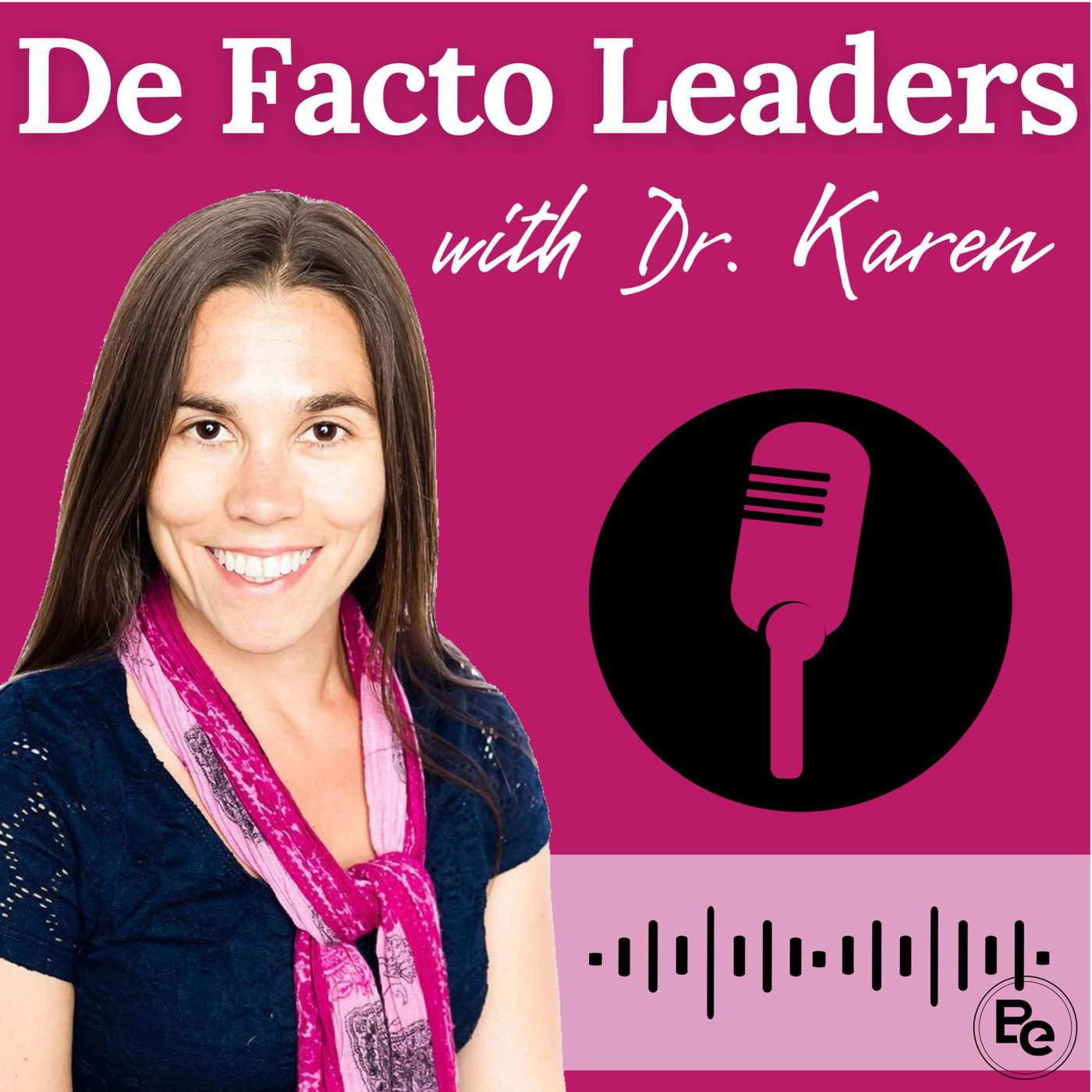
De Facto Leaders
Dr. Karen Dudek-Brannan
On the De Facto Leaders podcast, host Dr. Karen Dudek-Brannan helps pediatric therapists and educators become better leaders, so they can make a bigger impact with their services. With over 15 years of experience supporting school-age kids with diverse learning needs, Dr. Karen shares up-to-date evidence-based practices, her own experiences and guest interviews designed to help clinicians, teachers, and aspiring school leaders feel more confident in the way they serve their students and clients. She’ll cover a range of topics designed to help you support students' emotional and academic growth and set kids up for success in adulthood, including how to support language, literacy, executive functioning, and how to help IEP teams working together to support kids across the day. Whether you want to learn more effective strategies for your therapy session or classroom, be a more influential leader on your team, or find creative ways to use your skills to advance in your career, Dr. Karen has you covered.
Episodes
Mentioned books
Aug 28, 2024 • 51min
Re-release: The impact of texting on literacy and the skills needed for effective word-reading
Texting's influence on children's reading and spelling skills takes center stage, exploring necessary word decoding abilities. The conversation highlights innovative leadership strategies aimed at enhancing literacy through collaborative efforts with Reading Is Fundamental. It also stresses the importance of a balanced approach to digital communication and traditional reading methods. Parents and educators gain practical tips for fostering vocabulary development and addressing book equity, all while navigating the challenges of literacy in today's texting-savvy world.
Aug 21, 2024 • 1h 6min
Creating a culture of collaboration on your school team (with Kurtis Hewson)
I’m a huge supporter of professionals taking ownership of their careers; regardless of the systemic issues at play.But having said that, I ALSO like to help educators get to a place where they can work towards addressing systems issues head on.That’s why I was so excited to talk with Kurtis Hewson about the Collaborative Response Framework in episode 174 of De Facto Leaders.Kurtis Hewson is an award-winning former administrator and teacher, as well as teaching faculty at the post-secondary level. He is the co-founder of Jigsaw Learning, a co-author of the text, “Collaborative Response: Three Foundational Components That Transform How We Respond to the Needs of Learners” (Corwin, 2022), and currently works with districts and schools nationally and internationally establishing Collaborative Response frameworks and interacting with thousands of educators annually.Good teachers, therapists, and administrators often develop toolkits they can use to offer a continuum of support to students. But as Kurtis points out, they’re often operating in “silos of excellence”. What would happen if team members worked together to pool their resources? We discuss this topic in this episode, including:✅People in education talk a lot about the problems with “the system”. But what is the “system” and how do we improve it?✅Is talking about individual student needs always the best use of time at team meetings?✅Meetings sometimes feel like an obligation or a waste of time. How do we change that?✅What types of meetings should district level teams have and what’s the purpose of each?✅Why school teams need 4 tiers of support rather than the traditional 3 tiers of RtI.In this episode, I mention the School of Clinical Leadership, my program that helps related service providers develop a strategic plan for putting executive functioning support in place in collaboration with their school teams. You can learn more about that program here: https://drkarendudekbrannan.com/clinicalleadershipYou can learn more about how to connect with Kurtis and his work at: https://www.jigsawlearning.ca/Read about the Overview of Collaborative Response here: https://bit.ly/CR-overview Read the Introductory Chapter of the text Collaborative Response - https://bit.ly/CR-introLearn about the Layers of Collaborative Teams Here: https://www.jigsawlearning.ca/publications/blog-posts/scaffolding-our-collaborative-response-purposeful-layering-tLearn the Five Considerations to Transform Your Team Meetings here: https://www.jigsawlearningonline.com/five-planning-considerations-to-transform-your-team-meetings
Learn more about today's sponsors, Playworks, IXL and Renaissance:Learn more about Renaissance:As a global leader in education technology operating in more than 110 countries, Renaissance is committed to providing educators with insights and resources to accelerate growth and help all students build a strong foundation for success. We believe that technology can unlock a more effective learning experience, ensure that students get the personalized teaching they need to thrive, and help educators and administrators to truly, fully, See Every Student. Learn more at renaissance.com.We’re proud to be sponsored by Playworks, a 501(c)3 nonprofit organization with evidence-based practices that help schools improve the health and well-being of children by increasing opportunities for physical activity and safe, meaningful play.If you’re a school or district leader struggling with the challenge of chronic absenteeism, as so many are across the U.S., you may not realize that structured recess is a research-backed approach to keep kids in school. In fact, a UC Berkeley study of Title I schools found that those partnering with Playworks had significantly lower chronic absenteeism rates. Further, Mathematica research demonstrated that Playworks schools spent 27% less time transitioning from recess back to learning, saving teachers valuable instructional time. These results are possible for your students, too. Learn how Playworks can help you improve student-educator relationships, belonging, and attendance by signing up for a quick no-obligation conversation. We’re also thrilled to be sponsored by IXL. IXL’s comprehensive teaching and learning platform for math, language arts, science, and social studies is accelerating achievement in 95 of the top 100 U.S. school districts. Loved by teachers and backed by independent research from Johns Hopkins University, IXL can help you do the following and more:Simplify and streamline technologySave teachers’ timeReliably meet Tier 1 standardsImprove student performance on state assessments🚀 Ready to see why leading districts trust IXL for their educational needs? Visit IXL.com/BE today to learn more about how IXL can elevate your school or district.
Aug 14, 2024 • 1h 26min
School leadership and middle management (with Chris Dodge and Dr. Chris Jones)
A while back, I heard someone refer to school administrators and other public sector leaders as “middle managers”, and it really hit home for me. As I’ve transitioned through different roles in my career, I’ve gotten into the trap of thinking that when I achieve the “next step”, I’ll finally have the influence I want. In my experience, telling myself that I’ll be satisfied with the level of impact I can make when I reach the “next step” is a recipe for disappointment.In reality, I don’t think I’ll ever be able to fix all the things I want to fix, and I’m slowly coming to terms with that; learning to pick which battles are worth fighting.As I’ve talked with others who have transitioned to different administrative roles, this seems to be a common challenge faced by people in middle management positions. That’s why I invited Dr. Chris Jones and Chris Dodge to episode 173 of De Facto Leaders to talk about what it's like to be a middle manager in public sector systems like the schools. Chris Dodge has been a lead learner in elementary school settings for ten years and currently the principal at the Thorndyke Road School is Worcester, MA, Chris works to create collaborative structures and systems that bring stakeholder voice into school level decision making, as well as strategies that promote student success and achievement. His schools utilize these systems to promote a vision of serving the whole child, ensuring that students’ social-emotional and academic needs are being met. Most notably, in 2014, Christopher led the Dexter Park School in Orange, MA to become a MA Department of Education appointed Innovation School, awarded for its inclusionary practice work. Aside from the role as principal, Christopher has served on DESE’s Principal/Teacher Advisory Cabinet, Commissioner Riley’s Return to School Teaching and Learning Working Group during COVID19, as well as on the MSAA (Massachusetts School Administrators Association) Executive Board. He has been published in numerous blogs and publications such as “Rogue Leader” and “STOP Series: 100 No Nonsense Things Teachers and Leaders Should Stop Doing”, and is featured in podcasts such as “Seeing to Lead” and “Becoming Principal”. Passionate about supporting and mentoring leaders and educators, Christopher is also a consultant with Seaside Educational Consultants and an adjunct instructor at Assumption University in Worcester, MA.Dr. Chris Jones has been an educator in Massachusetts for 22 years. His experience in the classroom ranged from 8th – 11th grade working in an urban setting. A portion of this was spent opening a high school division for an expanding charter school. He has just finished his 15th year as a building administrator. Chris is also the Vice President of the Massachusetts State Administrators Association (MSAA). True to his “why” of improving the educational experience for as many people as possible, he is currently the Principal of Whitman-Hanson Regional High School in Whitman, Massachusetts. He is the author of SEEing to Lead (https://drcsjones.blog/seeing-to-lead-podcast/), a book that provides strategies for how modern leaders can and must support, engage, and empower their teachers to elevate student success. Chris vlogs weekly about continuous improvement and is also the host of the podcast SEEing to Lead as a way to amplify teachers’ voices in an effort to improve education as a whole. His overarching goal is to positively model continuous improvement in all facets of life by being purposeful, acting with integrity, and building character.Chris is passionate about continuous improvement and the idea that success is not a destination, but a process. Chris is a teacher centered principal and his beliefs around the importance of a positive work environment, continuous growth, and a healthy family work-life integration can be seen in the presentations and workshops he has given for the Massachusetts School Administrators Association (MSAA), Massachusetts Computer Using Educators (MassCUE), Massachusetts Association of Supervision and Curriculum Development (MASCD), the Association of Supervision and Curriculum Development (ASCD), the National Association of Secondary School Principals (NASSP); and his participation in the Better Leaders Better Schools Mastermind group.A finalist for the Massachusetts School Administrators Association’s Principal of the Year award and named the 2022 Massachusetts School Counselors Associaltion’s (MASCA) Administrator of the Year, Chris is described by his past Superintendent as being “…wholly invested in the success of the school…a creative problem-solver who is able to deliberate yet be decisive, be creative yet accountable…calm and clear-headed even under the most trying of times…has built a strong collaborative and collegial school culture…he is a positive influence on teachers, teaching, and learning.”Chris’ education includes a BA from Bridgewater State University, an MA from Salem State University, and a Doctorate from Northeastern University. He currently resides in Southeastern Massachusetts with his wife, Mary (Bella) and two boys, Tommy and Scotty.In this conversation, we talked about questions like:✅What is it like to be a decision-maker who reports to other decision-makers? Are there times when it’s been difficult to give staff direction because you were waiting on a decision that was over your head?✅What is the best way for people on the front-line (e.g., teachers, therapists) to provide you with information you can bring to your leadership to help move initiatives along?✅How do you know when to escalate something vs. try to handle it on your own?✅When bringing questions/concerns to leadership, how do you provide enough information that you give adequate context without getting in the weeds and overwhelming them?In this episode, I mention the School of Clinical Leadership, my program that helps related service providers develop a strategic plan for putting executive functioning support in place in collaboration with their school teams. You can learn more about that program here: https://drkarendudekbrannan.com/clinicalleadershipYou can connect with Chris Dodge on Instagram @principaldodge1 : (https://www.instagram.com/principaldodge1/), on Twitter @PrincipalDodge1 : (https://twitter.com/PrincipalDodge1), and on LinkedIn here: https://www.linkedin.com/in/chris-dodge-a33343204/You can listen to my previous episode with Chris Dodge here: EP138: Increasing access to instructional programs in rural districts (with Chris Dodge): https://drkarendudekbrannan.com/ep-119-teacher-centered-leadership-with-dr-chris-jones/You can connect with Dr. Chris Jones on LinkedIn here : https://www.li...
Aug 7, 2024 • 59min
Increasing attendance with student engagement and connectedness (with Jen Perry)
How can districts reverse chronic absenteeism and gain a deeper understanding of why students don’t come to school? Can we measure how “connected” students are to their schools? How do we impact the level of connection they feel with potential mentors in their lives? I invited Jen Perry to episode 172 of the De Facto Leaders podcast to discuss this topic and explore ways schools can assess student engagement and put meaningful programs in place to increase it. Jen Perry is Senior Manager of Learning Design and Whole Learner at Edmentum. Jen has worked over 30+ years with youth in educational and community settings. As a teacher, administrator, and trainer, her passion has been to help educators develop an understanding of the importance of social emotional learning and build trauma-informed responses and systems. This work has included supporting youth, administrators, and schools in understanding behavior and implementing transformational change through strength-based approaches.In this conversation, we discussed:✅Using positive youth development models to support youth involved with the legal system.✅Changing our assumptions about kids who have “risk factors” and resources. ✅Helping youth build developmental assets through community navigation and academic support.✅Research on the effectiveness of high-impact tutoring in increasing attendance and student engagement.✅How do we help kids connect academic work to meaningful life goals? ✅Giving students the language they need for self-advocacy and self-awareness.In this episode, we mentioned the following resources:“The Poverty Problem: How Education Can Promote Resilience and Counter Poverty’s Impact on Brain Development and Functioning” by Horacio Sanchez Link here: https://www.amazon.com/Poverty-Problem-Resilience-Development-Functioning/dp/1071842927Maguillie, L, Perry, J., Aiello, J. (2019). The impact of an Alternative to Detention Program on Developmental Assets for adolescents involved in the juvenile justice or legal system. Journal of Applied Juvenile Justice Services.Link here: https://irp.cdn-website.com/45a58767/files/uploaded/2019-Alternative%20to%20Detention%20%28Maggiulli%29.pdfWhole Learner Foundations: Understanding Behavior and our Default SettingLink here: https://www.edmentum.com/intl/resources/webinars/whole-learner-foundations-understanding-behavior-and-our-default-setting/Jen Perry on Students and ConnectionLink here: https://www.youtube.com/watch?v=38EMkeKK96cJen Perry on Teacher Well-beingLink here: https://www.youtube.com/watch?v=dMuiiq56bsYTargeted Skills Instruction-Accelerate High-Impact Virtual Tutoring ServicesLink here: https://www.edmentum.com/products/virtual-tutoring/Learn more about where to connect with Jen on Linked here (https://www.linkedin.com/in/jen-perry-8aaa99204/) or at edmentum.com. In this episode, I mention the School of Clinical Leadership, my program that helps related service providers develop a strategic plan for putting executive functioning support in place in collaboration with their school teams. You can learn more about that program here: https://drkarendudekbrannan.com/clinicalleadership
Learn more about today's sponsors, Playworks, IXL and Renaissance:Learn more about Renaissance:As a global leader in education technology operating in more than 110 countries, Renaissance is committed to providing educators with insights and resources to accelerate growth and help all students build a strong foundation for success. We believe that technology can unlock a more effective learning experience, ensure that students get the personalized teaching they need to thrive, and help educators and administrators to truly, fully, See Every Student. Learn more at renaissance.com.We’re proud to be sponsored by Playworks, a 501(c)3 nonprofit organization with evidence-based practices that help schools improve the health and well-being of children by increasing opportunities for physical activity and safe, meaningful play.If you’re a school or district leader struggling with the challenge of chronic absenteeism, as so many are across the U.S., you may not realize that structured recess is a research-backed approach to keep kids in school. In fact, a UC Berkeley study of Title I schools found that those partnering with Playworks had significantly lower chronic absenteeism rates. Further, Mathematica research demonstrated that Playworks schools spent 27% less time transitioning from recess back to learning, saving teachers valuable instructional time. These results are possible for your students, too. Learn how Playworks can help you improve student-educator relationships, belonging, and attendance by signing up for a quick no-obligation conversation. We’re also thrilled to be sponsored by IXL. IXL’s comprehensive teaching and learning platform for math, language arts, science, and social studies is accelerating achievement in 95 of the top 100 U.S. school districts. Loved by teachers and backed by independent research from Johns Hopkins University, IXL can help you do the following and more:Simplify and streamline technologySave teachers’ timeReliably meet Tier 1 standardsImprove student performance on state assessments🚀 Ready to see why leading districts trust IXL for their educational needs? Visit IXL.com/BE today to learn more about how IXL can elevate your school or district.
Jul 31, 2024 • 53min
Social-emotional learning for adults (featuring Crissy Mombela, Lisa Navarra, and Dr. Theresa Melito-Conners)
Most discussions around social-emotional learning are about helping kids stay regulated, healthy, and adjusted, but we can’t forget about the adults. Being in any type of role that involves caring for others can be incredibly dysregulating; whether you’re a K-12 professional or a parent. That’s why in this episode, I’m highlighting past interview clips with guests that address emotional regulation and self-care in adults. In this episode, you’ll hear discussions on:✅How to teach behavioral expectations in class (and why this can help maintain safety and security among staff and students).✅How to use co-regulation strategies to manage challenging behaviors such as eloping or property destruction. ✅Supporting bus drivers, security guards, and other non-teaching school personnel who interact with students. ✅Administrators think that self-care is important for students and teachers; but are they taking care of themselves?✅Going beyond fluffy self-care tips (like wine and bubble baths) and creating sustainable habits.This episode includes clips from the following interviews:EP 152: The cost of caring: Compassion fatigue in education and healthcare (with Crissy Mombela) Link here: https://drkarendudekbrannan.com/ep-152-the-cost-of-caring-compassion-fatigue-in-education-and-healthcare-with-crissy-mombela/EP 111: Supporting self-regulation in K-12 kids (with Lisa Navarra)Link here: https://drkarendudekbrannan.com/ep-111-supporting-self-regulation-in-k-12-kids-with-lisa-navarra/EP 103: Self-care cabaret for teachers, therapists, and school leaders (with Dr. Theresa-Melito Conners)Link here: https://drkarendudekbrannan.com/ep-103-self-care-cabaret-for-teachers-therapists-and-school-leaders-with-dr-theresa-melito-conners/In this episode, I mention the School of Clinical Leadership, my program that helps related service providers develop a strategic plan for putting executive functioning support in place in collaboration with their school teams. You can learn more about that program here: https://drkarendudekbrannan.com/clinicalleadership
Learn more about today's sponsors, Playworks, IXL and Renaissance:Learn more about Renaissance:As a global leader in education technology operating in more than 110 countries, Renaissance is committed to providing educators with insights and resources to accelerate growth and help all students build a strong foundation for success. We believe that technology can unlock a more effective learning experience, ensure that students get the personalized teaching they need to thrive, and help educators and administrators to truly, fully, See Every Student. Learn more at renaissance.com.We’re proud to be sponsored by Playworks, a 501(c)3 nonprofit organization with evidence-based practices that help schools improve the health and well-being of children by increasing opportunities for physical activity and safe, meaningful play.If you’re a school or district leader struggling with the challenge of chronic absenteeism, as so many are across the U.S., you may not realize that structured recess is a research-backed approach to keep kids in school. In fact, a UC Berkeley study of Title I schools found that those partnering with Playworks had significantly lower chronic absenteeism rates. Further, Mathematica research demonstrated that Playworks schools spent 27% less time transitioning from recess back to learning, saving teachers valuable instructional time. These results are possible for your students, too. Learn how Playworks can help you improve student-educator relationships, belonging, and attendance by signing up for a quick no-obligation conversation. We’re also thrilled to be sponsored by IXL. IXL’s comprehensive teaching and learning platform for math, language arts, science, and social studies is accelerating achievement in 95 of the top 100 U.S. school districts. Loved by teachers and backed by independent research from Johns Hopkins University, IXL can help you do the following and more:Simplify and streamline technologySave teachers’ timeReliably meet Tier 1 standardsImprove student performance on state assessments🚀 Ready to see why leading districts trust IXL for their educational needs? Visit IXL.com/BE today to learn more about how IXL can elevate your school or district.
Jul 24, 2024 • 1h 3min
Making intentional decisions and leaning on the expertise of your team (with Dr. Jen Schwanke)
As a school leader, when is it best to make “top-down” decisions, and when should you make it a collaborative process?How can you tell which stakeholder input to prioritize?What’s the best way to communicate with your staff in a way that feels transparent, but doesn’t burden them with too much information? How can you make decisions confidently when you’re supervising staff in positions you’ve never held yourself? I invited Dr. Jen Schwanke to episode 170 of the De Facto Leaders podcast to discuss these questions. Dr. Jen Schwanke is a longtime educator, teaching and leading at all levels. She is the author of four ASCD books, including the recently-released The Principal’s Guide to Conflict Management, and has published hundreds of articles for various educational publishers. She has written and presented for multiple state and local education organizations, and has provided professional development to various districts in the areas of school climate, personnel, and instructional leadership. An instructor in educational administration at Miami University of Ohio and The Ohio State University, Dr. Schwanke currently serves as a Deputy Superintendent in Ohio. You can find her at jenschwanke.com.In this conversation, we discuss:✅Getting to the “root cause” of pain points: How can you tell what people really need from you? ✅Being decisive vs. being collaborative: The different types of decisions leaders need to make and the strategies for handling them✅When should we use our own expertise to solve problems, and when should we leverage the expertise of others?✅Shaking things up vs. maintaining the status quo: How this changes the way you leadYou can connect with Dr. Schwanke at her website at jenschwanke.com, on X @jenschwanke (http://jenschwanke.com), and on Instagram here: https://www.instagram.com/drjenschwanke/In this episode, I mention the School of Clinical Leadership, my program that helps related service providers develop a strategic plan for putting executive functioning support in place in collaboration with their school teams. You can learn more about that program here: https://drkarendudekbrannan.com/clinicalleadership
Learn more about today's sponsors, Playworks, IXL and Renaissance:Learn more about Renaissance:As a global leader in education technology operating in more than 110 countries, Renaissance is committed to providing educators with insights and resources to accelerate growth and help all students build a strong foundation for success. We believe that technology can unlock a more effective learning experience, ensure that students get the personalized teaching they need to thrive, and help educators and administrators to truly, fully, See Every Student. Learn more at renaissance.com.We’re proud to be sponsored by Playworks, a 501(c)3 nonprofit organization with evidence-based practices that help schools improve the health and well-being of children by increasing opportunities for physical activity and safe, meaningful play.If you’re a school or district leader struggling with the challenge of chronic absenteeism, as so many are across the U.S., you may not realize that structured recess is a research-backed approach to keep kids in school. In fact, a UC Berkeley study of Title I schools found that those partnering with Playworks had significantly lower chronic absenteeism rates. Further, Mathematica research demonstrated that Playworks schools spent 27% less time transitioning from recess back to learning, saving teachers valuable instructional time. These results are possible for your students, too. Learn how Playworks can help you improve student-educator relationships, belonging, and attendance by signing up for a quick no-obligation conversation. We’re also thrilled to be sponsored by IXL. IXL’s comprehensive teaching and learning platform for math, language arts, science, and social studies is accelerating achievement in 95 of the top 100 U.S. school districts. Loved by teachers and backed by independent research from Johns Hopkins University, IXL can help you do the following and more:Simplify and streamline technologySave teachers’ timeReliably meet Tier 1 standardsImprove student performance on state assessments🚀 Ready to see why leading districts trust IXL for their educational needs? Visit IXL.com/BE today to learn more about how IXL can elevate your school or district.
Jul 17, 2024 • 50min
How to support executive functioning with environmental scaffolding (self-talk, time-perception, planning)
Today, I wanted to share some FAQs that people ask about how to teach executive functioning. Some of those common questions are:How do you teach self-talk, time-perception, and strategic-planning?How do you offer help without making kids prompt-dependent?I understand that executive functioning intervention is more than just checklists and behavior charts, but what’s the right way to structure interventions?How can I provide environmental scaffolding after students leave my therapy sessions? What exactly is “environmental scaffolding”? I understand I need to coach and train others, but how should that look in practice? One of the ways I answer these questions is through the concept of “scalable protocols”. This is an alternative to the way we traditionally think about lesson plans. It allows you to define the specifics of the “how”, which is why people are asking questions such as the ones I’ve listed above, and also enables clinicians to train others. In this episode, I share the audio of two video clips that help give an overview of how that could look, as well as the overview of a framework I use to support executive functioning in context. If you’re a clinician who wants to know how to do this in therapy AND coach others, it will help you through the first step in that process. If you’re a parent or teacher and you want to learn a strategy you can use to support kids, you can also use this strategy. In this episode, I mentioned this blog post https://drkarenspeech.com/whats-better-than-an-executive-functioning-lesson-plan/), where I include the full video clips that contain screen shares of some of the protocols I mentioned. I also mention this article about scalable protocols and how they fit in to your intervention model. Link here: https://drkarenspeech.com/executive-functioning-support-three-paradigm-shifts-for-school-teams/In this episode, I mention the School of Clinical Leadership, my program that helps related service providers develop a strategic plan for putting executive functioning support in place in collaboration with their school teams. You can learn more about that program here: https://drkarendudekbrannan.com/clinicalleadership
Learn more about today's sponsors, Playworks, IXL and Renaissance:Learn more about Renaissance:As a global leader in education technology operating in more than 110 countries, Renaissance is committed to providing educators with insights and resources to accelerate growth and help all students build a strong foundation for success. We believe that technology can unlock a more effective learning experience, ensure that students get the personalized teaching they need to thrive, and help educators and administrators to truly, fully, See Every Student. Learn more at renaissance.com.We’re proud to be sponsored by Playworks, a 501(c)3 nonprofit organization with evidence-based practices that help schools improve the health and well-being of children by increasing opportunities for physical activity and safe, meaningful play.If you’re a school or district leader struggling with the challenge of chronic absenteeism, as so many are across the U.S., you may not realize that structured recess is a research-backed approach to keep kids in school. In fact, a UC Berkeley study of Title I schools found that those partnering with Playworks had significantly lower chronic absenteeism rates. Further, Mathematica research demonstrated that Playworks schools spent 27% less time transitioning from recess back to learning, saving teachers valuable instructional time. These results are possible for your students, too. Learn how Playworks can help you improve student-educator relationships, belonging, and attendance by signing up for a quick no-obligation conversation. We’re also thrilled to be sponsored by IXL. IXL’s comprehensive teaching and learning platform for math, language arts, science, and social studies is accelerating achievement in 95 of the top 100 U.S. school districts. Loved by teachers and backed by independent research from Johns Hopkins University, IXL can help you do the following and more:Simplify and streamline technologySave teachers’ timeReliably meet Tier 1 standardsImprove student performance on state assessments🚀 Ready to see why leading districts trust IXL for their educational needs? Visit IXL.com/BE today to learn more about how IXL can elevate your school or district.
Jul 10, 2024 • 46min
What do administrators need from school therapists and teachers? (featuring Eric Makelky, Jalita Johnson, and Jethro Jones)
Almost every school leader that I know has said they didn’t realize what they were getting themselves into when they started their first administrative position. In this episode, I wanted to share clips from past “De Facto Leaders” guests to showcase some of the challenges faced by school administrators (or those hoping to move into an administrative role). You’ll hear discussions on:✅Qualities of a good principal: Protecting staff and removing barriers✅Navigating ambiguity and impostor syndrome as a leader✅Can teaching practices change if the system isn’t ready? ✅Investing in curriculums: The end user is the TEACHER, not the student. ✅Asking for help: How to make it an easy “yes” for the other person. This episode includes clips from the following interviews:EP 109: Can my principal evaluate me if they’ve never done my job?(with Eric Makelky)? Link here: https://drkarendudekbrannan.com/ep-109-can-my-principal-evaluate-me-if-theyve-never-done-my-job-with-eric-makelky/EP 151: Does your SYSTEM support your policy and your curriculum? (with Jalita Johnson) Link here: https://drkarendudekbrannan.com/ep-151-does-your-system-support-your-policy-and-your-curriculum-with-jalita-johnson/EP 112: How to “lead up” to your school administrator (with Jethro Jones) Link here: https://drkarendudekbrannan.com/ep-109-can-my-principal-evaluate-me-if-theyve-never-done-my-job-with-eric-makelky/In this episode, I mention Language Therapy Advance Foundations, my program that helps SLPs create a system for language therapy. You can learn more about Language Therapy Advance Foundations here: https://drkarenspeech.com/languagetherapy/
Learn more about today's sponsors, Playworks, IXL and Renaissance:Learn more about Renaissance:As a global leader in education technology operating in more than 110 countries, Renaissance is committed to providing educators with insights and resources to accelerate growth and help all students build a strong foundation for success. We believe that technology can unlock a more effective learning experience, ensure that students get the personalized teaching they need to thrive, and help educators and administrators to truly, fully, See Every Student. Learn more at renaissance.com.We’re proud to be sponsored by Playworks, a 501(c)3 nonprofit organization with evidence-based practices that help schools improve the health and well-being of children by increasing opportunities for physical activity and safe, meaningful play.If you’re a school or district leader struggling with the challenge of chronic absenteeism, as so many are across the U.S., you may not realize that structured recess is a research-backed approach to keep kids in school. In fact, a UC Berkeley study of Title I schools found that those partnering with Playworks had significantly lower chronic absenteeism rates. Further, Mathematica research demonstrated that Playworks schools spent 27% less time transitioning from recess back to learning, saving teachers valuable instructional time. These results are possible for your students, too. Learn how Playworks can help you improve student-educator relationships, belonging, and attendance by signing up for a quick no-obligation conversation. We’re also thrilled to be sponsored by IXL. IXL’s comprehensive teaching and learning platform for math, language arts, science, and social studies is accelerating achievement in 95 of the top 100 U.S. school districts. Loved by teachers and backed by independent research from Johns Hopkins University, IXL can help you do the following and more:Simplify and streamline technologySave teachers’ timeReliably meet Tier 1 standardsImprove student performance on state assessments🚀 Ready to see why leading districts trust IXL for their educational needs? Visit IXL.com/BE today to learn more about how IXL can elevate your school or district.
4 snips
Jul 3, 2024 • 48min
A framework for executive functioning intervention: Three shifts for school teams
Discover innovative strategies to support students with executive dysfunction. Explore the need for collaboration among educators and therapists, shifting away from traditional therapy models. Learn how personalized approaches can enhance social skills development. Delve into the importance of integrating executive functioning support across various educational settings, ensuring skills are generalized and applicable in real life. Effective interventions aim to empower students through perspective-taking and self-advocacy techniques.
Jun 26, 2024 • 1h 18min
The role of syntax in supporting language processing and executive functioning
Language and executive functioning have a bidirectional relationship (Baron & Arbel, 2022; Larson, et al., 2019). This means that building language skills can impact executive functioning, and vice versa. A significant amount of executive functioning skills are required to comprehend language-based academic tasks like reading and writing. Yet strategic thinking (which is part of executive functioning) requires a significant amount of internal dialogue; which is very difficult to engage in without adequate vocabulary or ability to use and understand complex syntax (Fahy, 2014). Complex sentences are loaded with language that indicates cause and effect or temporal information; all which are essential for strategic planning. On top of that, many students continue to struggle with reading comprehension without direct work on foundational language skills; even if they’re taught comprehension strategies (Eberhardt, 2013; Scott, 2009; Scott & Koonce, 2014; Nippold, 2017).One might make the argument then (which I often do), that these underlying language skills are necessary to developing strong executive functioning skills. This makes both treatment planning, diagnosis, and determining eligibility for educational programming complicated; especially when it comes to legal guidelines as well as state and local policies. That’s why in episode 166 of De Facto Leaders, I’m sharing a Q & A session I did in my Language Therapy Advance Foundations member’s group to talk about the relationship between syntax, processing and higher level cognitive processes like executive functioning. In this episode, I share: ✅How to create a strategic plan if you need to build a system for language therapy and a system for executive functioning intervention?✅Should you focus on the students' needs or your own needs when planning your professional development goals?✅Common comorbidities and diagnoses to consider when focusing on language, executive functioning, and reading/writing.✅The impact of syntax on other language and cognitive processes.✅Common sentence types that are difficult for individuals with DLD and other diagnoses that impact language.✅Ineffective strategies used to comprehend difficult sentence types.✅Why do these difficult sentence types impact comprehension, processing, and our ability to engage in internal dialogue and strategic planning?In this episode, I mention Language Therapy Advance Foundations, my program that helps SLPs create a system for language therapy. You can learn more about Language Therapy Advance Foundations here: https://drkarenspeech.com/languagetherapy/I also mentioned the School of Clinical Leadership, my program that helps related service providers develop a strategic plan for putting executive functioning support in place in collaboration with their school teams. You can learn more about that program here: https://drkarendudekbrannan.com/clinicalleadership You can view the YouTube version of this episode with slides here: https://youtu.be/7-F0fjjJ0F8I also mentioned the following resources:Ultimate Guide to Sentence Structure : https://drkarenspeech.com/sentencestructureThe 5 Component Language Therapy Framework: https://drkarenspeech.com/languageSyntactic Development in the School-Age Years: https://drkarenspeech.com/syntactic-development-school-age-years/K-12 Professional Learning: It’s about what the adults need, not just the kids: https://drkarenspeech.com/k-12-professional-learning-its-about-what-adults-need-not-just-the-kids/De Facto Leaders EP 159: Comorbidities and Differential Diagnosis: https://drkarendudekbrannan.com/ep-159-comborbidities-and-differential-diagnosis-adhd-dld-dyslexia/
Learn more about today's sponsors, Playworks, IXL and Renaissance:Learn more about Renaissance:As a global leader in education technology operating in more than 110 countries, Renaissance is committed to providing educators with insights and resources to accelerate growth and help all students build a strong foundation for success. We believe that technology can unlock a more effective learning experience, ensure that students get the personalized teaching they need to thrive, and help educators and administrators to truly, fully, See Every Student. Learn more at renaissance.com.We’re proud to be sponsored by Playworks, a 501(c)3 nonprofit organization with evidence-based practices that help schools improve the health and well-being of children by increasing opportunities for physical activity and safe, meaningful play.If you’re a school or district leader struggling with the challenge of chronic absenteeism, as so many are across the U.S., you may not realize that structured recess is a research-backed approach to keep kids in school. In fact, a UC Berkeley study of Title I schools found that those partnering with Playworks had significantly lower chronic absenteeism rates. Further, Mathematica research demonstrated that Playworks schools spent 27% less time transitioning from recess back to learning, saving teachers valuable instructional time. These results are possible for your students, too. Learn how Playworks can help you improve student-educator relationships, belonging, and attendance by signing up for a quick no-obligation conversation. We’re also thrilled to be sponsored by IXL. IXL’s comprehensive teaching and learning platform for math, language arts, science, and social studies is accelerating achievement in 95 of the top 100 U.S. school districts. Loved by teachers and backed by independent research from Johns Hopkins University, IXL can help you do the following and more:Simplify and streamline technologySave teachers’ timeReliably meet Tier 1 standardsImprove student performance on state assessments🚀 Ready to see why leading districts trust IXL for their educational needs? Visit IXL.com/BE today to learn more about how IXL can elevate your school or district.

