

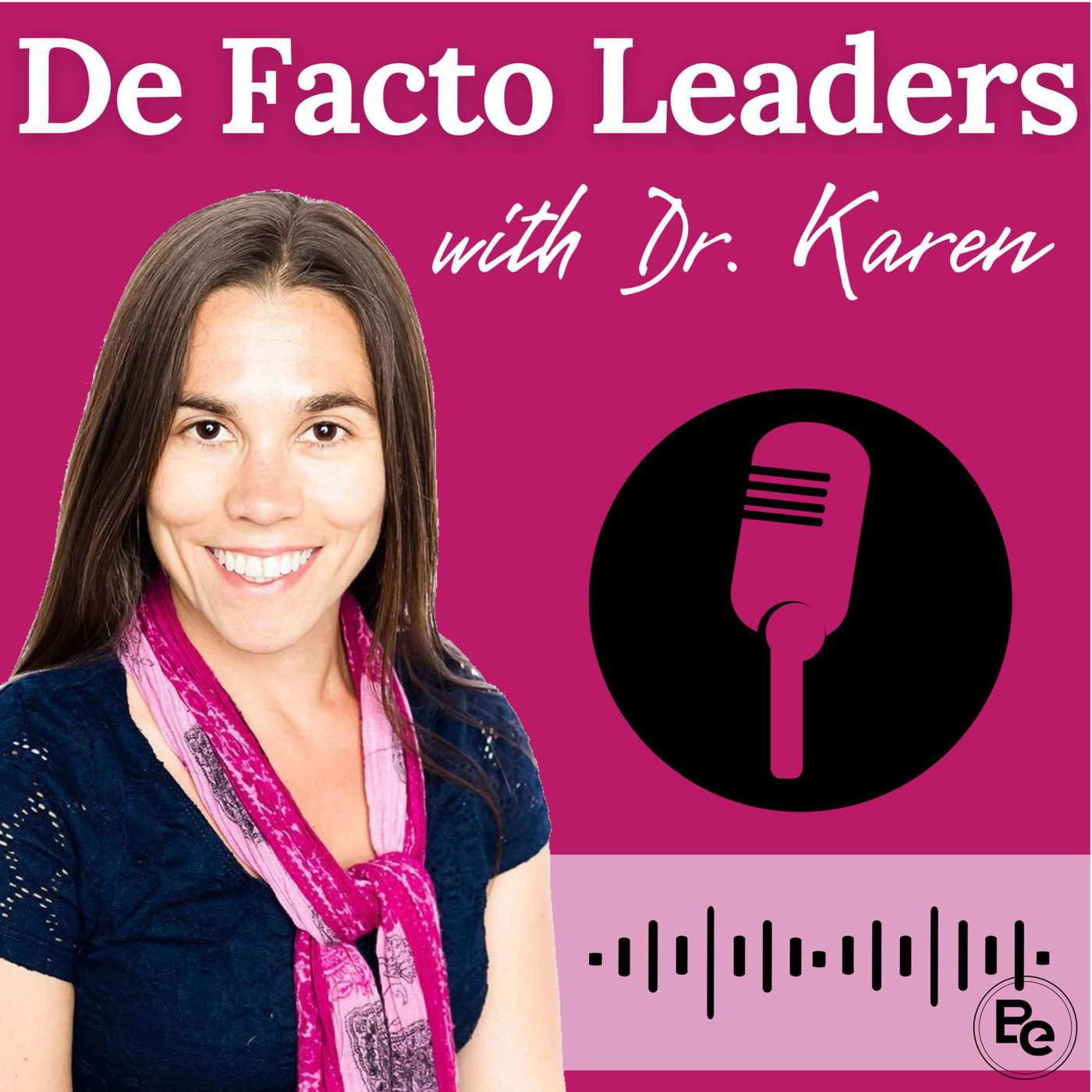
De Facto Leaders
Dr. Karen Dudek-Brannan
On the De Facto Leaders podcast, host Dr. Karen Dudek-Brannan helps pediatric therapists and educators become better leaders, so they can make a bigger impact with their services. With over 15 years of experience supporting school-age kids with diverse learning needs, Dr. Karen shares up-to-date evidence-based practices, her own experiences and guest interviews designed to help clinicians, teachers, and aspiring school leaders feel more confident in the way they serve their students and clients. She’ll cover a range of topics designed to help you support students' emotional and academic growth and set kids up for success in adulthood, including how to support language, literacy, executive functioning, and how to help IEP teams working together to support kids across the day. Whether you want to learn more effective strategies for your therapy session or classroom, be a more influential leader on your team, or find creative ways to use your skills to advance in your career, Dr. Karen has you covered.
Episodes
Mentioned books
Oct 1, 2025 • 38min
Engaging Families and the Role of Tech in Addressing Book Deserts (featuring Cassandra Williams)
In this episode, I reflect on my conversation with my colleague Cassandra Williams as we discuss book and resource deserts, as well as how to engage with school communities. In the interview clip I share, Cassandra shares a story of how one of her colleagues found a surprising way to increase attendance at parent-teacher conferences when he took the time to ask members of the community what their needs were. Additionally, I share my commentary on how technology can both help and hinder literacy skills. Cassandra Williams is a true innovator in the education field, having dedicated over 25 years of her life to revolutionizing existing systems and setting new standards of excellence. With a degree in Elementary Education from Southern Illinois University and a Master’s from California State University, she is also the founder of two successful elementary schools in Indianapolis. Her research has focused on coaching teachers to accelerate student achievement, often utilizing video and other technologies as learning tools. Her most recent passion is the Educational Innovation 360° (Link here: https://www.educationalinnovation360.com/) e-Instructional Coaching System, which she designed and developed in 2018.Topics covered in this episode: ✅ When parents aren’t engaging, are you addressing the issue from a place of curiosity or judgement?✅ Is technology a solution when schools lack access to books or curriculum materials?✅ Using technology for professional development and training: Balancing efficiency with connection. You can connect with Cassandra on LinkedIn here (https://www.linkedin.com/in/cassandra-williams-777b7927/), on Twitter here (https://twitter.com/Edinnovation360), and on Facebook here (https://www.facebook.com/Educationalinnovation360/), on Instagram @educationalinnovation360 (https://www.instagram.com/educationalinnovation360/)You can learn more about her coaching and professional development for schools and individuals at Educationalinnovation360.com (https://www.educationalinnovation360.com/).You can listen to the original interview with Cassandra on the De Facto Leaders podcast here: EP 113: Making literacy accessible and equitable (with Cassandra Williams) Link here: https://drkarendudekbrannan.com/ep-113-making-literacy-accessible-and-equitable-with-cassandra-williams/You can listen to Cassandra’s interview on SEEing to Lead with Dr. Chris Jones here where they discuss using video as a tool for teacher training and development: Educational Innovation 360 (Link here: https://stl.bepodcast.network/s3/24)In this episode, I mention the School of Clinical Leadership, my program for related service providers who want to take a leadership role in implementing executive functioning support. You can learn more about the program here: https://drkarendudekbrannan.com/efleadershipI also mentioned Language Therapy Advance Foundations, my program that helps SLPs and other service providers create a system for language therapy. You can learn more about the program here: https://drkarenspeech.com/languagetherapy/
Learn more about today's sponsors, Playworks, IXL and Renaissance:Learn more about Renaissance:As a global leader in education technology operating in more than 110 countries, Renaissance is committed to providing educators with insights and resources to accelerate growth and help all students build a strong foundation for success. We believe that technology can unlock a more effective learning experience, ensure that students get the personalized teaching they need to thrive, and help educators and administrators to truly, fully, See Every Student. Learn more at renaissance.com.We’re proud to be sponsored by Playworks, a 501(c)3 nonprofit organization with evidence-based practices that help schools improve the health and well-being of children by increasing opportunities for physical activity and safe, meaningful play.If you’re a school or district leader struggling with the challenge of chronic absenteeism, as so many are across the U.S., you may not realize that structured recess is a research-backed approach to keep kids in school. In fact, a UC Berkeley study of Title I schools found that those partnering with Playworks had significantly lower chronic absenteeism rates. Further, Mathematica research demonstrated that Playworks schools spent 27% less time transitioning from recess back to learning, saving teachers valuable instructional time. These results are possible for your students, too. Learn how Playworks can help you improve student-educator relationships, belonging, and attendance by signing up for a quick no-obligation conversation. We’re also thrilled to be sponsored by IXL. IXL’s comprehensive teaching and learning platform for math, language arts, science, and social studies is accelerating achievement in 95 of the top 100 U.S. school districts. Loved by teachers and backed by independent research from Johns Hopkins University, IXL can help you do the following and more:Simplify and streamline technologySave teachers’ timeReliably meet Tier 1 standardsImprove student performance on state assessments🚀 Ready to see why leading districts trust IXL for their educational needs? Visit IXL.com/BE today to learn more about how IXL can elevate your school or district.
Sep 24, 2025 • 28min
Navigating Language Therapy as the Only SLP in the District
Ever feel overwhelmed being the only SLP in your district without a network of fellow clinicians for support? You're not alone; many in similar situations face these challenges.In this episode, I’m sharing a case study of an SLP who, despite being the sole clinician in her district, felt the pressure of not having a trusted system she could rely on for language therapy. Searching for a structured, effective approach, she turned to the Language Therapy Advance Foundations program. There, she developed a reliable system she could bring to her team, transforming her therapy sessions and instilling confidence in her practice.I also reflect on ways you can gain a sense of belonging, even if you’re the only one in your discipline.In this episode, I’ll share:✅ Managing the challenges and isolation of being the only SLP in a district while building a trustworthy framework for therapy.✅ Developing a system that empowers you to handle your caseload with confidence, even without peer support.✅ Creating a dependable, efficient approach to language therapy that benefits both the clinician's peace of mind and the students' progress.Join us as we explore how this solo SLP navigated her unique situation and emerged with a structured system she could trust and share with her team.In this episode, I mentioned this previous podcast interview: EP 109: Can my principal evaluate me if they’ve never done my job? (with Eric Makelky) here: https://drkarendudekbrannan.com/ep-109-can-my-principal-evaluate-me-if-theyve-never-done-my-job-with-eric-makelky/This case study came from a member of Language Therapy Advance Foundations, my program that gives SLPs and other service providers create a system for language therapy. You can learn more about the program here: https://drkarenspeech.com/languagetherapy/
Learn more about today's sponsors, Playworks, IXL and Renaissance:Learn more about Renaissance:As a global leader in education technology operating in more than 110 countries, Renaissance is committed to providing educators with insights and resources to accelerate growth and help all students build a strong foundation for success. We believe that technology can unlock a more effective learning experience, ensure that students get the personalized teaching they need to thrive, and help educators and administrators to truly, fully, See Every Student. Learn more at renaissance.com.We’re proud to be sponsored by Playworks, a 501(c)3 nonprofit organization with evidence-based practices that help schools improve the health and well-being of children by increasing opportunities for physical activity and safe, meaningful play.If you’re a school or district leader struggling with the challenge of chronic absenteeism, as so many are across the U.S., you may not realize that structured recess is a research-backed approach to keep kids in school. In fact, a UC Berkeley study of Title I schools found that those partnering with Playworks had significantly lower chronic absenteeism rates. Further, Mathematica research demonstrated that Playworks schools spent 27% less time transitioning from recess back to learning, saving teachers valuable instructional time. These results are possible for your students, too. Learn how Playworks can help you improve student-educator relationships, belonging, and attendance by signing up for a quick no-obligation conversation. We’re also thrilled to be sponsored by IXL. IXL’s comprehensive teaching and learning platform for math, language arts, science, and social studies is accelerating achievement in 95 of the top 100 U.S. school districts. Loved by teachers and backed by independent research from Johns Hopkins University, IXL can help you do the following and more:Simplify and streamline technologySave teachers’ timeReliably meet Tier 1 standardsImprove student performance on state assessments🚀 Ready to see why leading districts trust IXL for their educational needs? Visit IXL.com/BE today to learn more about how IXL can elevate your school or district.
Sep 17, 2025 • 28min
Case Study: Shouldn’t I have language therapy figured out by now?
Ever feel like you should have language therapy figured out by now, but you're still struggling? Even experienced clinicians can feel that way.In this episode, I’m sharing a case study of a seasoned SLP who, despite years of experience, felt like she was missing a key piece of the puzzle when it came to language therapy. Battling decision fatigue and a lack of a reliable system, she joined my Language Therapy Advance Foundations program and created a reliable system that made her feel confident showing up to sessions.In this episode, we’ll discuss:✅ Overcoming the feeling of inadequacy as a veteran clinician and acknowledging the need for a more structured approach to language therapy.✅ How streamlining decision-making allowed for more focused therapy sessions. ✅ Strategies for working on language skills that support executive functioning. ✅ Creating a predictable, efficient system for building language skills that support reading and writing. This case study came from a member of Language Therapy Advance Foundations, my program that gives SLPs and other service providers create a system for language therapy. You can learn more about the program here: https://drkarenspeech.com/languagetherapy/
Learn more about today's sponsors, Playworks, IXL and Renaissance:Learn more about Renaissance:As a global leader in education technology operating in more than 110 countries, Renaissance is committed to providing educators with insights and resources to accelerate growth and help all students build a strong foundation for success. We believe that technology can unlock a more effective learning experience, ensure that students get the personalized teaching they need to thrive, and help educators and administrators to truly, fully, See Every Student. Learn more at renaissance.com.We’re proud to be sponsored by Playworks, a 501(c)3 nonprofit organization with evidence-based practices that help schools improve the health and well-being of children by increasing opportunities for physical activity and safe, meaningful play.If you’re a school or district leader struggling with the challenge of chronic absenteeism, as so many are across the U.S., you may not realize that structured recess is a research-backed approach to keep kids in school. In fact, a UC Berkeley study of Title I schools found that those partnering with Playworks had significantly lower chronic absenteeism rates. Further, Mathematica research demonstrated that Playworks schools spent 27% less time transitioning from recess back to learning, saving teachers valuable instructional time. These results are possible for your students, too. Learn how Playworks can help you improve student-educator relationships, belonging, and attendance by signing up for a quick no-obligation conversation. We’re also thrilled to be sponsored by IXL. IXL’s comprehensive teaching and learning platform for math, language arts, science, and social studies is accelerating achievement in 95 of the top 100 U.S. school districts. Loved by teachers and backed by independent research from Johns Hopkins University, IXL can help you do the following and more:Simplify and streamline technologySave teachers’ timeReliably meet Tier 1 standardsImprove student performance on state assessments🚀 Ready to see why leading districts trust IXL for their educational needs? Visit IXL.com/BE today to learn more about how IXL can elevate your school or district.
Sep 10, 2025 • 47min
Balancing Language, Academic Content Areas, and Executive Functioning (featuring Jill Fahy)
What if choosing between language and executive functioning for your students wasn't an "either/or" decision? And how can we effectively balance academic content with broader cognitive skills? It's a complex challenge, and the answer isn't always obvious.In this episode, I share commentary and a clip of my conversation with Jill Fahy, where we discuss the impact of executive functioning skills on the college experience. Jill is a licensed speech-language pathologist and professor in the Department of Communication Sciences and Disorders at Eastern Illinois University. She is also the co-director of the Autism Center and Director of the Students with Autism Transitional Education Program, where she develops and delivers transitional programming in social skills and executive functions for college students. In this episode, you’ll discover:✅ Should we work on language or executive functioning first? The answer isn’t straightforward.✅ Balancing academic content areas and broader cognitive skills: Why both parents and professionals need to learn about executive functioning as it relates to their context. ✅ Educating the public on cognition and evidence-based practices, and why it’s so easy for vulnerable individuals to grasp on to pseudoscience. ✅ How to use “asset stacking” to address the need to work on multiple interconnected areas at once (e.g., content area skills, language, cognition).You can connect with Jill via email at jkfahy@eiu.edu. You can read her article, Assessment of Executive Functions in School-Aged Children: Challenges and Solutions for the SLP from ASHA Perspectives here: https://pubs.asha.org/doi/10.1044/sbi15.4.151You can learn more about the Students Transitional Education Program at Eastern Illinois University here: https://www.eiu.edu/step/ and the Autism Center here: https://www.eiu.edu/autismcenter/In this episode, I mention the School of Clinical Leadership, my program for related service providers who want to take a leadership role in implementing executive functioning support. You can learn more about the program here: https://drkarendudekbrannan.com/efleadership
Learn more about today's sponsors, Playworks, IXL and Renaissance:Learn more about Renaissance:As a global leader in education technology operating in more than 110 countries, Renaissance is committed to providing educators with insights and resources to accelerate growth and help all students build a strong foundation for success. We believe that technology can unlock a more effective learning experience, ensure that students get the personalized teaching they need to thrive, and help educators and administrators to truly, fully, See Every Student. Learn more at renaissance.com.We’re proud to be sponsored by Playworks, a 501(c)3 nonprofit organization with evidence-based practices that help schools improve the health and well-being of children by increasing opportunities for physical activity and safe, meaningful play.If you’re a school or district leader struggling with the challenge of chronic absenteeism, as so many are across the U.S., you may not realize that structured recess is a research-backed approach to keep kids in school. In fact, a UC Berkeley study of Title I schools found that those partnering with Playworks had significantly lower chronic absenteeism rates. Further, Mathematica research demonstrated that Playworks schools spent 27% less time transitioning from recess back to learning, saving teachers valuable instructional time. These results are possible for your students, too. Learn how Playworks can help you improve student-educator relationships, belonging, and attendance by signing up for a quick no-obligation conversation. We’re also thrilled to be sponsored by IXL. IXL’s comprehensive teaching and learning platform for math, language arts, science, and social studies is accelerating achievement in 95 of the top 100 U.S. school districts. Loved by teachers and backed by independent research from Johns Hopkins University, IXL can help you do the following and more:Simplify and streamline technologySave teachers’ timeReliably meet Tier 1 standardsImprove student performance on state assessments🚀 Ready to see why leading districts trust IXL for their educational needs? Visit IXL.com/BE today to learn more about how IXL can elevate your school or district.
Sep 3, 2025 • 1h 8min
Finding a Place for AI in Therapy and Product Development (with Natalie Yona)
In this episode of De Facto Leaders, I’m joined by speech-language therapist Natalie Yona from Cognishine to explore one of the most nuanced conversations happening in today: Where does AI actually belong in therapy?Cognishine is a multilingual, multidisciplinary digital intervention platform designed for therapists, educators, and care professionals—offering a rich library of evidence-based, culturally tailored activities and tools that streamline workflows, boost engagement, and support both in-person and remote therapy without replacing clinicians.Natalie Yona, M.A., is a Speech-Language Therapist (SLT) with over 16 years of extensive experience in pediatric and adult communication disorders, with specialization in neurological rehabilitation, early childhood development, fluency, and voice disorders. She currently holds the position of VP of Clinical Strategy, where she leads the development and integration of innovative digital tools designed to support cognitive and linguistic rehabilitation across hospitals, clinics, and community care settings. Her work emphasizes the creation of clinically grounded, accessible solutions that empower therapists and significantly enhance patient outcomes across age groups and medical conditions.As technology becomes more embedded in clinical work, therapists and educators are facing a delicate balancing act. On one hand, AI has the potential to streamline workflows, reduce administrative burden, and alleviate the decision fatigue so many clinicians experience. On the other hand, there's growing concern about over-reliance on AI in ways that could compromise clinical judgment or even try to replace the therapist entirely.We discuss:✅ Why AI shouldn’t be used to make clinical decisions—and what it can do instead.✅ How technology can serve as a delivery mechanism for interventions and parent engagement activities, rather than a substitute for human connection.✅ What it looks like to embed AI tools in to your product development cycle while preserving clinical expertise and quality assurance. ✅ The book desert challenge: Does AI have a place in ensuring our clients have access to high-quality reading passages? Whether you’re a therapist, supervisor, or administrator trying to make sense of AI’s role in mental health services, this episode offers a grounded, thoughtful look at how we can harness technology with intention.You can learn more about Natalie’s work at Cognishine on their website here: https://www.cognishine.com/You can listen to my episode with Dr. Karen Rose (former VP of Research and Clinical Development from Cognishine) here: EP 204: Using Digital Resources to Combat Therapist Burnout (with Dr. Karen Rose): https://drkarendudekbrannan.com/ep-204-using-digital-resources-to-improve-team-collaboration-and-combat-therapist-burnout-with-dr-karen-rose/In this episode, I mention the School of Clinical Leadership, my program for related service providers who want to take a leadership role in implementing executive functioning support. You can learn more about the program here: https://drkarendudekbrannan.com/efleadership
Learn more about today's sponsors, Playworks, IXL and Renaissance:Learn more about Renaissance:As a global leader in education technology operating in more than 110 countries, Renaissance is committed to providing educators with insights and resources to accelerate growth and help all students build a strong foundation for success. We believe that technology can unlock a more effective learning experience, ensure that students get the personalized teaching they need to thrive, and help educators and administrators to truly, fully, See Every Student. Learn more at renaissance.com.We’re proud to be sponsored by Playworks, a 501(c)3 nonprofit organization with evidence-based practices that help schools improve the health and well-being of children by increasing opportunities for physical activity and safe, meaningful play.If you’re a school or district leader struggling with the challenge of chronic absenteeism, as so many are across the U.S., you may not realize that structured recess is a research-backed approach to keep kids in school. In fact, a UC Berkeley study of Title I schools found that those partnering with Playworks had significantly lower chronic absenteeism rates. Further, Mathematica research demonstrated that Playworks schools spent 27% less time transitioning from recess back to learning, saving teachers valuable instructional time. These results are possible for your students, too. Learn how Playworks can help you improve student-educator relationships, belonging, and attendance by signing up for a quick no-obligation conversation. We’re also thrilled to be sponsored by IXL. IXL’s comprehensive teaching and learning platform for math, language arts, science, and social studies is accelerating achievement in 95 of the top 100 U.S. school districts. Loved by teachers and backed by independent research from Johns Hopkins University, IXL can help you do the following and more:Simplify and streamline technologySave teachers’ timeReliably meet Tier 1 standardsImprove student performance on state assessments🚀 Ready to see why leading districts trust IXL for their educational needs? Visit IXL.com/BE today to learn more about how IXL can elevate your school or district.
Aug 27, 2025 • 17min
Part 5: Five Skills to Create Your Executive Functioning Intervention Framework
One of my favorite “hooks” or titles to use when I’m talking about executive functioning centers around the idea that executive functioning intervention is about “more than just checklists”. I like this title so much because one of the go-to interventions or accommodations for students with executive functioning difficulties includes some type of visual strategy or “checklist” to help them remember steps to important tasks. Yet many teams are finding that students don’t use the visuals or supports they’re given, and they still aren’t able to keep up with transitions, classroom routines, or turn their assignments in on time.That’s why in this fifth episode of my podcast series on “Five Skills to Create Your Executive Functioning Intervention Framework”, I talked about the final skill: EncodingWhat I uncover in this episode:✅ How we use encoding when making a list or planning for the future.✅ How weak encoding skills limit a student’s ability to use supports like visual schedules, checklists, or self-talk effectively.✅ How adults unintentionally inhibit the development of encoding when introducing cognitive tools like planners or lists. ✅ Why students may appear unmotivated or resistant when the real issue is an inability to visualize future events and transfer that mental imagery into words. In this episode, I mentioned my free training for school leaders who want to create a research-based executive functioning implementation plan for their school teams. You can sign up for the training here: https://drkarendudekbrannan.com/efleadership
Learn more about today's sponsors, Playworks, IXL and Renaissance:Learn more about Renaissance:As a global leader in education technology operating in more than 110 countries, Renaissance is committed to providing educators with insights and resources to accelerate growth and help all students build a strong foundation for success. We believe that technology can unlock a more effective learning experience, ensure that students get the personalized teaching they need to thrive, and help educators and administrators to truly, fully, See Every Student. Learn more at renaissance.com.We’re proud to be sponsored by Playworks, a 501(c)3 nonprofit organization with evidence-based practices that help schools improve the health and well-being of children by increasing opportunities for physical activity and safe, meaningful play.If you’re a school or district leader struggling with the challenge of chronic absenteeism, as so many are across the U.S., you may not realize that structured recess is a research-backed approach to keep kids in school. In fact, a UC Berkeley study of Title I schools found that those partnering with Playworks had significantly lower chronic absenteeism rates. Further, Mathematica research demonstrated that Playworks schools spent 27% less time transitioning from recess back to learning, saving teachers valuable instructional time. These results are possible for your students, too. Learn how Playworks can help you improve student-educator relationships, belonging, and attendance by signing up for a quick no-obligation conversation. We’re also thrilled to be sponsored by IXL. IXL’s comprehensive teaching and learning platform for math, language arts, science, and social studies is accelerating achievement in 95 of the top 100 U.S. school districts. Loved by teachers and backed by independent research from Johns Hopkins University, IXL can help you do the following and more:Simplify and streamline technologySave teachers’ timeReliably meet Tier 1 standardsImprove student performance on state assessments🚀 Ready to see why leading districts trust IXL for their educational needs? Visit IXL.com/BE today to learn more about how IXL can elevate your school or district.
Aug 20, 2025 • 17min
Part 4: Five Skills to Create Your Executive Functioning Intervention Framework
Every time I give a session on executive functioning, I have clinicians and teachers ask me the same thing:“How can I motivate students who don’t seem to care or don’t want to try new things?”Or something like “How can I convince students why this (insert task) is going to be important to them in the future?”The short answer is that you don’t “convince” them of anything. At least not in the moment. Instead, you create the experiences and opportunities that are going to help the student acquire the skills, experience the consequences, and develop the confidence to deal with uncertainty/unfamiliar situations. When students appear resistant to try things, or seem to “not learn from past mistakes”, this can often be tied to weak episodic memory. Episodic memory—the ability to see a mental picture of a past event, allows students to think back on past experiences and use them to prepare for the future. When you struggle to do this, it’s difficult to recall past mistakes or feedback in the moment. It’s also difficult to think back on past experiences when you might have done something well, which may make you feel less prepared for tasks that are challenging or less familiar. This may cause nervousness or resistance toward difficult tasks if you can’t “see” back into the past (episode memory) or think into the future to know what you should be doing now (future pacing). Unfortunately, on the surface, this may look like defiance, apathy, or lack of motivation. That’s why in fourth episode in my “Five Skills to Create Your Executive Functioning Intervention Framework”, I discuss the fourth skill: Episodic Memory What I’ll uncover in this episode:✅ The critical role episodic memory plays in executive functioning: applying prior knowledge, anticipating consequences, and adjusting behavior.✅ How difficulties with episodic memory impact a student’s confidence and willingness to try new things, or their persistence with challenging tasks. ✅ Why episodic memory interacts with other executive functioning skills, including future pacing, time perception, and self-talk.In this episode, I mentioned my free training for school leaders who want to create a research-based executive functioning implementation plan for their school teams. You can sign up for the training here: https://drkarendudekbrannan.com/efleadership
Learn more about today's sponsors, Playworks, IXL and Renaissance:Learn more about Renaissance:As a global leader in education technology operating in more than 110 countries, Renaissance is committed to providing educators with insights and resources to accelerate growth and help all students build a strong foundation for success. We believe that technology can unlock a more effective learning experience, ensure that students get the personalized teaching they need to thrive, and help educators and administrators to truly, fully, See Every Student. Learn more at renaissance.com.We’re proud to be sponsored by Playworks, a 501(c)3 nonprofit organization with evidence-based practices that help schools improve the health and well-being of children by increasing opportunities for physical activity and safe, meaningful play.If you’re a school or district leader struggling with the challenge of chronic absenteeism, as so many are across the U.S., you may not realize that structured recess is a research-backed approach to keep kids in school. In fact, a UC Berkeley study of Title I schools found that those partnering with Playworks had significantly lower chronic absenteeism rates. Further, Mathematica research demonstrated that Playworks schools spent 27% less time transitioning from recess back to learning, saving teachers valuable instructional time. These results are possible for your students, too. Learn how Playworks can help you improve student-educator relationships, belonging, and attendance by signing up for a quick no-obligation conversation. We’re also thrilled to be sponsored by IXL. IXL’s comprehensive teaching and learning platform for math, language arts, science, and social studies is accelerating achievement in 95 of the top 100 U.S. school districts. Loved by teachers and backed by independent research from Johns Hopkins University, IXL can help you do the following and more:Simplify and streamline technologySave teachers’ timeReliably meet Tier 1 standardsImprove student performance on state assessments🚀 Ready to see why leading districts trust IXL for their educational needs? Visit IXL.com/BE today to learn more about how IXL can elevate your school or district.
Aug 13, 2025 • 25min
Part 3: Five Skills to Create Your Executive Functioning Intervention Framework
Students with executive functioning challenges often intend to complete tasks or meet expectations—but struggle to execute consistently. The reason? They aren’t mentally envisioning future scenarios, predicting the steps needed to reach a goal, and thinking about what they need to be doing NOW in order to meet that goal. This cognitive skill, called future pacing, allows students to visualize the process and outcome of their actions, building a critical link between planning and follow-through.In the third episode in my “Five Skills to Create Your Executive Functioning Intervention Framework”, I break it down in detail. What I’ll uncover in this episode:✅ What future pacing is—and why it's essential for supporting goal-directed behavior and flexible thinking.✅ How future pacing interacts with skills like time perception, self-talk, and episodic memory.✅ Why students with executive functioning deficits often struggle to anticipate obstacles, sequence steps, or understand how present actions impact future outcomes.✅ Practical ways to teach students how to mentally rehearse tasks—bridging the gap between knowing what to do and actually doing it.✅ How building future pacing into interventions improves self-regulation, motivation, and task persistence.In this episode, I mentioned my upcoming free live virtual training hosted by Parallel Learning that’s coming up on August 14, 2025 from 6:30-8:00 PM EST. It’s called “Executive Functioning: Beyond Checklists and Planners”. You’ll earn a free CEU, get to learn about a company that offers remote work opportunities, and get to learn some of the concepts I teach in my paid programs. You can sign up for the training here: https://parallellearning-20474008.hs-sites.com/ashakickoffwebinar25?utm_source=partnership&utm_medium=partner_karen_dudek&utm_campaign=webinar_ashadrkaren_8.14.2025&utm_content=blankI also mentioned my free training for school leaders who want to create a research-based executive functioning implementation plan for their school teams. You can sign up for the training here: https://drkarendudekbrannan.com/efleadership
Learn more about today's sponsors, Playworks, IXL and Renaissance:Learn more about Renaissance:As a global leader in education technology operating in more than 110 countries, Renaissance is committed to providing educators with insights and resources to accelerate growth and help all students build a strong foundation for success. We believe that technology can unlock a more effective learning experience, ensure that students get the personalized teaching they need to thrive, and help educators and administrators to truly, fully, See Every Student. Learn more at renaissance.com.We’re proud to be sponsored by Playworks, a 501(c)3 nonprofit organization with evidence-based practices that help schools improve the health and well-being of children by increasing opportunities for physical activity and safe, meaningful play.If you’re a school or district leader struggling with the challenge of chronic absenteeism, as so many are across the U.S., you may not realize that structured recess is a research-backed approach to keep kids in school. In fact, a UC Berkeley study of Title I schools found that those partnering with Playworks had significantly lower chronic absenteeism rates. Further, Mathematica research demonstrated that Playworks schools spent 27% less time transitioning from recess back to learning, saving teachers valuable instructional time. These results are possible for your students, too. Learn how Playworks can help you improve student-educator relationships, belonging, and attendance by signing up for a quick no-obligation conversation. We’re also thrilled to be sponsored by IXL. IXL’s comprehensive teaching and learning platform for math, language arts, science, and social studies is accelerating achievement in 95 of the top 100 U.S. school districts. Loved by teachers and backed by independent research from Johns Hopkins University, IXL can help you do the following and more:Simplify and streamline technologySave teachers’ timeReliably meet Tier 1 standardsImprove student performance on state assessments🚀 Ready to see why leading districts trust IXL for their educational needs? Visit IXL.com/BE today to learn more about how IXL can elevate your school or district.
Aug 6, 2025 • 22min
Part 2: Five Skills to Create Your Executive Functioning Intervention Framework
I’m often asked if I can create an “executive functioning lesson plan” that a clinician could do within a 20-minute therapy session with a student or group of students. I understand why people ask me for things like this. This traditional “pull-out” model of therapy is what many clinicians have been taught in our preservice training, and it’s often what’s focused on in professional development for clinicians. This model works well for many skills. It also plays a part in executive functioning intervention. But it’s not enough. Doing “executive functioning” lesson plans without some type of support plan in place for other settings would be like a soccer player doing drills and conditioning without ever playing soccer. Does the right isolated work provide support and a foundation? Yes. Is it necessary? Also yes.But is it enough on its own, without direct application in the situation when those skills will be needed? Absolutely not. I know school teams are overwhelmed, and embedding support across a students’ day requires systems and collaboration that aren’t often in place in many schools (yet). It’s a lot to ask, but it’s what needs to happen. And with the right plan, it’s possible-which is what I show school leaders how to do in the School of Clinical Leadership. That’s why in this second episode in my series on “Five Skills to Create Your Executive Functioning Implementation Framework”, I cover the second skill: Self TalkWhat I cover in this episode:✅ The two distinct types of self-talk: Strategy self-talk and Self-belief self-talk✅ How self-talk integrates with other executive functions like time perception, future pacing, and episodic memory✅ The connection between self-talk and principles of Cognitive Behavioral Therapy (CBT)—and how to embed those principles into daily routines, not just therapy rooms✅ Why explicit instruction and modeling of self-talk helps students shift from reactive to proactive problem-solving✅ How deficits in self-talk can derail time management, task initiation, and flexible thinking—despite external supports✅ How to start working on self-talk with your students right away-even if you haven’t built strong team collaboration systems yet.In this episode, I mentioned my upcoming free live virtual training hosted by Parallel Learning that’s coming up on August 14, 2025 from 6:30-8:00 PM EST. It’s called “Executive Functioning: Beyond Checklists and Planners”. You’ll earn a free CEU, get to learn about a company that offers remote work opportunities, and get to learn some of the concepts I teach in my paid programs. You can sign up for the training here. I also mentioned my free training for school leaders who want to create a research-based executive functioning implementation plan for their school teams. You can sign up for the training here.
Learn more about today's sponsors, Playworks, IXL and Renaissance:Learn more about Renaissance:As a global leader in education technology operating in more than 110 countries, Renaissance is committed to providing educators with insights and resources to accelerate growth and help all students build a strong foundation for success. We believe that technology can unlock a more effective learning experience, ensure that students get the personalized teaching they need to thrive, and help educators and administrators to truly, fully, See Every Student. Learn more at renaissance.com.We’re proud to be sponsored by Playworks, a 501(c)3 nonprofit organization with evidence-based practices that help schools improve the health and well-being of children by increasing opportunities for physical activity and safe, meaningful play.If you’re a school or district leader struggling with the challenge of chronic absenteeism, as so many are across the U.S., you may not realize that structured recess is a research-backed approach to keep kids in school. In fact, a UC Berkeley study of Title I schools found that those partnering with Playworks had significantly lower chronic absenteeism rates. Further, Mathematica research demonstrated that Playworks schools spent 27% less time transitioning from recess back to learning, saving teachers valuable instructional time. These results are possible for your students, too. Learn how Playworks can help you improve student-educator relationships, belonging, and attendance by signing up for a quick no-obligation conversation. We’re also thrilled to be sponsored by IXL. IXL’s comprehensive teaching and learning platform for math, language arts, science, and social studies is accelerating achievement in 95 of the top 100 U.S. school districts. Loved by teachers and backed by independent research from Johns Hopkins University, IXL can help you do the following and more:Simplify and streamline technologySave teachers’ timeReliably meet Tier 1 standardsImprove student performance on state assessments🚀 Ready to see why leading districts trust IXL for their educational needs? Visit IXL.com/BE today to learn more about how IXL can elevate your school or district.
Jul 30, 2025 • 24min
Part 1: Five Skills to Create Your Executive Functioning Intervention Framework
Executive function is often defined as “having good time management skills”. While this isn’t completely off-base, it’s a vast oversimplification.The REASON people are good at time management is because they have the ability to estimate and sense the passage of time. Most “textbook” definitions of executive functioning don’t fully call this out, and as a result many educators and clinicians have a difficult time figuring out how to design instruction and intervention that supports executive functioning. Instead of embedding support across the day, interventions get siloed in special education, or lumped into long lists of cookie cutter classroom accommodations that overwhelm general education teachers. Kids don’t generalize skills from one setting to another, even though people think they’re working on “time management”, and well-meaning adults find themselves giving constant “five minute warnings” as they try to help their students keep up with the pace of classroom activities or even basic functional tasks (e.g., getting things together, making transitions). Let’s be honest: If “five minute warnings” were an effective method of teaching executive functioning and “time management”, we wouldn’t have to be doing them constantly. What if there was a way to help kids develop these skills, so we could fade all the prompting? The good news is, there is. The first step is recognizing that the core skill we’re teaching is TIME PERCEPTION. When you google a definition of executive functioning, you’ll likely get a list of 8 or 9 skills. Things like attention, working memory, shifting, ideational fluency, and self-regulation. It’s important for educators, clinicians, and school leaders to understand these terms and what they are, but then they need to organize these abstract cognitive skills into concrete skills that can be both taught explicitly and layered across a students’ day. That’s why the framework I teach organizes executive functioning into 5 areas: 1. Time perception2. Self-talk3. Future pacing4. Episodic memory5. Encoding. In this first episode of a 5-part podcast series, I discuss the first one: Time perception. In this episode, I’ll reveal:✅ What “time perception” means in the context of executive functioning (beyond simply knowing how to tell time).✅ How time perception deficits interfere with task initiation, sustained attention, and task completion.✅ Why students may appear "defiant" or "unmotivated" when the real issue is inaccurate time estimation/perception.✅ How poor time perception creates barriers for following schedules, meeting deadlines, or pacing tasks appropriately.✅ Intervention principles to help build a student’s internal sense of time as part of a larger EF support plan.In this episode, I mentioned my upcoming free live virtual training hosted by Parallel Learning that’s coming up on August 14, 2025 from 6:30-8:00 PM EST. It’s called “Executive Functioning: Beyond Checklists and Planners”. You’ll earn a free CEU, get to learn about a company that offers remote work opportunities, and get to learn some of the concepts I teach in my paid programs. You can sign up for the training here. I also mentioned my free training for school leaders who want to create a research-based executive functioning implementation plan for their school teams. You can sign up for the training here.
Learn more about today's sponsors, Playworks, IXL and Renaissance:Learn more about Renaissance:As a global leader in education technology operating in more than 110 countries, Renaissance is committed to providing educators with insights and resources to accelerate growth and help all students build a strong foundation for success. We believe that technology can unlock a more effective learning experience, ensure that students get the personalized teaching they need to thrive, and help educators and administrators to truly, fully, See Every Student. Learn more at renaissance.com.We’re proud to be sponsored by Playworks, a 501(c)3 nonprofit organization with evidence-based practices that help schools improve the health and well-being of children by increasing opportunities for physical activity and safe, meaningful play.If you’re a school or district leader struggling with the challenge of chronic absenteeism, as so many are across the U.S., you may not realize that structured recess is a research-backed approach to keep kids in school. In fact, a UC Berkeley study of Title I schools found that those partnering with Playworks had significantly lower chronic absenteeism rates. Further, Mathematica research demonstrated that Playworks schools spent 27% less time transitioning from recess back to learning, saving teachers valuable instructional time. These results are possible for your students, too. Learn how Playworks can help you improve student-educator relationships, belonging, and attendance by signing up for a quick no-obligation conversation. We’re also thrilled to be sponsored by IXL. IXL’s comprehensive teaching and learning platform for math, language arts, science, and social studies is accelerating achievement in 95 of the top 100 U.S. school districts. Loved by teachers and backed by independent research from Johns Hopkins University, IXL can help you do the following and more:Simplify and streamline technologySave teachers’ timeReliably meet Tier 1 standardsImprove student performance on state assessments🚀 Ready to see why leading districts trust IXL for their educational needs? Visit IXL.com/BE today to learn more about how IXL can elevate your school or district.

