

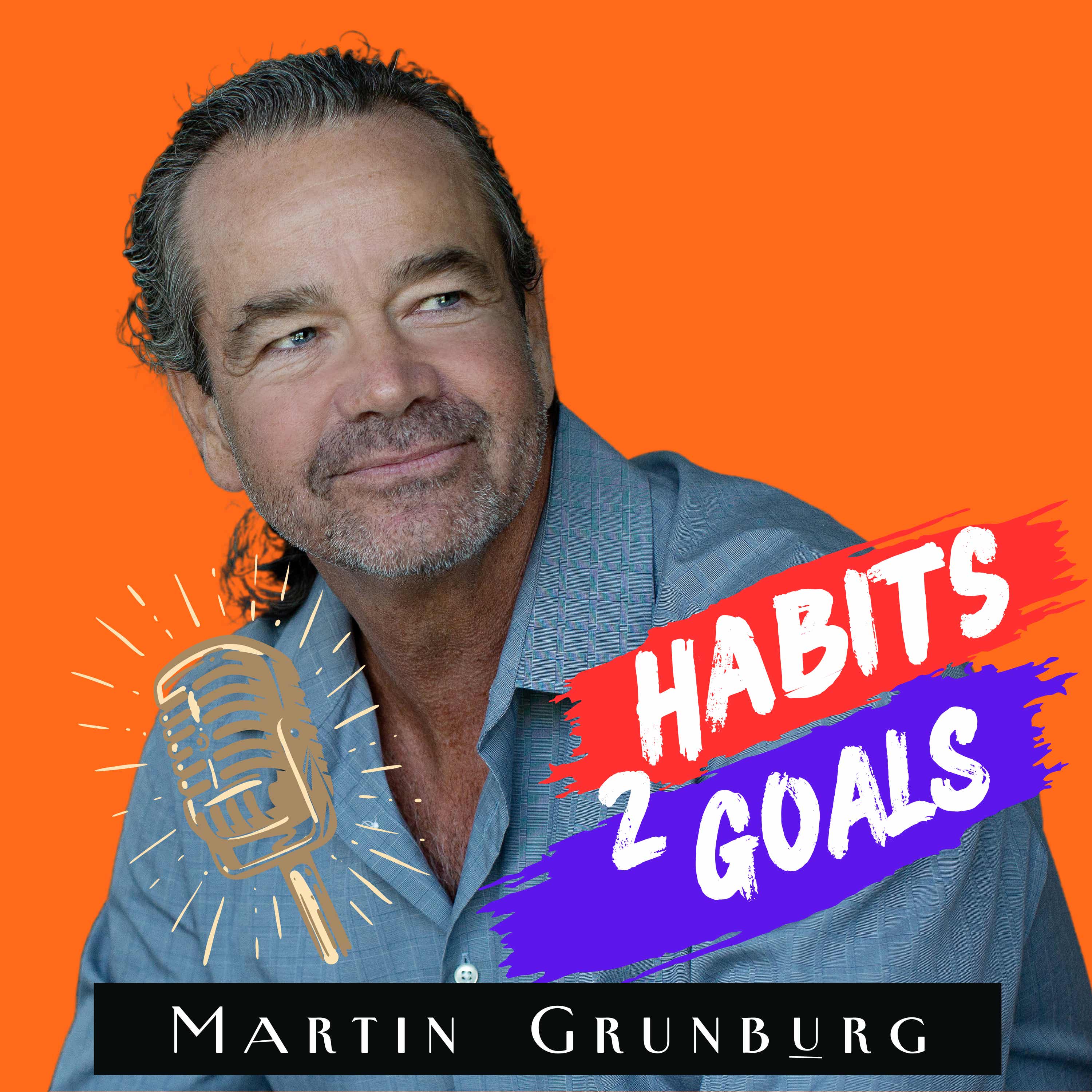
Habits 2 Goals: The Habit Factor® Podcast with Martin Grunburg
Martin Grunburg
WE ARE NOW LIVE ON SUBSTACK w/ H2G Premium Content!
If you’ve ever struggled to achieve your goals you are not alone! The reason just might be because ALL prior goal achievement methods missed ONE key element— habit!
That's right, The Habit Factor® (bestselling book and app) exposed a timeless truth that helped to launch an entirely new genre of productivity apps (habit trackers) and help thousands around the world achieve their goals faster!
There’s a reason top coaches, consultants, trainers, Professional athletes, Olympians, PhD’s and the very best learning institutions world-wide have adopted and recommend The Habit Factor®.
Learn The Habit Factor's method for goal achievement and how to use Habit Alignment Technology™ to achieve your most important goals faster than you ever thought possible!
Learn more at: http://thehabitfactor.com habits2goals.substack.com
If you’ve ever struggled to achieve your goals you are not alone! The reason just might be because ALL prior goal achievement methods missed ONE key element— habit!
That's right, The Habit Factor® (bestselling book and app) exposed a timeless truth that helped to launch an entirely new genre of productivity apps (habit trackers) and help thousands around the world achieve their goals faster!
There’s a reason top coaches, consultants, trainers, Professional athletes, Olympians, PhD’s and the very best learning institutions world-wide have adopted and recommend The Habit Factor®.
Learn The Habit Factor's method for goal achievement and how to use Habit Alignment Technology™ to achieve your most important goals faster than you ever thought possible!
Learn more at: http://thehabitfactor.com habits2goals.substack.com
Episodes
Mentioned books

Apr 2, 2025 • 21min
Skeh-Wee To
Launches April 15, 2025! » Don’t Die with Your Music Still In You“The cave you fear to enter holds the treasure you seek.” ~Joseph CampbellEverybody Dies, But Not Everybody LivesLet’s call it what it is:Fear.Real, gut-level, heart-thumping fear.The kind of fear that shows up right before you leap.Or, begin the difficult conversation.Or, commit to chasing your dream goal. What if fear isn’t the villain? What if it’s an invitation?Welcome to the cave.And, The Hero’s Journey (See EVERYTHING)The Cave is the Call to AdventureJoseph Campbell, the master mythologist, mapped it all out.The Hero’s Journey is the underlying story behind every great story.Luke Skywalker hears the call.Alice tumbles down the rabbit hole.Dorothy’s world is swept into color.And you? You KNOW the calling… and, you’re standing at the entrance of the cave.This is the call to adventure. The choice to enter the unknown.And just like in the myths, you have a choice:Remain in the known world, where it’s safe and stagnant.Or step into the unknown, where it’s SKEH-WEE —and transformational.Funny how it works.The fear is the test. It’s the guard at the gate. It is the dragon.Behind it? Growth. Gold. Treasure. And, your STORY.What’s worse than fear?Regret.» Don’t Die with Your Music Still In You This is a public episode. If you'd like to discuss this with other subscribers or get access to bonus episodes, visit habits2goals.substack.com/subscribe

Mar 25, 2025 • 28min
The Denominator
Mind Bullet Monday: The Denominator » The Habit Mastery Workshop“The pleasure isn’t from the activity—it’s from your brain’s calculation of how much more there is to do.” ~Dr. KEver feel like no matter how much you accomplish, it’s never enough?You’re not lazy or broken.You’re probably caught up in the mathematics of misery.We’re calling this episode The Denominator for a reason.Recently, YouTube neuroscientist and psychiatrist Dr. K (from the HealthyGamer channel) addressed one of the most misunderstood emotional conditions today—anhedonia: the inability to feel joy in life.His insight, after reviewing a recent study on his YouTube channel?It’s not just about what you’re doing—it’s what you think remains undone.In short, the denominator is your mental chatter—story—about everything that remains unfinished.It’s the looming, pending, unresolved business that intensifies overwhelm and, in the process, diminishes your ability to feel good.And when nothing feels good, people begin to shut down—motivation disappears.This maps eerily well to a core concept within The Pressure Paradox™, where pressure—in the psychological sense—is often referenced as Force divided by Area.That’s right. It’s the same as the physics formula for pressure:P = F / ABy the way: you’re not alone if you’re thinking, “Slow down MG, we shouldn’t be conflating physics and psychology!”DeepSeek AI said the same thing to me. Until it (he? she?) did.(See the bottom.)In The Pressure Paradox™, the denominator—Area—represents one’s available resources: skills, time, energy, capacity, money, etc.The smaller the denominator, the greater the pressure. The larger it is, the more the force is diffused—and thus, the pressure is mitigated.When anyone is short on time, energy—even emotional bandwidth—and staring down a mountain of unmet goals—pressure spikes.Their story? One of insufficiency.Anhedonia and the Hidden Math of Misery: Since we think predominantly in terms of stories (see EVERYTHING), our brains script everything in real-time—call it “Thought 2.0.”According to the study Dr. K references, dopamine release is based on this calculation:Progress ÷ Perceived Total WorkPerceived being the operative word.If you believe you have 30 units to address and you’ve only made 1 unit of progress, his point is clear:The dopamine release is marginal—1/30.The larger the denominator—the imagined, storied workload—the flatter and more joyless the experience becomes.And, here’s where things get interesting.Dichotomy Collapse(Bridging Present & Future)How often do we talk about dichotomous thinking on this show?Almost as much as we talk about P.A.R.R.It turns out, P.A.R.R. addresses this precise phenomenon:The tension between being present and active (low denominator) and planning for a future goal (big denominator).Dr. K shows how an oversized denominator—thinking in massive time scales like years or decades, paired with big goals—kills dopamine release and leaves us feeling numb.P.A.R.R. breaks this dilemma down.It shifts that “unsurmountable” thinking from impossible to simply directional—that’s the destination.Today, we made progress.When following P.A.R.R., the denominator becomes just the “Target Day.”And that’s it.P.A.R.R. encourages you to hold a long-term vision and stay grounded in today’s focused action.By checking off our habits in the present, we feel good, stay present, and still move toward long-term goals.The denominator is reduced to that day—while we hold on to the long-term vision.Nothing is surrendered.For 15+ years, P.A.R.R. has been bridging this gap—and, according to science, addressing this denominator unknowingly.P.A.R.R. — The MethodPlan: Identify a meaningful habit—or three—aligned with your goal. Set your target days and minimum success criteria (MSC).Act: Execute in small, manageable steps.Record: Track it daily, using binary metrics (1 or 0), and take brief notes.Reassess: Review after 28 days.P.A.R.R. helps people feel great—by shrinking the denominator. This is a public episode. If you'd like to discuss this with other subscribers or get access to bonus episodes, visit habits2goals.substack.com/subscribe

Mar 19, 2025 • 21min
Skeh-Wee
Mind Bullet Monday: Skeh-Wee » The Habit Mastery Workshop“Courage is the mother of all virtues because, without it, you cannot consistently practice any other virtue.” ~Aristotle”We’ve approached this topic from seemingly every angle possible…Time for one more.Skew-Wee.AlfredAI and I—at your service.Most of what’s scary is risky.Most of what’s risky is necessary for personal growth.As Jim Rohn put it:“It’s all risky. The moment you were born, it got risky. Getting married is risky. Having kids is risky. I’ll tell you how risky life is, you’re not going to get out alive!”Public speaking? Skew-Wee.Posting an article or podcast episode? Skew-Wee.Publishing a book? Skew-Wee.One more time: “Courage is the mother of all virtues.”There’s another way to say this, but we’re not going there.How do you develop the virtue of courage?Anyone?The same way you develop any habit—intentional practice.Just ask our hero, Ben Franklin. (From H2G, Season 2)What About Real Danger?Risk shouldn’t be an excuse for recklessness.Calculated courage versus blind fear… but what is calculated courage?Determining the value of the desired outcomeUnderstanding the driving why behind the desireKnowing the difference between probable, improbable, and impossibleRecognizing the real risk—“Right View”This is where (borrowed once again from The Pressure Paradox™) The 3 P’s come into play.Since we can’t escape pressure forever—only temporarily—we’d better learn to handle it.What are the 3 P’s? This is a public episode. If you'd like to discuss this with other subscribers or get access to bonus episodes, visit habits2goals.substack.com/subscribe

Mar 10, 2025 • 21min
Possessed
Possessed – MBM: Mind Bullet Monday » The Habit Mastery Workshop“At the highest level, you don’t pursue the goal; you embody it.”In Season 6, Episode 49, we explored Obsessed—what I framed as Desire Level 10.0. Upon further reflection, I recognize that was incorrect.To be obsessed with a goal is a very high-level desire, but there’s a higher level.Possessed.When we think of obsession, we often picture someone deeply fixated on a goal, fully immersed, operating at a level of focus that few understand. But there’s still a degree of self-awareness in obsession. The person is aware they are obsessed.Possession is different.The separation between you and your mission becomes nearly indistinguishable at this level. The idea owns you. It consumes you. It drives your actions intuitively—with little conscious effort.Key Distinctions Between Obsessed and PossessedObsessed = Intensity Level 10.0 → High desire, relentless pursuit.Possessed = Beyond 10.0 → You are compelled. It’s no longer a choice.Deadline + Pressure + Maximum Intensity = Possessed → External forces fuel internal drive until you must act.In The Pressure Paradox™, we explore how pressure favorably channels energy and fosters focus.At its peak, pressure eliminates hesitation and forces action.To be possessed is when pressure fuses with identity—you’re no longer chasing a goal; you become one with the goal."A man possessed by his goal does not doubt or hesitate—he moves with a confidence that even surprises himself."Questions to consider:What happens when hesitation disappears, and all that remains is action? This is a public episode. If you'd like to discuss this with other subscribers or get access to bonus episodes, visit habits2goals.substack.com/subscribe

Feb 5, 2025 • 19min
You: The Scientist
Still don't know how to track the 'right way'? » The Habit Mastery Workshop“Behavior is science. Achievement is art."Today we break down a simple but powerful concept: become a scientist when it comes to your goals and personal transformation. Too many people rely on motivation, willpower, or vague intentions. Real progress comes from data—collecting data: tracking habits, testing what works, taking notes accordingly, and making adjustments along the way."Key Takeaways from This Episode🔬 Data > FeelingsWe trust scientists, doctors, and accountants because they work with data—not guesses.If a doctor made a claim without data, we’d be skeptical. The same should apply to personal goals: without tracking, how can we truly know we’re making progress?"⚖️ Your Habits Serve Two MastersHabits are a means to two ends: who you become and what you accomplish.Good habits, when aligned with your goals, drive achievement—but they also shape your virtues, your character, and the person you become in the process🎯 The Intention-Action GapMost people have good intentions but fail to follow through.The key to closing this gap? Tracking habits. It forces the intersection of desire and action—that’s what willpower truly is: taking actions that align with your intentions.📊 Habit Tracking with P.A.R.R.: Putting the Science of Behavior to WorkScientists gather data. Goal achievers must do the same.Why is science so fascinating? Because it relies on data. So, where’s your freakin’ data?🛠 Plan, Act, Record, Reassess (P.A.R.R.)Traditional habit models treat humans like rats in a maze.The P.A.R.R. methodology (Plan, Act, Record, Reassess) accounts for human capacities of choice, intention and reflection.💡 Habit Tracking = A Performance HackIf you're stuck, frustrated, or unsure why progress isn’t happening, start tracking your habits.Without data, troubleshooting is difficult—if not impossible. Habit tracking is the hack to accelerate progress toward your goals and ideals. Get after it!The Challenge: Become the Scientist of Your Own LifeIf goals matter, stop relying on gut feelings. Experiment. Track. Adjust.The Habits-to-Goals methodology is the both a philosophy and a framework. Your data will be your guide."Until you intersect your intention with your actions, you are not moving toward your goals and ideals."ShareEnter: The Habit Factor’s P.A.R.R. MethodologyThe Habit Factor provides a simple, repeatable system to create lasting change by focusing on habits as the foundation for achieving your goals.Habits are the foundation for meaningful change, and this is the method to build them:Plan: Define “Target Days” (specific days for action) and “Minimum Success Criteria” (a low bar to build momentum).Act: Stick to the plan consistently, even if imperfectly.Record: Track progress using a binary system (1 for success, 0 for no success).Reassess: After 28 days, review your results to adjust and improve.This simple framework bridges the gap between intention and consistent action, empowering you to design habits that align with your goals. This is a public episode. If you'd like to discuss this with other subscribers or get access to bonus episodes, visit habits2goals.substack.com/subscribe

10 snips
Jan 27, 2025 • 21min
You Are Always Motivated
Discover the truth about motivation—you’re always motivated, even if it's not towards your goals. Explore how pleasure and pain influence decisions, and why cultivating discipline is key to personal growth. Learn that every effort to face challenges is a step closer to your ideals. Motivation isn’t the issue; it’s about redirecting it towards what truly matters. Gain insights on the importance of self-reflection and habit tracking to align your actions with your intentions.

Jan 20, 2025 • 18min
Why Most Self-Help Fails (and What Actually Works)
Explore why self-help often falls short of its promises by highlighting the gap between knowing what to do and actually doing it. Discover the importance of habits as the foundation for lasting change, and how the P.A.R.R. Methodology can guide you through planning, acting, recording, and reassessing your progress. Learn about the common pitfalls of motivational programs and how a habit-centric approach can lead to success. Get ready to bridge the action gap and make meaningful transformations in your life!

12 snips
Jan 13, 2025 • 22min
Three, 3-Letter Words That Can Change Your Life
Explore how small words can create significant shifts in your mindset. Discover the transformative power of 'yet' to spark hope and remind you that growth is always possible. Learn how 'get' can turn obligations into opportunities, fostering gratitude in everyday tasks. Embrace 'and' to break free from rigid thinking and recognize the interconnectedness of habits and goals. This conversation inspires a fresh outlook on challenges and encourages you to make positive changes in your life.

Jan 6, 2025 • 14min
Attention: You Don’t Stand a Chance.
“What holds your attention, tends to hold your future.” In today’s hyper-connected world, staying focused feels nearly impossible. Algorithms are designed to serve up distractions tailored to our deepest interests. Case in point: I recently visited YouTube for instructions and was immediately bombarded with an irresistible buffet of videos—chess, surfing, golf, etc…Within 30 seconds, I forgot what I was even looking for. Sound familiar?The battle for your attention isn’t just a minor inconvenience—it’s a full-scale assault on your productivity, your goals, and your future. Every moment we surrender to distractions, we’re not just losing time; we’re forming habits of fractured attention and diminished focus. By being proactive and intentional, you can reclaim your attention and your future.Key Ideas to Guard Your Attention:Out of Sight, Out of Mind (and its Corollary): Removing distractions from your environment works wonders: the less you see, the less tempted you’ll be. Delete non-essential apps, declutter your workspace, and turn off notifications. But here’s the kicker: Out of Mind, Out of Sight. As soon as your attention fragments, your focus and the mental “sight” of your project leave you. Once the vision of what you’re working on fades, it’s as if the task itself disappears. Protect your attention, and you protect your inner vision.Create Attention Sanctuaries: Dedicate specific times and spaces for deep work. A clean, distraction-free desk and a phone left in another room can work wonders.Guardrails for Your Mind:Pomodoro Technique: Work in focused bursts (e.g., 25 minutes), then take short breaks. This prevents burnout and builds focus and stamina.Phone in DND: Set your phone to “Do Not Disturb” during work blocks. Use tools like Focus Mode to block distracting apps.Single-Tasking Over Multitasking: Do one thing at a time and do it well. Multitasking splinters attention and increases mistakes.Recognize Environmental Triggers:Social media apps, autoplay features, and algorithm-driven feeds are designed to hook you. Acknowledge these triggers and implement barriers:Use browser extensions like Freedom or StayFocusd to limit time on certain websites.Log out of accounts when not actively using them.Reflect and Realign:Set daily intentions: What’s the one thing you need to accomplish today?End your day with a quick reflection: Did you win the battle for your attention? What could you adjust tomorrow?Write It Down:The simplest yet most effective way to keep your focus is to write things down. As Confucius said, “The weakest ink is stronger than the strongest memory.” Writing anchors your thoughts reinforces your goals, and provides a clear roadmap when distractions inevitably pull you away. The act of revisiting your notes restores clarity and commitment. This is a public episode. If you'd like to discuss this with other subscribers or get access to bonus episodes, visit habits2goals.substack.com/subscribe

Dec 30, 2024 • 24min
Finish Strong
“It’s not how you start that matters, it’s how you finish.” ~Michael Jordan»Tired of spinning your wheels? One course can change everything » The Habit Mastery Workshop. Begins 1/17/25Let’s talk about finishing strong. Does anyone remember who led at halftime, anyway?Whether it’s the final reps of a workout, the last chapter of a book, the home stretch of a goal, or the end of the year, finishing with purpose and intensity changes everything.The act of finishing strong isn't just motivational fluff; it's a game-changer for habit-building, self-confidence, and—bonus—a sweet dopamine rush.Benefits of Finishing StrongSupercharges Confidence: Ending on a high note convinces your brain you’re the kind of person who executes on a plan and finishes what they start. When your last mile is faster than your first mile—you’re finishing strong! Finishing what you plan—even small tasks (behaviors you’re looking to cultivate into habits)—produces self-efficacy. Self-efficacy is the cornerstone of The Habit Factor’s P.A.R.R., habit-building methodology.Reinforces Habit Strength: Imagine your habit as a snowball rolling downhill. Finishing strong reinforces your commitment; it grows larger and faster and gains momentum with each successful completion.Brain Candy: When you complete a task—almost any task you set out to accomplish—your brain rewards you with dopamine, serotonin, oxytocin, and endorphins. Bonus: all these feel-good chemicals help to reinforce your motivation to get back after it!Tomorrow Meets a Stronger You: Today’s strong finish equates to you rejoining that next practice effort even stronger. You’re essentially handing future-you a gift—you’re paying it forward with each strong finish!Laser Focus: Aiming to finish strong forces you to up the ante—increase the energy, intensity, and focus.“A good start’s a joyful run, but finishing strong is second to none.”P.A.R.R. and Finishing StrongThe Habit Factor’s P.A.R.R. methodology (Plan, Act, Record, Reassess) sets you up for a strong finish by helping you to establish a “low bar”—making finishing strong easier.How it all connects:Plan: Start with your habit’s “Target Days” are they (M, W, F) or (Tu, Th)? Notice they do NOT need to be every day. You select the days that work with you and your schedule. Then, identify the “Minimum Success Criteria” (MSC)—the “low-bar” part of your habit-building plan. For instance, 5 pushups or 25 pushups? Writing for 10 minutes or 10 pages?Act: Each action (according to your plan) becomes a mini-finish line. Crush it on your target days, and you’re already finishing strong at a micro-level, which keeps the momentum building.Record: Track your progress against your “Targets” and build accountability. The more you see wins stack up, the easier it is to keep finishing strong.Reassess: Reflecting on what worked (and what didn’t) ties a neat bow on your efforts and preps you for the next challenge.When you approach habits with P.A.R.R., you’re not just grinding—you’re creating a cycle of intentional starts and triumphant finishes.How to Finish StrongSet Your Sights on Small Wins: Small helps to get started—convincing yourself it’ll be easy to start. Establishing low “Minimum Success Criteria” on your “Target Days” is the secret weapon of P.A.R.R., which works to help get started AND to finish strong.Consistency Beats Intensity: Skip the “all or nothing” mindset. Show up consistently and let habit strength compound over time.Plan to Win: Strong finishes rarely happen by accident. Decide in advance if you’ll be exceeding your “Minimum Success Criteria.” Not so you can get two checks—but so you’ll finish strong and show up next time even stronger.Reflect and Celebrate: Celebration is almost instantaneous as your natural reward systems—endorphins and neurotransmitters like serotonin and dopamine—will kick in every time you complete your “Minimum Success Criteria” on your “Target Days.” It won’t just be a mental high-five… it’ll be an emotional one that will keep you pumped and motivated as you prove self-efficacy.“Habit development cares little about bursts of energy. Habits are developed via consistency over time. The notion that you have to keep daily streaks alive or you can’t miss two days is completely a myth. Consistency over time is the key to habit development, period.” This is a public episode. If you'd like to discuss this with other subscribers or get access to bonus episodes, visit habits2goals.substack.com/subscribe

