

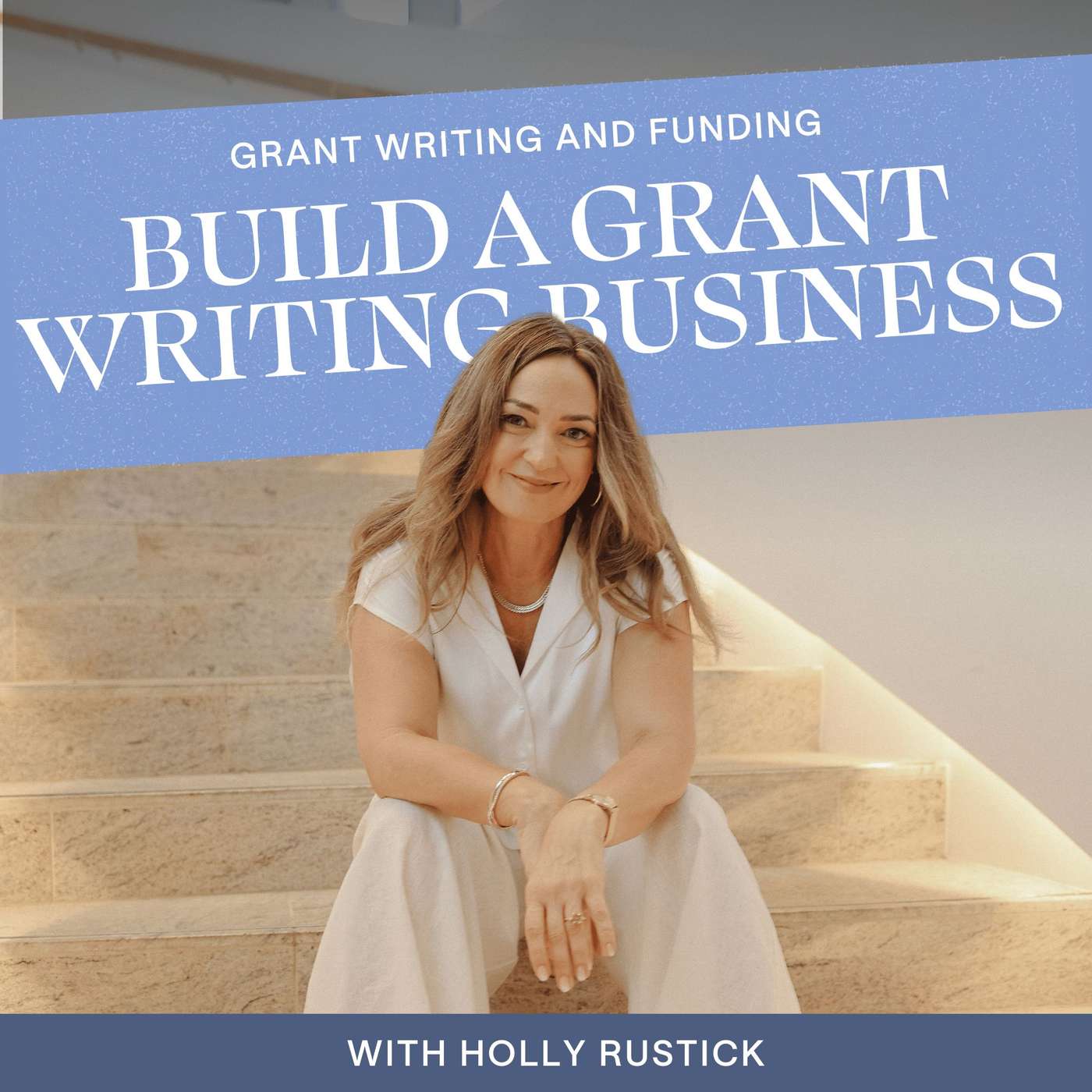
Grant Writing & Funding
Holly Rustick
Quit your toxic nonprofit job and replace your full-time income while writing grants part-time, from home! Join our students in the Freelance Grant Writer Academy to create Financial Stability and Flexibility through writing grants for causes you are passionate about: https://grantwritingandfunding.com/freelance-grant-writer-academy
World-renowned grant writing expert and Amazon bestselling author Holly Rustick provides coaching that helps new and experienced grant writers replace their full-time income while writing grants part-time from home (or anywhere they want to live or travel in the world).
She coaches changemakers to master grant writing and start to grow 6-figure+ grant writing businesses on part-time hours via her signature group program, “Freelance Grant Writer Academy."
As an unapologetic feminist, Holly’s work in coaching female grant writers to master grant writing, find their cause-area niche, and navigate value-based pricing and nonprofit sales is breaking glass ceilings for women all over the world.
Every week, she coaches thousands of people through the top-ranking podcast, Grant Writing & Funding, books on grant writing, and inside the Freelance Grant Writer Academy.
Holly has 20 years of experience in grant writing, and began her freelance grant writing journey back in 2005. While teaching in Kuwait and Indonesia, and then earning a Master’s Degree in International Political Economy in Belgium, Holly saw the light of setting up a virtual-based business in grant writing back in the mid-2000s. Having secured more than $45 million of dollars for nonprofit organizations, and then setting up a multi 6-figure freelance business, Holly has a mission to help female grant writers break out of toxic nonprofit J-O-B-S and create high-level income while freelance grant writing.
Inside the Freelance Grant Writer Academy, students have secured more than $225+ million in grant funding and $4+ million in revenue in their grant writing businesses within two years.
To amplify this work, she is past-president of the Guam Women’s Chamber of Commerce and was appointed to the Guam Business Advisory Task Force as an advisor to the first female governor of Guam. Holly lives on the island of Guam with her beautiful daughter, Isabella.
If you are interested in replacing your full-time income while writing grants part-time from home (or from anywhere in the world!) join the Freelance Grant Writer Academy!
www.grantwritingandfunding.com.
World-renowned grant writing expert and Amazon bestselling author Holly Rustick provides coaching that helps new and experienced grant writers replace their full-time income while writing grants part-time from home (or anywhere they want to live or travel in the world).
She coaches changemakers to master grant writing and start to grow 6-figure+ grant writing businesses on part-time hours via her signature group program, “Freelance Grant Writer Academy."
As an unapologetic feminist, Holly’s work in coaching female grant writers to master grant writing, find their cause-area niche, and navigate value-based pricing and nonprofit sales is breaking glass ceilings for women all over the world.
Every week, she coaches thousands of people through the top-ranking podcast, Grant Writing & Funding, books on grant writing, and inside the Freelance Grant Writer Academy.
Holly has 20 years of experience in grant writing, and began her freelance grant writing journey back in 2005. While teaching in Kuwait and Indonesia, and then earning a Master’s Degree in International Political Economy in Belgium, Holly saw the light of setting up a virtual-based business in grant writing back in the mid-2000s. Having secured more than $45 million of dollars for nonprofit organizations, and then setting up a multi 6-figure freelance business, Holly has a mission to help female grant writers break out of toxic nonprofit J-O-B-S and create high-level income while freelance grant writing.
Inside the Freelance Grant Writer Academy, students have secured more than $225+ million in grant funding and $4+ million in revenue in their grant writing businesses within two years.
To amplify this work, she is past-president of the Guam Women’s Chamber of Commerce and was appointed to the Guam Business Advisory Task Force as an advisor to the first female governor of Guam. Holly lives on the island of Guam with her beautiful daughter, Isabella.
If you are interested in replacing your full-time income while writing grants part-time from home (or from anywhere in the world!) join the Freelance Grant Writer Academy!
www.grantwritingandfunding.com.
Episodes
Mentioned books

Mar 2, 2018 • 27min
Needs and Strengths Assessment
How to Do a Boss Needs and Strengths Assessment for a Nonprofit OrganizationProjects. The very word makes some nonprofits scurry around and try to develop something trivial out of thin air to look like they are doing something. Or, sadly, to develop something that they may not need just because there is grant funding out there for that type of project. The former is referred to as draining the money, and the latter is coined chasing the money. Before you even get to projects, you need to make sure your nonprofit has a strong, clear mission and vision statement, has conducted a SWOT analysis, has reviewed lessons learned, and has SMART objectives and goals. If you don’t know what I am talking about, please refer to my other podcasts!Now you are in a great place in your strategic planning to actually identify the best projects that will support your mission and vision and meet the needs that your nonprofit addresses for your target demographic.Woo-hoo! So, should you jump on grants.gov and see what the federal government is funding so that you can develop projects around where the money is? Honestly, don’t do that.First, develop your projects that are centric to your mission and vision. Then go grant hunting. We will get into more grant specifics after this strategic planning segment, but don’t dismiss how important it is to first get all your ducks in a row. Otherwise, even if you do get that funding, you may not be able to sustain it or meet the objectives.Believe me, I’ve seen those organizations that just chase the money and some of them do get the grants awarded, but that is not necessarily a good thing. I have seen organizations give money back to funding sources because they cannot meet the objectives due to the project never being aligned with their mission and vision or meeting their beneficiaries’ needs.That’s where the good old business plan comes into play. The secret is, if you have been following this Strategic Planning series, then you have already developed a chunk of your business plan. But before you start listing your projects and dumping a bunch of money into them, let’s stop and take a breath and do a Needs & Strengths Assessment. I know, one of you just swore and the other one rolled their eyes. I know you are itching to get out there, but if you really want your project to succeed and not have to restart it twenty times, then this step is vital.Needs and Strengths Assessment – What it isFirst, you need to identify the needs and strengths that your beneficiaries or target demographic faces. Many nonprofits and organizations only utilize a Needs Assessment to understand the challenges and be aware of what projects are actually needed and leave out the strengths segment.But savvy, productive nonprofits implement a Needs & Strengths Assessment to identify the particular barriers and strengths for their beneficiaries or target priority. The difference between the two is that the straight-up Needs Assessment is only focused on the challenges and the lack of resources. This approach does not take into account the strengths in the community and what is working.When you know the positive aspects of what works in a community, you know what to leverage and grow. This approach is more solution-oriented and reduces risks of coming up with designs that might not work to solve problems.For example, a Needs Assessment might just be a survey listing all the barriers that your beneficiaries face, so you are still kind of in the dark of what could work. Sure, you know what you need, but you still do not have a clear picture of what might work. A Needs & Strengths Assessment may also include questions to find out what strengths exist in the community (or for the individual or target), and possible open-ended questions for focus groups to create a platform for brainstorming solutions.Don’t Duplicate Projects“There are no original ideas. There are only original people.” ~ Barbara Grizzuti HarrisonAnother item that might manifest through your Needs & Strengths Assessment could be that there are already other nonprofits doing projects that you think are needed. Let’s face it, just because you thought of a project doesn’t mean the same type of project isn’t already out there.You may find out that another nonprofit is already facilitating a service/project that would meet the needs of your community, but your beneficiaries face transportation challenges to get to those services. That information would be very important, as you could then see if it would be more efficient for your organization to conduct similar services in your geographic area, or if providing transportation to existing services in other areas would be more beneficial/economical.The MethodsA Needs & Strengths Assessment may take many different forms depending on your resources (time, money, and people). Typical methods include written or online surveys, focus groups, observations, testimonials, phone surveys, and so forth. But altogether there are similar designs as the end results of finding out the needs and strengths are the same. These characteristics include:A pre-set list of questionsA pre-determined sample of the number and types of people to answer these questions chosen in advanceThe results of the survey are utilized for a call-to-action of actually addressing the needs and levering the strengthsCan be shared on your website or with partnersSupport grants and other funding requestsConducting a Needs & Strengths Assessment will help your nonprofit increase credibility among partners, provide support when applying for project funding from funding sources, and enhance relationships with your beneficiaries. How often do organizations think they know what their beneficiaries need (but never ask)? And then develop a project that only fails, and the staff become discouraged and blame it on the beneficiaries. Ouch. Yes, that happens. Understanding needs and strengths are vital in formulating projects. Do not assume you know what is needed without conducting an assessment…we all know what ASSUME stands for. Rather, find out what people need and what they find useful.But I don’t have the moneyConducting a Needs & Strengths Assessment does not need to cost a small fortune. Sure, extensive research can cost a pretty penny, but finding out basic needs and strengths does not need to entail hiring a Survey Consultant for $50,000. The Assessment can be as simple as drafting together some questions, then sitting in a group with your beneficiaries, and asking them the questions. You could even draft out the questions and send out out the survey through Survey Monkey (free for less than 10 questions) or through Google Docs (free with unlimited questions and includes super cool graphs with the results).What Questions? Wait, isn’t that a question?First, you will want to identify what you want to find out.For example, if diabetes is a huge epidemic in your community, you m...

Feb 20, 2018 • 12min
The Key to Success. Annual and Quarterly Planning
Annual planning is where it’s at. Where what is at?That amazesauce level of productivity you see in highly successful nonprofits—the kind that makes you wonder how they do it (or maybe even makes you a little jealous). Here’s the truth: those organizations aren’t just lucky—they’re intentional. And the good news?You can be that nonprofit too.In this episode, we break down why annual planning is the foundation for sustainable success and how it helps you move from reactive scrambling to strategic action. But let’s be clear—nothing wildly successful happens overnight. Real results come from consistent, intentional steps taken over time.We talk about how to approach annual planning in a way that’s realistic, actionable, and aligned with your mission—so you can build momentum, increase productivity, and create long-term impact. If you’re ready to stop guessing and start planning your way to success, this episode is for you.ABOUT HOLLY RUSTICKGrant Writing & Funding (GWF) has a Global Movement to Secure $1 Billion in Grant Funding for Good and $30 Million in Grant Writing Businesses by 2030. Holly Rustick, CEO of GWF, is leading the movement; a world-renowned grant writer with 20+ years of experience, bestselling author, and business coach for new and seasoned grant writers to replace their full-time income writing grants part-time from home through her signature programs: the Freelance Grant Writer Academy and the Grant Professional Mentorship.Rustick is the host of the top grant writing podcast “Grant Writing & Funding” and the author of the Bestselling book, The Beginner’s Guide to Grant Writing. With an MA in International Political Economy, past-president of the Guam Women’s Chamber of Commerce, serving on numerous boards of directors, Holly is also an unapologetic feminist. She lives on the island of Guam with her beautiful daughter, Isabella. CONNECT WITH HOLLY RUSTICKWebsite: https://grantwritingandfunding.com/RESOURCES:Weekly Newsletter: “Write Grants. Get Paid” - Get thought leadership on grant and freelance grant writing strategies every week in your inbox. https://grantwritingandfunding.com/Freelance Grant Writer Academy: Replace your Full-Time Income Writing Grants Part-Time from Home. https://grantwritingandfunding.com/freelance-grant-writer-academy/Grant Professional Mentorship: Double your Monthly Revenue with an Income Stream Outside of Grant Writing. https://grantwritingandfunding.com/mentorshipRATE, REVIEW, & FOLLOW THE PODCASTFavor, please? If you love this podcast, would you please do me a favor and leave a review on iTunes or your podcast listener?This helps others find the podcast and I read each and every review!“Every time I listen to Holly’s show, I learn something” <– If that sounds like you, please consider rating and reviewing my show!Also, if you haven’t done so already, follow the Grant Writing & Funding podcast to get grant and freelance grant writing proven strategies and conversations in your podcast player every single week.Thanks for listening!Warmly,Holly RustickLeading the $1 Billion for Good Movement: By 2030, aspiring and seasoned grant writers inside the Freelance Grant Writer Academy & Grant Professional Mentorship will 1) WIN $1 Billion in Grants, and 2) MAKE $30 Million in their Grant Writing Businesses. We are on our way already.

Feb 16, 2018 • 15min
Strategic Partnerships for Your Nonprofit
Sometimes nonprofits exist inside a vacuum. This is not conducive for sustainability, let alone the chance of survival. One reason for this segregation, that I often hear, is that one thinks another nonprofit organization will ‘compete’ with them and limit their ability to obtain funding. Another reason is that many nonprofit staff and executives can never seem to get out of the office to meet with potential partners.The thing is, partnerships are resources. Partnerships can literally make the difference between your nonprofit being able to pay the bills or have to shut down. There are different types of partnerships, but all are extremely valuable.Comprehensive Service PartnersCorporate / Funder / Donor PartnershipsBeneficiary PartnershipsComprehensive Services PartnersEngaging with a healthy number of partnerships that offer comprehensive services in relation to your nonprofit is really important as they enable you to share knowledge, training, lessons learned, and tangible resources.For example, if you are part of a nonprofit that serves domestic violence survivors, then some partners may be the Police Department, Department of Public Health and Social Services, Women Infants and Children (WIC), the hospital, local clinics that serve women, psychiatrist offices, other nonprofit shelters, the courts, Department of Corrections, daycare centers, employment agencies, shelters, community colleges, and so forth.Other nonprofit organizations could include victim advocate peers, substance abuse centers for women, human trafficking nonprofits, foster homes, public legal counsel, and so forth. Basically, any other entity that you could leverage for support or, on the flip-side, that you may receive referrals from. Your job is really to know all the ins and outs about ALL other organizations that could provide comprehensive services for your beneficiaries.For instance, if a survivor of domestic violence enters your facility, but all you offer is a three-day emergency shelter, you would immediately begin to find longer-term shelter, support for the courts (if needed), childcare, or school support if the survivor arrived with children, and so forth. Just knowing a phone number or e-mail address from a website may not be enough.It really is essential to develop relationships with these organizations so you have a system down to streamline these services. Your relationship should be to the point where you know the point of contact on a first-name basis, and understand all of their services, including eligibility. Nonprofits should be excellent at referrals to other services. I have witnessed this first-hand, where a family came into an organization with five children, and immediately partners were called and shelter was arranged within a matter of hours. This is wonderful… but can be rare.Make sure you are attending coalition meetings and know who the other players are in your field. This can be the difference between helping your beneficiaries or not. A way to build these relationships further is to co-apply for grants or funding for projects.The fact that you are working with partners is a strength to funding sources and can offer a split-share of grant writing. Also, giving the ability to serve your beneficiaries in a comprehensive manner.Corporate / Funder / Donor RelationshipsCorporate / Funder / Donor Relationships are important for all nonprofit organizations because we all need funding! But how often do you only reach out to these individuals or entities when you are not asking for money?Do you really try and develop a partnership with them?Developing a partnership is simple in that you can send these funding sources consistent information about your organization. Rather than only hitting them up for money once or twice a year, give them free tickets to attend one of your events or invite them to attend programs and projects their funds are helping to make happen.This way you are actually building the relationship and giving them value before you ask them for anything. This is huge because most nonprofits do NOT do this. By doing this you will inadvertently research these funding sources more strategically.Allowing your organization to find ones that really would resonate with your cause in the best way. For example, if you are giving out free tickets to a fundraiser you are going to be pickier about who you are giving the free tickets too. You would probably spend a bit more time figuring out if they would be a good long-term relationship when you are the one offering the value.That is a good thing. Because while you want every Tom, Dick, and Harry to give to your nonprofit, it just won’t happen. It would be better to have long-term relationships with funding sources that really get what you do, and commit to you being the main sponsor every year.Wow, can you imagine that?It’s almost like your nonprofit can start to have ‘retainer’ relationships with funding sources as you develop relationships so tight that they commit to giving you a portion of their funds every quarter. This can happen! But it’s not going to happen if they only know of you by your cold call solicitations every year. I cannot stress this enough. Develop a relationship and your partnership will rock.Beneficiary PartnershipsIt would be a bit strange if you weren’t developing relationships with the people you actually serve. Sure, your ‘beneficiaries’ may not be people, as I know some of you serve animals or are in the arts, or restoration of historic buildings, and so on, but you still want to build understanding and be on the cutting edge of those other ‘beneficiaries.’For those of you who do serve people, then here are some ideas on how to develop deeper relationships and partnerships with these individuals. You could conduct an annual survey to see if you are meeting the continually changing needs that they have, focus groups, one-on-one interviews, on-line quizzes, or simply create more staff-to-beneficiary projects or activities.For instance, maybe your staff primarily does administration when survivors come in the door. Maybe every staff could rotate in facilitating a group class in their field of expertise. Passion with and for the survivors will really grow the relationships and compassion. If beneficiaries are not people, then continue learning about the need you serve is key. Become an expert in your field and the go-to person for people to go to when they have a question about your demographic.So now that you have better relationships with comprehensive services, funding sources, and your beneficiaries, how do you measure it? How does this really help your organization financially?You’ve got to pay the bills and knowing someone’s first name may not make the direct difference. Indirectly, this does help with funding. Maybe you don’t really need the funding to grow a childcare portion of your nonprofit because you can develop a Memorandum o...

Feb 6, 2018 • 15min
Ep. 18: How to Get Your Nonprofit from Surviving to Thriving
Is your nonprofit stuck in survival mode?
Planning is key, but taking the time to do it is where you need to start (refer to Episode 15 to see how to set a schedule). Once you have taken the time and have reviewed your previous year, it is time to set your goals, objectives, and activities, so you can go from struggling to thriving.
So what the heck are the differences between goals, objectives, and activities?
Goals are the overarching, comparable to a large globe of aspirational destinations you want to reach. Objectives are the tangible flights or boats on how you are going to reach those places. Activities are how you do the day-to-day work of saving up for your trip.
Visit www.grantwritingandfunding.com for more info on how to get your nonprofit from surviving to thriving!
Favor, please?
If you love this podcast, would you please do me a favor and leave a review on iTunes or your podcast listener?
This helps others find the podcast and I read each and every review!
If you have any questions, feel free to email
holly@grantwritingandfunding.com
I’d love to connect with you!
YouTube: https://www.youtube.com/channel/UCWzIfwJt0az9KKwKz1Uc8vg
Instagram: https://www.instagram.com/hollyrustick
LinkedIn: https://www.linkedin.com/in/holly-rustick-0765b817/
Facebook: https://www.facebook.com/grantwritingandfunding/
Pinterest: https://www.pinterest.com/grantwritingandfunding/
Thanks for listening!
Holly Rustick
Expert Grant Writer & Bestselling Author
https://www.grantwritingandfunding.com/
✨✨ Visit www.grantwritingandfunding.com to get the proven G.R.A.N.T.S. formula to write winning grants ✨✨

Jan 26, 2018 • 50min
Crowdfunding for Your Nonprofit
Are you struggling to figure out how to crowdfund for your nonprofit, especially when most advice seems geared toward products instead of causes? In this episode, Holly Rustick sits down with Steve Vick, Founder of Nonprofit Ally, to break down how nonprofits can run successful crowdfunding campaigns that actually generate results. Drawing from his experience as Executive Director of Noble Paws, Steve shares what works—and what doesn’t—when it comes to crowdfunding in the nonprofit space. They discuss how to approach crowdfunding as a viable income stream, common mistakes organizations make, and practical strategies to help you stop spinning your wheels and start raising funds with confidence. Whether you're new to crowdfunding or looking to improve your current efforts, this episode will give you the clarity and direction you need to move forward.ABOUT OUR GUESTSteve Vick is the Founder of Nonprofit Ally and former Executive Director of Noble Paws, where he gained firsthand experience leading successful crowdfunding campaigns for nonprofit organizations. He specializes in helping nonprofits diversify their revenue streams and build sustainable funding strategies. Through his work, Steve equips organizations with practical tools and insights to effectively launch and manage crowdfunding initiatives.OTHER RESOURCES:Weekly Newsletter: “Write Grants. Get Paid” - Get thought leadership on grant and freelance grant writing strategies every week in your inbox. https://grantwritingandfunding.com/Freelance Grant Writer Academy: Replace your Full-Time Income Writing Grants Part-Time from Home. https://grantwritingandfunding.com/freelance-grant-writer-academy/Grant Professional Mentorship: Double your Monthly Revenue with an Income Stream Outside of Grant Writing.https://grantwritingandfunding.com/mentorshipRATE, REVIEW, & FOLLOW THE PODCASTFavor, please? If you love this podcast, would you please do me a favor and leave a review on iTunes or your podcast listener?This helps others find the podcast and I read each and every review!“Every time I listen to Holly’s show, I learn something” ← If that sounds like you, please consider rating and reviewing my show!Also, if you haven’t done so already, follow the Grant Writing & Funding podcast to get grant and freelance grant writing proven strategies and conversations in your podcast player every single week.Thanks for listening!Warmly,Holly RustickLeading the $1 Billion for Good Movement: By 2030, aspiring and seasoned grant writers inside the Freelance Grant Writer Academy & Grant Professional Mentorship will 1) WIN $1 Billion in Grants, and 2) MAKE $30 Million in their Grant Writing Businesses. We are on our way already.

Jan 17, 2018 • 21min
Ep. 16: Reviewing Wins and Challenges
You’ve started your organizational strategic planning, now you are ready to evaluate last year and move into planning for this year.
If you haven’t, no worries, just go ahead and listen to episode 15 on Grant Writing & Funding. Or better yet, visit our website at www.grantwritingandfunding.com/15 to get the free downloadable to set yourself up for your upcoming year
You may be at the point where you have completed your “Why,” reviewed your organization’s mission and vision statements, conducted a S.W.O.T. analysis, outlined your agenda, and now you are ready to review last year and get going on this year. But how do you do this without it turning into a griping session about all the failures or only celebrating the wins and dismissing any lessons to be learned?
Today’s podcast will discuss how to conduct the best evaluation.
Favor, please?
If you love this podcast, would you please do me a favor and leave a review on iTunes or your podcast listener?
This helps others find the podcast and I read each and every review!
If you have any questions, feel free to email
holly@grantwritingandfunding.com
I’d love to connect with you!
YouTube: https://www.youtube.com/channel/UCWzIfwJt0az9KKwKz1Uc8vg
Instagram: https://www.instagram.com/hollyrustick
LinkedIn: https://www.linkedin.com/in/holly-rustick-0765b817/
Facebook: https://www.facebook.com/grantwritingandfunding/
Pinterest: https://www.pinterest.com/grantwritingandfunding/
Thanks for listening!
Holly Rustick
Expert Grant Writer & Bestselling Author
https://www.grantwritingandfunding.com/
✨✨ Visit www.grantwritingandfunding.com to get the proven G.R.A.N.T.S. formula to write winning grants ✨✨

Jan 6, 2018 • 31min
Ep. 15: Your Agenda for Strategic Planning 2018
It’s a new year and you are ready and organized with all your quarters outlined, projects in place, and all fund-raising events set up, right?
I mean, you know when you will be applying for grants and have your calendars synced for all employees and board of directors…or do you?
Or, like many other nonprofits, you are starting 2018:
● stuck in survival mode
● too busy to make time for planning
● have been meaning to do some research but are preoccupied
● don’t even know where to start as things change quickly and constantly
If this sounds like your organization, like so many nonprofit organizations (i.e. the majority of nonprofits), then this article is for you.
It is time to change the way that you have been functioning, get organized and prepare for the new year so that your capacity and revenue will increase. This article will change the life of your nonprofit. This isn’t hyperbole, it is the pure facts.
This podcast will take your organization from survival mode to a thriving zone.
1. What is your Why?
2. Mission and Vision Review
3. S.W.O.T. (Strengths, Weaknesses, Opportunities, and Threats) Analysis
4. Evaluate what worked and didn’t work for the previous year (we will go over this more in the next article and podcast)
5. Outline Goals, Objectives and Activities
6. Brainstorm and list all resources and partnerships
7. Take out a calendar and list down usual and new major events, such as fundraisers, crowdfunding, or projected grants
8. Make a list of all committees required to get each task done
9. Schedule a monthly (at least) review meeting of the plan
To download the toolkit agenda, visit https://grantwritingandfunding.com/grant-writing-funding-015-your-agenda-strategic-planning-2018.
To watch this podcast on YouTube, please visit: http://somup.com/cFV16GVUOY
Favor, please?
If you love this podcast, would you please do me a favor and leave a review on iTunes or your podcast listener?
This helps others find the podcast and I read each and every review!
If you have any questions, feel free to email
holly@grantwritingandfunding.com
I’d love to connect with you!
YouTube: https://www.youtube.com/channel/UCWzIfwJt0az9KKwKz1Uc8vg
Instagram: https://www.instagram.com/hollyrustick
LinkedIn: https://www.linkedin.com/in/holly-rustick-0765b817/
Facebook: https://www.facebook.com/grantwritingandfunding/
Pinterest: https://www.pinterest.com/grantwritingandfunding/
Thanks for listening!
Holly Rustick
Expert Grant Writer & Bestselling Author
https://www.grantwritingandfunding.com/
✨✨ Visit www.grantwritingandfunding.com to get the proven G.R.A.N.T.S. formula to write winning grants ✨✨

Dec 14, 2017 • 13min
Ep. 14: Creating Credibility and Culture Part IV: Lead Generator for Nonprofits
Lead generators, oftentimes known as free opt-ins or email list builders, are essential for nonprofits.
Online businesses have this down to a T and use lead generators on a regular basis.
Lead generators are catching on in the nonprofit sector and websites, but some of you still may be saying, “Lead-what?” Just what is a lead generator?
Favor, please?
If you love this podcast, would you please do me a favor and leave a review on iTunes or your podcast listener?
This helps others find the podcast and I read each and every review!
If you have any questions, feel free to email
holly@grantwritingandfunding.com
I’d love to connect with you!
YouTube: https://www.youtube.com/channel/UCWzIfwJt0az9KKwKz1Uc8vg
Instagram: https://www.instagram.com/hollyrustick
LinkedIn: https://www.linkedin.com/in/holly-rustick-0765b817/
Facebook: https://www.facebook.com/grantwritingandfunding/
Pinterest: https://www.pinterest.com/grantwritingandfunding/
Thanks for listening!
Holly Rustick
Expert Grant Writer & Bestselling Author
https://www.grantwritingandfunding.com/
✨✨ Visit www.grantwritingandfunding.com to get the proven G.R.A.N.T.S. formula to write winning grants ✨✨

Nov 22, 2017 • 25min
Ep. 13: Creating Credibility & Culture: Part V Branding, Call to Action, and Website Audit
Oh boy. That’s right. It’s time to address it. The big W. Your Website.
This episode is a nonprofit’s crash course on different types of websites, how to communicate your brand, and what you should NOT do on your website. Nonprofit websites, in particular, can be a little overwhelming and are known for being the cause of one too many headaches. With the prevalent combination of tiny fonts, non-contrasting colors, and a scream to “Give! Give! Give!” with no clear vision of why one should give or an easy way on how to give. ARRGH!
We are going to go into the overall approach to your website, give some tips on how to get the traffic it deserves and reveal ways for visitors to take the call to action that you provide. It doesn’t matter if you use WordPress, Square Space, Wix, or any of the other countless web platforms that are available. The formatting that we are going to discuss will work for them all in providing a better way to communicate your brand.
Favor, please?
If you love this podcast, would you please do me a favor and leave a review on iTunes or your podcast listener?
This helps others find the podcast and I read each and every review!
If you have any questions, feel free to email
holly@grantwritingandfunding.com
I’d love to connect with you!
YouTube: https://www.youtube.com/channel/UCWzIfwJt0az9KKwKz1Uc8vg
Instagram: https://www.instagram.com/hollyrustick
LinkedIn: https://www.linkedin.com/in/holly-rustick-0765b817/
Facebook: https://www.facebook.com/grantwritingandfunding/
Pinterest: https://www.pinterest.com/grantwritingandfunding/
Thanks for listening!
Holly Rustick
Expert Grant Writer & Bestselling Author
https://www.grantwritingandfunding.com/
✨✨ Visit www.grantwritingandfunding.com to get the proven G.R.A.N.T.S. formula to write winning grants ✨✨

Oct 4, 2017 • 14min
Creating Credibility & Culture: Part IV Website Vs. Facebook
Why your nonprofit needs a website and not just a Facebook pageYou can have the most awesome nonprofit or business in the world, but in this day and age, you need that awesomeness to be reflected online. And by online, I don’t just mean social media or a mediocre URL.Do you still have a website that was created in the early millennium? You know the one that I am talking about. It is crammed with information in small font and looks more like a brochure than a website. I see this a lot, especially with nonprofits. Instead of communicating a unique mission, skill set, or storyline, beneficiaries are given a standard impersonal message.They find themselves led through a maze of Error 401 pages and outdated events. Completely devoid of the services and projects that they offer, presented in a color scheme bound to give the browser a headache.The Five Main Reasons your Organization Needs a Website and not just a Facebook Page:Your organization will own the website, whereas social media can change or shut down at any moment.A website creates credibility for your organization.Your website will communicate your branding more efficiently.Your donation/fundraising campaign can be hosted on your website.You can collect emails through your website by offering value.Next time we will look at different types of websites, how to communicate your brand, and what you should not do on your website.ABOUT HOLLY RUSTICKGrant Writing & Funding (GWF) has a Global Movement to Secure $1 Billion in Grant Funding for Good and $30 Million in Grant Writing Businesses by 2030. Holly Rustick, CEO of GWF, is leading the movement; a world-renowned grant writer with 20+ years of experience, bestselling author, and business coach for new and seasoned grant writers to replace their full-time income writing grants part-time from home through her signature programs: the Freelance Grant Writer Academy and the Grant Professional Mentorship. Rustick is the host of the top grant writing podcast “Grant Writing & Funding” and the author of the Bestselling book, The Beginner’s Guide to Grant Writing. With an MA in International Political Economy, past-president of the Guam Women’s Chamber of Commerce, serving on numerous boards of directors, Holly is also an unapologetic feminist. She lives on the island of Guam with her beautiful daughter, Isabella. CONNECT WITH HOLLY RUSTICK Website: https://grantwritingandfunding.com/ RESOURCES:Weekly Newsletter: “Write Grants. Get Paid” - Get thought leadership on grant and freelance grant writing strategies every week in your inbox. https://grantwritingandfunding.com/Freelance Grant Writer Academy: Replace your Full-Time Income Writing Grants Part-Time from Home. https://grantwritingandfunding.com/freelance-grant-writer-academy/Grant Professional Mentorship: Double your Monthly Revenue with an Income Stream Outside of Grant Writing. https://grantwritingandfunding.com/mentorship RATE, REVIEW, & FOLLOW THE PODCASTFavor, please? If you love this podcast, would you please do me a favor and leave a review on iTunes or your podcast listener?This helps others find the podcast and I read each and every review!“Every time I listen to Holly’s show, I learn something” <– If that sounds like you, please consider rating and reviewing my show!Also, if you haven’t done so already, follow the Grant Writing & Funding podcast to get grant and freelance grant writing proven strategies and conversations in your podcast player every single week.Thanks for listening!Warmly,Holly RustickLeading the $1 Billion for Good Movement: By 2030, aspiring and seasoned grant writers inside the Freelance Grant Writer Academy & Grant Professional Mentorship will 1) WIN $1 Billion in Grants, and 2) MAKE $30 Million in their Grant Writing Businesses. We are on our way already.

