

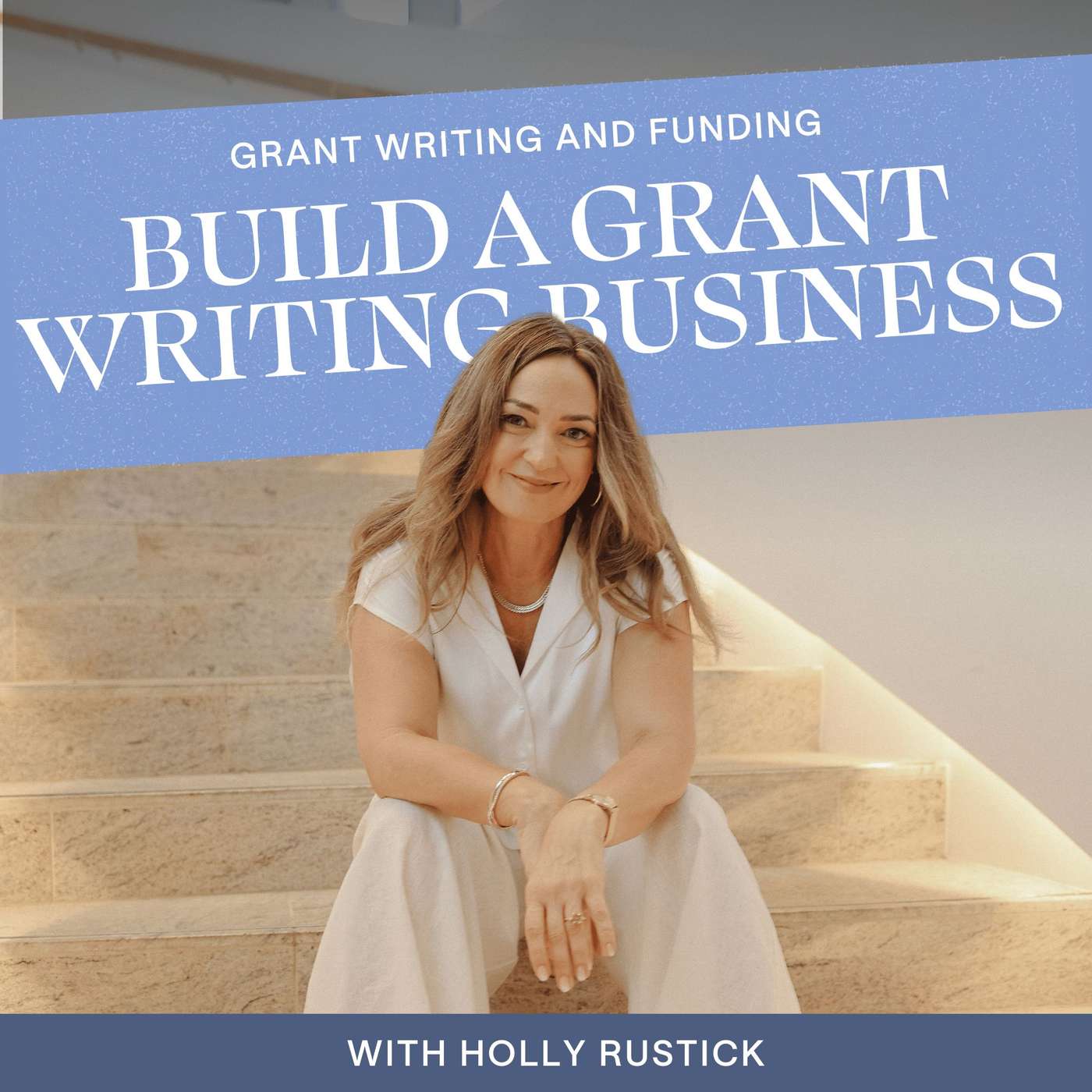
Grant Writing & Funding
Holly Rustick
Quit your toxic nonprofit job and replace your full-time income while writing grants part-time, from home! Join our students in the Freelance Grant Writer Academy to create Financial Stability and Flexibility through writing grants for causes you are passionate about: https://grantwritingandfunding.com/freelance-grant-writer-academy
World-renowned grant writing expert and Amazon bestselling author Holly Rustick provides coaching that helps new and experienced grant writers replace their full-time income while writing grants part-time from home (or anywhere they want to live or travel in the world).
She coaches changemakers to master grant writing and start to grow 6-figure+ grant writing businesses on part-time hours via her signature group program, “Freelance Grant Writer Academy."
As an unapologetic feminist, Holly’s work in coaching female grant writers to master grant writing, find their cause-area niche, and navigate value-based pricing and nonprofit sales is breaking glass ceilings for women all over the world.
Every week, she coaches thousands of people through the top-ranking podcast, Grant Writing & Funding, books on grant writing, and inside the Freelance Grant Writer Academy.
Holly has 20 years of experience in grant writing, and began her freelance grant writing journey back in 2005. While teaching in Kuwait and Indonesia, and then earning a Master’s Degree in International Political Economy in Belgium, Holly saw the light of setting up a virtual-based business in grant writing back in the mid-2000s. Having secured more than $45 million of dollars for nonprofit organizations, and then setting up a multi 6-figure freelance business, Holly has a mission to help female grant writers break out of toxic nonprofit J-O-B-S and create high-level income while freelance grant writing.
Inside the Freelance Grant Writer Academy, students have secured more than $225+ million in grant funding and $4+ million in revenue in their grant writing businesses within two years.
To amplify this work, she is past-president of the Guam Women’s Chamber of Commerce and was appointed to the Guam Business Advisory Task Force as an advisor to the first female governor of Guam. Holly lives on the island of Guam with her beautiful daughter, Isabella.
If you are interested in replacing your full-time income while writing grants part-time from home (or from anywhere in the world!) join the Freelance Grant Writer Academy!
www.grantwritingandfunding.com.
World-renowned grant writing expert and Amazon bestselling author Holly Rustick provides coaching that helps new and experienced grant writers replace their full-time income while writing grants part-time from home (or anywhere they want to live or travel in the world).
She coaches changemakers to master grant writing and start to grow 6-figure+ grant writing businesses on part-time hours via her signature group program, “Freelance Grant Writer Academy."
As an unapologetic feminist, Holly’s work in coaching female grant writers to master grant writing, find their cause-area niche, and navigate value-based pricing and nonprofit sales is breaking glass ceilings for women all over the world.
Every week, she coaches thousands of people through the top-ranking podcast, Grant Writing & Funding, books on grant writing, and inside the Freelance Grant Writer Academy.
Holly has 20 years of experience in grant writing, and began her freelance grant writing journey back in 2005. While teaching in Kuwait and Indonesia, and then earning a Master’s Degree in International Political Economy in Belgium, Holly saw the light of setting up a virtual-based business in grant writing back in the mid-2000s. Having secured more than $45 million of dollars for nonprofit organizations, and then setting up a multi 6-figure freelance business, Holly has a mission to help female grant writers break out of toxic nonprofit J-O-B-S and create high-level income while freelance grant writing.
Inside the Freelance Grant Writer Academy, students have secured more than $225+ million in grant funding and $4+ million in revenue in their grant writing businesses within two years.
To amplify this work, she is past-president of the Guam Women’s Chamber of Commerce and was appointed to the Guam Business Advisory Task Force as an advisor to the first female governor of Guam. Holly lives on the island of Guam with her beautiful daughter, Isabella.
If you are interested in replacing your full-time income while writing grants part-time from home (or from anywhere in the world!) join the Freelance Grant Writer Academy!
www.grantwritingandfunding.com.
Episodes
Mentioned books

Jul 24, 2019 • 24min
081: 7 Reasons to Get IRB Approval and How it Can Make You Money
What is IRB approval? Do I need one as a grant writer? Do I need one before starting my research? All these questions and more answered as Holly discusses the Institutional Review Board (IRB).
Listen to the podcast on iTunes, SoundCloud, Stitcher or watch on YouTube!
To share your thoughts:
Send Holly an email at holly@grantwritingandfunding.com
To help out the show:
Leave an honest review on iTunes. Your ratings and reviews really help, and I read all of them!
Subscribe on iTunes or on YouTube.
Looking for more? Follow us on Instagram @grantwriting_funding

Jul 16, 2019 • 23min
Ep. 80: 8 Ways to Cite Research for Grants
Learn how to track sources and file them into a stunning bibliography for your grant. We're all about citations and celebrations because it's Holly's Birthday! Head on over to www.grantwritingandfunding.com/80 for your FREE gift! Listen to the podcast on iTunes, SoundCloud, Stitcher or watch on YouTube! To share your thoughts: Send Holly an email at holly@grantwritingandfunding.com To help out the show: Leave an honest review on iTunes. Your ratings and reviews really help, and I read all of them! Subscribe on iTunes or on YouTube. Looking for more? Follow us on Instagram @grantwriting_funding

Jul 10, 2019 • 28min
Social Media Polls Made Easy for Grants
Gathering data is important when supporting grants, connecting with your beneficiaries, providing credibility for your projects, and even understanding what projects to develop. Data can be gathered in a multitude of different ways and as we discussed last week in our re-broadcast for conducting a Needs & Strengths Assessment (episode 78), I discussed methods for Needs & Strengths Assessments to utilize are online surveys, in-person surveys, and focus groups.However, there are some other methods (and can be FREE or very affordable) ways to gather research. One, low hanging fruit way, to gather data that we will discuss today is using polls on Facebook and Instagram.Social media can be a great platform to gather information about the needs and strengths of your beneficiaries or those who you may want to serve. So, let’s look at some main big social media mongrels. This is not extensive at all, but these are some of the larger social media platforms and you will walk away today being able to gather data on these platforms using very simple processes. If you have never utilized social media polls to gather information for your nonprofit or a nonprofit that you work with, after this episode you will be able to do it.A full disclaimer is that any tactic that I am talking about as of July 2019 may change in the future as social media is always changing strategies, user interfaces, and options. These polls may not always be an option or as we speak they may be getting more and more robust. But the essence behind the strategy is the same. Social media is to create interaction and I am sure that connecting with your supporters, beneficiaries, and advocates utilizing social media will always be possible to some extent. Facebook Social Media PollsAs of 2019 Facebook is still the behemoth on social media. Yes, there are shifts and I see more and more people are using other social media platforms as their main sources, but Facebook is still king as has the most users at 2.23 billion users every month. That’s nearly a 1/3 of the world’s population!Many nonprofits only have a Facebook page for their nonprofit and not even a website. I do not recommend this at all (and you can listen to more about why in episode 12: https://www.grantwritingandfunding.com/12) but the fact is this true. In any case, you should have some sort of social media platform for your nonprofit, or the ones you work with, and because of Facebook’s size, many nonprofits have pages on Facebook.In order to really utilize Facebook for polls, ads, and other ways you need to have a separate page for your nonprofit or a group and not just your personal page.For nonprofits, I like Facebook nonprofit pages so they can set up groups, go Live, add updated information, create ads, and form a tribe. So how do you gather information utilizing Facebook polls?Facebook has the option to easily create a poll in groups or on non-personal pages. All you have to do is click on ‘create a post’ and you have the option for poll. You can even add images to each choice. This is a great way to get your supporters or beneficiaries to answer some questions. I am an administrator of a couple of pages on Facebook and one poll I recently did was to ask people in the group which type of funding they are most focused on securing for their nonprofits in 2019. I gave them the choices of 1) grants, 2) fundraising events, 3) crowdfunding campaign, 4) donor support, 5) create products, or to 6) create services. If you are part of “Fund My Nonprofit” on Facebook, you can scroll down the page and check it out. If you are not yet in the group, please join as this is a free group and has hundreds of members! Just look for “Fund My Nonprofit – Funding Tips and How-To’s”.The Facebook poll I created took me less than a minute and the feedback was super helpful on a couple of different levels. One level is that I know what type of content to create for this group because I know what most people will find the most valuable. Most people clicked ‘grant funding’ which is perfect for me as that is what I can talk about all day long!Another level on how it was helpful is that it gives the people a voice and creates a stronger tribe. They get to tell me what they want more of and have a voice to contribute in the group.How do you get people to take your poll, though?Well, polls are simple, too, and very quick for people to take. You can use open-ended questions and ask people to reply in the comments, but by providing pre-set answers you will in most cases get a higher amount of responses. This is because when people are on social media, they are getting pings and notifications from a bunch of different sources all at the same time. Polls make a quick and easy way to gather information from a specific group of people.Guiding people to your pollThe best way you can get an increased number of people replying to your poll is to also email out the list. For example, since I am targeting mainly people who work at nonprofits for my poll I will also email my list and ask people to respond to the poll by providing a link. Once people start responding to the poll, then Facebook does a funny thing of algorithms by notifying more people that like or follow your page and let them know about it. This is pretty cool as Facebook starts to do the work for you. However, you may have this in a private FB group and don’t want any and everyone’s reaction to it and only your targeted audience. That is fine as FB will only let people in your private group know.Other than email, you can also drive people to your poll by creating ads on Facebook. In this way you can specifically narrow your target to the people with interests in your poll. I can pick a certain city and their interest has to include nonprofits. It is pretty cool, but ads will cost you money. The good thing is you can control how much money you will spend. We won’t go into creating ads as that is its own entire episode or series of episode, but this is an option. One reason you might do a targeted ad is if you do not have a lot of followers or want a larger response rate.Another simple way to drive people to your poll is by creating more social media posts with the link back to your poll.Of course polls are not the only way to gather information on Facebook, but I find they are the simplest and most straightforward way.Polls on InstagramCreate a poll utilizing Instagram Stories:Create a new Instagram StoryTap the sticker icon at the top of the screenTap to select the “Poll” sticker iconFill in the question for your pollTap “Your Story” or “Send To >” to share your poll to your StoryThis can also be shared with your Facebook page if you have it connected. This is cool way to add a poll.To check the results on your pollScroll up on your story (or if it’s been more than 24 hours, go to Archives in your Instagram account)Click on the postScroll up.Very cool.For either Facebook, LinkedIn, Instagram and otherCreate an engaging image or video and inside the text ask people a question and to leave their answer in the comment section. This can be a way to get more information, as well.You can also utilize so...

Jul 3, 2019 • 35min
078: Rebroadcast: Needs and Strengths Assessment
Join us as Holly revisits an important topic for nonprofits: Needs and Strengths Assessment! We discuss why your organization needs this research before applying for grants, and how to survey your audience to get the data you need.
Listen to the podcast on iTunes, SoundCloud, Stitcher or watch on YouTube!
To share your thoughts:
Send Holly an email at holly@grantwritingandfunding.com
To help out the show:
Leave an honest review on iTunes. Your ratings and reviews really help, and I read all of them!
Subscribe on iTunes or on YouTube.
Looking for more? Follow us on Instagram @grantwriting_funding

Jun 26, 2019 • 18min
077: How to Get Wildly Successful Media for Nonprofits: Tips on How to Write a Press Release
Get the free downloadable on www.grantwritingandfunding.com/77 that includes a template press release, a sample press release, and a podcast audio!
As a grant freelancer or nonprofit freelancer, writing press releases can be another stream of income or expanded portfolio that you provide your clients. A great press release to write is when one of your clients wins a grants! Woo-hoo! Send that out to the local press 😊
Listen to the podcast on iTunes, SoundCloud, Stitcher or watch on YouTube!
To share your thoughts:
Send Holly an email at holly@grantwritingandfunding.com
To help out the show:
Leave an honest review on iTunes. Your ratings and reviews really help, and I read all of them!
Subscribe on iTunes or on YouTube.
Looking for more? Follow us on Instagram @grantwriting_funding

Jun 19, 2019 • 28min
076: 10 Steps to Get Video Comfortable for Your Nonprofit [w/ Downloadable]
Lights, camera, action! Are you ready to be on camera to represent your nonprofit? Join Holly as she shares valuable tips and tricks to being comfortable on video.
Check out the podcast blog post on www.grantwritingandfunding.com/76 for a free downloadable that goes with this week's upload.
This downloadable will ensure that you are ALWAYS ready before going on camera, whether that's your iPhone or on TV!
Listen to the podcast on iTunes, SoundCloud, Stitcher or watch on YouTube!
To share your thoughts:
Send Holly an email at holly@grantwritingandfunding.com
To help out the show:
Leave an honest review on iTunes. Your ratings and reviews really help, and I read all of them!
Subscribe on iTunes or on YouTube.
Looking for more? Follow us on Instagram @grantwriting_funding

Jun 12, 2019 • 58min
075: How to get Nonprofits Noticed [Free PR Checklist]
Join Holly as she discusses public relations with Nikki R. Jones! With 12 years of communication experience, Nikki explains how nonprofits can navigate traditional and new media to create awareness for your organization.
Listen to the podcast on iTunes, SoundCloud or Stitcher or watch on YouTube!
To share your thoughts:
Send Holly an email at holly@grantwritingandfunding.com
To help out the show:
Leave an honest review on iTunes. Your ratings and reviews really help, and I read all of them!
Subscribe on iTunes or on YouTube.
Looking for more? Follow us on Instagram @grantwriting_funding

Jun 5, 2019 • 29min
4 Proven Ways To Get Nonprofit Clients
Are you a freelance grant writer or nonprofit consultant?If you are then you know that one thing you want to know is how to get nonprofit clients! Sure, in the beginning you may have gotten a lot of people asking you to write grants, but how do you know if they will be a good-fit nonprofit client?In order to secure nonprofit clients, freelance grant writers need to understand and do the following:1) Understand the different types of nonprofitsYou first need to really identify what types of nonprofits you want to target and to know that you need to understand the different types of nonprofit organizations.Are they the cash cow, the expanding monkey, or the pups?2) Be aware of funding priority shiftsThis means, pay attention to trends and make your mark as an expert! Maybe you have nonprofit organizations asking about:your grant writing success, orif you can write grants and get paid on commissionBe prepared to answer those questions! But also know what is going on in the grant writing arena.3) Do you want to be a generalist or specialist?These are all things for you to consider as a grant writer. What type of clients do you want to work with?Generalist: Maybe you love working with nonprofits that are varied, in different states, and have a variety of projects. You love a challenge! You love learning about the latest trends and projects going on all over the world and are at your best when you can learn about new projects.Specialist: You might be a specialist if you absolutely are passionate about working for a specific cause. Maybe you were in a nonprofit that served at-risk youth and you want to continue to serve other nonprofits that have this same specific cause. You want to focus most of your grant writing on writing to specific federal and founding funding sources that fund at-risk youth projects. You start an Instagram page on at-risk youth facts and statistics, create posts when grants are available, and follow the hashtag #nonprofityouth. Maybe your passion stems from being an at-risk youth yourself and you want to become part of that movement. This is a topic that you never get tired of talking about.4) Write grants!Get really good at first increasing the number of grants that you write. Just by doing this you will get experience! Sometimes you may have to start off as a volunteer, or working more as a generalist, but other things you can do are to take a grant writing course and show that you have some sort of experience.So to sum up how to identify and get nonprofit clients as a grant writer are the following:Understand the different types of nonprofits (and know which ones you want to work with)Be aware of funding priorities shiftingIdentify if you want (or need to be) a generalist or specialist grant writerWrite GrantsABOUT HOLLY RUSTICKGrant Writing & Funding (GWF) has a Global Movement to Secure $1 Billion in Grant Funding for Good and $30 Million in Grant Writing Businesses by 2030. Holly Rustick, CEO of GWF, is leading the movement; a world-renowned grant writer with 20+ years of experience, bestselling author, and business coach for new and seasoned grant writers to replace their full-time income writing grants part-time from home through her signature programs: the Freelance Grant Writer Academy and the Grant Professional Mentorship. Rustick is the host of the top grant writing podcast “Grant Writing & Funding” and the author of the Bestselling book, The Beginner’s Guide to Grant Writing. With an MA in International Political Economy, past-president of the Guam Women’s Chamber of Commerce, serving on numerous boards of directors, Holly is also an unapologetic feminist. She lives on the island of Guam with her beautiful daughter, Isabella. CONNECT WITH HOLLY RUSTICK Website: https://grantwritingandfunding.com/ RESOURCES:Weekly Newsletter: “Write Grants. Get Paid” - Get thought leadership on grant and freelance grant writing strategies every week in your inbox. https://grantwritingandfunding.com/Freelance Grant Writer Academy: Replace your Full-Time Income Writing Grants Part-Time from Home. https://grantwritingandfunding.com/freelance-grant-writer-academy/Grant Professional Mentorship: Double your Monthly Revenue with an Income Stream Outside of Grant Writing. https://grantwritingandfunding.com/mentorship RATE, REVIEW, & FOLLOW THE PODCASTFavor, please? If you love this podcast, would you please do me a favor and leave a review on iTunes or your podcast listener?This helps others find the podcast and I read each and every review!“Every time I listen to Holly’s show, I learn something” <– If that sounds like you, please consider rating and reviewing my show!Also, if you haven’t done so already, follow the Grant Writing & Funding podcast to get grant and freelance grant writing proven strategies and conversations in your podcast player every single week.Thanks for listening!Warmly,Holly RustickLeading the $1 Billion for Good Movement: By 2030, aspiring and seasoned grant writers inside the Freelance Grant Writer Academy & Grant Professional Mentorship will 1) WIN $1 Billion in Grants, and 2) MAKE $30 Million in their Grant Writing Businesses. We are on our way already.

May 31, 2019 • 23min
What's Your Grant Success? 5 Reasons This Is Myth
If you are a freelance grant writer, then you probably get asked by potential clients what your grant writing success rate is; i.e.:“What is your grant writing success rate?”While I completely understand this question, it isn’t the clearest level of success for a grant writer.Sure, there is validation of having grants awarded. I definitely recommend boasting about your secured grants so potential nonprofit clients can see what types of grants and clients you have worked with.But stating an 80 percent or 50 percent success rate doesn’t really say how good of a grant writer you are. Chances are the nonprofit client that asks you your success rate won’t be able to interpret what is a ‘good’ success rate either.Of course, you can and should track grants won for your own method, but there are better ways to identify your value as a grant writer.What is Your Grant Writing Success Rate?A lot of time you, as a grant writer, won’t even know what your success rate is unless you are tracking it. But your success rate is built upon a variety of variables.#1) Quantity: If you have a ton of clients, your success rate could be lower. For example, you may write 10 grants per client and get two or three grants awarded per client. That could be a total of 30 grants secured and could total well into the millions of dollars. But your success rate would only be 10 percent. Ugh! On the other hand, if you only have written one grant and got it secured, then you have a 100 percent success rate. But you can see how that may not be a good indicator of you being a good grant writer.#2) Nonprofit Credibility: A grant writer’s success rate is much of the time really supported by the credibility and experience of the nonprofit. If a nonprofit has been around for 40+ years, has secured a multitude of grants (maybe 30 percent + of the annual operating budget is supported by grants), and has a strong infrastructure then your grant writing success rate is automatically increased just based on the health of the nonprofit. As a reviewer looks at resumes with a strong track record on managing grants and implementing projects, they will have more confidence in the application versus a start-up nonprofit’s grant application.#3) Nonprofit Project Experience: If the nonprofit has had years of experience serving a similar project that it is asking for funding for, they will have a leg-up. This differs from overall experience, as it looks at specific project experience. For example, if the nonprofit has a women’s project that serves victims of crime with housing and they are requesting grant funding for supportive services for their existing clients, they will have a higher chance of securing a grant compared to a nonprofit who has never served victims of crime and is asking for the same funding. According to Funding For Good, a success rate for a well-established nonprofit can be around 90 percent, expanding programs around 80 percent, and start-up projects around 30 percent. So it really does depend, in large part, of how much the nonprofit has experience with similar projects. Funding begets funding.#4) Funding priorities: This year is the year of opioid grants, research, and STEM funding. Last year the funding priority was human trafficking. The trends of federal grants are reflected of the political administration.#5) Knowing the grant: Another variable is how well you as a grant writer know a certain grant. I know other grant writers who only write grants for specific grants and categories; such as SAMHSA grants for family and children programs. They know they are more successful and like to write these grants so that is all they do. Some departments at universities focus nearly exclusively on NSF and NIH grants. This is due to it being a super good fit and them getting experience writing these grants and in return their success being very good at securing these grants.The top 5 reasons that success rates are not a true indicator on your grant writing skills are:A percentage is tweaked by the number of grants you have writtenThe credibility of the nonprofitThe experience that the nonprofit has with the projectCurrent funding priorities of federal grants and society trendsHow well you, as a grant writer, know the grantSo, what are good indicators for grant success?#1: The types and number of grants you have secured: The bottom line is writing more grants produces more awarded grants. It’s simple math. But, also it really depends on the types of grants you are writing and getting awarded. Maybe you know a lot about project for women in need so it’ll be easier for you to secure certain DOJ or SAMHSA grants. Then those types of clients will be more drawn to you because of your success with those grants.#2: The types of nonprofits you have worked with: If you have worked with start-up nonprofits, and due to the nature of start-ups work more on developing projects, then you will be more attractive for start-ups. Vice versa if you work with larger nonprofits, then you might be able to have leverage with working with other larger nonprofits.#3: How well you are aware of priority shifts: Staying up-to-date on the political and economic climate is essential as a grant writer. Noting what is a priority for funding sources can also help you market to new clients. But most of all, this helps secure and maintain clients because you go through the shifts and pay attention to the federal guidelines and societal changes under foundations. Following grants.gov to keep up with federal guidelines is a good idea, and also following foundations on social media can give you updated information on where trends are headed.#4: How well you know the grant or agency: This aligns with #1 and #3 but goes a step deeper. How well do you know a particular funding source? Go a step further and develop relationships with people who serve on the board at local foundations.#5: How much funding you have secured. This is basic. Nonprofit clients want to know how much money you have secured. This goes back to #1 on funding begets funding, and writing more and more grants increases your knowledge on writing grants!ABOUT HOLLY RUSTICKGrant Writing & Funding (GWF) has a Global Movement to Secure $1 Billion in Grant Funding for Good and $30 Million in Grant Writing Businesses by 2030. Holly Rustick, CEO of GWF, is leading the movement; a world-renowned grant writer with 20+ years of experience, bestselling author, and business coach for new and seasoned grant writers to replace their full-time income writing grants part-time from home through her signature programs: the Freelance Grant Writer Academy and the Grant Professional Mentorship. Rustick is the host of the top grant writing podcast “Grant Writing & Funding” and the author of the...

May 23, 2019 • 18min
072: 4 Reasons Why You Should Get Paid As A Grant Writer and 3 Ways A Nonprofit Can Pay You
"How can I get paid as a grant writer?" A question that's on everyone's mind, but how do you approach it?
A nonprofit might not have the budget to pay your for your work, or maybe you think you can be paid in a commission.
In this podcast, Holly discusses the best ways a nonprofit can pay you as a grant writer.
To share your thoughts:
Send Holly an email at holly@grantwritingandfunding.com
To help out the show:
Leave an honest review on iTunes. Your ratings and reviews really help, and I read all of them!
Subscribe on iTunes or on YouTube.
Looking for more? Follow us on Instagram @grantwriting_funding

