

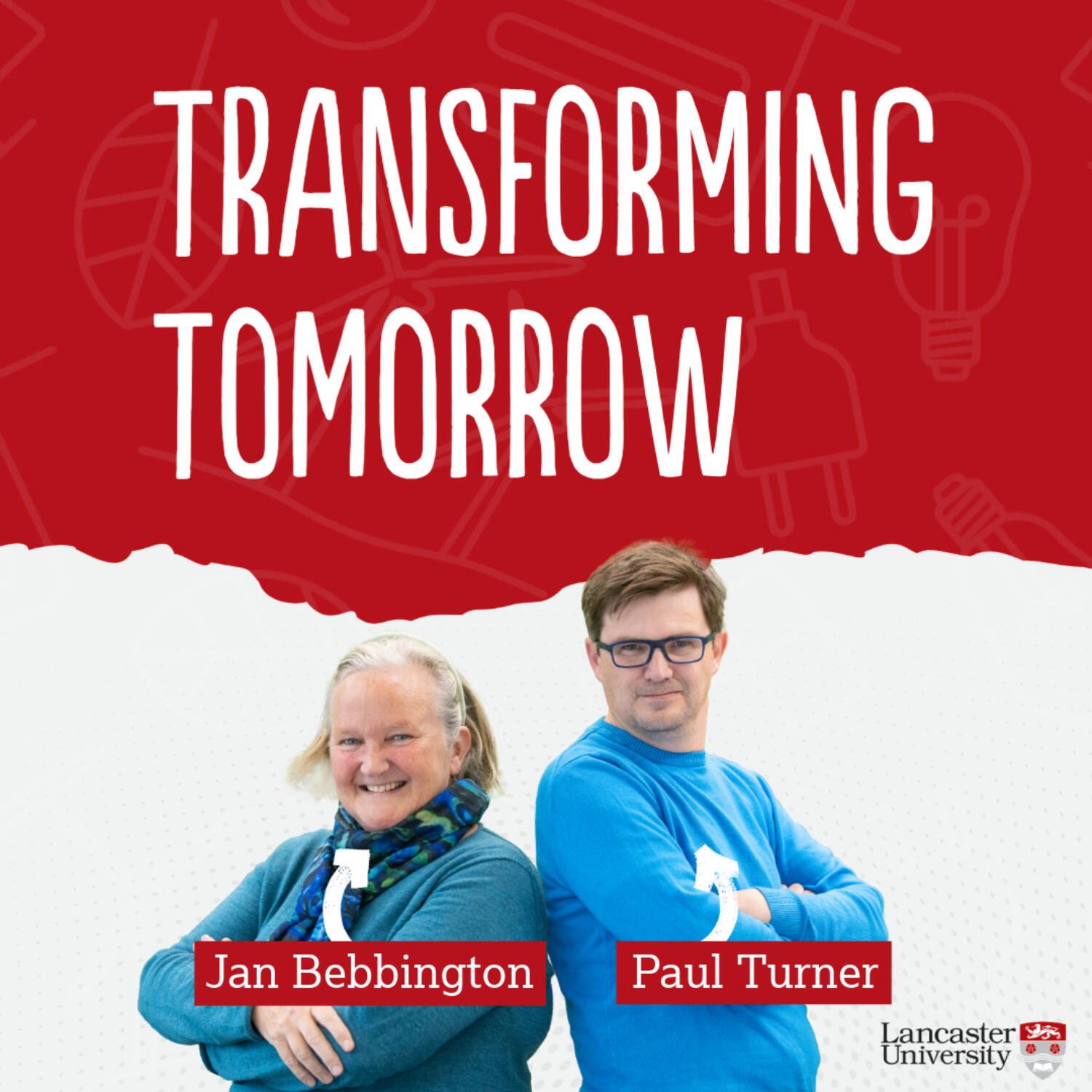
Transforming Tomorrow
The Pentland Centre for Sustainability in Business
Sustainability is a key consideration for any contemporary business, from biodiversity to modern slavery, seabeds to factory floors. Transforming Tomorrow guides you through the complex, ever-changing and often exciting (yes, really!!) world of sustainability in business.
Alongside members of the Pentland Centre, international research experts, and business leaders, we cover the theory and practice of mainstreaming sustainability into purposeful business strategy and performance.
Whether you are leading change in your business, or just want to know more about how space weather, human trafficking or architecture may influence the future of sustainability, Transforming Tomorrow is the show for you.
Taking you through it all, hosts Jan and Paul bring insight, perspective, and more than occasional disagreement to their topics.
Professor Jan Bebbington is the Director of the Pentland Centre for Sustainability in Business at Lancaster University. Jan is an expert on accounting, benchmarking (to her co-host’s annoyance), and how business and sustainability intersect. She loves nature and wants to protect it – and hopes she can change the world (ideally for the better). She is also motivated to address inequality wherever it is found and especially to eliminate forced, bonded or child labour. Transforming Tomorrow is one small step on that quest.
Paul Turner is a former sports journalist who now works promoting the research activities in Lancaster University Management School – a poacher turned gamekeeper as his former colleagues would have it. He has always been interested in nature and the natural environment – it comes from growing up in Cumbria – and has been a vocal proponent of the work of the Pentland Centre since joining Lancaster University. He does not like rankings and benchmarking, and is not afraid to say so.
Join us every Monday to uncover new insights and become a little more inspired that you can make a difference in sustainability.
Alongside members of the Pentland Centre, international research experts, and business leaders, we cover the theory and practice of mainstreaming sustainability into purposeful business strategy and performance.
Whether you are leading change in your business, or just want to know more about how space weather, human trafficking or architecture may influence the future of sustainability, Transforming Tomorrow is the show for you.
Taking you through it all, hosts Jan and Paul bring insight, perspective, and more than occasional disagreement to their topics.
Professor Jan Bebbington is the Director of the Pentland Centre for Sustainability in Business at Lancaster University. Jan is an expert on accounting, benchmarking (to her co-host’s annoyance), and how business and sustainability intersect. She loves nature and wants to protect it – and hopes she can change the world (ideally for the better). She is also motivated to address inequality wherever it is found and especially to eliminate forced, bonded or child labour. Transforming Tomorrow is one small step on that quest.
Paul Turner is a former sports journalist who now works promoting the research activities in Lancaster University Management School – a poacher turned gamekeeper as his former colleagues would have it. He has always been interested in nature and the natural environment – it comes from growing up in Cumbria – and has been a vocal proponent of the work of the Pentland Centre since joining Lancaster University. He does not like rankings and benchmarking, and is not afraid to say so.
Join us every Monday to uncover new insights and become a little more inspired that you can make a difference in sustainability.
Episodes
Mentioned books

Nov 17, 2025 • 50min
Where Eagles Died
Broadsword calling Danny Boy. We’re going where eagles dare to investigate the sad fate of beautiful birds of prey in 19th century Scotland.
A concerted effort to hunt golden eagles led to a massive reduction in their numbers in the 1800s. But why were they persecuted? And what can we learn from how many were killed to tell us how many there used to be?
Jason Harrison, who combines being a PhD researcher at Lancaster University with being Jan’s husband, joins us to discuss his work on sustainable mountain development in Scotland, and the eagles who live there in particular.
We discover what was happening in the Scottish Highlands when the eradication efforts stared, skirt around the politics of the Highland Clearances, talk about why landowners wanted rid of eagles (and foxes), and how they drove golden eagles from their habitats.
Valuable bounties were offered on eagles, their chicks and eggs – and you needed gruesome proof to claim the rewards – and it led to up to 75% of the population being wiped out. This is a tale of man against beast, where man was the definite victor, and where – to Jan’s delight – accounting record keeping is the key to understanding historical biodiversity baselines.
We discuss how place names can tell us where eagles used to nest; look at the status of the birds in Scotland and England today – and how the fate of England’s hen harriers now harks back 200 years; and wonder why there is no specific Sustainable Development Goal for mountains.
How do Wordsworth and the Lord of the Rings fit into all this? And what’s the story with Balamory?
Discover more about the University of the Highlands and Islands’ Centre for Mountain Studies here: https://www.perth.uhi.ac.uk/subject-areas/centre-for-mountain-studies/
And see the paper by Agetsuma on estimating previous populations from hunting data: https://journals.plos.org/plosone/article?id=10.1371/journal.pone.0198794
Episode Transcript
Nov 10, 2025 • 42min
The Ongoing Case of Humanity vs Planet Earth
How can courts enforce the right to a healthy environment? And how are international courts, individuals and companies shaping the laws that will affect our futures?
It’s time for us to bring the law back to Transforming Tomorrow, to look at how the legal system is evolving as the climate is changing.
Camilo Cornejo Martinez, a PhD researcher in Lancaster University School of Law, joins us once again to discuss how verdicts and advisory opinions from across Europe, the Americas, and the world are shaping nations’ attitudes and behaviours.
We look at how the courts view the impact of human activity on the seas, the responsibilities of states when it comes to climate change, why even advisory opinions – and we explain what those are – have weight in courtrooms and law-making, and ask how does denouncing climate treaties affect a country’s legal position?
We discover how a group of students from Pacific states have made a major impact on international rulings; the obligations of nations to abide by the likes of the Kyoto Protocol – whether or not they signed the agreement; and how the International Court of Justice has surprised even the most optimistic climate lawyers with their opinions.
Plus, pirate courts!
Discover more about Camilo and his work here: https://www.lancaster.ac.uk/pentland/about/meet-the-team/camilo-cornejo-martinez
And these are links to explanations about the various cases and advisory opinions that we discussed with Camilo:
Klimaseniorinnen case from the European Court of Human Rights (April 2024) - https://www.netzerolawyers.com/news-events/failure-to-act-on-climate-change-violates-human-rights-the-klimaseniorinnen-case
Advisory Opinion on Climate Change from the International Tribunal for the Law of the Sea -ITLOS- (May 2024) - https://www.biicl.org/blog/77/a-commentary-on-itlos-advisory-opinion-on-climate-change
Advisory Opinion on Climate Change from the Inter-American Court of Human Rights (July 2025) - https://blogs.law.columbia.edu/climatechange/2025/07/08/a-blueprint-for-rights-based-climate-action-the-inter-american-court-of-human-rights-advisory-opinion-on-the-climate-emergency/
Advisory Opinion on Climate Change from the International Court of Justice (July 2025) - https://commonslibrary.parliament.uk/research-briefings/cbp-10354/
Episode Transcript
Nov 3, 2025 • 43min
Connecting the Arctic and Outer Space
It’s time to go back to outer space – and to explore another frontier region – as we push the boundaries of sustainability in new directions.
We bring together Donald Trump, satellites, Greenland, rocket launches, polar bears – and penguins – to explore the connections between the Arctic and Outer Space.
Dr Mia Bennett, from the University of Washington, has seen a polar bear in Svalbard, but her expertise is on the indigenous people of the Arctic and how the space industry has grown in their homeland and affected their lives.
She tells us how her dreams of being an astronaut evolved into an interest in the Earth’s poles, and then the links between them in the forms of satellites, inter-continental missiles, and spaceports.
We go back to the origins of the connections between the Arctic and space, when stars were used to navigate and to monitor the seasons; how the threats of the Cold War turned the Arctic into a region to monitor space, and the impacts of this development on the land and the local peoples.
We discover how populations have been displaced and damaged by colonial and militaristic expansions, how land and sea have been polluted by radioactive waste, how food systems have been disrupted, and how Trump’s Greenland obsession fits into the bigger historical picture.
But we also learn how the growth in the satellite industry – particularly Elon Musk’s Starlink network – has brought jobs to new areas through ground stations in the harsh environs of the far north, and that there are other benefits for the indigenous communities as well.
Jan dredges up her worst snow-related puns, Paul ponders why he keeps forgetting Greenland is an island, and we ask, what is the perfect number of penguins in a fight?
Mia and Klaus Dodds have written a book about the future of the Arctic, Unfrozen: The Fight for the Future of the Arctic. Discover it here: https://yalebooks.co.uk/book/9780300259995/unfrozen/
Read about the Outer Space Treaty here: https://www.unoosa.org/oosa/en/ourwork/spacelaw/treaties/introouterspacetreaty.html
And find out more about Mia and her work here: https://www.cryopolitics.com
Episode Transcript
Oct 27, 2025 • 45min
What We Leave Behind
The future is coming – who will be there to lead us into it? Some companies are operating with the future in mind, but how much and how so? What legacy will they leave behind?
Professor Nick Barter, from Griffith University, in Australia, returns to discuss the concept of generational governance – where organisations consider the next generation in their actions.
Nick tells us whether we are closer to the Future Normal being normal now, looks at how we think 30 years ahead, and reveals the importance of bringing younger people into the boardroom – and even having next generation advisory boards.
We consider existing examples of companies with future boards in place; talk about how Wales and Finland set examples for other countries to follow; wonder how we can help the next generation move in the right direction; and dig deeper into Nick’s survey of companies across the UK, Japan, and Australia, to see what it reveals about attitudes and practices around generational governance.
Plus, why is everything 5 out of 10 in Japan, how have we lost sight of the meaning of sustainability, what are the origins of Nintendo, and – possibility most importantly – how sustainable are the Moomins?
See how Wales has integrated future generations into its thinking: https://futuregenerations.wales/
Take a glimpse into the Finnish Committee for the Future: https://www.parliament.fi/EN/valiokunnat/tulevaisuusvaliokunta/Pages/default.aspx
Read about Dr Innan Sasaki’s work on ancient companies in Japan: https://www.lancaster.ac.uk/lums/research/fifty-four-degrees/old-and-crafty
And discover more about Nick’s work on his Future Normal site: https://futurenormal.net/
Episode Transcript
Oct 20, 2025 • 48min
AI, Data Centres, and The Great Energy Problem
Did you make an action figure avatar of yourself? Do you ask ChatGPT every time you have a question? Does Co-Pilot write your emails for you?
If you answered yes to any of these questions, did you think about the energy consumption and sustainability consequences?
We tell you how much energy a ChatGPT search uses – and as generative AI becomes increasingly commonplace, and infrastructure spring up around the world to cope with demand, we need to understand these often-invisible costs that come with it. It might even cost you a loaf from your local bakery!
Professor Adrian Friday – still not a fan of the Sustainable Development Goals – returns to talk to us about data centres, what they are, how big they are, and what happens in them; who they provide services for; their need for rare earth metals; and the need to cool and power them – and to deal with the heat they generate. It turns out data centres use more energy each year than Italy – and the demand is growing faster than the system can cope with.
We discover why Adrian’s picture (with silly hat included) is stuck on Paul’s fridge; contemplate the logistical difficulties of putting a data centre at the bottom of the sea; discuss the potential need to take an army of ninjas to change a lightbulb; realise the importance of AI to the survival of the Welsh language; and rant about the blanket default of AI across all of life.
And remember, to turn off the AI functionality of a ‘normal’ Google search, simply type ‘-ai’ at the end of your search.
A UK Parliament research briefing provides an entry point to our discussions: https://commonslibrary.parliament.uk/research-briefings/cbp-10315/
And discover more about Adrian’s work here: https://www.lancaster.ac.uk/sci-tech/about-us/people/adrian-friday
Episode Transcript
Oct 13, 2025 • 50min
Human Trafficking
People are trafficked illegally around the world every day. They are coerced and exploited – the victims of criminal gangs, of war, of poverty, and are exploited for commercial and sexual means.
We return to the topic of modern slavery, this time with someone who has experience on the ground in the UK, Greece, Australia, and Bangladesh, and who has some shocking tales to tell.
Kyla Raby is an antislavery specialist completing her PhD at the University of South Australia. She has designed and managed support services for refugees and survivors of trafficking, is a Non-Executive Director of Be Slavery Free, and was an inaugural member of the New South Wales Anti-Slavery Commissioner's advisory panel. In other words, she knows her stuff.
We uncover the extent of human trafficking into the UK and the development of response services; how Modern Slavery Acts in Britain and Australia changed the situation in the two countries; the problem of forced marriage and domestic violence; the importance of recognising the impact of trauma on trafficking victims and building support structures; and the problem of relying on consumer behaviour to force corporations to change their actions on modern slavery in their supply chains.
Kyla talks us through her time in Cox’s Bazar, the world’s largest refugee camp on the border of Bangladesh and Myanmar – home to around 1.4 million people (which would make it the second-largest city in the UK). This is a hotspot for human trafficking, and one negatively affected by cuts to global aid funding. And we compare this with Greece in 2016, towards the end of the refugee crisis.
Kyla is also Australian, prompting Jan to test Paul out on his knowledge of the differences between New Zealand and Oz, and create a new species of koala bears made from kiwi fruit.
Watch the Everyday Slavery series here: https://www.youtube.com/@Everyday_Slavery
Find out about the Palermo Protocol, designed to present, suppress and punish trafficking in persons: https://www.ohchr.org/en/instruments-mechanisms/instruments/protocol-prevent-suppress-and-punish-trafficking-persons
And the California Transparency in Supply Chains Act: https://oag.ca.gov/SB657
And, finally, discover more about Kyla and her work here: https://people.unisa.edu.au/Kyla.Raby#About-me
Episode Transcript
Oct 6, 2025 • 52min
Space Weather
What’s the weather like in space? This isn’t the British obsession with the weather gone made, it really exists!
It may not be covered in the TV forecasts, but it affects our lives – and on technology.
This is not Michael Fish and telling us about rain on Mars, or storms on Jupiter, but how solar activity influences us on earth.
Jim Wild is President-Elect of the Royal Astronomical Society and a Professor of Space Physics at Lancaster University, and is perfectly placed to tell us all about what space weather is.
He brings us up to (light) speed about solar flares, predicting the sun’s behaviour, how space operators can protect themselves, how it might affect you and your phone, the importance of the Earth’s magnetic field (and its similarities with the shields on the Starship Enterprise), monitoring the aurora borealis, and his work with UK infrastructure operators on the risk of space weather to their operations.
Plus, we learn about the Carrington Event in 1859, when telegraph lines went haywire after a giant solar flare erupted. What might happen if something similar were to occur in the modern electronic world? How often do these big solar events happen (and could they be bigger)? And how does it all tie in with the Northern Lights over Lancaster and GPS glitches for farmers and their tractors in California?
You can find out about Aurora Watch UK here: https://aurorawatch.lancs.ac.uk/
See the latest space weather forecasts from the UK Met Office here: https://weather.metoffice.gov.uk/specialist-forecasts/space-weather
And discover more about Jim and his work here: https://www.lancaster.ac.uk/sci-tech/about-us/people/jim-wild
Episode Transcript
Jul 14, 2025 • 37min
Sustainability Inspiration, Optimism – and the Edmonton Oilers!
It has been a turbulent nine months for the world of sustainability – and for Transforming Tomorrow. So, what have we learned?
Paul and Jan look back over the series and discover themes that run through our guests’ thoughts on sustainability – whether they were with us to talk about plastics or biodiversity, Morecambe Bay or Malaysia.
It’s a chance to talk about how things have already changed since we talked to some guests and pick out our favourite moments from a packed series.
We consider the recognition of the importance of long-term resilience and determination to change and progress; realise just how wide a reach there is to the sustainability world; celebrate what once was theory being turned into practice; and place hope in the next generation.
Plus, we find the time to discuss which of our hosts is most likely to murder the other (and Jan’s possession of a new sword); give Luxembourg it’s due when it comes to asteroid mining; and lament Paul’s ice hockey tipping prowess.
Transforming Tomorrow will return for a third season in autumn 2025.
Episode Transcript
Jul 7, 2025 • 42min
What Can Businesses do for Biodiversity?
You might not see climate change on your doorstep every day, but you can see biodiversity loss.
Find out what businesses are doing to address biodiversity concerns, and how they can be helped to improve their actions.
Dr Michael Burgass is from Biodiversify, a consultancy company that uses cutting-edge science to develop biodiversity strategies for some of the world’s largest companies. He has long been interested in how people interact with their environment.
As businesses have become more interested and engaged with biodiversity, Michael is working with companies who are at the heart of some of the planet’s biggest issues. The mainstreaming of biodiversity into company planning means just about all organisations are becoming involved.
We learn about spatial science, physical risk and transition risk, look at action and implementation over discussion and policy, discuss why big companies are listening to external experts when it comes to biodiversity education, the impacts of biodiversity loss on supply chains, and how the Science Based Targets for Nature can help to validate company efforts.
Find out more about Biodiversify here: https://biodiversify.com/
And learn about the Science Based Targets for Nature here: https://sciencebasedtargetsnetwork.org/how-%20it-works/the-first-science-based-targets-for-nature/
Episode Transcript
Jun 30, 2025 • 42min
Sustainability Transformation in Universities
Discover how you can embed sustainability across a Higher Education organisation.
Dr Alex Ryan, Director and Founder of Learning Energy, returns to her old Lancaster University haunts to tell us about her work inside and outside universities on the ‘great big gobbling monster’ of sustainability. Alex helps people and organisations address sustainability challenges: work is not always easy.
We discuss the evolution of understanding and action in universities over the last 20 years; the importance of changes to culture and strategy; how to place the common good ahead of self-interest when making changes; and how the university sector mirrors other areas of society and the economy when it comes to attitudes and behaviours around sustainability.
We discover how a positive mindset change across an organisation can help overcome ‘change humps’; the essential role of universities in brokering systems change; and how to think differently around reporting and numbers.
Plus, Jan questions her own knowledge and skills, we discover Paul and Alex’s differing experiences of Lancaster University Library and its fines system, the Great Vowel Shift gets belated publicity, and we consider becoming the Pentland Centre for Love and Justice in Business.
Read the Advance HE Measuring What Matters report here: https://www.advance-he.ac.uk/knowledge-hub/measuring-what-matters
Episode Transcript

