

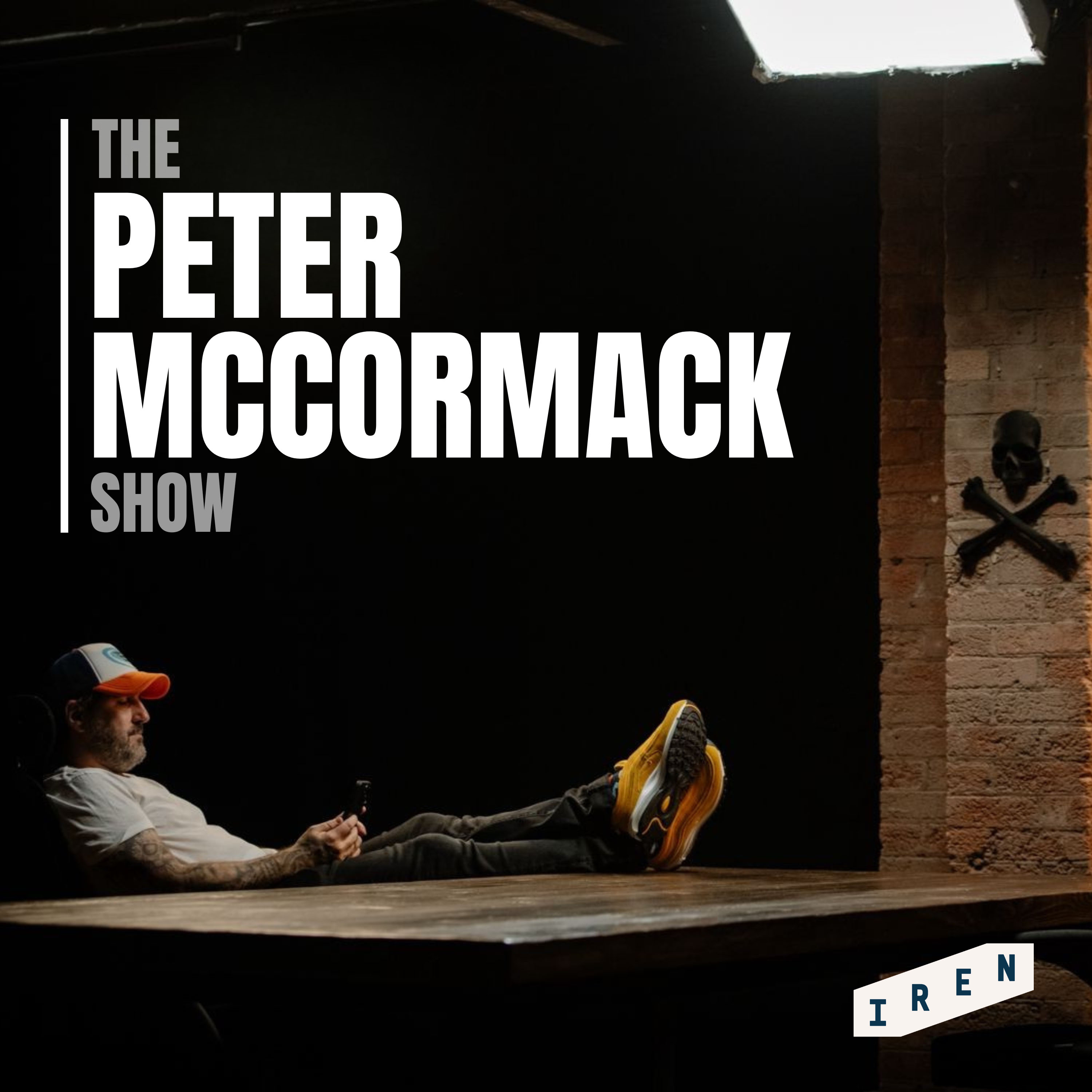
The Peter McCormack Show
Peter McCormack
I’m just a retired rapper from Bedford, UK, trying to understand this crazy world.So I speak to smart people about money, power, politics and why things feel the way they do. Hosted on Acast. See acast.com/privacy for more information.
Episodes
Mentioned books

May 27, 2022 • 1h 35min
Censorship Resistant Social Media with Justin Rezvani - WBD506
Justin Rezvani is the founder and CEO of Zion. In this interview, we discuss completing Ironman, his near-death experience, recovery and perspectives, and motivations for building a new business. Justin explains his vision to enable creators to own distribution and the future of social media. - - - - Not many of us walk through life thinking any day could be our last. But most live as though we have unlimited tomorrows. We leave dreams unfulfilled, arguments unresolved, our attention diverted to the wrong priorities. For those who experience death, but live to tell the tale, it is a pivotal event that leads to a refocused life. And for those who do get a second chance, they tend to grab opportunities as they arise. Justin came through a near-death experience and traumatic rehabilitation. Once recovered he seized the chance to use Bitcoin to remake social media. Better for creators, and users. Better for the curation and protection of online discussion. Better for the development of communities. The issues with current centralised platforms are obvious to all at the moment. Business models are incentivised to capture attention, not to nurture civil debate. The digital town square has turned into a digital bear bit. And yet censorship has turned into a blunt instrument open to abuse. The rule book needs rewriting. Bitcoin, decentralised identification and other technology offer an opportunity to provide creators ownership of the distribution. Communities will no longer be tied to a platform. There will always be aggregators of content, but creators and their audience will now have the flexibility to move across a decentralised internet if and when they choose or require. Hosted on Acast. See acast.com/privacy for more information.

May 25, 2022 • 1h 22min
Bitcoin in El Salvador - Part 2 with Nayib Bukele - WBD505
The full interview with President Nayib Bukele, undertaken days after the Bitcoin Law became effective on September 7th 2021, sections of which were included in my film "Follow The Money #1 - Bitcoin in El Salvador". In this interview, we discuss motivation, opposition and legacy. - - - - A few days following Bitcoin being given legal status, I was granted an exclusive access interview with President Bukele for the purposes of my film "Follow The Money #1 - Bitcoin in El Salvador". Following the release of the film, it is time to publish the full interview. It has been over 8 months since El Salvador became the first country in the world to make Bitcoin legal tender. A lot has been written about El Salvador's Bitcoin Law, and a lot has happened since. But what was it like to be at the centre of this unprecedented event? An event that could change not just El Salvador's future, but also Bitcoin's and the rest of the world. The discussion covers President Bukele's enthusiasm for what Bitcoin can do for his country and his people; the incredible timescale within which the law was passed (it was a mere 3 months from being enacted to becoming law); the strategy behind the country's purchases of Bitcoin; internal and external opposition; and the plan behind the articles of the Bitcoin Law. As background noise to all these changes is vocal concerns about authoritarian actions Bukele is taking; he has removed judges, influenced a change in the constitution to enable a potential second term, had troops enter parliament, and implemented stern policies aimed at reducing gang violence. The term "dictator" is banded around. Nevertheless, he is an extremely popular president: he has an approval rating of 85%. Many citizens, sick of the years of violence and corruption, are pleased to finally see a decisive Salvadoran President. Could he become a beacon for the wider region? Could he be the leader of the Bitcoin age? Hosted on Acast. See acast.com/privacy for more information.

May 23, 2022 • 1h 33min
The Bitcoin Awakening with John Vallis - WBD504
John Vallis is a Bitcoin podcaster who hosts Bitcoin Rapid Fire. In this interview, we discuss what freedom means, parallels between Bitcoin and religious values, living a meaningful life, psychedelics and their importance, and a new civilisation centred on truth. - - - - Bitcoin provides freedom. Financial freedom; freedom from coercion; freedom of movement. But how should those who benefit from Bitcoin use this freedom? Should they use it to fulfil their own desires? Or are there higher values that Bitcoiners should strive to attain? Should Bitcoiners draw back into their citadels? Or, should they actively engage in trying to shape a better world? Such decisions will be influenced by the values such individuals hold. In our fiat economy, self-interest is deemed to be the principle that supports a functioning and prosperous society. Institutionally driven moral codes have been supplemented by the needs of the market. Religion has been replaced; prayer and faith have given way to data and patterns. It is assumed that science and rejection of the divine have driven a more advanced society. And yet, ephemeral pursuits of money and power seem to be the root of a lot of the problems we face today. Some feel that more sophisticated behaviours were displayed by previous civilisations: humans have previously been more in tune with nature. Psychedelics is thought to have played a part in this process. Many cultures throughout history used psychedelic practices to enable them to break away from their ego. This gave them a wider perspective - a more holistic view of the world around them. Bitcoin shows that current values in a fiat world are misaligned: selfish short term pursuits are failing us; we have lost sight of the truth. Could psychedelics hold the key to helping more people to make that shift to see the fallacy of our current systems? Is the loss of ego needed to determine how best to mould this new world evolving around us? Hosted on Acast. See acast.com/privacy for more information.

May 19, 2022 • 1h 17min
Why are Bitcoin Forks Contentious with Adam Back - WBD503
Adam Back, an original cypherpunk, inventor of Hashcash and co-founder and CEO of Blockstream. We discuss the controversy around BIP 119: the soft fork proposal aiming to add "covenants" to Bitcoin. We also talk about the collapse of Luna. - - - - Flexible smart contracts are a USP of Ethereum and other blockchains. Currently, Bitcoin only enables basic smart contract functionality, such as a timelock that specifies when a transaction can be spent. BIP 119 proposes to add more flexibility for applying restrictions to transactions via a new programme operation code (opcode) called CheckTemplateVerify (CTV). CTV would enable conditions on spending UTXOs that would limit, not when they are spent, but how. These are referred to as "covenants". It is envisaged CTV could significantly enhance Bitcoin by enabling a raft of new and powerful applications to be developed; these could bring new security, privacy and scalability benefits. The concern is that CTV is a significant change and could open up potential unknown security risks, or that if this functionality is desirable, it could be possible be better achieved with a different technical approach BIP119 has been authored and enthusiastically promoted by Bitcoin developer, Jeremy Rubin. It has been around now for 2 years, and whilst Rubin has generated support for BIP119, he has also faced criticism from prominent Bitcoiners for his approach and so far there doesn't seem to be consensus among the protocol development community on implementing the proposal. The consideration, approval and activation of changes to Bitcoin are methodical and slow. Further, such changes normally involve the development of competing ideas, and a collaborative approach to combine the best elements from these efforts. Notable critics feel that BIP119 is being too forcefully promoted and that more time is needed to test and consider alternatives. The pressure to innovate will always be there. The issue at hand is Bitcoin's USP: it has never been hacked. This has been hard-won. So it seems BIP119 isn't going to get a formal consensus at the moment. Rubin, however, could bypass the Core developers and implement a UASF. Could we again be about to test the limits of Bitcoin's rough consensus process? Hosted on Acast. See acast.com/privacy for more information.

May 16, 2022 • 1h 39min
Texas is Bitcoin Country with Will Cole - WBD502
Will Cole is Chief Product Officer at Unchained Capital. In this interview, we discuss Texas and Austin as ideological centres for Bitcoin, the undervalued importance of state sovereignty in the US, CBDCs being the greatest disaster for liberty and personal freedom, and toxicity on Twitter. - - - - Something is happening in Texas. It has always had an independent streak, rooted in its rich history. The state was born of revolution, and it was initially a republic in the mid 19th century before the Mexican-American War. That thirst for freedom is hard-wired into the Texan psyche. Now it is a beacon to Americans from other states seeking increasingly elusive sovereignty. It is therefore not surprising then that Bitcoin has been adopted and fostered in Texas. From very early in it's history, a strong community of maximalists united and sought to safeguard Bitcoin in this part of the US. That effort is now starting to pay off. The strong affinity for Bitcoin by Texans has evolved such that the state is fast becoming the centre of groundbreaking efforts to integrate Bitcoin and energy grids. The state is arguably spearheading a new adoption wave within the US that includes serious politicians. Could Texas take the next step and create the conditions to orange pill a nation? Those Bitcoiners in the state aren't waiting to find out. They're moving at pace to help Texas and other states continue the outreach, policy drafting and technical buildout to realise the benefits of what is a keenly American innovation. They're also keenly focused on the attack vectors on the horizon, be it CBDCs or divisions within the community. Hosted on Acast. See acast.com/privacy for more information.

May 13, 2022 • 1h 28min
The Risks of Hyperbitcoinisation with Rob Hamilton - WBD501
Rob Hamilton, a programmer and data scientist, dives into the complexities of hyperbitcoinization and its societal implications. He discusses how Bitcoin's rise as a global currency presents risks like entrenched inequality and social conflict. Hamilton emphasizes the importance of maintaining technological consensus while navigating community fragmentation. The conversation also touches on Bitcoin's potential to enhance energy markets, stabilize grids, and the need for genuine, in-person dialogue to foster understanding in the evolving Bitcoin community.

May 11, 2022 • 1h 47min
Bitcoin is Truth with Jeff Booth & Austin Hill - WBD500
Jeff Booth is an Entrepreneur and Author of 'The Price of Tomorrow' and Austin Hill is a cypherpunk & former Blockstream CEO. In this interview, we discuss the unique sense of hope in El Salvador, the loss of freedom, Bitcoin as objective truth and hope, Elon Musk and Twitter. - - - - Show 500!!! What a ride it's been since I recorded my first show in November 2017. I'm so grateful to all the listeners, particularly those who send their support. Thanks to all the fascinating people I've had the privilege to interview: so many great stories, opinions, and advice. Thanks to my amazing sponsors - you enable my team to make what we think is the best show in the market. And finally, big up to the team, roll on the next 500! This show is as good as it gets in terms of guests and subject matter. Two major figures within the industry who I'm now lucky enough to call friends. And I hope you enjoy listening to them as much as I did. They're as excited about Bitcoin's opportunities as they've ever been. We speak about their recent visit to El Salvador and the unique and inspiring mood of hope within the country. The media are still dubious about Bukele's Bitcoin reforms, and the government is dealing with tough domestic and international challenges. However, it is infectious to hear how inspired two seasoned entrepreneurs are by what they witnessed in the country. Jeff and Austin also talk about the societal issues that Bitcoin is perhaps uniquely placed to mitigate: threats to freedom, not just from authoritarian governments but also from traditionally liberal establishments; pervasive misinformation directed at citizens; and rapid technological changes that will upend society. This is why Jeff and Austin are bullish that UX improvements have the potential to onboard hundreds of millions more to Bitcoin. Hosted on Acast. See acast.com/privacy for more information.

May 9, 2022 • 1h 60min
Bitcoin & Absolute Freedom with Junseth - WBD499
Junseth is a OG bitcoiner and the former co-host of Bitcoin Uncensored. In this interview, we discuss government being the logical extent of libertarianism, the evolution of news media, falling for conspiracies, admitting when you're wrong, opinion versus fact, and the return of Trump. - - - - Our lives are full of examples of infective institutions, inefficient governance, waste, want, and an eagerness to wage war. It is hard to argue in defence of the state. Yet, any popular movements against the actions of the state are ignored. In these times, libertarian arguments are powerful and persuasive: the state, shielded by coercion, is ineffective so we need to tear it down. However, we don't need to be fans of the state to be worried about the alternatives. In a world of 8 billion people, with increasing complexity, specialisation, and disagreement, is it rational to think that we can organise ourselves into voluntary and agreeable groups? History lacks examples of such structures working to support advanced functioning societies. So, why are we so ready to accept at face value vague promises that a better world can be achieved through radical means? Is it that uncertainty and nuance aren't rewarded by today's click-bait driven media? Like moths to a light, are we all drawn towards more exciting, adventurous, and confident narratives built on conspiracy and anarchy? In a small way, podcasting is an attempt to provide airtime for the truth. Whilst it's true that those who take extreme positions can build strong audiences, the biggest audiences are drawn to the more honest explorations of subjects. Despite attacks from MSM, the popularity of Joe Rogan shows there is a huge demand for authentic and reasoned debate. People want the truth. The question is, as MSM becomes increasingly unwilling to provide such a service, are we going to have to rely on a community of independent content creators to meet this demand? Hosted on Acast. See acast.com/privacy for more information.

May 6, 2022 • 1h 31min
I Was in a Cult with Tuur Demeester - WBD498
Tuur Demeester is a Bitcoin investor and economist. In this interview, we discuss how he was drawn into a toxic online cult, his awakening and leaving, Twitter enabling cultist behaviours within Bitcoin and why it's key to give air to all voices within Bitcoin. - - - - Wisdom is developed through experience: an individual's interaction with other people and events, and their personal reflections on the outcomes, enhance understanding of both the self and the world. Knowledge isn't endowed genetically, and education provides limited direction. Perspective on exposure to our environment is what drives tangible learning and growth. People can easily find themselves developing beliefs, and engaging in actions, with the benefit of hindsight they later deem antithetical to an evolved worldview. Submission to a cult, that is adherence to common belief systems and behaviours advocated by a charismatic leader, is an extreme example of this. People will largely dismiss the idea that they could be susceptible to becoming a cultist. And yet, even the most infamous cults are full of highly educated, principled, and engaging people. People who have then made life decisions that are hard to objectively comprehend. The truth is that we're all susceptible. Commonly cults are cast as people in white robes; collectives holed up in fortified buildings; empty-eyed automatons following a messianic figure. But cults are less obvious and more pervasive than we'd imagine. Today, with easy access to powerful and toxic social media tools, building and energising and channelling an audience is available to anyone with a voice. It's never been easier to develop a cult. So, where are the dividing lines? What's the difference between impassioned rhetoric and dangerous invective? Should we try and conduct reasoned debate using tools that are structurally deficient for such tasks? How open can we be to divergent opinions in a world full of noise and pressure? Could we sleepwalk into a cult, or worse, become a corrupted cult leader? Hosted on Acast. See acast.com/privacy for more information.

May 4, 2022 • 1h 11min
The Anarchist Lens with Michael Malice - WBD497
Michael Malice is an anarchist, author, and podcaster. In this interview, we discuss declining versus flourishing US cities, transitioning away from the state, Ukraine and Putin, conspiracies to cancel, challenges to free speech, and the enfeeblement of the media and education system. - - - - Anarchism has quickly evolved from being an extreme ideology, which was at best a interesting thought experiment, to a political vision whose merits are being given increasingly serious consideration. Even those who believe in the power of collectivism are questioning the effectiveness of our current institutions. But with power comes responsibility. Do anarchists truly believe that tearing down the state and its associated power structures will result in a better world? Or is there a more nuanced and pragmatic approach? Is retention of some collective organisation desirable? Would decreased centralization and dominance of the state be a sufficient victory for anarchists? Whatever the end state envisioned by advocates of scholars such as Bakunin, Goldman, Berkman and Rothbard, there are plenty of power structures that anarchists believe require radical reconstruction. Mainstream media, universities, schools, and rent seeking businesses: they are all targets. Even if some anarchists are changing to think that a better and fairer world does not mean starting again from the ground up, don't think that their objective is anything short of an extensive reordering of society. Hosted on Acast. See acast.com/privacy for more information.

