

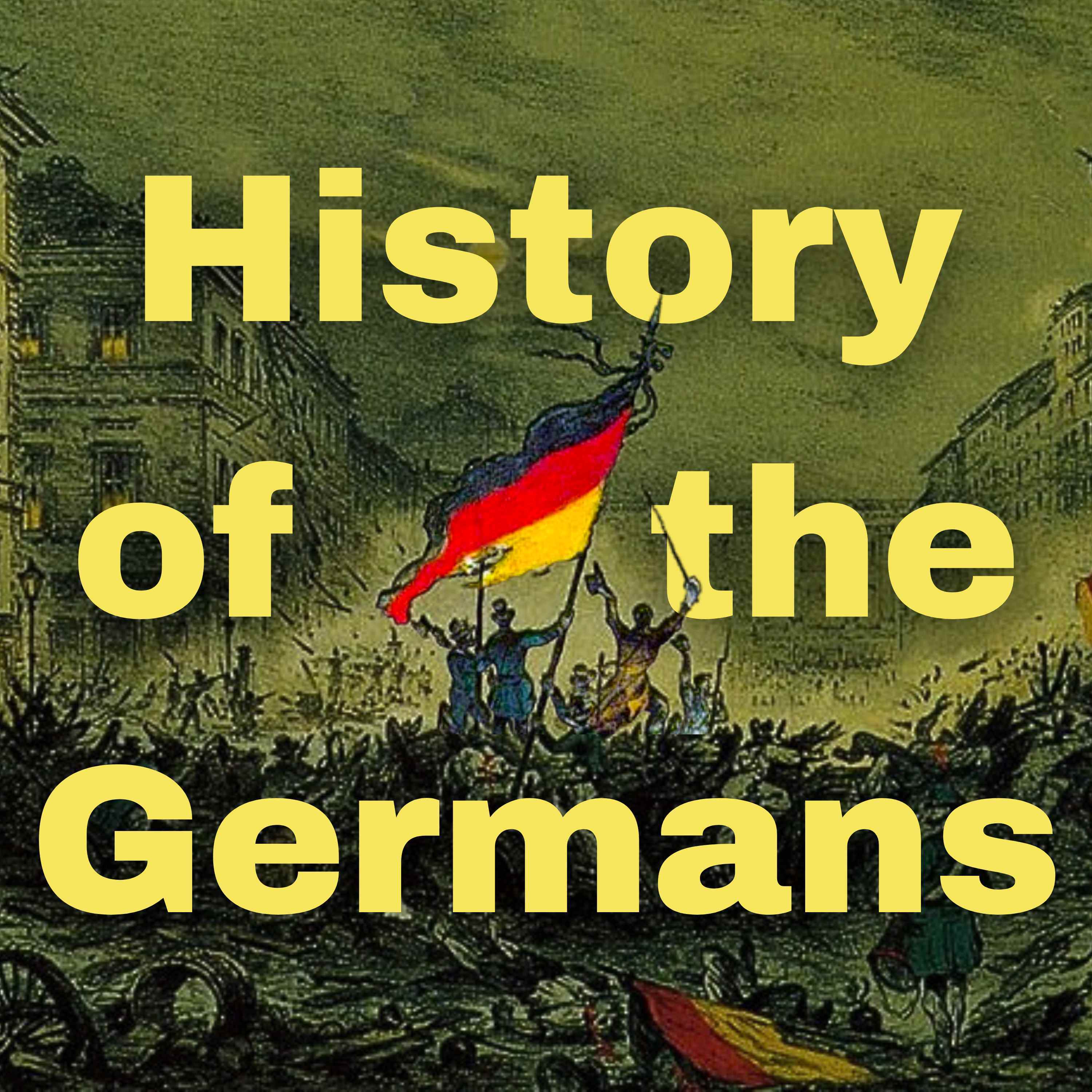
History of the Germans
Dirk Hoffmann-Becking
A narrative history of the German people from the Middle Ages to Reunification in 1991. Episodes are 25-35 min long and drop on Thursday mornings.
"A great many things keep happening, some good, some bad". Gregory of Tours (539-594)
HotGPod is now entering its 9th season. So far we have covered:
Ottonian Emperors (# 1- 21)
- Henry the Fowler (#1)
- Otto I (#2-8)
- Otto II (#9-11)
- Otto II (#11-14)
- Henry II (#15-17)
- Germany in 1000 (#18-21)
Salian Emperors(#22-42)
- Konrad II (#22- 25)
- Henry III (#26-29)
- Henry IV/Canossa (#30-39)
- Henry V (#40-42)
- Concordat of Worms (#42)
Early Hohenstaufen (#43-69)
- Lothar III (#43-46)
- Konrad III (#47-49)
- Frederick Barbarossa (#50-69)
Late Hohenstaufen (#70-94)
- Henry VI (#70-72)
- Philipp of Swabia (#73-74)
- Otto IV (#74-75)
- Frederick II (#75-90)
- Epilogue (#91-94)
Eastern Expansion (#95-108)
The Hanseatic League (#109-127)
The Teutonic Knights (#128-137)
The Interregnum and the early Habsburgs (#138 ff
- Rudolf von Habsburg (#139-141)
- Adolf von Nassau (#142)
- Albrecht von Habsburg (#143)
- Heinrich VII (#144-148)
- Ludwig the Bavarian (#149-153)
- Karl IV (#154-163)
The Reformation before the Reformation
- Wenceslaus the Lazy (#165)
- The Western Schism (#166/167)
- The Ottomans (#168)
- Sigismund (#169-#184
The Empire in the 15th Century
- Mainz & Hessen #186
- Printing #187-#188
- Universities #190
- Wittelsbachs #189, #196-#199
- Baden, Wuerrtemberg, Augsburg, Fugger (#191-195)
- Maps & Arms (#201-#202)
The Fall and Rise of the House of Habsburg
- Early habsburgs (#203-#207)
- Albrecht II (#208)
-Freidrich III (#209-
"A great many things keep happening, some good, some bad". Gregory of Tours (539-594)
HotGPod is now entering its 9th season. So far we have covered:
Ottonian Emperors (# 1- 21)
- Henry the Fowler (#1)
- Otto I (#2-8)
- Otto II (#9-11)
- Otto II (#11-14)
- Henry II (#15-17)
- Germany in 1000 (#18-21)
Salian Emperors(#22-42)
- Konrad II (#22- 25)
- Henry III (#26-29)
- Henry IV/Canossa (#30-39)
- Henry V (#40-42)
- Concordat of Worms (#42)
Early Hohenstaufen (#43-69)
- Lothar III (#43-46)
- Konrad III (#47-49)
- Frederick Barbarossa (#50-69)
Late Hohenstaufen (#70-94)
- Henry VI (#70-72)
- Philipp of Swabia (#73-74)
- Otto IV (#74-75)
- Frederick II (#75-90)
- Epilogue (#91-94)
Eastern Expansion (#95-108)
The Hanseatic League (#109-127)
The Teutonic Knights (#128-137)
The Interregnum and the early Habsburgs (#138 ff
- Rudolf von Habsburg (#139-141)
- Adolf von Nassau (#142)
- Albrecht von Habsburg (#143)
- Heinrich VII (#144-148)
- Ludwig the Bavarian (#149-153)
- Karl IV (#154-163)
The Reformation before the Reformation
- Wenceslaus the Lazy (#165)
- The Western Schism (#166/167)
- The Ottomans (#168)
- Sigismund (#169-#184
The Empire in the 15th Century
- Mainz & Hessen #186
- Printing #187-#188
- Universities #190
- Wittelsbachs #189, #196-#199
- Baden, Wuerrtemberg, Augsburg, Fugger (#191-195)
- Maps & Arms (#201-#202)
The Fall and Rise of the House of Habsburg
- Early habsburgs (#203-#207)
- Albrecht II (#208)
-Freidrich III (#209-
Episodes
Mentioned books

Mar 26, 2026 • 44min
Ep.230: Margaret of Austria (1480-1530) - The League of Cambrai
Another Thursday and another episode dealing with another epic fail of our hero, Maximilian I. But despite a military campaign that once again failed for all the usual reasons, no money, no strategy, no luck, this time he is rescued not by a marriage or imperial princes suddenly inflicted with an unlikely case of backbone, but by his daughter, Margaret, archduchess of Austria, dowager duchess of Savoy and governor of the Netherlands. In an age that featured a number of impressive women, from Caterina Sforza to Elisabeth I, Margaret may be lesser known, but could easily hold her own amongst such illustrious company. She brought together an alliance that rescued her father’s lands, re-established imperial power in Northern Italy and brought the mighty republic of Venice almost to collapse. And then did it again, again and once more.Meanwhile her father first made himself emperor in the least impressive ceremony ever, before throwing his hat in the ring to become – tat, tat, taa – the pope.

Mar 19, 2026 • 48min
Ep. 229: Joanna the (not?) Mad (1504-1555) - How the Habsburgs gained Spain
“Bella gerant alii, tu felix Austria nube" – ‘Let others wage war; thou, happy Austria, marry’ is one of the few terms that almost anyone with a cursory interest in European history knows, only rivalled by the Voltaire quote thou shall not utter in my presence ever. It evokes the image of a handsome alpine boy full of charm and apple strudel wooing some princess into peacefully handing over the richest lands is Europe. And this narrative of peaceful transition to a benign dynasty is another one of the great propaganda successes of the house of Habsburg.The saying was attributed to Matthias Corvinus, the king of Hungary who had once occupied Vienna, then to the humanist Ulrich von Hutten, but first evidence of its use dates back to 1654, more than 150 years after the famous marriages that made an empire. From 1680 it was read out at Habsburg weddings to emphasise the peaceful nature of its rulers.It definitely did not originate in the days of Maximilian I when all these dynastic alliances were formed and bore fruit. Talking about gentle and peaceful transition was preposterous against the backdrop of a 15 -year long war over the succession to the grand Dukes of Burgundy, and the roller coaster ride that is today’s topic, the way the Habsburgs acquired the crown of Spain.The music for the show is Flute Sonata in E-flat major, H.545 by Carl Phillip Emmanuel Bach (or some claim it as BWV 1031 Johann Sebastian Bach) performed and arranged by Michel Rondeau under Common Creative Licence 3.0.As always:Homepage with maps, photos, transcripts and blog: www.historyofthegermans.comIf you wish to support the show go to: Support • History of the Germans PodcastFor do it yourself merchandise go to: Merchandise • History of the Germans PodcastFacebook: @HOTGPod Threads: @history_of_the_germans_podcastBluesky: @hotgpod.bsky.socialInstagram: history_of_the_germansTwitter: @germanshistoryTo make it easier for you to share the podcast, I have created separate playlists for some of the seasons that are set up as individual podcasts. they have the exact same episodes as in the History of the Germans, but they may be a helpful device for those who want to concentrate on only one season.So far I have:The OttoniansSalian Emperors and Investiture ControversyFredrick Barbarossa and Early HohenstaufenFrederick II Stupor MundiSaxony and Eastward ExpansionThe Hanseatic LeagueThe Teutonic KnightsThe Holy Roman Empire 1250-1356The Reformation before the ReformationThe Empire in the 15th centuryThe Fall and Rise of the Habsburgs

Mar 12, 2026 • 26min
Ep. 228 – Maximilian I (1493-1519) - The Princes and the Emperor.
If there was one group that consistently thwarted Maximilian’s grand plans for world domination, it was the princes of the Holy Roman Empire. He had given in to their demands for Imperial Reform, had granted the Reichstag far reaching powers, had established the Reichskammergericht as a law court independent of imperial authority and had announced the much longed for ban on feuding. But did the princes, counts, knights and cities hold up their end of the bargain and paid him taxes to raise the armies needed to defend the borders of the empire – well you bet.They left him hanging before Livorno, they collected berries instead of fighting in the Swiss war, and – spoiler alert – they will not raise a little finger to help Ludovioco il Moro to regain his duchy of Milan, even though Milan had been an imperial fief since the days of Charlemagne and Otto the Great. No money, no soldiers, nothing.The music for the show is Flute Sonata in E-flat major, H.545 by Carl Phillip Emmanuel Bach (or some claim it as BWV 1031 Johann Sebastian Bach) performed and arranged by Michel Rondeau under Common Creative Licence 3.0.As always:Homepage with maps, photos, transcripts and blog: www.historyofthegermans.comIf you wish to support the show go to: Support • History of the Germans PodcastFor do it yourself merchandise go to: Merchandise • History of the Germans PodcastFacebook: @HOTGPod Threads: @history_of_the_germans_podcastBluesky: @hotgpod.bsky.socialInstagram: history_of_the_germansTwitter: @germanshistoryTo make it easier for you to share the podcast, I have created separate playlists for some of the seasons that are set up as individual podcasts. they have the exact same episodes as in the History of the Germans, but they may be a helpful device for those who want to concentrate on only one season.So far I have:The OttoniansSalian Emperors and Investiture ControversyFredrick Barbarossa and Early HohenstaufenFrederick II Stupor MundiSaxony and Eastward ExpansionThe Hanseatic LeagueThe Teutonic KnightsThe Holy Roman Empire 1250-1356The Reformation before the ReformationThe Empire in the 15th centuryThe Fall and Rise of the Habsburgs

Mar 5, 2026 • 38min
Ep. 227: Landsknechte vs. Swiss Mercenaries – The Swabian (Swiss) War of 1499
Why are the Swiss called the Swiss? After all, Schwyz in only of 26 cantons, and not one of the largest ones. How did the proud and prosperous citizens of Zurich or Berne, mighty city states in their own right, decide they wanted to be named after a mountainous region largely inhabited by peasants tending to their gorgeous brown cattle, the Braunvieh. They even called their national airline Swissair, until my former colleagues at McKinsey let the air out of that one.So, why Swiss? The answer goes back to today’s topic, a war that the Swiss call the Schwabenkreig or Swabian War. This war played a massive role in Swiss historiography, and its main battles at the Caven and at Dornach was mentioned in the same breath as Morgarten and Sempach. It was seen as the moment when Switzerland de facto exited the Holy Roman Empire and began ploughing its own furrow in European history. Meanwhile in Germany, this war that we called the Schweizerkreig or Swiss War is largely forgotten amongst the hundreds of other military conflicts.It was also the first of many contests between the two formidable fighting forces of the Renaissance, the Swiss Reisläufer and the German Landsknechte. These soldiers of fortune have percolated the national consciousness on both sides, their fanciful dress depicted in art on both sides of the Rhine and still providing one of Rome’s most instagrammable photo opportunities.That on top of the usual incompetence and skullduggery should be incentive enough to listen to this episode.The music for the show is Flute Sonata in E-flat major, H.545 by Carl Phillip Emmanuel Bach (or some claim it as BWV 1031 Johann Sebastian Bach) performed and arranged by Michel Rondeau under Common Creative Licence 3.0.As always:Homepage with maps, photos, transcripts and blog: www.historyofthegermans.comIf you wish to support the show go to: Support • History of the Germans PodcastFor do it yourself merchandise go to: Merchandise • History of the Germans PodcastFacebook: @HOTGPod Threads: @history_of_the_germans_podcastBluesky: @hotgpod.bsky.socialInstagram: history_of_the_germansTwitter: @germanshistoryTo make it easier for you to share the podcast, I have created separate playlists for some of the seasons that are set up as individual podcasts. they have the exact same episodes as in the History of the Germans, but they may be a helpful device for those who want to concentrate on only one season.So far I have:The OttoniansSalian Emperors and Investiture ControversyFredrick Barbarossa and Early HohenstaufenFrederick II Stupor MundiSaxony and Eastward ExpansionThe Hanseatic LeagueThe Teutonic KnightsThe Holy Roman Empire 1250-1356The Reformation before the ReformationThe Empire in the 15th centuryThe Fall and Rise of the Habsburgs

Feb 26, 2026 • 36min
Ep. 226: Maximilian I (1493-1519) - A Grand Plan for a Great War
Europe's political landscape is shifting fundamentally. No longer are wars fought between kings and their vassals, and emperors against popes - it is all about the balance of power. and this balaance is firmly out of whack. The largest, richest and most populous part of Europe, the empire that still formally included Italy, the Low Countries, the Swiss Confederation, Bohemia and Burgundy, was also its politically weakest entity, whilst the kings of France leveraged their smaller but more coherent state into European dominance.The struggle between France and its neighbours with england looking on was to become the dominant political pattern of Western European politics for 250 or arguable 350 years.Maximilian has a Grand Plan that could have nipped these centuries of death and destruction in the bud. But he did not...Karl Marx once said that history repeates itself twice, first as tragedy and then as farce. he was wrong on many (not all) things. This one repeats not twice but ten, if not dozens of times, but first as farce and then as tragedy...Enjoy the ride..The music for the show is Flute Sonata in E-flat major, H.545 by Carl Phillip Emmanuel Bach (or some claim it as BWV 1031 Johann Sebastian Bach) performed and arranged by Michel Rondeau under Common Creative Licence 3.0.As always:Homepage with maps, photos, transcripts and blog: www.historyofthegermans.comIf you wish to support the show go to: Support • History of the Germans PodcastFor do it yourself merchandise go to: Merchandise • History of the Germans PodcastFacebook: @HOTGPod Threads: @history_of_the_germans_podcastBluesky: @hotgpod.bsky.socialInstagram: history_of_the_germansTwitter: @germanshistoryTo make it easier for you to share the podcast, I have created separate playlists for some of the seasons that are set up as individual podcasts. they have the exact same episodes as in the History of the Germans, but they may be a helpful device for those who want to concentrate on only one season.So far I have:The OttoniansSalian Emperors and Investiture ControversyFredrick Barbarossa and Early HohenstaufenFrederick II Stupor MundiSaxony and Eastward ExpansionThe Hanseatic LeagueThe Teutonic KnightsThe Holy Roman Empire 1250-1356The Reformation before the ReformationThe Empire in the 15th centuryThe Fall and Rise of the Habsburgs

Feb 19, 2026 • 1h 3min
The Imperial Reform of 1495 with Prof. Duncan Hardy
Prof Duncan Hardy is one of the leading experts in the history of the Holy Roman Empire and one of his main topics is the Imperial reform of 1495, making him the ideal guest for our show.In his first book, Associative Political Culture in the Holy Roman Empire he tries to define what the Holy Roman Empire was a question we will almost certainly spend quite some time discussing today.His forthcoming book, which he had so kindly sent me an advance copy, should be familiar to you all, since I do use it as a source for the show. It is titled Law, Society and Political Culture in Late Medieval and Reformation Germany and contains a large number of edited and translated primary sources illustrating German history circa 1350 to 1550.As a special treat, listeners to the Hstory of the Germans can order the book at Manchester University press with a 30% discount. The discount code is mentioned at the end of teh interview, so listen out. You can order ithere:Manchester University Press - Law, society and political culture in late medieval and Reformation GermanyDuncan has a PHD from Oxford University, fellowships from Cambridge, Erfurt and Bielefeld and currently teaches at the University of Central Florida.And he is a fellow listener of the show. So this will be the time where all my mistakes and random speculations will be dragged into the glare of academic scrutiny.The music for the show is Flute Sonata in E-flat major, H.545 by Carl Phillip Emmanuel Bach (or some claim it as BWV 1031 Johann Sebastian Bach) performed and arranged by Michel Rondeau under Common Creative Licence 3.0.As always:Homepage with maps, photos, transcripts and blog: www.historyofthegermans.comIf you wish to support the show go to: Support • History of the Germans PodcastFor do it yourself merchandise go to: Merchandise • History of the Germans PodcastFacebook: @HOTGPod Threads: @history_of_the_germans_podcastBluesky: @hotgpod.bsky.socialInstagram: history_of_the_germansTwitter: @germanshistoryTo make it easier for you to share the podcast, I have created separate playlists for some of the seasons that are set up as individual podcasts. they have the exact same episodes as in the History of the Germans, but they may be a helpful device for those who want to concentrate on only one season.So far I have:The OttoniansSalian Emperors and Investiture ControversyFredrick Barbarossa and Early HohenstaufenFrederick II Stupor MundiSaxony and Eastward ExpansionThe Hanseatic LeagueThe Teutonic KnightsThe Holy Roman Empire 1250-1356The Reformation before the ReformationThe Empire in the 15th centuryThe Fall and Rise of the Habsburgs

Feb 12, 2026 • 37min
Ep. 225: Imperial Reform 1495 - The Ewige Landfrieden (Public Peace) of 1495
Let me start today’s episode with some outrageous national stereotypes. If an Englishman is disappointed with the way the affairs of state are conducted, he writes a letter to his member of Parliament. A Frenchman in that same situation rents a tractor and dumps manure outside the Palais d’Elysee. A German threatens to file a lawsuit with the constitutional court, the Bundesverfassungsgericht.Where did the Germans pick up the belief that courts and the law will protect them against government overreach? Sure, 19th and early 20th century judges had on occasion stood up to the Kaiser’s administration and the Grundgesetz, the liberal constitution of 1949, had become a cornerstone of our national identity following the comprehensive loss of moral standing.But there is also a long strain that goes back to the Holy Roman Empire and the two imperial courts, the Reichskammergericht and the Reichshofrat. These courts have a bad reputation, not only because Johan Wolfgang von Goethe saw it fit to ridicule his former place of work. However, not everyone shared this negative perspective. Many social groups down to mere commoners relied on these independent judges to protect their life and property against rapacious princes.The music for the show is Flute Sonata in E-flat major, H.545 by Carl Phillip Emmanuel Bach (or some claim it as BWV 1031 Johann Sebastian Bach) performed and arranged by Michel Rondeau under Common Creative Licence 3.0.As always:Homepage with maps, photos, transcripts and blog: www.historyofthegermans.comIf you wish to support the show go to: Support • History of the Germans PodcastFor do it yourself merchandise go to: Merchandise • History of the Germans PodcastFacebook: @HOTGPod Threads: @history_of_the_germans_podcastBluesky: @hotgpod.bsky.socialInstagram: history_of_the_germansTwitter: @germanshistoryTo make it easier for you to share the podcast, I have created separate playlists for some of the seasons that are set up as individual podcasts. they have the exact same episodes as in the History of the Germans, but they may be a helpful device for those who want to concentrate on only one season.So far I have:The OttoniansSalian Emperors and Investiture ControversyFredrick Barbarossa and Early HohenstaufenFrederick II Stupor MundiSaxony and Eastward ExpansionThe Hanseatic LeagueThe Teutonic KnightsThe Holy Roman Empire 1250-1356The Reformation before the ReformationThe Empire in the 15th centuryThe Fall and Rise of the Habsburgs

Feb 5, 2026 • 42min
Ep. 224: Imperial Reform 1495 – The Reichstag of the Holy Roman Empire
I am afraid today’s episode is not your usual swordplay and skullduggery. What we are looking at today is the Reichstag as it operated throughout the Holy Roman Empire from 1495 to 1803. Sounds a bit like dour constitutional law, but bear with me.We will look at a couple of classic tropes, like, whether the empire consisted of more than 300 sovereign states who could do whatever they wanted, whether the Reichstag was a talking shop hat never did anything except stopping the emperor from becoming a proper monarch. And, as usual, we will talk about money and printing, and why German politician speeches are invariably long on fact and short on rhetoric.The music for the show is Flute Sonata in E-flat major, H.545 by Carl Phillip Emmanuel Bach (or some claim it as BWV 1031 Johann Sebastian Bach) performed and arranged by Michel Rondeau under Common Creative Licence 3.0.As always:Homepage with maps, photos, transcripts and blog: www.historyofthegermans.comIf you wish to support the show go to: Support • History of the Germans PodcastFor do it yourself merchandise go to: Merchandise • History of the Germans PodcastFacebook: @HOTGPod Threads: @history_of_the_germans_podcastBluesky: @hotgpod.bsky.socialInstagram: history_of_the_germansTwitter: @germanshistoryTo make it easier for you to share the podcast, I have created separate playlists for some of the seasons that are set up as individual podcasts. they have the exact same episodes as in the History of the Germans, but they may be a helpful device for those who want to concentrate on only one season.So far I have:The OttoniansSalian Emperors and Investiture ControversyFredrick Barbarossa and Early HohenstaufenFrederick II Stupor MundiSaxony and Eastward ExpansionThe Hanseatic LeagueThe Teutonic KnightsThe Holy Roman Empire 1250-1356The Reformation before the ReformationThe Empire in the 15th centuryThe Fall and Rise of the Habsburgs

Jan 29, 2026 • 40min
Ep. 223: Imperial Reform 1495 – The Diet of Worms
We are now 7 episodes into the action-packed life of emperor Maximilian and he is only 35 years old. We still have another 24 years to go and they will be again full of wars, outlandish schemes, including one where he wants to make himself pope and of course marriages that create an empire. But if you look into German history schoolbooks, the thing that Maximilian is most famous for is what we will discuss today, the Imperial reforms that start in earnest in 1495 and will go through some iterations, before being largely completed in 1555.Of the 1495 reforms, the Ewige Landfrieden is the most impactful. And it begins as follows quote:“..from this moment on, no person of whatever rank, status, or condition shall make war on others, or rob, declare feud with, invade, or besiege them, or help anyone else to do so in person or through servitors; or violently occupy any castle, town, market, fortress, village, farmstead, or hamlet, or seize them illegally against another's will, or damage them with fire or in any other way, or assist by word or deed or in any other way support or supply any perpetrators of such deeds, or knowingly harbor, house, feed, or give drink, aid, and comfort to such persons.”That sounds great. Who could possibly disagree with that? Why did it take months and months of negotiations to agree this?Let’s find out.The music for the show is Flute Sonata in E-flat major, H.545 by Carl Phillip Emmanuel Bach (or some claim it as BWV 1031 Johann Sebastian Bach) performed and arranged by Michel Rondeau under Common Creative Licence 3.0.As always:Homepage with maps, photos, transcripts and blog: www.historyofthegermans.comIf you wish to support the show go to: Support • History of the Germans PodcastFor do it yourself merchandise go to: Merchandise • History of the Germans PodcastFacebook: @HOTGPod Threads: @history_of_the_germans_podcastBluesky: @hotgpod.bsky.socialInstagram: history_of_the_germansTwitter: @germanshistoryTo make it easier for you to share the podcast, I have created separate playlists for some of the seasons that are set up as individual podcasts. they have the exact same episodes as in the History of the Germans, but they may be a helpful device for those who want to concentrate on only one season.So far I have:The OttoniansSalian Emperors and Investiture ControversyFredrick Barbarossa and Early HohenstaufenFrederick II Stupor MundiSaxony and Eastward ExpansionThe Hanseatic LeagueThe Teutonic KnightsThe Holy Roman Empire 1250-1356The Reformation before the ReformationThe Empire in the 15th centuryThe Fall and Rise of the Habsburgs

Jan 22, 2026 • 45min
Ep. 222: Maximilian I (1493-1519) – Italian Wars and Spanish Marriages
The world is a-changing. Maximilian I may still dream of the medieval universal empire where he will lead Christendom in an epic crusade to expel the Turks from the European mainland, even reconquering Jerusalem. Meanwhile his main adversary, king Charles VIII of France unleashed the fury of war in Italy, kicking off a struggle that would last for 50 years and replaced the medieval world of popes and emperors with a system based on the balance of powers.In the near term, this expedition to conquer the kingdom of Naples triggered not only the outbreak of Syphilis, but also the double marriage between Habsburg and Spain that Maximilian did not want, but ended up being the second of the three marriages that created an empire.Lots to get through, none of it boring..The music for the show is Flute Sonata in E-flat major, H.545 by Carl Phillip Emmanuel Bach (or some claim it as BWV 1031 Johann Sebastian Bach) performed and arranged by Michel Rondeau under Common Creative Licence 3.0.As always:Homepage with maps, photos, transcripts and blog: www.historyofthegermans.comIf you wish to support the show go to: Support • History of the Germans PodcastFor do it yourself merchandise go to: Merchandise • History of the Germans PodcastFacebook: @HOTGPod Threads: @history_of_the_germans_podcastBluesky: @hotgpod.bsky.socialInstagram: history_of_the_germansTwitter: @germanshistoryTo make it easier for you to share the podcast, I have created separate playlists for some of the seasons that are set up as individual podcasts. they have the exact same episodes as in the History of the Germans, but they may be a helpful device for those who want to concentrate on only one season.So far I have:The OttoniansSalian Emperors and Investiture ControversyFredrick Barbarossa and Early HohenstaufenFrederick II Stupor MundiSaxony and Eastward ExpansionThe Hanseatic LeagueThe Teutonic KnightsThe Holy Roman Empire 1250-1356The Reformation before the ReformationThe Empire in the 15th centuryThe Fall and Rise of the Habsburgs

