

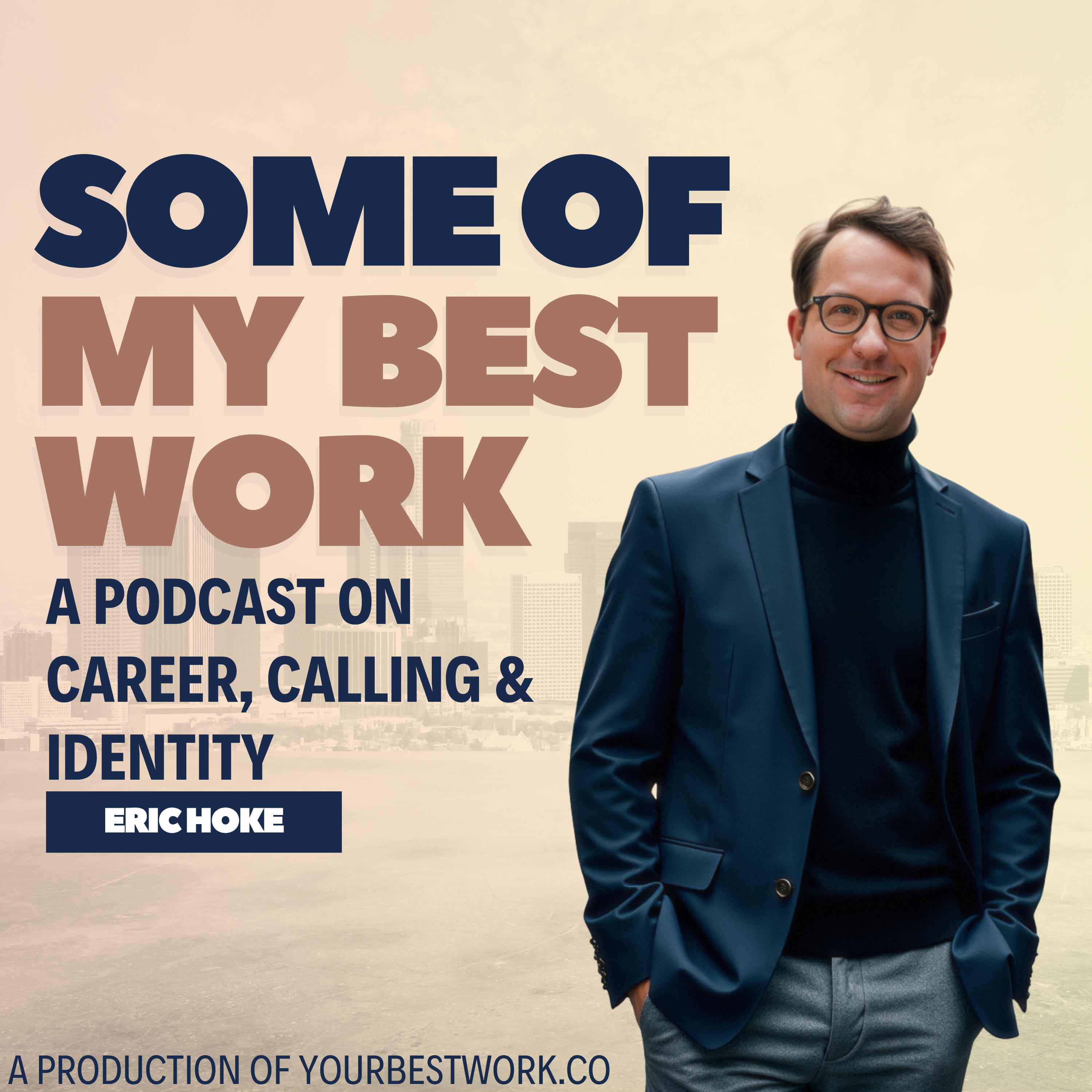
Some of my Best Work with Eric Hoke
Eric Hoke
Conversations on Career, Calling, Identity erichoke.substack.com
Episodes
Mentioned books

6 snips
Jul 24, 2025 • 27min
How to win over the CEO when you're a career changer. Paul Scribner. Episode 14.
Paul Scribner, CEO of Raven Resources Corporation, shares his expertise in corporate finance and asset-based investing. He emphasizes the power of voice communication over text to build genuine partnerships. For career changers, he stresses the importance of clearly translating your value and understanding success metrics in a new environment. Scribner advocates for hiring non-traditional candidates, highlighting how diverse backgrounds enhance teams and foster adaptability. Embrace feelings of imposter syndrome while maintaining curiosity in your professional journey.

Jul 17, 2025 • 56min
Why does faith feel different after you turn 40? Spiritual Director Tim Pynes. Episode 13.
Episode Takeaways:Fly Fishing as Spiritual PracticeFly fishing became a deeply spiritual practice for Tim, offering healing, rhythm, stillness, and connection to the divine.The flow state it brings is similar to long drives without music or waiting on a surfboard—moments where the mind slows and the soul speaks.It’s not about catching fish but about slowing down, being present, and finding clarity.What is Spiritual Direction?Spiritual direction is akin to mentoring for the soul—a relationship in which a more seasoned believer walks alongside someone seeking clarity, healing, or deeper intimacy with God.Inspired by the Celtic concept of Anam cara ("soul friend"), a spiritual director listens deeply and helps individuals reflect on their lives and spiritual journeys.It's not therapy or coaching but a form of sacred listening and mirroring that invites transformation.The Role of a "Soul Friend"A soul friend is not your best buddy or pastor, but someone you can be vulnerable and authentic with, without fear of judgment.Tim emphasizes the value of someone “holding up a mirror” to reflect what’s really going on—hence his nickname, “The Velvet Hammer.”First-Half vs. Second-Half of Life FaithMany churches are excellent at supporting the first half of life (identity formation, habits, community), but less so in the second half (questions, mystery, intimacy with God).Spiritual direction helps people in midlife ask: “What now?” when former practices or church structures no longer feel adequate or life-giving.The journey becomes less about formulas and more about art, nuance, and presence.Common Struggles Clients FaceDisenchantment with inherited theology or church structures.Feeling distant from God despite doing all the “right things.”A loss of spiritual vitality or excitement.Questions about whether the spiritual path they’ve been on still fits them.Deconstruction and Re-enchantmentTim encourages people to honor their spiritual past without being bound to it.Faith changes are developmental, not failures.Clients often seek to re-enchant their faith—to experience vitality, awe, and a renewed sense of divine connection.Practices to Reconnect with GodJournaling emotions daily with a sentence on how you feel and why.Daily gratitude or “God sightings”, noticing divine presence in ordinary life.Writing a personal psalm each day to express lament, joy, or frustration.Paying attention to your desires, especially new ones that surface—these may be spiritual breadcrumbs.Theology Checks and “Unsigned Contracts”Many people operate under an unspoken contract with God: “If I do X, God will do Y.” Tim calls this “a contract God didn’t sign.”Letting go of transactional theology is essential for spiritual freedom and maturity.You can follow Tim’s Work at his website. This is a public episode. If you would like to discuss this with other subscribers or get access to bonus episodes, visit erichoke.substack.com

5 snips
Jul 10, 2025 • 1h 3min
How Jiu-Jitsu Saved My Life and Career with Chad Brooks - Episode 12
Takeaways from today’s episode:Leadership & MinistryRelational capital is essential: Trust must be built before meaningful change can occur in any organization.Identity must be rooted in Christ: Healthy pastors don't derive their identity from their performance or congregation.Embrace adaptive leadership: Leaders must discern whether challenges are technical (clear solutions) or adaptive (requiring new thinking and more profound questions).Balcony leadership > Dance floor leadership: Leaders need to step back for perspective instead of constantly reacting on the front lines.Jiu-Jitsu as Professional ParallelsJiu-jitsu fosters humility, trust, and a deep sense of community, making it ideal for individuals in isolating roles, such as ministry or entrepreneurship.It's therapeutic and relational: Many practitioners find healing from social anxiety and develop close bonds.Marital Arts is a surprising model for discipleship: The structured mentorship, mutual accountability, and growth mirror spiritual formation.A powerful self-defense and confidence tool for kids, especially girls.Productivity & StrategyHustle isn’t sustainable: Ministry leaders must shift from a focus on hustle to a strategy-driven approach.Strategic productivity is key: Know what to focus on, when to rest, and when to push.Reactive leadership burns you out; responsive leadership builds stability.Slower, deeper work leads to sustainable growth, especially in post-COVID churches.Writing & Publishing: Self-publishing is a powerful tool: It allows for speed, ownership, and creating a legacy of practical, useful books.Think library, not masterpiece: Build a body of helpful content over time instead of aiming for a single magnum opus.Books are stepping stones, not capstones: Writing helps clarify and share what you’re already learning.You can find Chad on X/Twitter (@revchadbrooks) or Substack at Chad Brooks. His website is www.revchadbrooks.com Be sure to pick up his new book, “Is My Church Healthy?” This is a public episode. If you would like to discuss this with other subscribers or get access to bonus episodes, visit erichoke.substack.com

8 snips
Jul 3, 2025 • 14min
No Experience? No Problem: The Proven Framework to Change Careers without going back to school. Episode 11.
Curious about breaking into a new industry? Discover how networking can be a game changer—spend the majority of your time making connections with industry professionals. Learn the importance of reskilling with affordable online courses to boost your qualifications. Plus, find out how to effectively tailor your job applications instead of using a scattergun approach. Real-life career transitions highlight the power of personal connections and the flexibility of gig work in navigating career changes.

10 snips
Jun 26, 2025 • 24min
The One Question That Could Save Your Job Interview. Episode 10
Discover how to network without feeling awkward by offering value first and seeking common ground. Uncover the secrets to getting past first-round interviews, including doing thorough research on the company and solving their problems with your skills. Learn to craft a compelling elevator pitch that focuses on your professional background. Building rapport early is key, and thoughtful follow-up can leave a lasting impression. These insights will elevate your job search experience!

Jun 19, 2025 • 1h 11min
Can Hustle & Faithfulness Coexist? Episode 9 with Anthony Carrai Jr.
Key Takeaways from today’s episode:* Calling Through Crisis:* After years in ministry, Anthony found himself disillusioned with the performance-driven model of the church. The pandemic triggered a personal and professional re-evaluation that led him to leave traditional ministry.* From Stage to Studio:* With a background in music production (as part of AC & Brady, with millions of streams), Anthony channeled his creative passion into launching 1010 Creative, a content agency serving mission-driven brands and small businesses.* The Limitations of Big Church Metrics:* Anthony vulnerably shares how his initial goal—building the “biggest youth ministry”—became an idol. Despite drawing large crowds, he recognized the need for sustainable discipleship and formation.* Missional Communities as a Future Church Expression:* Inspired by a more relational and incarnational model, Anthony now dreams of planting missional communities on Long Island that make disciples in everyday spaces—such as dinner tables and delis—rather than on large stages.* Entrepreneurship as Calling:* When job opportunities dried up, Anthony drew on his entrepreneurial instincts, learning to build a business that aligned with his calling while supporting his family outside of traditional church paychecks.* Rooted Vision for Long Island:* Anthony feels called back to his hometown—one of the most unreached and spiritually apathetic regions in America—to be a missionary and build culture-shaping communities and businesses.* Content with a Mission:* Through 1010 Creative, Anthony helps local businesses grow by creating strategic content marketing that generates leads, attracts customers, and tells authentic brand stories.You can connect with Anthony on YouTube, on Instagram @AnthonyCarraiJr, and his business Ten Ten Creative.Thanks for listening. If you have questions you’d like me to cover on this podcast, reply to this e-mail or DM me. Jeffrey Riggs produced this podcast episode.Music by Fyodor Zharkov from Pixabay This is a public episode. If you would like to discuss this with other subscribers or get access to bonus episodes, visit erichoke.substack.com

Jun 12, 2025 • 50min
Faith, Friendship, Fear: Episode 8 with Macho Lara
Key Takeaways from today’s episode:* Friendship and Adult Connection:We reflect on our deep friendship, how it has grown, and the intentionality required to maintain meaningful relationships as adults, particularly among men. Macho shares his background as a loner and how adulthood has allowed him to build lasting friendships.* Life Transitions and Calling:Macho discusses his and his family's major life moves—from Pittsburgh to Georgia and eventually to New York City. He recounts a pivotal moment when he sensed an unexpected call to return to NYC despite having just settled elsewhere, describing a process of discernment, prayer, and confirmation through the community.* Church Planting Journey:He shares the origin story of planting The Table NYC, a diverse faith community in Queens. Initially resistant to leading a church, Macho explains how events and growing leadership opportunities led him and his wife to recognize the call to plant a church. Their approach began with dinner gatherings in their apartment to build community organically.* Bivocational Ministry:Macho talks about the challenges and benefits of being bivocational—working in IT while leading a church. He distinguishes between bivocationalism as a necessity and strategy, ultimately embracing it as the latter. He reflects on how working outside the church has kept him connected to the broader community and how this model has become a sustainable way to live out his calling in an expensive city like New York.* Faithfulness in Uncertainty:The conversation ends with Macho discussing how he remains faithful through uncertainty, especially amid recent personal health challenges. He emphasizes learning to shorten his time in frustration and doubt, trusting in God's past faithfulness to sustain him through present struggles.Ways to Connect:Listeners can follow Macho’s writing at macholara.substack.com or find him by searching online. His church, The Table NYC, is based in Sunnyside, Queens.Macho is currently launching a Kickstarter for his forthcoming book, Ctrl+Alt➔Believe, I encourage you to support here.Thanks for listening. If you have questions you’d like me to cover on this podcast, reply to this e-mail or DM me. Jeffrey Riggs produced this podcast episode.Music by Fyodor Zharkov from Pixabay This is a public episode. If you would like to discuss this with other subscribers or get access to bonus episodes, visit erichoke.substack.com

Jun 5, 2025 • 38min
Special Edition: "The Bible don't pay the bills" a raw conversation with Dr. Kevin Middleton
Today’s Special Edition of “Your Best Work: The Podcast” is audio from Covo Con with Dr. Kevin Middleton and Covocational Ministry in the Black Church. Here are some practical takeaways.* Blend Marketplace and Ministry Skills* Pursue practical, marketable skills alongside ministry training. This dual approach provides financial stability and resilience, as seen during crises like COVID, and reflects Middleton’s pastor’s wisdom: “Bible doesn’t pay the bills, skills and marketplace degrees will.”* Embrace Shared Leadership* Move away from the solo-pastor model by identifying and empowering congregants’ gifts (e.g., through conversations or tools like the APES framework: Apostles, Prophets, Evangelists, Shepherds, Teachers). Delegate responsibilities to build a collaborative, sustainable church structure.* Prioritize Personal Health and Balance* Implement regular self-care practices: weekly therapy, monthly spiritual direction, a consistent Sabbath, and hobbies (e.g., gaming, hiking). Middleton’s use of a Google calendar to create margin and limit unnecessary meetings helps maintain sanity and vitality.* Engage Younger Generations Holistically* Recognize that Millennials and Gen Z value meaningful work outside traditional church roles (e.g., nonprofits, justice initiatives). Equip them to see all vocations as holy, fostering a church culture that integrates faith and daily life rather than competing with platforms like TikTok for influence.* Cultivate a Covocational Framework* Build a church culture where everyone’s calling is supported, not just the pastor’s. Host events like job fairs or faith-and-work series to affirm congregants’ marketplace roles, ensuring the church doesn’t stifle individuality but mobilizes it for mission.* Avoid the Celebrity Pastor Trap* Reject the mindset of being the sole decision-maker. Share responsibility to prevent burnout, enhance accountability, and ensure the church thrives beyond any single leader’s tenure, as Middleton illustrates with biblical examples like Moses and Jesus.* Have Fun and Stay Human* Incorporate enjoyment into ministry life (e.g., playing Mario Kart, walking in nature). Following Eugene Peterson’s advice to not take oneself too seriously, find hobbies and community moments that ground you and refresh your perspective.This Substack is reader-supported. To receive new posts and support my work, consider becoming a free or paid subscriber. This is a public episode. If you would like to discuss this with other subscribers or get access to bonus episodes, visit erichoke.substack.com

7 snips
May 29, 2025 • 26min
Episode 7: Turn AI into your Career Coach and how to write a book in 3 days.
Section 1: Using AI in Job Seeking:I answer the question of a listener struggling to choose a job, get callbacks, pivot industries, and ask how to use AI effectively. * Treat AI as a Career Guide: Input your resume, skills, and interests into AI tools (e.g., ChatGPT or Grok) to get tailored job suggestions or rewrites. Ask questions like, “What jobs suit my skills?” or “How should I rewrite my resume for this role?”* Optimize for ATS (Applicant Tracking Systems): Copy a job description into AI, identify the top 10-20 keywords, and naturally embed them in your resume to improve visibility to recruiters. Avoid gaming the system (e.g., using hidden keywords).* Use AI as an Interview Coach: Paste a job description into AI and request 10 sample interview questions. Practice answering them, record responses, and ask AI for feedback to refine your answers.* Get Resume Feedback: Upload your resume to AI and ask for feedback on clarity, grammar, and redundancy to polish it.* Note: AI is ~80% accurate, so use it as a starting point and validate with professionals or industry peers for the remaining 20%.Section 2. How to write a book in Three Days:A listener with limited idea for a book asks me how I wrote a 40,000-word book in three days:* Preparation is Key: Over months, I outlined the book’s chapters, ideas, and stories in notebooks early in the morning. This created a “skeleton” before a writing retreat.* Distraction-Free Retreat: I wrote my manuscript over three days at Mount Savior Monastery (no Wi-Fi, spotty cell service). The monastery’s prayer schedule provided natural breaks every 2-3 hours, boosting focus.* Tools for Editing: Post-retreat, I used Grammarly (premium version) to fix over 2,000+ grammatical errors, spending ~20 hours refining the “crappy first draft.”* Book Details: The book, a hybrid of fiction and self-help, focuses on vocation, calling, and identity. Patrick Lencioni’s fable-style leadership books inspired it. It’s currently being queried for traditional or hybrid publishing.* Advice for Busy Writers: Jot ideas in notebooks over months, block a 3-day distraction-free retreat, and use tools like Grammarly for editing.Thanks for listening. If you have questions you’d like me to cover on this podcast, reply to this e-mail or DM me. Jeffrey Riggs produced this podcast episode.Music by Fyodor Zharkov from Pixabay This is a public episode. If you would like to discuss this with other subscribers or get access to bonus episodes, visit erichoke.substack.com

11 snips
May 22, 2025 • 32min
Special Edition: Killer Job Seeking tips from Executive Career Coach Keith Roseboro
Keith Roseboro, a certified career coach and recruiter, shares his expertise on transitioning from ministry to corporate jobs. He emphasizes the importance of identifying transferable skills and reframing experiences for recruiters. Keith advises against using church-specific jargon and highlights the significance of a polished LinkedIn profile for networking. He provides tips for effective interview preparation, including researching company culture and using the STAR method to showcase unique value. Listeners gain actionable insights to navigate the evolving job market.

