

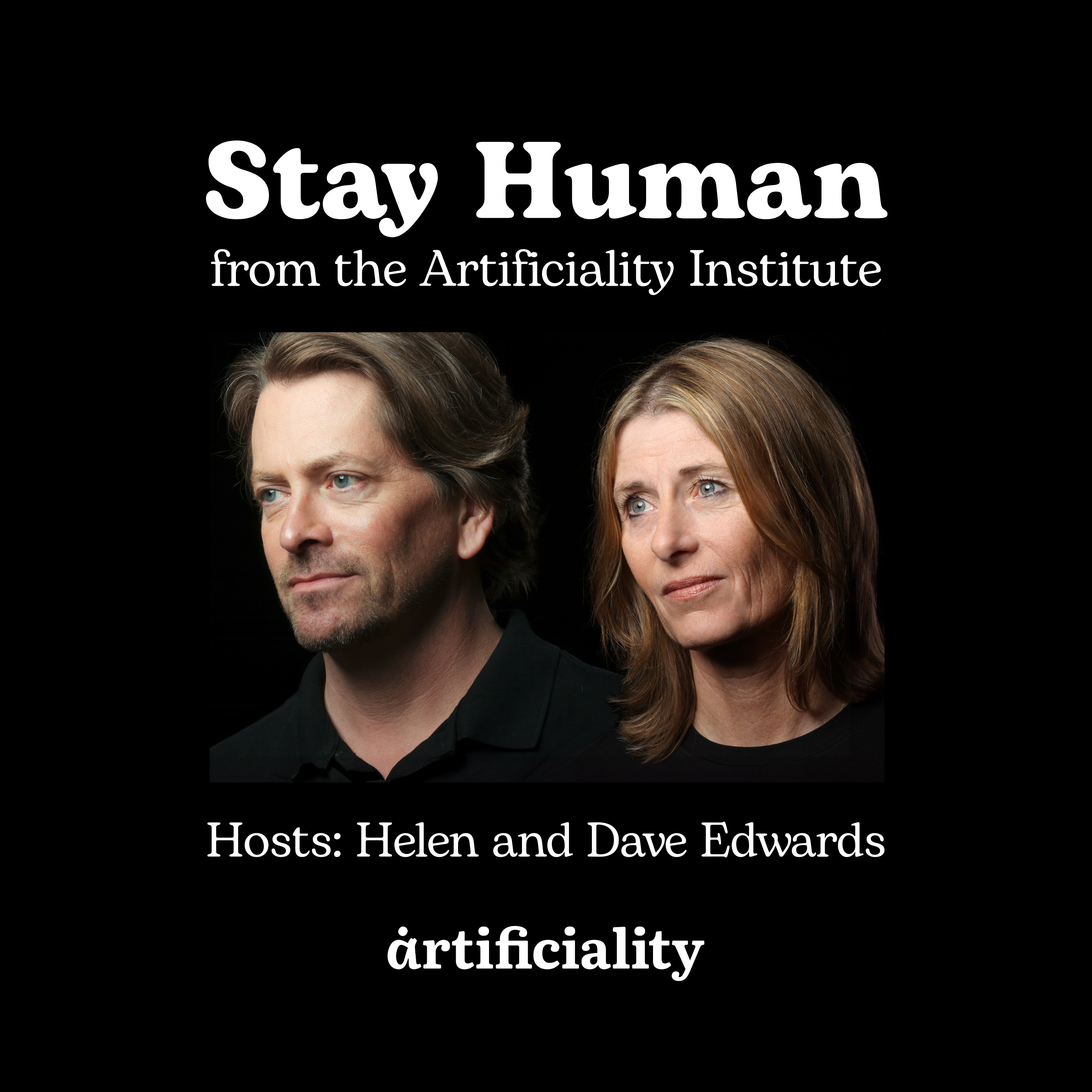
Stay Human, from the Artificiality Institute
Helen and Dave Edwards
Exploring how AI changes the way we think, who we become, and what it means to be human. We explore how AI changes the way we think, who we become, and what it means to be human. We believe AI shouldn't just be safe or efficient—it should be worth it. Through story-based research, education, and community, we help people choose the relationship they want with machines—so they remain the authors of their own minds.
Episodes
Mentioned books

Mar 2, 2024 • 43min
Angel Acosta: Contemplation, Healing, and AI
We’re excited to welcome to the podcast Dr. Angel Acosta, an expert on healing-centered education and leadership. Angel runs the Acosta Institute which helps communities process trauma and build environments for people to thrive.
He also facilitates leadership programs at the Garrison Institute that support the next generation of contemplative leaders. With his background in social sciences, curriculum design, and adult education, Angel has been thinking deeply about how artificial intelligence intersects with mindfulness, social justice and education.
In our conversation, we explore how AI can help or hinder our capacity for contemplation and healing. For example, does offloading cognitive tasks to AI tools like GPT create more mental space for mindfulness? How do we ensure these technologies don’t increase anxiety and threaten our sense of self?
We also discuss the promise and perils of AI for transforming education. What roles might AI assistants play in helping educators be more present with students? How can we design assignments that account for AI without compromising learning? What would a decolonized curriculum enabled by AI look like?
And we envision more grounded, humanistic uses of rapidly evolving AI—from thinking of it as "ecological technology" interdependent with the natural world, to leveraging its pattern recognition in service of collective healing and wisdom. What guiding principles do we need for AI that enhances both efficiency and humanity? How can we consciously harness it to create the conditions for people and communities to thrive holistically?
We’d like to thank our friends at the House of Beautiful Business for sparking our relationship with Angel—we highly recommend you check out their events and join their community.
Let’s dive into our conversation with Angel Acosta.
About Artficiality from Helen & Dave Edwards:
Artificiality is a research and services business founded in 2019 to help people make sense of artificial intelligence and complex change. Our weekly publication provides thought-provoking ideas, science reviews, and market research and our monthly research releases provides leaders with actionable intelligence and insights for applying AI in their organizations. We provide research-based and expert-led AI strategy and complex change management services to organizations around the world.
We are artificial philosophers and meta-researchers who aim to make the philosophical more practical and the practical more philosophical. We believe that understanding AI requires synthesizing research across disciplines: behavioral economics, cognitive science, complexity science, computer science, decision science, design, neuroscience, philosophy, and psychology. We are dedicated to unraveling the profound impact of AI on our society, communities, workplaces, and personal lives.
Subscribe for free at https://www.artificiality.world.
If you enjoy our podcasts, please subscribe and leave a positive rating or comment. Sharing your positive feedback helps us reach more people and connect them with the world’s great minds.
Learn more about Sonder Studio
Subscribe to get Artificiality delivered to your email
Learn about our book Make Better Decisions and buy it on Amazon
Thanks to Jonathan Coulton for our music
This is a public episode. If you would like to discuss this with other subscribers or get access to bonus episodes, visit www.artificiality.world.
#ai #artificialintelligence #generativeai #airesearch #complexity #futureofai
Feb 23, 2024 • 45min
Doug Belshaw: Serendipity Surface & AI
We're excited to welcome Doug Belshaw to the show today. Doug is a founding member of the We Are Open Co-op which helps organizations with sensemaking and digital transformation.
Doug coined the term "serendipity surface" to describe cultivating an attitude of curiosity and increasing the chance encounters we have by putting ourselves out there. We adopted the term quite some time ago and were eager to talk with Doug about how he thinks about serendipity surfaces in the age of generative AI.
As former Head of Web Literacy at Mozilla and now currently pursuing a master's degree in systems thinking, Doug has a wealth of knowledge on topics spanning education, technology, productivity and more. In our conversation today, we'll explore concepts like productive ambiguity, cognitive ease, and rewilding your attention. Doug shares perspectives from his unique career journey as well as personal stories and projects exemplifying the creative potential of AI. We think you’ll find this a thought-provoking discussion on human-AI collaboration, lifelong learning, digital literacy, ambiguity, and the future of work. Let’s dive into our conversation with Doug Belshaw.
Key points:
Doug coined the term Serendipity Surface to describe cultivating curiosity, increasing random encounters and possibilities by putting ourselves out there. He sees it as the opposite of reducing "attack surface" in security; it's about expanding opportunities.
Doug shares an example of prompting ChatGPT extensively over 24 hours with a flood risk report, personas and perspectives to decide on a complex house purchase. This shows the creative potential of using AI tools to augment human thinking and decisions.
Doug discusses the sweet spot of productive ambiguity where concepts resonate with a common meaning yet leave room for interpretation by individuals based on their contexts. It encourages engagement and spreading of ideas.
As an educator, Doug advocates thoughtfully adopting emerging tech to develop engaged, literate and curious learners rather than reactively banning tools. Friction facilitates learning.
Ultimately, Doug sees potential for AI collaboration that brings our humanity, empathy, creativity and curiosity to the forefront if we prompt and apply these tools judiciously.
Links for Doug Belshaw:
Dr Doug Belshaw
We Are Open Cooperative
Thought Shrapnel
Open Thinkering
Ambiguiti.es
About Artficiality from Helen & Dave Edwards:
Artificiality is a research and services business founded in 2019 to help people make sense of artificial intelligence and complex change. Our weekly publication provides thought-provoking ideas, science reviews, and market research and our monthly research releases provides leaders with actionable intelligence and insights for applying AI in their organizations. We provide research-based and expert-led AI strategy and complex change management services to organizations around the world.
We are artificial philosophers and meta-researchers who aim to make the philosophical more practical and the practical more philosophical. We believe that understanding AI requires synthesizing research across disciplines: behavioral economics, cognitive science, complexity science, computer science, decision science, design, neuroscience, philosophy, and psychology. We are dedicated to unraveling the profound impact of AI on our society, communities, workplaces, and personal lives.
Subscribe for free at https://www.artificiality.world.
If you enjoy our podcasts, please subscribe and leave a positive rating or comment. Sharing your positive feedback helps us reach more people and connect them with the world’s great minds.
Learn more about Sonder Studio
Subscribe to get Artificiality delivered to your email
Learn about our book Make Better Decisions and buy it on Amazon
Thanks to Jonathan Coulton for our music
This is a public episode. If you would like to discuss this with other subscribers or get access to bonus episodes, visit www.artificiality.world.
#ai #artificialintelligence #generativeai #airesearch #complexity #futureofai
Feb 17, 2024 • 50min
Richard Kerris of NVIDIA: AI, Creators, and Developers
We’re excited to welcome Richard Kerris, Vice President of Developer Relations and GM of Media & Entertainment at NVIDIA, to the show today. Richard has had an extensive career working with creators and developers across film, music, gaming, and more. He offers valuable insights into how AI and machine learning are transforming creative tools and workflows.
In particular, Richard shares his perspective on how these advanced technologies are democratizing access to high-end capabilities, putting more power into the hands of a broader range of storytellers. He discusses the implications of this for the media industry—will it displace roles or expand opportunities? And we explore Richard's vision for what the future may look like in 5-10 years in terms of applications being auto-generated to meet specialized user needs.
We think you’ll find the wide-ranging conversation fascinating as we explore topics from AI-enhanced content creation to digital twins and AI assistants. Let’s dive into our discussion with Richard Kerris .
Key Points:
Democratization of creative tools is enabling more people to produce high-quality media content. This expands opportunities, rather than displacing roles.
Future apps may be auto-generated via AI to meet specialized user needs, rather than created as generic solutions.
Industrial metaverse allows manufacturers to optimize workflows through virtual prototyping.
Open USD provides a common language for 3D tools to communicate, improving collaboration.
AI agents will become commonplace assistants customized to individual interests and needs.
Computing power growth is enabling complex digital twins like the human body to improve health outcomes.
Generative AI introduces new considerations around rights of trained content and output.
Education benefits from AI’s ability to showcase different artistic styles and techniques.
About Artficiality from Helen & Dave Edwards:
Artificiality is a research and services business founded in 2019 to help people make sense of artificial intelligence and complex change. Our weekly publication provides thought-provoking ideas, science reviews, and market research and our monthly research releases provides leaders with actionable intelligence and insights for applying AI in their organizations. We provide research-based and expert-led AI strategy and complex change management services to organizations around the world.
We are artificial philosophers and meta-researchers who aim to make the philosophical more practical and the practical more philosophical. We believe that understanding AI requires synthesizing research across disciplines: behavioral economics, cognitive science, complexity science, computer science, decision science, design, neuroscience, philosophy, and psychology. We are dedicated to unraveling the profound impact of AI on our society, communities, workplaces, and personal lives.
Subscribe for free at https://www.artificiality.world.
If you enjoy our podcasts, please subscribe and leave a positive rating or comment. Sharing your positive feedback helps us reach more people and connect them with the world’s great minds.
Learn more about Sonder Studio
Subscribe to get Artificiality delivered to your email
Learn about our book Make Better Decisions and buy it on Amazon
Thanks to Jonathan Coulton for our music
This is a public episode. If you would like to discuss this with other subscribers or get access to bonus episodes, visit www.artificiality.world.
#ai #artificialintelligence #generativeai #airesearch #complexity #futureofai
Feb 6, 2024 • 51min
Tyler Marghetis: The Leaps of Human Imagination
We're excited to welcome Tyler Marghetis, Assistant Professor of Cognitive & Information Sciences at the University of California, Merced, to the show today. Tyler studies what he calls the "lulls and leaps" or "ruts and ruptures" of human imagination and experience.
He's fascinated by how we as humans can get stuck in certain patterns of thinking and acting, but then also occasionally experience radical transformations in our perspectives. In our conversation, Tyler shares with us some of his lab's fascinating research into understanding and even predicting these creative breakthroughs and paradigm shifts. You'll hear about how he's using AI tools to analyze patterns in things like Picasso's entire body of work over his career. Tyler explains why he believes isolation and slowness are actually key ingredients for enabling many of history's greatest creative leaps. And he shares with us how his backgrounds in high-performance sports and in the LGBTQ community shape his inclusive approach to running his university research lab.
It's a wide-ranging and insightful discussion about the complexity of human creativity and innovation. Let's dive in to our interview with Tyler Marghetis.
About Artficiality from Helen & Dave Edwards:
Artificiality is a research and services business founded in 2019 to help people make sense of artificial intelligence and complex change. Our weekly publication provides thought-provoking ideas, science reviews, and market research and our monthly research releases provides leaders with actionable intelligence and insights for applying AI in their organizations. We provide research-based and expert-led AI strategy and complex change management services to organizations around the world.
We are artificial philosophers and meta-researchers who aim to make the philosophical more practical and the practical more philosophical. We believe that understanding AI requires synthesizing research across disciplines: behavioral economics, cognitive science, complexity science, computer science, decision science, design, neuroscience, philosophy, and psychology. We are dedicated to unraveling the profound impact of AI on our society, communities, workplaces, and personal lives.
Subscribe for free at https://www.artificiality.world.
If you enjoy our podcasts, please subscribe and leave a positive rating or comment. Sharing your positive feedback helps us reach more people and connect them with the world’s great minds.
Learn more about Sonder Studio
Subscribe to get Artificiality delivered to your email
Learn about our book Make Better Decisions and buy it on Amazon
Thanks to Jonathan Coulton for our music
This is a public episode. If you would like to discuss this with other subscribers or get access to bonus episodes, visit www.artificiality.world.
#ai #artificialintelligence #generativeai #airesearch #complexity #futureofai
Jan 30, 2024 • 1h 3min
James Evans: Scientific Progress
Why is scientific progress slowing down? That's a question that's been on the minds of many. But before we dive into that, let's ponder this—how do we even know that scientific progress is decelerating? And in an era where machines are capable of understanding complexities that sometimes surpass human cognition, how should we approach the future of knowledge?
Joining us in this exploration is Professor James Evans from the University of Chicago. As the director of the Knowledge Lab at UChicago, Professor Evans is at the forefront of integrating machine learning into the scientific process. His work is revolutionizing how new ideas are conceived, shared, and developed, not just in science but in all knowledge and creative processes.
Our conversation today is a journey through various intriguing landscapes. We'll delve into questions like:
Why has the pace of scientific discovery slowed, and can AI be the catalyst to reaccelerate it?
How does the deluge of information and the battle for attention affect the evolution of ideas?
What are the predictive factors for disruption and novelty in the idea landscape?
How should teams be structured to foster disruptive innovation?
What risks do homogeneity in thinking and AI model concentration pose?
How can we redefine diversity in the context of both human and AI collaboration?
What does the evolving nature of knowledge mean for the next generation of scientists?
Can tools like ChatGPT enhance diversity and innovative capabilities in research?
Is it time to debunk the myth of the lone genius and focus instead on the collective intelligence of humans and AI?
We're also thrilled to discuss Professor Evans' upcoming book, "Knowing," which promises to be a groundbreaking addition to our understanding of these topics.
So, whether you're a scientist, a creative, a business leader, a data scientist or just someone fascinated by the interplay of human intelligence and artificial technology, this episode is sure to offer fresh perspectives and insights.
About Artficiality from Helen & Dave Edwards:
Artificiality is a research and services business founded in 2019 to help people make sense of artificial intelligence and complex change. Our weekly publication provides thought-provoking ideas, science reviews, and market research and our monthly research releases provides leaders with actionable intelligence and insights for applying AI in their organizations. We provide research-based and expert-led AI strategy and complex change management services to organizations around the world.
We are artificial philosophers and meta-researchers who aim to make the philosophical more practical and the practical more philosophical. We believe that understanding AI requires synthesizing research across disciplines: behavioral economics, cognitive science, complexity science, computer science, decision science, design, neuroscience, philosophy, and psychology. We are dedicated to unraveling the profound impact of AI on our society, communities, workplaces, and personal lives.
Subscribe for free at https://www.artificiality.world.
If you enjoy our podcasts, please subscribe and leave a positive rating or comment. Sharing your positive feedback helps us reach more people and connect them with the world’s great minds.
Learn more about Sonder Studio
Subscribe to get Artificiality delivered to your email
Learn about our book Make Better Decisions and buy it on Amazon
Thanks to Jonathan Coulton for our music
This is a public episode. If you would like to discuss this with other subscribers or get access to bonus episodes, visit www.artificiality.world.
#ai #artificialintelligence #generativeai #airesearch #complexity #futureofai
Jan 23, 2024 • 50min
Ed Sim: AI Venture Capital
Few understand how to anticipate major technology shifts in the enterprise better than today's guest, Ed Sim. Ed is a pioneer in the world of venture capital, specifically focusing on enterprise software and infrastructure since 1996. He founded Boldstart in 2010 to invest at the earliest stages of enterprise software companies, growing the firm from $1M to around $375M today.
So where does an experienced investor who has seen countless tech waves come and go place his bets in this new AI-first future? That’s the key topic we dive into today.
While AI forms a core part of our dialogue, Ed emphasizes that he doesn’t look at pitches and go “Oh, AI, I need to invest in that.” Rather, he tries to see if founders have identified a real pain point, have a unique approach to solving it, and can clearly articulate how they will provide a significant improvement over status quo. AI is an important component, of course, but it isn’t a reason to invest alone.
With that framing in mind, Ed shares where he is most excited to invest in light of recent generative AI breakthroughs. Unsurprisingly, AI security ranks high on his list given enterprises’ skittishness around adopting any technology that could compromise sensitive data or infrastructure. Ed saw this need early, backing a startup called Protect AI in March 2022 that focuses specifically on monitoring and certifying the security of AI systems.
The implications of AI have branched into virtually every sector, but Ed reminds us that as investors and builders, we must stay grounded in solving real problems vs just chasing the shiny new thing.
Key Points:
Ed Sim started Boldstart Ventures in 2010 to provide early stage funding for enterprise startups, writing smaller checks than typical VC firms. The firm now manages a nearly $200 million main fund and a $175 million opportunity fund.
Generative AI is an exciting new technology, but the key is backing founders who are solving real problems for end users in a unique way that is 10x better than current solutions. AI is just the underlying technology.
AI security is critical for enterprise adoption. Ed invested early in Protect AI, which helps monitor AI models for security, privacy, and compliance issues. AI security will be key to scale adoption.
There are still open questions around data governance with large language models that access sensitive company data. Approaches that check governance policies before providing answers are the safest for now.
Factors like inference cost, subscription fatigue, and proving ROI will impact how quickly some of the consumer generative AI applications gain traction. Creative solutions around caching, pricing models, and hybrid human+AI loops can help.
There will be opportunities related to embedding expertise into systems to empower junior and senior employees. Tools like GitHub Copilot show potential to augment technical skills.
About Artficiality from Helen & Dave Edwards:
Artificiality is a research and services business founded in 2019 to help people make sense of artificial intelligence and complex change. Our weekly publication provides thought-provoking ideas, science reviews, and market research and our monthly research releases provides leaders with actionable intelligence and insights for applying AI in their organizations. We provide research-based and expert-led AI strategy and complex change management services to organizations around the world.
We are artificial philosophers and meta-researchers who aim to make the philosophical more practical and the practical more philosophical. We believe that understanding AI requires synthesizing research across disciplines: behavioral economics, cognitive science, complexity science, computer science, decision science, design, neuroscience, philosophy, and psychology. We are dedicated to unraveling the profound impact of AI on our society, communities, workplaces, and personal lives.
Subscribe for free at https://www.artificiality.world.
If you enjoy our podcasts, please subscribe and leave a positive rating or comment. Sharing your positive feedback helps us reach more people and connect them with the world’s great minds.
Learn more about Sonder Studio
Subscribe to get Artificiality delivered to your email
Learn about our book Make Better Decisions and buy it on Amazon
Thanks to Jonathan Coulton for our music
This is a public episode. If you would like to discuss this with other subscribers or get access to bonus episodes, visit www.artificiality.world.
#ai #artificialintelligence #generativeai #airesearch #complexity #futureofai
Jan 16, 2024 • 57min
Rodrigo Liang: SambaNova and Generative AI in the Enterprise
One of our research obsessions is Edge AI through which we study opportunities to build and deploy AI on a computing device at the edge of a network. The premise is that AI in the cloud benefits from scale but is challenged by cost and privacy and Edge AI solves many of these challenges by eliminating cloud computing costs and keeping data within secure environments.
Given this interest, we were excited to talk with Rodrigo Liang, the Co-Founder and CEO of SambaNova Systems which has built a platform to deliver enterprise grade chips, software, and models in a fully integrated system, purpose built for AI. In this interview, Rodrigo discusses how his company is enabling enterprises to adopt AI in a secure, customizable way that builds long-term value by building AI assets. Their full-stack solutions aim to simplify AI model building and deployment, especially by leveraging open source frameworks and using modular, fine-tuned expert models tailored to clients' private data.
Key Points:
SambaNova Systems aims to help companies adopt AI technology, particularly in enterprise environments. It provides full-stack AI solutions including hardware, software, models, etc. to simplify adoption.
The company’s offerings are designed to enable companies to leverage AI while maintaining data privacy and security. A modular approach provides the flexibility to adapt to diverse enterprise needs.
SambaNova takes an "AI asset" approach focused on creating long-term value rather than just providing "AI tools." A focus on open source models provides diversity of technology while reducing vendor lock-in.
The company’s software stack enables fine-tuning of granular models on customer data, creating a multitude of AI experts to serve the enterprise. Unlimited use encourages experimentation without the same cost challenges as public cloud AI.
About Artficiality from Helen & Dave Edwards:
Artificiality is a research and services business founded in 2019 to help people make sense of artificial intelligence and complex change. Our weekly publication provides thought-provoking ideas, science reviews, and market research and our monthly research releases provides leaders with actionable intelligence and insights for applying AI in their organizations. We provide research-based and expert-led AI strategy and complex change management services to organizations around the world.
We are artificial philosophers and meta-researchers who aim to make the philosophical more practical and the practical more philosophical. We believe that understanding AI requires synthesizing research across disciplines: behavioral economics, cognitive science, complexity science, computer science, decision science, design, neuroscience, philosophy, and psychology. We are dedicated to unraveling the profound impact of AI on our society, communities, workplaces, and personal lives.
Subscribe for free at https://www.artificiality.world.
If you enjoy our podcasts, please subscribe and leave a positive rating or comment. Sharing your positive feedback helps us reach more people and connect them with the world’s great minds.
Learn more about Sonder Studio
Subscribe to get Artificiality delivered to your email
Learn about our book Make Better Decisions and buy it on Amazon
Thanks to Jonathan Coulton for our music
This is a public episode. If you would like to discuss this with other subscribers or get access to bonus episodes, visit www.artificiality.world.
#ai #artificialintelligence #generativeai #airesearch #complexity #futureofai
4 snips
Jan 11, 2024 • 1h 6min
Best of: Barbara Tversky & Spacial Cognition
Barbara Tversky, an Emerita professor of psychology at Stanford and a thought leader in spatial cognition, shares her groundbreaking insights on how our physical interactions shape cognitive processes. The conversation explores the connection between spatial reasoning and AI, highlighting how Large Multimodal Models mirror human sensory integration. Tversky also discusses the powerful role of external expressions in creativity, the dynamics of memory during crises, and the cultural nuances influencing urban driving behaviors. These concepts are increasingly relevant as we navigate AI's evolving landscape.
Dec 13, 2023 • 1h 2min
Stephen Fleming: Consciousness and AI
In this episode, we speak with cognitive neuroscientist Stephen Fleming about theories of consciousness and how they relate to artificial intelligence. We discuss key concepts like global workspace theory, higher order theories, computational functionalism, and how neuroscience research on consciousness in humans can inform our understanding of whether machines may ever achieve consciousness. In particular, we talk with Steve about a recent research paper, Consciousness in Artificial Intelligence, which he co-authored with Patrick Butlin, Robert Long, Yoshua Bengio, and several others.
Steve provides an overview of different perspectives from philosophy and psychology on what mechanisms may give rise to consciousness. He explains global and local theories, the idea of a higher order system monitoring lower level representations, and similarities and differences between human and machine intelligence. The conversation explores current limitations in neuroscience for studying consciousness empirically and opportunities for interdisciplinary collaboration between neuroscientists and AI researchers.
Key Takeaways:
Consciousness and intelligence are separate concepts—you can have one without the other
Global workspace theory proposes consciousness arises when information is broadcast to widespread brain areas
Higher order theories suggest a higher system monitoring lower representations enables consciousness
Computational functionalism looks at information processing rather than biological substrate
Attributing intelligence versus attributing experience/consciousness invoke different dimensions of social perception
More research needed in neuroscience and social psychology around people’s intuitions about machine consciousness
Stephen Fleming is Professor of Cognitive Neuroscience at the Department of Experimental Psychology, University College London. Steve’s work aims to understand the mechanisms supporting human subjective experience and metacognition by employing a combination of psychophysics, brain imaging and computational modeling. He is the author of *Know Thyself*, a book on the science of metacognition, about which we interviewed him on Artificiality in December of 2021.
Episode Notes:
2:13 - Origins of the paper Stephen co-authored on consciousness in artificial intelligence
5:17 - Discussion of demarcating intelligence vs phenomenal consciousness in AI
6:34 - Explanation of computational functionalism and mapping functions between humans and machines
13:42 - Examples of theories like global workspace theory and higher order theories
19:27 - Clarifying when sensory information reaches consciousness under global theories
23:02 - Challenges in precisely defining aspects like the global workspace computationally
28:35 - Connections between higher order theories and generative adversarial networks
30:43 - Ongoing empirical evidence still needed to test higher order theories
36:52 - Iterative process needed to update theories based on advancing neuroscience
40:40 - Open questions remaining despite foundational research on consciousness
46:14 - Mismatch between public perceptions and indicators from neuroscience theories
50:30 - Experiments probing anthropomorphism and consciousness attribution
56:17 - Surprising survey results on public views of AI experience
59:36 - Ethical issues raised if public acceptance diverges from scientific consensus
About Artficiality from Helen & Dave Edwards:
Artificiality is a research and services business founded in 2019 to help people make sense of artificial intelligence and complex change. Our weekly publication provides thought-provoking ideas, science reviews, and market research and our monthly research releases provides leaders with actionable intelligence and insights for applying AI in their organizations. We provide research-based and expert-led AI strategy and complex change management services to organizations around the world.
We are artificial philosophers and meta-researchers who aim to make the philosophical more practical and the practical more philosophical. We believe that understanding AI requires synthesizing research across disciplines: behavioral economics, cognitive science, complexity science, computer science, decision science, design, neuroscience, philosophy, and psychology. We are dedicated to unraveling the profound impact of AI on our society, communities, workplaces, and personal lives.
Subscribe for free at https://www.artificiality.world.
If you enjoy our podcasts, please subscribe and leave a positive rating or comment. Sharing your positive feedback helps us reach more people and connect them with the world’s great minds.
Learn more about Sonder Studio
Subscribe to get Artificiality delivered to your email
Learn about our book Make Better Decisions and buy it on Amazon
Thanks to Jonathan Coulton for our music
This is a public episode. If you would like to discuss this with other subscribers or get access to bonus episodes, visit www.artificiality.world.
#ai #artificialintelligence #generativeai #airesearch #complexity #futureofai
Dec 6, 2023 • 1h 1min
Steven Sloman: LLMs and Deliberative Reasoning
If you’ve used a large language model, you’ve likely had one or more moments of amazement as the tool immediately responded with impressive content from its massive data cosmos training set. But you’ve likely also had moments of confusion or disillusionment as the tool responded with irrelevant or incorrect responses, displaying a lack of reasoning.
A recent research paper from Meta caught our eye because it proposes a new mechanism called System 2 Attention which “leverages the ability of LLMs to reason in natural language and follow instructions in order to decide what to attend to.” The name System 2 is derived from the work of Daniel Kahneman who in his 2011 book, Thinking, Fast and Slow, differentiated between System 1 thinking as intuitive and near-instantaneous and System 2 thinking as slower and effortful. The Meta paper also references our friend Steven Sloman who in 1996 made the case for two systems of reasoning—associative and deliberative or rule-based.
Given our interest in the idea of LLMs being able to help people make better decisions—which often requires more deliberative thinking—we asked Steve to come back on the podcast to get his reaction to this research and generative AI in general. Yet again, we had a dynamic conversation about human cognition and modern AI, which field is learning what from the other, and a few speculations about the future. We’re grateful for Steve taking the time to talk with us again and hope that he’ll join us for a third time when his next book is released sometime in 2024.
Steven Sloman is a professor of cognitive, linguistic, and psychological sciences at Brown University where he has taught since 1992. He studies how people think, including how we think as a community, a topic he wrote a fantastic book about with Philip Fernbach called The Knowledge Illusion: Why We Never Think Alone. For more about that work, please check out our first interview with Steve from June of 2021.
About Artficiality from Helen & Dave Edwards:
Artificiality is a research and services business founded in 2019 to help people make sense of artificial intelligence and complex change. Our weekly publication provides thought-provoking ideas, science reviews, and market research and our monthly research releases provides leaders with actionable intelligence and insights for applying AI in their organizations. We provide research-based and expert-led AI strategy and complex change management services to organizations around the world.
We are artificial philosophers and meta-researchers who aim to make the philosophical more practical and the practical more philosophical. We believe that understanding AI requires synthesizing research across disciplines: behavioral economics, cognitive science, complexity science, computer science, decision science, design, neuroscience, philosophy, and psychology. We are dedicated to unraveling the profound impact of AI on our society, communities, workplaces, and personal lives.
Subscribe for free at https://www.artificiality.world.
If you enjoy our podcasts, please subscribe and leave a positive rating or comment. Sharing your positive feedback helps us reach more people and connect them with the world’s great minds.
Learn more about Sonder Studio
Subscribe to get Artificiality delivered to your email
Learn about our book Make Better Decisions and buy it on Amazon
Thanks to Jonathan Coulton for our music
This is a public episode. If you would like to discuss this with other subscribers or get access to bonus episodes, visit www.artificiality.world.
#ai #artificialintelligence #generativeai #airesearch #complexity #futureofai

