

The Aperiodical
Christian Perfect, Peter Rowlett and Katie Steckles
Occasional(ly) mathematical blogging
Episodes
Mentioned books

Oct 31, 2013 • 26min
All Squared, Number 10: Maths journalism
Evelyn Lamb is a professional mathematician who has taken up journalism on the side. She received the AAAS Mass Media Fellowship last year, and spent the summer writing for the magazine Scientific American. We talked to her about maths journalism, the challenges involved in making advances accessible to a wider audience, and the differences between blogging and print journalism.
Here are some links to go with the things we talked about:
AAAS Mass Media Fellowship
Evelyn Lamb.
Evelyn on Twitter.
Roots of Unity, Evelyn’s blog at Scientific American.
The AMS Blog on Maths Blogs, edited by Evelyn Lamb and Brie Finegold.
Solved? 80-year-old puzzle of the infinite sphere, New Scientist‘s coverage of last year’s invariant subspace ‘proof’.
Adam Goucher’s blog, Complex Projective 4-Space.
Evelyn’s Carnival of Maths post.
Oct 14, 2013 • 52min
All Squared, Number 9: Miscellanea with CP and Cushing
We have an unusual All Squared podcast for you this time. My good friend David Cushing has been asking to do a podcast for absolutely ages. We couldn’t decide on a single topic to talk about, so instead I suggested we just sit down and chat about maths in general, like we do when there isn’t a microphone in front of us.
We talked for about an hour and a half, but because I’m completely stupid we lost a big chunk of it when the microphone switched off. To make things even worse, we recorded in a room with a ridiculously loud fan, so there’s that to contend with. Anyway, we talked about some fun stuff, so I think it’s worth listening to.
Here are some links relevant to the things we talked about.
David would like you to know that $5 \times 16017 = 80085$.
The book David brought was Topology, by James Munkres.
Brouwer’s fixed-point theorem says that for any continuous function $f$ with certain properties mapping a compact convex set into itself there is a point $x_0$ such that $f(x_0) = x_0$.
The pancake theorem is referred to by MathWorld as “a two-dimensional version of the ham sandwich theorem”, so CP wins. The ham sandwich theorem says that the volumes of any $n$ $n$-dimensional solids can be simultaneously bisected by an $(n-1)$-dimensional hyperplane.
The hairy ball theorem says that there is no nonvanishing continuous tangent vector field on even-dimensional $n$-spheres – there’s always a point on the sphere where the function is zero.
The black hole information paradox says that it’s possible for a black hole to destroy information. In 2004 Stephen Hawking conceded his bet that information is destroyed, so CP wins again. (Guess who’s writing this summary)
The book CP brought was Only Problems, Not Solutions by Florentin Smarandache. It turns out he’s a bit of a character!
The family of sequences which contains a sequence for each digit, except inexplicably 1, was “Primes with $n$ consecutive digits beginning with the digit $D$”
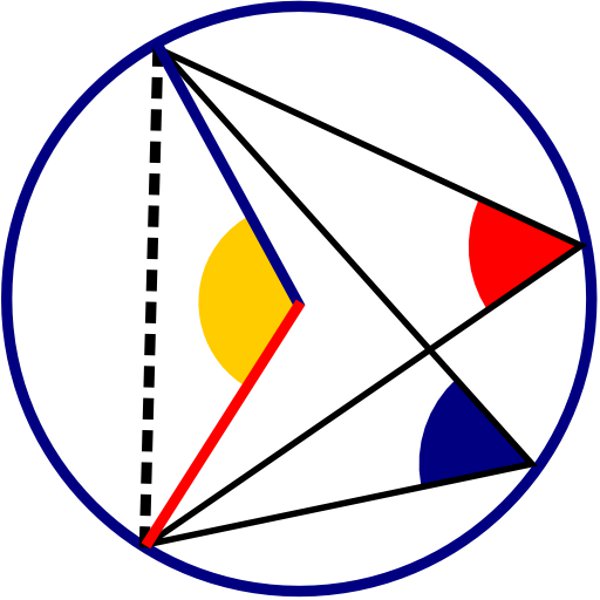
Problem 102 of Only Problems… contained this cool diagram:
We can’t remember what “the Russian book” was. Sorry!
The powerful numbers are sequence A060355 in the OEIS.
Paul Erdős made a conjecture on arithmetic progressions.
The Bee Gees consisted of brothers Barry, Robin, and Maurice Gibb. That’s three people: a powerful triple.
$x^2 – 8y^2 = 1$ is a Pell equation, and the reason why the continued fraction representation of $\sqrt{8}$ generates consecutive pairs of powerful numbers.
The Muddy Children puzzle is a good introduction to public announcement logic. The slides we were looking at were “The Muddy Children: a logic for public announcement”, by Jesse Hughes.
Analysis vs Algebra predicts eating corn?
David was playing Wuzzit Trouble by InnerTube Games. It was reviewed here by Colin Beveridge last month.
Oct 6, 2013 • 25min
All Squared, Number 8: Martin Gardner (Colm Mulcahy part 2)
This is the second and final part of our interview with Colm Mulcahy. Last week we talked about card magic; in this part we moved on to the subject of Martin Gardner and the gatherings of interesting people associated with his name.
We’ve tacked on some blather we recorded about the British Science Festival in Newcastle to the end of this podcast. Listen in to hear what we think about maths! (We’re broadly in favour of it.)
Here are some links to go with the things we talked about:
Martin’s autobiography, Undiluted Hocus Pocus, came out last month. Here’s a review in Plus Magazine.
Mathematics Awareness Month in 2014 will be on the theme of “Magic, Mystery and Mathematics”, to celebrate Martin Gardner’s centenary.
The Gathering 4 Gardner happens every two years. The next one is in 2014, but it’s invitation only!
Celebrations of Mind happen all round the world to carry on the Gardnerian spirit. You can look at a map of all the events and register your own at the official site.
Colm’s book Mathematical Card Magic: Fifty-Two New Effects is published by CRC Press, priced £19.99/$29.95 and available from the booksellers in general.
Sep 29, 2013 • 29min
All Squared, Number 7: Card Magic (Colm Mulcahy part 1)
Colm Mulcahy is an original Aperiodical contributor (Aperiodicontributor?) and friend of the site. He’s spent the last year and a bit writing his new book, Mathematical Card Magic: Fifty-Two New Effects. It came out a few weeks ago, so we thought it was a good opportunity to talk to him and find out just what’s so great about mathematical magic tricks.
Actually, we had that thought quite a while ago and if we’d been the least bit organised this podcast would’ve come out the same day as the book. As it happened, we first arranged to talk to Colm back in May, and then it took literally three months before we actually managed to record the interview.
… And then it took us three weeks to edit it up and upload it. Sorry!
Because Colm had so much interesting stuff to say, we’ve split the interview into two parts. In this first half we talk about the book and mathematical card magic; in the second part, out next week, we talk about Martin Gardner and the Celebration of Mind.
Mathematical Card Magic: Fifty-Two New Effects is published by CRC Press, priced £19.99/$29.95.
May 18, 2013 • 28min
All Squared, Number 6: Favourite maths books (part 2)
This number of the All Squared podcast contains the final third of our interview with the inestimable David Singmaster, and then a bit from CP about his favourite book, “A treatise on practical arithmetic, with book-keeping by single entry“, by William Tinwell.
The first part of the interview, and plenty of links to go with it, were in Number 5 of the podcast.
Here are some links to the things we referred to in this podcast:
The Casa di Galileo.
The Internet Archive has scanned in Dickson’s History of the Theory of Numbers (and Volume 2 and Volume 3).
David’s notes are written in the SCRIPT markup language. If you know anything about it and have an idea of how to put it on the web, please get in touch.
The Internet Archive also has a scanned-in copy of the fifth edition of Christian’s favourite book, A Treatise of Practical Arithmetic (the “of” seems to have changed to “on” for the sixth edition).
Tynemouth Market.
The MathsJam annual conference is attended by not just David, Katie and CP, but a whole load of people who are really passionate about recreational maths in all its forms. Registration for the 2013 meeting has just opened – you know what to do!
Finally, here are some pictures of Christian’s favourite book, so you don’t just have to imagine what he was talking about:
We hope you enjoy listening to this two-parter. We certainly enjoyed recording it!
May 11, 2013 • 30min
All Squared, Number 5: Favourite maths books (part 1)
Good maths books are simultaneously plentiful and rare. While there are a few classics almost everyone knows about and has copies of (Gardner, Hardy, etc.), the trade in lesser-known maths books is considerably less well-organised. Very few bookshops have well-stocked maths sections, and insipid pop maths books dominate. Unless you hear about a good maths book through word of mouth, you’ll often only encounter it once it’s ended up in a second-hand bookshop, usually a refugee from an emptied maths department library.
But books, more than anything else, are where the beauty of maths really manifests itself. It’s where ideas are presented most clearly, after they’ve had time to percolate through a few more brains. We talked to David Singmaster, professor of maths and metagrobologist, about his favourite maths books.
Here are some links to the things we referred to in the podcast, along with some bonus extras:
The Slocum Puzzle Collection at Indiana University
Luca Pacioli on Wikipedia
Scans of the manuscript of De Viribus Quantitatis
The Conjuring Arts Research Center’s edition of De Viribus Quantitatis
The one pile game (Static Nim)
Nim on Wikipedia
Nimber on Wikipedia
Nim Multiplication by Lenstra (link goes to a big PDF)
The game that wasn’t solved was Sprouts, which is analysed using nimbers in Computer analysis of Sprouts with nimbers by Lemoine and Viennot
Winning Ways for your Mathematical Plays by Berlekamp, Conway and Guy
Melancholia by Albrecht Dürer at the British Museum (it’s also the icon for our Arty Maths section over there on the right!)
The Blind Abbess and her Nuns at The Puzzle Museum
The vertical-horizontal illusion at Wikipedia
George Hart’s page on De Divina Proportione (and one on Leonardo da Vinci’s illustrations)
Scans of De Divina Proportione at archive.org
The drawings CP was thinking of were from the Codex Guelf, and posted at BibliOdyssey.
Between 1981 and 1985 David edited and published Cubic Circular. With David’s permission, Jaap Scherphuis has put every issue online.
CP recommends Westwood Books in Sedbergh and Barter Books in Alnwick as sources of unusual second-hand maths books. The chap who runs Westwood is an ex-mathematician and does a good job of saving books being thrown out of university libraries.
Part 2 will appear next week.
Apr 9, 2013 • 36min
All Squared, Number 4: How interesting!
It’s a repeat booking for the Festival of the Spoken Nerd in number 4 (or 16 if you belong to Team All Squared) of our podcast. Standup mathematician Matt Parker joined us to talk about interesting coincidences.
Here are some links to the things we referred to in the podcast, along with some bonus extras:
The operator precedence problem that makes Katie want to cry
Colin Wright has blogged about it
Chocolate maths!
Robert Munafo’s Notable properties of specific numbers
The Online Encyclopedia of Integer Sequences
A135650 – Even perfect numbers written in base 2
A002904 – Delete all letters except c,d,i,l,m,v,x from n then read as Roman numeral if possible, otherwise 0
A000012 – The simplest sequence of positive numbers: the all 1’s sequence.
The episode of Relatively Prime about interesting number facts, including the OEIS.
Matt Parker plugged a couple of things:
Festival of the Spoken Nerd
Maths Gear
Matt’s solo show, The Number Ninja
Next time, which should be soon, we’ll be talking to a Fantastic Mystery Guest about our favourite maths books.
Mar 14, 2013 • 29min
All Squared, Number 3: As Easy As…
Remember, remember,
The fourteenth of March.
While the previous number of All Squared failed to achieve topicality by appearing several weeks after the event it was about, this time we’ve hit the nail bang on the head with a podcast all about π day… on π day!
We chatted to Festival of the Spoken Nerd’s Steve Mould about remembering π – how much can you memorise; how much should you memorise; and if you really insist on memorising it, what’s the best way to do it?
Here are some links to the things we referred to in the podcast, along with some bonus extras:
The number of this episode is 3, which is exactly π if you don’t think very hard when you read the Bible
A chronology of the computation of π
Epic π quest sets 10 trillion digit record, at New Scientist
Download 4 million digits of π
“Using pi calculated out to only 39 decimal places would allow one to compute the circumference of the entire universe to the accuracy of less than the diameter of a hydrogen atom.“
The π Code – π in base 26 ≈ D.DRSQLOL
33,333 digits of π in base-(the 1000 most common words in the English language)
Japanese breaks pi memory record on BBC News (in which “Conventionally, 3.14159 is used as pi.”)
Japanese man claims new record for memorising ‘pi’ at the Daily Mail (in which “It is usually written out to a maximum of three decimal places, as 3.141, in math textbooks.”)
Akira Haraguchi
The official world record for memorising π is held by Chao Lu of China, who memorised 67,890 decimal digits.
Kolmogorov complexity (Steve had the definition right – it measures just the length of the description of the thing, and doesn’t measure the resources required to interpret that description)
Normal number
Find your birthday in π
Find any string of digits in π
Michael Hogg’s method of memorising 100 digits of π
Joshua Foer: Moonwalking with Einstein – a talk about a book about memory
Irrational sonnets (where the stanzas have 3,1,4,1,5 lines) in French, or in English
A mnemonic for π which is also a pangram, in French
Previously on The Aperiodical: Random walks on π, a marvellous visualisation of the digits of π.
Circular reasoning: who first proved that $C/d$ is a constant? – a historical essay by David Richeson.
While Steve was chatting to us, his collaborator Matt Parker was measuring π with pies for Numberphile.
Steve Mould has his fingers in, if you’ll excuse one final pun, many pies. Here are some links to some of his projects you might find interesting:
Steve’s homepage
Festival of the Spoken Nerd
Maths Gear
Steve’s on Twitter
Mar 5, 2013 • 30min
All Squared, Number 2 – Pancake formula
Here’s the second edition of our new podcast, All Squared. This time we talked to Dr Andrew Taylor, PhD, about nonsense formulas in the news. In particular, since we recorded very close to pancake day, we took a close look at the various “formulas for the perfect pancake” printed in UK newspapers.
Here are some links to the things we referred to, along with some further reading. Since we found so many nonsense formula stories, I’ll split the links into two sections: nonsense and the rest.
Nonsense formula stories
Flipping clever! Formula for the perfect pancake revealed by maths boffins (but we’ll still end up with ours stuck to the ceiling) – Daily Mail (2013)
The perfect pancake? Easy, just follow this formula … 100 – [10L – 7F + C(k – C) + T(m – T)]/(S – E) – Daily Mail (2009); the one with the amazing stock photo
Formula for perfect pancake unveiled by scientists – The Telegraph (2009)
How to toss the perfect pancake – Daily Express; the one without the actual formula
The perfect pancake toss – Shortlist; includes the formula
Why today’s the perfect day to change your life – Daily Mail
Revealed: The formula for a perfect family Christmas – drink two parts wine for every three chocolates – Daily Mail
Scientists are serious about having a laugh – The Telegraph
Scientists reveal formula for the perfect sitcom – The Telegraph
Horror’s perfect formula – London Evening Standard; the one where “blood and guts” = $\sin x$.
Here’s my happy marriage secret: avoid romance – The Telegraph
The formula for perfect parking – NPR
The rest
The geometry of perfect parking – Simon Blackburn; PDF
The Tommy Westphall universe
Jewish Problems – Tanya Khovanova’s collection of Russian “coffin” problems on the arXiv, including number 1’s quickly-read puzzle.
Mathematical Puzzles, a Connoisseur’s Collection, by Peter Winkler
The Muddy Children: a logic for public announcement – slides by Jesse Hughes
CP’s Interesting Esoterica collection
Number 3 will appear in exactly 9 days. You can probably guess what it’ll be about. But can you guess who we’ll be talking to?
You can subscribe to All Squared through our RSS feed. We’ll set up an iTunes thing if anyone asks for it.
Feb 24, 2013 • 27min
All Squared, Number 1: Maths out loud
We’ve been quietly making plans and gathering material for a new project over the past couple of weeks, after noticing that there’s an unusual paucity of maths podcasts at the moment. Well, that exciting new project is now happening, and it’s a half-hour podcast featuring maths, guests, puzzles and links from the internet. It’s called All Squared, and it’ll contain cringe-inducing intro/ending contrivances, interesting guest interviews on topical and other subjects, and a panoply of mathematical curiosities.
This is the first number of the podcast (we thought ‘episode’ would set unrealistic expectations of regularity, and we can never resist a pun). It includes an interview with Edmund Harriss about spoken mathematics, as well as a puzzle which we’ll give the answer to in the next number, and a great mathematical flash game to keep you occupied until that appears.
Here are some links to the things we referred to, along with some further reading:
Mathematics Out Loud at Maxwell’s Demon, Edmund’s blog
Milton’s Paradise Lost (Project Gutenberg ebook version)
The Pythagorean Proposition, a book containing nearly 370 proofs
The proof of Pythagoras’ theorem that Katie gave
Pythagorean Theorem poem
Maths Poetry at Mr P’s Maths Page
Gunfight at the cubic corral – Thony Christie on Cardano, Tartaglia and 16th Century maths competitions
The same topic at The Story of Mathematics
CP’s proof without words on YouTube
Edmund says Sphere Packings, Lattices and Groups by John Conway is particularly readable.
Z-Rox, the dimensionally deficient game, at Kongregate
Number 2 (or should it be 4?) will appear soonish.

