

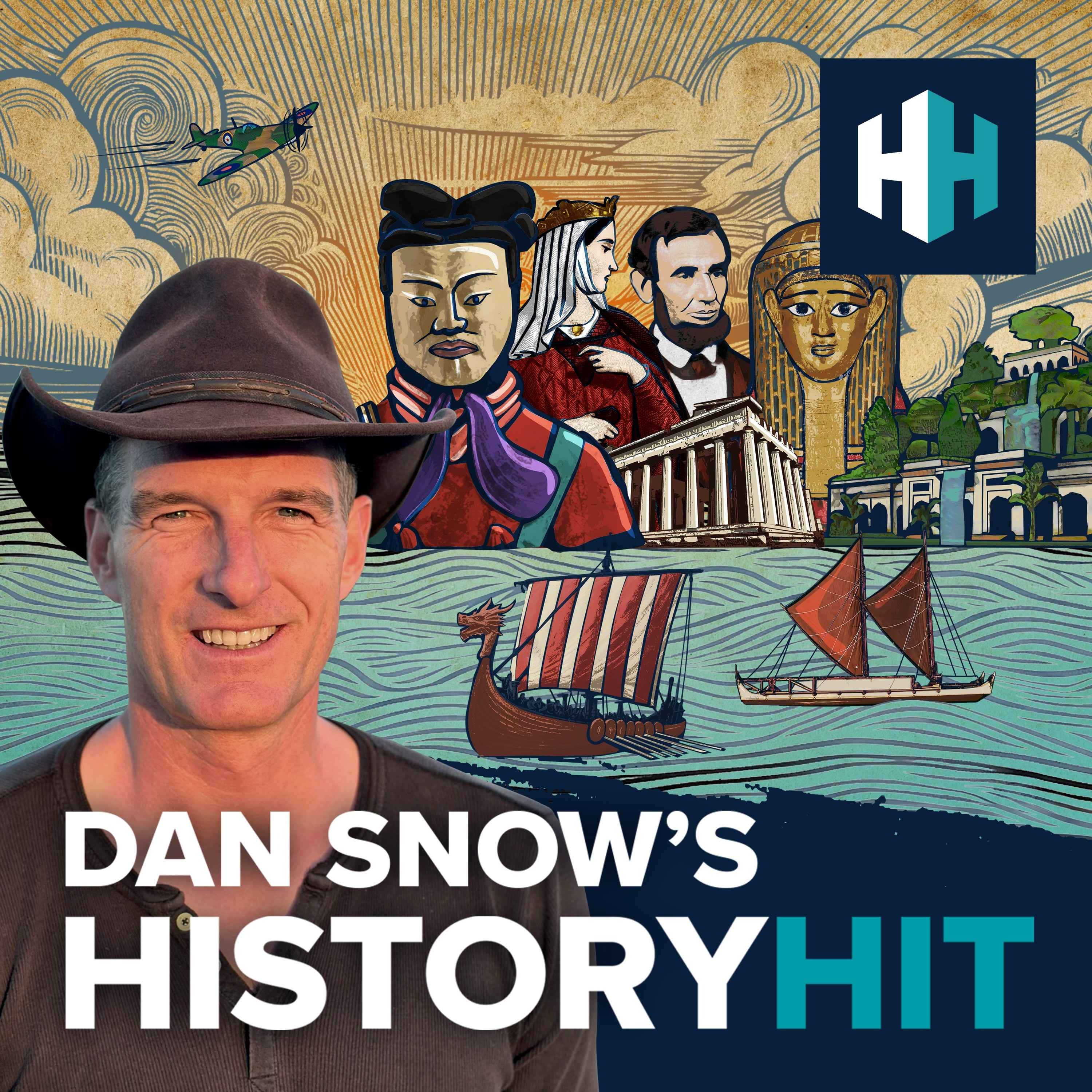
Dan Snow's History Hit
History Hit
Historian Dan Snow journeys across the globe to tell the stories of history's defining moments. From the Colosseum in Rome to the Great Wall of China, the battlefields of Waterloo to the Tomb of Tutankhamun, join Dan as he explores the how and why of the greatest monuments, battles, heroes, villains and events that have shaped our world.New episodes on Mondays and Thursdays with bonus subscriber only episodes every other Friday.You can get in touch with us at ds.hh@historyhit.comA podcast by History Hit, the world's best history channel and creators of award-winning podcasts The Ancients, Gone Medieval, and Betwixt the Sheets.Sign up to History Hit for hundreds of hours of original documentaries, with a new release every week and ad-free podcasts. Sign up at https://www.historyhit.com/subscribe.
Hosted on Acast. See acast.com/privacy for more information.
Hosted on Acast. See acast.com/privacy for more information.
Episodes
Mentioned books

Jul 2, 2021 • 31min
The Battle of the Somme
105 years ago the battle of the Somme raged on into its second day. 60,000 British casualties we recorded on its first day and by its close in November 1916 over a million men had been killed or wounded. It is the bloodiest battle in British military history and in Germany, the battle was described as the bloody field grave of the German army. It has become a byword for futile slaughter; but is that reputation deserved?In this archive episode, Paul Reed a military historian, author and battlefield guide joins the podcast. Paul has immense knowledge of both the First and Second World Wars and guides Dan through the opening day of the battle on the 1 July and the following bloody weeks and months of conflict.
Hosted on Acast. See acast.com/privacy for more information.

Jul 1, 2021 • 27min
100 years of the Chinese Communist Party
100 years ago the Chinese Communist Party was founded and across the span of that century has become one of the most powerful organisations on the planet. Today, it is an economic powerhouse and a superpower challenger to the United States. Its origins were humble though with just a few members at its foundation. Indeed, the official anniversary date of 1 July was chosen by Chairman Mao years later as the real date remains a mystery. China saw an epic struggle through the 20th century both with external enemies and between its own people with the CCP emerging victorious in 1949. Following the communist victory, there were decades of Mao's rule which became increasingly erratic and led to the death of many millions during the Great Leap Forward and the Cultural revolution. Following Mao's death, the country changed tack and started to move towards the China that we know today economically and politically. To help make sense of this tumultuous 100 years and where China stands today on the world stage Dan is joined by Richard McGregor a journalist and author and formerly the Beijing and Washington bureau chief for the Financial Times.
Hosted on Acast. See acast.com/privacy for more information.

Jun 29, 2021 • 29min
Marginalised in the Middle Ages with Eleanor Janega
Much of Medieval history focuses on the kings, queens, bishops, and the nobility of the period, but what do we know about those people on the margins of society? Like today the elite made up only a small percentage of the population and the vast majority of the population of medieval Europe were peasants or craftspeople. There were other groups who were forced to the very edge of society such as sex workers, leppers, jews and immigrants. But as Elena Janega, today's guest on the podcast, has discovered there is a surprising amount to be discovered about these marginalised groups. What she has found calls into question many of our assumptions and preconceptions about life in the middle ages.Eleanor Janega is a medieval historian specialising in social history. She is a lecturer at the London School of Economics, hosts the 'Going Medieval' series on History Hit TV and runs a popular blog of the same name on intersections between medieval history and pop culture.
Hosted on Acast. See acast.com/privacy for more information.

Jun 28, 2021 • 33min
Sarajevo 1914: Assassination of the Archduke
Europe in 1914 was a tinderbox of imperial tensions and the spark that would light the conflagration would be the assassination of Archduke Franz Ferdinand. But there is much more to this story than simply the murder of two royals on the street of Sarajevo. Archduke Franz Ferdinand was an often misunderstood figure seemingly hard and old fashioned. But in private he was a dedicated family man and husband who had married for love against the wishes of the Emporer and he and Sophie had endured snubs and humiliation at court because of it. He had travelled the world and hoped to reform the Austrian-Hungarian empire he was supposed to one day rule. Sue Woolmans, historian and author of The Assassination of the Archduke: Sarajevo 1914 and the Murder that Changed the World, joins the podcast to discuss the real Franz Ferdinand. She guides Dan through the life of Franz Ferdinand and the incompetence, bad luck and chance on the day that would lead to the death of the Archduke and begin a century of conflict.
Hosted on Acast. See acast.com/privacy for more information.

Jun 27, 2021 • 25min
Berlin and the Dawn of the Cold War
In the aftermath of World War II, amongst the shattered ruins of Berlin a new conflict was born, the Cold War. With the common purpose of defeating Nazi Germany gone the allied powers were soon no longer allies. Berlin had been divided before the end of the war at the Yalta Conference between the British, French, United States and Soviets. However, Berlin was deep in the Soviet-occupied zone of Germany and Stalin wished to wrest control of it from the other allied powers. The situation became so tense that it almost sparked another world war and the allies remained steadfast in their determination to hold onto their sectors of the city. This culminated in the Berlin Airlift where many thousands of tons of supplies were flown into the city daily to defy the Soviet blockade and keep its residents from starvation. The fantastic historian and writer Giles Milton is today's guest to discuss his new book Checkmate in Berlin which explores the history of Berlin in the immediate post-war period. Giles and Dan discuss how tensions between the former allies flared, the flourishing black market in Berlin at the time, how the British and Americans were able to pull off the extraordinary feat of the airlift and its consequences.
Hosted on Acast. See acast.com/privacy for more information.

Jun 26, 2021 • 37min
From Airman to Attorney General: RAF Navigator Johnny Smythe
Beginning with his birth in 1915 in Sierra Leone, the life of John Henry Smythe OBE MBE is almost unbelievable. From becoming a navigator in the RAF during the Second World War, to being held captive in a German POW camp, to being the Senior Officer making key decisions about the futures of the people aboard HMT Empire Windrush and becoming Attorney General for Sierra Leone; the twists and turns in this story are incredible. James from our sibling podcast Warfare was joined by John’s son, Eddy, and the BBC’s Tim Stokes to hear this account of life during and after the Second World War, in which we even get a glimpse of JFK. Listen out for Eddy’s song, written in memory of his father, at the end of the episode. You can find the music video here.Tim’s article can be found here.
Hosted on Acast. See acast.com/privacy for more information.

Jun 25, 2021 • 32min
Hunting the Viking Great Heathen Army
In 865 AD Britain was invaded by the Great Heathen Army an alliance of Scandanavian warriors determined to conquer the kingdoms of East Anglia, Northumbria, Merica and Wessex. Over the next few years, all of those kingdoms would fall to the Viking forces with the exception of Wessex. In May 878 Alfred the Great defeated the Vikings at the Battle of Edington. However, despite this defeat, the Vikings did not leave, but rather reached an agreement with Alfred allowing them to retain control of much of the north and east of England in what would become known as the Danelaw. Professor Cat Jarman joins Dan as they travel across the country exploring the key sites of the Viking conquest and looking to discover what may still be to discover about the Great Heathen Army.
Hosted on Acast. See acast.com/privacy for more information.

Jun 24, 2021 • 21min
History of Freemasonry
John Dickie joins Dan from the History Hit Archive to discuss the international story of an organisation that now has 6 million members across the globe. Tracing the origins from local fraternities of stonemasons at the turn of the fifteenth century, John takes Dan on the freemasons' journey from Britain to America, Australia, Italy and India. Find out exactly what the freemasons are, how they have been perceived, and why they seem to attract so many conspiracy theories.
Hosted on Acast. See acast.com/privacy for more information.

Jun 23, 2021 • 30min
The World According to Obama Official Ben Rhodes
Ben Rhodes has served at the very pinnacle of politics in his role as deputy national security adviser in Barack Obama's Whitehouse and seen what it takes to run a democracy and take the tough decisions that are needed. But since leaving the Oval Office the world has seen a slide towards populism, nationalism and even authoritarianism. But how can this descent into dangerous political waters be stopped? After leaving politics Ben spent three years travelling the world speaking to leaders, activists and dissidents across dozens of countries. His new book After the Fall: Being American in the World We've Made documents those journeys and he speaks to Dan about what he discovered, the truths we have to face about our societies and how the United States can set an example for the world.
Hosted on Acast. See acast.com/privacy for more information.

Jun 22, 2021 • 44min
Operation Barbarossa
On 22 June 1941 Hitler unleashed Operation Barbarossa the biggest military operation in human history. More than 3 million men of the Axis poured into the Soviet Union beginning a conflict, that even within the context of the Second World War, was unprecedented in both its scale and savagery. Operation Barbarossa began with unparalleled success for the Wehrmacht and its allies with millions of Soviet soldiers killed and captured in the opening months of this titanic struggle. But by the winter of 1941 and against all the odds the German war machine had been halted outside the gates of Moscow marking the beginning of the end for the Nazi regime. To better understand this enormous operation Dan is joined by the author and broadcaster Jonathan Dimbleby who has written a new book Barbarossa: How Hitler Lost the War. They discuss why Barbarossa was launched, the inhuman nature of the fighting and the horrific treatment of civilians and particularly the Jews, whether Barbarossa could have ever been successful and looking at the more human side behind the almost unbelievable scale of the fighting.
Hosted on Acast. See acast.com/privacy for more information.

