

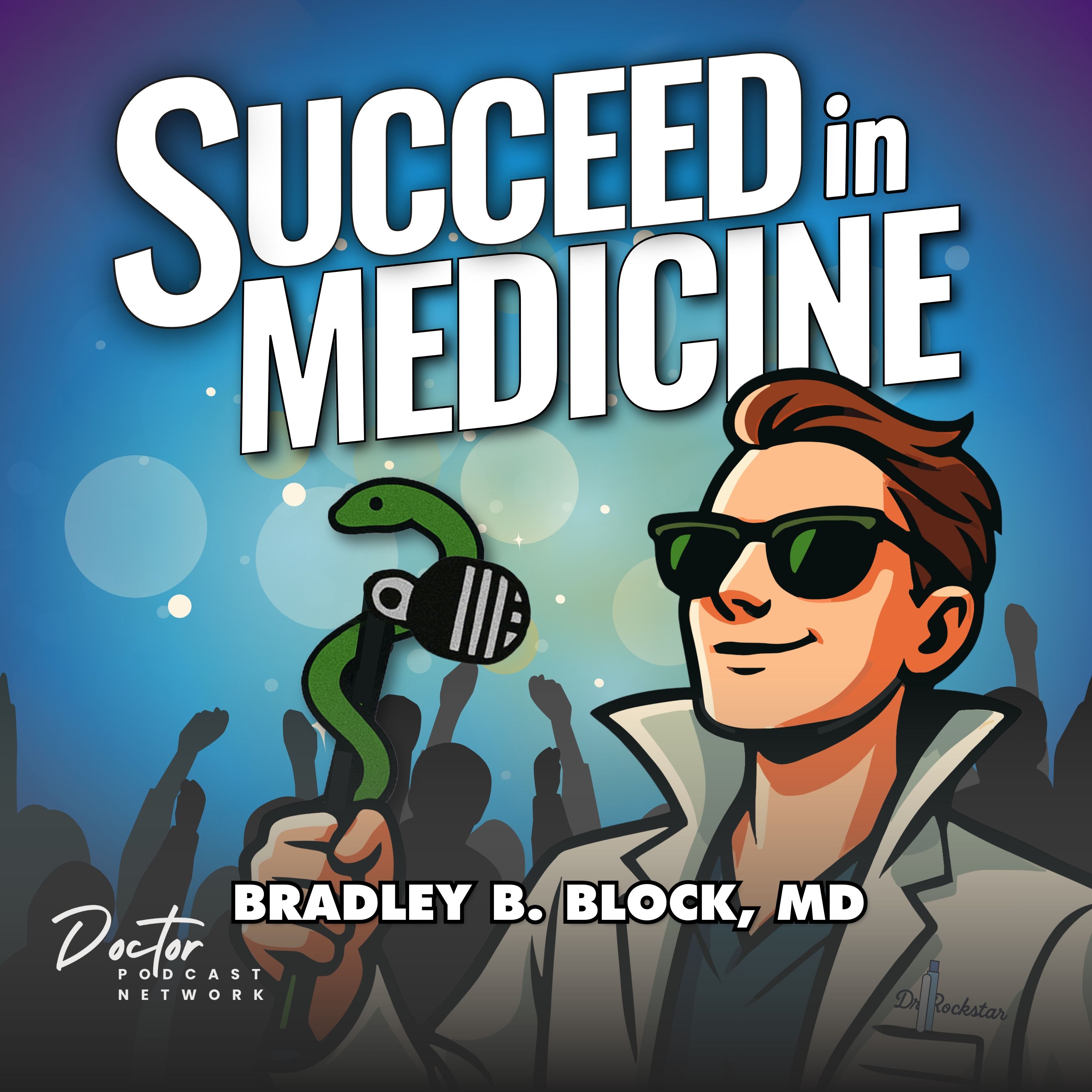
Succeed in Medicine: Practical Knowledge for Busy Physicians
Bradley B. Block, MD, Doctor Podcast Network
Was your medical education enough to handle everything physician life demands? From lawsuits to leadership, career decisions to challenging conversations, balancing the personal with the professional — not enough was addressed in medical school, residency or fellowship.
This medical podcast fills those gaps so you can live up to the expectations that come with the white coat — not just in the exam room, but in all the places your MD follows you. This show is the physician mentor you didn’t realize you needed.
Your host, Dr. Bradley Block, a private practice ENT, is right there with you — navigating the same challenges and bringing in world-class guests to teach, as he puts it, “everything we should have been learning while we were memorizing Kreb’s cycle.” With nearly 500 episodes and close to half a million downloads, Brad has built a trusted space where physicians come for brass-tacks, immediately-applicable advice.
You don’t need another certification. You need a medical podcast that can be your physician mentor. It covers interpersonal skills, medical education, doctor personal finance, doctor charting, doctor careers, doctor mental health, physician soft skills, physician parenting, physician executive skills, medical decision making, medical professional development, physician side gigs, main gigs, reacting to bad reviews, misinformation, social media, negotiating and what to do when someone yells, “Is there a doctor on board?”
Guests have included Lady Glaucomflecken Kristen Flanary, Matt Abrahams, PhD, Gita Pensa, MD, Nneka Unachukwu, MD, (Dr. Una) Amy Fogelman, MD, and Bapu Jena, MD, PhD.
A proud founding member of the Doctor Podcast Network!
This medical podcast fills those gaps so you can live up to the expectations that come with the white coat — not just in the exam room, but in all the places your MD follows you. This show is the physician mentor you didn’t realize you needed.
Your host, Dr. Bradley Block, a private practice ENT, is right there with you — navigating the same challenges and bringing in world-class guests to teach, as he puts it, “everything we should have been learning while we were memorizing Kreb’s cycle.” With nearly 500 episodes and close to half a million downloads, Brad has built a trusted space where physicians come for brass-tacks, immediately-applicable advice.
You don’t need another certification. You need a medical podcast that can be your physician mentor. It covers interpersonal skills, medical education, doctor personal finance, doctor charting, doctor careers, doctor mental health, physician soft skills, physician parenting, physician executive skills, medical decision making, medical professional development, physician side gigs, main gigs, reacting to bad reviews, misinformation, social media, negotiating and what to do when someone yells, “Is there a doctor on board?”
Guests have included Lady Glaucomflecken Kristen Flanary, Matt Abrahams, PhD, Gita Pensa, MD, Nneka Unachukwu, MD, (Dr. Una) Amy Fogelman, MD, and Bapu Jena, MD, PhD.
A proud founding member of the Doctor Podcast Network!
Episodes
Mentioned books

Jul 31, 2019 • 52min
Build Stronger Patient Relationships with Emotional Intelligence with Dr. Shakila Angadi
On today's episode, we spoke about emotional intelligence with the Inspired Dentist, Dr. Shakila Angadi. She is a dentist and social & emotional intelligence certified coach that is determined to help improve the lives of fellow health care professionals. She graduated from the University of Missouri Kansas City School of Dentistry and has been in private practice for over 11 years. She realized that empathetic communication and self-awareness techniques were the key to expanding her practice and leadership skills exponentially. You can learn more about EQ and her coaching programs on www.theinspireddentist.comand on social media Facebook and Instagram @theinspireddentist.We start out defining EIQ, or the emotional intelligence quotient and how she ended up becoming a certified coach in this area. She tells us the common issues health professionals have that seek her expertise and how she helps them address those issues. In discussing how it can help the doctor-patient relationship, she gives a particularly powerful piece of advice, saying just ONE THING to each patient, and that will help all of us connect with our patients just a little bit better.Find this and all episodes on your favorite podcast platform at PhysiciansGuidetoDoctoring.comPlease be sure to leave a five star review, a nice comment and SHARE!!!A medical podcast to build your physician soft skills and avoid being a burnt out physician.
This medical podcast is your physician mentor to fill the gaps in your medical education. We cover physician soft skills, charting, interpersonal skills, doctor finance, doctor mental health, medical decisions, physician parenting, physician executive skills, navigating your doctor career, and medical professional development. This is critical CME for physicians, but without the credits (yet). A proud founding member of the Doctor Podcast Network!Visit www.physiciansguidetodoctoring.com to connect, dive deeper, and keep the conversation going. Let’s grow! Disclaimer:This podcast is for informational purposes only and is not a substitute for professional medical, financial, or legal advice. Always consult a qualified professional for personalized guidance. Hosted by Simplecast, an AdsWizz company. See pcm.adswizz.com for information about our collection and use of personal data for advertising.

Jul 25, 2019 • 39min
Caring for Trans and Gender Diverse Patients with Dr. Crystal Beal of QueerDoc
Be Calm and Queer On – What Your Trans and Gender Diverse Patients Want You to KnowDr. Crystal Beal answers the questions that will helps us better care for our transgender and gender diverse patients. They went to med school at Florida State University, and completed the Valley Family Medicine Residency program, part of the University of Washington. They are the physician- owner of QueerDoc. Dr. Beal hopes to change the experience of care for the trans and gender diverse community and raise the bar for gender affirming care. Through QueerDoc, Dr. Beal provides increased access to expert, affirming, and culturally competent care for queer and gender expansive children, adolescents, and adults. They currently serve Washington and Alaska (through partnership with Full Spectrum Health), and have dreams of expanding service to several more states as an online queer and gender affirming healthcare provider.We talk about why Dr. Beal created their practice and we talk a little about some of the specific needs of gender-diverse people. They make some suggestions about how to best introduce yourself to patients who may be gender diverse, and as it turns out, it really sounds like the best way to introduce yourself to all of your patients. Dr. Beal educates use about issues they have faced when interacting with the medical establishment as a patient and gives some pointers for how we can all interact with gender diverse individuals to make sure the relationship develops as it should, based on trust and free from stigma and biases. We end with some great resources for learning more about the gender diverse community and a great place to start is QueerDoc.com.This is a medical podcast with a physician mentor to help with physician soft skills as it relates to a gender diverse population; this isn't just about medical decisions. This is about being the good physician these patients deserve.
This medical podcast is your physician mentor to fill the gaps in your medical education. We cover physician soft skills, charting, interpersonal skills, doctor finance, doctor mental health, medical decisions, physician parenting, physician executive skills, navigating your doctor career, and medical professional development. This is critical CME for physicians, but without the credits (yet). A proud founding member of the Doctor Podcast Network!Visit www.physiciansguidetodoctoring.com to connect, dive deeper, and keep the conversation going. Let’s grow! Disclaimer:This podcast is for informational purposes only and is not a substitute for professional medical, financial, or legal advice. Always consult a qualified professional for personalized guidance. Hosted by Simplecast, an AdsWizz company. See pcm.adswizz.com for information about our collection and use of personal data for advertising.
Jul 18, 2019 • 53min
How to Avoid Doctor Regret with a Bad Financial Advisor with Ryan Inman
Ryan Inman is a fee-only financial advisor who works exclusively with physicians and he teaches how to pick a financial advisor. How did he end up in the physician niche? He understands us. His wife is a pediatric pulmonologist and part of why he understands the struggle so well is that they’ve been together since college. He graduated from the University of San Diego and has two masters, one in business administration and another in Accounting and financial management. He manages Physician Wealth Services, which does financial planning for physicians, and he has his own podcast where he answers physician specific financial questions, called the Financial Residency and manages with Physician Finance Facebook group.We discuss how to find a financial advisor and answer questions like, what is a fiduciary, who should I buy life and disability insurance from, is picking stocks and timing the market possible with enough research, what services should a financial advisor provide and what is the most common financial mistake he sees physicians make. Find this and all episodes on your favorite podcast platform at PhysiciansGuidetoDoctoring.comPlease be sure to leave a five star review, a nice comment and SHARE!!!This is a doctor finance episode and your first step toward physician financial independence. One of the most common causes of an overwhelmed doctor and physician stress is not medical decisions, but personal finance. Learn from this physician mentor!
This medical podcast is your physician mentor to fill the gaps in your medical education. We cover physician soft skills, charting, interpersonal skills, doctor finance, doctor mental health, medical decisions, physician parenting, physician executive skills, navigating your doctor career, and medical professional development. This is critical CME for physicians, but without the credits (yet). A proud founding member of the Doctor Podcast Network!Visit www.physiciansguidetodoctoring.com to connect, dive deeper, and keep the conversation going. Let’s grow! Disclaimer:This podcast is for informational purposes only and is not a substitute for professional medical, financial, or legal advice. Always consult a qualified professional for personalized guidance. Hosted by Simplecast, an AdsWizz company. See pcm.adswizz.com for information about our collection and use of personal data for advertising.

Jul 11, 2019 • 36min
Your Female Physician Finance Questions Answered with Bonnie Koo, MD
Dr. Bonnie Koo, is a dermatologist and former systems administrator at Morgan Stanley. She is a graduate of Barnard College and Columbia University’s College of Physicians & Surgeons and completed her dermatology residency at UC Irvine. She created the website WealthyMomMD.com to fill the void of knowledge and resources specific to women physicians on how to take control of their finances. She directs the Women Physicians Personal Finance group on Facebook--the largest online community of women physicians mastering their finances.We discuss some of the financial issues that are more common to female physicians, from prenuptial agreements, taking care of financial ill-prepared parents or other family members, the importance of having your financial house in order, outsourcing to buy more time, and why it is importance to secure disability insurance before you get pregnant. Find this and all episodes on your favorite podcast platform at PhysiciansGuidetoDoctoring.comPlease be sure to leave a five star review, a nice comment and SHARE!!!Doctor finance should be part of our medical education, but it isn't, so we discuss financial issues specific to female physicians. This is a leading cause of physician stress. Don't derail your doctor career and end up a burnt out physician. Listen to this coach for physicians.
This medical podcast is your physician mentor to fill the gaps in your medical education. We cover physician soft skills, charting, interpersonal skills, doctor finance, doctor mental health, medical decisions, physician parenting, physician executive skills, navigating your doctor career, and medical professional development. This is critical CME for physicians, but without the credits (yet). A proud founding member of the Doctor Podcast Network!Visit www.physiciansguidetodoctoring.com to connect, dive deeper, and keep the conversation going. Let’s grow! Disclaimer:This podcast is for informational purposes only and is not a substitute for professional medical, financial, or legal advice. Always consult a qualified professional for personalized guidance. Hosted by Simplecast, an AdsWizz company. See pcm.adswizz.com for information about our collection and use of personal data for advertising.
Jun 27, 2019 • 48min
Physician Financial Independence Starts with These Questions with Jimmy Turner, MD
The next three episodes comprise an intro to the Physician's Guide to Personal Finance. We start with the Physician Philosopher, an anesthesiologist blogger who wants his audience to understand their "why" to understand their "how" of personal finance. Next week we interview Bonnie Koo, MD, the voice of female physician finance, and the following week we interview Ryan Inman, a fee-only financial advisor who understands the specifics of physicians' financial needs as he exclusively works with us and he's married to one of us.To understand The Physician Philosopher's book, you first need to understand the Pareto Principle, or the 80/20 rule, which states that 80% of the effects come from 20% of the causes. James Turner, MD, aka Physician Philosopher, believes this about personal finance. To get 80% of the benefit, you only need to understand 20% of the concepts. To quote the phys ed coach from Teen Wolf, “the rest is cream cheese.” We discussed the 20% he wants physicians to understand to take control of their personal finances. He completed his undergraduate studies at Erskine College, went to medical school at Wake Forest, was an anesthesia resident at North Carolina Baptist Hospital before returning to Wake Forest as a regional anesthesia and acute pain management fellow and there he has stayed as an attending. He is currently creating a personal finance curriculum for the PA, CRNA and medical students of Wake Forest. His blog is thephysicianphilosopher.com, now part of the White Coat Investor Network, and his new book, The Physician Philosopher’s Guide to Personal Finance, is available everywhere fine books are sold.We start out discussing some philosophical questions, the Kinder questions, that have helped him to focus on his priorities and why this is critical in personal finance. We get into the financial independence movement and how to calculate how much money you need to be financially independent; why it is totally fine that he bought a tricked-out new car despite this being anathema to his spending philosophy, an introduction to public student loan forgiveness and who should be looking into this, and why the 80:20 rule may help you avoid the need to hire a financial advisor. Find this and all episodes on your favorite podcast platform at PhysiciansGuidetoDoctoring.comPlease be sure to leave a five star review, a nice comment and SHARE!!!This is typically a medical podcast, but with this physician mentor we are covering doctor finance, something we should cover more in our medical education as it is a major source of physician stress and doctor regret.
This medical podcast is your physician mentor to fill the gaps in your medical education. We cover physician soft skills, charting, interpersonal skills, doctor finance, doctor mental health, medical decisions, physician parenting, physician executive skills, navigating your doctor career, and medical professional development. This is critical CME for physicians, but without the credits (yet). A proud founding member of the Doctor Podcast Network!Visit www.physiciansguidetodoctoring.com to connect, dive deeper, and keep the conversation going. Let’s grow! Disclaimer:This podcast is for informational purposes only and is not a substitute for professional medical, financial, or legal advice. Always consult a qualified professional for personalized guidance. Hosted by Simplecast, an AdsWizz company. See pcm.adswizz.com for information about our collection and use of personal data for advertising.

Jun 26, 2019 • 36min
Is "Medicare for All" a Slogan or a Solution? with Adam E. Block, PhD
Adam E. Block, PhD is currently an Assistant Professor of Public Health at the School of Health Sciences and Practice at New York Medical College. He is a health economist with deep experience in the hospital, health plan and government sectors. His research is focused on how individuals make decisions in health care markets including patient choice of hospitals, physicians and insurance plans. We discuss the new push for “Medicare for all.” First, we discuss what Medicare is, what it covers and doesn’t cover, then get into House Bill 1384, the Medicare for all act of 2019. We discuss why this could be financially problematic for physicians and lead to a physician shortage for patients. Ultimately, we discuss that for political reasons, we really don’t need to worry about this on a national level, but it could happen on a state level.Prior to joining New York Medical College in 2017, he worked developing contracting models for value-based purchasing for a major hospital system and has worked extensively performing financial analysis and evaluation of medical management programs for a large Medicaid managed care plan.Before that, Dr. Block spent several years developing the legislation on the Affordable Care Act as an economist at the Congressional Joint Committee on Taxation and subsequently wrote regulations and regulatory impact analyses for key parts of the Affordable Care Act as Division Director of Health Plan Policy in the Center for Consumer Information and Insurance Oversight at CMS. In July, 2018 Dr. Block founded Charm Economics, LLC a translational economics consulting group. His consulting work focuses on managed care contracting and pricing optimization of new technology and data analytics. Dr. Block received his PhD in Health Policy from Harvard and undergraduate degree in neuroscience from Amherst College.This is a medical podcast for your medical education about health policy.
This medical podcast is your physician mentor to fill the gaps in your medical education. We cover physician soft skills, charting, interpersonal skills, doctor finance, doctor mental health, medical decisions, physician parenting, physician executive skills, navigating your doctor career, and medical professional development. This is critical CME for physicians, but without the credits (yet). A proud founding member of the Doctor Podcast Network!Visit www.physiciansguidetodoctoring.com to connect, dive deeper, and keep the conversation going. Let’s grow! Disclaimer:This podcast is for informational purposes only and is not a substitute for professional medical, financial, or legal advice. Always consult a qualified professional for personalized guidance. Hosted by Simplecast, an AdsWizz company. See pcm.adswizz.com for information about our collection and use of personal data for advertising.

Jun 22, 2019 • 57min
Separating Fact from Fiction in Lyme Diagnosis and Treatment with Daniel Solomon, MD
Because borrelia burgdorferi is a spirochete; a spiral! A little mnemonic device for the med students.Dr. Daniel Solomon is an infectious disease doctor on staff at the Brigham and Women’s Hospital and an instructor of medicine at Harvard Medical School. He went to med school at Yale, and then did both residency and fellowship at the Brigham, although fellowship was combined with Mass General, where he was on the HIV Clinician Educator track. He is actively involved in improving care at the intersection of injection drug use and infectious diseases, where he integrates addiction treatment and infectious disease care to improve infection and addiction related outcomes. He also teaches clinical reasoning at Harvard Medical School, and is a course director for the Harvard ID in Primary Care CME course, giving talks on immunizations and Lyme Disease.We start off talking about the measles outbreak, but the main focus of the talk is Lyme disease and it is chock full of useful information. We discuss the presentations of primary Lyme, early and late disseminated, the treatment and work-up. We discuss prevention in light of the fact that we both have 3-year olds that run around outside in Lyme endemic areas. We end by discussing how the presentation of Lyme can be missed, the symptoms hard to appreciate, and the tests sometimes difficult to interpret, but he helps us parse through all that and we end by differentiating chronic Lyme from post-treatment Lyme disease syndrome, one of which is recognized by the CDC and infectious disease community.Medical education in a medical podcast with a physician mentor about medical decisions in the diagnosis and treatment of Lyme disease. Find this and all episodes on your favorite podcast platform at PhysiciansGuidetoDoctoring.comPlease be sure to leave a five star review, a nice comment and SHARE!!!
This medical podcast is your physician mentor to fill the gaps in your medical education. We cover physician soft skills, charting, interpersonal skills, doctor finance, doctor mental health, medical decisions, physician parenting, physician executive skills, navigating your doctor career, and medical professional development. This is critical CME for physicians, but without the credits (yet). A proud founding member of the Doctor Podcast Network!Visit www.physiciansguidetodoctoring.com to connect, dive deeper, and keep the conversation going. Let’s grow! Disclaimer:This podcast is for informational purposes only and is not a substitute for professional medical, financial, or legal advice. Always consult a qualified professional for personalized guidance. Hosted by Simplecast, an AdsWizz company. See pcm.adswizz.com for information about our collection and use of personal data for advertising.

Jun 13, 2019 • 1h
Lessons for Physicians on Human Design Flaws and Imperfections
Professor Nathan Lents studied biology at St. Louis University and then completed his PhD at St. Louis University’s school of medicine in Pharmacological and Physiological Sciences. PhDs need residencies, too, so he did his postdoctoral training in cancer genomics at NYU and loved New York so much that he stayed and is now a Professor at John Jay College in Manhattan and director of the honors program. He maintains the Human Evolution Blog and his podcast is called This World of Humans. His book, Human Errors: A Panorama of Our Glitches, from Pointless Bones to Broken Genes, discusses the beauty of our flaws. We are not the well-oiled machines that we think we are. In today’s episode we start by discussing how this book caused an unexpected run-in with the intelligent design folks, and then get into the cognitive biases and heuristics that help shape our reality and how this, while designed as an advantage, can frequently be a disadvantage in our modern world. We then get into the design flaws, like the vitamins that we should be able to make ourselves but can’t, vitamins and minerals we absorb poorly or in the wrong place, and finally end on the paleo diet and intermittent fasting. You’ll have to listen to the end to find out which this evolutionary biologist advocates and why.He can be found at NathanLents.com
This medical podcast is your physician mentor to fill the gaps in your medical education. We cover physician soft skills, charting, interpersonal skills, doctor finance, doctor mental health, medical decisions, physician parenting, physician executive skills, navigating your doctor career, and medical professional development. This is critical CME for physicians, but without the credits (yet). A proud founding member of the Doctor Podcast Network!Visit www.physiciansguidetodoctoring.com to connect, dive deeper, and keep the conversation going. Let’s grow! Disclaimer:This podcast is for informational purposes only and is not a substitute for professional medical, financial, or legal advice. Always consult a qualified professional for personalized guidance. Hosted by Simplecast, an AdsWizz company. See pcm.adswizz.com for information about our collection and use of personal data for advertising.

Jun 6, 2019 • 45min
Differentiating Reflux, Post-Nasal Drip, and Habitual Throat Clearing
Should we assume EVERYONE has reflux until proven otherwise? Does reflux cause global warming? If there’s a post-nasal drip, is there a pre-nasal drip? Where’s all that mucus coming from anyway? On today’s episode we discuss the epidemics of reflux and post-nasal drip with laryngologist Dr. Matthew Clary, an assistant professor at the University of Colorado Anschutz Medical Campus. Dr. Clary went to medical school at The Ohio State, started his otolaryngology residency at George Washington, which is where I met him, as I was in DC, too, at Georgetown at the same time. After two years, he defected and transferred to Thomas Jefferson University, now the Sidney Kimmel Medical College and then did a laryngology fellowship at UCSF.Dr. Clary and I discuss laryngopharyngeal reflux and post-nasal drip and other conditions one should be considering if your patient has one of these, but doesn’t seem to be improving. We discuss common misconceptions about these conditions and how many patients with complaints like globus, throat clearing, and throat mucus may have a voice disorder. He gives us recommendations for some simple exercises that might help and we end with some advice for professional voice users like us physicians, who, like it or not, are professional voice uses because we speak to our patients all day long. He does not have a presence on social media, so if you are looking to find him, you’ll have to make an appointment. Here’s his professional website. He takes a dang good picture.This is a medical podcast with a physician mentor that may help with medical decisions around reflux, post-nasal drip, and habitual throat clearing. This is not medical advice. https://www.cudoctors.com/Find_A_Doctor/Profile/20862
This medical podcast is your physician mentor to fill the gaps in your medical education. We cover physician soft skills, charting, interpersonal skills, doctor finance, doctor mental health, medical decisions, physician parenting, physician executive skills, navigating your doctor career, and medical professional development. This is critical CME for physicians, but without the credits (yet). A proud founding member of the Doctor Podcast Network!Visit www.physiciansguidetodoctoring.com to connect, dive deeper, and keep the conversation going. Let’s grow! Disclaimer:This podcast is for informational purposes only and is not a substitute for professional medical, financial, or legal advice. Always consult a qualified professional for personalized guidance. Hosted by Simplecast, an AdsWizz company. See pcm.adswizz.com for information about our collection and use of personal data for advertising.

May 30, 2019 • 43min
Common Doctor Charting and Coding Mistakes Corrected
What is something that is tough to learn and every doctor should know it better than they do? Aside from Kreb’s Cycle. Billing and coding! Dr. Charlotte Akor is a nationally recognized speaker and physician coach on billing and coding. In this interview, we discuss the necessary history, physical and medical decision making in order to bill and code appropriately and then get into the weeds about proper coding of medical decision making. She uses examples to help explain medical decision making with diagnoses of varying complexity. We then get into the time-based codes and how to appropriately document for this. We end with the common modifiers and some newer codes that are frequently missed in the primary care setting. Dr. Akor completed her undergraduate education at Yale, attended medical school at West Virginia University, and completed her ophthalmology residency at SUNY Buffalo. She then completed TWO fellowships, one in ophthalmologic pathology at Emory and one in pediatric ophthalmology at Children’s Health Care of Atlanta Hospital. She is the former head of the Pediatric Ophthalmology on the faculty of The University of Texas at Houston Health Sciences Center and is now in a hospital-based practice in Abilene, Texas. She is the Amazon best-selling author of Medical Coding Decoded and can be found at CharlotteAkorMD.com.This is a medical podcast with a physician mentor that will help with physician financial independence as it can help you get paid for the work that you do in your doctor career. Find this and all episodes on your favorite podcast platform at PhysiciansGuidetoDoctoring.comPlease be sure to leave a five star review, a nice comment and SHARE!!!
This medical podcast is your physician mentor to fill the gaps in your medical education. We cover physician soft skills, charting, interpersonal skills, doctor finance, doctor mental health, medical decisions, physician parenting, physician executive skills, navigating your doctor career, and medical professional development. This is critical CME for physicians, but without the credits (yet). A proud founding member of the Doctor Podcast Network!Visit www.physiciansguidetodoctoring.com to connect, dive deeper, and keep the conversation going. Let’s grow! Disclaimer:This podcast is for informational purposes only and is not a substitute for professional medical, financial, or legal advice. Always consult a qualified professional for personalized guidance. Hosted by Simplecast, an AdsWizz company. See pcm.adswizz.com for information about our collection and use of personal data for advertising.

