

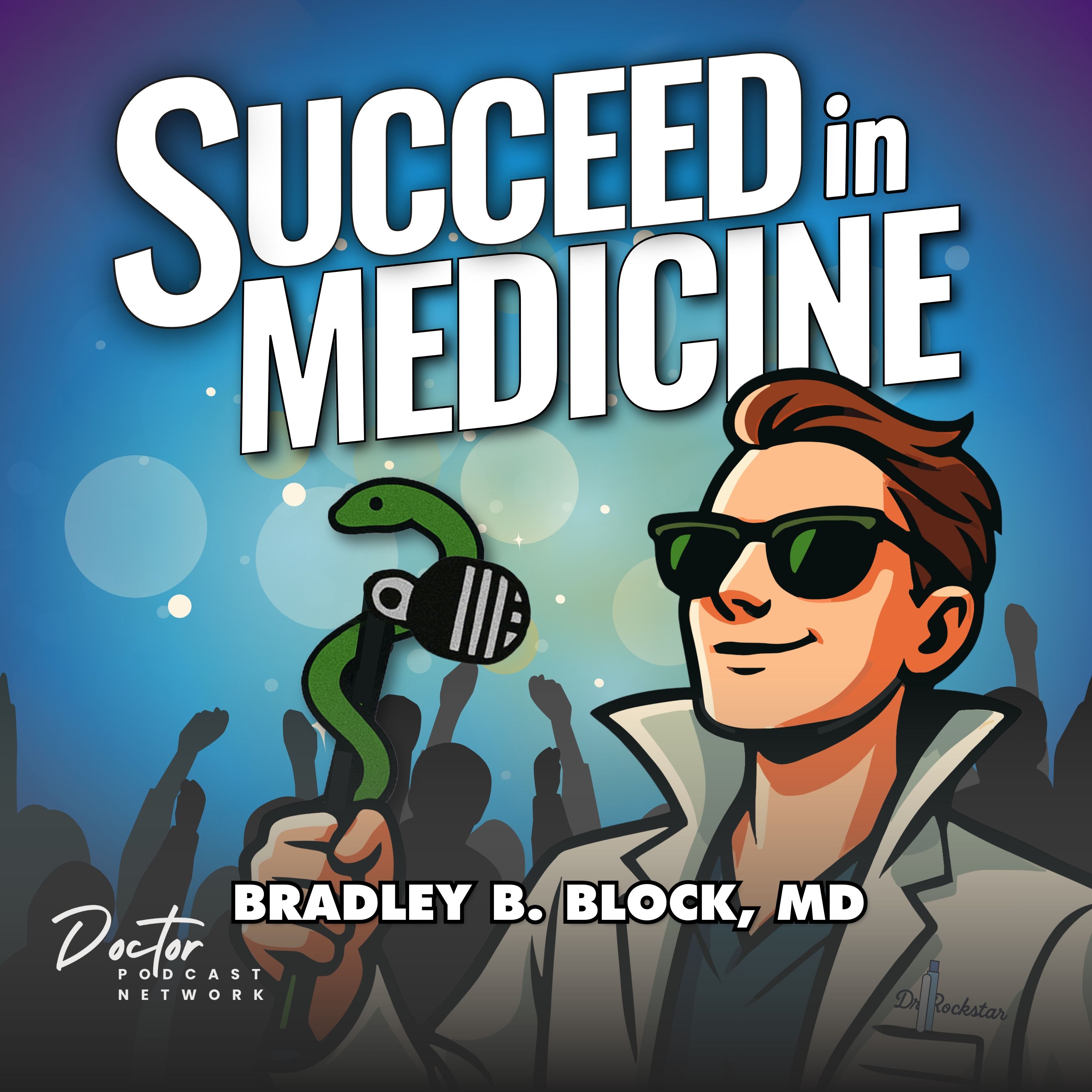
Succeed in Medicine: Practical Knowledge for Busy Physicians
Bradley B. Block, MD, Doctor Podcast Network
Was your medical education enough to handle everything physician life demands? From lawsuits to leadership, career decisions to challenging conversations, balancing the personal with the professional — not enough was addressed in medical school, residency or fellowship.
This medical podcast fills those gaps so you can live up to the expectations that come with the white coat — not just in the exam room, but in all the places your MD follows you. This show is the physician mentor you didn’t realize you needed.
Your host, Dr. Bradley Block, a private practice ENT, is right there with you — navigating the same challenges and bringing in world-class guests to teach, as he puts it, “everything we should have been learning while we were memorizing Kreb’s cycle.” With nearly 500 episodes and close to half a million downloads, Brad has built a trusted space where physicians come for brass-tacks, immediately-applicable advice.
You don’t need another certification. You need a medical podcast that can be your physician mentor. It covers interpersonal skills, medical education, doctor personal finance, doctor charting, doctor careers, doctor mental health, physician soft skills, physician parenting, physician executive skills, medical decision making, medical professional development, physician side gigs, main gigs, reacting to bad reviews, misinformation, social media, negotiating and what to do when someone yells, “Is there a doctor on board?”
Guests have included Lady Glaucomflecken Kristen Flanary, Matt Abrahams, PhD, Gita Pensa, MD, Nneka Unachukwu, MD, (Dr. Una) Amy Fogelman, MD, and Bapu Jena, MD, PhD.
A proud founding member of the Doctor Podcast Network!
This medical podcast fills those gaps so you can live up to the expectations that come with the white coat — not just in the exam room, but in all the places your MD follows you. This show is the physician mentor you didn’t realize you needed.
Your host, Dr. Bradley Block, a private practice ENT, is right there with you — navigating the same challenges and bringing in world-class guests to teach, as he puts it, “everything we should have been learning while we were memorizing Kreb’s cycle.” With nearly 500 episodes and close to half a million downloads, Brad has built a trusted space where physicians come for brass-tacks, immediately-applicable advice.
You don’t need another certification. You need a medical podcast that can be your physician mentor. It covers interpersonal skills, medical education, doctor personal finance, doctor charting, doctor careers, doctor mental health, physician soft skills, physician parenting, physician executive skills, medical decision making, medical professional development, physician side gigs, main gigs, reacting to bad reviews, misinformation, social media, negotiating and what to do when someone yells, “Is there a doctor on board?”
Guests have included Lady Glaucomflecken Kristen Flanary, Matt Abrahams, PhD, Gita Pensa, MD, Nneka Unachukwu, MD, (Dr. Una) Amy Fogelman, MD, and Bapu Jena, MD, PhD.
A proud founding member of the Doctor Podcast Network!
Episodes
Mentioned books

Feb 29, 2020 • 46min
Cutting the Crap on the Gut Microbiome with Frank Cusimano, PhD
Dr. Frank Cusimano, PhD, has a doctorate in Nutrition and Metabolic Biology from Columbia University and is currently a medical student at the Arizona College of Osteopathic medicine. Having done his PhD on the gut microbiome, a hot topic, we dive into the science of prebiotics, probiotics, postbiotics and antibiotics. What can we actually recommend to patients to help them with GI upset while on antibiotics? How does the microbiome influence inflammatory bowel disease? How can the gut actually influence our brains? A previous guest discussed how the colon is the window to the soul. Turns out there’s science behind that! Having been a sponsored athlete as an adult, Dr. Cusimano is currently a medical student uniquely blending his understanding of biochemistry with human physiology and human potential. In college he received both a BS and BA from SMU in Chemistry and Biology and then went on to complete a MS from Johns Hopkins University in Biotechnology concentrating in Bioinformatics, all in addition to his PhD. He is the host of the Surviving Medicine Podcast and a regular contributor for Medscape and Doximity. Find this and all episodes on your favorite podcast platform at PhysiciansGuidetoDoctoring.com Please be sure to leave a five-star review, a nice comment and SHARE!!! Instagram: https://www.instagram.com/dr.cusimano/ Twitter: https://twitter.com/frank_cusimano Instagram: https://www.instagram.com/surviving.medicine/ Website: http://survivingmedicine.org/ Podcast: http://itunes.apple.com/us/podcast/surviving-medicine/id1276029472?mt=2
This medical podcast is your physician mentor to fill the gaps in your medical education. We cover physician soft skills, charting, interpersonal skills, doctor finance, doctor mental health, medical decisions, physician parenting, physician executive skills, navigating your doctor career, and medical professional development. This is critical CME for physicians, but without the credits (yet). A proud founding member of the Doctor Podcast Network!Visit www.physiciansguidetodoctoring.com to connect, dive deeper, and keep the conversation going. Let’s grow! Disclaimer:This podcast is for informational purposes only and is not a substitute for professional medical, financial, or legal advice. Always consult a qualified professional for personalized guidance. Hosted by Simplecast, an AdsWizz company. See pcm.adswizz.com for information about our collection and use of personal data for advertising.

Feb 27, 2020 • 31min
A Panorama of Human Glitches Seen in the Musculoskeletal and Reproductive System with Professor Nathan Lents, PhD
Professor Nathan Lents studied biology at St. Louis University and then completed his PhD at St. Louis University’s school of medicine in Pharmacological and Physiological Sciences. PhDs need residencies, too, so he did his postdoctoral training in cancer genomics at NYU and loved New York so much that he stayed and is now a Professor at John Jay College in Manhattan and director of the honors program. His book, Human Errors: A Panorama of Our Glitches, from Pointless Bones to Broken Genes, discusses the beauty of our flaws. We are not the well-oiled machines that we think we are. This is part three out of three of my interview with Professor Lents. For the orthopods, we discuss how the wrist and ankles developed in such a nonsensical way, and why standing upright causes problems from herniated discs to ACL tears. For the OBs, we discuss reproduction and why infant mortality is so high, our ability to procreate is so inefficient, and if we are already so inefficient, how menopause can actually be advantageous for natural selection. He maintains the Human Evolution Blog and his podcast is called This World of Humans. He can be found at NathanLents.com Find this and all episodes on your favorite podcast platform at PhysiciansGuidetoDoctoring.com Please be sure to leave a five-star review, a nice comment and SHARE!!! This episode is brought to you by Orange County Bookkeepers (OCB) Healthcare Accounting: an all in one accounting firm for small healthcare businesses and private medical practices. One thing that I personally love about OCB Accountants, is that they are QuickBook professionals with over 20 years’ experience, focusing specifically on healthcare. They utilize a tailored approach individualized to your needs. They are a full-service bookkeeping firm specializing in accounting, payroll, taxes and financial planning. For our listeners, for a limited time, they are offering 25% off their services for the first 3 months. You can visit them at OCBmed.com or call 833-671-3873 or 949-215-6200.
This medical podcast is your physician mentor to fill the gaps in your medical education. We cover physician soft skills, charting, interpersonal skills, doctor finance, doctor mental health, medical decisions, physician parenting, physician executive skills, navigating your doctor career, and medical professional development. This is critical CME for physicians, but without the credits (yet). A proud founding member of the Doctor Podcast Network!Visit www.physiciansguidetodoctoring.com to connect, dive deeper, and keep the conversation going. Let’s grow! Disclaimer:This podcast is for informational purposes only and is not a substitute for professional medical, financial, or legal advice. Always consult a qualified professional for personalized guidance. Hosted by Simplecast, an AdsWizz company. See pcm.adswizz.com for information about our collection and use of personal data for advertising.

Feb 23, 2020 • 36min
A Panorama of Human Glitches Seen in Otolaryngology and Nutrition with Professor Nathan Lents, PhD
Professor Nathan Lents studied biology at St. Louis University and then completed his PhD at St. Louis University’s school of medicine in Pharmacological and Physiological Sciences. PhDs need residencies, too, so he did his postdoctoral training in cancer genomics at NYU and loved New York so much that he stayed and is now a Professor at John Jay College in Manhattan and director of the honors program. His book, Human Errors: A Panorama of Our Glitches, from Pointless Bones to Broken Genes, discusses the beauty of our flaws. We are not the well-oiled machines that we think we are. This is part two out of three of my interview with Professor Lents. In this episode, we talk about how anthropologists have actually informed our current knowledge of nutritional science from the perspective of “how were we designed to eat?” We then get into the weeds with a few medical specialties. For the ENTs, we discuss how the recurrent laryngeal ended up in the chest, why humans are the only primates who choke on their food, and what the heck do the sinuses really do? He maintains the Human Evolution Blog and his podcast is called This World of Humans. He can be found at NathanLents.com Find this and all episodes on your favorite podcast platform at PhysiciansGuidetoDoctoring.com Please be sure to leave a five-star review, a nice comment and SHARE!!! This episode is brought to you by Orange County Bookkeepers (OCB) Healthcare Accounting: an all in one accounting firm for small healthcare businesses and private medical practices. One thing that I personally love about OCB Accountants, is that they are QuickBook professionals with over 20 years’ experience, focusing specifically on healthcare. They utilize a tailored approach individualized to your needs. They are a full-service bookkeeping firm specializing in accounting, payroll, taxes and financial planning. For our listeners, for a limited time, they are offering 25% off their services for the first 3 months. You can visit them at OCBmed.com or call 833-671-3873 or 949-215-6200.
This medical podcast is your physician mentor to fill the gaps in your medical education. We cover physician soft skills, charting, interpersonal skills, doctor finance, doctor mental health, medical decisions, physician parenting, physician executive skills, navigating your doctor career, and medical professional development. This is critical CME for physicians, but without the credits (yet). A proud founding member of the Doctor Podcast Network!Visit www.physiciansguidetodoctoring.com to connect, dive deeper, and keep the conversation going. Let’s grow! Disclaimer:This podcast is for informational purposes only and is not a substitute for professional medical, financial, or legal advice. Always consult a qualified professional for personalized guidance. Hosted by Simplecast, an AdsWizz company. See pcm.adswizz.com for information about our collection and use of personal data for advertising.

Feb 1, 2020 • 42min
Support for Physician Burnout Syndrome with Torie Sepah, MD
Torie Sepah, MD, completed her internship in family medicine at Kaiser Permanente Los Angeles Medical Center, then went on to complete a psychiatry residency at LA County + USC Medical Center. She has studied physician burnout syndrome extensively. It is a topic that is very personal to her and we discuss why. She defines the syndrome, what the major causes are, what the consequences are and what has actually been proven to help. Among them is connection. Her Facebook group – Physician to Physician: Healing the Practice of Medicine, has become a signal in the noise surrounding burnout, providing us with a community of physicians who understand the hardships of our field and can help. She has worked extensively in correctional medicine, having served as the chief psychiatrist at the California Institution for Women, being the first female chief psychiatrist at that prison. Since 2018, Dr. Sepah is a community psychiatrist once again, seeing patients with HIV in an integrated clinic and running her own interventional psychiatry clinic, which focuses on deep Transcranial Magnetic Stimulation (dTMS) as well as reproductive psychiatry, neuropsychiatric disorders, and early diagnoses or schizophrenia. Dr. Sepah is an assistant clinical professor, department of psychiatry, Keck School of Medicine of USC. Prior to becoming a physician, she was a journalist and assistant editor of Ms. Magazine, writing the health column which prompted her interest in medicine. Dr. Sepah can be reached at her self-titled site, Torie Sepah, MD, and on Twitter @toriesepahmd. Find this and all episodes on your favorite podcast platform at PhysiciansGuidetoDoctoring.com Please be sure to leave a five-star review, a nice comment and SHARE!!! This episode is brought to you by Orange County Bookkeepers (OCB) Healthcare Accounting: an all in one accounting firm for small healthcare businesses and private medical practices. One thing that I personally love about OCB Accountants, is that they are QuickBook professionals with over 20 years’ experience, focusing specifically on healthcare. They utilize a tailored approach individualized to your needs. They are a full-service bookkeeping firm specializing in accounting, payroll, taxes and financial planning. For our listeners, for a limited time, they are offering 25% off their services for the first 3 months. You can visit them at OCBmed.com or call 833-671-3873 or 949-215-6200.
This medical podcast is your physician mentor to fill the gaps in your medical education. We cover physician soft skills, charting, interpersonal skills, doctor finance, doctor mental health, medical decisions, physician parenting, physician executive skills, navigating your doctor career, and medical professional development. This is critical CME for physicians, but without the credits (yet). A proud founding member of the Doctor Podcast Network!Visit www.physiciansguidetodoctoring.com to connect, dive deeper, and keep the conversation going. Let’s grow! Disclaimer:This podcast is for informational purposes only and is not a substitute for professional medical, financial, or legal advice. Always consult a qualified professional for personalized guidance. Hosted by Simplecast, an AdsWizz company. See pcm.adswizz.com for information about our collection and use of personal data for advertising.

Feb 1, 2020 • 48min
Discussing Flipping the Script on Health Disparities with Max Jordan Nguemeni Tiako
Max Jordan Nguemeni Tiako is a 4th year med student (out of 5) at the Yale School of Medicine and hosts his own podcast, Flip the Script, about healthcare disparities. He starts out discussing how some of what we learn about race being a risk factor for some diseases are a product of social constructs, not genetic predisposition. We then discuss racial disparities in substance-use disorder treatment. We then pivot from health disparities to physician training disparities. We learn about the hardships faced by minority medical students from microaggressions from students and faculty to disparities in grading and how this can affect career trajectory. He ends by discussing some pearls he has learned from his own podcast. Mr. Tiako grew up in Yaounde, Cameroon, and moved to the US to attend Howard University, got a BS in in civil and environmental engineering and then a Masters in Bioengineering from the Georgia Institute of Technology. He is currently doing research connecting his civil/environmental engineering background to identify elements of urban design that can be leveraged to improve health outcomes and move the needle towards health equity. His research fellowship is at the Center for Emergency Care & Policy research at the University of Pennsylvania. He spends his free time writing about racism and medical education in the medical student magazine InTraining. His Twitter handle: @MaxJordan_N His podcast can be found here: iTunes: https://podcasts.apple.com/us/podcast/flip-the-script/id1402777078 Soundcloud: https://soundcloud.com/yaleuniversity/sets/flip-the-script Spotify: https://open.spotify.com/show/1judlJj8gLg8OnVJtpXv7O?si=snZWGMbaRiafUfJZajHRyw This episode is brought to you by Orange County Bookkeepers (OCB) Healthcare Accounting: an all in one accounting firm for small healthcare businesses and private medical practices. One thing that I personally love about OCB Accountants, is that they are QuickBook professionals with over 20 years’ experience, focusing specifically on healthcare. They utilize a tailored approach individualized to your needs. They are a full-service bookkeeping firm specializing in accounting, payroll, taxes and financial planning. For our listeners, for a limited time, they are offering 25% off their services for the first 3 months. You can visit them at OCBmed.com or call 833-671-3873 or 949-215-6200.
This medical podcast is your physician mentor to fill the gaps in your medical education. We cover physician soft skills, charting, interpersonal skills, doctor finance, doctor mental health, medical decisions, physician parenting, physician executive skills, navigating your doctor career, and medical professional development. This is critical CME for physicians, but without the credits (yet). A proud founding member of the Doctor Podcast Network!Visit www.physiciansguidetodoctoring.com to connect, dive deeper, and keep the conversation going. Let’s grow! Disclaimer:This podcast is for informational purposes only and is not a substitute for professional medical, financial, or legal advice. Always consult a qualified professional for personalized guidance. Hosted by Simplecast, an AdsWizz company. See pcm.adswizz.com for information about our collection and use of personal data for advertising.

Dec 21, 2019 • 59min
Healing People, Not Patients with Jonathan Weinkle, MD
Jonathan Weinkle, MD, is a general internist and general pediatrician who came to medicine after deciding against careers as a philosopher or a rabbi and is the author of Healing People, Not Patients. He starts off by teaching us how he was able to write a book about his patient interactions without violating HIPAA. His book illustrates the many ways in which it is important to really know our patients as people in order to effectively treat them. The paradox of this is that there never seems to be enough time to do this well, so Dr. Weinkle teaches us how to connect without losing efficiency. While cultural competency is usually discussed, Dr. Weinkle believes that cultural humility really the key – recognizing we don’t know what we don’t know about someone else’s culture. How to keep moving through a visit if you are really listening “with both ears,” but the patient continues to repeat themselves as if you aren’t listening. He also discusses the importance of allowing the patient to set the agenda and then establishing limits to that agenda at the start of the visit. He practices primary care medicine at the Squirrel Hill Health Center, a Federally Qualified Health Center and certified Patient Centered Medical Home, providing comprehensive care to patients of all ages with and without insurance and representing a broad diversity of languages, faiths, cultures, native lands, and socioeconomic backgrounds. In addition, Dr. Weinkle serves as a medical advisor to the Closure project of the Jewish Healthcare Foundation (JHF), a project intended to improve the quality of care and change the individual experience at end-of-life. Under the auspices of the JHF, he is crafting a program to help clinicians master the core competency of respectful communication with patients and families, based largely on the ideas in this book and the research underlying it. Finally, Dr. Weinkle serves as Clinical Assistant Professor in the Departments of Pediatrics and Family Medicine at his alma mater, and as Medical Director of the Physician Assistant Studies Program at Chatham University. Driving all of these endeavors is a strong commitment to infusing his interactions with patients with the core values of his Jewish faith, beginning with the idea that both patient and provider are created in the Divine image and must act and be treated accordingly. He can be found at http://healerswholisten.com and @healerswholistn on Twitter. Find this and all episodes on your favorite podcast platform at PhysiciansGuidetoDoctoring.com Please be sure to leave a five-star review, a nice comment and SHARE!!!
This medical podcast is your physician mentor to fill the gaps in your medical education. We cover physician soft skills, charting, interpersonal skills, doctor finance, doctor mental health, medical decisions, physician parenting, physician executive skills, navigating your doctor career, and medical professional development. This is critical CME for physicians, but without the credits (yet). A proud founding member of the Doctor Podcast Network!Visit www.physiciansguidetodoctoring.com to connect, dive deeper, and keep the conversation going. Let’s grow! Disclaimer:This podcast is for informational purposes only and is not a substitute for professional medical, financial, or legal advice. Always consult a qualified professional for personalized guidance. Hosted by Simplecast, an AdsWizz company. See pcm.adswizz.com for information about our collection and use of personal data for advertising.
Dec 21, 2019 • 38min
Substance Use Disorders in Physicians and How to Get Help with Sean Fogler, MD, Part 2
Sean Fogler, MD is the Community Outreach Coordinator at the Pennsylvania Harm Reduction Coalition (PAHRC), a person in long-term recovery, physician and certified recovery specialist. He has over 15 years of experience in the healthcare industry working as a physician, and with patients, administrators, and insurance organizations. This is the second part of the interview. In this portion, we start off discussing how to effectively help friends and colleagues with substance use disorder, the importance of language in this area, and then he tells his story.Dr. Fogler is active in the recovery community and has a special interest in trauma and substance use disorders in professionals. He volunteers as a peer support specialist for Lawyers Concerned for Lawyers and works to improve public health policy for mental health and substance use disorders. Through his lived experience, he educates, informs, and works to battle the shame and stigma that keeps the disease of addiction alive. Sean’s role at PAHRC involves engagement, education, writing, speaking, fund raising and expanding knowledge of the disease of addiction and harm reduction. Sean holds a bachelor’s degree from The University of Toronto, and a Doctor of Medicine degree from Ross University School of Medicine. He completed an internship in Internal Medicine and a residency in Anesthesiology at Hahnemann University Hospital in Philadelphia, Pennsylvania.Find this and all episodes on your favorite podcast platform at PhysiciansGuidetoDoctoring.comPlease be sure to leave a five-star review, a nice comment and SHARE!!!This medical podcast with a physician mentor explores substance use disorders in physicians, why busy doctors and overwhelmed physicians are at higher risk than the general public, and how to find real help. We discuss physician lessons on recognizing substance use, understanding Physician Health Programs, and navigating both the positives and areas for improvement in these systems. Listeners will learn about critical elements of recovery, practical doctor help resources, and strategies for reducing physician stress while protecting their doctor career. This episode offers good physicians, physician parents, female physicians, and physician executives medical education and physician soft skills to address addiction, support physician mental health, and become fulfilled doctors who recover, rebuild, and continue to thrive in medicine.https://www.paharmreduction.org/https://www.healthprosinrecovery.com/https://twitter.com/sean_foglerhttps://www.instagram.com/sean_fogler/https://www.facebook.com/profile.php?id=100019053703530 https://www.linkedin.com/in/sean-fogler-md-2602aa12b/
This medical podcast is your physician mentor to fill the gaps in your medical education. We cover physician soft skills, charting, interpersonal skills, doctor finance, doctor mental health, medical decisions, physician parenting, physician executive skills, navigating your doctor career, and medical professional development. This is critical CME for physicians, but without the credits (yet). A proud founding member of the Doctor Podcast Network!Visit www.physiciansguidetodoctoring.com to connect, dive deeper, and keep the conversation going. Let’s grow! Disclaimer:This podcast is for informational purposes only and is not a substitute for professional medical, financial, or legal advice. Always consult a qualified professional for personalized guidance. Hosted by Simplecast, an AdsWizz company. See pcm.adswizz.com for information about our collection and use of personal data for advertising.
Dec 21, 2019 • 30min
Substance Use Disorders in Physicians and How to Get Help with Sean Fogler, MD, Part 1
Sean Fogler, MD is the Community Outreach Coordinator at the Pennsylvania Harm Reduction Coalition (PAHRC), a person in long-term recovery, physician and certified recovery specialist. He has over 15 years of experience in the healthcare industry working as a physician, and with patients, administrators, and insurance organizations. This is a two-part episode. In this first part, we talk about how common a substance use disorder is among physicians and why we are at higher risk than the general public. He then gives guidance on where to go to seek help if you have a substance use disorder. We discuss Physician’s Health Programs and some of the positives and areas for improvement of those programs. He then discusses some critical elements to recovery.Sean is active in the recovery community and has a special interest in trauma and substance use disorders in professionals. He volunteers as a peer support specialist for Lawyers Concerned for Lawyers and works to improve public health policy for mental health and substance use disorders. Through his lived experience, he educates, informs, and works to battle the shame and stigma that keeps the disease of addiction alive. Sean’s role at PAHRC involves engagement, education, writing, speaking, fund raising and expanding knowledge of the disease of addiction and harm reduction. Sean holds a bachelor’s degree from The University of Toronto, and a Doctor of Medicine degree from Ross University School of Medicine. He completed an internship in Internal Medicine and a residency in Anesthesiology at Hahnemann University Hospital in Philadelphia, Pennsylvania.Find this and all episodes on your favorite podcast platform at SucceedinMedicine.comPlease be sure to leave a five-star review, a nice comment and SHARE!!!https://www.paharmreduction.org/https://www.healthprosinrecovery.com/https://twitter.com/sean_foglerhttps://www.instagram.com/sean_fogler/https://www.facebook.com/profile.php?id=100019053703530 https://www.linkedin.com/in/sean-fogler-md-2602aa12b/This medical podcast with a physician mentor explores substance use disorders in physicians, why busy doctors and overwhelmed physicians are at higher risk than the general public, and how to find real help. We discuss physician lessons on recognizing substance use, understanding Physician Health Programs, and navigating both the positives and areas for improvement in these systems. Listeners will learn about critical elements of recovery, practical doctor help resources, and strategies for reducing physician stress while protecting their doctor career. This episode offers good physicians, physician parents, female physicians, and physician executives medical education and physician soft skills to address addiction, support physician mental health, and become fulfilled doctors who recover, rebuild, and continue to thrive in medicine.
This medical podcast is your physician mentor to fill the gaps in your medical education. We cover physician soft skills, charting, interpersonal skills, doctor finance, doctor mental health, medical decisions, physician parenting, physician executive skills, navigating your doctor career, and medical professional development. This is critical CME for physicians, but without the credits (yet). A proud founding member of the Doctor Podcast Network!Visit www.physiciansguidetodoctoring.com to connect, dive deeper, and keep the conversation going. Let’s grow! Disclaimer:This podcast is for informational purposes only and is not a substitute for professional medical, financial, or legal advice. Always consult a qualified professional for personalized guidance. Hosted by Simplecast, an AdsWizz company. See pcm.adswizz.com for information about our collection and use of personal data for advertising.
Dec 21, 2019 • 38min
Why Smart Doctors Schedule Nap Time with Phil Boucher, MD
On today’s episode we speak to Dr. Phil Boucher, pediatrician, podcaster, physician coach, blogger, and physician efficiency expert. We discuss ways to make sure the private practice physician is maximizing the use of their time. That doesn’t mean no naps! He mentions scheduling nap time into one of his days! The key is to plan as much of your day as possible, schedule in some flex time for unexpected events, and be as proactive as possible about doing your work at times in which you are most efficient – when nobody else is around or awake. Make it happen! This was a great conversation with someone many of you already know from his large online footprint.Dr. Phil Boucher is a board-certified pediatrician in Lincoln, NE and business consultant. He helps private practice owners design a thriving practice and fulfilling life. Phil is an expert on marketing, branding, and organizational systems specifically for physicians, and his passion is helping tired, overworked private practice physicians climb out of the trenches to work less and earn more. He is the host of private practice matters, which can be found at privatepracticematters.comFind this and all episodes on your favorite podcast platform at SucceedinMedicine.comPlease be sure to leave a five-star review, a nice comment and SHARE!!!This medical podcast with a physician mentor explores how private practice physicians, busy doctors, and overwhelmed doctors can maximize their time and energy without burning out. We discuss physician lessons in time management, planning flex time, and scheduling work when you are most efficient—even if that means building nap time into your doctor career schedule. Listeners will learn physician soft skills for organizing their day, avoiding doctor regret, and reducing physician stress while still getting more done. This episode gives good physicians, physician parents, female physicians, and physician executives practical strategies to improve patient encounters, streamline doctor charting, and become fulfilled doctors who use their time wisely.
This medical podcast is your physician mentor to fill the gaps in your medical education. We cover physician soft skills, charting, interpersonal skills, doctor finance, doctor mental health, medical decisions, physician parenting, physician executive skills, navigating your doctor career, and medical professional development. This is critical CME for physicians, but without the credits (yet). A proud founding member of the Doctor Podcast Network!Visit www.physiciansguidetodoctoring.com to connect, dive deeper, and keep the conversation going. Let’s grow! Disclaimer:This podcast is for informational purposes only and is not a substitute for professional medical, financial, or legal advice. Always consult a qualified professional for personalized guidance. Hosted by Simplecast, an AdsWizz company. See pcm.adswizz.com for information about our collection and use of personal data for advertising.
Nov 21, 2019 • 39min
Addressing Physician Racial Biases Provide Equitable Care, with Uché Blackstock, MD
Dr. Uché Blackstock is an emergency medicine physician who is passionate about addressing the detrimental effects of structural racism on health outcomes. We discuss the origins of structural racism and how this continues to influence the health outcomes of minorities. She then gives us some tools for reflecting on our own biases and how we can work to address them. In addition to patient care, we talk about improving the diversity of faculty, and the importance of mentorship and sponsorship. We end by discussing something each of us can start doing tomorrow in order to address our own biases.Dr. Blackstock went to Harvard for both undergrad and medical school, did her emergency medicine residency at SUNY Downstate/ King’s County Hospital Center and then a fellowship in ultrasound at St. Luke’s Roosevelt. She is now associate professor at NYU as well as the faculty director of recruitment, retention and inclusion at the office of diversity affairs at the medical school. She recently started her company Advancing Health Equity, which aims to partner with healthcare organizations to address some of the critical factors that contribute to health inequity, through educational trainings and racial equity culture analytics. She can be found at advancinghealthequity.com and on Twitter @dr_uche_bee.The implicit bias test that she discussed can be found here: https://implicit.harvard.edu/implicit/takeatest.htmlFind this and all episodes on your favorite podcast platform at SucceedinMedicine.comPlease be sure to leave a five-star review, a nice comment and SHARE!!!This medical podcast with a physician mentor explores how structural racism shapes health outcomes and why busy doctors and overwhelmed physicians must reflect on their own biases to provide equitable care. We discuss physician lessons on recognizing bias, improving patient encounters, and using physician soft skills to communicate with patients respectfully. Listeners will learn practical steps for addressing physician stress tied to bias, improving medical decisions, and fostering diversity through mentorship and sponsorship. This episode gives good physicians, female physicians, physician parents, and physician executives actionable tools to avoid doctor regret, become inspiring physicians, and move toward physician financial independence by aligning their doctor career with equitable patient care.
This medical podcast is your physician mentor to fill the gaps in your medical education. We cover physician soft skills, charting, interpersonal skills, doctor finance, doctor mental health, medical decisions, physician parenting, physician executive skills, navigating your doctor career, and medical professional development. This is critical CME for physicians, but without the credits (yet). A proud founding member of the Doctor Podcast Network!Visit www.physiciansguidetodoctoring.com to connect, dive deeper, and keep the conversation going. Let’s grow! Disclaimer:This podcast is for informational purposes only and is not a substitute for professional medical, financial, or legal advice. Always consult a qualified professional for personalized guidance. Hosted by Simplecast, an AdsWizz company. See pcm.adswizz.com for information about our collection and use of personal data for advertising.

