

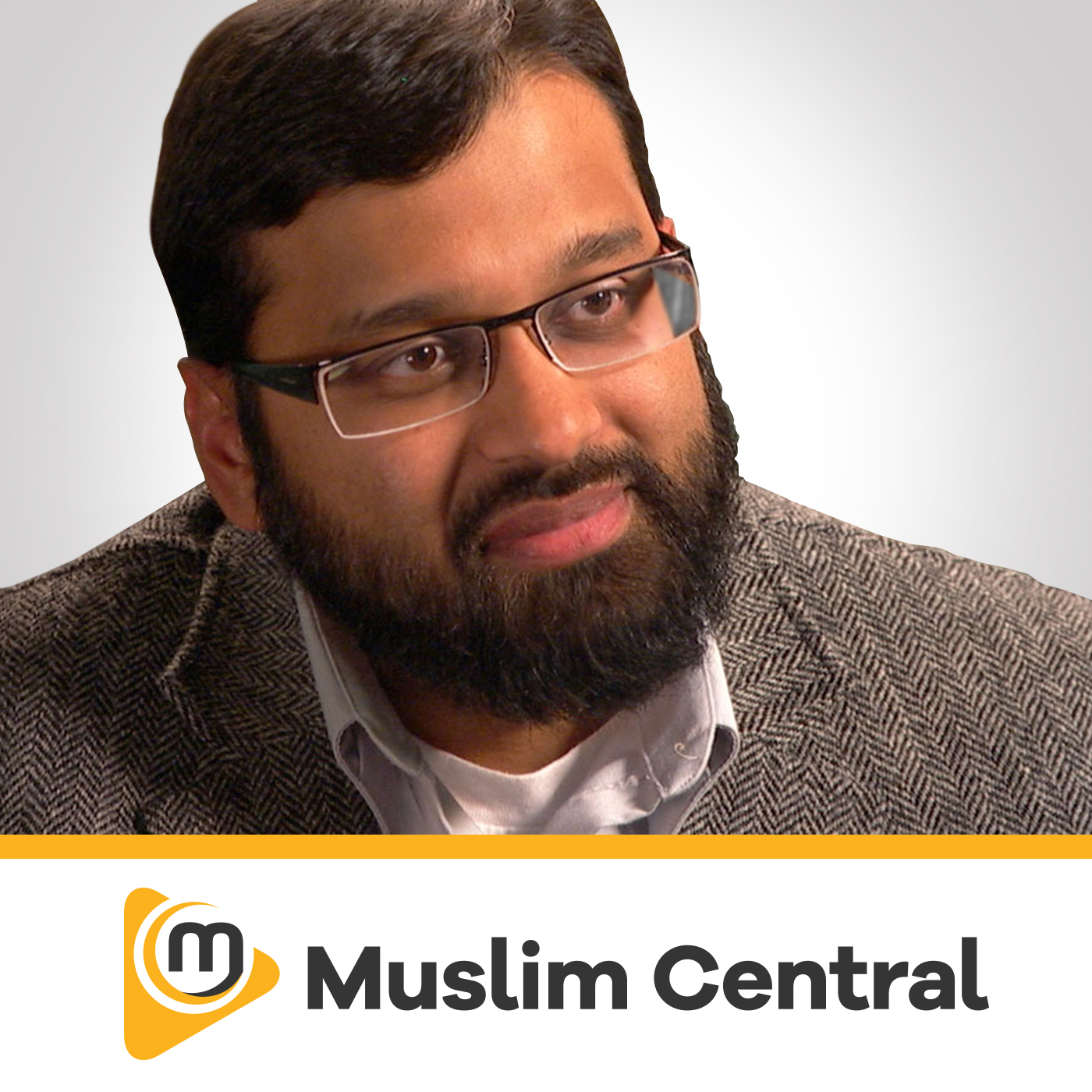
Yasir Qadhi
Muslim Central
Yasir Qadhi was born in Houston, Texas and completed his primary and secondary education in Jeddah, Saudi Arabia. He graduated with a B.Sc. in Chemical Engineering from the University of Houston, after which he was accepted as a student at the Islamic University of Madinah.
After completing a diploma in Arabic, he graduated with a B.A. from the College of Hadith and Islamic Sciences.
Thereafter, he completed a M.A. in Islamic Theology from the College of Dawah, after which he returned to America and completed his doctorate, in Religious Studies, from Yale University. Currently he is teaching at Rhodes College, in Memphis, TN.
After completing a diploma in Arabic, he graduated with a B.A. from the College of Hadith and Islamic Sciences.
Thereafter, he completed a M.A. in Islamic Theology from the College of Dawah, after which he returned to America and completed his doctorate, in Religious Studies, from Yale University. Currently he is teaching at Rhodes College, in Memphis, TN.
Episodes
Mentioned books

Aug 1, 2012 • 1h 22min
The Man of Two Gardens
Shaykh Dr Yasir Qadhi discusses the story of the man with the two gardens which is mentioned in Surah Kahf. Through this story, Allah gives us the parable of this world with the Akhirah. The story gives us the lesson that the ultimate world is the hereafter.
This story is about the fitnah of the pleasures of this world which caused the man with two gardens to be arrogant and undeterred by the presence of the actual Jannah in the Hereafter. The man falsely believed that all his wealth was his effort and good luck and that he was better than his friend.
Allah says that his arrogance and delusion is what brought him down and the destruction of the garden is the ultimate proof of that. Because of his belief that his wealth would remain in continuity, he remained ignorant and so involved in this world that he made the mistake of even assuming that he would get even something better in the actual Jannah too since Allah has been happy with him.
But he is humbled by his friend who reminds him of the feebleness of this creation and how temporary it is. He also admonishes him for indulging in Shirk by taking credit for his garden. Rather it was Allah alone who could give the creation whatever he chose to give.
Aug 1, 2012 • 55min
The Piece of The Puzzle
Shaykh Yasir Qadhi implores upon us through this lecture to stand strong in the times of fitnah and with the help of Sabr, to glide through the difficult times and do not lose Iman. We are reasserted with the fact to be firm on the straight path and to remember that one enters Jannah only after encountering Fitnah.
The concept of fitnah is entirely dependent on the concept of shariah. Without one, the other cannot thrive. We maintain the principles of Shariah always, then Fitnah will die a natural death and vice versa. For this to materialize, we need to make Dua, remain firm in religion, perform good deeds, learn and teach the religion and most importantly, exercise patience from the beginning till the end of Fitnah.
Numerous hadiths have been told to make us understand the concept of Fitnah completely and also in the Qur'an,Surah Asr summarises the fitnah concept most appropriately.
Anas ibn Malik RA said that the Messenger of Allah ﷺ said, “The people will see a time of patience in which someone adhering to his religion will be as if he were grasping a hot coal.”
We should change individually to change the Muslim ummah collectively. We are a part of the bigger puzzle and we can and should bring about the revolution of change in the community.
Aug 1, 2012 • 1h 1min
The Story of The Ifk Part 01 of 02
The topic of the shameful slander of Aisha RA is up for discussion by Shaykh Yasir Qadhi in this interesting lecture.
The story of the Ifk or slander is explicitly cited in a hadith from Al Bukhari that is elaborately long and is referenced in first person by Aisha RA herself. It involves a lost necklace, a sahaba by the name of Safwan bin Muattal RA and the rumour inflicter - Abdullah ibn Ubayy ibn Salul. What transpired in that event? Why did this slander go beyond control?
Do listen intently to fully comprehend the actuality of the incident and consequently, put all false stories to rest.
Aug 1, 2012 • 1h
The Story of The Ifk Part 02 of 02
Shaykh Yasir Qadhi delves deeper into the reason behind the slander of Aisha RA which was the need for revenge by the hypocrites after Allah had exposed them in Surah Munafiqun. Abdullah ibn Ubayy capitalised on the opportunity the minute he saw it and sought to get even through Aisha RA.
Three sahabah made it even more difficult as they were prime factors in the spreading of this disgusting rumour and they were -Mistah (Aisha's RA second cousin), Hamala bint Jahsh, Hasani bint Thabit.
Testimony is sought from Ali RA and Usama bin Zaid RA by the Prophet ﷺ and each of them suggest the Messenger of Allah what they think. Then the help of Bareerah, the maid servant of Aisha RA is called for in citing details on the matter that transpired that night.
The end to these false rumours and the horrendous slander of Aisha RA came in the form of Allah’s intervention through verses and revelation to the Prophet ﷺ. The first section of Surah Nur is a firm declaration on the punishment that shall be meted out for slandering.
This story reasserts the honorable and high stature of Aisha RA. She is the mother of the believers and is pure, the daughter of the pure, and she is the wife of the Prophet ﷺ. Her purity and dignity has been verified by Allah SWT and one who does not uphold this is not from among the Muslims.
Aug 1, 2012 • 1h 10min
The Treaty of Hudaibiyyah
Shaykh Yasir Qadhi elaborates in immense detail the Treaty of Hudaybiyyah which is a monumental and historic event in the life of our beloved Prophet ﷺ and what we can extrapolate, inculcate and imbibe in our daily existence from the happenings of this turning point of an event in the history of Islam. What is noteworthy is how the Muslims got an opportunity to unexpectedly extract benefits from the clenches of a certain defeat.
In 6H, the Prophet ﷺ dreamt that he and his followers were entering Makkah and performing Tawaf. Hence, he declared his plan to visit Makkah to perform Umrah. In order to avoid confrontation of any sort, the Prophet ﷺ changed the route of Taneem to a lesser-known place called Hudaibiyah. The Makkans sent Urwah bin Mas'ud to negotiate with the Prophet ﷺ, in their bid to stop him from entering Makkah. The Prophet ﷺ later sent Uthman bin Affan RA who had good contacts in Makkah for a counter negotiation. But they captured him and spread a rumor that Uthman has been killed.
The people rushed to take an oath of allegiance on the calling of the Prophet ﷺ and within a short span of time, news reached Makkah that 1400 volunteers were ready to fight the Makkans. This scared the Makkans so much so that they agreed to discuss terms of peace with him.They also released Uthman and sent Suhayl bin Amr Al-Thaqafi to negotiate the terms of peace with the Prophet Muhammad ﷺ. The following were the terms of the Treaty called the Treaty of Hudaybiyyah:
In the name of Almighty Allah.
These are the conditions of peace between Muhammad, son of Abdullah, and Suhayl Ibn Amr the envoy of Makkah:
There will be an armistice between the two parties and no fighting for the next 10 years.
Any person or tribe who wishes to join Muhammad and to enter into any agreement with him is free to do so. Likewise any person or tribe who wishes to join the Quraysh and to enter into any agreement with them is free to do so.
If any Makkan went to Madinah, then Muslims would return him to Makkah, but if any Muslim from Madinah went to Makkah, he would not be returned.
If any young man, or one whose father is alive, goes to Muhammad without permission from his father or guardian, will be returned to his father or guardian. But if anyone goes to the Quraysh of Makkah, will not be returned.
This year the Muslims will go back without entering Makkah. But next year Muhammad and his followers can enter Makkah, spend three days and perform the Umrah.
The Prophet ﷺ demonstrated exemplary patience by accepting all these terms as dictated. The Treaty of Hudaybiyyah had numerous benefits for the Muslims due to the farsightedness of the Prophet ﷺ:
The Makkan leadership recognized Prophet Mohammed ﷺ as a leader of Madinah.
The Treaty terminated the hostile behavior of Quraysh against Muslims.
Muslims were equally allowed to make alliances with other tribes.
10 years armistice with Quraysh provided a unique opportunity to preach Islam and to deal with their rivals in other parts of the peninsula.
Regarding performing Umrah this year, Muslims received a written guarantee to perform it next year peacefully. When the Prophet ﷺ returned from Hudaibiya, he received the Divine Revelation that Allah SWT had put a seal of honor on this Treaty and called it "Fatah Al-Mubeen" (Manifest Victory) in the Qur'an. He also rewarded His pleasure to those who took oath of allegiance under a tree called Bait Ridwan and termed that Allah’s protection was upon the hand of the Prophet ﷺ.
Aug 1, 2012 • 1h 3min
Usool AlHadith Part 01 of 03
Shaykh Yasir Qadhi delves into the topic of the Sunnah and the Hadith and we are acquainted with numerous aspects related to it such as the legal status of the Sunnah, importance of the Sunnah, the proofs that depict Sunnah as the source of law and so on and so forth.
What does one mean by Sunnah and Hadith? Sunnah has been defined in various ways by different scholars:
The scholars of Fiqh define Sunnah as an act which is not obligatory but if done, it will be rewarded.
The scholars of Hadith define Sunnah as the actions, statements, tacit approvals and the actual characteristics of the Prophet ﷺ.
The scholars of Aqeedah define Sunnah as what is believed and followed in Islam.
What does one mean by Hadith? According to the shariah, Hadith is the statement of the Prophet ﷺ. Sunnah is preserved in the form of Hadith.
There are 7 proofs which explicitly illustrate the importance of following the Sunnah and that it is something that we cannot do absolutely without. They are as follows:
The infallibility of the Prophets.
The role and purpose of sending of the Prophet ﷺ.
The obedience of the Sahabas to the Prophet ﷺ in any given circumstance which Allah has praised in numerous verses in the Qur'an.
The Quran contains verses that emphasize:
Belief in the Prophet ﷺ.
The Prophet ﷺ as the explainer of the Qur'an.
The revelation of the Quran and Hiqma (wisdom) which is in reality the Sunnah.
Obedience to the Prophet ﷺ is obligatory.
Obedience to the Prophet ﷺ showcases your true love for Allah.
The status of the Prophet ﷺ and the etiquette that he must be shown.
The Hadith of the Prophet ﷺ that mention the importance of following his Hadith. Some among them are as follows:
The Prophet ﷺ says he has been given something else with the Qur'an which shows that his Sunnah is also an integral part of Islam.
The Prophet ﷺ told the sahabas to preserve the Sunnah and forbade them from lying about it.
Application of basic common sense which makes us comprehend that when even the basic pillars of faith cannot be accomplished without the assistance of the Sunnah, then how can the rest of the things pertaining to Islam see the light of the day without the application of the Sunnah of the Prophet ﷺ.
Unanimous Consensus also reasserts the fact that Sunnah has to be followed.
Aug 1, 2012 • 59min
Usool AlHadith Part 02 of 03
Shaykh Yasir Qadhi explains and touches base on the topic of Usool Al Hadith in the second part of the three part series.
The process of consolidation of the Sunnah of the Prophet ﷺ was established during the Prophet's ﷺ lifetime. The concept of travelling in the quest for knowledge made a primary base for the preservation of Sunnah. Muwatta Imam Malik wrote the first physical book of hadith almost 120 years after the death of the Prophet ﷺ.
Sahih Bukhari and Sahih Muslim have all the Hadith inside them of pure authenticity. The main 6 works of the Sunan are the following:
Sahih Bukhari
Sahih Muslim
Sunan al-Nasa'i
Sunan Abu Dawud
Sunan al-Tirmidhi
Sunan Ibn Majah
Mishkat al-Masabih , Forty Hadith of An Nawawi, Riyad As Saliheen, Kanz -ul- Ummal are the most common referenced books for Hadith. But they are not the books with Isnad. For the Isnad, one has to go back to the Sahih books.
Aug 1, 2012 • 56min
Usool AlHadith Part 03 of 03
Shaykh Yasir Qadhi discusses the Usul Ul Hadith in this final part of the series.
Conditions of Hadith:
It must have a continuous Isnad. Isnad decides the authenticity of any Hadith.
Adalah - honesty and integrity
The person must have precise and accurate memory - Dabt.
The hadith should conform to similar hadiths narrated on the same topic whose chains are stronger.
It cannot have any hidden defect.
Tahdhib al-Kamal, Tahdhib al-Tahdhib, Taqrib al-Tahdhib are some of the major books related to hadith and the origins of the same are introduced to us aptly.
What is the opinion on the Daeef hadith? There are three opinion son the same:
Accept them.
You accept them but with certain conditions.
It should not be touched.

