

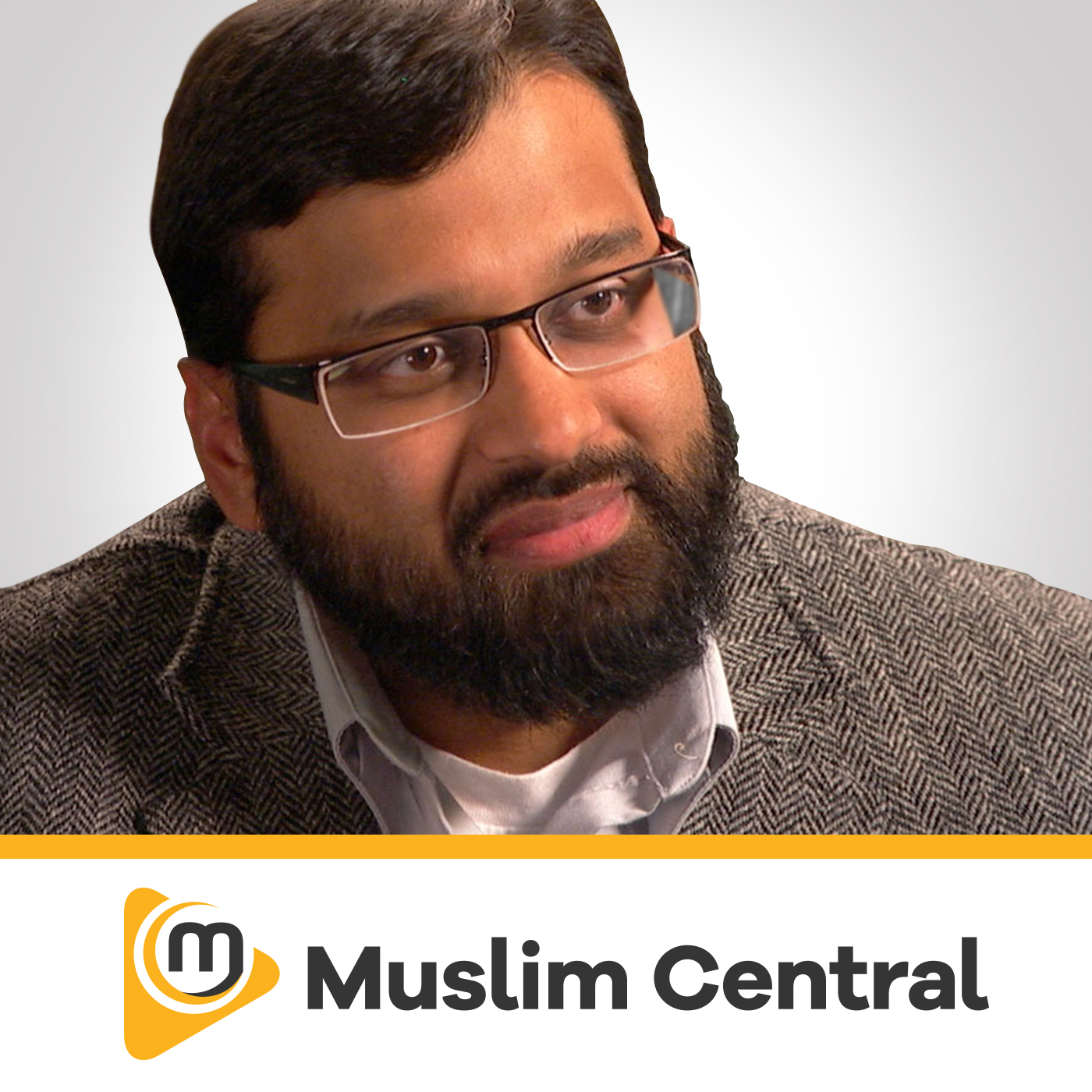
Yasir Qadhi
Muslim Central
Yasir Qadhi was born in Houston, Texas and completed his primary and secondary education in Jeddah, Saudi Arabia. He graduated with a B.Sc. in Chemical Engineering from the University of Houston, after which he was accepted as a student at the Islamic University of Madinah.
After completing a diploma in Arabic, he graduated with a B.A. from the College of Hadith and Islamic Sciences.
Thereafter, he completed a M.A. in Islamic Theology from the College of Dawah, after which he returned to America and completed his doctorate, in Religious Studies, from Yale University. Currently he is teaching at Rhodes College, in Memphis, TN.
After completing a diploma in Arabic, he graduated with a B.A. from the College of Hadith and Islamic Sciences.
Thereafter, he completed a M.A. in Islamic Theology from the College of Dawah, after which he returned to America and completed his doctorate, in Religious Studies, from Yale University. Currently he is teaching at Rhodes College, in Memphis, TN.
Episodes
Mentioned books

Feb 18, 2015 • 39min
Dua In Distress And Calamity That Guarantees A Response
Shaykh Yasir Qadhi acquaints us with the duas to be said in times of distress and calamity such that an affirmative response is gained.
Ibn ‘Abbas RA said: When Prophet Ibraheem AS was thrown into the fire of Namrood, he said: “Hasbunallahu wa Ni’mal Wakeel - Allah (Alone) is sufficient for us, and, He is the Best Disposer of affairs.” So did Prophet Muhammad ﷺ, when he was told: “A great army of the pagans had gathered against him, so fear them”. But he said: “Allah (Alone) is sufficient for us, and He is the Best Disposer of affairs (for us)”.
Dua of Prophet Yunus AS -’ La Ilaha Illa Anta Subhanaka Inni Kuntu Minaz Zalimeen - There are none worthy of worship besides You. Glorified are You. Surely I am from the wrongdoers.’
Trials and calamities test the true strength of a Believer and exhibit his stance in this situation - that is, whether he evokes Allah with humility and submissiveness placing complete trust in Allah or otherwise.
Feb 13, 2015 • 1h 27min
Seerah - 102 The Mosque And Grave Of Prophet Muhammad
Shaykh Yasir Qadhi discusses the Qabr of the Prophet ﷺ which is a part of our history and heritage.
The Shaykh begins with the exact position of the houses of the wives of the Prophet SAW which he used to take turns in visiting. The house of Aisha RA was the one whose entrance also opened into the Masjid and hence, was a bit privileged in position. The inside of the house of the Prophet ﷺ is also discussed in vivid details with help from digital models that have recreated the house to the most approximate version. Here, we see the mattress, the utensils, the curtain and much more such items that would have been present in the house
We also get acquainted with the details of the expansion of the Masjid of the Prophet ﷺ in around 9 H under the Khilafa of Al Waleed Ibn Abdul Malik. What did he do to the houses of the wives of the Prophet ﷺ? Listen intently.
There are also reports of the attempts made at smuggling the body of the Prophet ﷺ in the time just to merit themselves with greatness and show off their courage. It obviously failed every single time.
The Big Fire - it is an incident that was very tragic and which happened due to the accidental falling of the lamp which made the entire area go up in flames. This resulted also in the original Mushaf of Uthman Ibn Affan RA being burnt completely. Even though the Masjid was burnt down, Allah protected the Grave of the Prophet ﷺ.
A square of sorts was built around the Grave of the Prophet ﷺ by Baibarus which remained intact for 200 years. But then,a Second Big Fire happened in 886 H, which burned the Masjid down again.
A person by the name of Samhudi was the first person to enter the blessed grave in over 500 years to clean up the Qabr and preserve the original structure of Umar Ibn Abdul Aziz.
The green lattice structure that we see atop the Masjid an Nabawi was actually the brainchild of Sultan Quit Pa of the Mamluk dynasty.
Feb 6, 2015 • 1h 16min
Blessings Of Iman
Shaykh Yasir Qadhi takes us on a journey which acquaints us with additional fruits of Iman. In this compelling talk, Shaykh Yasir gets us acquainted with the rewards for adhering to the Branches of Faith. Amongst numerous blessings awarded to us by Allah SWT, some are listed below:
Entry into Paradise (Jannah).
Protection from Hell (Jahannam).
Good deeds will be rewarded in the Hereafter.
Forgiveness of sins by having firm Eemaan.
Allah will defend us if we ensure we are blessed with a strong interest in Iman.
Fearing nobody except Allah. having Iman blesses us with courage and fortitude that makes us fear no one.
Finding comfort in one's faith (Islam).
A winner in every situation (never a loser in any situation).
Finding a way out in every difficulty.
Gives refuge from committing more evil deeds.
Helps us with the Angel of Death at time of our end.
True unification of Muslim brothers and sisters globally.
Acceptance of benefit when sincere advice is meted out to a Mu’min.
Noor (light) on the Day of Judgement due to firm Iman.
Greatest blessing in the form of looking directly at the face of Allah SWT.
May Allah perfect and strengthen our Iman make us efficient in tasting each and every fruit of Iman. May Allah keep us steadfast in our goals towards reaffirmation of Eemaan.
Feb 1, 2015 • 1h 7min
Fiqh of Marriage 4
Shaykh Yasir Qadhi discusses the Fiqh of marriage and numerous points come to the fore.
What should be given as Mahr? And how much Mahr should be given? What is the ruling of the Mahr when a marriage is annulled? Shaykh Yasir Qadhi elaborates explicitly and we get enlightened no end.
It is obligatory for a man to do the Walima once a marriage is done. It is also obligatory to respond to the invitation of a Walima unless there is a valid excuse.
The greatest right of a man on the woman is his right to take his wife within the regulated rulings. The greatest right of a woman on a man is to care for him in all ways possible.
What is the ruling on multiple wives? What are their rights? Listen intently.
Feb 1, 2015 • 1h 14min
Fiqh of Marriage 3
Shaykh Yasir Qadhi touches important points on the Fiqh of Marriage.
We should only take into account the religion when marriage is considered and not on other factors like status, race, lineage.
Types of marriage contracts that has been prohibited in Islam:
Nikaḥ Shighar
Nikaḥ Mutah
Not giving Mahr to the woman
The Wali cannot say for the Nikah to happen without conjugal union
Medical factors
Nikah Al Kuffar - we are acquainted with the laws, conditions and basics of this kind of marriage by Shaykh Yasir Qadhi.
Feb 1, 2015 • 1h 10min
Fiqh of Marriage 2
Shaykh Yasir Qadhi delves into the topic of marriage in its entirety and we get a comprehensive view on the Fiqh of marriage.
There are some sharth are involved for marriage:
Specification of the man and the woman involved in the marriage.
The male and the female should not have been prohibited to marry by nay way such as blood relation.
There must be a wali present who must be a male, sane, of age, free man, he must be of the same religion as the girl,he must have Adalah and he must have Rushd.
The approval of both spouses.
Two witnesses must be present -who are male only.
2 Rukn are absolutely essential for every Nikah - the proposal which is sent by the wali of the girl and the acceptance which is done by the groom.
Feb 1, 2015 • 1h 32min
Fiqh of Marriage 1
Shaykh Yasir Qadhi discusses the fiqh of marriage while explicitly elucidating the conditions and procedure of marriage.
Marriage is Mustahab and is a Sunnah. It becomes obligatory when he fears he might commit Haram.
Conditions and procedure of marriage:
Bride and groom must be specified.
Both the bride and the groom should give consent for marriage.
The Wali should approve of the marriage.
Two witnesses should be present during the marriage contract.
There be no actual preventive factors.
What nullifies a marriage?
Temporary marriage.
Marriage where one substitutes partners.
Marrying to make first wife Halal for the husband.
Who is the Wali and what is his status in a marriage? What is Mahr? Shaykh Yasir Qadhi answers.
Jan 31, 2015 • 1h 47min
Seerah - 101 The Death of Prophet Muhammad
Shaykh Yasir Qadhi now reaches the finale of sorts of the Seerah of the Prophet ﷺ - the Death of the Messenger of Allah ﷺ.
Usama Ibn Zayd is entrusted with the coveted honour and prestige of heading the expedition to As Sham. But when he left in the month of Shawwal for the same, he was called back to Madinah by the people due to the failing health of the Prophet ﷺ.
About the final sickness of the Prophet ﷺ, there are numerous verses in the Noble Qur'an and the Sunnah that stand testimony to the fact that his death was an imminent reality. But because of the intense love, admiration and respect that the Ummah had for him, the thought of it was unimaginable and unbearable.
When the Prophet ﷺ visited the house of his wife Maymoonah on the 1st or 2nd Rabi al-Awwal, the fever began. So, he sought permission from his other wives to rest in the house of A'isha RA. As time passed by, over the days, his health deteriorated considerably and he needed help from Abbas and Ali RA to help him even stand.
Whilst in the Masjid in his feeble state,he gave some valuable advice to the Muslims - not to take the graves of the Prophets as Masjids,clearance of any debt that he may have and unjust hitting done on anyone.
The Prophet ﷺ led the Maghrib salah on a Friday which was the final salah he led in the Masjid publically and he recited Surah Mursalat. When Bilal RA called him for Isha, he gets up to go but loses consciousness and faints on the bed itself. What happened next? What is the role of Abu Bakr RA in this entire thing? Shaykh Yasir answers explicitly and we are left mesmerised by the turn of events.
On the Fajr of Monday, 12th Rabi al-Awwal in the 11th year of the Hijrah when he lifts the curtain and sees his Ummah praying the salah, he is overjoyed and satisfied that indeed Islam has triuphed.
We gain valuable insights into the entire period of the suffering of the Prophet ﷺ due to the pangs of death, his Duas that are being made by him, his instruction to Usama Ibn Zayd RA and so much moe. Listen intently as the entire scene comes to life due to Shaykh Yasir’s eloquent recreation and explanation of the same.
There are innumerable lessons to imbibe and inculcate form the Seerah of the Prophet ﷺ. True love for the Prophet ﷺ can only be calculated by the intensity and eagerness in our actions, following the Sunnah by demonstrating his mercy, hoping to have his intercession on the Day of Judgement.
Jan 30, 2015 • 1h 21min
Seerah - 100 The Farewell Hajj
Shaykh Yasir Qadhi discusses at length the very important topic in the Seerah - the Farewell Hajj of the Prophet ﷺ. This was the first and final Hajj of the Messenger of Allah ﷺ.
The Prophet ﷺ left on the 25th Dhul Qa'dah in the year 10 H and reached Mecca on the 4th Dhul Hijjah.when he reached Dhul Hulayfah,he prayed two rakat and entered the state of Ihram. This Hajj was called Hajjatul Wada'a. There are three types of Haj which are Jaaiz:
Hajj Qiran - Umrah and Hajj with one Ihram.
Hajj Ifrad - only doing Hajj, no Umrah.
Hajj Tamattu - separating Umrah from Hajj with separate Iihram for each.
Meanwhile, the Prophet ﷺ sent told Ali RA to bring 100 camels from Yemen to Mecca for the Hajj.hence,Ali arrived with 100 camels and he immediately entered into the tent of Fatimah RA. What happened next? Listen intently.
On the morning of the 8th of Dhul Hijjah, the Prophet SAW prayed Fajr in the Ka'bah and started his journey to Mina. The Hadith of Jabir ibn Abd Allah RA is as detailed as it gets explaining the entire procedure of Hajj as done by the Prophet ﷺ. It is truly a revelation with many Fiqhi doubts being put to rest and also our unintentional assumptions and mistakes can be rectified once in for all.
The Prophet ﷺ gave during Hajj, three Khutbahs: he gave a khutbah on the day of Arafat and Khutbahs in Mina too on the 10th and 11th or even the 12th of Dhul Hijjah. The 9th dhul Hijjah is the day of 'Al Hajj Akbar' which is the Day of Arafat which is when Allah revealed Wahi to the messenger of Allah ﷺ which says -'This day I have perfected for you your religion and completed My favor upon you and have approved for you Islam as religion.’
The Prophet ﷺ after three nights in Mina, left on the 13th Dhul Hijjah.
The prime benefits of the Sermons of the Prophet ﷺ are the abolishment of the old customs of jahiliya, demonstration of preaching by commencing from his own family, annihilation of racism and jahiliyyah tribes, strengthening of ties and relations amongst the Ummah, emphasis on the rights of women and many more.
Jan 28, 2015 • 1h 34min
Fiqh of Ramadan
Shaykh Yasir Qadhi discusses the Fiqh of Ramadan in this informative lecture.
Rules pertaining to Fiqh of Ramadan:
Niyah for the fast.
Avoiding the things that nullify the fast - eating and drinking intentionally, intimacy,vomiting intentionally etc.
Eat Suhoor.
Making Dua in the final minutes of the fast.
To bring about Iftar at our expense.
To fast with the soul along with the body.
The people who are not obliged to fast.
Listen intently and be acquainted with important details.

